air condition SUBARU TRIBECA 2014 1.G Owner's Manual
[x] Cancel search | Manufacturer: SUBARU, Model Year: 2014, Model line: TRIBECA, Model: SUBARU TRIBECA 2014 1.GPages: 426, PDF Size: 6.37 MB
Page 186 of 426
to the OFF position as soon as theoutside dusty condition clears.
NOTE
When driving on a dusty road or behinda vehicle that emits unpleasant exhaustgases, set the air inlet selection buttonto the ON position.
From time to time, return the air inletselection button to the OFF position todraw outside air into the passengercompartment.
&Rear air conditioner
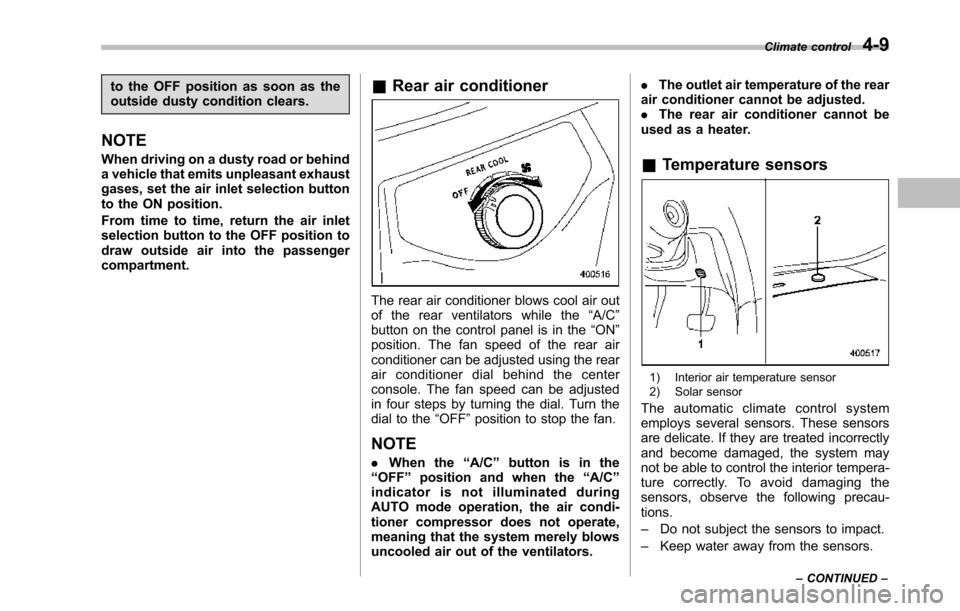
The rear air conditioner blows cool air outof the rear ventilators while the“A/C”button on the control panel is in the“ON”position. The fan speed of the rear airconditionercan be adjusted using the rearair conditioner dial behind the centerconsole. The fan speed can be adjustedin four steps by turning the dial. Turn thedial to the“OFF”position to stop the fan.
NOTE
.When the“A/C”button is in the“OFF”position and when the“A/C”indicator is not illuminated duringAUTO mode operation, the air condi-tioner compressor does not operate,meaning that the system merely blowsuncooled air out of the ventilators.
.The outlet air temperature of the rearair conditioner cannot be adjusted..The rear air conditioner cannot beused as a heater.
&Temperature sensors
1) Interior air temperature sensor2) Solar sensor
The automatic climate control systememploys several sensors. These sensorsare delicate. If they are treated incorrectlyand become damaged, the system maynot be able to control the interior tempera-ture correctly. To avoid damaging thesensors, observe the following precau-tions.
–Do not subject the sensors to impact.
–Keep water away from the sensors.
Climate control4-9
–CONTINUED–
Page 187 of 426
4-10Climate control
–Do not cover the sensors.
The sensors are located as follows.
–Solar sensor: beside windshielddefroster grille
–Interior air temperature sensor: on theside of the driver-side part of the centerpanel
–Outside temperature sensor: behindfront grille
Operating tips for heater and
air conditioner
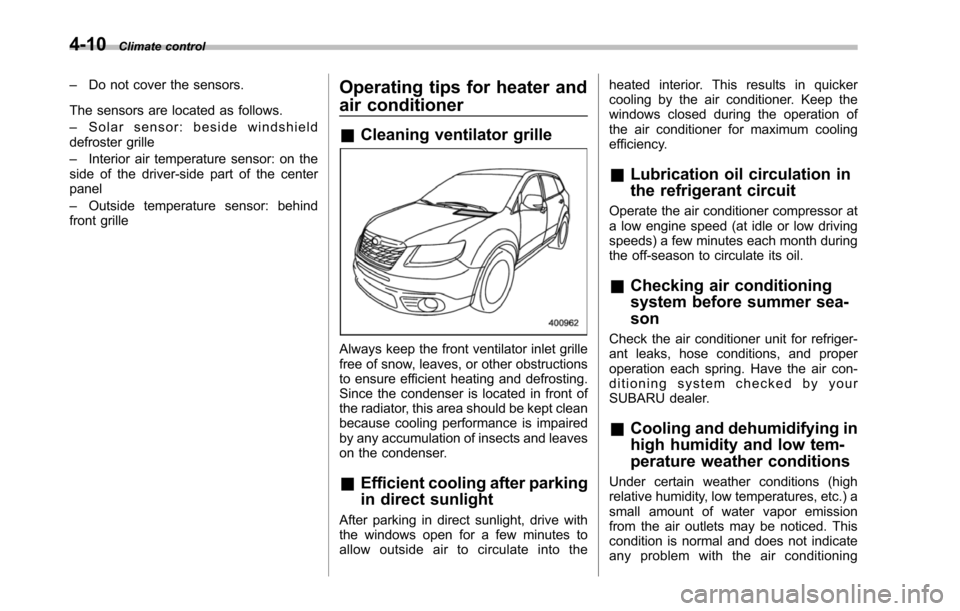
&Cleaning ventilator grille
Always keep the front ventilator inlet grillefree of snow, leaves, or other obstructionsto ensure efficient heating and defrosting.Since the condenser is located in front ofthe radiator, this area should be kept cleanbecause cooling performance is impairedby any accumulation of insects and leaveson the condenser.
&Efficient cooling after parking
in direct sunlight
After parking in direct sunlight, drive withthe windows open for a few minutes toallow outside air to circulate into the
heated interior. This results in quickercooling by the air conditioner. Keep thewindows closed during the operation ofthe air conditioner for maximum coolingefficiency.
&Lubrication oil circulation in
the refrigerant circuit
Operate the air conditioner compressor ata low engine speed (at idle or low drivingspeeds) a few minutes each month duringthe off-season to circulate its oil.
&Checking air conditioning
system before summer sea-
son
Check the air conditioner unit for refriger-ant leaks,hose conditions, and properoperation each spring. Have the air con-ditioning system checked by yourSUBARU dealer.
&Cooling and dehumidifying in
high humidity and low tem-
perature weather conditions
Under certain weather conditions (highrelative humidity, low temperatures, etc.) asmall amount of water vapor emissionfrom the air outlets may be noticed. Thiscondition is normal and does not indicateany problem with the air conditioning
Page 188 of 426
system.
&Air conditioner compressor
shut-off when engine is
heavily loaded
To improve acceleration and gas mileage,the air conditioner compressor is designedto temporarily shut off during air condi-tioner operation whenever the acceleratoris fully depressed such as during rapidacceleration or when driving on a steepupgrade.
&Refrigerant for your climate
control system
Your air conditioner uses ozone friendlyrefrigerant HFC134a. Therefore, the meth-od of adding, changing or checking therefrigerant is different from the method forCFC12 (freon). Consult your SUBARUdealer for service. Repairs needed as aresult of using the wrong refrigerant arenot covered under warranty.
Air filtration system
Replace the filter element according to thereplacement schedule shown in the fol-lowing. This schedule should be followedto maintain the filter’sdustcollectionability. Under extremely dusty conditions,the filter should be replaced more fre-quently. It is recommended that you haveyour filter checked or replaced by yourSUBARU dealer. For replacement, werecommend the use of a genuineSUBARU airfilter kit.
Replacement schedule:
Every 15 months or 15,000 miles (24,000km) whichever comes first
&Replacing the air filter
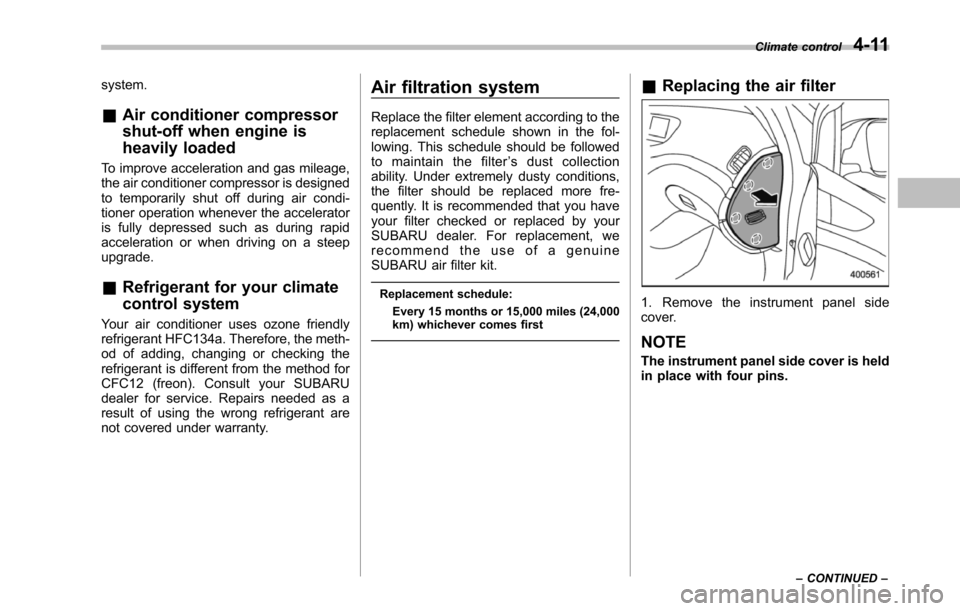
1. Remove the instrument panel sidecover.
NOTE
The instrument panel side cover is heldin place with four pins.
Climate control4-11
–CONTINUED–
Page 249 of 426
7-2Starting and operating
Fuel
CAUTION
Use of a fuel which is low in qualityor use of an inappropriate fueladditive may cause engine damage.
&Fuel requirements
The engine is designed to operate usingunleaded gasolinewith an octane ratingof87 AKI (90 RON) or higher.
!Fuel octane rating
This octane rating is the average of theResearch Octane and Motor Octanenumbers andis commonly referred to asthe Anti Knock Index (AKI).
Using a gasoline with a lower octanerating can causepersistent and heavyknocking, which can damage the engine.Do not be concerned if your vehiclesometimes knocks lightly when you driveup a hill or when you accelerate. Contactyour SUBARU dealer if you use a fuel withthe specified octane rating and yourvehicle knocks heavily or persistently.
!Unleaded gasoline
The neck of the fuel filler pipe is designedto accept only an unleaded gasoline filler
nozzle. Under no circumstances shouldleaded gasoline be used because it willdamage the emission control system andmay impair driveability and fuel economy.
!California fuel
If your vehicle was certified to CaliforniaEmission Standards as indicated on theunderhood tune-up label, it is designed tooptimize engine and emission controlsystem performance with gasoline thatmeets the clean burning low-sulfur Cali-fornia gasoline specifications. If you live inany other state than California, yourvehicle will operate on gasoline meetingFederal specifications. Gasoline sold out-side California is permitted to have highersulfur levels, which may affect the perfor-mance of your vehicle’s catalytic converterand may produce a sulfur exhaust odor orsmell. SUBARU recommends that you trya different brand of unleaded gasolinehaving lower sulfur to determine if theproblem is fuel related before returningyour vehicle to an authorized dealer forservice. The CHECK ENGINE warninglight/Malfunction indicator light may alsoilluminate. If this occurs, return to yourauthorized SUBARU dealer for diagnosis.If it is determined that the condition iscausedby the type of fuel used, repairsmay not be covered by your warranty.
!MMT
Some gasoline contains an octane-en-hancing additive called MMT (Methylcy-clopentadienyl Manganese Tricarbonyl). Ifyou use such fuels, your emission controlsystem performance may deteriorate andthe CHECK ENGINE warning light/Mal-function indicator light may illuminate. Ifthis happens, return to your authorizedSUBARU dealer for service. If it isdetermined that the condition is causedby the type of fuel used, repairs may notbe covered by your warranty.
!Gasoline for cleaner air
CAUTION
Do not let fuel spill on the exteriorsurfaces of the vehicle. Fuels con-taining alcohol may cause paintdamage, which is not covered underthe SUBARU Limited Warranty.
Yo u r u s e o f g a s o l i n e w i t h d e t e r g e n tadditives will help prevent deposits fromforming in your engine and fuel system.This helps keepyour engine in tune andyour emission control system workingproperly, and is a way of doing your partfor cleaner air. If you continuously use ahigh quality fuel with the proper detergentand other additives, you should never
Page 250 of 426
need to add any fuel system cleaningagents to your fuel tank.
Many gasolines are now blended withmaterials called oxygenates. Use of thesefuels can also help keep the air cleaner.Oxygenated blend fuels, such as MTBE(Methyl Tertiary Butyl ether) or ethanol(ethyl or grain alcohol) may be used inyour vehicle, but should contain no morethan 15% MTBE or 10% ethanol for theproper operation of your SUBARU.
In addition, some gasoline suppliers arenow producing reformulated gasolines,which are designed to reduce vehicleemissions. SUBARU approves the use ofreformulated gasoline.
If you are not sure what the fuel contains,you should ask your service stationoperators if their gasolines contain deter-gents and oxygenates and if they havebeen reformulated to reduce vehicle emis-sions.
As additional guidance, only use fuelssuited for your vehicle as explained in thefollowing.
.Fuel should be unleaded and have anoctane rating no lower than that specifiedin this manual.
.Methanol (methyl or wood alcohol) issometimes mixed with unleaded gasoline.
Methanol can be used in your vehicleONLYif it does not exceed 5% of the fuelmixtureANDif it is accompanied bysufficient quantities of the proper cosol-vents and corrosion inhibitors required toprevent damage to the fuel system. Do notuse fuel containing methanolEXCEPTunder these conditions.
.If undesirable driveability problems areexperienced and you suspect they may befuel related, try a different brand of gaso-line before seeking service at yourSUBARU dealer.
.Fuel system damage or driveabilityproblems whichresult from the use ofimproper fuel are not covered under theSUBARU Limited Warranty.
&Fuel filler lid and cap
!Refueling
Only oneperson should be involved inrefueling. Do not allow others to approachthe area of the vehicle near the fuel fillerpipe while refueling is in progress.
Be sure to observe any other precautionsthat are posted at the service station.
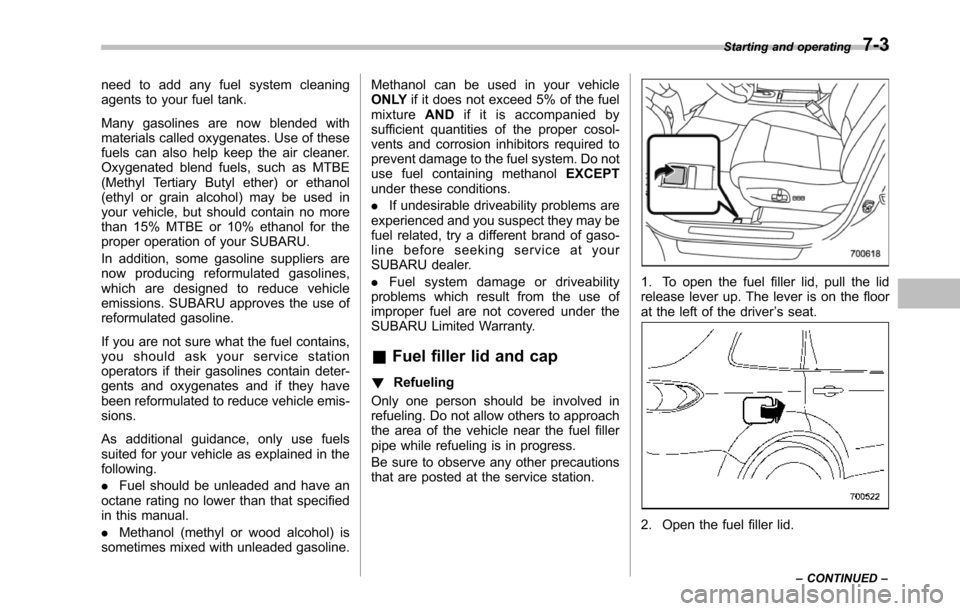
1. To open the fuel filler lid, pull the lidrelease lever up. The lever is on the floorat the left of the driver’s seat.
2. Open the fuel filler lid.
Starting and operating7-3
–CONTINUED–
Page 257 of 426
7-10Starting and operating
transmitter within a few seconds immedi-ately following remote engine start shut-down.
&Pre-heating or pre-cooling
the interior of the vehicle
Before exiting the vehicle, set the tem-perature controls to the desired settingand operation. After the system starts thevehicle, the heater or air-conditioning willactivate and heat or cool the interior toyour setting.
&Service mode
In service mode, the remote start functionis temporarily disabled to prevent thesystem from unexpectedly starting theengine while being serviced.
!To engage the service mode
Turn the ignition switch to the“ON”position, depress and hold the brake pedalthen, press and release the“”button onthe remote engine start transmitter threetimes. The system will pause for 1 secondand then flash the parking lights and honkthe hornthree times indicating that thesystem is in service mode. When attempt-ing to activate the remote start systemwhile in service mode, the parking lightswill flash and the horn will honk two timesand will not start.
!To disengage the service mode
Turn the ignition switch to the“ON”position, depress and hold the brakepedal, then press and release the“”button on the remote engine start trans-mitter three times. The system will pausefor 1 second and flash the parking lightsone time indicating that the system hasexited service mode.
NOTE
When taking your vehicle in for service,it is recommended that you inform theservice personnel that your vehicle isequippedwith a remote engine startsystem.
&Remote engine start trans-
mitter programming and pro-
grammable feature option
New transmitters can be programmed tothe remote engine start system in theevent that remote engine start transmittersare lost, stolen or damaged. The remoteengine start system also has one pro-grammable feature that can be adjustedfor user preference.
The remote engine start system can beprogrammed to either make an audiblehorn chirp upon remote start activation ornot. Remote engine start transmitter pro-gramming and feature programming can
be adjusted using the following procedure.
1. Open the driver’s door (the driver’sdoor must remain opened throughout theentire process).
2. Insert the key into the vehicle’s ignitionswitch and turn to the“ON”position.
3. Locate the small black programmingbutton behind the fuse box cover, on thedriver’s side left under the dashboardpanel.
4. Press and hold the black programmingbutton for 10 to 15 seconds. The horn willhonk and the parking lights will flash threetimes to indicate that the system hasentered programming mode. At this pointyou can perform either action (step 5 orstep 6).
5. To program a remote transmitter:press and release the“”button on eachtransmitter. The horn will honk and theparking lights will flash one time to indicatea successful transmitter learn each timethe“”button is pressed. You canprogram up to eight transmitters.
6. To toggle the Horn Confirmation chirpsON/OFF: press and release the brake totoggle the feature. The horn will chirp andthe parking lights will flash one time toindicate Confirmation Horn Chirps are“OFF”. The horn will honk and the parkinglights will flash 2 times to indicate Con-firmation Horn Chirps are“ON”. Depres-
Page 268 of 426
constant brake pedal pressure.Do not pump the brake pedalsince doing so may defeat theoperation of the ABS system.
The ABS system prevents the lock-up ofwheels which may occur during suddenbraking or braking on slippery road sur-faces. This helps prevent the loss ofsteering control and directional stabilitycaused by wheel lock-up.
When the ABS system is operating, youmay hear a chattering noise or feel a slightvibration in the brake pedal. This is normalwhen the ABS operates.
The ABS system will not operate when thevehicle speed is below approximately 6mph (10 km/h).
&ABS system self-check
You may feel a slight shock in the brakepedal and hear the operating sound ofABS from the engine compartment justafter the vehicle is started. This is causedby an automatic functional test of the ABSsystem being carried out and does notindicate any abnormal condition.
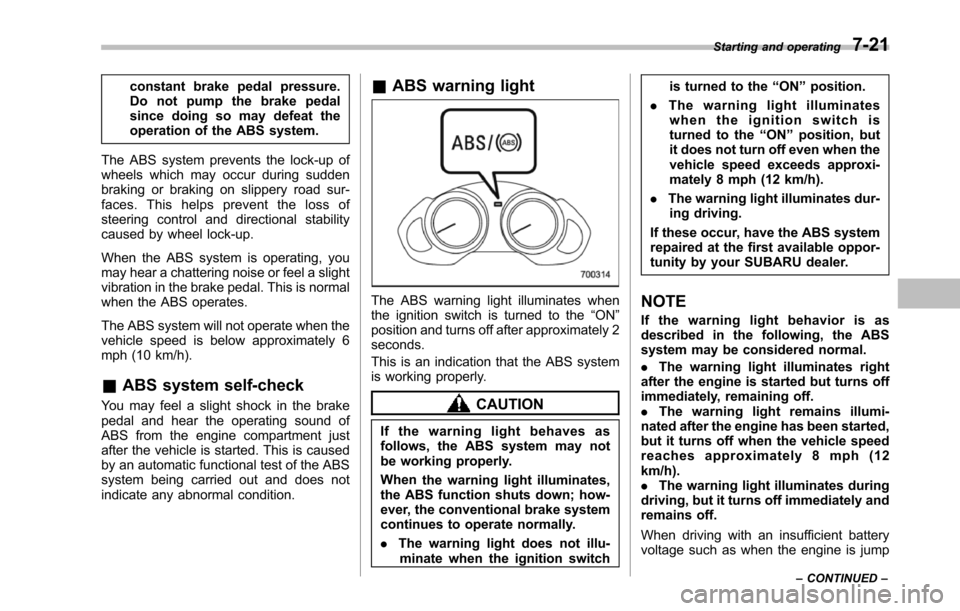
&ABS warning light
The ABS warning light illuminates whenthe ignition switch is turned to the“ON”position and turns off after approximately 2seconds.
This is an indication that the ABS systemis working properly.
CAUTION
If the warning light behaves asfollows, the ABS system may notbe working properly.
Whenthe warning light illuminates,the ABS function shuts down; how-ever, the conventional brake systemcontinues to operate normally.
.The warning light does not illu-minatewhen the ignition switch
is turned to the“ON”position.
.The warning light illuminateswhen the ignition switch isturned to the“ON”position, butit does not turn off even when thevehicle speed exceeds approxi-mately 8 mph (12 km/h).
.The warning light illuminates dur-ing driving.
If these occur, have the ABS systemrepaired at the first available oppor-tunity by your SUBARU dealer.
NOTE
If the warning light behavior is asdescribed in the following, the ABSsystem may be considered normal.
.The warning light illuminates rightafterthe engine is started but turns offimmediately, remaining off..The warning light remains illumi-nated after the engine has been started,but it turns off when the vehicle speedreaches approximately 8 mph (12km/h)..The warning light illuminates duringdriving, but it turns off immediately andremains off.
When driving with an insufficient batteryvoltage suchas when the engine is jump
Starting and operating7-21
–CONTINUED–
Page 281 of 426
8-2Driving tips
New vehicle break-in driving
–the first 1,000 miles (1,600
km)
The performance and long life of yourvehicle are dependent on how you handleand care for your vehicle while it is new.Follow these instructions during the first1,000 miles (1,600 km):
.Do not race the engine. And do notallow engine speed to exceed 4,000 rpmexcept in an emergency.
.Do not drive at one constant engine orvehicle speed for a long time, either fast orslow.
.Avoid starting suddenly and rapidacceleration, except in an emergency.
.Avoid hard braking, except in anemergency.
The same break-in procedures should beapplied to a newly installed or overhauledengine or when brake pads or brakelinings are replaced with new ones.
Fuel economy hints
The following suggestions will help to saveyour fuel.
.Select the proper gear position for thespeed and road conditions.
.Avoid sudden acceleration or decelera-tion. Always accelerate gently until youreach the desired speed. Then try tomaintain that speed for as long aspossible.
.Do not pump the accelerator and avoidracing the engine.
.Avoid unnecessary engine idling.
.Keep the engine properly tuned.
.Keep the tires inflated to the correctpressureshown on the tire placard, whichis located under the door latch on thedriver’s side. Low pressure will increasetire wear and fuel consumption.
.Use the air conditioner only whennecessary.
.Keep the front and rear wheels inproper alignment.
.Avoid carrying unnecessary luggage orcargo.
Engine exhaust gas (carbon
monoxide)
WARNING
.Never inhale engine exhaust gas.Engine exhaust gas containscarbon monoxide, a colorlessand odorless gas which is dan-gerous, or even lethal, if inhaled.
.Always properly maintain the en-gine exhaust system to preventengine exhaust gas from enter-ing the vehicle.
.Never run theengine in a closedspace, such as a garage, exceptfor the brief time needed to drivethe vehicle in or out of it.
.Avoid remaining in a parkedvehicle for a lengthy time whilethe engine is running. If that isunavoidable, then use the venti-lation fan to force fresh air intothe vehicle.
.Always keep the front ventilatorinlet grille free from snow, leavesor other obstructions to ensurethat the ventilation system al-ways works properly.
.If at any time you suspect that
Page 282 of 426
exhaust fumes are entering thevehicle, have the problemchecked and corrected as soonas possible. If you must driveunder these conditions, driveonly with all windows fully open.
.Keep the rear gate closed whiledriving to prevent exhaust gasfrom entering the vehicle.
NOTE
Due to the expansion and contractionof the metals used in the manufactureof the exhaust system, you may hear acrackling sound coming from the ex-haust systemfor a short time after theengine has been shut off. This sound isnormal.
Catalytic converter
WARNING
.Avoid fire hazards. Do not driveor park the vehicle anywherenear flammable materials (e.g.grass, paper, rags or leaves),because the catalytic converteroperates at very high tempera-tures.
.Keep everyone and flammablematerials away from the exhaustpipe while the engine is running.The exhaust gas is very hot.
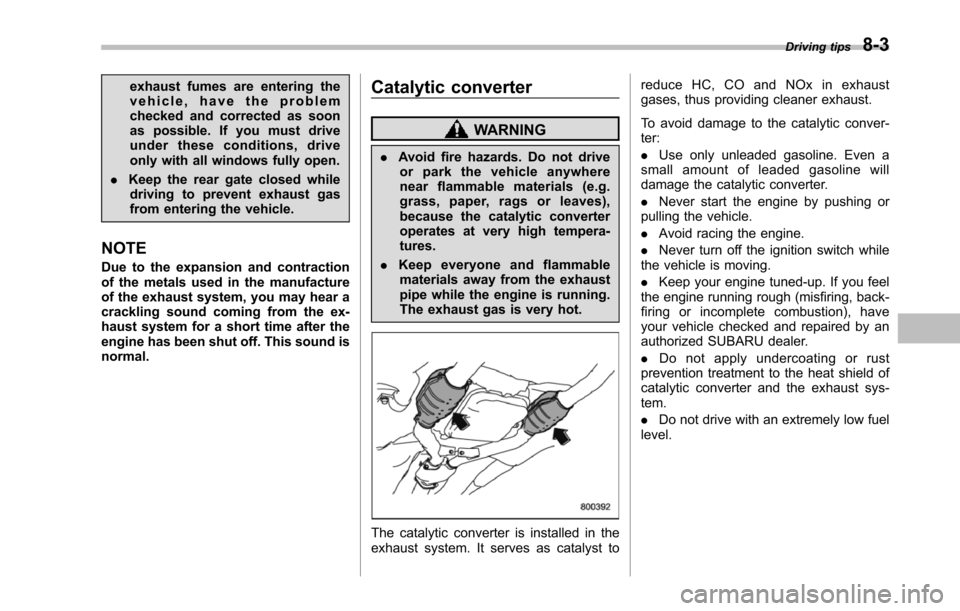
The catalytic converter is installed in theexhaust system. It serves as catalyst to
reduce HC, CO and NOx in exhaustgases, thus providing cleaner exhaust.
To avoid damage to the catalytic conver-ter:
.Use only unleaded gasoline. Even asmall amount of leaded gasoline willdamage the catalytic converter.
.Never start the engine by pushing orpulling the vehicle.
.Avoidracing the engine.
.Never turn off the ignition switch whilethe vehicle is moving.
.Keep your engine tuned-up. If you feelthe engine running rough (misfiring, back-firing or incomplete combustion), haveyour vehicle checked and repaired by anauthorized SUBARU dealer.
.Do not apply undercoating or rustprevention treatment to the heat shield ofcatalytic converter and the exhaust sys-tem.
.Do not drive with an extremely low fuellevel.
Driving tips8-3
Page 286 of 426
depth of the water and the bottom of thestream bed for firmness and ensure thatthe bed of the stream is flat. Drive slowlyand completely through the stream. Thewater should be shallow enough that itdoes not reach the vehicle’s undercar-riage. Water entering the engine air intakeor the exhaust pipe or water splashingonto electrical parts may damage yourvehicle and may cause it to stall. Neverattempt to drive through rushing water;regardless of its depth, it can wash awaythe ground from under your tires, resultingin possible loss of traction and evenvehicle rollover.
.Always check your brakes for effec-tiveness immediately after driving in sand,mud or water. Do this by driving slowlyand stepping on the brake pedal. Repeatthat process several times to dry out thebrake discsand brake pads.
.Do not drive or park over or nearflammable materials such as dry grass orfallen leaves,as they may burn easily. Theexhaust system is very hot while theengine is running and right after enginestops. This could create a fire hazard.
.After driving through tall grass, mud,rocks, sand, rivers, etc., check that thereis no grass, bush, paper, rags, stones,sand, etc. adhering to or trapped on theunderbody. Clear off any such matter from
the underbody. If the vehicle is used withthese materials trapped or adhering to theunderbody, a mechanical breakdown orfire could occur.
.Secure all cargo carried inside thevehicle and make certain that it is notpiled higher than the seatbacks. Duringsudden stops or jolts, unsecured cargocould be thrown around in the vehicle andcause injury. Do not pile heavy loads onthe roof. Those loads raise the vehicle’scenter of gravity and make it more proneto tip over.
.If you must rock the vehicle to free itfrom sand or mud, depress the acceleratorpedal slightly andmove the select leverback and forth between“D”and“R”repeatedly. Do not race the engine. Forthe best possible traction, avoid spinningthe wheels when trying to free the vehicle.
.When the road surface is extremelyslippery, you can obtain better traction bystarting the vehicle with the transmissionin 2nd than 1st.
.Never equip your vehicle with tireslarger than thosespecified in this manual.
.Wash the vehicle’s underbody after off-road driving. Suspension components areparticularly prone to dirt buildup, so theyneed to be washed thoroughly.
.Frequent driving of an AWD modelunder hard-driving conditions such as
rough roads or off roads will necessitatemore frequent replacement of engine oil,brake fluid and transmission oil than thatspecified in the maintenance scheduledescribed in the“Warranty and Mainte-nance Booklet”.
Remember that damage done to yourSUBARU while operating it off-road andnot using common sense precautionssuch as those listed above is not eligiblefor warranty coverage.
Driving tips8-7