ECU SUBARU TRIBECA 2014 1.G Repair Manual
[x] Cancel search | Manufacturer: SUBARU, Model Year: 2014, Model line: TRIBECA, Model: SUBARU TRIBECA 2014 1.GPages: 426, PDF Size: 6.37 MB
Page 303 of 426
8-24Driving tips
Vehicle without cooling kit: 200 lbs (90 kg)
Vehicle with cooling kit: 350 lbs (158 kg)
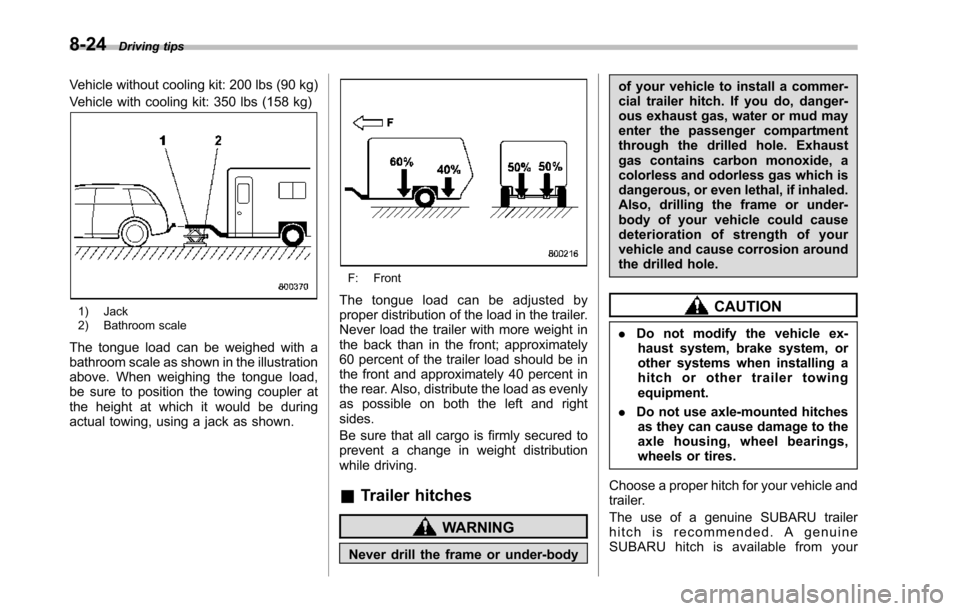
1) Jack2) Bathroom scale
The tongue load can be weighed with abathroomscale as shown in the illustrationabove. When weighing the tongue load,be sure to position the towing coupler atthe height at which it would be duringactual towing, using a jack as shown.
F: Front
The tongue load can be adjusted byproper distribution of the load in the trailer.Never load the trailer with more weight inthe back thanin the front; approximately60 percent of the trailer load should be inthe front and approximately 40 percent inthe rear. Also, distribute the load as evenlyas possible on both the left and rightsides.
Be sure that all cargo is firmly secured toprevent a change in weight distributionwhile driving.
&Trailer hitches
WARNING
Never drill the frame or under-body
of your vehicle to install a commer-cial trailer hitch. If you do, danger-ous exhaust gas, water or mud mayenter the passenger compartmentthrough the drilled hole. Exhaustgas contains carbon monoxide, acolorless and odorless gas which isdangerous, or even lethal, if inhaled.Also, drilling the frame or under-body of your vehicle could causedeterioration of strength of yourvehicle and cause corrosion aroundthe drilled hole.
CAUTION
.Do not modify the vehicle ex-haust system, brake system, orother systems when installing ahitch or other trailer towingequipment.
.Do not use axle-mounted hitchesas they can cause damage to theaxle housing, wheel bearings,wheels or tires.
Choose a proper hitch for your vehicle andtrailer.
The use of a genuine SUBARU trailerhitch is recommended. A genuineSUBARU hitch is available from your
Page 305 of 426
8-26Driving tips
blind spots occur with the vehicle’s stan-dard side mirrors, use towing mirrors thatconform with Federal, state/province and/or other applicable regulations.
!Trailer lights
CAUTION
Direct splicing or other improperconnection of trailer lights maydamage your vehicle’selectricalsystem and cause a malfunction ofyour vehicle’s lighting system.
Connection of trailer lights to your vehi-cle’s electrical system requires modifica-tions to the vehicle’s lighting circuit toincrease its capacity and accommodatewiring changes. To ensure the trailer lightsare connected properly, please consultyour SUBARU dealer. Check for properoperation of the turn signals, stop lightsand parking lights each time you hitch up.
!Tires
WARNING
Never tow a trailer when the tem-porary spare tire is used. The tem-porary spare tire is not designed tosustain the towing load. Use of thetemporary spare tire when towing
can result in failure of the spare tireand/or less stability of the vehicle.
Make sure that all the tires on your vehicleare properly inflated. Refer to“Tires”F12-8.
Trailer tire condition, size, load rating andproper inflation pressure should be inaccordance with the trailer manufacturer’sspecifications.
In the event your vehicle gets a flat tirewhen towing a trailer, ask a commercialroad service to repair the flat tire.
If you carry a regular size spare tire in yourvehicle or trailer as a precaution againstgetting a flat tire, be sure that the sparetire is firmly secured.
&Trailer towing tips
CAUTION
.Never exceed 45 mph (72 km/h)when towing a trailer in hillycountry on hot days.
.When towing a trailer, steering,stability, stopping distance andbraking performance will be dif-ferent from normal operation. Forsafety’s sake, you should employ
extra caution when towing atrailer and you should neverspeed. You should also keep thefollowing tips in mind:
!Before starting out on a trip
.Check that the vehicle and vehicle-to-hitch mounting are in good condition. Ifany problems are apparent, do not tow thetrailer.
.Check that the vehicle sits horizontallywith the trailer attached. If the vehicle istippedsharply up at the front and down atthe rear, check the total trailer weight,GVW, GAWs and tongue load again, thenconfirm that the load and its distributionare acceptable.
.Check that the tire pressures arecorrect.
.Checkthat the vehicle and trailer areconnected properly. Confirm that–the trailer tongue is connectedproperly to the hitch ball.–the trailer lights connector is con-nected properly and trailer’s stop lightsilluminate when the vehicle’s brakepedal is pressed, and that the trailer’sturn signal lights flash when thevehicle’s turn signal lever is operated.–the safety chains are connectedproperly.
Page 306 of 426
–all cargo in the trailer is securedsafely in position.–the side mirrors provide a goodrearward field of view without a sig-nificant blind spot..Sufficient time should be taken to learnthe“feel”of the vehicle/trailer combinationbefore starting out on a trip. In an area freeof traffic, practice turning, stopping andbacking up.
!Driving with a trailer
.You should allow for considerably morestopping distance when towing a trailer.Avoid sudden braking because it mayresult in skidding or jackknifing and loss ofcontrol.
.Avoid uneven steering, sharp turns andrapid lane changes.
.Slow down before turning. Make alonger than normal turning radius becausethe trailer wheels will be closer than thevehicle wheels to the inside of the turn. Ina tight turn, the trailer could hit yourvehicle.
.Crosswinds will adversely affect thehandling of your vehicle and trailer, caus-ing sway. Crosswinds can be due toweather conditions or the passing of largetrucks or buses. If swaying occurs, firmlygrip the steering wheel and slow downimmediately but gradually.
.When passing other vehicles, consid-erable distance is required because of theadded weight and length caused byattaching the trailer to your vehicle.
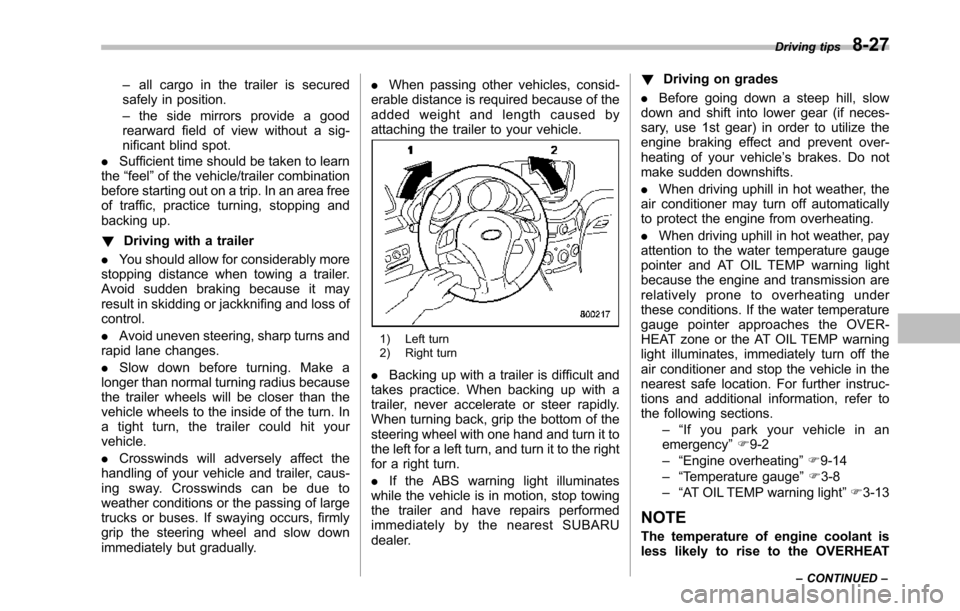
1) Left turn2) Right turn
.Backing up with a trailer is difficult andtakes practice. When backing up with atrailer, never accelerate or steer rapidly.When turning back, grip the bottom of thesteering wheel with one hand and turn it tothe left for a left turn, and turn it to the rightfor a right turn.
.If the ABS warning light illuminateswhile the vehicle is in motion, stop towingthe trailer and have repairs performedimmediately by the nearest SUBARUdealer.
!Driving on grades
.Before going down a steep hill, slowdown and shift into lower gear (if neces-sary, use 1st gear) in order to utilize theengine braking effect and prevent over-heating of your vehicle’s brakes. Do notmake sudden downshifts.
.When driving uphill in hot weather, theair conditioner may turn off automaticallyto protect the engine from overheating.
.When driving uphill in hot weather, payattention to the water temperature gaugepointer and AT OIL TEMP warning lightbecause the engine and transmission arerelatively prone to overheating underthese conditions. If the water temperaturegauge pointer approaches the OVER-HEAT zone or the AT OIL TEMP warninglight illuminates, immediately turn off theair conditioner and stop the vehicle in thenearest safe location. For further instruc-tions and additional information, refer tothe following sections.–“If you park your vehicle in anemergency”F9-2–“Engine overheating”F9-14–“Temperature gauge”F3-8–“AT OIL TEMP warning light”F3-13
NOTE
The temperature of engine coolant isless likely to rise to the OVERHEAT
Driving tips8-27
–CONTINUED–
Page 312 of 426
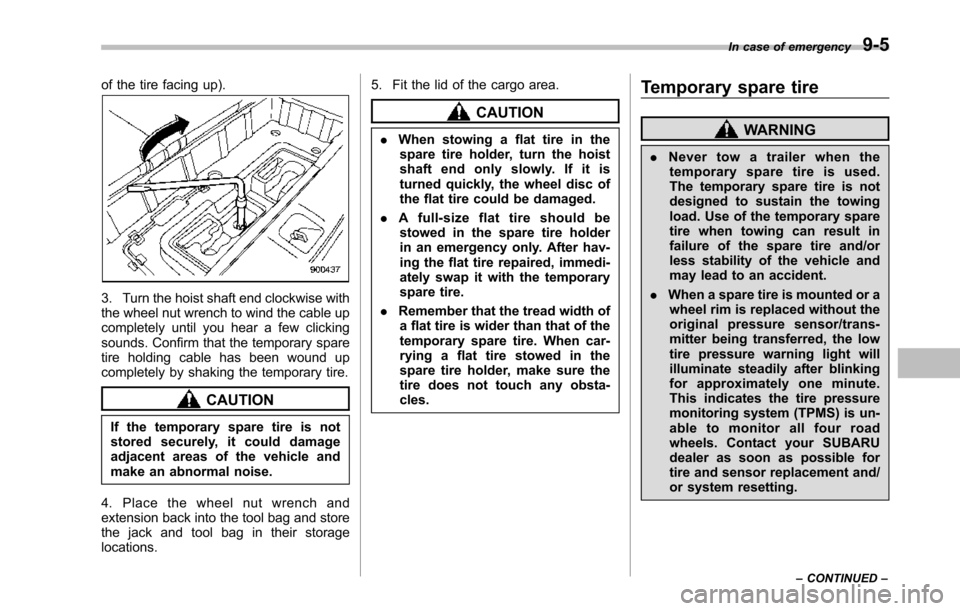
of the tire facing up).
3. Turn the hoist shaft end clockwise withthe wheel nut wrench to wind the cable upcompletely until you hear a few clickingsounds.Confirm that the temporary sparetire holding cable has been wound upcompletely by shaking the temporary tire.
CAUTION
If the temporary spare tire is notstored securely, it could damageadjacent areas of the vehicle andmake an abnormal noise.
4. Place the wheel nut wrench andextension back into the tool bag and storethe jackand tool bag in their storagelocations.
5. Fit the lid of the cargo area.
CAUTION
.When stowing a flat tire in thespare tire holder, turn the hoistshaft end only slowly. If it isturned quickly, the wheel disc ofthe flat tire could be damaged.
.Afull-sizeflattireshouldbestowed in the spare tire holderin an emergency only. After hav-ingthe flat tire repaired, immedi-ately swap it with the temporaryspare tire.
.Remember that the tread width ofa flat tire is wider than that of thetemporary spare tire. When car-rying a flat tire stowed in thespare tire holder, make sure thetiredoes not touch any obsta-cles.
Temporary spare tire
WARNING
.Never tow a trailer when thetemporary spare tire is used.The temporary spare tire is notdesigned to sustain the towingload. Use of the temporary sparetire when towing can result infailure of the spare tire and/orless stability of the vehicle andmay lead to an accident.
.When a spare tire is mounted or awheel rim is replaced without theoriginal pressure sensor/trans-mitter being transferred, the lowtire pressure warning light willilluminate steadily after blinkingfor approximately one minute.This indicates the tire pressuremonitoring system (TPMS) is un-able to monitor all four roadwheels. Contact your SUBARUdealer as soon as possible fortire and sensor replacement and/or system resetting.
In case of emergency9-5
–CONTINUED–
Page 314 of 426
.Always turn off the engine beforeraising the flat tire off the groundusing the jack. Never swing orpush the vehicle supported withthe jack. The jack can come outof the jacking point due to a joltand this can result in a severeaccident.
1. Park on a hard, level surface, when-ever possible, then stop the engine.
2. Set the parking brake securely andshift in the“P”(Park) position.
3. Turn on the hazard warning flasherandhave everyone get out of the vehicle.
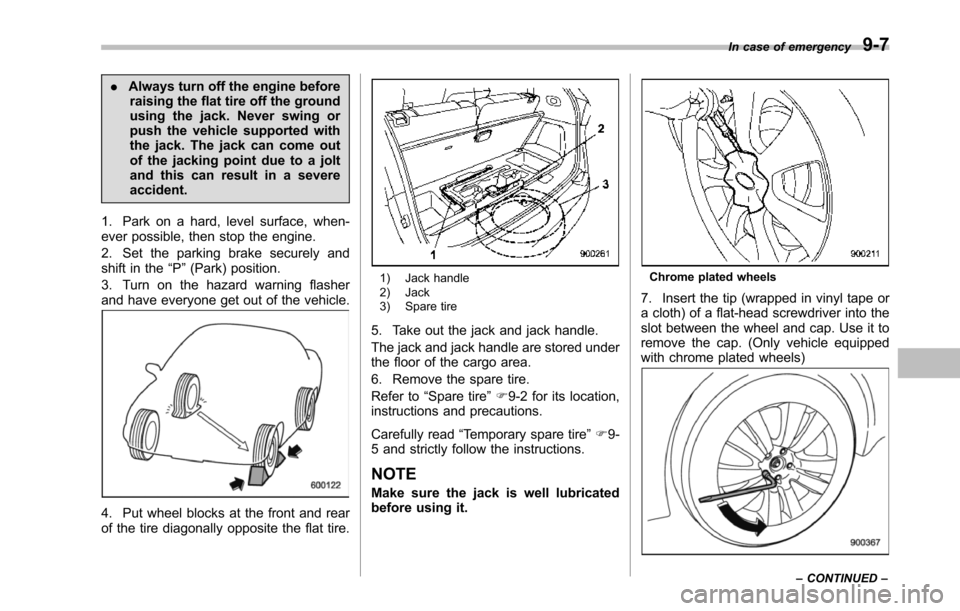
4. Put wheel blocks at the front and rearof the tire diagonally opposite the flat tire.
1) Jack handle2) Jack3) Spare tire
5. Take out the jack and jack handle.
The jack and jack handle are stored underthe floor of the cargo area.
6. Remove the spare tire.
Refer to“Spare tire”F9-2 for its location,instructions andprecautions.
Carefully read“Temporary spare tire”F9-5 and strictly follow the instructions.
NOTE
Make sure the jack is well lubricatedbefore using it.
Chrome plated wheels
7. Insert the tip (wrapped in vinyl tape ora cloth) of a flat-head screwdriver into theslot between the wheel and cap. Use it toremove the cap. (Only vehicle equippedwith chrome plated wheels)
In case of emergency9-7
–CONTINUED–
Page 316 of 426
WARNING
Do not use oil or grease on thewheel studs or nuts when the sparetire is installed. This could cause thenuts to become loose and lead to anaccident.
15. Turn the jack handle counterclockwiseto lower the vehicle.
CAUTION
There are 2 types of wheel nutwrenches that apply to differentlengths.
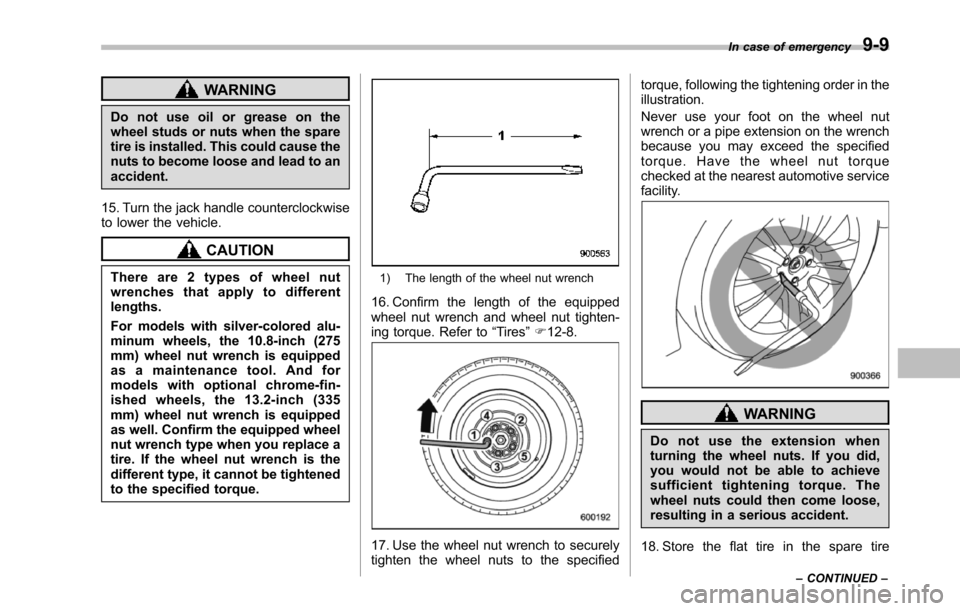
For models with silver-colored alu-minumwheels, the 10.8-inch (275mm) wheel nut wrench is equippedas a maintenance tool. And formodels with optional chrome-fin-ished wheels, the 13.2-inch (335mm) wheel nut wrench is equippedas well. Confirm the equipped wheelnut wrench type when you replace atire. If the wheel nut wrench is thedifferent type, it cannot be tightenedto the specified torque.
1) The length of the wheel nut wrench
16. Confirm the length of the equippedwheel nut wrench and wheel nut tighten-ing torque. Refer to“Tires”F12-8.
17. Use the wheel nut wrench to securelytighten thewheel nuts to the specified
torque, following the tightening order in theillustration.
Never use your foot on the wheel nutwrench or a pipe extension on the wrenchbecause you may exceed the specifiedtorque. Have the wheel nut torquechecked at the nearest automotive servicefacility.
WARNING
Do not use the extension whenturning the wheel nuts. If you did,you would not be able to achievesufficient tightening torque. Thewheel nuts could then come loose,resulting in a serious accident.
18. Store the flat tire in the spare tire
In case of emergency9-9
–CONTINUED–
Page 322 of 426
&Towing and tie-down hooks
The towing hooks should be used only inan emergency (e.g., to free a stuck vehiclefrom mud, sand or snow).
CAUTION
.Use only the specified towinghooks and tie-down hooks. Neveruse suspension parts or otherparts of the body for towing ortie-down purposes.
.Never use the tie-down hookclosest to the muffler under thevehicle for towing purposes.
.To prevent deformation to thebumperand the towing hook, donot apply excessive lateral loadto the towing hooks.
Front towing hook:
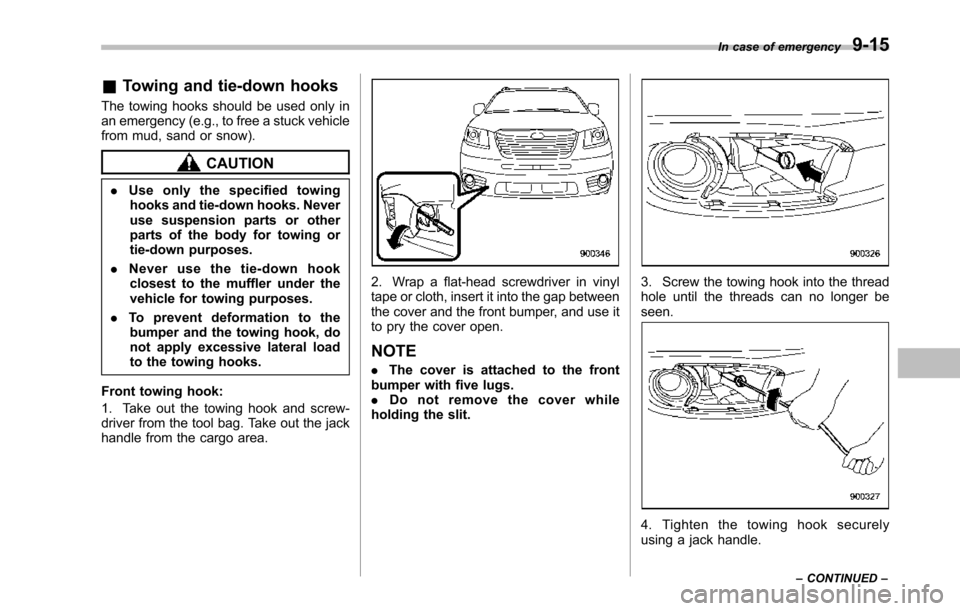
1. Take out the towing hook and screw-driver from the tool bag. Take out the jackhandle from the cargo area.
2. Wrap a flat-head screwdriver in vinyltape or cloth, insert it into the gap betweenthe cover and the front bumper, and use itto pry the cover open.
NOTE
.The cover is attached to the frontbumper with five lugs..Do not remove the cover whileholding the slit.
3. Screw the towing hook into the threadhole until the threads can no longer beseen.
4. Tighten the towing hook securelyusing a jack handle.
In case of emergency9-15
–CONTINUED–
Page 323 of 426
9-16In case of emergency
After towing, remove the towing hook fromthe vehicle and stow it in the tool bag.
Fit the towing hook cover on the bumper.
WARNING
.Do not use the towing hookexcept when towing your vehicle.
.Be sure to remove the towinghook after towing. Leaving thetowing hook mounted on thevehicle could interfere with prop-er operation of the SRS airbagsystem in a frontal collision.
Rear towing hook:
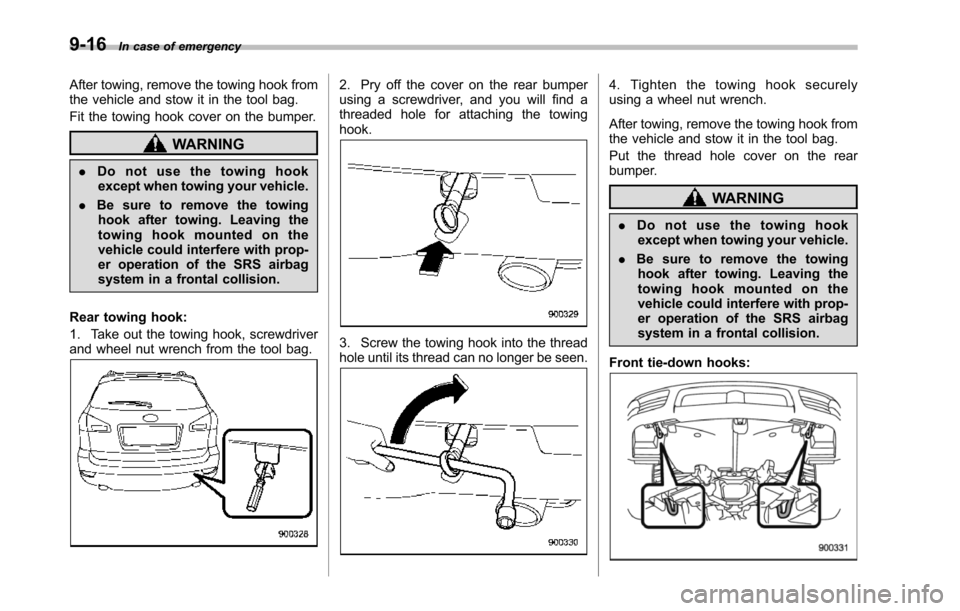
1. Take out the towing hook, screwdriverand wheel nut wrench from the tool bag.
2. Pry off the cover on the rear bumperusing a screwdriver, and you will find athreaded hole for attaching the towinghook.
3. Screw the towing hook into the threadhole until its thread can no longer be seen.
4. Tighten the towing hook securelyusing a wheel nut wrench.
After towing, remove the towing hook fromthe vehicle and stow it in the tool bag.
Put the thread hole cover on the rearbumper.
WARNING
.Do not use the towing hookexcept when towing your vehicle.
.Be sure to remove the towinghook after towing. Leaving thetowing hook mounted on thevehicle could interfere with prop-er operation of the SRS airbagsystem in a frontal collision.
Front tie-down hooks:
Page 324 of 426
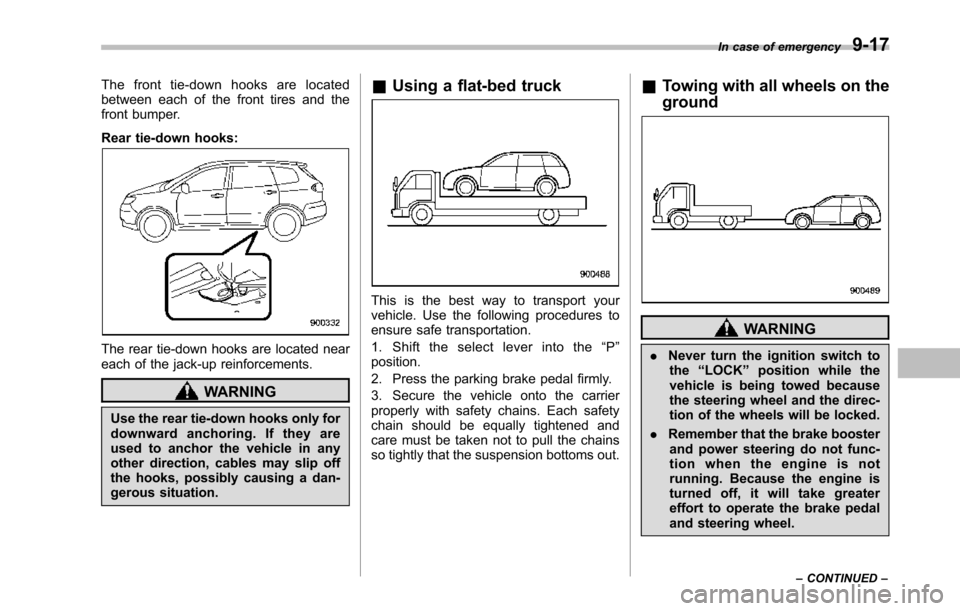
The front tie-down hooks are locatedbetween each of the front tires and thefront bumper.
Rear tie-down hooks:
The rear tie-down hooks are located neareach of the jack-up reinforcements.
WARNING
Use the rear tie-down hooks only fordownward anchoring. If they areused to anchor the vehicle in anyother direction, cables may slip offthe hooks,possibly causing a dan-gerous situation.
&Using a flat-bed truck
This is the best way to transport yourvehicle. Use the following procedures toensure safe transportation.
1. Shift the select lever into the“P”position.
2. Press the parking brake pedal firmly.
3. Secure the vehicle onto the carrierproperly with safety chains. Each safetychain should be equally tightened andcare must be taken not to pull the chainsso tightly that the suspension bottoms out.
&Towing with all wheels on the
ground
WARNING
.Never turn the ignition switch tothe“LOCK”position while thevehicle is being towed becausethe steeringwheel and the direc-tion of the wheels will be locked.
.Remember that the brake boosterand power steering do not func-tion when the engine is notrunning. Because the engine isturned off, it will take greatereffort to operate the brake pedaland steering wheel.
In case of emergency9-17
–CONTINUED–
Page 338 of 426
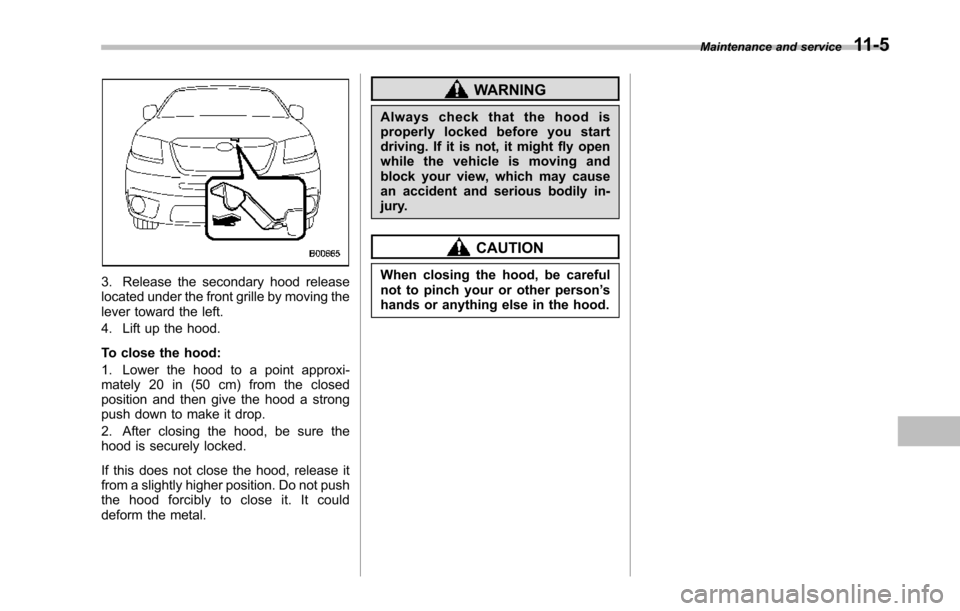
3. Release the secondary hood releaselocated under the front grille by moving thelever toward the left.
4. Lift up the hood.
To close the hood:
1. Lower the hood to a point approxi-mately 20 in (50 cm) from the closedposition and then give the hood a strongpush down to make it drop.
2. After closing the hood, be sure thehoodis securely locked.
If this does not close the hood, release itfrom a slightly higher position. Do not pushthe hood forcibly to close it. It coulddeform the metal.
WARNING
Always check that the hood isproperly locked before you startdriving. If it is not, it might fly openwhile the vehicle is moving andblock your view, which may causean accident and serious bodily in-jury.
CAUTION
When closing the hood, be carefulnot to pinch your or other person’shands or anything else in the hood.
Maintenance and service11-5