ECU SUBARU TRIBECA 2014 1.G Owner's Manual
[x] Cancel search | Manufacturer: SUBARU, Model Year: 2014, Model line: TRIBECA, Model: SUBARU TRIBECA 2014 1.GPages: 426, PDF Size: 6.37 MB
Page 68 of 426
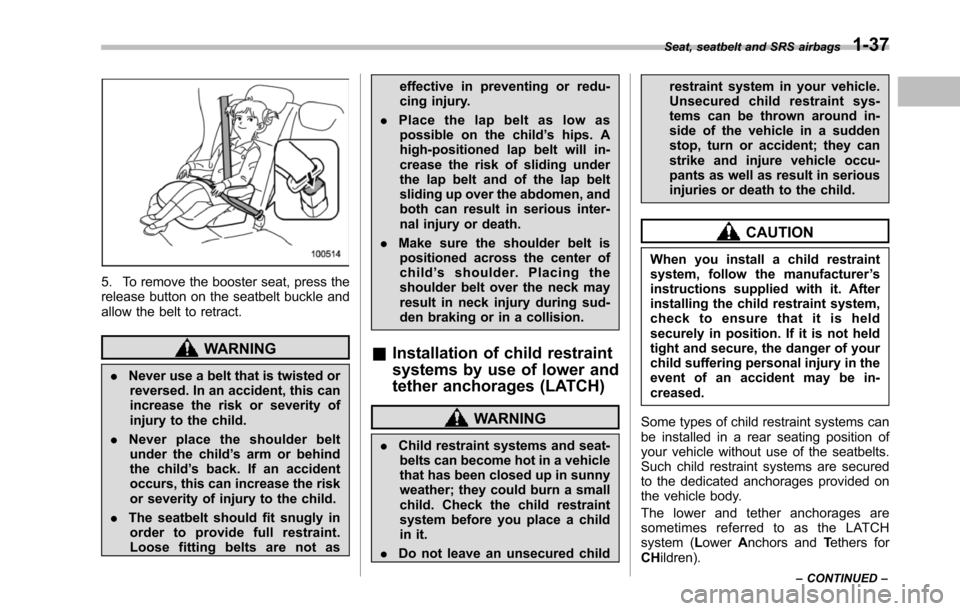
5. To remove the booster seat, press therelease button on the seatbelt buckle andallow the belt to retract.
WARNING
.Never use a belt that is twisted orreversed.In an accident, this canincrease the risk or severity ofinjury to the child.
.Never place the shoulder beltunder the child’s arm or behindthe child’s back. If an accidentoccurs, this can increase the riskor severity of injury to the child.
.The seatbelt should fit snugly inorder to provide full restraint.Loose fitting belts are not as
effective in preventing or redu-cing injury.
.Place the lap belt as low aspossible on the child’s hips. Ahigh-positioned lap belt will in-crease the risk of sliding underthe lap belt and of the lap beltsliding up over the abdomen, andboth can result in serious inter-nalinjury or death.
.Make sure the shoulder belt ispositioned across the center ofchild’sshoulder.Placingtheshoulder belt over the neck mayresult in neck injury during sud-den braking or in a collision.
&Installation of child restraint
systems by use of lower and
tether anchorages (LATCH)
WARNING
.Child restraint systems and seat-belts can become hot in a vehiclethat has been closed up in sunnyweather; they could burn a smallchild.Check the child restraintsystem before you place a childin it.
.Do not leave an unsecured child
restraint system in your vehicle.Unsecured child restraint sys-tems can be thrown around in-side of the vehicle in a suddenstop, turn or accident; they canstrike and injure vehicle occu-pants as well as result in seriousinjuries or death to the child.
CAUTION
When you install a child restraintsystem, follow the manufacturer’sinstructions supplied with it. Afterinstalling thechild restraint system,check to ensure that it is heldsecurely in position. If it is not heldtight and secure, the danger of yourchild suffering personal injury in theevent of an accident may be in-creased.
Some types of child restraint systems canbe installed in a rear seating position ofyour vehicle without use of the seatbelts.Such child restraint systems are securedto the dedicated anchorages provided onthe vehicle body.
The lower and tether anchorages aresometimes referred to as the LATCHsystem (LowerAnchors andTethers forCHildren).
Seat, seatbelt and SRS airbags1-37
–CONTINUED–
Page 70 of 426
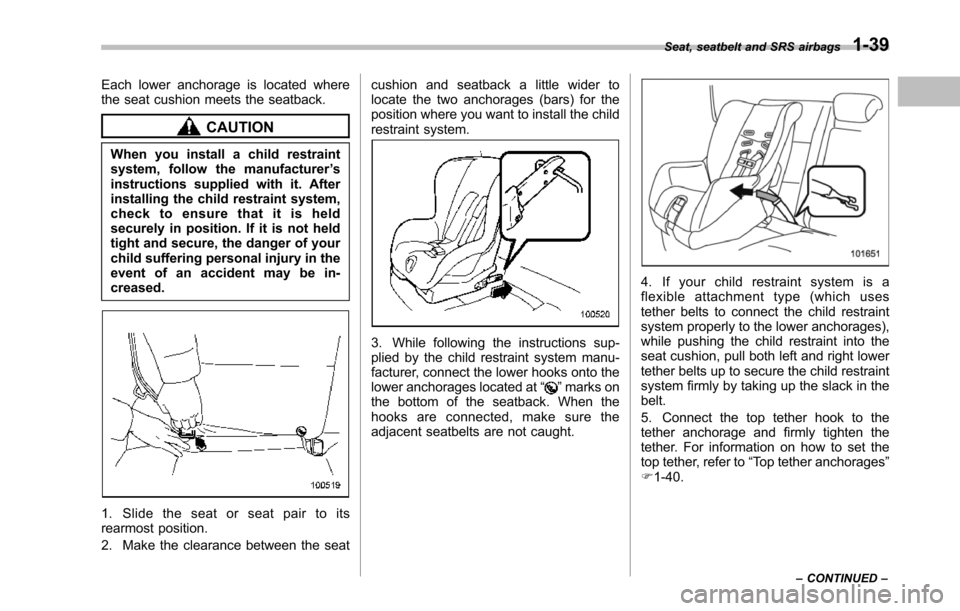
Each lower anchorage is located wherethe seat cushion meets the seatback.
CAUTION
When you install a child restraintsystem, follow the manufacturer’sinstructions supplied with it. Afterinstalling the child restraint system,check to ensure that it is heldsecurely in position. If it is not heldtight and secure, the danger of yourchild sufferingpersonal injury in theevent of an accident may be in-creased.
1. Slide the seat or seat pair to itsrearmost position.
2. Make the clearance between the seat
cushion and seatback a little wider tolocate the two anchorages (bars) for theposition where you want to install the childrestraint system.
3. While following the instructions sup-plied by the child restraint system manu-facturer, connect the lower hooks onto thelower anchorages located at“”marks onthe bottomof the seatback. When thehooks are connected, make sure theadjacent seatbelts are not caught.
4. If your child restraint system is aflexible attachment type (which usestether belts to connect the child restraintsystem properly to the lower anchorages),while pushing the child restraint into theseat cushion, pull both left and right lowertetherbelts up to secure the child restraintsystem firmly by taking up the slack in thebelt.
5. Connect the top tether hook to thetether anchorage and firmly tighten thetether. For information on how to set thetop tether, refer to“Top tether anchorages”F1-40.
Seat, seatbelt and SRS airbags1-39
–CONTINUED–
Page 71 of 426
1-40Seat, seatbelt and SRS airbags
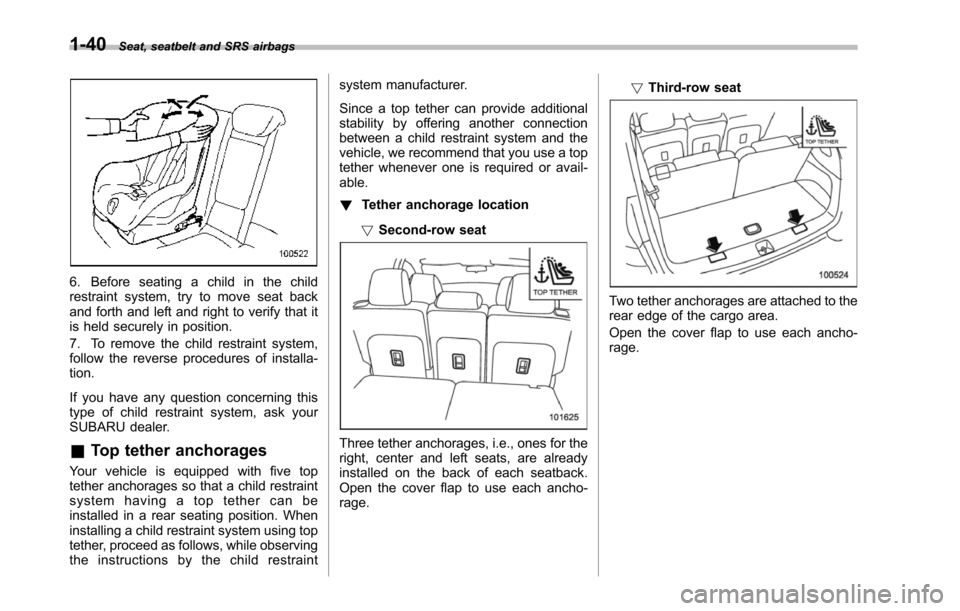
6. Before seating a child in the childrestraint system, try to move seat backand forth and left and right to verify that itis held securely in position.
7. To remove the child restraint system,follow the reverse procedures of installa-tion.
If you have any question concerning thistype of child restraint system, ask yourSUBARU dealer.
&Top tether anchorages
Your vehicle is equipped with five toptether anchorages so that a child restraintsystem having a top tether can beinstalled in a rear seating position. Wheninstalling a child restraint system using toptether, proceed as follows, while observingthe instructions by the child restraint
system manufacturer.
Since a top tether can provide additionalstability by offering another connectionbetween a child restraint system and thevehicle, we recommend that you use a toptether whenever one is required or avail-able.
!Tether anchorage location
!Second-row seat
Three tether anchorages, i.e., ones for theright, centerand left seats, are alreadyinstalled on the back of each seatback.Open the cover flap to use each ancho-rage.
!Third-row seat
Two tether anchorages are attached to therear edge of the cargo area.
Open the cover flap to use each ancho-rage.
Page 72 of 426
!To hook the top tether
!Second-row outboard seat
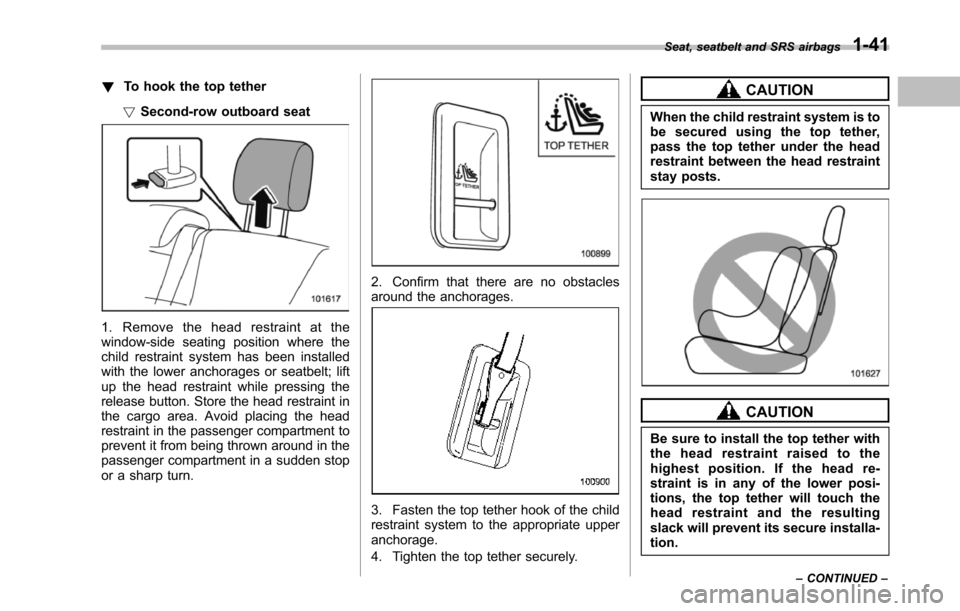
1. Remove the head restraint at thewindow-sideseating position where thechild restraint system has been installedwith the lower anchorages or seatbelt; liftup the head restraint while pressing therelease button. Store the head restraint inthe cargo area. Avoid placing the headrestraint in the passenger compartment toprevent it from being thrown around in thepassenger compartment in a sudden stopor a sharp turn.
2. Confirm that there are no obstaclesaround the anchorages.
3. Fasten the top tether hook of the childrestraint system to the appropriate upperanchorage.
4. Tighten the top tether securely.
CAUTION
When the child restraint system is tobe secured using the top tether,pass the top tether under the headrestraint between the head restraintstay posts.
CAUTION
Be sure to install the top tether withthe head restraint raised to thehighest position. If the head re-straint is in any of the lower posi-tions, the top tether will touch thehead restraint and the resultingslack will prevent its secure installa-tion.
Seat, seatbelt and SRS airbags1-41
–CONTINUED–
Page 73 of 426
1-42Seat, seatbelt and SRS airbags
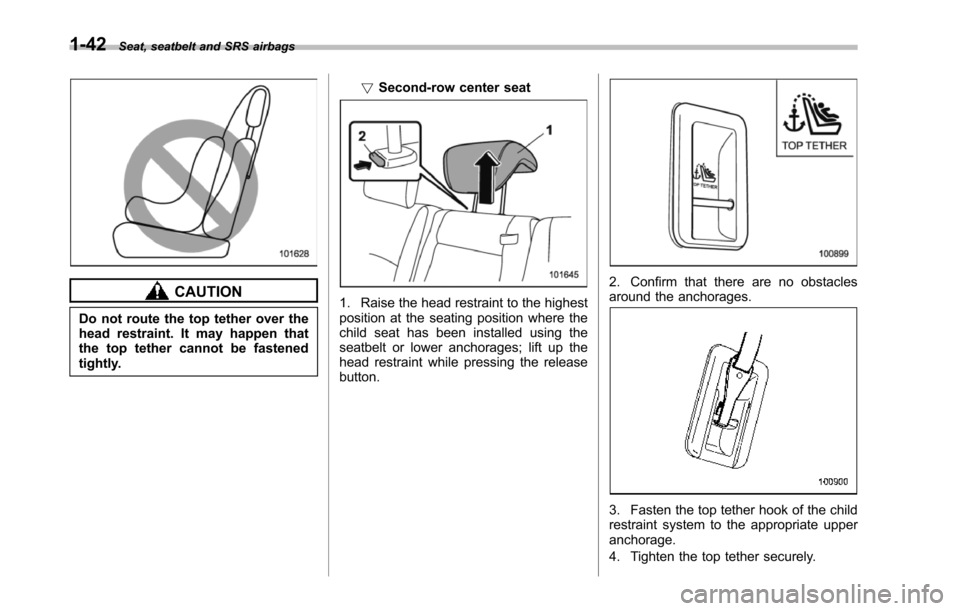
CAUTION
Do not route the top tether over thehead restraint. It may happen thatthe top tether cannot be fastenedtightly.
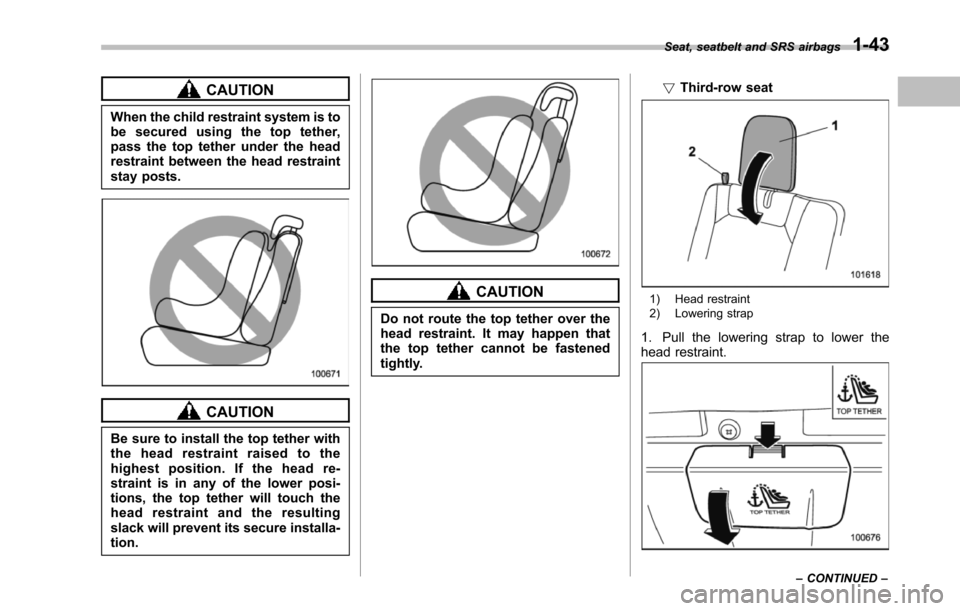
!Second-row center seat
1. Raise the head restraint to the highestposition at the seating position where thechild seat has been installed using theseatbelt or lower anchorages; lift up thehead restraint while pressing the releasebutton.
2. Confirm that there are no obstaclesaround the anchorages.
3. Fasten the top tether hook of the childrestraintsystem to the appropriate upperanchorage.
4. Tighten the top tether securely.
Page 74 of 426
CAUTION
When the child restraint system is tobe secured using the top tether,pass the top tether under the headrestraint between the head restraintstay posts.
CAUTION
Be sure to install the top tether withthe head restraint raised to thehighest position. If the head re-straint is in any of the lower posi-tions, the top tether will touch thehead restraint and the resultingslack will prevent its secure installa-tion.
CAUTION
Do not route the top tether over thehead restraint. It may happen thatthe top tether cannot be fastenedtightly.
!Third-row seat
1) Head restraint2) Lowering strap
1. Pull the lowering strap to lower thehead restraint.
Seat, seatbelt and SRS airbags1-43
–CONTINUED–
Page 75 of 426
1-44Seat, seatbelt and SRS airbags
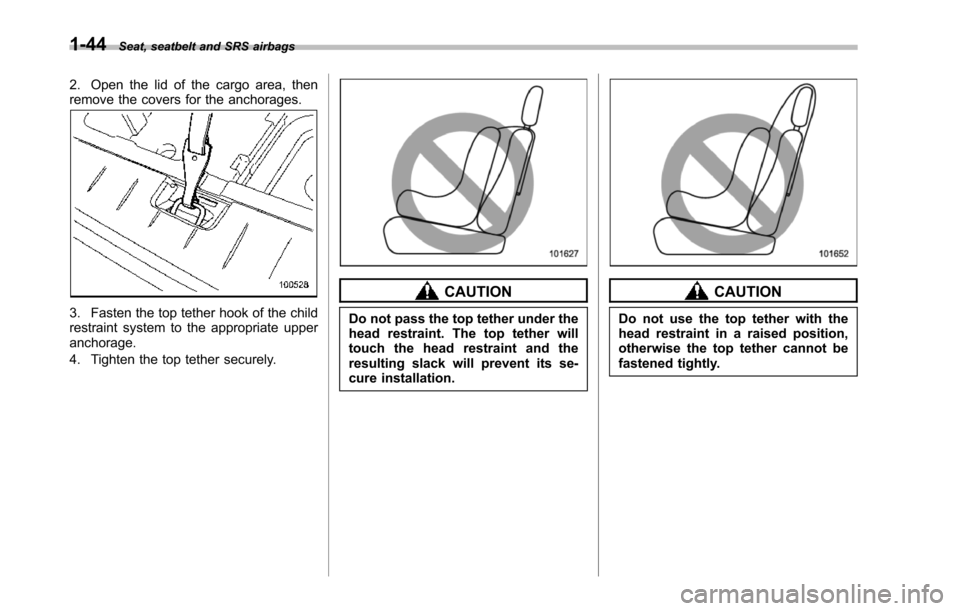
2. Open the lid of the cargo area, thenremove the covers for the anchorages.
3. Fasten the top tether hook of the childrestraint systemto the appropriate upperanchorage.
4. Tighten the top tether securely.
CAUTION
Do not pass the top tether under thehead restraint. The top tether willtouch the head restraint and theresulting slack will prevent its se-cure installation.
CAUTION
Do not use the top tether with thehead restraint in a raised position,otherwise the top tether cannot befastened tightly.
Page 77 of 426
1-46Seat, seatbelt and SRS airbags
refer to“Seatbelts”F1-17.
.Do not sit or lean unnecessarilyclose to the SRS airbag. Becausethe SRS airbag deploys withconsiderable speed–faster thanthe blink of an eye–and force toprotect in high speed collisions,the force of an airbag can injurean occupant whose body is tooclose to SRS airbag.
It is also important to wear yourseatbelt to help avoid injuriesthat can result when the SRSairbag contacts an occupant notin proper position such as onethrown forward during pre-acci-dent braking.
Even when properly positioned,there remainsa possibility thatan occupant may suffer minorinjury such as abrasions andbruises to the face or armsbecause of the SRS airbag de-ployment force.
.The SRS airbags deploy withconsiderable speed and force.Occupants who are out of properposition when the SRS airbagdeploys could suffer very seriousinjuries. Because the SRS airbagneeds enough space for deploy-
ment, the driver should alwayssit upright and well back in theseat as far from the steeringwheel as practical while stillmaintaining full vehicle controland the front passenger shouldmove the seat as far back aspossible and sit upright and wellback in the seat.
.Do not place any objects over ornear the SRS airbag cover orbetween you and the SRS airbag.If the SRS airbag deploys, thoseobjects could interfere with itsproper operation and could bepropelled inside the vehicle andcause injury.
WARNING
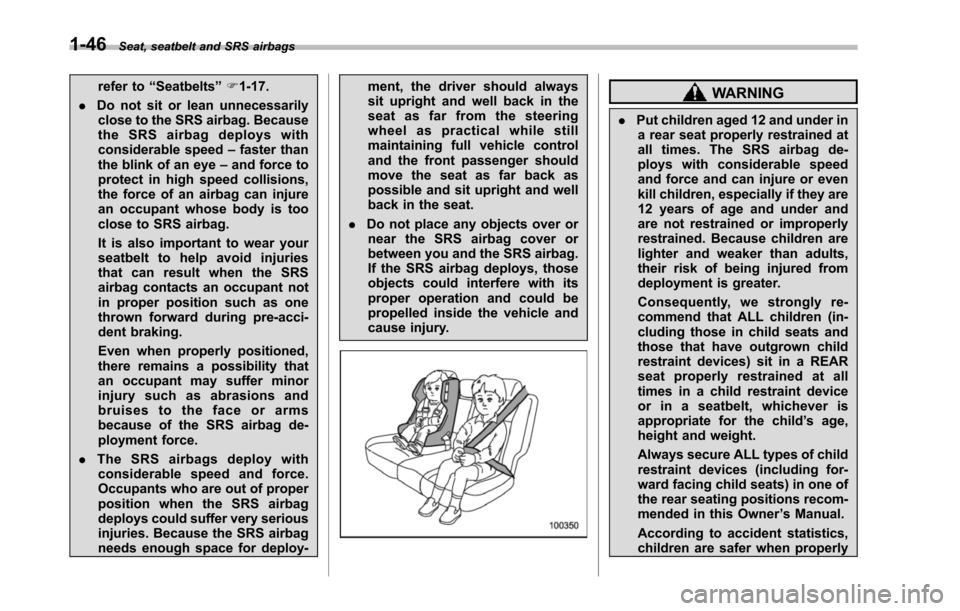
.Put children aged 12 and under ina rear seat properly restrained atall times. The SRS airbag de-ploys with considerable speedand force and can injure or evenkill children, especially if they are12 years of age and under andare not restrained or improperlyrestrained. Because children arelighter and weaker than adults,their risk of being injured fromdeployment is greater.
Consequently, we strongly re-commend that ALL children (in-cluding those in child seats andthose that have outgrown childrestraintdevices) sit in a REARseat properly restrained at alltimes in a child restraint deviceor in a seatbelt, whichever isappropriate for the child’s age,height and weight.
Always secure ALL types of childrestraint devices (including for-ward facing child seats) in one ofthe rear seating positions recom-mended in this Owner’s Manual.
According to accident statistics,children are safer when properly
Page 94 of 426
Ahands-freemicrophoneorother accessory in such a loca-tion could be propelled throughthe cabin with great force by thecurtain airbag, or it could preventcorrect deployment of the curtainairbag. In either case, the resultcould be serious injuries.
WARNING
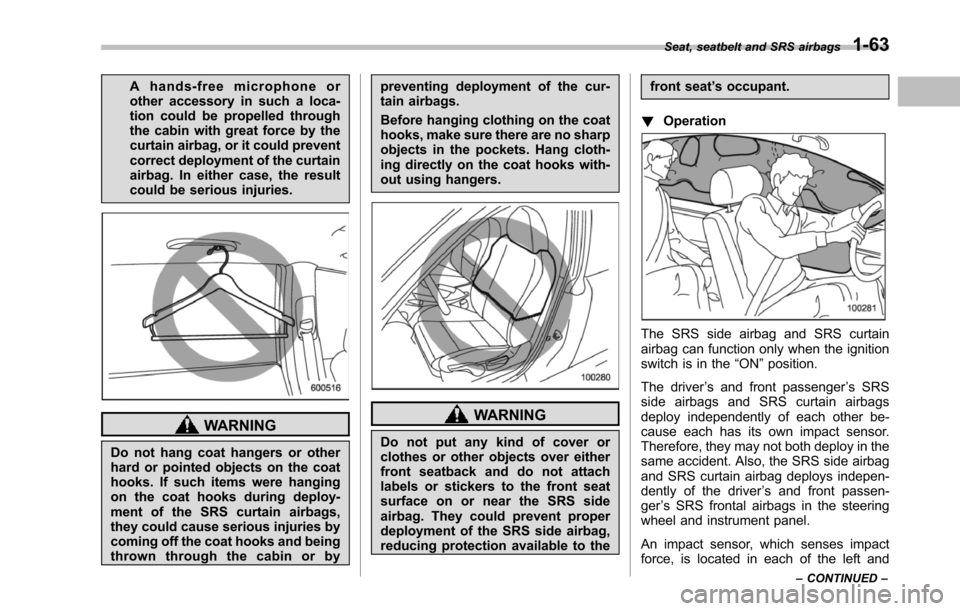
Do not hang coat hangers or otherhard or pointed objects on the coathooks. If such items were hangingon the coat hooks during deploy-ment of the SRS curtain airbags,they could cause serious injuries bycoming off the coat hooks and beingthrown through the cabin or by
preventing deployment of the cur-tain airbags.
Before hanging clothing on the coathooks, make sure there are no sharpobjects in the pockets. Hang cloth-ing directly on the coat hooks with-out using hangers.
WARNING
Do not put any kind of cover orclothes or other objects over eitherfront seatback and do not attachlabels or stickers to the front seatsurface on or near the SRS sideairbag. They could prevent properdeployment of the SRS side airbag,reducingprotection available to the
front seat’s occupant.
!Operation
The SRS side airbag and SRS curtainairbag can function only when the ignitionswitch is in the“ON”position.
The driver’s and front passenger’s SRSside airbags and SRS curtain airbagsdeploy independently of each other be-cause each has its own impact sensor.Therefore, they may not both deploy in thesame accident. Also, the SRS side airbagand SRS curtain airbag deploys indepen-dently of the driver’s and front passen-ger’s SRS frontal airbags in the steeringwheel and instrument panel.
An impact sensor, which senses impactforce, is located in each of the left and
Seat, seatbelt and SRS airbags1-63
–CONTINUED–
Page 106 of 426
Keys..................................................................... 2-2Key number plate................................................ 2-2
Immobilizer.......................................................... 2-3Security ID plate.................................................. 2-3Security indicator light........................................ 2-4Key replacement................................................. 2-4
Door locks........................................................... 2-5Locking and unlocking from the outside .............. 2-5Locking and unlocking from the inside................ 2-5Batterydrainage prevention function................... 2-6
Power door locking switches............................. 2-7Key lock-in prevention function........................... 2-8
Remote keyless entry system............................ 2-8Locking the doors............................................... 2-9Unlocking the doors........................................... 2-10Unlocking the rear gate...................................... 2-10Illuminated entry................................................ 2-10Vehicle finder function........................................ 2-10Sounding a panic alarm...................................... 2-11Selecting audible signal operation...................... 2-11Replacing the battery......................................... 2-11
Replacing lost transmitters................................ 2-12
Alarm system..................................................... 2-16System operation............................................... 2-16Activating and deactivating the alarm system..... 2-16If you have accidentally triggered the alarmsystem............................................................ 2-17Arming the system............................................ 2-17Disarming the system........................................ 2-18Valet mode........................................................ 2-18Passive arming.................................................. 2-19Tripped sensor identification.............................. 2-20Shock sensors (dealer option)............................ 2-20
Child safety locks.............................................. 2-21
Windows............................................................. 2-21Power windows................................................. 2-21
Rear gate............................................................ 2-24
Moonroof (if equipped)...................................... 2-25Tilt function....................................................... 2-26Sliding function................................................. 2-26Anti-entrapment function.................................... 2-26Sun shade......................................................... 2-27
Keys and doors
2