steering wheel SUBARU TRIBECA 2014 1.G Owners Manual
[x] Cancel search | Manufacturer: SUBARU, Model Year: 2014, Model line: TRIBECA, Model: SUBARU TRIBECA 2014 1.GPages: 426, PDF Size: 6.37 MB
Page 10 of 426
Safety precautions when
driving
&Seatbelt and SRS airbag
WARNING
.All persons in the vehicle shouldfasten their seatbelts BEFOREthe vehicle starts to move. Other-wise, the possibility of seriousinjury becomes greater in theevent of a sudden stop or acci-dent.
.To obtain maximum protection inthe event of an accident, thedriver and all passengers in thevehicle shouldalways wear seat-belts when the vehicle is moving.The SRS (Supplemental RestraintSystem) airbag does not do awaywith the need to fasten seatbelts.In combination with the seat-belts, it offers the best combinedprotection in case of a seriousaccident.
Not wearing a seatbelt increasesthe chance of severe injury ordeath in a crash even when thevehicle has the SRS airbag.
.The SRS airbags deploy withconsiderable speed and force.Occupants who are out of properposition when the SRS airbagdeploys could suffer very seriousinjuries. Because the SRS airbagneeds enough space for deploy-ment, the driver should alwayssit upright and well back in theseat as far from the steeringwheel as practical while stillmaintaining full vehicle controland the front passenger shouldmove the seat as far back aspossible and sit upright and wellback in the seat.
For instructions and precautions, carefullyread the following sections.
.For the seatbelt system, refer to“Seat-belts”F1-17.
.For the SRS airbag system, refer to“*SRS airbag (Supplemental RestraintSystem airbag)”F1-45.
&Child safety
WARNING
.Never hold a child on your lap orin your arms while the vehicle ismoving. The passenger cannotprotect the child from injury in acollision, because the child willbe caught between the passen-ger and objects inside the vehi-cle.
.While riding in the vehicle, in-fants and small children shouldalways be placed in one of therear seating positions recom-mended in this Owner’s Manualin an infant or child restraintsystem which is appropriate forthe child’sage,heightandweight. If a child is too big for achild restraint system, the childshould sit in a REAR seat and berestrained using the seatbelts.According to accident statistics,children are safer when properlyrestrained in the rear seatingpositions than in the front seat-ing positions. Never allow a childto stand up or kneel on the seat.
.Put childrenaged 12 and under ina REAR seat properly restrained
5
–CONTINUED–
Page 33 of 426
1-2Seat, seatbelt and SRS airbags
Front seats
WARNING
.Never adjust the seat while driv-ing to avoid loss of vehicle con-trol and personal injury.
.Before adjustingthe seat, makesure luggage and the hands andfeet of second-row seat passen-gers are clear of the adjustingmechanism.
.Do not put objects under the frontseats. They may interfere withfront seat locking and cause anaccident.
.Seatbelts provide maximum re-straint when the occupant sitswell back and upright in the seat.To r e d u c e t h e r i s k o f s l i d i n gunder the seatbelt in a collision,the front seatbacks should bealways used in the upright posi-tion while the vehicle is running.If the front seatbacks are notused in the upright position in acollision, the risk of sliding underthe lap belt and of the lap beltsliding up over the abdomen willincrease, and both can result inserious internalinjury or death.
.The SRS airbags deploy withconsiderable speed and force.Occupants who are out of properposition when the SRS airbagdeploys could suffer very seriousinjuries. Because the SRS airbagneeds enough space for deploy-ment, the driver should alwayssit upright and well back in theseat as far from the steeringwheel as practical while stillmaintaining full vehicle controland the frontpassenger shouldmove the seat as far back aspossible and sit upright and wellback in the seat.
WARNING
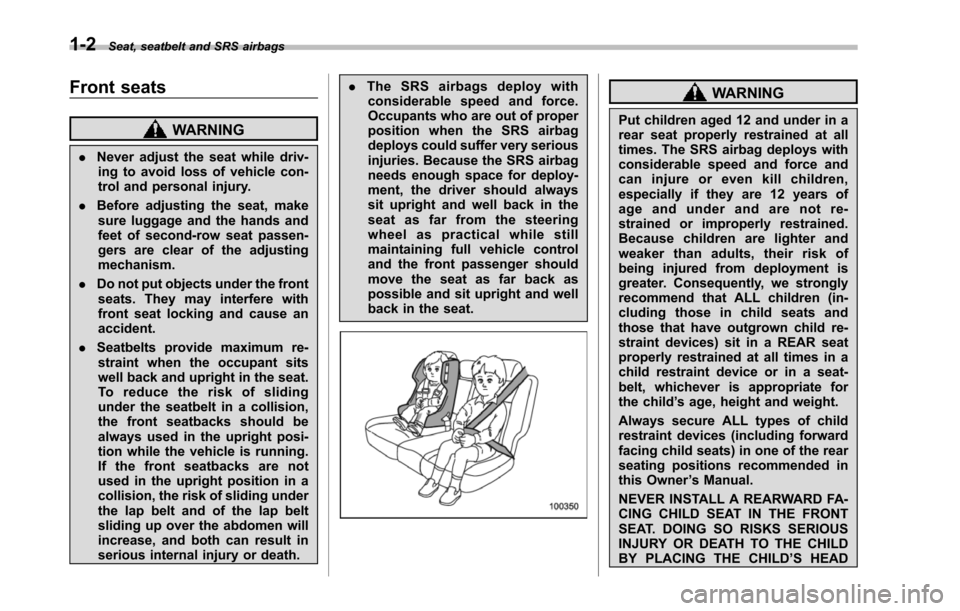
Put children aged 12 and under in arear seat properly restrained at alltimes. The SRS airbag deploys withconsiderable speed and force andcan injure or even kill children,especially if they are 12 years ofage and under and are not re-strained or improperly restrained.Because children are lighter andweaker than adults, their risk ofbeing injured from deployment isgreater. Consequently, we stronglyrecommend that ALL children (in-cluding those in child seats andthose that have outgrown child re-straint devices) sit in a REAR seatproperly restrained at all times in achild restraint device or in a seat-belt, whichever is appropriate forthe child’s age, height and weight.
Always secure ALL types of childrestraint devices (including forwardfacingchild seats) in one of the rearseating positions recommended inthis Owner’s Manual.
NEVER INSTALL A REARWARD FA-CING CHILD SEAT IN THE FRONTSEAT. DOING SO RISKS SERIOUSINJURY OR DEATH TO THE CHILDBY PLACING THE CHILD’S HEAD
Page 50 of 426
instead of across the weakerabdomen.
.Seatbelts provide maximum re-straint when the occupant sitswell back and upright in the seat.To r e d u c e t h e r i s k o f s l i d i n gunder the seatbelt in a collision,thefront seatbacks should bealways used in the upright posi-tion while the vehicle is running.If the front seatbacks are notused in the upright position in acollision, the risk of sliding underthe lap belt and of the lap beltsliding up over the abdomen willincrease, and both can result inserious internal injury or death.
.Do not put cushions or any othermaterials between occupantsand seatbacks or seat cushions.If you do so, the risk of slidingunder the lap belt and of the lapbelt sliding up over the abdomenwill increase, and both can resultin serious internal injury ordeath.
WARNING
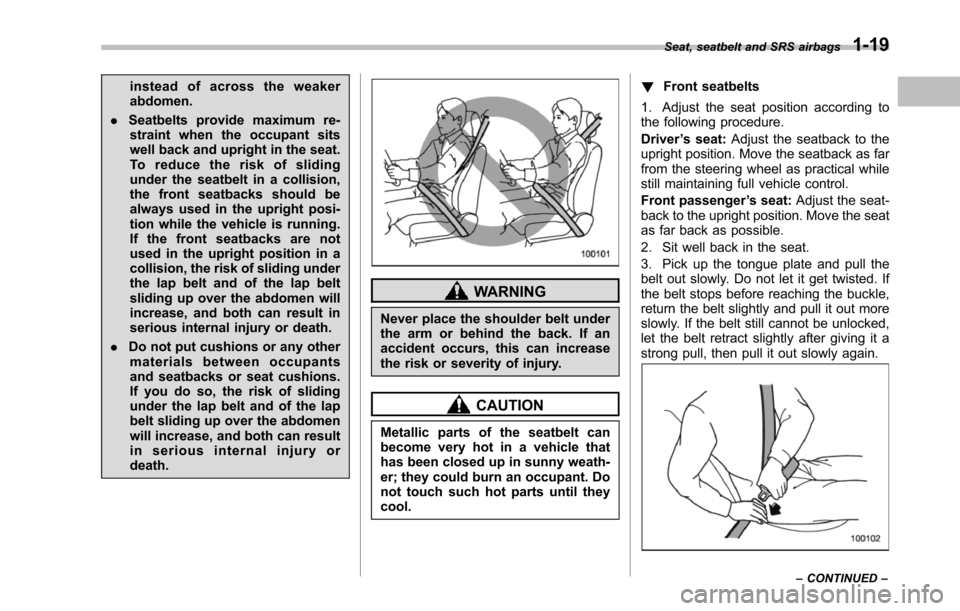
Never place the shoulder belt underthe arm or behind the back. If anaccident occurs, this can increasethe risk or severity of injury.
CAUTION
Metallic parts of the seatbelt canbecome very hot in a vehicle thathas been closed up in sunny weath-er; they could burn an occupant. Donot touch such hot parts until theycool.
!Front seatbelts
1. Adjust the seat position according tothe following procedure.
Driver’s seat:Adjust the seatback to theupright position. Move the seatback as farfrom the steering wheel as practical whilestill maintaining full vehicle control.
Front passenger’s seat:Adjust the seat-back to the upright position. Move the seatas far back as possible.
2. Sit well back in the seat.
3. Pick up the tongue plate and pull thebelt out slowly. Do not let it get twisted. Ifthe belt stops before reaching the buckle,return the beltslightly and pull it out moreslowly. If the belt still cannot be unlocked,let the belt retract slightly after giving it astrong pull, then pull it out slowly again.
Seat, seatbelt and SRS airbags1-19
–CONTINUED–
Page 77 of 426
1-46Seat, seatbelt and SRS airbags
refer to“Seatbelts”F1-17.
.Do not sit or lean unnecessarilyclose to the SRS airbag. Becausethe SRS airbag deploys withconsiderable speed–faster thanthe blink of an eye–and force toprotect in high speed collisions,the force of an airbag can injurean occupant whose body is tooclose to SRS airbag.
It is also important to wear yourseatbelt to help avoid injuriesthat can result when the SRSairbag contacts an occupant notin proper position such as onethrown forward during pre-acci-dent braking.
Even when properly positioned,there remainsa possibility thatan occupant may suffer minorinjury such as abrasions andbruises to the face or armsbecause of the SRS airbag de-ployment force.
.The SRS airbags deploy withconsiderable speed and force.Occupants who are out of properposition when the SRS airbagdeploys could suffer very seriousinjuries. Because the SRS airbagneeds enough space for deploy-
ment, the driver should alwayssit upright and well back in theseat as far from the steeringwheel as practical while stillmaintaining full vehicle controland the front passenger shouldmove the seat as far back aspossible and sit upright and wellback in the seat.
.Do not place any objects over ornear the SRS airbag cover orbetween you and the SRS airbag.If the SRS airbag deploys, thoseobjects could interfere with itsproper operation and could bepropelled inside the vehicle andcause injury.
WARNING
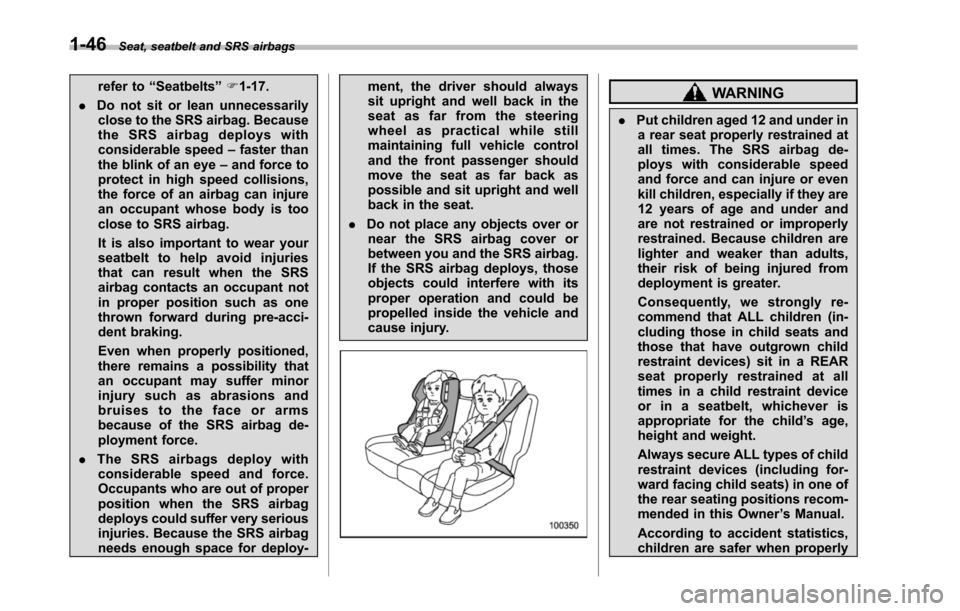
.Put children aged 12 and under ina rear seat properly restrained atall times. The SRS airbag de-ploys with considerable speedand force and can injure or evenkill children, especially if they are12 years of age and under andare not restrained or improperlyrestrained. Because children arelighter and weaker than adults,their risk of being injured fromdeployment is greater.
Consequently, we strongly re-commend that ALL children (in-cluding those in child seats andthose that have outgrown childrestraintdevices) sit in a REARseat properly restrained at alltimes in a child restraint deviceor in a seatbelt, whichever isappropriate for the child’s age,height and weight.
Always secure ALL types of childrestraint devices (including for-ward facing child seats) in one ofthe rear seating positions recom-mended in this Owner’s Manual.
According to accident statistics,children are safer when properly
Page 80 of 426
&SUBARU advanced frontal
airbag system
Your vehicle is equipped with a SUBARUadvanced frontal airbag system that com-plies with the new advanced frontal airbagrequirements in the amended FederalMotor Vehicle Safety Standard (FMVSS)No. 208.
The SUBARU advanced frontal airbagsystem automatically determines the de-ployment force of the driver’s SRS frontalairbag at the time of deployment as well aswhether or not to activate the frontpassenger’s SRS frontal airbag and, ifactivated, the deployment force of theSRS frontal airbag at the time of deploy-ment.
Your vehicle has warning labels on thedriver’s and front passenger’s sun visorsbeginning withthe phrase“EVENWITHADVANCED AIR BAGS”and a tagattached to the glove box lid beginningwiththe phrase“Evenwith Advanced AirBags”. Make sure that you carefully readthe instructions on the warning labels andtag.
Always wearyour seatbelt. The SUBARUadvanced frontal airbag system is asupplemental restraint system and mustbe used in combination with a seatbelt. Alloccupants should wear a seatbelt or beseated in an appropriate child restraint
system.
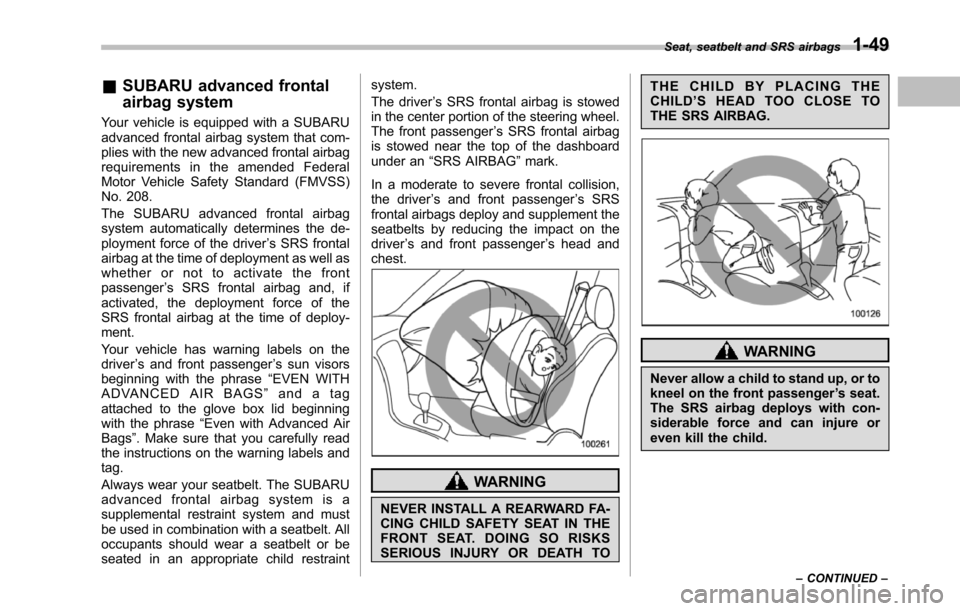
The driver’s SRS frontal airbag is stowedin the center portion of the steering wheel.The front passenger’s SRS frontal airbagis stowed near the top of the dashboardunder an“SRS AIRBAG”mark.
In a moderate to severe frontal collision,the driver’s and front passenger’s SRSfrontal airbagsdeploy and supplement theseatbelts by reducing the impact on thedriver’s and front passenger’s head andchest.
WARNING
NEVER INSTALL A REARWARD FA-CING CHILD SAFETY SEAT IN THEFRONT SEAT. DOING SO RISKSSERIOUS INJURY OR DEATH TO
THE CHILD BY PLACING THECHILD’SHEADTOOCLOSETOTHE SRS AIRBAG.
WARNING
Never allow a child to stand up, or tokneel on the front passenger’s seat.The SRS airbag deploys with con-siderable force and can injure oreven kill the child.
Seat, seatbelt and SRS airbags1-49
–CONTINUED–
Page 81 of 426
1-50Seat, seatbelt and SRS airbags
WARNING
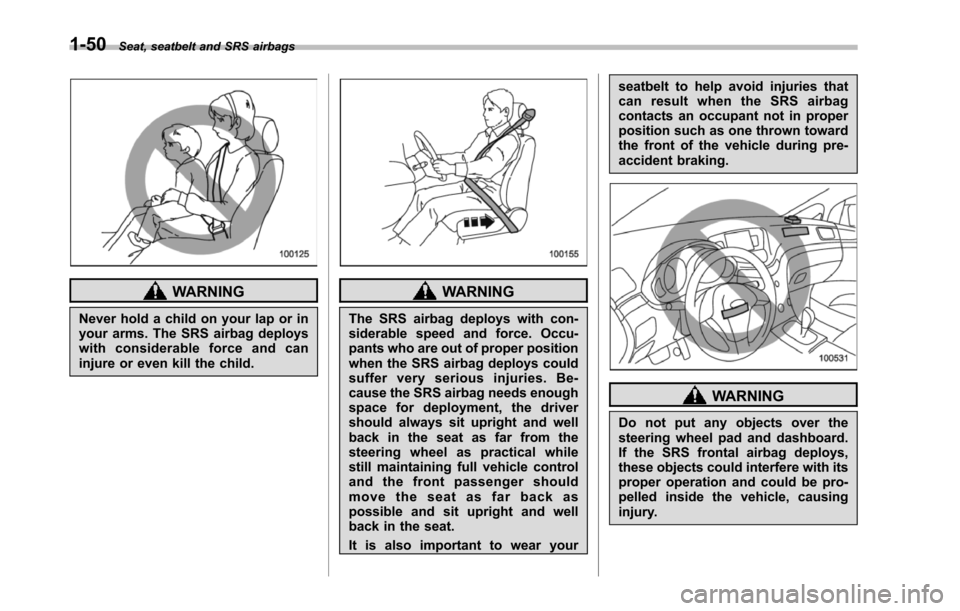
Never hold a child on your lap or inyour arms. The SRS airbag deployswith considerable force and caninjure or even kill the child.
WARNING
The SRS airbag deploys with con-siderable speed and force. Occu-pants who are out of proper positionwhen the SRS airbag deploys couldsuffer very serious injuries. Be-cause the SRS airbag needs enoughspace for deployment, the drivershould always sit upright and wellback in the seat as far from thesteering wheel as practical whilestill maintaining full vehicle controland the front passenger shouldmove the seat as far back aspossible and sit upright and wellbackin the seat.
It is also important to wear your
seatbelt to help avoid injuries thatcan result when the SRS airbagcontacts an occupant not in properposition such as one thrown towardthe front of the vehicle during pre-accident braking.
WARNING
Do not put any objects over thesteeringwheel pad and dashboard.If the SRS frontal airbag deploys,these objects could interfere with itsproper operation and could be pro-pelled inside the vehicle, causinginjury.
Page 86 of 426
straight in the center of the seat cushion,correctly fasten the seatbelt, position his/her legs out forward, and adjust the seat tothe rearmost position. Turn the ignitionswitch to the“ON”position. If the OFFindicator remains illuminated while the ONindicator remains off, take the followingactions.
.Turn the ignition switch to the“LOCK”position.
.Ensure that there are no articles,books, shoes, or other objects trappedunder the seat, at the rear of the seat, oron the side of the seat.
.Next, turn the ignition switch to the“ON”position andwait 6 seconds to allowthe system to complete self-checking.Following the system check, both indica-tors turn off for 2 seconds. Now, the ONindicator should illuminate while the OFFindicator remains off.
If the OFF indicator still remains illumi-nated while the ON indicator remains off,ask the occupant to move to the rear seatand immediately contact your SUBARUdealer for an inspection.
!How to contact the vehicle manu-facturer concerning modificationsfor persons with disabilities thatmay affect the advanced airbagsystem (U.S. only)
Changing or moving any parts of the frontseats, seatbelts, front bumper, front sideframe, instrument panel, combination me-ter, steering wheel, steering column, tire,suspension or floor panel can affect theoperation of the SUBARU advanced air-bag system. If you have any questions,you may contact the following SUBARUdistributors.
Subaru of America, Inc.
Customer Dealer Services Department
P.O. Box 6000
Cherry Hill, NJ 08034-6000
1-800-SUBARU3 (1-800-782-2783)
Servco Subaru Inc., dba Subaru Hawaii
2850 Pukoloa Street, Suite 202, Honolulu,HI 96819
808-839-2273
Shen’s Corporation dba Prestige Automo-bile
491, East Marine Drive, Route 1 Dededo,Guam
671-633-2698
Trebol Motors
P.O. Box 11204, San Juan, Puerto Rico00910
787-793-2828
There are currently no SUBARU distribu-tors in any other U.S. territories. If you arein such an area, please contact theSUBARU distributor or dealer from whichyou bought your vehicle.
Seat, seatbelt and SRS airbags1-55
–CONTINUED–
Page 87 of 426
1-56Seat, seatbelt and SRS airbags
!Operation
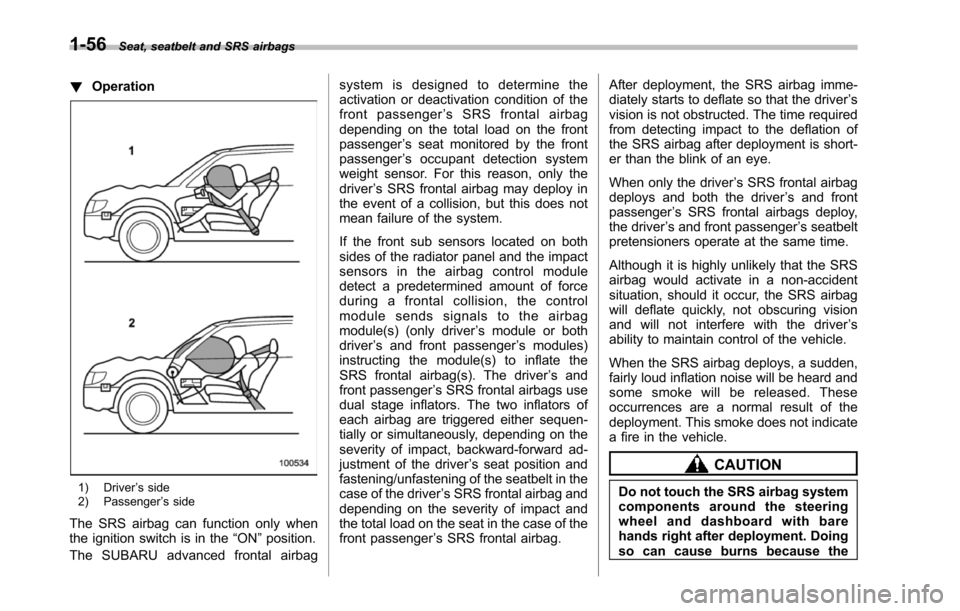
1) Driver’s side2) Passenger’s side
The SRS airbag can function only whenthe ignition switch is in the“ON”position.
The SUBARU advanced frontal airbag
system is designed to determine theactivation or deactivation condition of thefront passenger’sSRSfrontalairbagdepending on the total load on the frontpassenger’s seat monitored by the frontpassenger’s occupant detection systemweight sensor. For this reason, only thedriver’s SRS frontal airbag may deploy inthe event of a collision, but this does notmeanfailure of the system.
If the front sub sensors located on bothsides of the radiator panel and the impactsensors in the airbag control moduledetect a predetermined amount of forceduring a frontal collision, the controlmodule sends signals to the airbagmodule(s) (only driver’s module or bothdriver’s and front passenger’s modules)instructing the module(s) to inflate theSRS frontal airbag(s). The driver’s andfront passenger’s SRS frontal airbags usedual stage inflators. The two inflators ofeach airbag are triggered either sequen-tially or simultaneously, depending on theseverity of impact, backward-forward ad-justmentof the driver’s seat position andfastening/unfastening of the seatbelt in thecase of the driver’s SRS frontal airbag anddepending on the severity of impact andthe total load on the seat in the case of thefront passenger’s SRS frontal airbag.
After deployment, the SRS airbag imme-diately starts to deflate so that the driver’svision is not obstructed. The time requiredfrom detecting impact to the deflation ofthe SRS airbag after deployment is short-er than the blink of an eye.
When only the driver’s SRS frontal airbagdeploys and both the driver’s and frontpassenger’s SRS frontal airbags deploy,the driver’s and front passenger’s seatbeltpretensioners operate at the same time.
Although it is highly unlikely that the SRSairbag would activate in a non-accidentsituation, should it occur, the SRS airbagwill deflate quickly, not obscuring visionand will not interfere with the driver’sability to maintain control of the vehicle.
When the SRS airbag deploys, a sudden,fairly loud inflation noise will be heard andsome smoke will be released. Theseoccurrencesare a normal result of thedeployment. This smoke does not indicatea fire in the vehicle.
CAUTION
Do not touch the SRS airbag systemcomponents around the steeringwheel and dashboard with barehands right after deployment. Doingso can cause burns because the
Page 94 of 426
Ahands-freemicrophoneorother accessory in such a loca-tion could be propelled throughthe cabin with great force by thecurtain airbag, or it could preventcorrect deployment of the curtainairbag. In either case, the resultcould be serious injuries.
WARNING
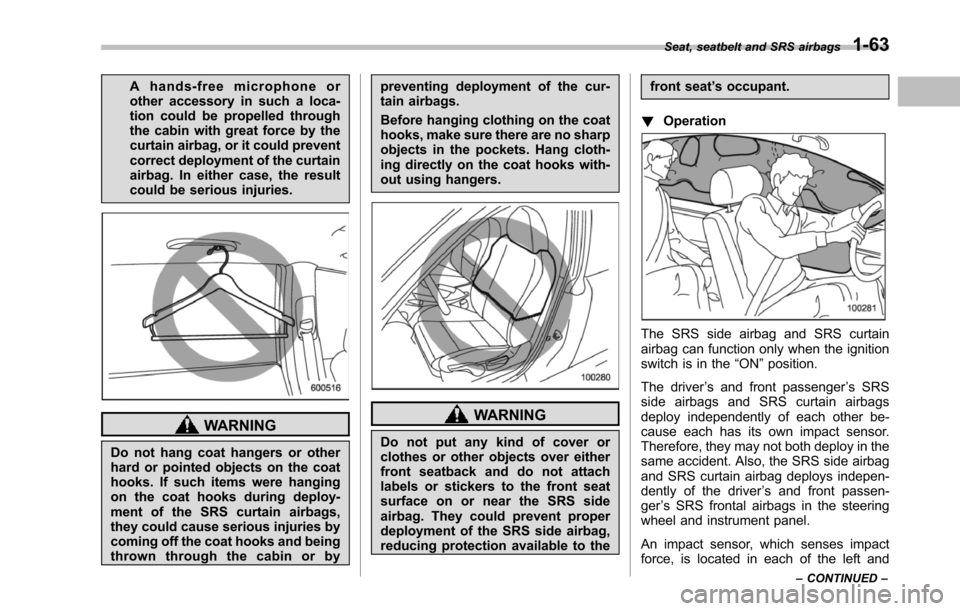
Do not hang coat hangers or otherhard or pointed objects on the coathooks. If such items were hangingon the coat hooks during deploy-ment of the SRS curtain airbags,they could cause serious injuries bycoming off the coat hooks and beingthrown through the cabin or by
preventing deployment of the cur-tain airbags.
Before hanging clothing on the coathooks, make sure there are no sharpobjects in the pockets. Hang cloth-ing directly on the coat hooks with-out using hangers.
WARNING
Do not put any kind of cover orclothes or other objects over eitherfront seatback and do not attachlabels or stickers to the front seatsurface on or near the SRS sideairbag. They could prevent properdeployment of the SRS side airbag,reducingprotection available to the
front seat’s occupant.
!Operation
The SRS side airbag and SRS curtainairbag can function only when the ignitionswitch is in the“ON”position.
The driver’s and front passenger’s SRSside airbags and SRS curtain airbagsdeploy independently of each other be-cause each has its own impact sensor.Therefore, they may not both deploy in thesame accident. Also, the SRS side airbagand SRS curtain airbag deploys indepen-dently of the driver’s and front passen-ger’s SRS frontal airbags in the steeringwheel and instrument panel.
An impact sensor, which senses impactforce, is located in each of the left and
Seat, seatbelt and SRS airbags1-63
–CONTINUED–
Page 103 of 426
1-72Seat, seatbelt and SRS airbags
&SRS airbag system servicing
WARNING
.When discarding an airbag mod-ule or scrapping the entire vehi-cle damaged by a collision, con-sult your SUBARU dealer.
.The SRS airbag has no user-serviceable parts. Do not useelectrical test equipment on anycircuit related to the SRS airbagsystem. For required servicing ofthe SRS airbag, consult yournearest SUBARU dealer. Tamper-ing with or disconnecting thesystem’s wiring could result inaccidental inflation of the SRSairbag or could make the systeminoperative, which may result inserious injury.
CAUTION
If you need service or repair in areasindicated in the following list, havethe work performed by an author-ized SUBARU dealer. The SRS air-bag control module, impact sensorsand airbag modules are stored inthese areas.
.Under the center console
.Inside each front fender
.Steering wheel and column andnearby areas
.Top of the dashboard on frontpassenger’ssideandnearbyareas
.Each front seat and nearby area
.Inside each center pillar
.In each roof side (from the frontpillar to a point over the second-row seat)
.Between the second-row seatcushion and rear wheel houseon each side
.Under the second-row centerseat
In the event that the SRS airbag isdeployed, replacement of the systemshould be performed only by an author-ized SUBARU dealer. When the compo-nents of the SRS airbag system arereplaced, use only genuine SUBARUparts.
NOTE
In the following cases, contact yourSUBARU dealer as soon as possible.
.The front part of the vehicle was
involved in an accident in which onlythe driver’s SRS frontal airbag or bothdriver’sandfrontpassenger’sSRSfrontal airbags did not deploy..The pad of the steering wheel, thecover over the front passenger’s SRSfrontal airbag, or either roof side (fromthe front pillar to a point over thesecond-row seat) is scratched,cracked, or otherwise damaged..Center pillar, rear wheel house orrearfloor pan, or an area near theseparts, was involved in an accident inwhich the SRS side airbag and SRScurtain airbag did not deploy..The fabric or leather of either frontseatback is cut, frayed, or otherwisedamaged..The rear part of the vehicle wasinvolved in an accident in which noSRS airbag was deployed.
&Precautions against vehicle
modification
WARNING
To avoid accidental activation of thesystem or rendering the systeminoperative, which may result inserious injury, no modificationsshould be made to any components