towing SUBARU TRIBECA 2014 1.G Owners Manual
[x] Cancel search | Manufacturer: SUBARU, Model Year: 2014, Model line: TRIBECA, Model: SUBARU TRIBECA 2014 1.GPages: 426, PDF Size: 6.37 MB
Page 17 of 426
12
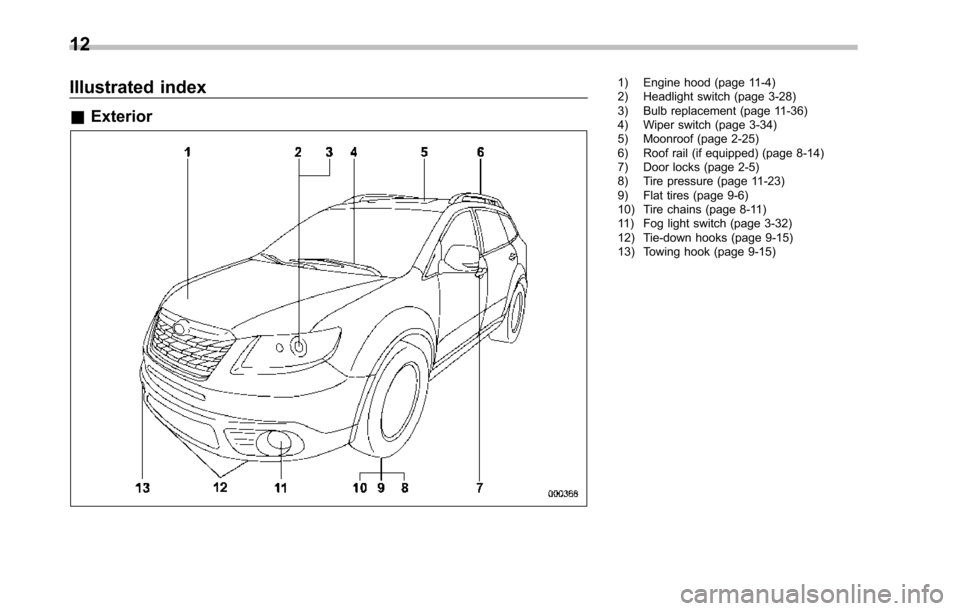
Illustrated index
&Exterior
1) Engine hood (page 11-4)2) Headlight switch (page 3-28)3) Bulb replacement (page 11-36)4) Wiper switch (page 3-34)5) Moonroof (page 2-25)6) Roof rail (if equipped) (page 8-14)7) Door locks (page 2-5)8) Tire pressure (page 11-23)9) Flat tires (page 9-6)10) Tire chains (page 8-11)11) Fog light switch (page 3-32)12) Tie-down hooks (page 9-15)13) Towing hook (page 9-15)
Page 18 of 426
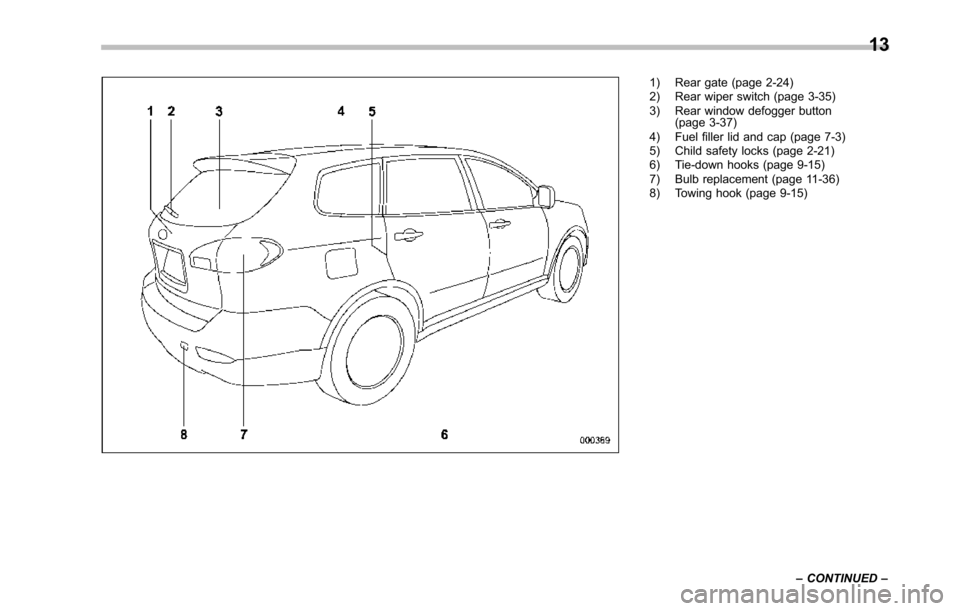
1) Rear gate (page 2-24)2) Rear wiper switch (page 3-35)3) Rear window defogger button(page 3-37)4) Fuel filler lid and cap (page 7-3)5) Child safety locks (page 2-21)6) Tie-down hooks (page 9-15)7) Bulb replacement (page 11-36)8) Towing hook (page 9-15)
13
–CONTINUED–
Page 146 of 426
!If the light is blinking
If the light is blinking while driving, anengine misfire condition has been de-tected which may damage the emissioncontrol system.
To prevent serious damage to the emis-sion control system, you should do thefollowing.
.Reduce vehicle speed.
.Avoid hard acceleration.
.Avoid steepuphill grades.
.Reduce the amount of cargo, if possi-ble.
.Stop towing a trailer as soon aspossible.
The CHECK ENGINE warning light maystop blinking and illuminate steadily afterseveral drivingtrips. You should have yourvehicle checked by an authorizedSUBARU dealer immediately.
&Charge warning light
If this light illuminates when the engine isrunning, it may indicate that the chargingsystem is not working properly.
If the light illuminates while driving or doesnot turn off after the engine starts, stop theengine at the first safe opportunity andcheck the alternator belt. If the belt isloose, broken or if the belt is in good
condition but the light remains illuminated,contact your nearest SUBARU dealerimmediately.
&Oil pressure warning
light
CAUTION
Do not operate the engine with theoil pressure warning light illumi-nated. This may cause serious en-gine damage.
If this light illuminates when the engine isrunning, it may indicate that the engine oilpressureis low and the lubricating systemis not working properly.
If the light illuminates while driving or doesnot turnoff after the engine starts, stop theengine at the first safe opportunity andcheck the engine oil level. If the oil level islow, add oil immediately. If the engine oil isat the proper level but the light remainsilluminated, contact your nearestSUBARU dealer immediately.
&AT OIL TEMP warning
light
If this light illuminates when the engine isrunning, it may indicate that the automatictransmission fluid temperature is too hot.
If the light illuminates while driving, im-mediately stop the vehicle in a safe placeand let the engine idle until the warninglight turns off.
!Automatic transmission controlsystem warning
If the light flashes after the engine starts, itmay indicate that the automatic transmis-sion control system is not working prop-erly. Contact your nearest SUBARU deal-er for service immediately.
&Rear differential oil
temperature warning
light
CAUTION
If the R.DIFF TEMP warning lightilluminates, reduce vehicle speedand stop the vehicle in a safelocation as soon as possible. Con-tinuing to drive with this light illumi-nated may damage the rear differ-ential and other parts of the power-train.
If this light illuminates when the engine isrunning, it may indicate that the reardifferential oil temperature is too hot.
If the light illuminates while driving, reduce
Instruments and controls3-13
–CONTINUED–
Page 164 of 426
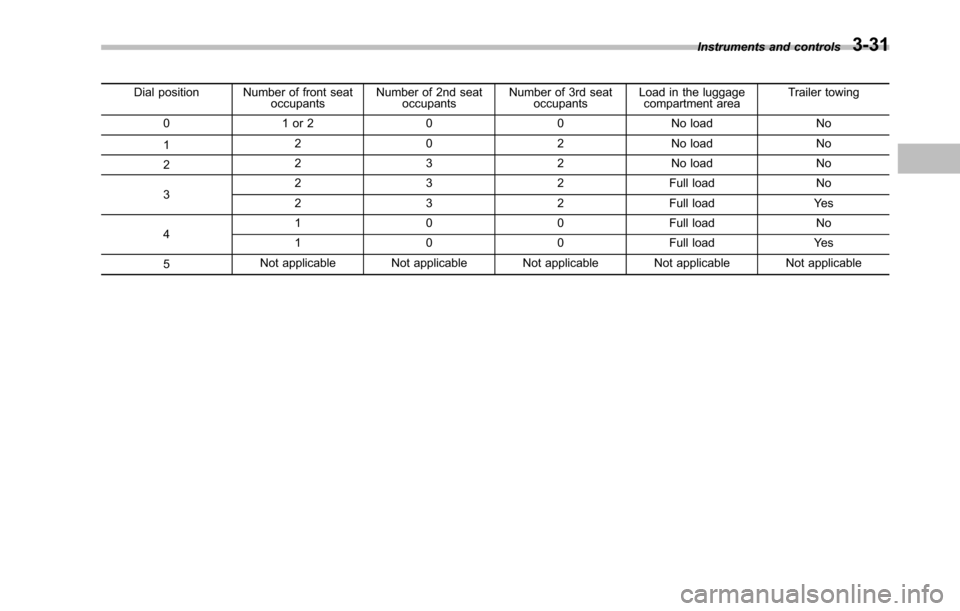
Dial position Number of front seatoccupantsNumber of 2nd seatoccupantsNumber of 3rd seatoccupantsLoad in the luggagecompartment areaTrailer towing
0 1 or 2 0 0 No load No
12 0 2 No load No
22 3 2 No load No
32 3 2 Full load No
2 3 2 Full load Yes
41 0 0 Full load No
1 0 0 Full load Yes
5Not applicable Not applicable Not applicable Not applicable Not applicable
Instruments and controls3-31
Page 271 of 426
7-24Starting and operating
that full vehicle control will bemaintained at all times and underall conditions, its activationshould be seen as a sign thatthe speed of the vehicle shouldbe reduced considerably.
.Whenever suspension compo-nents, steering components, oran axle are removed from avehicle equipped with VehicleDynamics Control system, havean inspection of that systemperformed by an authorizedSUBARU dealer.
.The following precautions shouldbe observed in order to ensurethat the Vehicle Dynamics Con-trol system is operating properly.
–All four wheels should befitted with tires of the samesize, type, and brand. Further-more, the amount of wearshould be the same for allfour tires.
–Keep the tire pressure at theproper level as shown on thevehicle placard attached tothe driver’s side door pillar.
In the event of wheelspin and/or skiddingon a slippery road surface and/or during
cornering and/or an evasive maneuver,the Vehicle Dynamics Control systemadjusts the engine’soutputandthewheels’respective braking forces to helpmaintain traction and directional control.
.Traction Control Function
The traction control function is designed toprevent spinning of the driving wheels onslippery road surfaces, thereby helping tomaintain traction and directional control.Activation of this function is shown bysteady illumination of the Vehicle Dy-namics Control operation indicator light.
.Skid Suppression Function
The skid suppression function is designedto help maintain directional stability bysuppressing the wheels’tendency to slidesideways during steering operations. Acti-vation of this function is shown by flashingof the Vehicle Dynamics Control operationindicator light.
NOTE
.Slight twitching of the brake pedalmay be felt when the Vehicle DynamicsControl system operates; a small de-gree of vehicle or steering wheel shak-ingmay also be noticed in this situa-tion. These are normal characteristicsof Vehicle Dynamics Control operationand are no cause for alarm..When driving off immediately after
starting the engine, a short operationnoise may be noticed coming from theengine compartment. This noise isgenerated as a result of a check beingperformed on the Vehicle DynamicsControl system and is normal..Depending on the timing of activa-tion of the brakes, the brake pedal mayseem to jolt when you drive off afterstarting the engine. This is a conse-quence of the Vehicle Dynamics Con-trol operational check and is normal..In the circumstances shown in thefollowing list, the vehicle may be lessstable than it feels to the driver. TheVehicle Dynamics Control System maytherefore operate. Such operation doesnot indicate a system malfunction.–on gravel-covered or ruttedroads–on unfinished roads–when the vehicle is towing atrailer–when the vehicle is fitted withsnow tires or winter tires.Activation of the Vehicle DynamicsControl system will cause operation ofthe steering wheel to feel slightlydifferent compared to that for normalconditions.
.Even if the vehicle is equipped witha Vehicle Dynamics Control system, it
Page 276 of 426
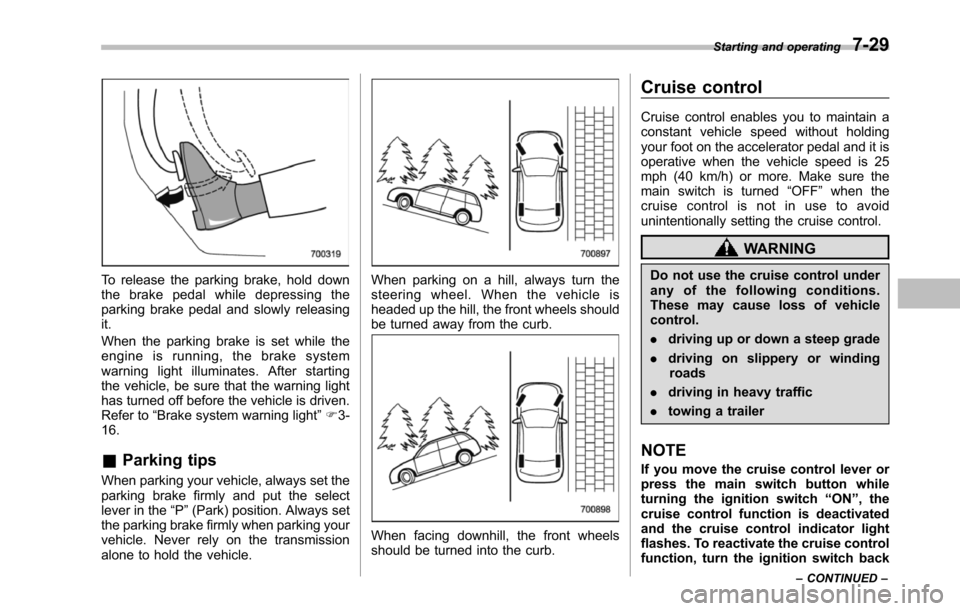
To release the parking brake, hold downthe brake pedal while depressing theparkingbrake pedal and slowly releasingit.
When the parking brake is set while theengine is running, the brake systemwarning light illuminates. After startingthe vehicle, be sure that the warning lighthas turned off before the vehicle is driven.Refer to“Brake system warning light”F3-16.
&Parking tips
When parking your vehicle, always set theparking brake firmly and put the selectlever in the“P”(Park) position. Always setthe parking brake firmly when parking yourvehicle. Never rely on the transmissionalone to hold the vehicle.
When parking on a hill, always turn thesteering wheel. When the vehicle isheadedup the hill, the front wheels shouldbe turned away from the curb.
When facing downhill, the front wheelsshould be turned into the curb.
Cruise control
Cruise control enables you to maintain aconstant vehicle speed without holdingyour foot on the accelerator pedal and it isoperative when the vehicle speed is 25mph (40 km/h) or more. Make sure themain switch is turned“OFF”whenthecruise control is not in use to avoidunintentionally setting the cruise control.
WARNING
Do not use the cruise control underany of the following conditions.These may cause loss of vehiclecontrol.
.driving up or down a steep grade
.driving on slippery or windingroads
.driving in heavy traffic
.towing a trailer
NOTE
If you move the cruise control lever orpress the main switch button whileturning the ignition switch“ON”, thecruise control function is deactivatedand the cruise control indicator lightflashes.To reactivate the cruise controlfunction, turn the ignition switch back
Starting and operating7-29
–CONTINUED–
Page 280 of 426
New vehicle break-in driving–the first1,000 miles (1,600 km)..................................... 8-2
Fuel economy hints............................................ 8-2
Engine exhaust gas (carbon monoxide)............ 8-2
Catalytic converter.............................................. 8-3
Periodic inspections........................................... 8-4
Driving in foreign countries............................... 8-4
Driving tips for AWD models.............................. 8-4
On-road and off-road driving.............................. 8-6
Winter driving...................................................... 8-8Operation during cold weather............................. 8-8Driving on snowy and icy roads.......................... 8-9Corrosion protection.......................................... 8-10Snow tires......................................................... 8-10Tire chains......................................................... 8-11Rockingthe vehicle............................................ 8-11
Loading your vehicle......................................... 8-12Vehicle capacity weight...................................... 8-12GVWR and GAWR (Gross Vehicle Weight Ratingand Gross Axle Weight Rating)........................ 8-13Roof rails and crossbar (if equipped).................. 8-14Roof molding and crossbar (if equipped)............ 8-17
Trailer hitch (if equipped).................................. 8-18Connecting a trailer........................................... 8-19When you do not tow a trailer ............................ 8-20
Trailer towing..................................................... 8-21Warranties and maintenance.............................. 8-21Maximum load limits.......................................... 8-21Trailer hitches.................................................... 8-24Connecting a trailer........................................... 8-25Trailer towing tips.............................................. 8-26
Driving tips
8
Page 284 of 426
.You must install four tires that areof the same size, circumferences,construction, manufacturer,brand (tread pattern), degree ofwear, speed symbol and loadindex. Mixing tires of other sizes,circumferences or constructionsmay result in severe mechanicaldamage to the drive train of yourvehicle and may affect ride,handling, braking and speed-ometer/odometer calibration. Italso may be dangerous and leadto loss of vehicle control.
CAUTION
If you use a temporary spare tire toreplace a flat tire, be sure to use theoriginaltemporary spare tire storedin the vehicle. Using other sizes mayresult in severe mechanical damageto the drive train of your vehicle.
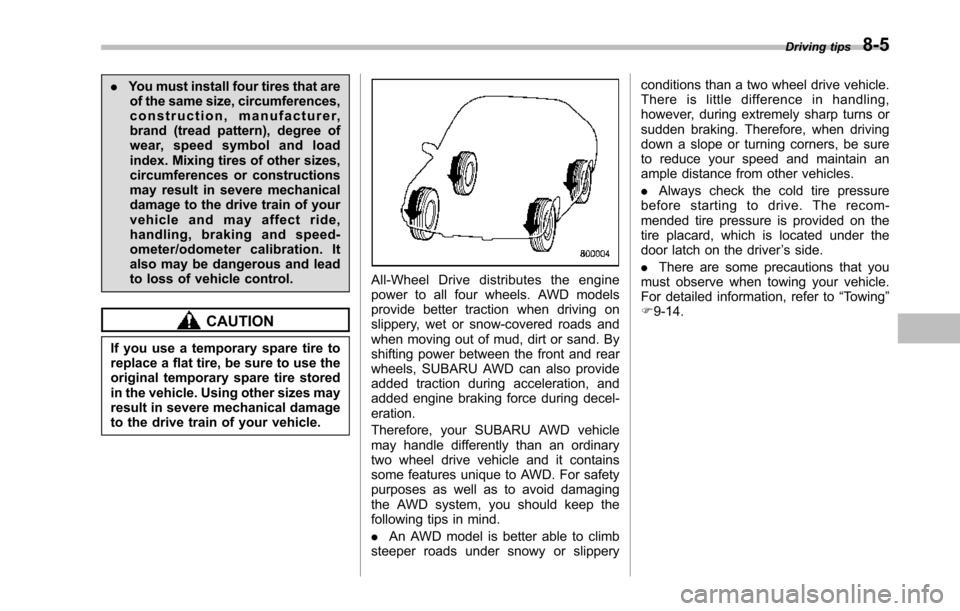
All-Wheel Drive distributes the enginepower to all four wheels. AWD modelsprovidebetter traction when driving onslippery, wet or snow-covered roads andwhen moving out of mud, dirt or sand. Byshifting power between the front and rearwheels, SUBARU AWD can also provideadded traction during acceleration, andadded engine braking force during decel-eration.
Therefore, your SUBARU AWD vehiclemay handle differently than an ordinarytwo wheel drive vehicle and it containssome features unique to AWD. For safetypurposes as well as to avoid damagingthe AWD system, you should keep thefollowing tips in mind.
.An AWD model is better able to climbsteeper roads under snowy or slippery
conditions than a two wheel drive vehicle.There is little difference in handling,however, during extremely sharp turns orsudden braking. Therefore, when drivingdown a slope or turning corners, be sureto reduce your speed and maintain anample distance from other vehicles.
.Always check the cold tire pressurebefore starting to drive. The recom-mended tire pressure is provided on thetire placard, which is located under thedoor latch on the driver’s side.
.There are some precautions that youmust observe when towing your vehicle.For detailed information, refer to“Towing”F9-14.
Driving tips8-5
Page 285 of 426
8-6Driving tips
On-road and off-road driving
WARNING
.In a rollover crash, an unbeltedperson is significantly morelikely to die than a person wear-ing a seatbelt. You the driver andall your passengers should fas-ten the seatbelts before startingto drive in order to minimize thechance of serious injury or death.
.Do not make sharp turns andquick maneuvers unless abso-lutely unavoidable. Such actionsare dangerous as you may losecontrol, possibly resulting in arolloverwhich could cause deathor serious injury.
.Always maintain a safe drivingspeed according to the road andweather conditions in order toavoid havingan accident on asharp turn, during sudden brak-ing or under other similar condi-tions.
.Whenever strong crosswinds arepresent, slow down sufficientlyto maintain control of your vehi-cle. Remember that your vehicle,with its higher profile and center
of gravity, is more likely to beaffected by crosswinds than or-dinary passenger cars.
.Always use the utmost care indriving–overconfidence be-cause you are driving an All-Wheel Drive model could easilylead to a serious accident.
Yo u r v e h i c l e i s c l a s s i f i e d a s a u t i l i t yvehicle. Utilityvehicles feature a higherground clearance which enables them tobe used for wide applications including off-road driving. But please keep in mind thatyour vehicle is neither a conventional off-road vehicle nor an all-terrain vehicle. Ahighercenter of gravity in relation to thetread width as compared with ordinarypassenger cars makes vehicles of thistype more likely to roll over. In reality, utilityvehicles have a significantly higher roll-over rate thanother types of vehicles. Thehigh ground clearance of this vehicle is areal advantage, giving you a better view ofthe road and allowing you to anticipateproblems earlier. However, remember thatyour utility vehicleis not designed for high-speed cornering comparable to ordinarypassenger cars and that your vehiclecould roll over if you make a sharp turnat high speed. If you do take yourSUBARU off-road, certain common sense
precautions such as those in the followinglist should be taken.
.Make certain that you and all of yourpassengers are wearing seatbelts.
.Carry some emergency equipment,such as a towing rope or chain, a shovel,wheel blocks, first aid kit and cell phone orcitizens band radio.
.Drive carefully. Do not take unneces-sary risks by driving in dangerous areas orover rough terrain.
.Slow down and employ extra caution atall times. When driving off-road, you willnot have the benefit of marked trafficlanes, banked curves, traffic signs andthe like.
.Do not drive across steep slopes.Instead, drive either straight up or straightdown the slopes. A vehicle can muchmore easily tip over sideways than it canend over end. Avoid driving straight up ordown slopes that are too steep.
.Avoid sharp turning maneuvers, espe-cially at higher speeds.
.Do not grip the inside or spokes of thesteering wheel. A bad bump could jerk thewheel andinjure your hands. Instead drivewith your fingers and thumbs on theoutside of the rim.
.If driving through water, such as whencrossing shallow streams, first check the
Page 297 of 426
8-18Driving tips
secure all cargo.
!Installing carrying attachments onthe crossbars
When installing any carrying attachmentssuch as a bike carrier, ski carrier, kayakcarrier, cargo basket, etc. on the cross-bars, follow the manufacturer’s instruc-tions and make sure that the attachmentsare securely fixed to the crossbars. Useonly attachments designed specifically forthe crossbars. The maximum load limit ofthe cargo,crossbars and carrying attach-ments must not exceed150 lbs (68 kg).Before operating the vehicle, make surethat the cargo is properly secured on theattachments.
NOTE
Remember that the vehicle’s center ofgravity is altered with the weight of theload on the roof, thus affecting thedriving characteristics.
Drive carefully. Avoid rapid starts, hardcornering and abrupt stops. Crosswindeffects will be increased.
!Removal and installation of thecrossbars
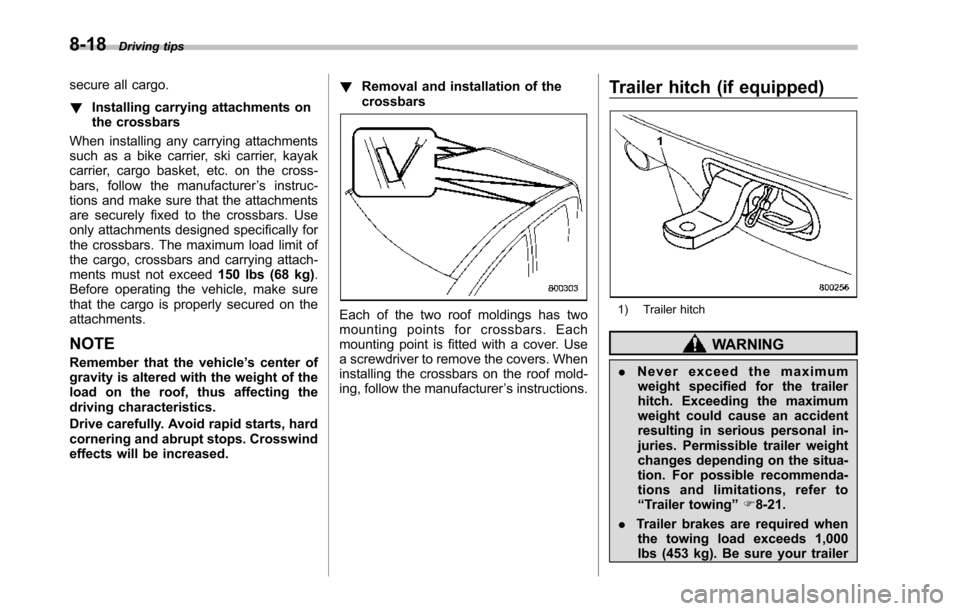
Each of the two roof moldings has twomounting points for crossbars. Eachmounting point is fitted with a cover. Usea screwdriver to remove the covers. Wheninstallingthe crossbars on the roof mold-ing, follow the manufacturer’s instructions.
Trailer hitch (if equipped)
1) Trailer hitch
WARNING
.Never exceed the maximumweight specified for the trailerhitch. Exceedingthe maximumweight could cause an accidentresulting in serious personal in-juries. Permissible trailer weightchanges depending on the situa-tion. For possible recommenda-tions and limitations, refer to“Trailer towing”F8-21.
.Trailer brakes are required whenthe towing load exceeds 1,000lbs (453 kg). Be sure your trailer