engine coolant SUBARU WRX 2016 User Guide
[x] Cancel search | Manufacturer: SUBARU, Model Year: 2016, Model line: WRX, Model: SUBARU WRX 2016Pages: 594, PDF Size: 19.43 MB
Page 501 of 594
Maintenance and service/Engine compartment overview
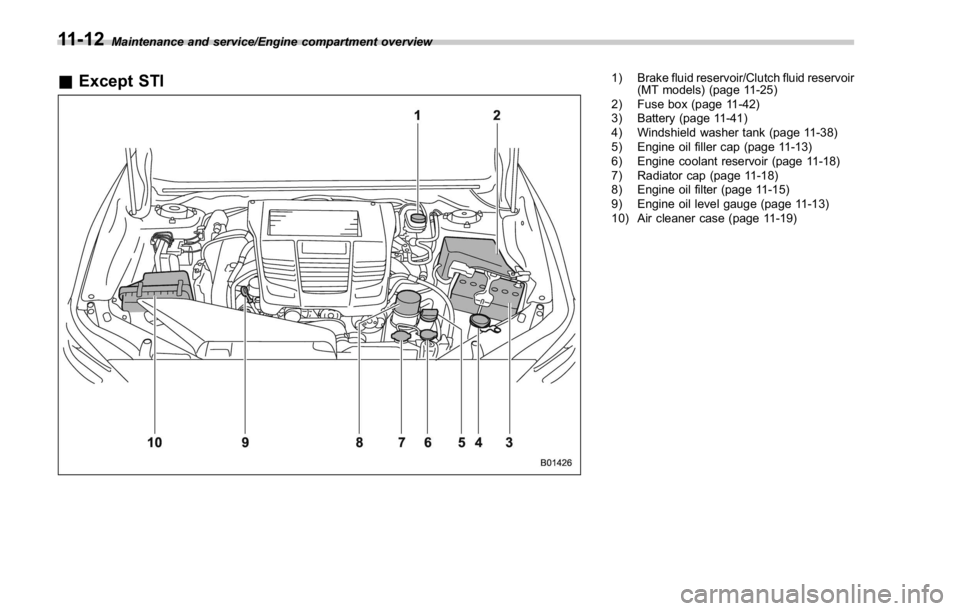
& Except STI 1) Brake fluid reservoir/Clutch fluid reservoir
(MT models) (page 11-25)
2) Fuse box (page 11-42)
3) Battery (page 11-41)
4) Windshield washer tank (page 11-38)
5) Engine oil filler cap (page 11-13)
6) Engine coolant reservoir (page 11-18)
7) Radiator cap (page 11-18)
8) Engine oil filter (page 11-15)
9) Engine oil level gauge (page 11-13)
10) Air cleaner case (page 11-19)
11-12
Page 506 of 594
used if synthetic oil is unavailable.
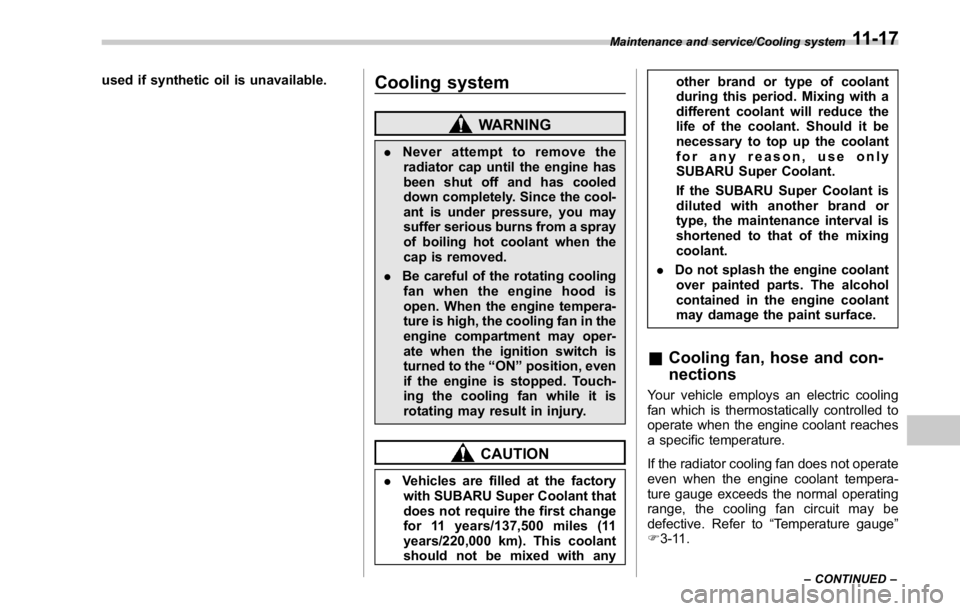
Cooling system WARNING. Never attempt to remove the
radiator cap until the engine has
been shut off and has cooled
down completely. Since the cool-
ant is under pressure, you may
suffer serious burns from a spray
of boiling hot coolant when the
cap is removed.
. Be careful of the rotating cooling
fan when the engine hood is
open. When the engine tempera-
ture is high, the cooling fan in the
engine compartment may oper-
ate when the ignition switch is
turned to the “ ON ” position, even
if the engine is stopped. Touch-
ing the cooling fan while it is
rotating may result in injury.
CAUTION
. Vehicles are filled at the factory
with SUBARU Super Coolant that
does not require the first change
for 11 years/137,500 miles (11
years/220,000 km). This coolant
should not be mixed with any other brand or type of coolant
during this period. Mixing with a
different coolant will reduce the
life of the coolant. Should it be
necessary to top up the coolant
for any reason, use only
SUBARU Super Coolant.
If the SUBARU Super Coolant is
diluted with another brand or
type, the maintenance interval is
shortened to that of the mixing
coolant.
. Do not splash the engine coolant
over painted parts. The alcohol
contained in the engine coolant
may damage the paint surface.
& Cooling fan, hose and con-
nections Your vehicle employs an electric cooling
fan which is thermostatically controlled to
operate when the engine coolant reaches
a specific temperature.
If the radiator cooling fan does not operate
even when the engine coolant tempera-
ture gauge exceeds the normal operating
range, the cooling fan circuit may be
defective. Refer to “ Temperature gauge ”
F 3-11. Maintenance and service/Cooling system
– CONTINUED –11-17
Page 507 of 594
Maintenance and service/Cooling system
Check the fuse and replace it if necessary.
Refer to “ Fuses ” F 11-42 and “ Fuses and
circuits ” F 12-10.
If the fuse is not blown, have the cooling
system checked by your SUBARU dealer.
If frequent addition of coolant is neces-
sary, there may be a leak in the engine
cooling system. It is recommended that
the cooling system and connections be
checked for leaks, damage, or looseness.
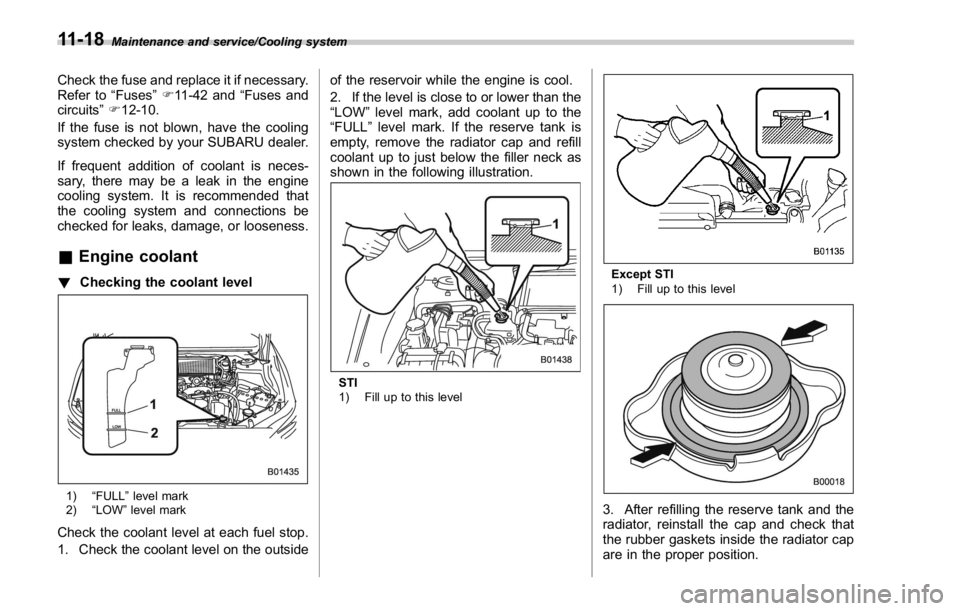
& Engine coolant! Checking the coolant level
1) “ FULL ” level mark
2) “ LOW ” level mark
Check the coolant level at each fuel stop.
1. Check the coolant level on the outside of the reservoir while the engine is cool.
2. If the level is close to or lower than the
“ LOW ” level mark, add coolant up to the
“ FULL ” level mark. If the reserve tank is
empty, remove the radiator cap and refill
coolant up to just below the filler neck as
shown in the following illustration.
STI
1) Fill up to this level Except STI
1) Fill up to this level
3. After refilling the reserve tank and the
radiator, reinstall the cap and check that
the rubber gaskets inside the radiator cap
are in the proper position.11-18
Page 508 of 594
CAUTION. Be careful not to spill engine
coolant when adding it. If coolant
touches the exhaust pipe, it may
cause a bad smell, smoke, and/or
a fire. If engine coolant gets on
the exhaust pipe, be sure to wipe
it off.
. Do not splash the engine coolant
over painted parts. The alcohol
contained in the engine coolant
may damage the paint surface.
! Changing the coolant
It may be difficult to change the coolant.
Have the coolant changed by your
SUBARU dealer if necessary.
The coolant should be changed according
to the maintenance schedule in the
“ Warranty and Maintenance Booklet ” .Air cleaner element WARNINGDo not operate the engine with the
air cleaner element removed. The air
cleaner element not only filters
intake air but also stops flames if
the engine backfires. If the air
cleaner element is not installed
when the engine backfires, you
could be burned.
CAUTIONWhen replacing the air cleaner ele-
ment, use a genuine SUBARU air
cleaner element. If it is not used,
there is the possibility of causing a
negative effect to the engine.
The air cleaner element functions as a
filter screen. When the element is perfo-
rated or removed, engine wear will be
excessive and engine life shortened.
It is not necessary to clean or wash the air
cleaner element. & Replacing the air cleaner
element Replace the air cleaner element according
to the maintenance schedule in the
“ Warranty and Maintenance Booklet ” . Un-
der extremely dusty conditions, replace it
more frequently. It is recommended that
you always use genuine SUBARU parts.
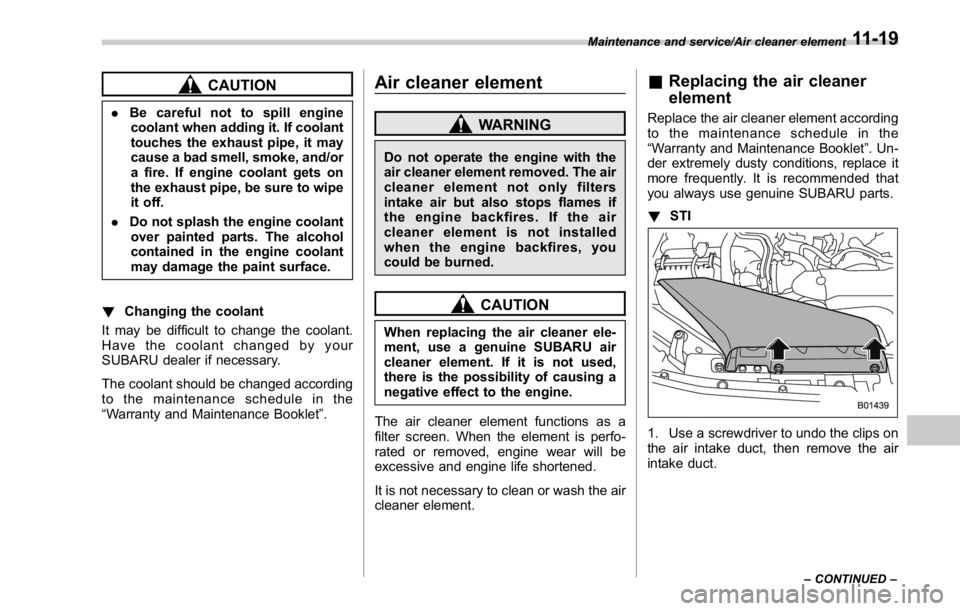
! STI
1. Use a screwdriver to undo the clips on
the air intake duct, then remove the air
intake duct. Maintenance and service/Air cleaner element
– CONTINUED –11-19
Page 527 of 594
Maintenance and service/Aluminum wheels
Aluminum wheels Aluminum wheels can be scratched and
damaged easily. Handle them carefully to
maintain their appearance, performance,
and safety.
. When any of the wheels are removed
and replaced for tire rotation or to change
a flat tire, always check the tightness of
the wheel nuts after driving approximately
600 miles (1,000 km). If any nut is loose,
tighten it to the specified torque.
. Never apply oil to the threaded parts,
wheel nuts, or tapered surface of the
wheel.
. Never let the wheel rub against sharp
protrusions or curbs.
. When wheel nuts, balance weights, or
the center cap is replaced, be sure to
replace them with genuine SUBARU parts
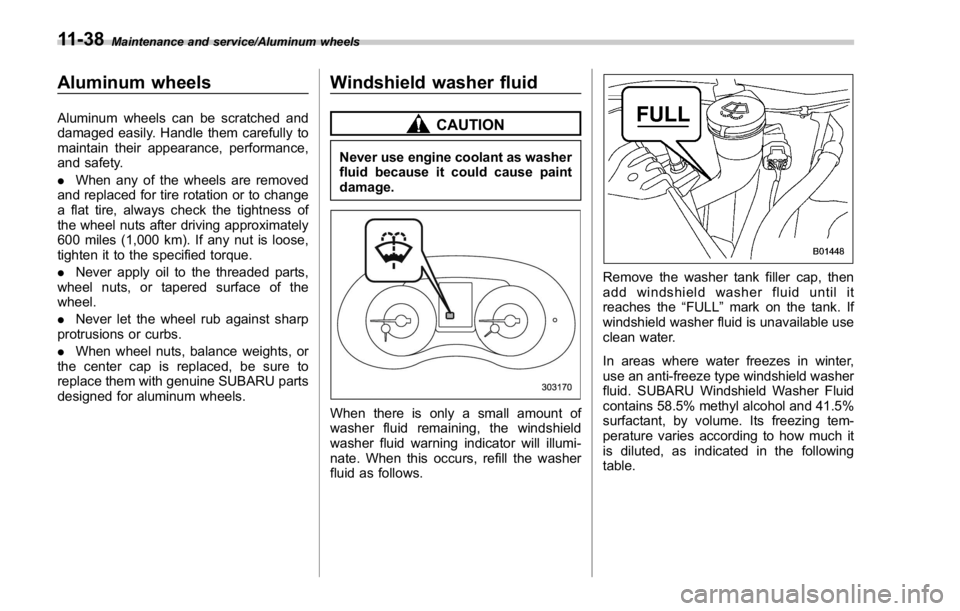
designed for aluminum wheels. Windshield washer fluid CAUTIONNever use engine coolant as washer
fluid because it could cause paint
damage.
When there is only a small amount of
washer fluid remaining, the windshield
washer fluid warning indicator will illumi-
nate. When this occurs, refill the washer
fluid as follows. Remove the washer tank filler cap, then
add windshield washer fluid until it
reaches the “ FULL ” mark on the tank. If
windshield washer fluid is unavailable use
clean water.
In areas where water freezes in winter,
use an anti-freeze type windshield washer
fluid. SUBARU Windshield Washer Fluid
contains 58.5% methyl alcohol and 41.5%
surfactant, by volume. Its freezing tem-
perature varies according to how much it
is diluted, as indicated in the following
table.11-38
Page 542 of 594

Specifications ..................................................... 12-2Dimensions ........................................................ 12-2
Engine ............................................................... 12-3
Fuel ................................................................... 12-3
Engine oil .......................................................... 12-4
Manual transmission, front differential and rear
differential gear oil ........................................... 12-6
Fluids ................................................................ 12-7
Engine coolant ................................................... 12-7
Electrical system ................................................ 12-8
Tires .................................................................. 12-8 Temporary spare tires ........................................ 12-8
Brake disc ......................................................... 12-9
Fuses and circuits ........................................... 12-10Fuse panel located in the passenger
compartment ................................................. 12-10
Fuse panel located in the engine
compartment ................................................. 12-12
Bulb chart ......................................................... 12-16
Vehicle identification ....................................... 12-18
Specifications
12
Page 548 of 594

*4: You may use this type of manual transmission oil. However, using this type of oil will detract from driveability and fuel efficiency.
& Fluids Fluid
Fluid type* 1
Fluid capacity* 2
Remarks* 3
Continuously variable transmission
fluid (CVT models) Consult your SUBARU dealer. 13.1 US qt (12.4 liters, 10.9 Imp qt) “ Continuously variable trans-
mission fluid ” F 11-23
Brake fluid FMVSS No. 116, fresh DOT 3 or DOT 4
brake fluid –“ Brake fluid ” F 11-25
Clutch fluid (MT models) FMVSS No. 116, fresh DOT 3 or DOT 4
brake fluid – “ Clutch fluid (MT models) ” F 11 -
26
Power steering fluid (STI) · SUBARU ATF
· “ Dexron III ” Type Automatic Transmis-
sion Fluid
· IDEMITSU ATF HP 0.7 US qt (0.7 liter, 0.6 Imp qt) “ Power steering fluid (STI) ”
F 11-24
*1: Use one of the indicated types of fluid.
*2: The indicated fluid quantity is only a guideline. The necessary quantity for replacement may differ slightly depending on the temperature and other
factors.
*3: For more details about maintenance and service, refer to the indicated section.
& Engine coolant Vehicle model Coolant capacity Coolant type
STI 8.2 US qt (7.7 liters, 6.8 Imp qt)
SUBARU Super Coolant
Except STI MT models 8.7 US qt (8.2 liters, 7.2 Imp qt)
CVT models 8.9 US qt (8.4 liters, 7.4 Imp qt)
The indicated coolant quantity is only a guideline. The necessary quantity for replacement may differ slightly depending on the temperature and other
factors. For more details about maintenance and service, refer to “ Cooling system ” F 11-17. Specifications/Specifications
– CONTINUED –12-7
Page 564 of 594

crease in temperature could cause
tread separation, and failure of the
tire(s). Possible resulting loss of
vehicle control could lead to an
accident. ! Measuring and adjusting air
pressure to achieve proper in-
flation
Check and, if necessary, adjust the
pressure of each tire (including the
spare) at least once a month and
before any long journey. Check the
tire pressures when the tires are
cold. Use a pressure gauge to
adjust the tire pressures to the
specific values. Driving even a
short distance warms up the tires
and increases the tire pressures.
Also, the tire pressures are affected
by the outside temperature. It is
best to check tire pressure out-
doors before driving the vehicle.
When a tire becomes warm, the air
inside it expands, causing the tire
pressure to increase. Be careful not
to mistakenly release air from a
warm tire to reduce its pressure. & Glossary of tire terminology .
Accessory weight
The combined weight (in excess of
those standard items which may be
replaced) of automatic transmis-
sion, power steering, power brakes,
power windows, power seats, radio,
and heater, to the extent that these
items are available as factory-in-
stalled equipment (whether in-
stalled or not). .
Bead
The part of the tire that is made of
steel wires, wrapped or reinforced
by ply cords and that is shaped to fit
the rim. .
Bead separation
A breakdown of the bond between
components in the bead. .
Bias ply tire
A pneumatic tire in which the ply
cords that extend to the beads are
laid at alternate angles substantially
less than 90 degrees to the center-
line of the tread.
.
Carcass
The tire structure, except tread and sidewall rubber which, when in-
flated, bears the load. .
Chunking
The breaking away of pieces of the
tread or sidewall. .
Cold tire pressure
The pressure in a tire that has been
driven less than 1 mile or has been
standing for three hours or more. .
Cord
The strands forming the plies in the
tire. .
Cord separation
The parting of cords from adjacent
rubber compounds. .
Cracking
Any parting within the tread, side-
wall, or inner liner of the tire
extending to cord material. .
Curb weight
The weight of a motor vehicle with
standard equipment including the
maximum capacity of fuel, oil and
coolant, and if so equipped, air
conditioning and additional weight
optional engine.Consumer information and Reporting safety defects/Tire information
– CONTINUED –13-5
Page 578 of 594

Booster ........................................................ 7-35, 11-27
Disc ..................................................................... 12-9
Fluid ............................................................ 11-25, 12-7
Pad and lining ...................................................... 11-30
Parking ........................................................ 7-44, 11-30
Pedal .................................................................. 11-27
System ................................................................. 7-35
Brake pedal
Free play ............................................................. 11-27
Reserve distance .................................................. 11-28
Brake system ............................................................ 7-35
Warning light ......................................................... 3-21
Braking ..................................................................... 7-35
Tips...................................................................... 7-35
Breaking-in of new brake pads and linings ................... 11-30
BSD/RCTA ................................................................ 7-56
BSD/RCTA approach indicator light/warning buzzer .... 7-59
BSD/RCTA OFF switch ........................................... 7-61
BSD/RCTA warning indicator ................................... 7-60
Bulb
Chart .................................................................. 12-16
Replacing ............................................................. 11-44
C
Catalytic converter ....................................................... 8-3
Center
Console .................................................................. 6-5
Changing
Coolant ................................................................ 11-19
Flat tire ................................................................... 9-4
Oil and oil filter ..................................................... 11-15 Charge warning light ................................................... 3-17
CHECK ENGINE warning light/Malfunction indicator
light ....................................................................... 3-16
Checking
Brake pedal free play ............................................ 11-27
Brake pedal reserve distance ................................. 11-28
Clutch function ..................................................... 11-28
Clutch pedal free play ........................................... 11-28
Coolant level ........................................................ 11-18
Fluid level (brake fluid) .......................................... 11-25
Fluid level (clutch fluid) .......................................... 11-26
Fluid level (power steering fluid) ............................. 11-24
Fluid level (washer fluid) ........................................ 11-38
Oil level (engine oil) .............................................. 11-13
Child restraint systems ................................................ 1-21
Installation of a booster seat .................................... 1-28
Installation with ALR/ELR seatbelt ............................ 1-24
Lower and tether anchorages ................................... 1-29
Top tether anchorages ............................................ 1-32
Child safety ................................................................... 4
Locks .................................................................... 2-32
Chime
Key........................................................................ 3-5
Light ..................................................................... 3-94
Seatbelt. ................................................................ 3-14
Cigarette lighter ........................................................... 6-9
Cleaning
Aluminum
wheels ................................................... 10-3
Interior .................................................................. 10-5
Ventilation grille ....................................................... 4-9
Climate control system ................................................. 4-3 Index
14-3
Page 580 of 594

Warning ........................................................ 3-22, 7-48
Emergency Locking Retractor (ELR) ............................. 1-13
Engine
Compartment overview .......................................... 11-11
Coolant ........................................................ 11-18, 12-7
Exhaust gas (carbon monoxide) ............................. 5, 8-2
Hood .................................................................... 11-9
Low oil level warning light ....................................... 3-17
Oil............................................................... 11-13, 12-4
Overheating .......................................................... 9-11
Starting & stopping ........................................... 7-9, 7-12
Event data recorder ......................................................... 8
Exterior care .............................................................. 10-2
F
Flat tires ..................................................................... 9-4
Floor mat .................................................................. 6-10
Fluid level
Brake .................................................................. 11-25
Clutch .................................................................. 11-26
Continuously variable transmission .......................... 11-23
Power steering ..................................................... 11-24
Fog light ................................................................... 3-99
Bulb .......................................................... 11-47, 12-16
Indicator light ......................................................... 3-35
Switch .................................................................. 3-99
Front
Differential gear oil ........................................ 11-23, 12-6
Fog light ...................................................... 3-99, 11-47
Fog light indicator light ............................................ 3-35
Seatbelt pretensioners ............................................ 1-17 Front fog light ............................................................. 3-99
Switch ................................................................... 3-99
Front seats ................................................................. 1-2
Forward and backward adjustment ............................ 1-4
Head restraint adjustment ......................................... 1-5
Power seat ............................................................. 1-5
Reclining ................................................................ 1-4
Seat height adjustment (driver ’ s seat) ........................ 1-4
Fuel ........................................................................... 7-3
Consumption indicator ..................................... 3-52, 3-54
Economy hints ........................................................ 8-2
Filler lid and cap ...................................................... 7-5
Gauge ................................................................... 3-10
Requirements ................................................. 7-3, 12-3
Fuses ..................................................................... 11-42
Fuses and circuits .................................................... 12-10
G
GAWR (Gross Axle Weight Rating) .. ............................. 8-12
Glove box ................................................................... 6-5
GVWR (Gross Vehicle Weight Rating) ........................... 8-12
H
Hazard warning flasher .......................................... 3-8, 9-2
Head restraint adjustment
Front seat ............................................................... 1-5
Rear
seat ............................................................... 1-8
Headlight
Beam leveler. ......................................................... 3-99
Bulb replacement ................................................. 11-44
Bulb replacing ...................................................... 11-44 Index
14-5