child lock SUBARU WRX 2016 Owners Manual
[x] Cancel search | Manufacturer: SUBARU, Model Year: 2016, Model line: WRX, Model: SUBARU WRX 2016Pages: 594, PDF Size: 19.43 MB
Page 9 of 594
. The SRS airbags deploy with
considerable speed and force.
Occupants who are out of proper
position when the SRS airbag
deploys could suffer very serious
injuries. Because the SRS airbag
needs enough space for deploy-
ment, the driver should always
sit upright and well back in the
seat as far from the steering
wheel as practical while still
maintaining full vehicle control
and the front passenger should
move the seat as far back as
possible and sit upright and well
back in the seat.
For instructions and precautions, carefully
read the following sections.
. For the seatbelt system, refer to “ Seat-
belts ” F 1-11.
. For the SRS airbag system, refer to
“ *SRS airbag (Supplemental Restraint
System airbag) ” F 1-33. & Child safety WARNING. Never hold a child on your lap or
in your arms while the vehicle is
moving. The passenger cannot
protect the child from injury in a
collision, because the child will
be caught between the passen-
ger and objects inside the vehi-
cle.
. While riding in the vehicle, in-
fants and small children should
always be placed in the REAR
seat in an infant or child restraint
system which is appropriate for
the child ’ s age, height and
weight. If a child is too big for a
child restraint system, the child
should sit in the REAR seat and
be restrained using the seatbelts.
According to accident statistics,
children are safer when properly
restrained in the rear seating
positions than in the front seat-
ing positions. Never allow a child
to stand up or kneel on the seat.
. Put children in the REAR seat
properly restrained at all times in
a child restraint device or in a
seatbelt. The SRS airbag deploys with considerable speed and
force and can injure or even kill
children, especially if they are
not restrained or improperly re-
strained. Because children are
lighter and weaker than adults,
their risk of being injured from
deployment is greater.
. NEVER INSTALL A REARWARD
FACING CHILD SEAT IN THE
FRONT SEAT. DOING SO RISKS
SERIOUS INJURY OR DEATH TO
THE CHILD BY PLACING THE
CHILD ’ S HEAD TOO CLOSE TO
THE SRS AIRBAG.
. Always turn the child safety locks
to the “ LOCK ” position when
children sit in the rear seat.
Serious injury could result if a
child accidentally opens the door
and falls out. Refer to “ Child
safety locks ” F 2-32.
. Always lock the passenger ’ s win-
dows using the lock switch when
children are riding in the vehicle.
Failure to follow this procedure
could result in injury to a child
operating the power window. Re-
fer to “ Windows ” F 2-32.
. Never leave unattended children,
adults or animals in the vehicle.4
Page 10 of 594
They could accidentally injure
themselves or others through
inadvertent operation of the ve-
hicle. Also, on hot or sunny days,
the temperature in a closed ve-
hicle could quickly become high
enough to cause severe or pos-
sibly fatal injuries.
. Help prevent children, adults or
animals from locking themselves
in the trunk. On hot or sunny
days, the temperature in the
trunk could quickly become high
enough to cause death or serious
heat-related injuries including
brain damage to anyone locked
inside, particularly for small chil-
dren.
. When leaving the vehicle, close
all windows and lock all doors.
Also make certain that the trunk
is closed.
For instructions and precautions, carefully
read the following sections.
. For the seatbelt system, refer to “ Seat-
belts ” F 1-11.
. For the child restraint system, refer to
“ Child restraint systems ” F 1-21.
. For the SRS airbag system, refer to
“ *SRS airbag (Supplemental Restraint System airbag) ” F 1-33.
& Engine exhaust gas (carbon
monoxide) WARNING. Never inhale engine exhaust gas.
Engine exhaust gas contains
carbon monoxide, a colorless
and odorless gas which is dan-
gerous, or even lethal, if inhaled.
. Always properly maintain the en-
gine exhaust system to prevent
engine exhaust gas from enter-
ing the vehicle.
. Never run the engine in a closed
space, such as a garage, except
for the brief time needed to drive
the vehicle in or out of it.
. Avoid remaining in a parked
vehicle for a lengthy time while
the engine is running. If that is
unavoidable, then use the venti-
lation fan to force fresh air into
the vehicle.
. Always keep the front ventilator
inlet grille free from snow, leaves
or other obstructions to ensure
that the ventilation system al-
ways works properly. . If at any time you suspect that
exhaust fumes are entering the
vehicle, have the problem
checked and corrected as soon
as possible. If you must drive
under these conditions, drive
only with all windows fully open.
. Keep the trunk lid closed while
driving to prevent exhaust gas
from entering the vehicle.
& Drinking and driving
WARNINGDrinking and then driving is very
dangerous. Alcohol in the blood-
stream delays your reaction time
and impairs your perception, judg-
ment and attentiveness. If you drive
after drinking – even if you drink just
a little – it will increase the risk of
being involved in a serious or fatal
accident, injuring or killing yourself,
your passengers and others. In
addition, if you are injured in the
accident, alcohol may increase the
severity of that injury.
Please don ’ t drink and drive.
Drunken driving is one of the most
– CONTINUED –5
Page 16 of 594
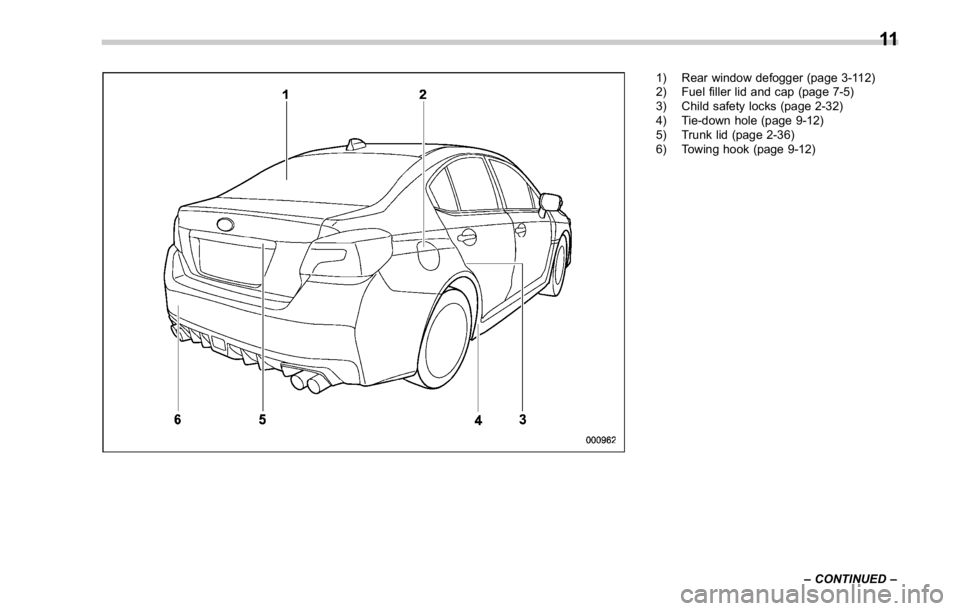
1) Rear window defogger (page 3-112)
2) Fuel filler lid and cap (page 7-5)
3) Child safety locks (page 2-32)
4) Tie-down hole (page 9-12)
5) Trunk lid (page 2-36)
6) Towing hook (page 9-12)
– CONTINUED –11
Page 30 of 594
Front seats ........................................................... 1-2Manual seat ........................................................ 1-4
Power seat (driver ’ s seat – if equipped) ... ............ 1-5
Head restraint adjustment .................................... 1-5
Seat heater (if equipped) .................................... 1-6
Rear seats ............................................................ 1-7Head restraint adjustment .................................... 1-8
Folding down the rear seatback ........................... 1-9
Seatbelts ............................................................. 1-11Seatbelt safety tips ............................................. 1-11
Emergency Locking Retractor (ELR) ................... 1-13
Automatic Locking Retractor/Emergency Locking
Retractor (ALR/ELR) ......................................... 1-13
Seatbelt warning light and chime ........................ 1-13
Fastening the seatbelt ........................................ 1-13
Seatbelt maintenance ......................................... 1-16
Front seatbelt pretensioners ............................. 1-17Seatbelt with shoulder belt pretensioner .. ........... 1-17
Seatbelt with shoulder belt and lap belt
pretensioners ................................................... 1-18
System monitors ................................................ 1-20
System servicing ................................................ 1-20 Precautions against vehicle modification ............ 1-21
Child restraint systems ..................................... 1-21Where to place a child restraint system .............. 1-23
Choosing a child restraint system ...................... 1-24
Installing child restraint systems with ALR/ELR
seatbelt ........................................................... 1-24
Installing a booster seat ..................................... 1-28
Installation of child restraint systems by use of
lower and tether anchorages (LATCH) .............. 1-29
Top tether anchorages ....................................... 1-32
*SRS airbag (Supplemental Restraint
System airbag) ................................................ 1-33Models with SRS airbags and lap/shoulder
restraints for driver, front passenger, and
window-side rear passengers . .......................... 1-33
Components ...................................................... 1-36
SUBARU advanced frontal airbag system ........... 1-38
SRS side airbag and SRS curtain airbag ............. 1-50
SRS airbag system monitors .............................. 1-57
SRS airbag system servicing ... .......................... 1-58
Precautions against vehicle modification ............ 1-59Seat, seatbelt and SRS airbags 1
Page 31 of 594
Seat, seatbelt and SRS airbags/Front seats
Front seats WARNING. Never adjust the seat while driv-
ing to avoid loss of vehicle con-
trol and personal injury.
. Before adjusting the seat, make
sure the hands and feet of rear
seat passengers and cargo are
clear of the adjusting mechan-
ism.
. After adjusting the seat, push it
slightly to make sure it is se-
curely locked. If the seat is not
securely locked, it may move or
the seatbelt may not operate
properly.
. Do not put objects under the front
seats. They may interfere with
front seat locking and cause an
accident.
. Seatbelts provide maximum re-
straint when the occupant sits
well back and upright in the seat.
To reduce the risk of sliding
under the seatbelt in a collision,
the front seatbacks should be
always used in the upright posi-
tion while the vehicle is running.
If the front seatbacks are not used in the upright position in a
collision, the risk of sliding under
the lap belt and of the lap belt
sliding up over the abdomen will
increase, and both can result in
serious internal injury or death.
. The SRS airbags deploy with
considerable speed and force.
Occupants who are out of proper
position when the SRS airbag
deploys could suffer very serious
injuries. Because the SRS airbag
needs enough space for deploy-
ment, the driver should always
sit upright and well back in the
seat as far from the steering
wheel as practical while still
maintaining full vehicle control
and the front passenger should
move the seat as far back as
possible and sit upright and well
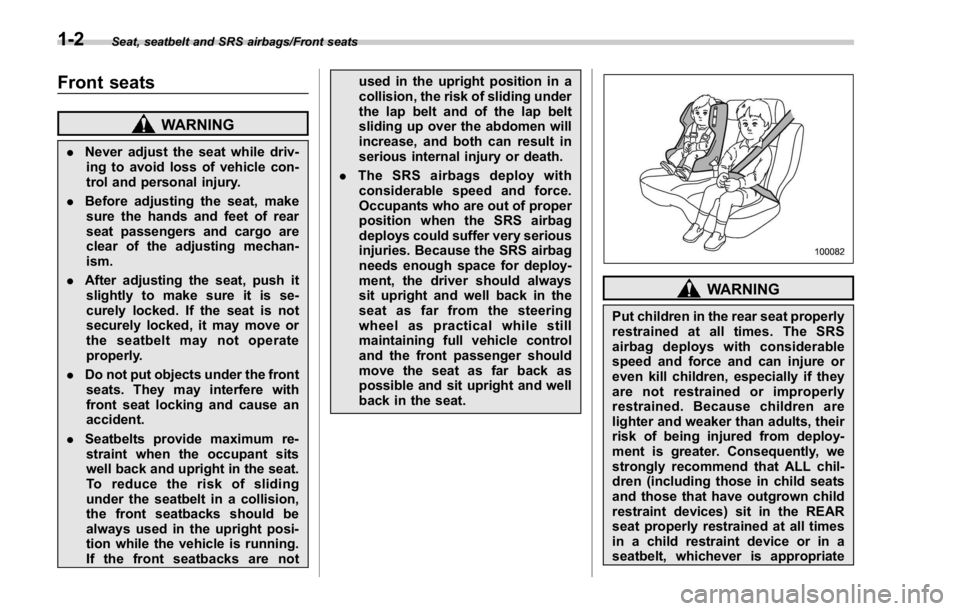
back in the seat. WARNINGPut children in the rear seat properly
restrained at all times. The SRS
airbag deploys with considerable
speed and force and can injure or
even kill children, especially if they
are not restrained or improperly
restrained. Because children are
lighter and weaker than adults, their
risk of being injured from deploy-
ment is greater. Consequently, we
strongly recommend that ALL chil-
dren (including those in child seats
and those that have outgrown child
restraint devices) sit in the REAR
seat properly restrained at all times
in a child restraint device or in a
seatbelt, whichever is appropriate1-2
Page 40 of 594
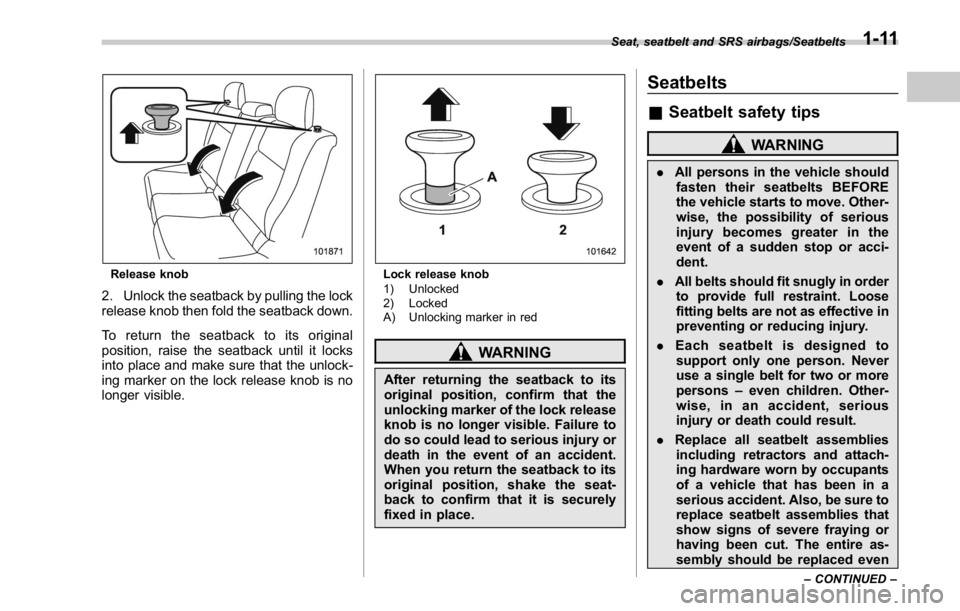
Release knob
2. Unlock the seatback by pulling the lock
release knob then fold the seatback down.
To return the seatback to its original
position, raise the seatback until it locks
into place and make sure that the unlock-
ing marker on the lock release knob is no
longer visible. Lock release knob
1) Unlocked
2) Locked
A) Unlocking marker in red
WARNING
After returning the seatback to its
original position, confirm that the
unlocking marker of the lock release
knob is no longer visible. Failure to
do so could lead to serious injury or
death in the event of an accident.
When you return the seatback to its
original position, shake the seat-
back to confirm that it is securely
fixed in place. Seatbelts & Seatbelt safety tips WARNING. All persons in the vehicle should
fasten their seatbelts BEFORE
the vehicle starts to move. Other-
wise, the possibility of serious
injury becomes greater in the
event of a sudden stop or acci-
dent.
. All belts should fit snugly in order
to provide full restraint. Loose
fitting belts are not as effective in
preventing or reducing injury.
. Each seatbelt is designed to
support only one person. Never
use a single belt for two or more
persons – even children. Other-
wise, in an accident, serious
injury or death could result.
. Replace all seatbelt assemblies
including retractors and attach-
ing hardware worn by occupants
of a vehicle that has been in a
serious accident. Also, be sure to
replace seatbelt assemblies that
show signs of severe fraying or
having been cut. The entire as-
sembly should be replaced even Seat, seatbelt and SRS airbags/Seatbelts
– CONTINUED –1-11
Page 42 of 594
& Emergency Locking Retrac-
tor (ELR) The driver ’ s seatbelt has an Emergency
Locking Retractor (ELR).
The emergency locking retractor allows
normal body movement but the retractor
locks automatically during a sudden stop,
impact or if you pull the belt very quickly
out of the retractor.
& Automatic Locking Retractor/
Emergency Locking Retrac-
tor (ALR/ELR) Each passenger ’ s seatbelt has an Auto-
matic Locking Retractor/Emergency Lock-
ing Retractor (ALR/ELR). The Automatic
Locking Retractor/Emergency Locking
Retractor normally functions as an Emer-
gency Locking Retractor (ELR). The ALR/
ELR has an additional locking mode
“ Automatic Locking Retractor (ALR)
mode ” intended to secure a child restraint
system. When the seatbelt is once drawn
out completely and is then retracted even
slightly, the retractor locks the seatbelt in
that position and the seatbelt cannot be
extended. As the belt is rewinding, clicks
will be heard which indicate the retractor
functions as an ALR. When the seatbelt is
retracted fully, the ALR mode is released.
When securing a child restraint system on the rear seats by the use of the seatbelt,
the seatbelt must be changed over to the
Automatic Locking Retractor (ALR) mode.
When the child restraint system is re-
moved, make sure that the seatbelt
retracts fully and the retractor returned to
the Emergency Locking Retractor (ELR)
mode.
For instructions on how to convert the
retractor to the ALR mode and restore it to
the ELR mode, refer to “ Installing child
restraint systems with ALR/ELR seatbelt ”
F 1-24.
& Seatbelt warning light
and chime Refer to “ Seatbelt warning light and
chime ” F 3-14.
& Fastening the seatbelt
WARNING
. Never use a belt that is twisted or
reversed. In an accident, this can
increase the risk or severity of
injury.
. Keep the lap belt as low as
possible on your hips. In a colli-
sion, this spreads the force of the
lap belt over stronger hip bones instead of across the weaker
abdomen.
. Seatbelts provide maximum re-
straint when the occupant sits
well back and upright in the seat.
To reduce the risk of sliding
under the seatbelt in a collision,
the front seatbacks should be
always used in the upright posi-
tion while the vehicle is running.
If the front seatbacks are not
used in the upright position in a
collision, the risk of sliding under
the lap belt and of the lap belt
sliding up over the abdomen will
increase, and both can result in
serious internal injury or death.
. Do not put cushions or any other
materials between occupants
and seatbacks or seat cushions.
If you do so, the risk of sliding
under the lap belt and of the lap
belt sliding up over the abdomen
will increase, and both can result
in serious internal injury or
death. Seat, seatbelt and SRS airbags/Seatbelts
– CONTINUED –1-13
Page 51 of 594
Seat, seatbelt and SRS airbags/Child restraint systems
properly secured in the vehicle. When
installing the child restraint system, care-
fully follow the manufacturer ’ s instructions.
According to accident statistics, children
are safer when properly restrained in the
rear seating positions than in the front
seating positions.
All U.S. states and Canadian provinces
require that infants and small children be
restrained in an approved child restraint
system at all times while the vehicle is
moving.
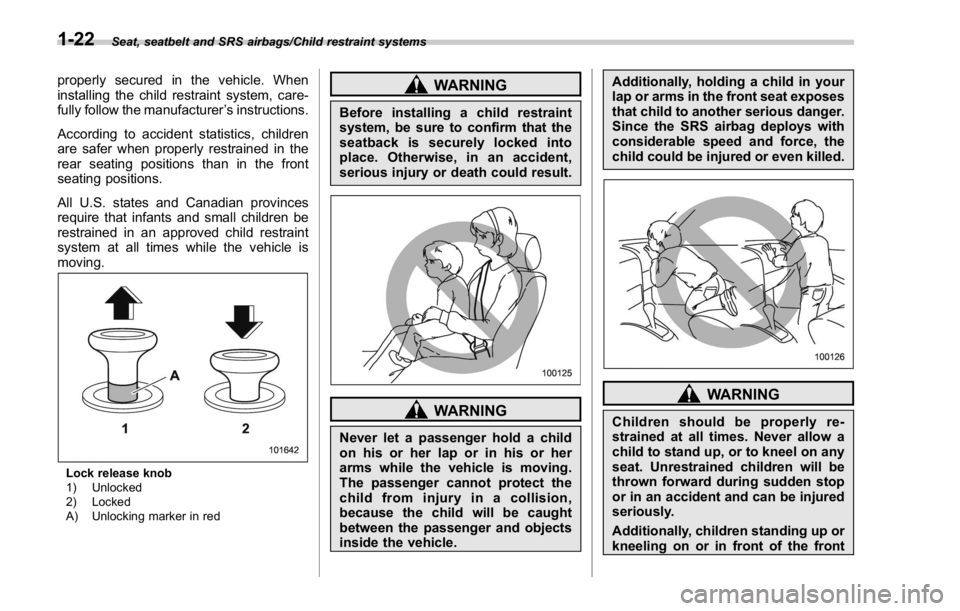
Lock release knob
1) Unlocked
2) Locked
A) Unlocking marker in red WARNINGBefore installing a child restraint
system, be sure to confirm that the
seatback is securely locked into
place. Otherwise, in an accident,
serious injury or death could result.
WARNING
Never let a passenger hold a child
on his or her lap or in his or her
arms while the vehicle is moving.
The passenger cannot protect the
child from injury in a collision,
because the child will be caught
between the passenger and objects
inside the vehicle. Additionally, holding a child in your
lap or arms in the front seat exposes
that child to another serious danger.
Since the SRS airbag deploys with
considerable speed and force, the
child could be injured or even killed.
WARNING
Children should be properly re-
strained at all times. Never allow a
child to stand up, or to kneel on any
seat. Unrestrained children will be
thrown forward during sudden stop
or in an accident and can be injured
seriously.
Additionally, children standing up or
kneeling on or in front of the front1-22
Page 52 of 594
seat are exposed another serious
danger. Since the SRS airbag de-
ploys with considerable speed and
force, the child could be injured or
even killed.
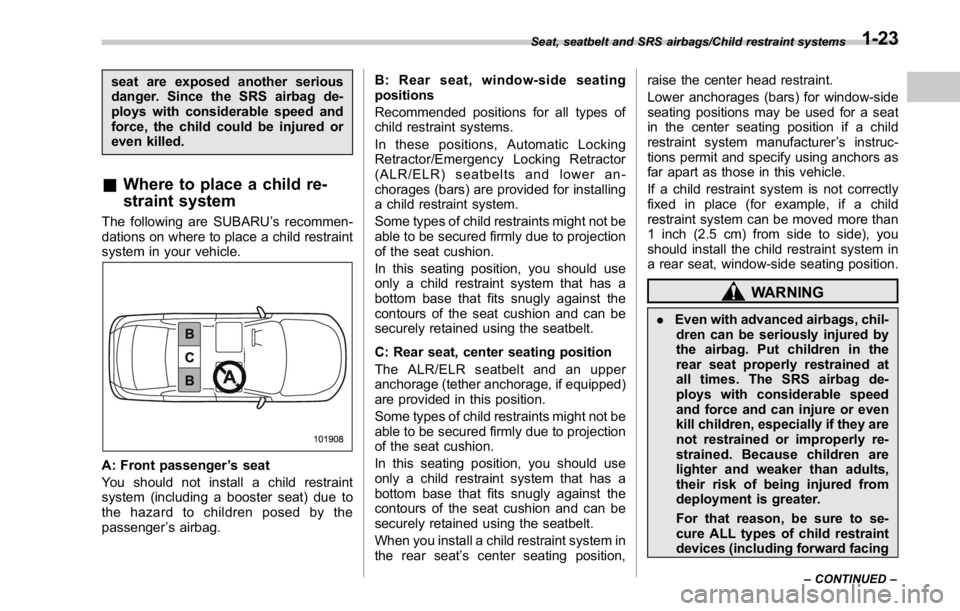
& Where to place a child re-
straint system The following are SUBARU ’ s recommen-
dations on where to place a child restraint
system in your vehicle.
A: Front passenger ’ s seat
You should not install a child restraint
system (including a booster seat) due to
the hazard to children posed by the
passenger ’ s airbag. B: Rear seat, window-side seating
positions
Recommended positions for all types of
child restraint systems.
In these positions, Automatic Locking
Retractor/Emergency Locking Retractor
(ALR/ELR) seatbelts and lower an-
chorages (bars) are provided for installing
a child restraint system.
Some types of child restraints might not be
able to be secured firmly due to projection
of the seat cushion.
In this seating position, you should use
only a child restraint system that has a
bottom base that fits snugly against the
contours of the seat cushion and can be
securely retained using the seatbelt.
C: Rear seat, center seating position
The ALR/ELR seatbelt and an upper
anchorage (tether anchorage, if equipped)
are provided in this position.
Some types of child restraints might not be
able to be secured firmly due to projection
of the seat cushion.
In this seating position, you should use
only a child restraint system that has a
bottom base that fits snugly against the
contours of the seat cushion and can be
securely retained using the seatbelt.
When you install a child restraint system in
the rear seat ’ s center seating position, raise the center head restraint.
Lower anchorages (bars) for window-side
seating positions may be used for a seat
in the center seating position if a child
restraint system manufacturer ’ s instruc-
tions permit and specify using anchors as
far apart as those in this vehicle.
If a child restraint system is not correctly
fixed in place (for example, if a child
restraint system can be moved more than
1 inch (2.5 cm) from side to side), you
should install the child restraint system in
a rear seat, window-side seating position.
WARNING. Even with advanced airbags, chil-
dren can be seriously injured by
the airbag. Put children in the
rear seat properly restrained at
all times. The SRS airbag de-
ploys with considerable speed
and force and can injure or even
kill children, especially if they are
not restrained or improperly re-
strained. Because children are
lighter and weaker than adults,
their risk of being injured from
deployment is greater.
For that reason, be sure to se-
cure ALL types of child restraint
devices (including forward facingSeat, seatbelt and SRS airbags/Child restraint systems
– CONTINUED –1-23
Page 54 of 594
stop, turn or accident; they can
strike and injure vehicle occu-
pants as well as result in serious
injuries or death to the child.
CAUTIONWhen you install a child restraint
system, follow the manufacturer ’ s
instructions supplied with it. After
installing the child restraint system,
check to ensure that it is held
securely in position. If it is not held
tight and secure, the danger of your
child suffering personal injury in the
event of an accident may be in-
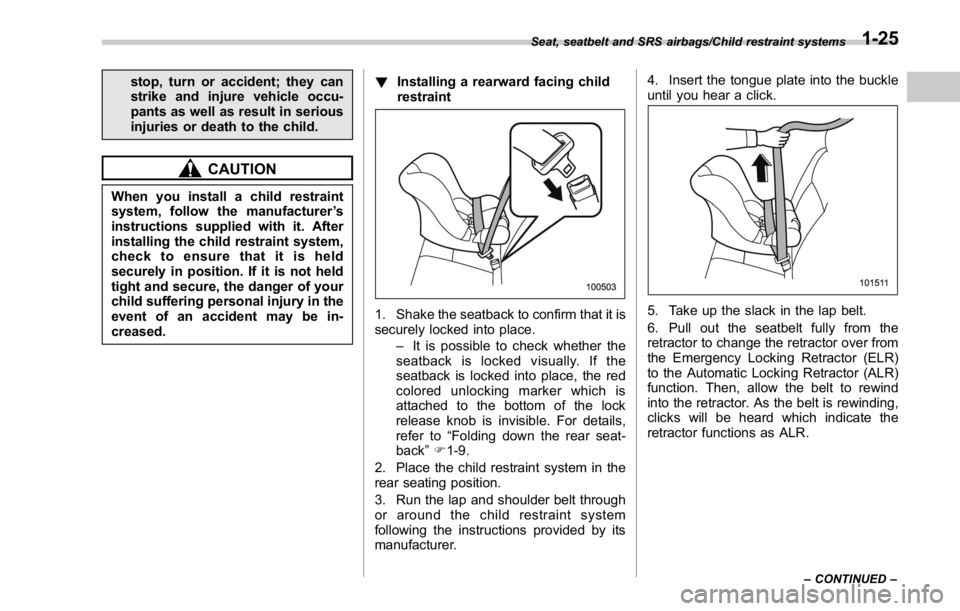
creased. ! Installing a rearward facing child
restraint
1. Shake the seatback to confirm that it is
securely locked into place.
– It is possible to check whether the
seatback is locked visually. If the
seatback is locked into place, the red
colored unlocking marker which is
attached to the bottom of the lock
release knob is invisible. For details,
refer to “ Folding down the rear seat-
back ” F 1-9.
2. Place the child restraint system in the
rear seating position.
3. Run the lap and shoulder belt through
or around the child restraint system
following the instructions provided by its
manufacturer. 4. Insert the tongue plate into the buckle
until you hear a click.
5. Take up the slack in the lap belt.
6. Pull out the seatbelt fully from the
retractor to change the retractor over from
the Emergency Locking Retractor (ELR)
to the Automatic Locking Retractor (ALR)
function. Then, allow the belt to rewind
into the retractor. As the belt is rewinding,
clicks will be heard which indicate the
retractor functions as ALR.Seat, seatbelt and SRS airbags/Child restraint systems
– CONTINUED –1-25