height SUBARU WRX 2016 User Guide
[x] Cancel search | Manufacturer: SUBARU, Model Year: 2016, Model line: WRX, Model: SUBARU WRX 2016Pages: 594, PDF Size: 19.43 MB
Page 448 of 594
& BSD/RCTA approach indica-
tor light/warning buzzer When the BSD/RCTA is active, the BSD/
RCTA approach indicator light and warn-
ing buzzer will operate to alert the driver to
the presence of the following vehicles.
. Vehicles in the neighboring lanes
. Vehicles approaching from the left or
right rear side when reversing
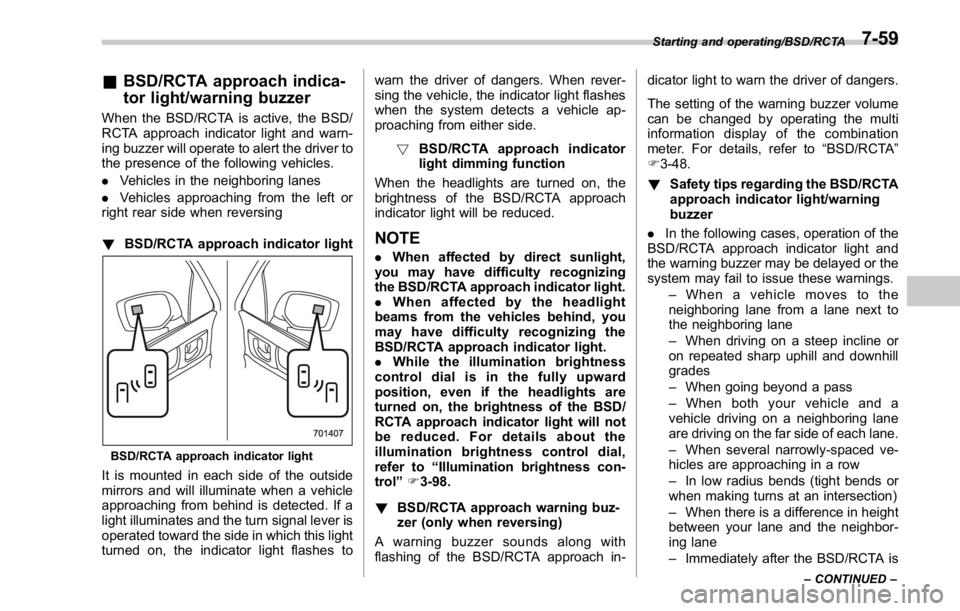
! BSD/RCTA approach indicator light
BSD/RCTA approach indicator light
It is mounted in each side of the outside
mirrors and will illuminate when a vehicle
approaching from behind is detected. If a
light illuminates and the turn signal lever is
operated toward the side in which this light
turned on, the indicator light flashes to warn the driver of dangers. When rever-
sing the vehicle, the indicator light flashes
when the system detects a vehicle ap-
proaching from either side.
! BSD/RCTA approach indicator
light dimming function
When the headlights are turned on, the
brightness of the BSD/RCTA approach
indicator light will be reduced.
NOTE . When affected by direct sunlight,
you may have difficulty recognizing
the BSD/RCTA approach indicator light.
. When affected by the headlight
beams from the vehicles behind, you
may have difficulty recognizing the
BSD/RCTA approach indicator light.
. While the illumination brightness
control dial is in the fully upward
position, even if the headlights are
turned on, the brightness of the BSD/
RCTA approach indicator light will not
be reduced. For details about the
illumination brightness control dial,
refer to “ Illumination brightness con-
trol ” F 3-98.
! BSD/RCTA approach warning buz-
zer (only when reversing)
A warning buzzer sounds along with
flashing of the BSD/RCTA approach in- dicator light to warn the driver of dangers.
The setting of the warning buzzer volume
can be changed by operating the multi
information display of the combination
meter. For details, refer to “ BSD/RCTA ”
F 3-48.
! Safety tips regarding the BSD/RCTA
approach indicator light/warning
buzzer
. In the following cases, operation of the
BSD/RCTA approach indicator light and
the warning buzzer may be delayed or the
system may fail to issue these warnings.
– When a vehicle moves to the
neighboring lane from a lane next to
the neighboring lane
– When driving on a steep incline or
on repeated sharp uphill and downhill
grades
– When going beyond a pass
– When both your vehicle and a
vehicle driving on a neighboring lane
are driving on the far side of each lane.
– When several narrowly-spaced ve-
hicles are approaching in a row
– In low radius bends (tight bends or
when making turns at an intersection)
– When there is a difference in height
between your lane and the neighbor-
ing lane
– Immediately after the BSD/RCTA is Starting and operating/BSD/RCTA
– CONTINUED –7-59
Page 498 of 594
Engine hood To open the hood:
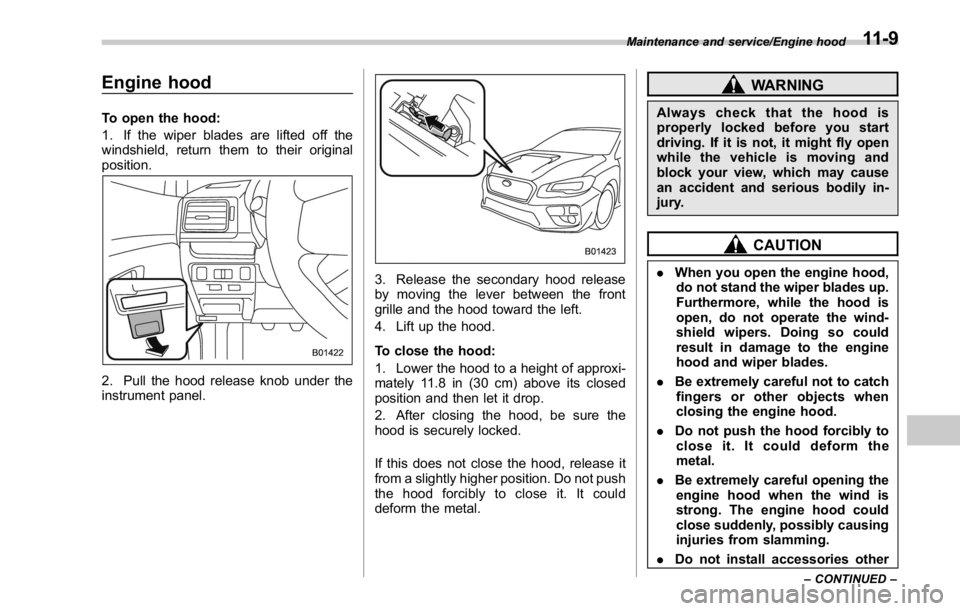
1. If the wiper blades are lifted off the
windshield, return them to their original
position.
2. Pull the hood release knob under the
instrument panel. 3. Release the secondary hood release
by moving the lever between the front
grille and the hood toward the left.
4. Lift up the hood.
To close the hood:
1. Lower the hood to a height of approxi-
mately 11.8 in (30 cm) above its closed
position and then let it drop.
2. After closing the hood, be sure the
hood is securely locked.
If this does not close the hood, release it
from a slightly higher position. Do not push
the hood forcibly to close it. It could
deform the metal. WARNINGAlways check that the hood is
properly locked before you start
driving. If it is not, it might fly open
while the vehicle is moving and
block your view, which may cause
an accident and serious bodily in-
jury.
CAUTION. When you open the engine hood,
do not stand the wiper blades up.
Furthermore, while the hood is
open, do not operate the wind-
shield wipers. Doing so could
result in damage to the engine
hood and wiper blades.
. Be extremely careful not to catch
fingers or other objects when
closing the engine hood.
. Do not push the hood forcibly to
close it. It could deform the
metal.
. Be extremely careful opening the
engine hood when the wind is
strong. The engine hood could
close suddenly, possibly causing
injuries from slamming.
. Do not install accessories other Maintenance and service/Engine hood
– CONTINUED –11-9
Page 516 of 594

Brake booster If the brake booster does not operate as
described in the following, have it checked
by your SUBARU dealer.
1. With the engine off, depress the brake
pedal several times, applying the same
pedal force each time. The distance the
pedal travels should not vary.
2. With the brake pedal depressed, start
the engine. The pedal should move
slightly down to the floor.
3. With the brake pedal depressed, stop
the engine and keep the pedal depressed
for 30 seconds. The pedal height should
not change.
4. Start the engine again and run for
approximately one minute then turn it off.
Depress the brake pedal several times to
check the brake booster. The brake
booster operates properly if the pedal
stroke decreases with each depression.
NOTE When you depress the brake pedal
strongly or suddenly, you might feel
that lighter depression of the brake
pedal generates a greater braking
force. However, even though these
occur, they do not indicate any mal-
functions, and the brake assist system is operating properly.
Brake assist is not a system that brings
more braking ability to the vehicle
beyond its breaking capability.
Brake pedal Check the brake pedal free play and
reserve distance according to the main-
tenance schedule in the “ Warranty and
Maintenance Booklet ” .
& Checking the brake pedal
free play
1) 0.02 – 0.11 in (0.5 – 2.7 mm)
Stop the engine and firmly depress the
brake pedal several times. Lightly pull the
brake pedal up with one finger to check
the free play with a force of less than 2 lbf
(10 N, 1 kgf).
If the free play is not within proper
specification, contact your SUBARU deal-
er. Maintenance and service/Brake booster
– CONTINUED –11-27
Page 543 of 594

Specifications/Specifications
Specifications These specifications are subject to change without notice.
& Dimensions in (mm)
Item STI Except STI
Overall length 180.9 (4,595)
Overall width 70.7 (1,795)
Overall height
58.1 (1,475)
Wheel base 104.3 (2,650)
Tread
Front 60.2 (1,530)
Rear 60.6 (1,540)
Ground clearance 4.9 (125)12-2
Page 561 of 594

Consumer information and Reporting safety defects/For U.S.A.
For U.S.A. The following information has been
compiled according to Code of
Federal Regulations “ Title 49, Part
575 ” . Tire information & Tire labeling
Many markings (e.g. Tire size, Tire
Identification Number or TIN) are
placed on the sidewall of a tire by
tire manufacturers. These markings
can provide you with useful infor-
mation on the tire. ! Tire size
Your vehicle comes equipped with
P-Metric tire size. It is important to
understand the sizing system in
selecting the proper tire for your
vehicles. Here is a brief review of
the tire sizing system with a break-
down of its individual elements.
! P Metric
With the P-Metric system, Section
Width is measured in millimeters.
To convert millimeters into inches,
divide by 25.4. The Aspect Ratio
(Section Height divided by Section
Width) helps provide more dimen-
sional information about the tire
size. Example:
(1) P = Certain tire type used on
light duty vehicles such as passen-
ger cars
(2) Section Width in millimeters
(3) Aspect Ratio (= section height
7 section width).
(4) R = Radial Construction
(5) Rim diameter in inches
! Load and Speed Rating De-
scriptions
The load and speed rating descrip-
tions will appear following the size
designation.
They provide two important facts
about the tire. First, the number
designation is its load index. Sec-
ond, the letter designation indicates
the tire ’ s speed rating.13-2
Page 580 of 594

Warning ........................................................ 3-22, 7-48
Emergency Locking Retractor (ELR) ............................. 1-13
Engine
Compartment overview .......................................... 11-11
Coolant ........................................................ 11-18, 12-7
Exhaust gas (carbon monoxide) ............................. 5, 8-2
Hood .................................................................... 11-9
Low oil level warning light ....................................... 3-17
Oil............................................................... 11-13, 12-4
Overheating .......................................................... 9-11
Starting & stopping ........................................... 7-9, 7-12
Event data recorder ......................................................... 8
Exterior care .............................................................. 10-2
F
Flat tires ..................................................................... 9-4
Floor mat .................................................................. 6-10
Fluid level
Brake .................................................................. 11-25
Clutch .................................................................. 11-26
Continuously variable transmission .......................... 11-23
Power steering ..................................................... 11-24
Fog light ................................................................... 3-99
Bulb .......................................................... 11-47, 12-16
Indicator light ......................................................... 3-35
Switch .................................................................. 3-99
Front
Differential gear oil ........................................ 11-23, 12-6
Fog light ...................................................... 3-99, 11-47
Fog light indicator light ............................................ 3-35
Seatbelt pretensioners ............................................ 1-17 Front fog light ............................................................. 3-99
Switch ................................................................... 3-99
Front seats ................................................................. 1-2
Forward and backward adjustment ............................ 1-4
Head restraint adjustment ......................................... 1-5
Power seat ............................................................. 1-5
Reclining ................................................................ 1-4
Seat height adjustment (driver ’ s seat) ........................ 1-4
Fuel ........................................................................... 7-3
Consumption indicator ..................................... 3-52, 3-54
Economy hints ........................................................ 8-2
Filler lid and cap ...................................................... 7-5
Gauge ................................................................... 3-10
Requirements ................................................. 7-3, 12-3
Fuses ..................................................................... 11-42
Fuses and circuits .................................................... 12-10
G
GAWR (Gross Axle Weight Rating) .. ............................. 8-12
Glove box ................................................................... 6-5
GVWR (Gross Vehicle Weight Rating) ........................... 8-12
H
Hazard warning flasher .......................................... 3-8, 9-2
Head restraint adjustment
Front seat ............................................................... 1-5
Rear
seat ............................................................... 1-8
Headlight
Beam leveler. ......................................................... 3-99
Bulb replacement ................................................. 11-44
Bulb replacing ...................................................... 11-44 Index
14-5
Page 584 of 594

Rear view camera ...................................................... 6-12
Rear window
Defogger .............................................................. 3-112
Recommended
Brake fluid. ............................................................ 12-7
Clutch fluid ................................................... 11-26, 12-7
Engine oil .............................................................. 12-4
Front differential gear oil ......................................... 12-6
Manual transmission oil .......................................... 12-6
Power steering fluid ................................................ 12-7
Rear differential gear oil .......................................... 12-6
Spark plugs ........................................................... 12-8
Refueling .................................................................... 7-5
Remote engine start system ........................................ 7-14
Remote keyless entry system ...................................... 2-21
Replacement
Brake pad and lining ............................................. 11-29
Wiper blades ........................................................ 11-39
Replacing
Access key battery ................................................ 11-50
Air cleaner element ............................................... 11-19
Battery (keyless access with push-button start
system) ...................................................... 2-18, 11-50
Battery (remote keyless entry system) ............. 2-24, 11-51
Lost transmitters (remote keyless entry system) ......... 2-24
Remote keyless entry transmitter battery .................. 11-51
Replacing bulbs .............................................. 11-44, 12-16
Front fog light ....................................................... 11-47
Headlight ............................................................. 11-44
License plate light ................................................. 11-49
Rear combination light ........................................... 11-48 Rear side marker light ........................................... 11-48
Rear turn signal light ............................................. 11-48
Stop light ............................................................. 11-48
Tail light. .............................................................. 11-48
REV indicator light and buzzer ..................................... 3-12
Rocking the vehicle .................................................... 8-10
S
Safety
Precautions when driving ............................................. 3
Symbol ...................................................................... 2
Warnings ................................................................... 2
Seat
Fabric ................................................................... 10-5
Front ...................................................................... 1-2
Heater .................................................................... 1-6
Height adjustment .................................................... 1-4
Power .................................................................... 1-5
Rear ...................................................................... 1-7
Seatbelt. ................................................................ 3, 1-11
Fastening .............................................................. 1-13
Maintenance .......................................................... 1-16
Pretensioners ......................................................... 1-17
Safety tips ............................................................. 1-11
Warning light and chime .......................................... 3-14
Security
Alarm
system ......................................................... 2-25
Immobilizer ............................................................. 2-3
Indicator light ......................................................... 3-33
Shock sensors ....................................................... 2-31 Index
14-9