ECU SUBARU WRX 2016 Owner's Manual
[x] Cancel search | Manufacturer: SUBARU, Model Year: 2016, Model line: WRX, Model: SUBARU WRX 2016Pages: 594, PDF Size: 19.43 MB
Page 59 of 594
Seat, seatbelt and SRS airbags/Child restraint systems
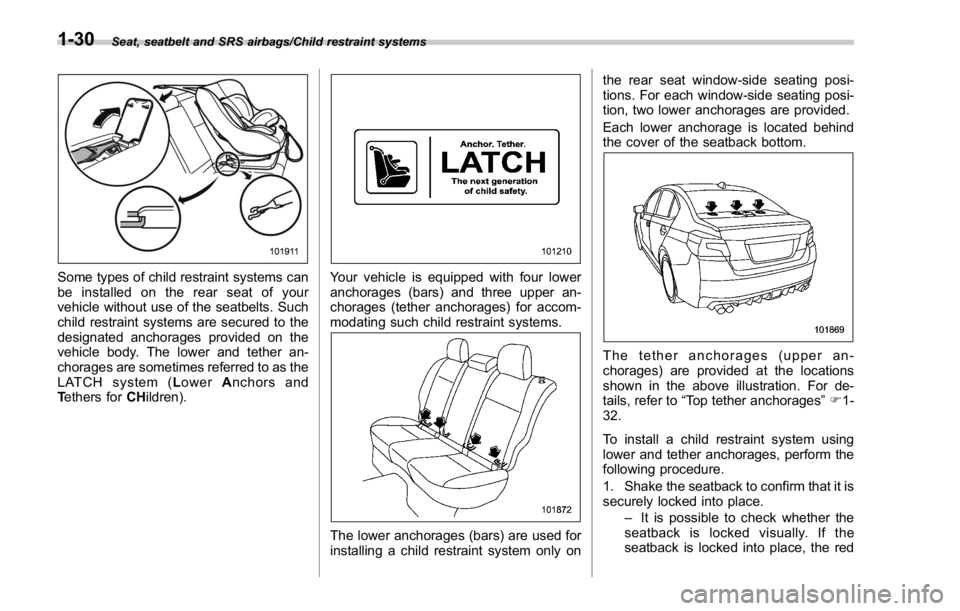
Some types of child restraint systems can
be installed on the rear seat of your
vehicle without use of the seatbelts. Such
child restraint systems are secured to the
designated anchorages provided on the
vehicle body. The lower and tether an-
chorages are sometimes referred to as the
LATCH system ( L ower A nchors and
T ethers for CH ildren). Your vehicle is equipped with four lower
anchorages (bars) and three upper an-
chorages (tether anchorages) for accom-
modating such child restraint systems.
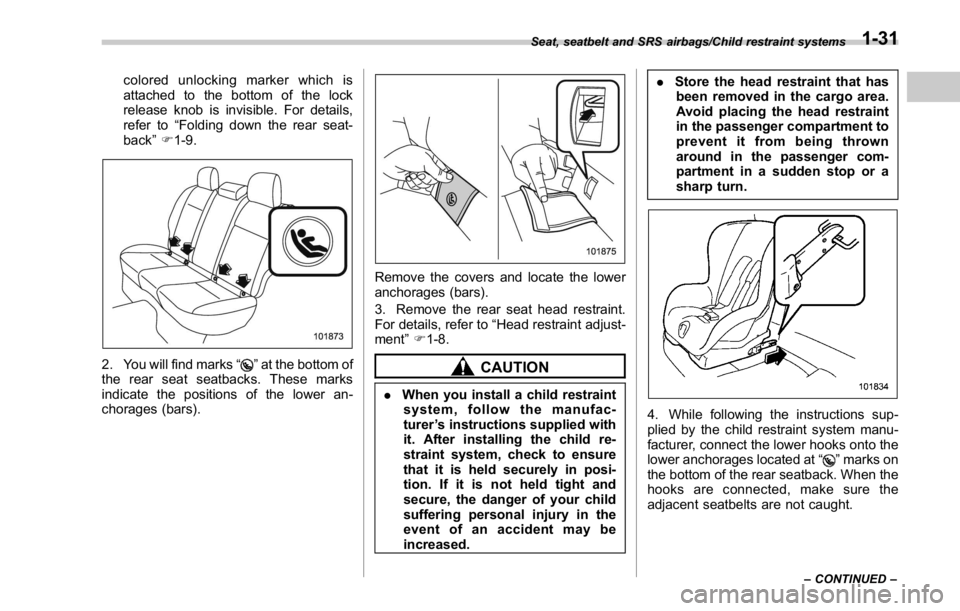
The lower anchorages (bars) are used for
installing a child restraint system only on the rear seat window-side seating posi-
tions. For each window-side seating posi-
tion, two lower anchorages are provided.
Each lower anchorage is located behind
the cover of the seatback bottom.
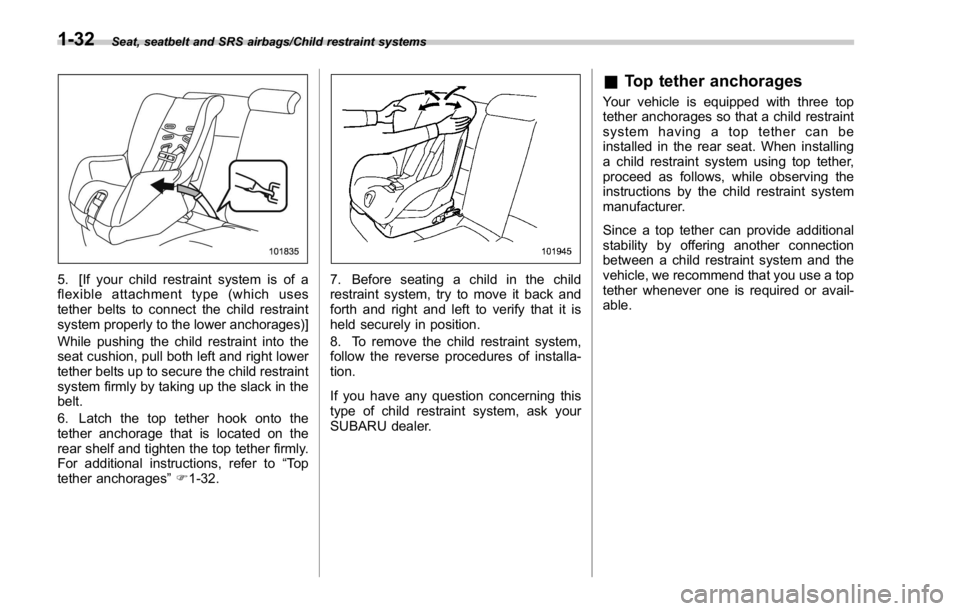
The tether anchorages (upper an-
chorages) are provided at the locations
shown in the above illustration. For de-
tails, refer to “ Top tether anchorages ” F 1-
32.
To install a child restraint system using
lower and tether anchorages, perform the
following procedure.
1. Shake the seatback to confirm that it is
securely locked into place.
– It is possible to check whether the
seatback is locked visually. If the
seatback is locked into place, the red1-30
Page 60 of 594
colored unlocking marker which is
attached to the bottom of the lock
release knob is invisible. For details,
refer to “ Folding down the rear seat-
back ” F 1-9.
2. You will find marks “ ” at the bottom of
the rear seat seatbacks. These marks
indicate the positions of the lower an-
chorages (bars). Remove the covers and locate the lower
anchorages (bars).
3. Remove the rear seat head restraint.
For details, refer to “ Head restraint adjust-
ment ” F 1-8.
CAUTION
. When you install a child restraint
system, follow the manufac-
turer ’ s instructions supplied with
it. After installing the child re-
straint system, check to ensure
that it is held securely in posi-
tion. If it is not held tight and
secure, the danger of your child
suffering personal injury in the
event of an accident may be
increased. . Store the head restraint that has
been removed in the cargo area.
Avoid placing the head restraint
in the passenger compartment to
prevent it from being thrown
around in the passenger com-
partment in a sudden stop or a
sharp turn.
4. While following the instructions sup-
plied by the child restraint system manu-
facturer, connect the lower hooks onto the
lower anchorages located at “
” marks on
the bottom of the rear seatback. When the
hooks are connected, make sure the
adjacent seatbelts are not caught.Seat, seatbelt and SRS airbags/Child restraint systems
– CONTINUED –1-31
Page 61 of 594
Seat, seatbelt and SRS airbags/Child restraint systems
5. [If your child restraint system is of a
flexible attachment type (which uses
tether belts to connect the child restraint
system properly to the lower anchorages)]
While pushing the child restraint into the
seat cushion, pull both left and right lower
tether belts up to secure the child restraint
system firmly by taking up the slack in the
belt.
6. Latch the top tether hook onto the
tether anchorage that is located on the
rear shelf and tighten the top tether firmly.
For additional instructions, refer to “ To p
tether anchorages ” F 1-32. 7. Before seating a child in the child
restraint system, try to move it back and
forth and right and left to verify that it is
held securely in position.
8. To remove the child restraint system,
follow the reverse procedures of installa-
tion.
If you have any question concerning this
type of child restraint system, ask your
SUBARU dealer. & Top tether anchorages Your vehicle is equipped with three top
tether anchorages so that a child restraint
system having a top tether can be
installed in the rear seat. When installing
a child restraint system using top tether,
proceed as follows, while observing the
instructions by the child restraint system
manufacturer.
Since a top tether can provide additional
stability by offering another connection
between a child restraint system and the
vehicle, we recommend that you use a top
tether whenever one is required or avail-
able.1-32
Page 62 of 594
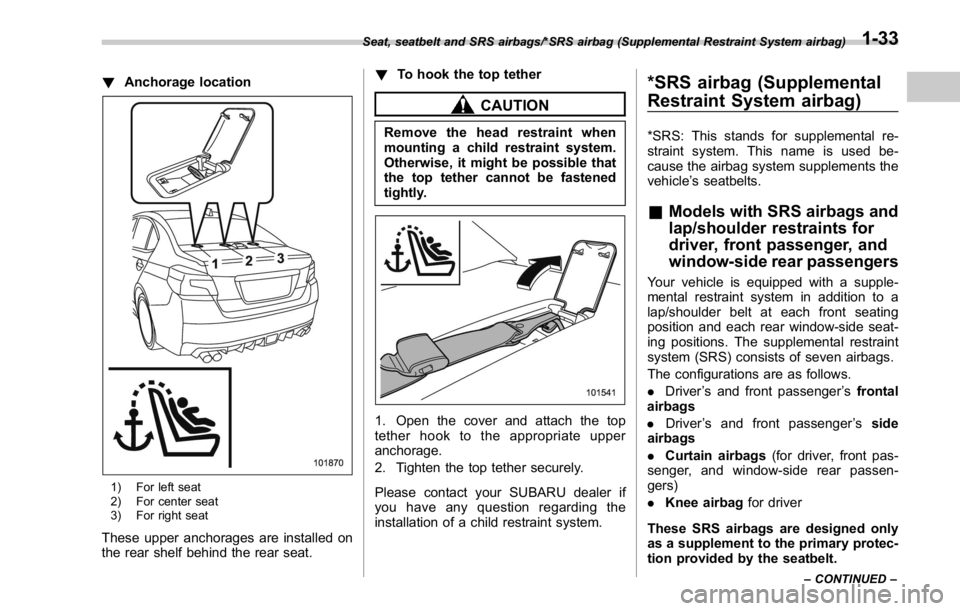
! Anchorage location
1) For left seat
2) For center seat
3) For right seat
These upper anchorages are installed on
the rear shelf behind the rear seat. ! To hook the top tether
CAUTIONRemove the head restraint when
mounting a child restraint system.
Otherwise, it might be possible that
the top tether cannot be fastened
tightly.
1. Open the cover and attach the top
tether hook to the appropriate upper
anchorage.
2. Tighten the top tether securely.
Please contact your SUBARU dealer if
you have any question regarding the
installation of a child restraint system. *SRS airbag (Supplemental
Restraint System airbag) *SRS: This stands for supplemental re-
straint system. This name is used be-
cause the airbag system supplements the
vehicle ’ s seatbelts.
& Models with SRS airbags and
lap/shoulder restraints for
driver, front passenger, and
window-side rear passengers Your vehicle is equipped with a supple-
mental restraint system in addition to a
lap/shoulder belt at each front seating
position and each rear window-side seat-
ing positions. The supplemental restraint
system (SRS) consists of seven airbags.
The configurations are as follows.
. Driver ’ s and front passenger ’ s frontal
airbags
. Driver ’ s and front passenger ’ s side
airbags
. Curtain airbags (for driver, front pas-
senger, and window-side rear passen-
gers)
. Knee airbag for driver
These SRS airbags are designed only
as a supplement to the primary protec-
tion provided by the seatbelt.Seat, seatbelt and SRS airbags/*SRS airbag (Supplemental Restraint System airbag)
– CONTINUED –1-33
Page 64 of 594
considerable speed and force
and can injure or even kill chil-
dren, especially if they are not
restrained or improperly re-
strained. Because children are
lighter and weaker than adults,
their risk of being injured from
deployment is greater.
For that reason, we strongly
recommend that ALL children
(including those in child seats
and those that have outgrown
child restraint devices) sit in the
REAR seat properly restrained at
all times in a child restraint
device or in a seatbelt, whichever
is appropriate for the child ’ s age,
height and weight.
Secure ALL types of child re-
straint devices (including for-
ward facing child seats) in the
REAR seats at all times.
According to accident statistics,
children are safer when properly
restrained in the rear seating
positions than in the front seat-
ing positions.
For instructions and precautions
concerning the child restraint
system, refer to “ Child restraint
systems ” F 1-21. . NEVER INSTALL A FORWARD
OR REARWARD FACING CHILD
SEAT IN THE FRONT SEAT.
DOING SO RISKS SERIOUS IN-
JURY OR DEATH TO THE CHILD
BY PLACING THE CHILD ’ S HEAD
TOO CLOSE TO THE SRS AIR-
BAG.
. Never allow a child to stand up,
or to kneel on the front passen-
ger ’ s seat, or never hold a child
on your lap or in your arms. The
SRS airbag deploys with consid-
erable force and can injure or
even kill the child.
CAUTION. When the SRS airbag deploys,
some smoke will be released.
This smoke could cause breath-
ing problems for people with a
history of asthma or other
breathing trouble. If you or your
passengers have breathing pro-
blems after SRS airbag deploys,
get fresh air promptly. . A deploying SRS airbag releases
hot gas. Occupants could get
burned if they come into direct
contact with the hot gas.
NOTE . When you sell your vehicle, we urge
you to explain to the buyer that it is
equipped with SRS airbags by alerting
the buyer to the applicable section in
this Owner ’ s Manual.
. If the SRS airbag deploys, fuel
supply will be cut off to reduce the risk
of fire caused by leaking fuel. For
details about restarting of the engine,
refer to “ If your vehicle is involved in
an accident ” F 9-18.Seat, seatbelt and SRS airbags/*SRS airbag (Supplemental Restraint System airbag)
– CONTINUED –1-35
Page 70 of 594

the occupant detection system determines
whether the front passenger ’ s SRS frontal
airbag should be deployed or not.
The occupant detection system may not
inflate the front passenger ’ s SRS frontal
airbag even when the driver ’ s SRS frontal
airbag deploys. This is normal. In this
case, although the front passenger ’ s SRS
frontal airbag does not operate, the front
passenger ’ s seatbelt pretensioner oper-
ates with the driver ’ s seatbelt preten-
sioner. For details about the seatbelt
pretensioner, refer to “ Front seatbelt pre-
tensioners ” F 1-17.
CAUTIONObserve the following precautions.
Failure to do so may prevent the
SUBARU advanced frontal airbag
system from functioning correctly
or cause the system to fail.
. Do not apply any strong impact
to the front passenger ’ sseat
such as by kicking.
. Do not let rear passengers rest
their feet between the front seat-
back and seat cushion.
. Do not spill liquid on the front
passenger ’ s seat. If liquid is
spilled, wipe it off immediately.
. Do not remove or disassemble the front passenger ’ s seat.
. Do not install any accessory
(such as an audio amplifier) other
than a genuine SUBARU acces-
sory under the front passenger ’ s
seat.
. Do not place anything (shoes,
umbrella, etc.) under the front
passenger ’ s seat.
. Do not use the front passenger ’ s
seat with the head restraint re-
moved.
. Do not leave any articles on the
front passenger ’ s seat or the
seatbelt tongue and buckle en-
gaged when you leave your ve-
hicle.
. Do not put sharp object(s) on the
seat or pierce the seat uphols-
tery.
. Do not place a magnet near the
seatbelt buckle and the seatbelt
retractor.
. Do not use front seats with their
backward-forward position and
seatback not being locked into
place securely. If any of them are
not locked securely, adjust them
again. For adjusting procedure,
refer to “ Manual seat ” F 1-4 (models equipped with manual
seats only).
If the seatbelt buckle switch and/or front
passenger ’ s occupant detection system
have failed, the SRS airbag system
warning light will illuminate. Have the
system inspected by your SUBARU deal-
er immediately if the SRS airbag system
warning light illuminates.
If your vehicle has sustained impact, this
may affect the proper function of the
SUBARU advanced frontal airbag system.
Have your vehicle inspected at your
SUBARU dealer. Do not let anyone use
the front passenger ’ s seat while you are
driving the vehicle to your SUBARU deal-
er.
NOTE The front passenger ’ s SRS side airbag
and SRS curtain airbag are not con-
trolled by the SUBARU advanced fron-
tal airbag system.
! Passenger ’ s frontal airbag ON and
OFF indicators
Refer to “ Front passenger ’ s frontal airbag
ON and OFF indicators ” F 3-16.Seat, seatbelt and SRS airbags/*SRS airbag (Supplemental Restraint System airbag)
– CONTINUED –1-41
Page 73 of 594

Seat, seatbelt and SRS airbags/*SRS airbag (Supplemental Restraint System airbag)
. Ensure that the backward-forward po-
sition and seatback of front passenger ’ s
seat are locked into place securely by
moving the seat back and forth.
If the ON indicator still remains illuminated
while the OFF indicator turns off after
taking relevant corrective actions de-
scribed above, relocate the child restraint
system to the rear seat and immediately
contact your SUBARU dealer for an
inspection.
NOTE When a child who has outgrown a child
restraint system or a small adult is
seated in the front passenger ’ s seat,
the SUBARU advanced frontal airbag
system may or may not activate the
front passenger ’ s SRS frontal airbag
depending on the occupant ’ s seating
posture. Children should always wear a
seatbelt when sitting in the seat irre-
spective of whether the airbag is
deactivated or activated. If the front
passenger ’ s SRS frontal airbag is acti-
vated (the ON indicator remains illumi-
nated while the OFF indicator turns off),
ensure that no article is placed on the
seat other than the occupant.
If the ON indicator still remains illumi-
nated while the OFF indicator turns off
despite the fact that the actions noted above have been taken, seat the child/
small adult in the rear seat and im-
mediately contact your SUBARU dealer
for an inspection. Even if the system
has passed the dealer inspection, it is
recommended that on subsequent trips
the child/small adult always take the
rear seat.
Children who have outgrown a child
restraint system should always wear the
seatbelt irrespective of whether the airbag
is deactivated or activated.
! Conditions in which front passen-
ger ’ s SRS frontal airbag is activated
The front passenger ’ s SRS frontal airbag
will be activated for deployment upon
impact when any of the following condi-
tions are met regarding the front passen-
ger ’ s seat.
. When the seat is occupied by an adult.
. When certain items (e.g. jug of water)
are placed on the seat.
! If the passenger ’ s frontal airbag
OFF indicator illuminates and
the ON indicator turns off even
when the front passenger ’ s seat
is occupied by an adult
This can be caused by the adult incor-
rectly sitting in the front passenger ’ s seat.
1. Turn the ignition switch to the “ LOCK ” / “ OFF ” position.
2. Ask the front passenger to set the
seatback to the upright position, sit up
straight in the center of the seat cushion,
correctly fasten the seatbelt, position his/
her legs out forward, and adjust the seat to
the rearmost position.
3. Turn the ignition switch to the “ ON ”
position.
If the OFF indicator remains illuminated
while the ON indicator remains off, take
the following actions.
1. Turn the ignition switch to the “ LOCK ” /
“ OFF ” position.
2. Make sure that the front passenger
does not use a blanket, seat cushion, seat
cover, seat heater or massager, etc.
3. If wearing excessive layers of clothing,
the front passenger should remove any
unnecessary items before sitting in the
front passenger ’ s seat, or should sit in a
rear seat.
4. Turn the ignition switch to the “ ON ”
position and wait 6 seconds to allow the
system to complete self-checking. Follow-
ing the system check, both indicators turn
off for 2 seconds. Now, the ON indicator
should illuminate while the OFF indicator
remains off.
If the OFF indicator still remains illumi-1-44
Page 90 of 594

Keys ..................................................................... 2-3Key number plate ................................................ 2-3
Immobilizer .......................................................... 2-3Security indicator light ........................................ 2-4
Key replacement ................................................. 2-4
Certification for immobilizer system ..................... 2-4
Door locks ........................................................... 2-5Locking and unlocking from the outside . ............. 2-5
Locking and unlocking from the inside ................ 2-7
Battery drainage prevention function ................... 2-7
Power door locking switches ............................. 2-8Key lock-in prevention function ........................... 2-9
Keyless access with push-button start
system (if equipped) ........................................ 2-9Safety precautions ............................................. 2-10
Locking and unlocking with “ keyless access ”
entry function. .................................................. 2-13
Selecting audible signal operation ...................... 2-16
Warning chimes and warning indicator ............... 2-16
Disabling keyless access function ...................... 2-16
When access key does not operate properly ....... 2-18
Replacing battery of access key ......................... 2-18
Replacing access key ......................................... 2-18
Certification for keyless access with push-button
start system ..................................................... 2-18
PIN Code Access (models with “ keyless
access with push-button start system ” )........ 2-19
Registering a PIN code ....................................... 2-20
Unlocking .......................................................... 2-21
Remote keyless entry system ........................... 2-21
Locking the doors .............................................. 2-22 Unlocking the doors .......................................... 2-22
Opening the trunk lid ......................................... 2-23
Vehicle finder function ....................................... 2-23
Sounding a panic alarm ..................................... 2-23
Selecting audible signal operation (models
without “ keyless access with push-button start
system ” ).......................................................... 2-23
Replacing the battery ......................................... 2-24
Replacing lost transmitters ................................ 2-24
Welcome lighting (if equipped) . .......................... 2-24
Certification for Remote keyless entry
system ............................................................ 2-24
Alarm system ..................................................... 2-25System operation ............................................... 2-26
Activating and deactivating the alarm system ..... 2-26
If you have accidentally triggered the alarm
system ............................................................ 2-26
Arming the system ............................................ 2-27
Disarming the system ........................................ 2-29
Valet mode ........................................................ 2-30
Passive arming (models without “ keyless access
with push-button start system ” ) ....................... 2-30
Tripped sensor identification .............................. 2-31
Shock sensors (dealer option).. .......................... 2-31
Child safety locks .............................................. 2-32
Windows ............................................................. 2-32
Power window operation by driver ..................... 2-33
Power window operation by passengers ............. 2-35
Initialization of power window .. .......................... 2-36
Trunk lid ............................................................. 2-36
To open and close the trunk lid from outside . ..... 2-36Keys and doors 2
Page 93 of 594

Keys and doors/Immobilizer
“ Ignition switch (models without push-
button start system) ” F 3-4.
CAUTION. Do not place the key under direct
sunlight or anywhere it may
become hot.
. Do not get the key wet. If the key
gets wet, wipe it dry with a cloth
immediately.
. Donotmodifyorremovethe
system. If modified or removed,
the proper operation of the sys-
tem cannot be guaranteed.
NOTE . To protect your vehicle from theft,
please pay close attention to the fol-
lowing security precautions:
– Never leave your vehicle unat-
tended with its keys inside.
– Before leaving your vehicle,
close all windows and the moon-
roof, and lock the doors.
– Do not leave spare keys or any
record of your key number in the
vehicle.
. The vehicle has a maintenance-free
type immobilizer system. & Security indicator light Refer to “ Security indicator light ” F 3-33.
& Key replacement Your key number plate will be required if
you ever need a replacement key made.
Any new key must be registered for use
with your vehicle ’ s immobilizer system
before it can be used. The maximum
number of keys that can be registered
for use with one vehicle is as follows.
. Four (models without “ keyless access
with push-button start system ” )
. Seven (models with “ keyless access
with push-button start system ” )
One key that has already been registered
is required in order to register a new key.
If you lose a key, the lost key ’ s ID code still
remains in the memory of the vehicle ’ s
immobilizer system. For security reasons,
the lost key ’ s ID code should be erased
from the memory. To erase the lost key ’ s
ID code, all keys that will be used are
required.
For details about new key registration and
erasing the lost key ’ s ID code, contact
your SUBARU dealer. & Certification for immobilizer
system For models with “ keyless access with
push-button start system ” :
Refer to “ Certification for keyless access
with push-button start system ” F 2-18.
For models without “ keyless access
with push-button start system ” :
! U.S.-spec. models
FCC ID: MOZRI-38BFH
CAUTIONFCC WARNING
Changes or modifications not ex-
pressly approved by the party re-
sponsible for compliance could void
the user ’ s authority to operate the
equipment.
This device complies with part 15 of the
FCC Rules. Operation is subject to the
following two conditions: (1) This device
may not cause harmful interference, and
(2) this device must accept any interfer-
ence received, including interference that
may cause undesired operation.2-4
Page 108 of 594
! Canada-spec. models
This device complies with Industry
Canada licence-exempt RSS standard
(s). Operation is subject to the following
two conditions: (1) this device may not
cause interference, and (2) this device
must accept any interference, including
interference that may cause undesired
operation of the device.
Le présent appareil est conforme aux
CNR d ’ Industrie Canada applicables aux
appareils radio exempts de licence. L ’ ex-
ploitation est autorisée aux deux condi-
tions suivantes: (1) l ’ appareil ne doit pas
produire de brouillage, et (2) l ’ utilisateur
de l ’ appareil doit accepter tout brouillage
radioélectrique subi, même si le brouillage
est susceptible d ’ en compromettre le
fonctionnement. ! Mexico-spec. models
IFT
RLVDE1413-2269
14AHC
DENSO PIN Code Access (models
with “ keyless access with
push-button start system ” )
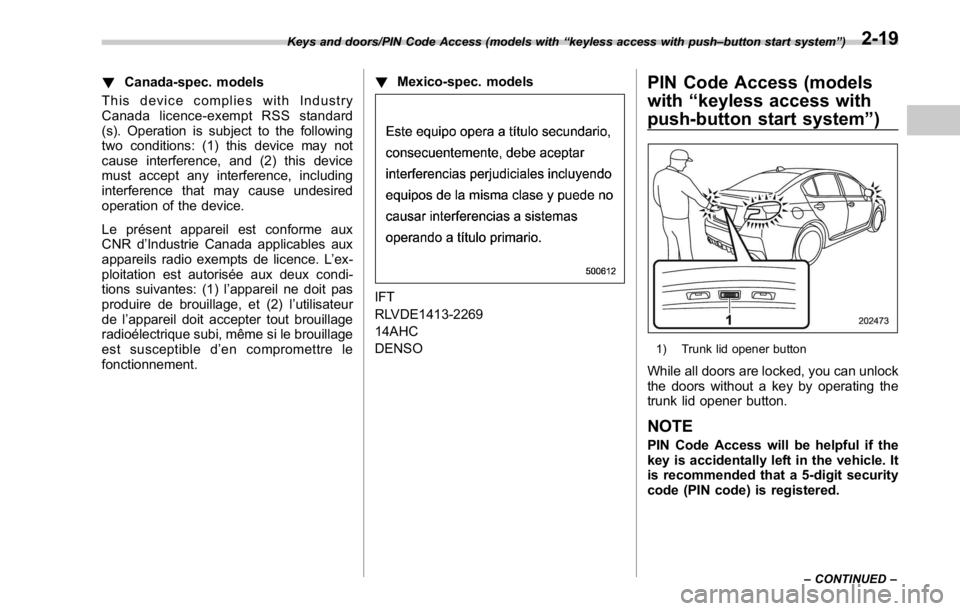
1) Trunk lid opener button
While all doors are locked, you can unlock
the doors without a key by operating the
trunk lid opener button.
NOTE PIN Code Access will be helpful if the
key is accidentally left in the vehicle. It
is recommended that a 5-digit security
code (PIN code) is registered.Keys and doors/PIN Code Access (models with “ keyless access with push – button start system ” )
– CONTINUED –2-19