lock SUBARU WRX 2018 Owners Manual
[x] Cancel search | Manufacturer: SUBARU, Model Year: 2018, Model line: WRX, Model: SUBARU WRX 2018Pages: 578, PDF Size: 33.21 MB
Page 373 of 578
(386,1)
北米Model "A1700BE-B" EDITED: 2017/ 10/ 11
heard that is characteristic of this type
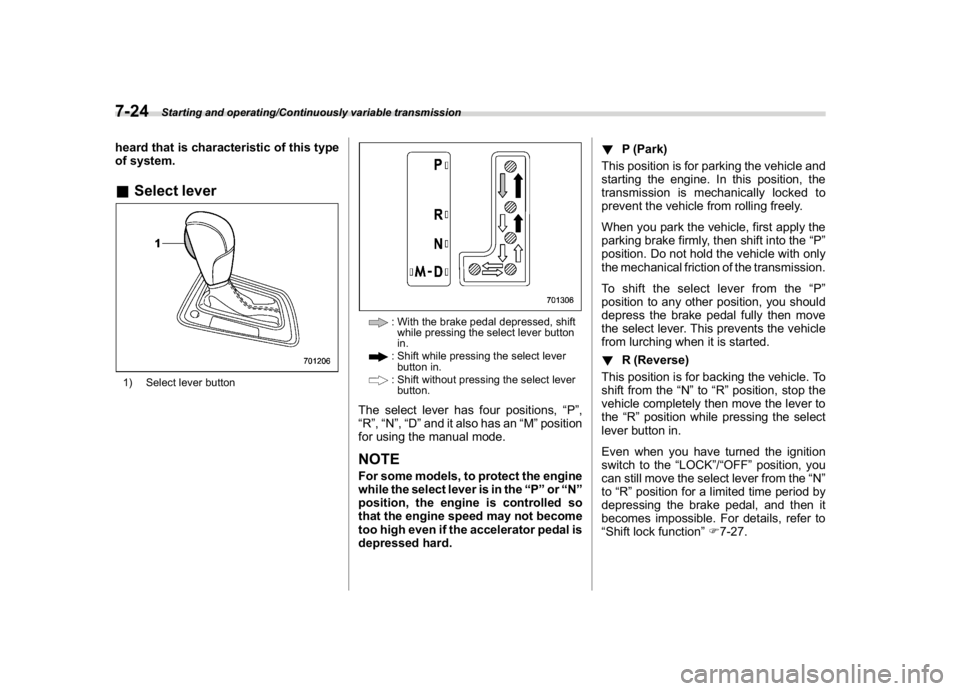
of system.&Select lever1) Select lever button
: With the brake pedal depressed, shift
while pressing the select lever button
in.: Shift while pressing the select lever
button in.: Shift without pressing the select lever
button.
The select lever has four positions,“P”,
“R”,“N”,“D”and it also has an“M”position
for using the manual mode.NOTEFor some models, to protect the engine
while the select lever is in the“P”or“N”
position, the engine is controlled so
that the engine speed may not become
too high even if the accelerator pedal is
depressed hard.!P (Park)
This position is for parking the vehicle and
starting the engine. In this position, the
transmission is mechanically locked to
prevent the vehicle from rolling freely.
When you park the vehicle, first apply the
parking brake firmly, then shift into the“P”
position. Do not hold the vehicle with only
the mechanical friction of the transmission.
To shift the select lever from the“P”
position to any other position, you should
depress the brake pedal fully then move
the select lever. This prevents the vehicle
from lurching when it is started.
!R (Reverse)
This position is for backing the vehicle. To
shift from the“N”to“R”position, stop the
vehicle completely then move the lever to
the“R”position while pressing the select
lever button in.
Even when you have turned the ignition
switch to the“LOCK”/“OFF”position, you
can still move the select lever from the“N”
to“R”position for a limited time period by
depressing the brake pedal, and then it
becomes impossible. For details, refer to
“Shift lock function”F7-27.
Starting and operating/Continuously variable transmission
7-24
Page 374 of 578
(387,1)
北米Model "A1700BE-B" EDITED: 2017/ 10/ 11
!N (Neutral)
This position is for restarting a stalled
engine. In this position, the transmission is
neutral, meaning that the wheels and
transmission are not locked. Therefore,
the vehicle will roll freely, even on the
slightest incline unless the parking brake
or foot brake is applied.
WARNING
Do not drive the vehicle with the
select lever in the“N”(neutral)
position. Engine braking has no
effect in this condition and the risk
of an accident is consequently in-
creased.NOTEIf the select lever is in the“N”position
when you stop the engine for parking,
you may not subsequently be able to
move it to the“R”and“P”positions. If
this happens, turn the ignition switch to
the“ON”position. You will then be able
to move the select lever to the“P”
position.!D (Drive)
This position is for normal driving. The
transmission shifts automatically and con-
tinuously into a suitable gear according to
the vehicle speed and the acceleration you
require. Also, while driving up and down a
hill, the transmission assists and controls
the driving performance and engine brak-
ing while corresponding to the road grade.
When more acceleration is required in the
“D”position, depress the accelerator pedal
fully to the floor and hold that position. The
transmission will automatically downshift.
If the Intelligent (I) mode or the Sport (S)
mode has been selected, the transmission
will operate like a conventional automatic
transmission. When you release the pedal,
the transmission will return to the original
gear position.
If you operate one of the shift paddles
behind the steering wheel while driving in
the“D”position, the transmission will
temporarily switch to the manual mode.
In this mode, you can shift into any gear
position using the shift paddles. For details
about the manual mode, refer to“Selection
of manual mode”F7-25. Once the vehicle
speed stabilizes, the transmission will
switch from the manual mode back to the
“D”position for normal driving.
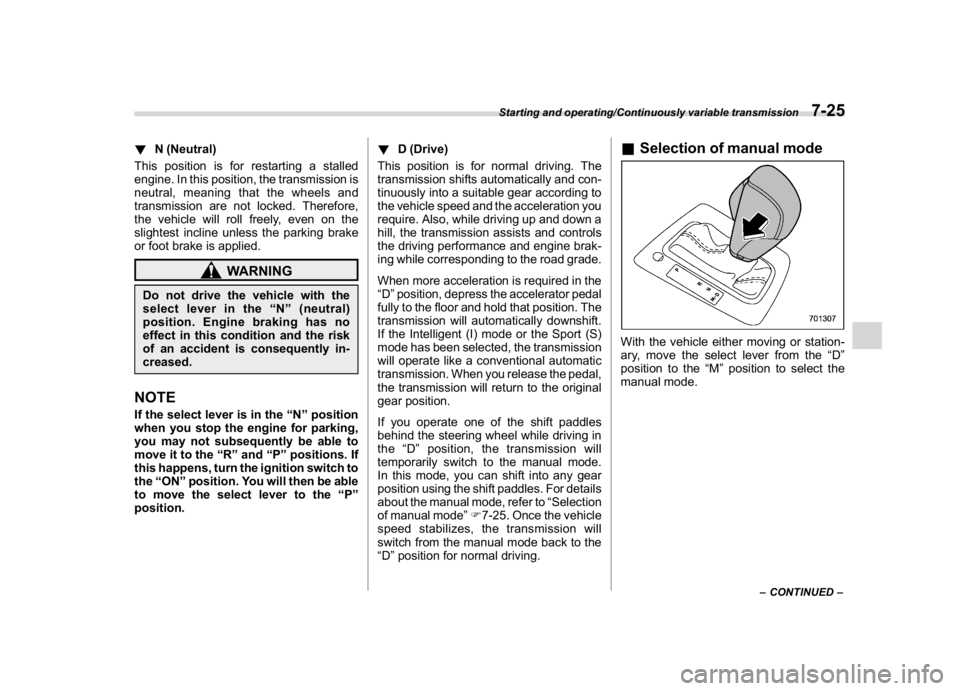
&Selection of manual modeWith the vehicle either moving or station-
ary, move the select lever from the“D”
position to the“M”position to select the
manual mode.
–CONTINUED–
Starting and operating/Continuously variable transmission
7-25
7
Page 376 of 578
(389,1)
北米Model "A1700BE-B" EDITED: 2017/ 10/ 11
red zone. Also, if the engine revolutions
reach the specified number, the fuel
supply will be cut. In this case, perform
shift up operation.
!To deselect the manual mode
To deselect the manual mode, return the
select lever to the“D”position from the“M”
position.&Shift lock functionThe shift lock function helps prevent the
improper operation of the select lever.
.You cannot move the select lever with
the ignition switch in the“ON”position and
the brake pedal depressed.
.You cannot move the select lever from
the“P”position to any other position
unless the brake pedal is depressed.
Depress the brake pedal first, and then
operate the select lever.
.Only the“P”position allows you to turn
the ignition switch from the“ACC”position
to the“LOCK”/“OFF”position and remove
the key from the ignition switch.
.If you turn the ignition switch to the
“LOCK”/“OFF”position while the select
lever is in the“N”position, the select lever
may not be moved to the“P”position after
a period of time. Therefore, move the
select lever to the“P”position with the
brake pedal depressed soon after turningthe ignition switch to the“LOCK”/“OFF”
position.
!Shift lock release
If you cannot move the select lever, turn
theignitionswitchbacktothe“ON”
position then move the select lever to the
“P”position with the select lever button
pressed and brake pedal depressed.
If the select lever does not move after
performing the above procedure, perform
the following steps.
.When you cannot shift the select
lever from“P”to“N”:
Refer to“
Shift lock release using the shift
lock release button”F7-27.
.When you cannot shift the select
lever from“N”to“R”,“P”:
Within 60 seconds after placing the ignition
switch in the“ACC”position, move the
select lever to the“P”position with the
select lever button pressed and brake
pedal depressed.
If you must perform the above procedure,
the shift lock system (or the vehicle control
system) may be malfunctioning. Contact a
SUBARU dealer for an inspection as soon
as possible.
If the select lever does not move after
performing the above procedure, refer to“Shift lock release using the shift lock
release button”F7-27.
!Shift lock release using the shift
lock release button
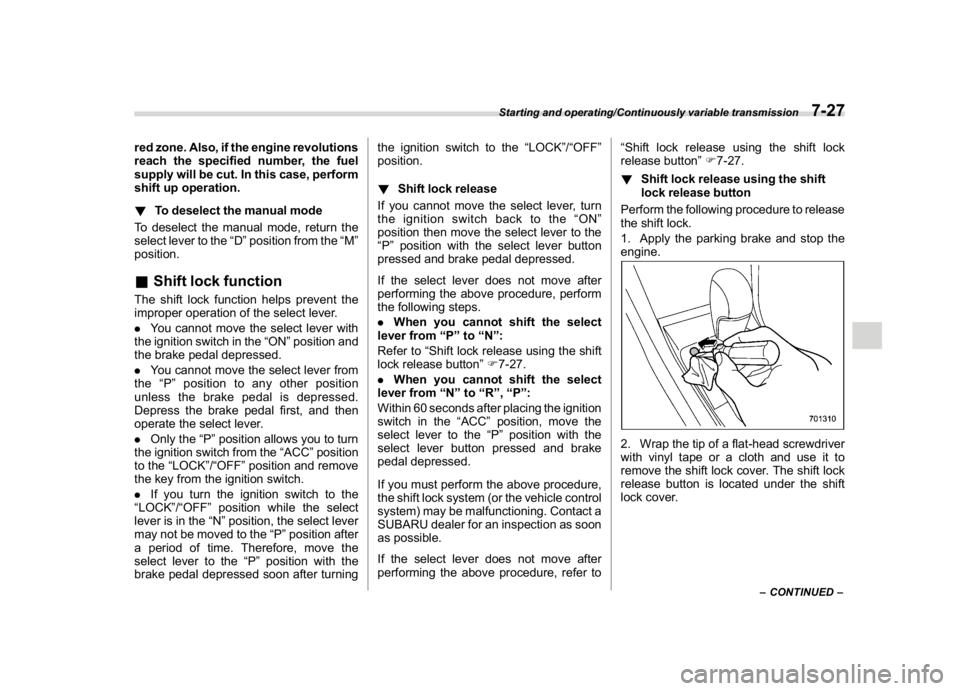
Perform the following procedure to release
the shift lock.
1. Apply the parking brake and stop the
engine.
2. Wrap the tip of a flat-head screwdriver
with vinyl tape or a cloth and use it to
remove the shift lock cover. The shift lock
release button is located under the shift
lock cover.
–CONTINUED–
Starting and operating/Continuously variable transmission
7-27
7
Page 377 of 578
(390,1)
北米Model "A1700BE-B" EDITED: 2017/ 10/ 11
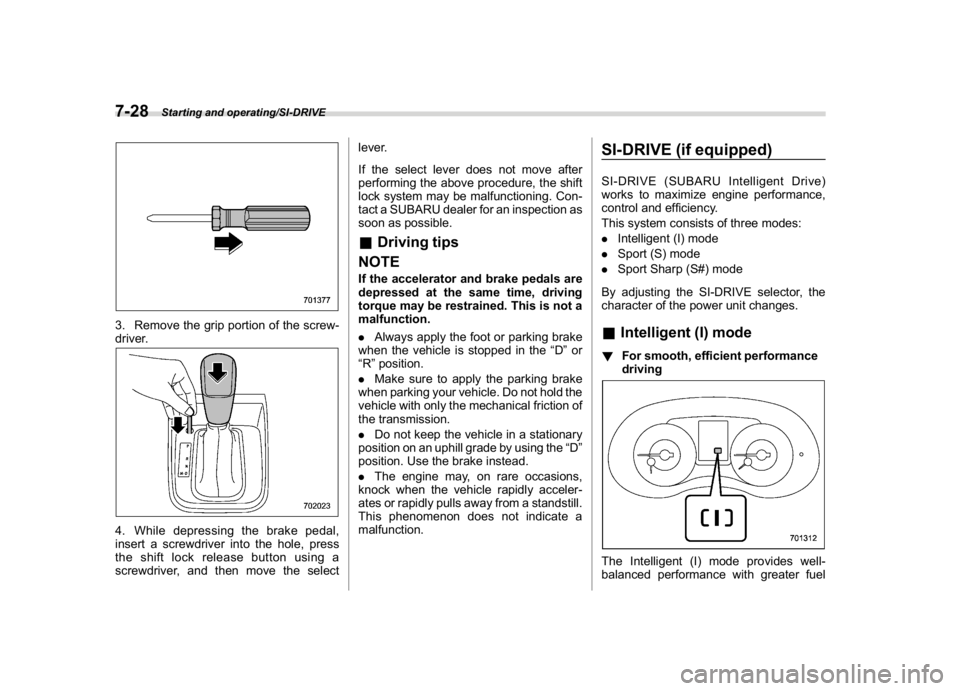
3. Remove the grip portion of the screw-
driver.4. While depressing the brake pedal,
insert a screwdriver into the hole, press
the shift lock release button using a
screwdriver, and then move the selectlever.
If the select lever does not move after
performing the above procedure, the shift
lock system may be malfunctioning. Con-
tact a SUBARU dealer for an inspection as
soon as possible.
&Driving tips
NOTEIf the accelerator and brake pedals are
depressed at the same time, driving
torque may be restrained. This is not a
malfunction.
.Always apply the foot or parking brake
when the vehicle is stopped in the“D”or
“R”position.
.Make sure to apply the parking brake
when parking your vehicle. Do not hold the
vehicle with only the mechanical friction of
the transmission.
.Do not keep the vehicle in a stationary
position on an uphill grade by using the“D”
position. Use the brake instead.
.The engine may, on rare occasions,
knock when the vehicle rapidly acceler-
ates or rapidly pulls away from a standstill.
This phenomenon does not indicate a
malfunction.
SI-DRIVE (if equipped)SI-DRIVE (SUBARU Intelligent Drive)
works to maximize engine performance,
control and efficiency.
This system consists of three modes:
.Intelligent (I) mode
.Sport (S) mode
.Sport Sharp (S#) mode
By adjusting the SI-DRIVE selector, the
character of the power unit changes.&Intelligent (I) mode!For smooth, efficient performance
drivingThe Intelligent (I) mode provides well-
balanced performance with greater fuel
Starting and operating/SI-DRIVE
7-28
Page 380 of 578
(393,1)
北米Model "A1700BE-B" EDITED: 2017/ 10/ 11
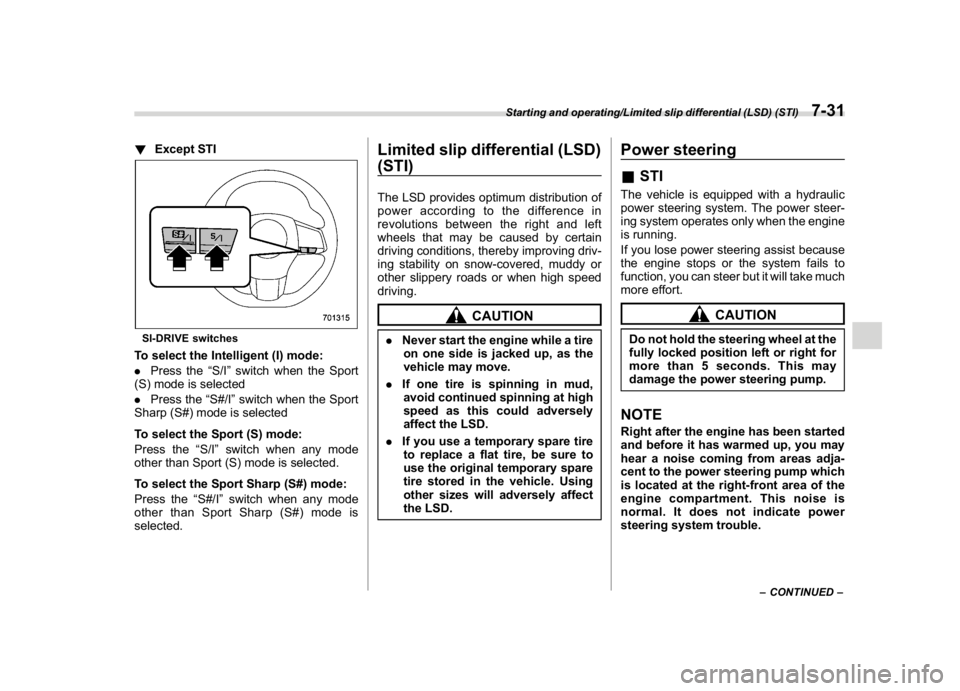
!Except STISI-DRIVE switchesTo select the Intelligent (I) mode:
.Press the“S/I”switch when the Sport
(S) mode is selected
.Press the“S#/I”switch when the Sport
Sharp (S#) mode is selected
To select the Sport (S) mode:
Press the“S/I”switch when any mode
other than Sport (S) mode is selected.
To select the Sport Sharp (S#) mode:
Press the“S#/I”switch when any mode
other than Sport Sharp (S#) mode is
selected.
Limited slip differential (LSD)
(STI)The LSD provides optimum distribution of
power according to the difference in
revolutions between the right and left
wheels that may be caused by certain
driving conditions, thereby improving driv-
ing stability on snow-covered, muddy or
other slippery roads or when high speed
driving.
CAUTION
.Never start the engine while a tire
on one side is jacked up, as the
vehicle may move.
.If one tire is spinning in mud,
avoid continued spinning at high
speed as this could adversely
affect the LSD.
.If you use a temporary spare tire
to replace a flat tire, be sure to
use the original temporary spare
tire stored in the vehicle. Using
other sizes will adversely affect
the LSD.
Power steering&STIThe vehicle is equipped with a hydraulic
power steering system. The power steer-
ing system operates only when the engine
is running.
If you lose power steering assist because
the engine stops or the system fails to
function, you can steer but it will take much
more effort.
CAUTION
Do not hold the steering wheel at the
fully locked position left or right for
more than 5 seconds. This may
damage the power steering pump.NOTERight after the engine has been started
and before it has warmed up, you may
hear a noise coming from areas adja-
cent to the power steering pump which
is located at the right-front area of the
engine compartment. This noise is
normal. It does not indicate power
steering system trouble.
–CONTINUED–
Starting and operating/Limited slip differential (LSD) (STI)
7-31
7
Page 384 of 578
(397,1)
北米Model "A1700BE-B" EDITED: 2017/ 10/ 11
ABS (Anti-lock Brake Sys-
tem)The ABS prevents the lock-up of wheels
which may occur during sudden braking or
braking on slippery road surfaces. This
helps prevent the loss of steering control
and directional stability caused by wheel
lock-up.
When the ABS is operating, you may hear
a chattering noise or feel a slight vibration
in the brake pedal. This is normal when the
ABS operates.
The ABS will not operate when the vehicle
speed is below approximately 6 mph (10
km/h).
WARNING
Always use the utmost care in driv-
ing–overconfidence because you
are driving a vehicle with the ABS
could easily lead to a serious acci-
dent.
CAUTION
.The ABS does not always de-
crease stopping distance. You
should always maintain a safe
following distance from other
vehicles.
.When driving on badly surfaced
roads, gravel roads, icy roads, or
over deep newly fallen snow,
stopping distances may be long-
er for a vehicle with the ABS than
one without. When driving under
these conditions, therefore, re-
duce your speed and leave ample
distance from other vehicles.
.When you feel the ABS operating,
you should maintain constant
brake pedal pressure. Do not
pump the brake pedal since
doing so may defeat the opera-
tion of the ABS system.
&ABS self-checkJust after the vehicle is started, you may
feel on the brake pedal a vibration similar
to when the ABS operates, and you may
also hear the sound of the ABS working
from the engine compartment. This is
caused by an automatic functional test of
the ABS being carried out and does not
indicate any abnormal condition.&ABS warning lightRefer to“ABS warning light”F3-20.
Starting and operating/ABS (Anti-lock Brake System)
7-35
7
Page 385 of 578
(398,1)
北米Model "A1700BE-B" EDITED: 2017/ 10/ 11
Electronic Brake Force Dis-
tribution (EBD) systemThe EBD system maximizes the effective-
ness of the brakes by allowing the rear
brakes to supply a greater proportion of the
braking force. It functions by adjusting the
distribution of braking force to the rear
wheels in accordance with the vehicle’s
loading condition and speed.
The EBD system is an integral part of the
ABS and uses some of the ABS compo-
nents to perform its function of optimizing
the distribution of braking force. If any of
the ABS components used by the EBD
system malfunction, the EBD system also
stops working.
When the EBD system is operating, you
may hear a chattering noise or feel a slight
vibration in the brake pedal. This is normal
and does not indicate a malfunction.
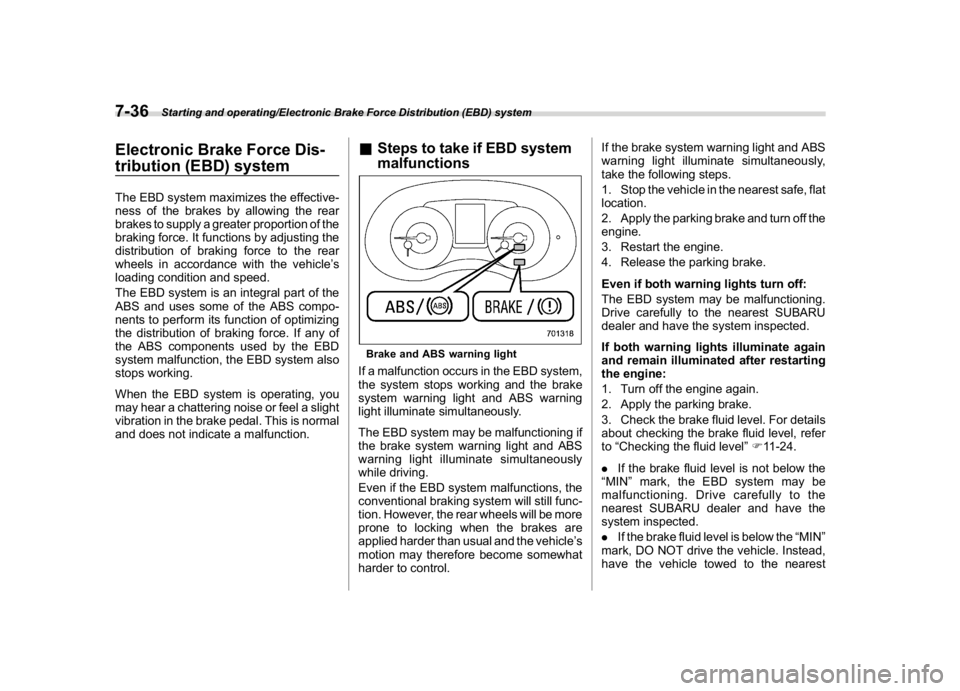
&Steps to take if EBD system
malfunctionsBrake and ABS warning lightIf a malfunction occurs in the EBD system,
the system stops working and the brake
system warning light and ABS warning
light illuminate simultaneously.
The EBD system may be malfunctioning if
the brake system warning light and ABS
warning light illuminate simultaneously
while driving.
Even if the EBD system malfunctions, the
conventional braking system will still func-
tion. However, the rear wheels will be more
prone to locking when the brakes are
applied harder than usual and the vehicle’s
motion may therefore become somewhat
harder to control.If the brake system warning light and ABS
warning light illuminate simultaneously,
take the following steps.
1. Stop the vehicle in the nearest safe, flat
location.
2. Apply the parking brake and turn off the
engine.
3. Restart the engine.
4. Release the parking brake.
Even if both warning lights turn off:
The EBD system may be malfunctioning.
Drive carefully to the nearest SUBARU
dealer and have the system inspected.
If both warning lights illuminate again
and remain illuminated after restarting
the engine:
1. Turn off the engine again.
2. Apply the parking brake.
3. Check the brake fluid level. For details
about checking the brake fluid level, refer
to“Checking the fluid level”F11-24.
.If the brake fluid level is not below the
“MIN”mark, the EBD system may be
malfunctioning. Drive carefully to the
nearest SUBARU dealer and have the
system inspected.
.If the brake fluid level is below the“MIN”
mark, DO NOT drive the vehicle. Instead,
have the vehicle towed to the nearest
Starting and operating/Electronic Brake Force Distribution (EBD) system
7-36
Page 389 of 578
(402,1)
北米Model "A1700BE-B" EDITED: 2017/ 10/ 11
off.
Creating an adequate driving wheel slip by
deactivating the Vehicle Dynamics Control
system temporarily may help to escape
from the following situations. Use the
Vehicle Dynamics Control OFF mode as
necessary.
.a standing start on a steeply sloping
road with a snowy, gravel-covered, or
otherwise slippery surface
.extrication of the vehicle when its
wheels are stuck in mud or deep snow
You should not deactivate the Vehicle
Dynamics Control system except under
the above-mentioned situations.NOTE.If you turn the ignition switch to the
“LOCK”/“OFF”position with the Vehi-
cle Dynamics Control system deacti-
vated, the system will be automatically
reactivated the next time the engine is
started.
.If you press and hold the switch for
30 seconds or longer, the Vehicle
Dynamics Control OFF indicator light
turns off, the Vehicle Dynamics Control
system is activated, and the system
ignores any further pressing of the
switch. To make the switch usable
again, turn the ignition switch to the“LOCK”/“OFF”position and restart the
engine.
.When the Vehicle Dynamics Control
OFF mode is selected, the vehicle’s
running performance is comparable
with that of a vehicle that does not have
a Vehicle Dynamics Control system. Do
not deactivate the Vehicle Dynamics
Control system except when absolutely
necessary.
.Even when the Vehicle Dynamics
Control OFF mode is selected, compo-
nents of the brake control system may
still activate. When the brake control
system is activated, the Vehicle Dy-
namics Control operation indicator
light illuminates.
Tire pressure monitoring
system (TPMS) (U.S.-spec.
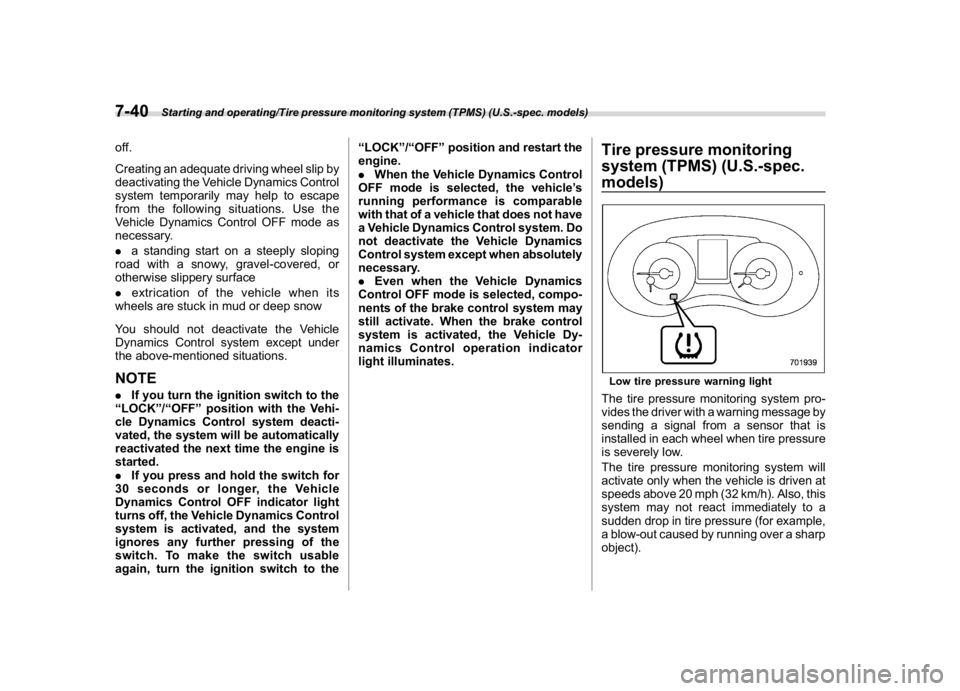
models)Low tire pressure warning lightThe tire pressure monitoring system pro-
vides the driver with a warning message by
sending a signal from a sensor that is
installed in each wheel when tire pressure
is severely low.
The tire pressure monitoring system will
activate only when the vehicle is driven at
speeds above 20 mph (32 km/h). Also, this
system may not react immediately to a
sudden drop in tire pressure (for example,
a blow-out caused by running over a sharp
object).
Starting and operating/Tire pressure monitoring system (TPMS) (U.S.-spec. models)
7-40
Page 392 of 578
(405,1)
北米Model "A1700BE-B" EDITED: 2017/ 10/ 11
2. Press the release button.
3. Lower the lever while keeping the
button pressed.
When the parking brake is set while the
engine is running, the parking brake
warning light illuminates. Be sure that the
warning light is turned off before driving off.
Refer to“Parking brake indicator (models
without electronic parking brake system)”
F3-21.
CAUTION
Never drive while the parking brake
is set because this will cause un-
necessary wear on the brake linings.
Make sure that the parking brake has
been fully released before driving
off.
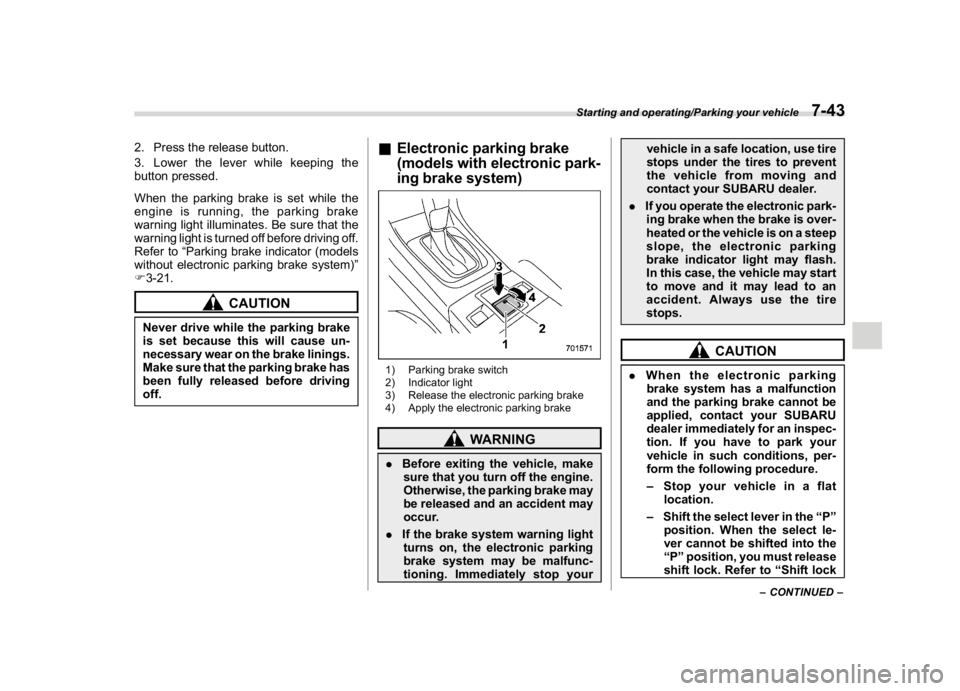
&Electronic parking brake
(models with electronic park-
ing brake system)1) Parking brake switch
2) Indicator light
3) Release the electronic parking brake
4) Apply the electronic parking brake
WARNING
.Before exiting the vehicle, make
sure that you turn off the engine.
Otherwise, the parking brake may
be released and an accident may
occur.
.If the brake system warning light
turns on, the electronic parking
brake system may be malfunc-
tioning. Immediately stop yourvehicle in a safe location, use tire
stops under the tires to prevent
the vehicle from moving and
contact your SUBARU dealer.
.If you operate the electronic park-
ing brake when the brake is over-
heated or the vehicle is on a steep
slope, the electronic parking
brake indicator light may flash.
In this case, the vehicle may start
to move and it may lead to an
accident. Always use the tire
stops.
CAUTION
.When the electronic parking
brake system has a malfunction
and the parking brake cannot be
applied, contact your SUBARU
dealer immediately for an inspec-
tion. If you have to park your
vehicle in such conditions, per-
form the following procedure.
–Stop your vehicle in a flat
location.
–Shift the select lever in the“P”
position. When the select le-
ver cannot be shifted into the
“P”position, you must release
shift lock. Refer to“Shift lock
–CONTINUED–
Starting and operating/Parking your vehicle
7-43
7
Page 393 of 578

(406,1)
北米Model "A1700BE-B" EDITED: 2017/ 10/ 11
function”F7-27.
–Use tire stops under the tires
to prevent the vehicle from
moving.
.Never drive with the parking
brake applied. Doing so will
cause unnecessary wear on the
brake linings. Before driving off,
always make sure that the park-
ing brake has been released and
the brake system warning light
has turned off.
Your vehicle is equipped with an electronic
parking brake. You can apply/release the
parking brake by operating the parking
brake switch.
To apply:Depress the brake pedal and
pull up the parking brake switch.
To release:Press the parking brake
switch firmly while the ignition switch is in
the“ON”position and the brake pedal is
depressed.
When the parking brake is applied while
the ignition switch is in the“ON”position,
the electronic parking brake indicator light
and the indicator light on the parking brake
switch illuminate. Refer to“Brake system
warning light”F3-21.
NOTE.If you press the parking brake switch
under the following conditions, the
parking brake will not be released.
–The ignition switch is in the
“ACC”or“LOCK”/“OFF”position.
–You are not depressing the brake
pedal.
.The electronic parking brake system
uses motors to apply the parking brake.
Therefore, operating sounds from the
motors will be heard when applying or
releasing the parking brake. Make sure
that the motor sounds are heard when
applying or releasing the parking
brake.
.If you operate the parking brake
switch under the following conditions,
a chirp will sound and the electronic
parking brake indicator light will flash.
–when the electronic parking
brake system has a malfunction
–when the electronic parking
brake operation is prohibited tem-
porarily
.When you cannot release the park-
ing brake due to, for example, a system
malfunction, contact your SUBARU
dealer and have your SUBARU dealer
release the parking brake.
.If you stop operating the electronicparking brake switch midway or oper-
ate extremely slowly, the system may
detect an error and turn on the brake
system warning light. However, this
does not indicate a malfunction if the
brake system warning light turns off
after operating the switch.
.When the electronic parking brake
has not been used for a long period of
time, the electronic parking brake may
operate automatically after the ignition
switch is turned to the“LOCK”/“OFF”
position. This occurs due to checking
the proper operation of the electronic
parking brake and does not indicate a
malfunction.
.If you cannot release the electronic
parking brake due to the switch mal-
function, refer to the instructions de-
scribed in“Automatic release function
by accelerator pedal”F7-45.
After activating the electronic parking
brake, you may hear a short sound
several minutes after the electronic
parking brake indicator light illumi-
nates as the system confirms proper
engagement. This sound is different
from the apply and release sound.
This can occur:
–If the brakes are extremely hot.
–If the car is parked on a steep
incline.
Starting and operating/Parking your vehicle
7-44