ABS SUBARU WRX 2018 User Guide
[x] Cancel search | Manufacturer: SUBARU, Model Year: 2018, Model line: WRX, Model: SUBARU WRX 2018Pages: 578, PDF Size: 33.21 MB
Page 383 of 578
(396,1)
北米Model "A1700BE-B" EDITED: 2017/ 10/ 11
cate any malfunctions, and the brake
assist system is operating properly.
.You might feel that the brake pedal is
applied by lighter force and generates a
greater braking force.
.You might hear an ABS operating
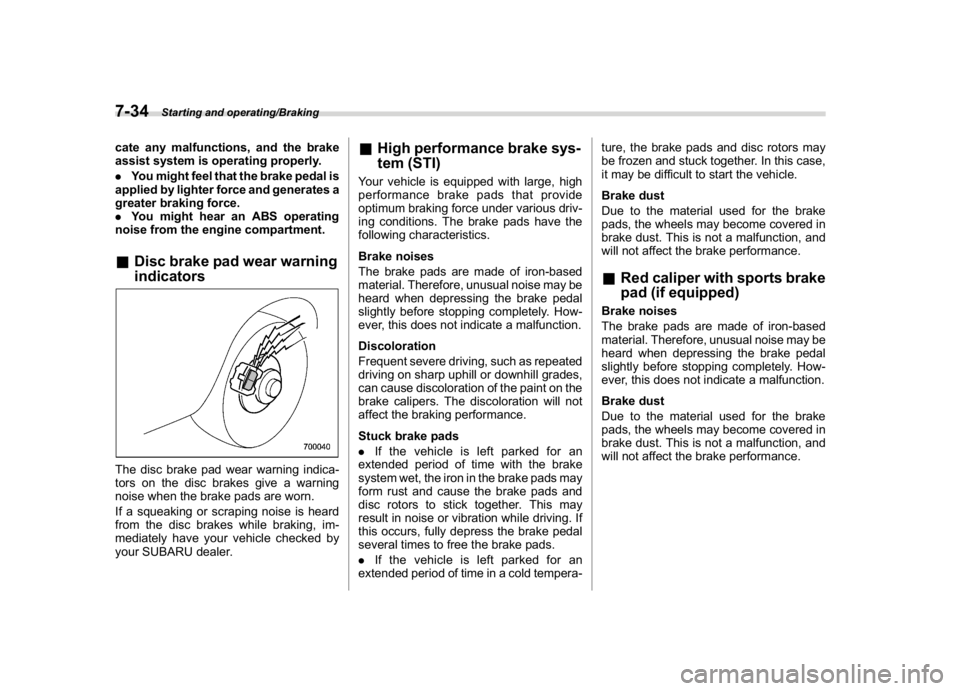
noise from the engine compartment.&Disc brake pad wear warning
indicatorsThe disc brake pad wear warning indica-
tors on the disc brakes give a warning
noise when the brake pads are worn.
If a squeaking or scraping noise is heard
from the disc brakes while braking, im-
mediately have your vehicle checked by
your SUBARU dealer.
&High performance brake sys-
tem (STI)Your vehicle is equipped with large, high
performance brake pads that provide
optimum braking force under various driv-
ing conditions. The brake pads have the
following characteristics.
Brake noises
The brake pads are made of iron-based
material. Therefore, unusual noise may be
heard when depressing the brake pedal
slightly before stopping completely. How-
ever, this does not indicate a malfunction.
Discoloration
Frequent severe driving, such as repeated
driving on sharp uphill or downhill grades,
can cause discoloration of the paint on the
brake calipers. The discoloration will not
affect the braking performance.
Stuck brake pads
.If the vehicle is left parked for an
extended period of time with the brake
system wet, the iron in the brake pads may
form rust and cause the brake pads and
disc rotors to stick together. This may
result in noise or vibration while driving. If
this occurs, fully depress the brake pedal
several times to free the brake pads.
.If the vehicle is left parked for an
extended period of time in a cold tempera-ture, the brake pads and disc rotors may
be frozen and stuck together. In this case,
it may be difficult to start the vehicle.
Brake dust
Due to the material used for the brake
pads, the wheels may become covered in
brake dust. This is not a malfunction, and
will not affect the brake performance.
&Red caliper with sports brake
pad (if equipped)Brake noises
The brake pads are made of iron-based
material. Therefore, unusual noise may be
heard when depressing the brake pedal
slightly before stopping completely. How-
ever, this does not indicate a malfunction.
Brake dust
Due to the material used for the brake
pads, the wheels may become covered in
brake dust. This is not a malfunction, and
will not affect the brake performance.
Starting and operating/Braking
7-34
Page 384 of 578
(397,1)
北米Model "A1700BE-B" EDITED: 2017/ 10/ 11
ABS (Anti-lock Brake Sys-
tem)The ABS prevents the lock-up of wheels
which may occur during sudden braking or
braking on slippery road surfaces. This
helps prevent the loss of steering control
and directional stability caused by wheel
lock-up.
When the ABS is operating, you may hear
a chattering noise or feel a slight vibration
in the brake pedal. This is normal when the
ABS operates.
The ABS will not operate when the vehicle
speed is below approximately 6 mph (10
km/h).
WARNING
Always use the utmost care in driv-
ing–overconfidence because you
are driving a vehicle with the ABS
could easily lead to a serious acci-
dent.
CAUTION
.The ABS does not always de-
crease stopping distance. You
should always maintain a safe
following distance from other
vehicles.
.When driving on badly surfaced
roads, gravel roads, icy roads, or
over deep newly fallen snow,
stopping distances may be long-
er for a vehicle with the ABS than
one without. When driving under
these conditions, therefore, re-
duce your speed and leave ample
distance from other vehicles.
.When you feel the ABS operating,
you should maintain constant
brake pedal pressure. Do not
pump the brake pedal since
doing so may defeat the opera-
tion of the ABS system.
&ABS self-checkJust after the vehicle is started, you may
feel on the brake pedal a vibration similar
to when the ABS operates, and you may
also hear the sound of the ABS working
from the engine compartment. This is
caused by an automatic functional test of
the ABS being carried out and does not
indicate any abnormal condition.&ABS warning lightRefer to“ABS warning light”F3-20.
Starting and operating/ABS (Anti-lock Brake System)
7-35
7
Page 385 of 578
(398,1)
北米Model "A1700BE-B" EDITED: 2017/ 10/ 11
Electronic Brake Force Dis-
tribution (EBD) systemThe EBD system maximizes the effective-
ness of the brakes by allowing the rear
brakes to supply a greater proportion of the
braking force. It functions by adjusting the
distribution of braking force to the rear
wheels in accordance with the vehicle’s
loading condition and speed.
The EBD system is an integral part of the
ABS and uses some of the ABS compo-
nents to perform its function of optimizing
the distribution of braking force. If any of
the ABS components used by the EBD
system malfunction, the EBD system also
stops working.
When the EBD system is operating, you
may hear a chattering noise or feel a slight
vibration in the brake pedal. This is normal
and does not indicate a malfunction.
&Steps to take if EBD system
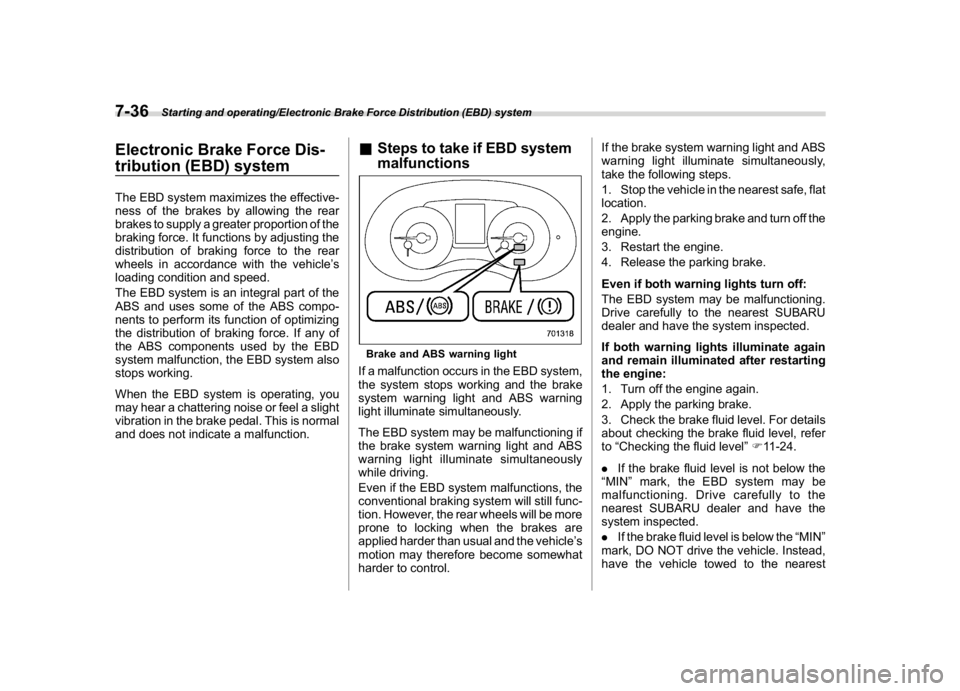
malfunctionsBrake and ABS warning lightIf a malfunction occurs in the EBD system,
the system stops working and the brake
system warning light and ABS warning
light illuminate simultaneously.
The EBD system may be malfunctioning if
the brake system warning light and ABS
warning light illuminate simultaneously
while driving.
Even if the EBD system malfunctions, the
conventional braking system will still func-
tion. However, the rear wheels will be more
prone to locking when the brakes are
applied harder than usual and the vehicle’s
motion may therefore become somewhat
harder to control.If the brake system warning light and ABS
warning light illuminate simultaneously,
take the following steps.
1. Stop the vehicle in the nearest safe, flat
location.
2. Apply the parking brake and turn off the
engine.
3. Restart the engine.
4. Release the parking brake.
Even if both warning lights turn off:
The EBD system may be malfunctioning.
Drive carefully to the nearest SUBARU
dealer and have the system inspected.
If both warning lights illuminate again
and remain illuminated after restarting
the engine:
1. Turn off the engine again.
2. Apply the parking brake.
3. Check the brake fluid level. For details
about checking the brake fluid level, refer
to“Checking the fluid level”F11-24.
.If the brake fluid level is not below the
“MIN”mark, the EBD system may be
malfunctioning. Drive carefully to the
nearest SUBARU dealer and have the
system inspected.
.If the brake fluid level is below the“MIN”
mark, DO NOT drive the vehicle. Instead,
have the vehicle towed to the nearest
Starting and operating/Electronic Brake Force Distribution (EBD) system
7-36
Page 387 of 578
(400,1)
北米Model "A1700BE-B" EDITED: 2017/ 10/ 11
should be taken into account
when driving the vehicle in
such a condition.
.If you use non-matching tires, the
Vehicle Dynamics Control sys-
tem may not operate correctly.
.The Vehicle Dynamics Control
system helps prevent unstable
vehicle motion such as skidding
using control of the brakes and
engine power. Do not turn off the
Vehicle Dynamics Control sys-
tem unless it is absolutely neces-
sary. If you must turn off the
Vehicle Dynamics Control sys-
tem, drive very carefully accord-
ing to the road surface condition.
In the event of wheelspin and/or skidding
on a slippery road surface and/or during
cornering and/or an evasive maneuver,
the Vehicle Dynamics Control system
adjusts the engine’s output and the
wheels’respective braking forces to help
maintain traction and directional control.
.Traction Control Function
The traction control function is designed to
prevent spinning of the driving wheels on
slippery road surfaces, thereby helping to
maintain traction and directional control.
Activation of this function is shown byflashing the Vehicle Dynamics Control
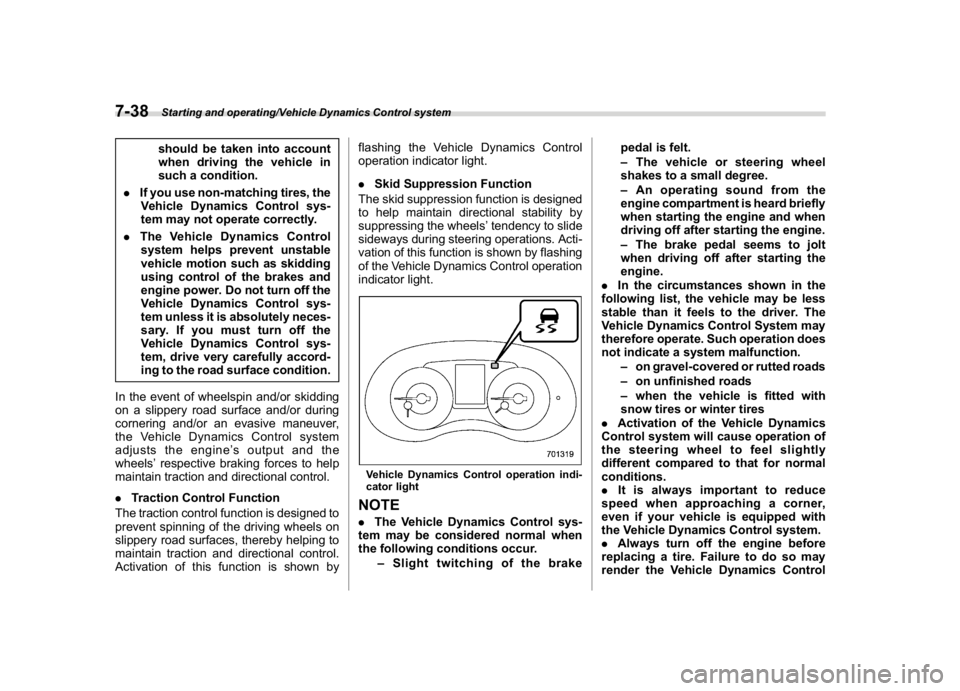
operation indicator light.
.Skid Suppression Function
The skid suppression function is designed
to help maintain directional stability by
suppressing the wheels’tendency to slide
sideways during steering operations. Acti-
vation of this function is shown by flashing
of the Vehicle Dynamics Control operation
indicator light.
Vehicle Dynamics Control operation indi-
cator lightNOTE.The Vehicle Dynamics Control sys-
tem may be considered normal when
the following conditions occur.
–Slight twitching of the brakepedal is felt.
–The vehicle or steering wheel
shakes to a small degree.
–An operating sound from the
engine compartment is heard briefly
when starting the engine and when
driving off after starting the engine.
–The brake pedal seems to jolt
when driving off after starting the
engine.
.In the circumstances shown in the
following list, the vehicle may be less
stable than it feels to the driver. The
Vehicle Dynamics Control System may
therefore operate. Such operation does
not indicate a system malfunction.
–on gravel-covered or rutted roads
–on unfinished roads
–when the vehicle is fitted with
snow tires or winter tires
.Activation of the Vehicle Dynamics
Control system will cause operation of
the steering wheelto feel slightly
different compared to that for normal
conditions.
.It is always important to reduce
speed when approaching a corner,
even if your vehicle is equipped with
the Vehicle Dynamics Control system.
.Always turn off the engine before
replacing a tire. Failure to do so may
render the Vehicle Dynamics Control
Starting and operating/Vehicle Dynamics Control system
7-38
Page 388 of 578
(401,1)
北米Model "A1700BE-B" EDITED: 2017/ 10/ 11
system unable to operate correctly.&Vehicle Dynamics Control
system monitorRefer to“Vehicle Dynamics Control warn-
ing light/Vehicle Dynamics Control opera-
tion indicator light”F3-26 and“Vehicle
Dynamics Control OFF indicator light/
Traction mode indicator light /”F3-27.&Vehicle Dynamics Control
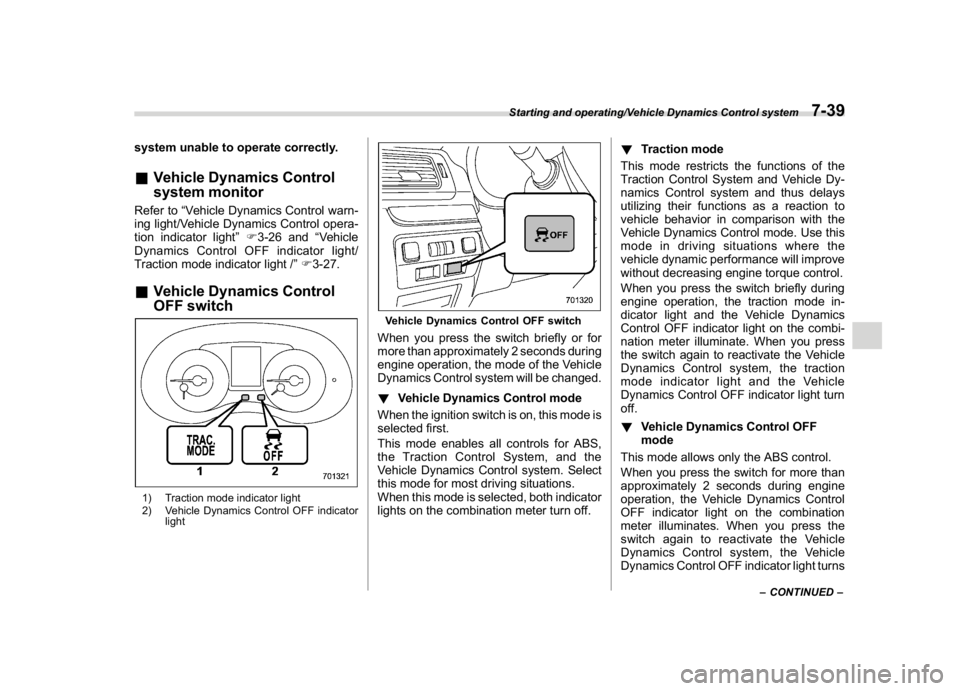
OFF switch1) Traction mode indicator light
2) Vehicle Dynamics Control OFF indicator
light
Vehicle Dynamics Control OFF switchWhen you press the switch briefly or for
more than approximately 2 seconds during
engine operation, the mode of the Vehicle
Dynamics Control system will be changed.
!Vehicle Dynamics Control mode
When the ignition switch is on, this mode is
selected first.
This mode enables all controls for ABS,
the Traction Control System, and the
Vehicle Dynamics Control system. Select
this mode for most driving situations.
When this mode is selected, both indicator
lights on the combination meter turn off.!Traction mode
This mode restricts the functions of the
Traction Control System and Vehicle Dy-
namics Control system and thus delays
utilizing their functions as a reaction to
vehicle behavior in comparison with the
Vehicle Dynamics Control mode. Use this
mode in driving situations where the
vehicle dynamic performance will improve
without decreasing engine torque control.
When you press the switch briefly during
engine operation, the traction mode in-
dicator light and the Vehicle Dynamics
Control OFF indicator light on the combi-
nation meter illuminate. When you press
the switch again to reactivate the Vehicle
Dynamics Control system, the traction
mode indicator light and the Vehicle
Dynamics Control OFF indicator light turn
off.
!Vehicle Dynamics Control OFF
mode
This mode allows only the ABS control.
When you press the switch for more than
approximately 2 seconds during engine
operation, the Vehicle Dynamics Control
OFF indicator light on the combination
meter illuminates. When you press the
switch again to reactivate the Vehicle
Dynamics Control system, the Vehicle
Dynamics Control OFF indicator light turns
–CONTINUED–
Starting and operating/Vehicle Dynamics Control system
7-39
7
Page 389 of 578
(402,1)
北米Model "A1700BE-B" EDITED: 2017/ 10/ 11
off.
Creating an adequate driving wheel slip by
deactivating the Vehicle Dynamics Control
system temporarily may help to escape
from the following situations. Use the
Vehicle Dynamics Control OFF mode as
necessary.
.a standing start on a steeply sloping
road with a snowy, gravel-covered, or
otherwise slippery surface
.extrication of the vehicle when its
wheels are stuck in mud or deep snow
You should not deactivate the Vehicle
Dynamics Control system except under
the above-mentioned situations.NOTE.If you turn the ignition switch to the
“LOCK”/“OFF”position with the Vehi-
cle Dynamics Control system deacti-
vated, the system will be automatically
reactivated the next time the engine is
started.
.If you press and hold the switch for
30 seconds or longer, the Vehicle
Dynamics Control OFF indicator light
turns off, the Vehicle Dynamics Control
system is activated, and the system
ignores any further pressing of the
switch. To make the switch usable
again, turn the ignition switch to the“LOCK”/“OFF”position and restart the
engine.
.When the Vehicle Dynamics Control
OFF mode is selected, the vehicle’s
running performance is comparable
with that of a vehicle that does not have
a Vehicle Dynamics Control system. Do
not deactivate the Vehicle Dynamics
Control system except when absolutely
necessary.
.Even when the Vehicle Dynamics
Control OFF mode is selected, compo-
nents of the brake control system may
still activate. When the brake control
system is activated, the Vehicle Dy-
namics Control operation indicator
light illuminates.
Tire pressure monitoring
system (TPMS) (U.S.-spec.
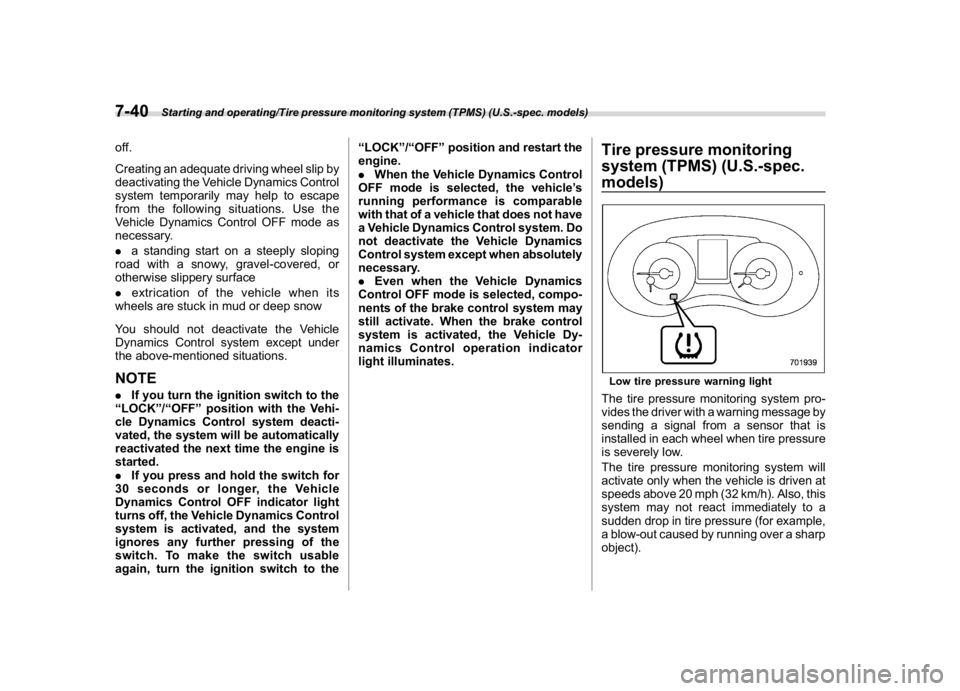
models)Low tire pressure warning lightThe tire pressure monitoring system pro-
vides the driver with a warning message by
sending a signal from a sensor that is
installed in each wheel when tire pressure
is severely low.
The tire pressure monitoring system will
activate only when the vehicle is driven at
speeds above 20 mph (32 km/h). Also, this
system may not react immediately to a
sudden drop in tire pressure (for example,
a blow-out caused by running over a sharp
object).
Starting and operating/Tire pressure monitoring system (TPMS) (U.S.-spec. models)
7-40
Page 401 of 578
(414,1)
北米Model "A1700BE-B" EDITED: 2017/ 10/ 11
NOTEIf you make an error when performing
any steps in the following procedure,
place the ignition switch in the“LOCK”/
“OFF”position once and then start
over again.
!To deactivate
1. Park your vehicle in a flat and safe
location and apply the parking brake.
2. Turn the ignition switch to the“LOCK”/
“OFF”position.
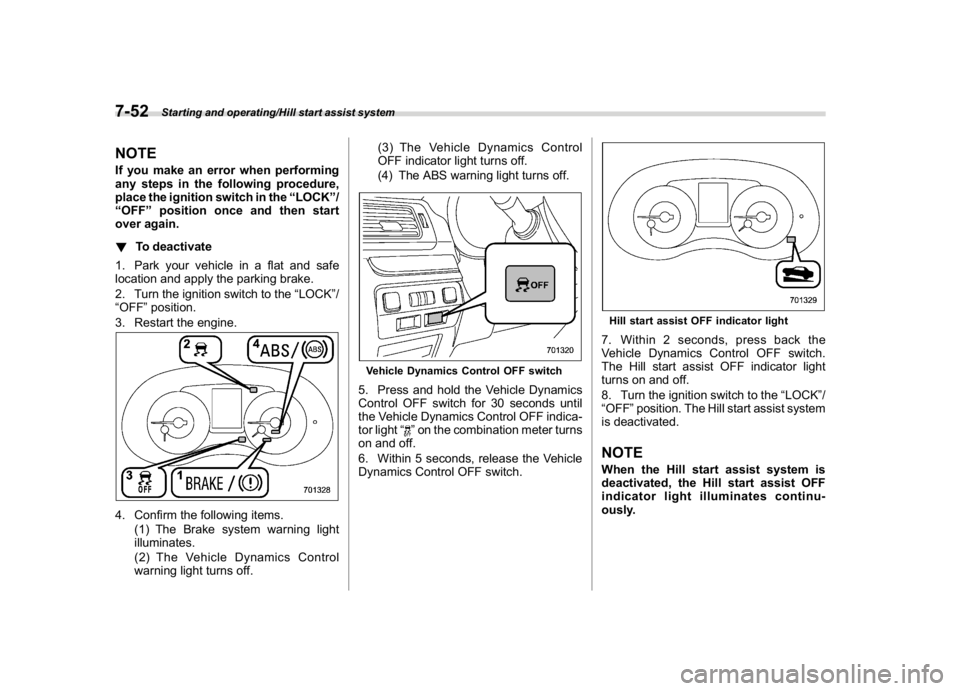
3. Restart the engine.4. Confirm the following items.
(1) The Brake system warning light
illuminates.
(2) The Vehicle Dynamics Control
warning light turns off.(3) The Vehicle Dynamics Control
OFF indicator light turns off.
(4) The ABS warning light turns off.
Vehicle Dynamics Control OFF switch5. Press and hold the Vehicle Dynamics
Control OFF switch for 30 seconds until
the Vehicle Dynamics Control OFF indica-
tor light“
”on the combination meter turns
on and off.
6. Within 5 seconds, release the Vehicle
Dynamics Control OFF switch.
Hill start assist OFF indicator light7. Within 2 seconds, press back the
Vehicle Dynamics Control OFF switch.
The Hill start assist OFF indicator light
turns on and off.
8. Turn the ignition switch to the“LOCK”/
“OFF”position. The Hill start assist system
is deactivated.NOTEWhen the Hill start assist system is
deactivated, the Hill start assist OFF
indicator light illuminates continu-
ously.
Starting and operating/Hill start assist system
7-52
Page 417 of 578

(430,1)
北米Model "A1700BE-B" EDITED: 2017/ 10/ 11
tem is set to on
.The select lever is in the“R”position
.The vehicle speed is between 1 to 9
mph (1.5 to 15 km/h)NOTE.When the Reverse Automatic Brak-
ing fail indicator is illuminated, the
Reverse Automatic Braking system
cannot be operated. Promptly contact
a SUBARU dealer to have the system
inspected.
.When the Reverse Automatic Brak-
ing system OFF indicator is illumi-
nated, the Reverse Automatic Braking
system cannot be operated.
.In the following cases, the system
may not be able to properly detect an
obstacle. Promptly contact a SUBARU
dealer to have the system inspected.
–A sticker, paint, or a chemical is
applied to the sonar sensors or the
rear bumper near the sonar sensor
–The rear bumper is modified
–The rear bumper has been re-
moved and reattached
–The ground clearance is changed
due to the vehicle’s loading condi-
tion or modification
–Ice, snow or mud is adhered to
the sonar sensors or the rear bum-
per near the sonar sensor–The rear bumper is exposed to
strong impact, or the rear bumper is
deformed
.On a steep hill, the system’s auto-
matic braking ability will be reduced.
.The system is designed to avoid
collisions by automatic hard braking
when the vehicle’s reversing speed is
less than approximately 3 mph (5 km/h).
However, the system does not guaran-
tee that the vehicle will be able to avoid
collisions in any situation.
.If the vehicle is reversed at an
extremely slow speed, the driver’s
operation may be prioritized. In this
case, automatic braking will not oper-
ate.
.The system may not be able to detect
the following objects
–Sharp or thin objects such as
poles, fences and ropes which may
not reflect the sound wave emitted
from the sonar sensor
–Objects that are too close to the
rear bumper when the select lever is
set to the“R”position
–Objects with a surface which may
not reflect the sound wave emitted
from the sonar sensor such as a
chain link fence.
.Objects the system is not designed
to detect–Pedestrians
–Moving objects including moving
vehicles
–Objects which absorb sound
waves such as cloth or snow
–Objects whose surface has a
diagonal angle
–Objects that are low to the ground
such as parking blocks
–Objects that are high above the
ground such as objects hanging
from above
.The system may not be able to
properly detect objects or may cause
a system malfunction when the follow-
ing conditions exist
High frequency sound from other
sources are nearby
–Horn sound from another vehicle
–Engine sound from other vehi-
cles
–Sound of an air brake
–Vehicle detection equipment or a
sonar from another vehicle
–A sound wave with a frequency
similar to the vehicle’s system is
transmitted nearby
–
A vehicle equipped with the same
system is reversing toward your
reversing direction
Starting and operating/Reverse Automatic Braking System
7-68
Page 433 of 578
(448,1)
北米Model "A1700BE-B" EDITED: 2017/ 10/ 11
–When the vehicle has been left
parked during a snowstorm
Check for snow or ice buildup on
the suspension, disc brakes and
brake hoses underneath the ve-
hicle. If there is caked snow or
ice, remove it, being careful not
to damage the disc brakes and
brake hoses and ABS harness.
When parking for long periods in cold
weather, you should observe the following
tips.
1. For MT models, place the shift lever in
the“1”or“R”position. For CVT models,
place the select lever in the“P”position.
2. Use tire stops under the tires to prevent
the vehicle from moving.
!Refueling in cold weather
To help prevent moisture from forming in
the fuel system and the risk of its freezing,
use of an antifreeze additive in the fuel
tank is recommended during cold weather.
Use only additives that are specifically
designed for this purpose. When an anti-
freeze additive is used, its effect lasts
longer if the tank is refilled whenever the
fuel level reaches half empty.
If your SUBARU is not going to be used for
an extended period, it is best to have thefuel tank filled to capacity.
&Driving on snowy and icy
roadsTo prevent skidding and slipping, avoid
sudden braking, abrupt acceleration, high-
speed driving, and sharp turning when
driving on snowy or icy roads.
Always maintain ample distance between
your vehicle and the vehicle ahead of you
to avoid the need for sudden braking.
To supplement the foot brake, use the
engine brake effectively to control the
vehicle speed. (Shift into a lower gear
when necessary.)
Avoid shifting down abruptly. Such beha-
vior can cause the wheels to lock, possibly
leading to loss of vehicle control.
An anti-lock brake system (ABS) en-
hances your vehicle’s braking perfor-
mance on snowy and icy roads. For
information on braking on slippery sur-
faces, refer to“ABS (Anti-lock Brake
System)”F7-35 and“Vehicle Dynamics
Control system”F7-37.
WARNING
Do not use the cruise control on
slippery roads such as snowy or icy
roads. This may cause loss of vehi-
cle control.
CAUTION
Avoid prolonged continuous driving
in snowstorms. Snow will enter the
engine’sintakesystemandmay
hinder the airflow, which could re-
sult in engine shutdown or even
breakdown.
!Wiper operation when snowing
Before driving in cold weather, make sure
the wiper blade rubbers are not frozen to
the windshield.
If the wiper blade rubbers are frozen to the
windshield, use the defroster and the
temperature set for maximum warmth until
the wiper blade rubbers are completely
thawed. Refer to“Climate control”F4-1.
If your vehicle is equipped with a wiper
deicer, use it. It is helpful to thaw the
windshield wiper blade rubbers. Refer to
“Defogger and deicer”F3-84.
When driving in snow, if frozen snow starts
Driving tips/Winter driving
8-8
Page 477 of 578

(496,1)
北米Model "A1700BE-B" EDITED: 2017/ 10/ 11
NOTE.When wiping, be careful not to
strongly disturb the ultra-suede piles.
.Use a clean cloth. When wiping,
rinse the cloth carefully and fully re-
move all dirt from it.&Liquid dirtFor any spillage cleaning, carry out the
following methods.
.Spilled liquids: Use tissue paper or
similar material to gently absorb the liquid.
.If mud, coffee, or other dirt hardens
after drying, use a lint brush or similar
means and gently brush the spot to
remove the dirt.
If the dirt cannot be removed after per-
forming the above cleaning, refer to“Dirt
from hands”F10-8.&Dirt from handsIf the texture or appearance has been
diminished by dirt from hands or other
sources, follow the procedure below for
cleaning.
Items to prepare:
A) Cloth dampened with neutral detergent
solution (5 - 10%) and strongly wrung out
B) Cloth dampened with warm water at
approximately 1048F (408C)Procedure:
1. Use a lint brush or similar means and
gently brush to remove adhering dust and
dirt.
2. Use the cloth that was dampened with
neutral detergent solution (5 - 10%) and
strongly wrung out (A) and grip the steer-
ing wheel with it, then wipe by moving the
cloth around the steering wheel as shown
in the figure.
3. In order to remove the remaining
neutral detergent on the ultra-suede, use
the cloth that was dampened with warm
water at approximately 1048F (408C) (B) to
grip the steering wheel with it, then wipe by
moving the cloth around the steering
wheel. Rinse the cloth with warm water
and repeat this step 3 times.
4. If the surface piles become disturbed,brush gently using a lint brush or similar
means.
CAUTION
.Do not use benzene, gasoline, or
other organic solvent, acidic or
alkaline detergents, dyes, bleach,
or similar substances. Doing so
may cause discoloration, wrin-
kles, or peeling of the paint.
.Do not use commercially avail-
able cleaners. They may contain
components that cause disco-
loration, wrinkles, and paint to
peel off.
.Strongly wring out the cloth dam-
pened with the neutral detergent
solution or warm water. If water
or detergent enters the steering
wheel switches or airbag, there is
the risk of causing malfunctions.
Appearance care/Steering wheel with ultra-suede covering
10-8