CVT SUBARU WRX 2018 Owner's Guide
[x] Cancel search | Manufacturer: SUBARU, Model Year: 2018, Model line: WRX, Model: SUBARU WRX 2018Pages: 578, PDF Size: 33.21 MB
Page 431 of 578

(446,1)
北米Model "A1700BE-B" EDITED: 2017/ 10/ 11
conditions than a two wheel drive vehicle.
There is little difference in handling, how-
ever, during extremely sharp turns or
sudden braking. Therefore, when driving
down a slope or turning corners, be sure to
reduce your speed and maintain an ample
distance from other vehicles.
.Always check the cold tire pressure
before starting to drive. The recommended
tire pressure is provided on the tire
placard, which is located under the door
latch on the driver’s side.
.Frequent driving of an AWD vehicle
under hard-driving conditions such as
steep hills or dusty roads will necessitate
more frequent replacement of the follow-
ing items than that specified in the“War-
ranty and Maintenance Booklet”.
–Engine oil
–Brake fluid
–Rear differential gear oil
–Manual transmission oil (MT mod-
els)
–Continuously variable transmission
fluid (CVT models)
–Front differential gear oil (CVT
models)
.There are some precautions that you
must observe when towing your vehicle.
For detailed information, refer to“Towing”
F9-21.
Driving precautionWater entering the engine air intake or the
exhaust pipe or water splashing onto
electrical parts may damage your vehicle
and may cause it to stall. Never attempt to
drive through rushing water; regardless of
its depth, it can wash away the ground
from under your tires, resulting in possible
loss of traction and even vehicle rollover.
Winter driving&Operation during cold weath-
erCarry some emergency equipment, such
as a window scraper, a bag of sand, flares,
a small shovel and jumper cables.
Check the battery and cables. Cold tem-
peratures reduce battery capacity. The
battery must be in good condition to
provide enough power for cold winter
starts.
It normally takes longer to start the engine
in very cold weather conditions. Use an
engine oil of a proper grade and viscosity
for cold weather. Using heavy summer oil
will make it harder to start the engine.
Keep the door locks from freezing by
squirting them with deicer or glycerin.
Forcing a frozen door open may damage
or separate the rubber weather strips
around the door. If the door is frozen, use
hot water to melt the ice, and afterwards
thoroughly wipe the water away.
Use a windshield washer fluid that con-
tains an antifreeze solution. Do not use
engine antifreeze or other substitutes
because they may damage the paint of
the vehicle.
Driving tips/Driving precaution
8-6
Page 433 of 578
(448,1)
北米Model "A1700BE-B" EDITED: 2017/ 10/ 11
–When the vehicle has been left
parked during a snowstorm
Check for snow or ice buildup on
the suspension, disc brakes and
brake hoses underneath the ve-
hicle. If there is caked snow or
ice, remove it, being careful not
to damage the disc brakes and
brake hoses and ABS harness.
When parking for long periods in cold
weather, you should observe the following
tips.
1. For MT models, place the shift lever in
the“1”or“R”position. For CVT models,
place the select lever in the“P”position.
2. Use tire stops under the tires to prevent
the vehicle from moving.
!Refueling in cold weather
To help prevent moisture from forming in
the fuel system and the risk of its freezing,
use of an antifreeze additive in the fuel
tank is recommended during cold weather.
Use only additives that are specifically
designed for this purpose. When an anti-
freeze additive is used, its effect lasts
longer if the tank is refilled whenever the
fuel level reaches half empty.
If your SUBARU is not going to be used for
an extended period, it is best to have thefuel tank filled to capacity.
&Driving on snowy and icy
roadsTo prevent skidding and slipping, avoid
sudden braking, abrupt acceleration, high-
speed driving, and sharp turning when
driving on snowy or icy roads.
Always maintain ample distance between
your vehicle and the vehicle ahead of you
to avoid the need for sudden braking.
To supplement the foot brake, use the
engine brake effectively to control the
vehicle speed. (Shift into a lower gear
when necessary.)
Avoid shifting down abruptly. Such beha-
vior can cause the wheels to lock, possibly
leading to loss of vehicle control.
An anti-lock brake system (ABS) en-
hances your vehicle’s braking perfor-
mance on snowy and icy roads. For
information on braking on slippery sur-
faces, refer to“ABS (Anti-lock Brake
System)”F7-35 and“Vehicle Dynamics
Control system”F7-37.
WARNING
Do not use the cruise control on
slippery roads such as snowy or icy
roads. This may cause loss of vehi-
cle control.
CAUTION
Avoid prolonged continuous driving
in snowstorms. Snow will enter the
engine’sintakesystemandmay
hinder the airflow, which could re-
sult in engine shutdown or even
breakdown.
!Wiper operation when snowing
Before driving in cold weather, make sure
the wiper blade rubbers are not frozen to
the windshield.
If the wiper blade rubbers are frozen to the
windshield, use the defroster and the
temperature set for maximum warmth until
the wiper blade rubbers are completely
thawed. Refer to“Climate control”F4-1.
If your vehicle is equipped with a wiper
deicer, use it. It is helpful to thaw the
windshield wiper blade rubbers. Refer to
“Defogger and deicer”F3-84.
When driving in snow, if frozen snow starts
Driving tips/Winter driving
8-8
Page 435 of 578

(450,1)
北米Model "A1700BE-B" EDITED: 2017/ 10/ 11
tion, brand and load range and you should
never mix radial, belted bias or bias tires
since this may result in dangerous hand-
ling characteristics. When you choose a
tire, make sure that there is enough
clearance between the tire and vehicle
body.
Remember to drive with care at all times
regardless of the type of tires on your
vehicle.&Tire chains
CAUTION
You cannot use tire chains on your
vehicle because of the lack of clear-
ance between the tires and vehicle
body.NOTEEven though you cannot use tire
chains, use of another type of traction
device (such as spring chains) may be
acceptable if use on your vehicle is
recommended by the device manufac-
turer, taking into account tire size and
road conditions. Follow the device
manufacturer’s instructions, especially
regarding maximum vehicle speed.
To help avoid damage to your vehicle,drive slowly, readjust or remove the
device if it is contacting your vehicle,
and do not spin your wheels. Damage
caused to your vehicle by use of a
traction device is not covered under
warranty.
Make certain that any traction device
you use is an SAE class S device, and
use it on the front wheels only. Always
use the utmost care when driving with a
traction device. Overconfidence be-
cause you are using a traction device
could easily lead to a serious accident.
&Rocking the vehicleIf you must rock the vehicle to free it from
snow, sand, or mud, depress the accel-
erator pedal slightly and move the shift
lever/select lever back and forth between
“1”/“D”and“R”repeatedly. Do not race the
engine. For the best possible traction,
avoid spinning the wheels when trying to
free the vehicle.
When the road surface is extremely
slippery, you can obtain better traction by
starting the vehicle with the transmission in
2nd than in 1st (MT models and CVT
models).
If your vehicle is a CVT model, for
information about holding the transmissionin the 2nd position, refer to“Selection of
manual mode”F7-25.
Driving tips/Winter driving
8-10
Page 446 of 578
(463,1)
北米Model "A1700BE-B" EDITED: 2017/ 10/ 11
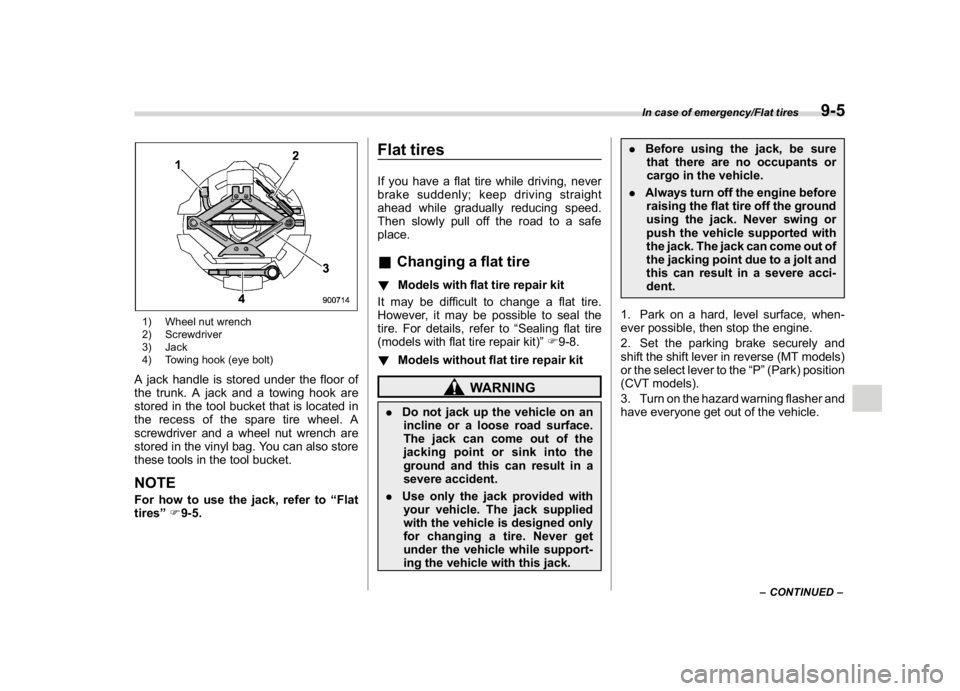
1) Wheel nut wrench
2) Screwdriver
3) Jack
4) Towing hook (eye bolt)A jack handle is stored under the floor of
the trunk. A jack and a towing hook are
stored in the tool bucket that is located in
the recess of the spare tire wheel. A
screwdriver and a wheel nut wrench are
stored in the vinyl bag. You can also store
these tools in the tool bucket.NOTEFor how to use the jack, refer to“Flat
tires”F9-5.
Flat tiresIf you have a flat tire while driving, never
brake suddenly; keep driving straight
ahead while gradually reducing speed.
Then slowly pull off the road to a safe
place.&Changing a flat tire!Models with flat tire repair kit
It may be difficult to change a flat tire.
However, it may be possible to seal the
tire. For details, refer to“Sealing flat tire
(models with flat tire repair kit)”F9-8.
!Models without flat tire repair kit
WARNING
.Do not jack up the vehicle on an
incline or a loose road surface.
The jack can come out of the
jacking point or sink into the
ground and this can result in a
severe accident.
.Use only the jack provided with
your vehicle. The jack supplied
with the vehicle is designed only
for changing a tire. Never get
under the vehicle while support-
ing the vehicle with this jack..Before using the jack, be sure
that there are no occupants or
cargo in the vehicle.
.Always turn off the engine before
raising the flat tire off the ground
using the jack. Never swing or
push the vehicle supported with
the jack. The jack can come out of
the jacking point due to a jolt and
this can result in a severe acci-
dent.
1. Park on a hard, level surface, when-
ever possible, then stop the engine.
2. Set the parking brake securely and
shift the shift lever in reverse (MT models)
or the select lever to the“P”(Park) position
(CVT models).
3. Turn on the hazard warning flasher and
have everyone get out of the vehicle.
–CONTINUED–
In case of emergency/Flat tires
9-5
9
Page 462 of 578
(479,1)
北米Model "A1700BE-B" EDITED: 2017/ 10/ 11
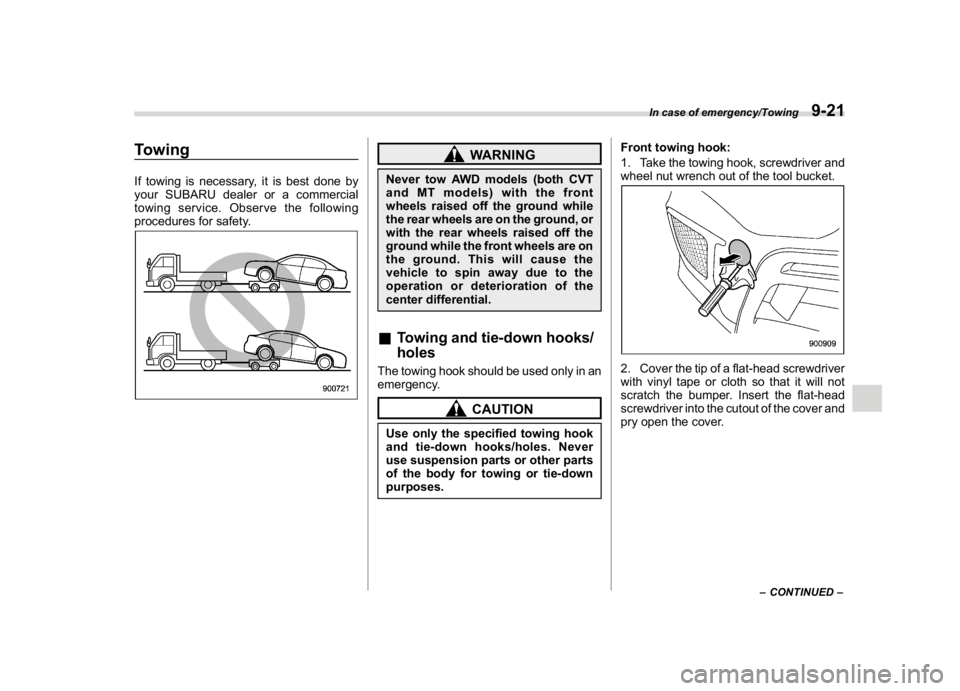
TowingIf towing is necessary, it is best done by
your SUBARU dealer or a commercial
towing service. Observe the following
procedures for safety.
WARNING
Never tow AWD models (both CVT
andMTmodels)withthefront
wheels raised off the ground while
the rear wheels are on the ground, or
with the rear wheels raised off the
ground while the front wheels are on
the ground. This will cause the
vehicle to spin away due to the
operation or deterioration of the
center differential.&Towing and tie-down hooks/
holesThe towing hook should be used only in an
emergency.
CAUTION
Use only the specified towing hook
and tie-down hooks/holes. Never
use suspension parts or other parts
of the body for towing or tie-down
purposes.Front towing hook:
1. Take the towing hook, screwdriver and
wheel nut wrench out of the tool bucket.
2. Cover the tip of a flat-head screwdriver
with vinyl tape or cloth so that it will not
scratch the bumper. Insert the flat-head
screwdriver into the cutout of the cover and
pry open the cover.
–CONTINUED–
In case of emergency/Towing
9-21
9
Page 465 of 578
(482,1)
北米Model "A1700BE-B" EDITED: 2017/ 10/ 11
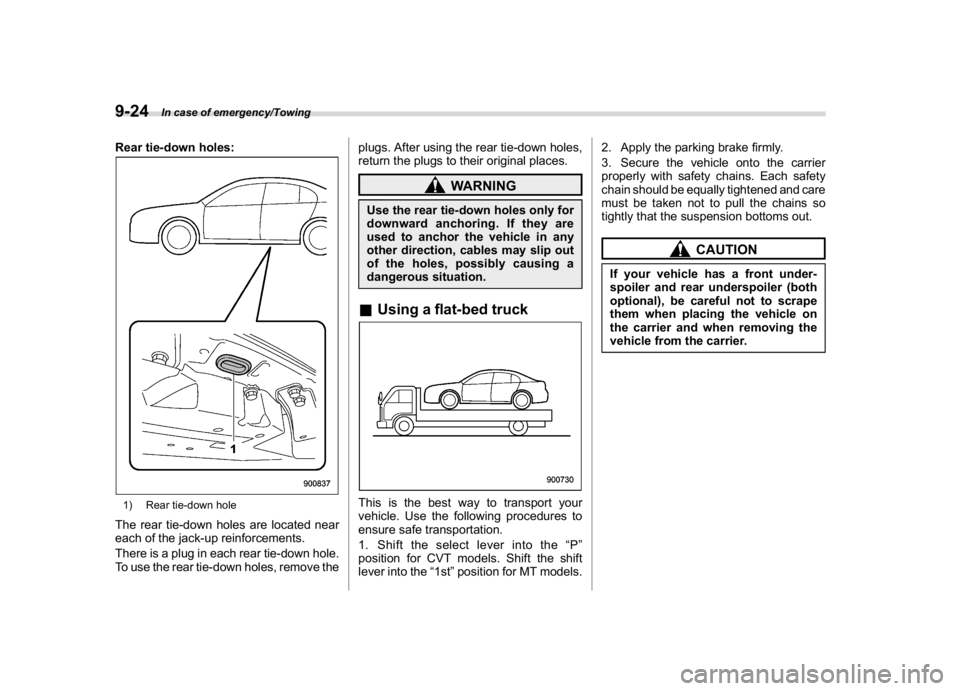
Rear tie-down holes:1) Rear tie-down holeThe rear tie-down holes are located near
each of the jack-up reinforcements.
There is a plug in each rear tie-down hole.
To use the rear tie-down holes, remove theplugs. After using the rear tie-down holes,
return the plugs to their original places.
WARNING
Use the rear tie-down holes only for
downward anchoring. If they are
used to anchor the vehicle in any
other direction, cables may slip out
of the holes, possibly causing a
dangerous situation.&Using a flat-bed truckThis is the best way to transport your
vehicle. Use the following procedures to
ensure safe transportation.
1. Shift the select lever into the“P”
position for CVT models. Shift the shift
lever into the“1st”position for MT models.2. Apply the parking brake firmly.
3. Secure the vehicle onto the carrier
properly with safety chains. Each safety
chain should be equally tightened and care
must be taken not to pull the chains so
tightly that the suspension bottoms out.
CAUTION
If your vehicle has a front under-
spoiler and rear underspoiler (both
optional), be careful not to scrape
them when placing the vehicle on
the carrier and when removing the
vehicle from the carrier.
In case of emergency/Towing
9-24
Page 466 of 578
(483,1)
北米Model "A1700BE-B" EDITED: 2017/ 10/ 11
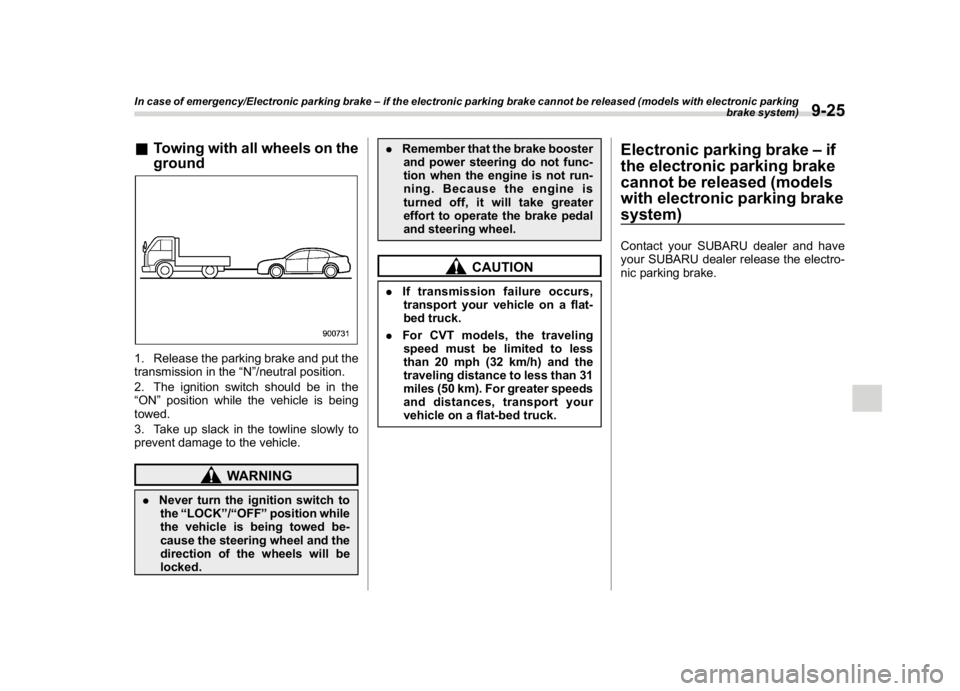
&Towing with all wheels on the
ground1. Release the parking brake and put the
transmission in the“N”/neutral position.
2. The ignition switch should be in the
“ON”position while the vehicle is being
towed.
3. Take up slack in the towline slowly to
prevent damage to the vehicle.
WARNING
.Never turn the ignition switch to
the“LOCK”/“OFF”position while
the vehicle is being towed be-
cause the steering wheel and the
direction of the wheels will be
locked..Remember that the brake booster
and power steering do not func-
tion when the engine is not run-
ning. Because the engine is
turned off, it will take greater
effort to operate the brake pedal
and steering wheel.
CAUTION
.If transmission failure occurs,
transport your vehicle on a flat-
bed truck.
.For CVT models, the traveling
speed must be limited to less
than 20 mph (32 km/h) and the
traveling distance to less than 31
miles (50 km). For greater speeds
and distances, transport your
vehicle on a flat-bed truck.
Electronic parking brake–if
the electronic parking brake
cannot be released (models
with electronic parking brake
system)Contact your SUBARU dealer and have
your SUBARU dealer release the electro-
nic parking brake.
In case of emergency/Electronic parking brake–if the electronic parking brake cannot be released (models with electronic parking
brake system)
9-25
9
Page 467 of 578
(484,1)
北米Model "A1700BE-B" EDITED: 2017/ 10/ 11
Access key fob–if access key
fob does not operate properly
CAUTION
Keep metallic objects, magnetic
sources and signal transmitters
away from the area between the
access key fob and the push-button
ignition switch. They may interfere
with the communication between
the access key fob and the push-
button ignition switch.
The following functions may be inoperable
because of strong radio signals in the
surrounding area or a low battery condition
of the access key fob.
.Locking/unlocking doors
.Switching power status
.Starting the engine
In such cases, perform the following
procedure. When the battery of the access
key fob is discharged, replace it with a new
one. Refer to“Replacing battery of access
key fob”F11-52.
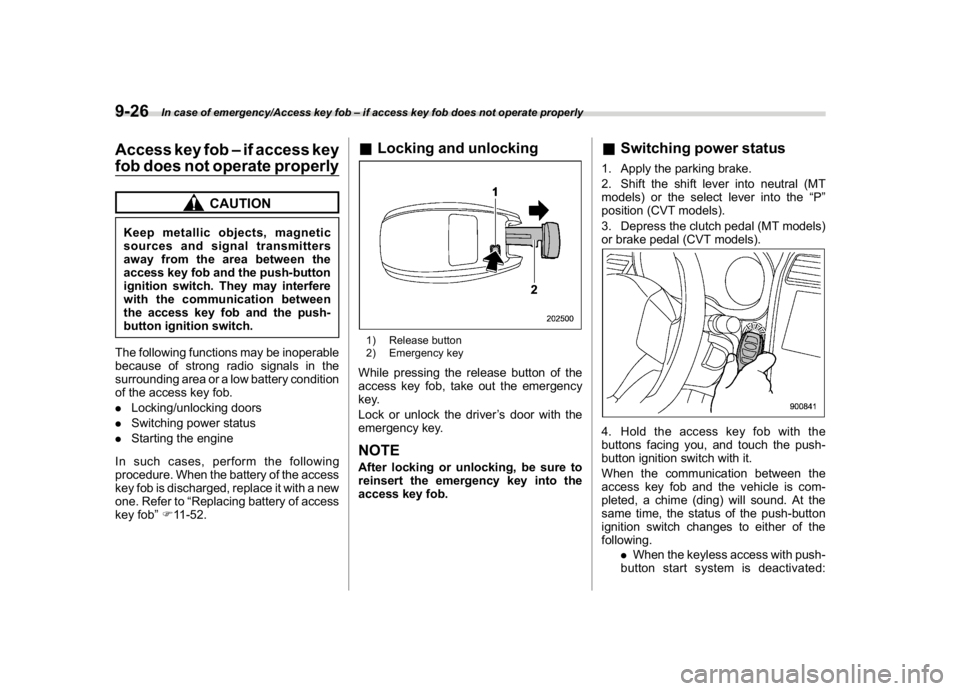
&Locking and unlocking1) Release button
2) Emergency keyWhile pressing the release button of the
access key fob, take out the emergency
key.
Lock or unlock the driver’s door with the
emergency key.NOTEAfter locking or unlocking, be sure to
reinsert the emergency key into the
access key fob.
&Switching power status1. Apply the parking brake.
2. Shift the shift lever into neutral (MT
models) or the select lever into the“P”
position (CVT models).
3. Depress the clutch pedal (MT models)
or brake pedal (CVT models).4. Hold the access key fob with the
buttons facing you, and touch the push-
button ignition switch with it.
When the communication between the
access key fob and the vehicle is com-
pleted, a chime (ding) will sound. At the
same time, the status of the push-button
ignition switch changes to either of the
following.
.When the keyless access with push-
button start system is deactivated:
In case of emergency/Access key fob–if access key fob does not operate properly
9-26
Page 468 of 578
(485,1)
北米Model "A1700BE-B" EDITED: 2017/ 10/ 11
“ACC”
.Under other conditions:“ON”
5. When the keyless access with push-
button start system is deactivated, press
the push-button ignition switch with the
clutch pedal (MT models) or brake pedal
(CVT models) released. The status of the
push-button ignition switch then changes
to“ON”.
NOTEIf the power does not switch even
though the above procedure was fol-
lowed precisely, contact your SUBARU
dealer.
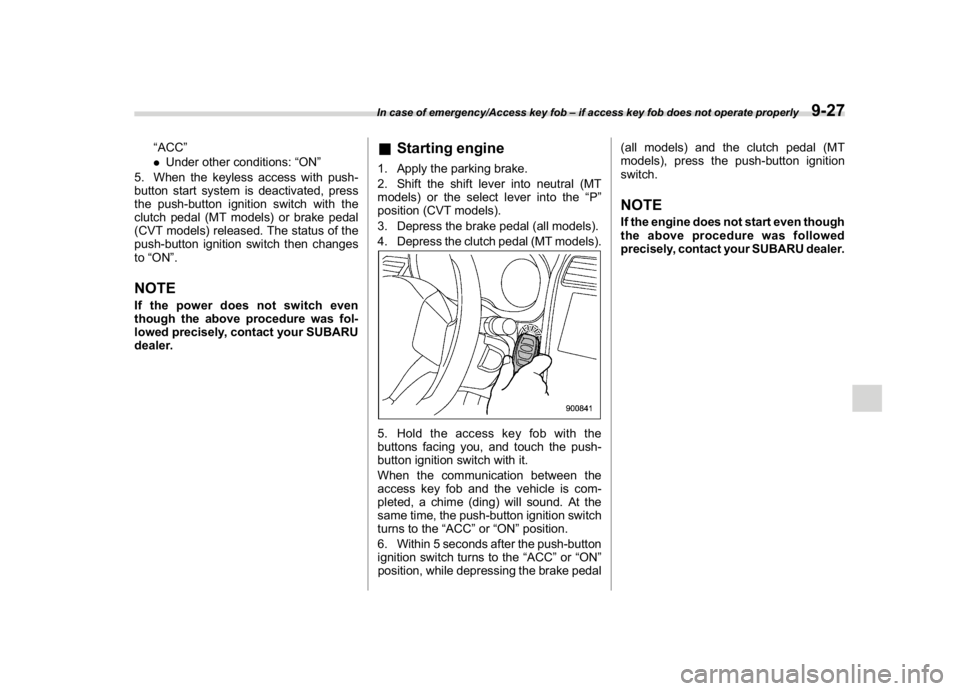
&Starting engine1. Apply the parking brake.
2. Shift the shift lever into neutral (MT
models) or the select lever into the“P”
position (CVT models).
3. Depress the brake pedal (all models).
4. Depress the clutch pedal (MT models).5. Holdtheaccesskeyfobwiththe
buttons facing you, and touch the push-
button ignition switch with it.
When the communication between the
access key fob and the vehicle is com-
pleted, a chime (ding) will sound. At the
same time, the push-button ignition switch
turns to the“ACC”or“ON”position.
6. Within 5 seconds after the push-button
ignition switch turns to the“ACC”or“ON”
position, while depressing the brake pedal(all models) and the clutch pedal (MT
models), press the push-button ignition
switch.
NOTEIf the engine does not start even though
the above procedure was followed
precisely, contact your SUBARU dealer.
In case of emergency/Access key fob–if access key fob does not operate properly
9-27
9
Page 478 of 578

(499,1)
北米Model "A1700BE-B" EDITED: 2017/ 10/ 11
Maintenance schedule.......................................... 11-3
Maintenance precautions..................................... 11-3
Before checking or servicing in the engine
compartment...................................................... 11-4
When checking or servicing in the engine
compartment...................................................... 11-5
When checking or servicing in the engine
compartment while the engine is running............ 11-5
Maintenance tips................................................... 11-6
Removing and reinstalling clips............................ 11-6
Engine hood.......................................................... 11-9
Engine compartment overview.......................... 11-11
STI...................................................................... 11-11
Except STI.......................................................... 11-12
Engine oil............................................................. 11-13
Engine oil consumption...................................... 11-13
Checking the oil level.......................................... 11-13
Changing the oil and oil filter.............................. 11-15
Recommended grade and viscosity..................... 11-15
Synthetic oil........................................................ 11-16
Cooling system................................................... 11-16
Cooling fan, hose and connections..................... 11-17
Engine coolant.................................................... 11-17
Air cleaner element............................................. 11-18
Replacing the air cleaner element........................ 11-19
Spark plugs......................................................... 11-21
Recommended spark plugs................................. 11-21
Drive belts........................................................... 11-21Manual transmission oil......................................11-22
Recommended grade and viscosity..................... 11-22
Continuously variable transmission fluid..........11-22
Front differential gear oil (CVT models) and
rear differential gear oil....................................11-23
Recommended grade and viscosity..................... 11-23
Power steering fluid (STI)...................................11-23
Checking the fluid level...................................... 11-23
Recommended fluid............................................ 11-24
Brake fluid............................................................11-24
Checking the fluid level...................................... 11-24
Recommended brake fluid.................................. 11-25
Clutch fluid (MT models).....................................11-25
Checking the fluid level...................................... 11-25
Recommended clutch fluid................................. 11-26
Brake booster......................................................11-26
Brake pedal..........................................................11-27
Checking the brake pedal free play..................... 11-27
Checking the brake pedal reserve distance ......... 11-27
Clutch pedal (MT models)...................................11-27
Checking the clutch function .............................. 11-27
Checking the clutch pedal free play.................... 11-28
Hill start assist system.......................................11-28
Replacement of brake pad andlining................11-28
Breaking-in of new brake pads (models with
electronic parking brake system)..................... 11-29
Breaking-in of new brake pads and linings
(models without electronic parking brake
system)........................................................... 11-29
Maintenance and service
11