Release SUZUKI ALTO 2007 6.G User Guide
[x] Cancel search | Manufacturer: SUZUKI, Model Year: 2007, Model line: ALTO, Model: SUZUKI ALTO 2007 6.GPages: 139, PDF Size: 2.63 MB
Page 57 of 139
Downloaded from www.Manualslib.com manuals search engine 58
76G-74E
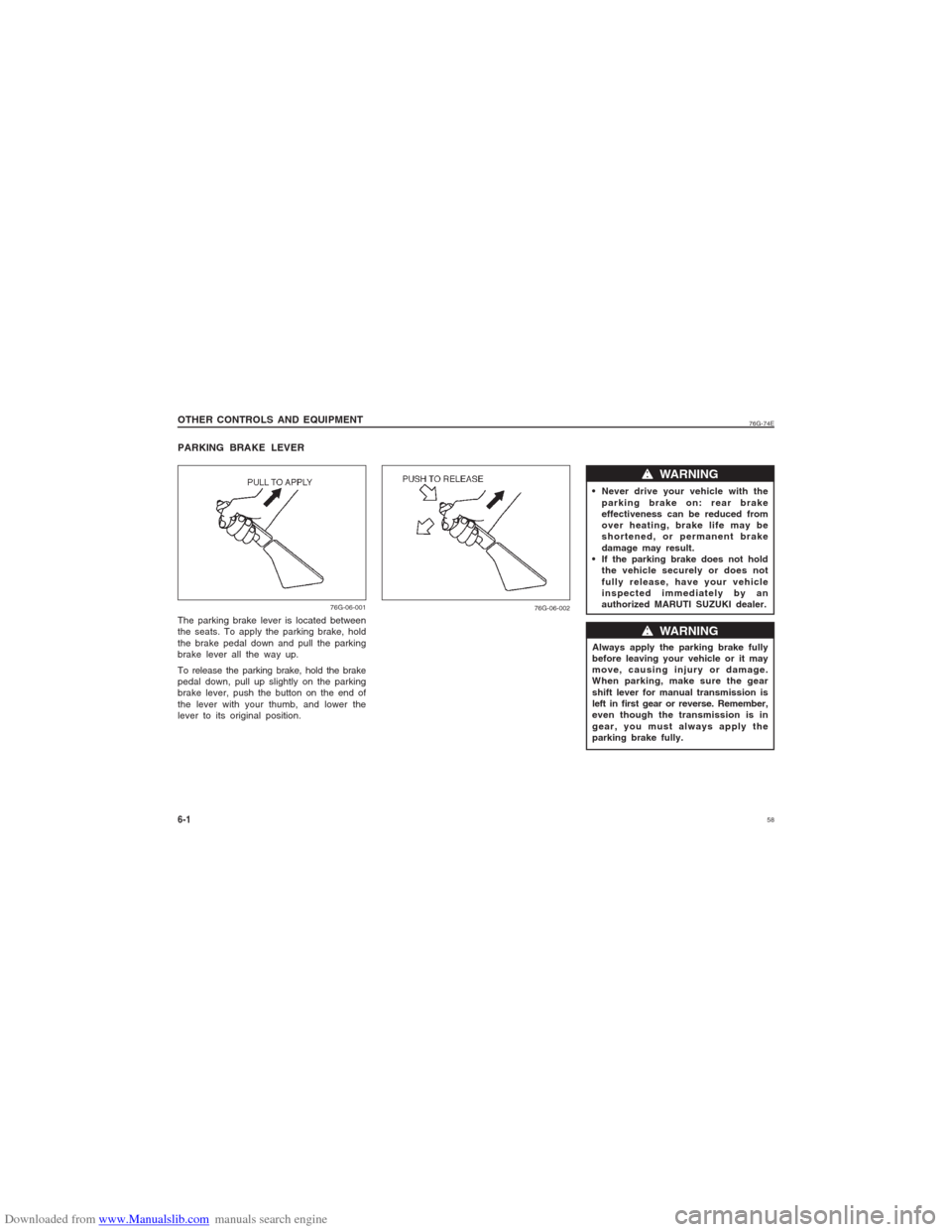
PARKING BRAKE LEVER
Never drive your vehicle with the
parking brake on: rear brake
effectiveness can be reduced from
over heating, brake life may be
shortened, or permanent brake
damage may result.
If the parking brake does not hold
the vehicle securely or does not
fully release, have your vehicle
inspected immediately by an
authorized MARUTI SUZUKI dealer.
Always apply the parking brake fully
before leaving your vehicle or it may
move, causing injury or damage.
When parking, make sure the gear
shift lever for manual transmission is
left in first gear or reverse. Remember,
even though the transmission is in
gear, you must always apply the
parking brake fully. The parking brake lever is located between
the seats. To apply the parking brake, hold
the brake pedal down and pull the parking
brake lever all the way up.
To release the parking brake, hold the brake
pedal down, pull up slightly on the parking
brake lever, push the button on the end of
the lever with your thumb, and lower the
lever to its original position.
w ww w
w WARNING
6-1
w ww w
w WARNING
OTHER CONTROLS AND EQUIPMENT
76G-06-001
76G-06-002
Page 62 of 139
Downloaded from www.Manualslib.com manuals search engine 6376G-74E
6-6
OTHER CONTROLS AND EQUIPMENT
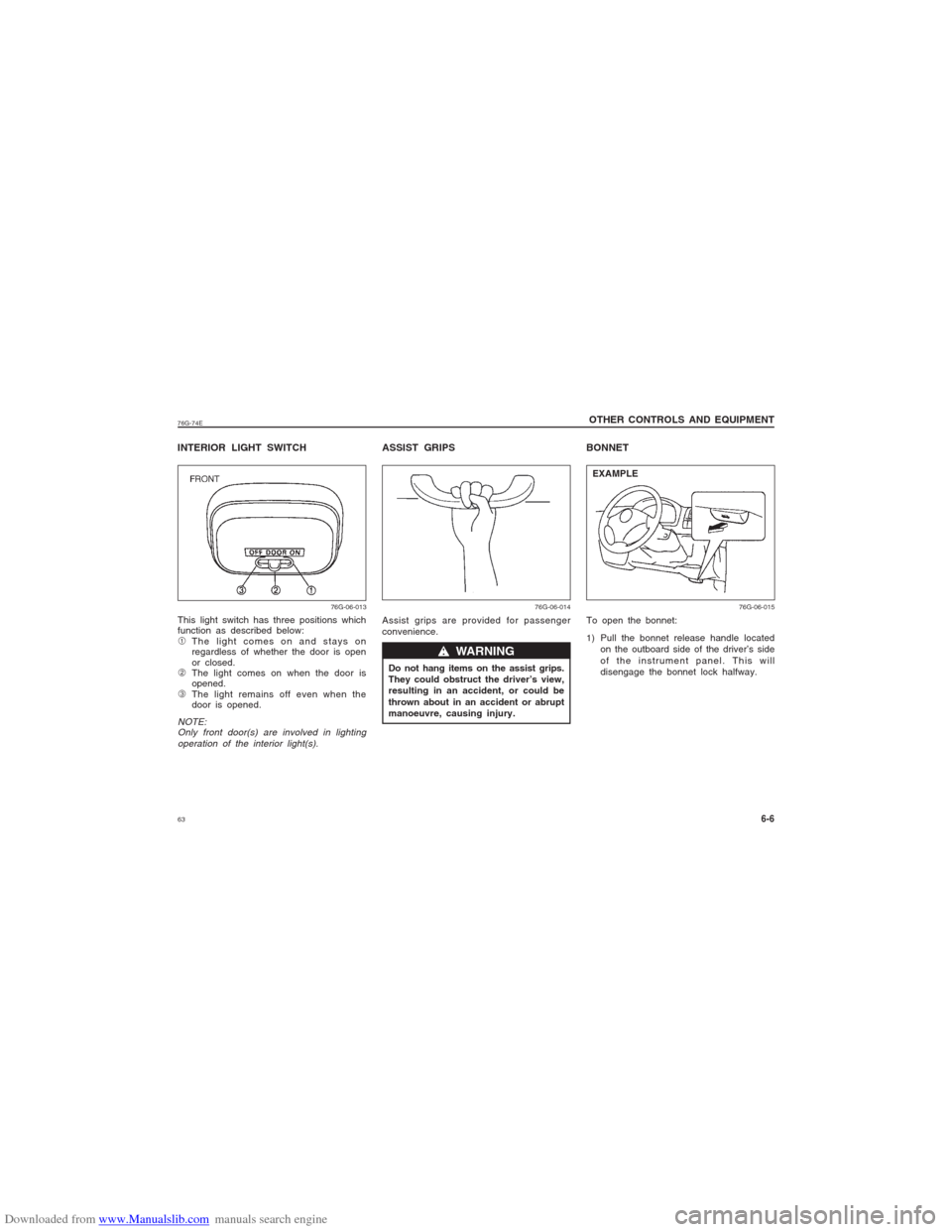
INTERIOR LIGHT SWITCH
This light switch has three positions which
function as described below:
1The light comes on and stays on
regardless of whether the door is open
or closed.
2The light comes on when the door is
opened.
3The light remains off even when the
door is opened.NOTE:
Only front door(s) are involved in lighting
operation of the interior light(s).
76G-06-013
ASSIST GRIPSAssist grips are provided for passenger
convenience.
Do not hang items on the assist grips.
They could obstruct the driver’s view,
resulting in an accident, or could be
thrown about in an accident or abrupt
manoeuvre, causing injury.
w ww w
w WARNING
BONNETTo open the bonnet:
1) Pull the bonnet release handle located
on the outboard side of the driver’s side
of the instrument panel. This will
disengage the bonnet lock halfway.
76G-06-014 76G-06-015
EXAMPLE
Page 63 of 139
Downloaded from www.Manualslib.com manuals search engine 64
76G-74E
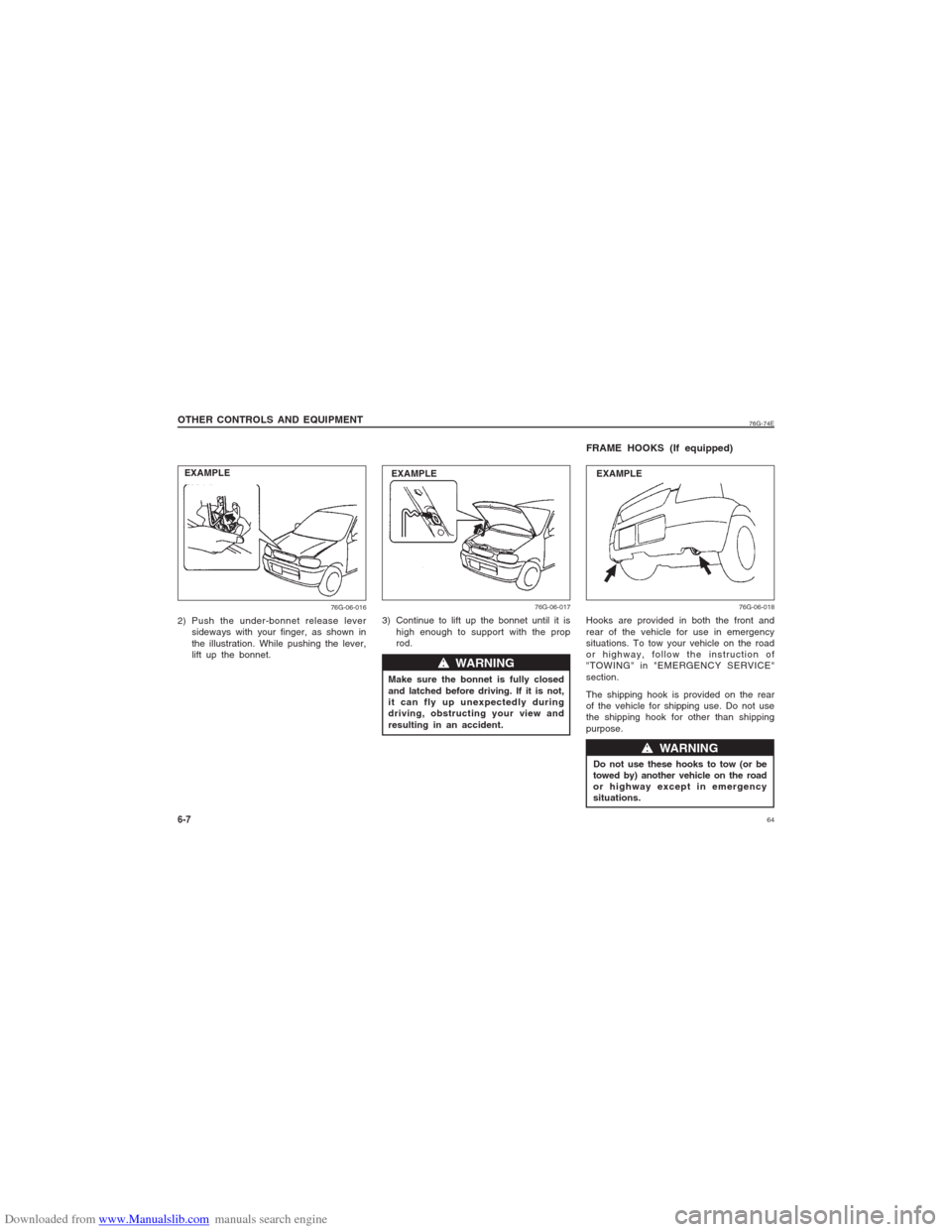
6-7OTHER CONTROLS AND EQUIPMENT2) Push the under-bonnet release lever
sideways with your finger, as shown in
the illustration. While pushing the lever,
lift up the bonnet.
76G-06-016
3) Continue to lift up the bonnet until it is
high enough to support with the prop
rod.
Make sure the bonnet is fully closed
and latched before driving. If it is not,
it can fly up unexpectedly during
driving, obstructing your view and
resulting in an accident.
w ww w
w WARNING
FRAME HOOKS (If equipped)
w ww w
w WARNING
Hooks are provided in both the front and
rear of the vehicle for use in emergency
situations. To tow your vehicle on the road
or highway, follow the instruction of
"TOWING" in "EMERGENCY SERVICE"
section.
The shipping hook is provided on the rear
of the vehicle for shipping use. Do not use
the shipping hook for other than shipping
purpose.
76G-06-017 76G-06-018
EXAMPLE
EXAMPLE EXAMPLE
Do not use these hooks to tow (or be
towed by) another vehicle on the road
or highway except in emergency
situations.
Page 69 of 139
Downloaded from www.Manualslib.com manuals search engine 70
76G-74E
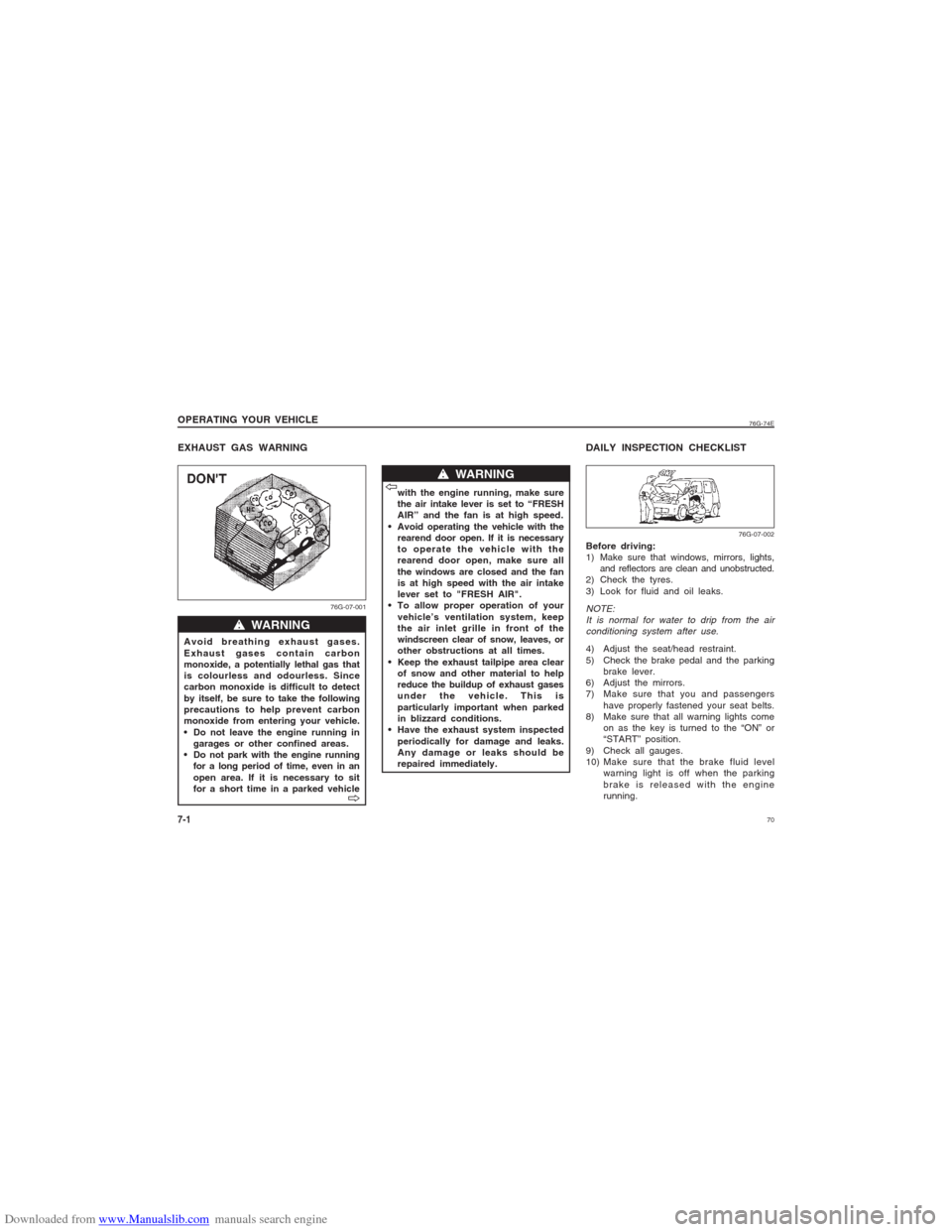
EXHAUST GAS WARNING
with the engine running, make sure
the air intake lever is set to “FRESH
AIR” and the fan is at high speed.
Avoid operating the vehicle with the
rearend door open. If it is necessary
to operate the vehicle with the
rearend door open, make sure all
the windows are closed and the fan
is at high speed with the air intake
lever set to "FRESH AIR".
To allow proper operation of your
vehicle’s ventilation system, keep
the air inlet grille in front of the
windscreen clear of snow, leaves, or
other obstructions at all times.
Keep the exhaust tailpipe area clear
of snow and other material to help
reduce the buildup of exhaust gases
under the vehicle. This is
particularly important when parked
in blizzard conditions.
Have the exhaust system inspected
periodically for damage and leaks.
Any damage or leaks should be
repaired immediately.
DAILY INSPECTION CHECKLIST
w ww w
w WARNING
7-1
w ww w
w WARNING
Before driving:
1)
Make sure that windows, mirrors, lights,
and reflectors are clean and unobstructed.
2) Check the tyres.
3) Look for fluid and oil leaks.NOTE:
It is normal for water to drip from the air
conditioning system after use.4) Adjust the seat/head restraint.
5) Check the brake pedal and the parking
brake lever.
6) Adjust the mirrors.
7) Make sure that you and passengers
have properly fastened your seat belts.
8) Make sure that all warning lights come
on as the key is turned to the “ON” or
“START” position.
9) Check all gauges.
10) Make sure that the brake fluid level
warning light is off when the parking
brake is released with the engine
running.
OPERATING YOUR VEHICLEAvoid breathing exhaust gases.
Exhaust gases contain carbon
monoxide, a potentially lethal gas that
is colourless and odourless. Since
carbon monoxide is difficult to detect
by itself, be sure to take the following
precautions to help prevent carbon
monoxide from entering your vehicle.
Do not leave the engine running in
garages or other confined areas.
Do not park with the engine running
for a long period of time, even in an
open area. If it is necessary to sit
for a short time in a parked vehicle
V VV V
V
V VV V
V
76G-07-00176G-07-002
Page 70 of 139
Downloaded from www.Manualslib.com manuals search engine 7176G-74E
Before starting the engine:
1) Make sure the parking brake is applied
fully.
2) Manual Transmission - Shift into “N”
(neutral) and depress the clutch pedal all
the way to the floor. Hold it while starting
the engine.
Make sure that the parking brake is
applied fully and the transmission is
in Neutral before attempting to start
the engine.
Stop turning the starter immediately
after the engine has started or the
starter system can be damaged.
Do not crank the engine for more
than 15 seconds at a time. If the
engine doesn’t start on the first try,
wait about 15 seconds before trying
again.
7-2
STARTING THE ENGINE
w ww w
w WARNING
OPERATING YOUR VEHICLE
Once a week, or each time you fill your fuel
tank, perform the following under-bonnet
checks:
1) Engine oil level.
2) Coolant level.
3) Brake fluid level.
4) Windscreen washer fluid level.
5) Battery solution level.
6) Bonnet latch operation.
Pull the bonnet release handle inside the
vehicle. Make sure that you can not
open the hood all the way without
releasing the secondary latch. Be sure
to close the hood securely after checking
for proper operation. See "All Latches,
Hinges & Locks" of "PERIODIC
MAINTENANCE SCHEDULE" in the
"INSPECTION AND MAINTENANCE"
section for lubrication schedule.
Make sure the bonnet is fully closed
and latched before driving. If it is not,
it can fly up unexpectedly during
driving, obstructing your view and
resulting in an accident.
w ww w
w WARNING
Starting a Cold Engine
Engine which is started after 6 hours should
be treated as cold engine.
For Electronic fuel injection models
With your foot off the accelerator pedal,
crank the engine by turning the ignition
key to “START”. Release the key when
the engine starts.
If the engine does not start after 15
seconds of cranking, wait about 15
seconds, then press down the
accelerator pedal to 1/3 of its travel and
try cranking the engine again. Release
the key and accelerator pedal when the
engine starts.
If the engine still does not start, try
holding the accelerator pedal all the way
to the floor while cranking. This should
clear the engine if it is flooded.
Starting a Warm Engine
For Electronic fuel injection models:
Use the same procedure as for “Starting a
Cold Engine”.
CAUTION
Page 71 of 139
Downloaded from www.Manualslib.com manuals search engine 72
76G-74E
7-3OPERATING YOUR VEHICLE
w ww w
w WARNINGCAUTION
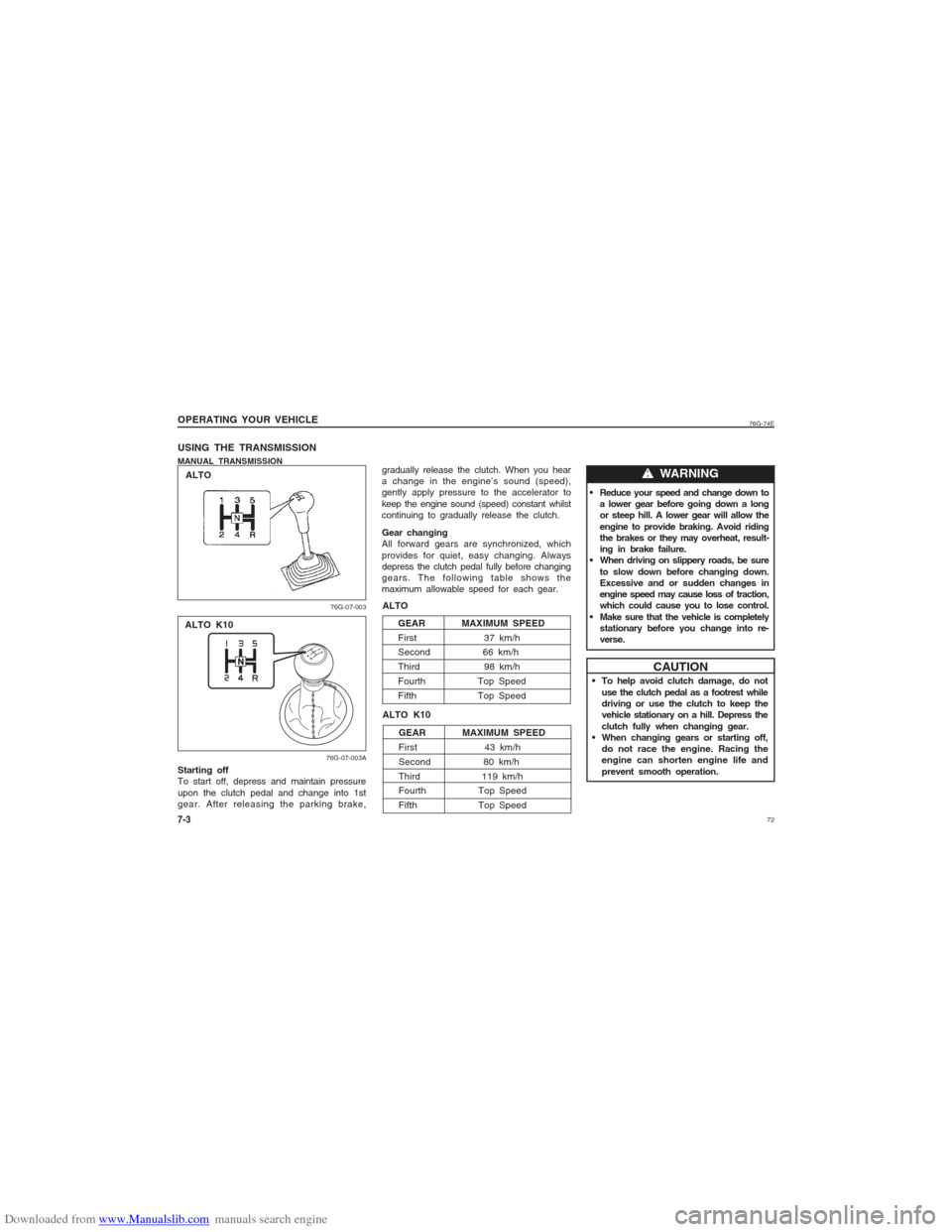
Starting off
To start off, depress and maintain pressure
upon the clutch pedal and change into 1st
gear. After releasing the parking brake,GEAR MAXIMUM SPEED
First 37 km/h
Second 66 km/h
Third 98 km/h
Fourth Top Speed
Fifth Top SpeedUSING THE TRANSMISSIONMANUAL TRANSMISSION
76G-07-00376G-07-003A
To help avoid clutch damage, do not
use the clutch pedal as a footrest while
driving or use the clutch to keep the
vehicle stationary on a hill. Depress the
clutch fully when changing gear.
When changing gears or starting off,
do not race the engine. Racing the
engine can shorten engine life and
prevent smooth operation. Reduce your speed and change down to
a lower gear before going down a long
or steep hill. A lower gear will allow the
engine to provide braking. Avoid riding
the brakes or they may overheat, result-
ing in brake failure.
When driving on slippery roads, be sure
to slow down before changing down.
Excessive and or sudden changes in
engine speed may cause loss of traction,
which could cause you to lose control.
Make sure that the vehicle is completely
stationary before you change into re-
verse. gradually release the clutch. When you hear
a change in the engine’s sound (speed),
gently apply pressure to the accelerator to
keep the engine sound (speed) constant whilst
continuing to gradually release the clutch.
Gear changing
All forward gears are synchronized, which
provides for quiet, easy changing. Always
depress the clutch pedal fully before changing
gears. The following table shows the
maximum allowable speed for each gear.
ALTO
ALTO K10
GEAR MAXIMUM SPEED
First 43 km/h
Second 80 km/h
Third 119 km/h
Fourth Top Speed
Fifth Top Speed
ALTO
ALTO K10
Page 91 of 139
Downloaded from www.Manualslib.com manuals search engine 92
76G-74E
w ww w
w WARNING
The rear shock absorbers are filled with
high pressure gas. Never attempt to
disassemble it or throw it into a fire.
Avoid storing it near a heater or heating
device. When scrapping the absorber,
the gas must be released from the
absorber safely. Ask your dealer for
assistance. All maintenance should be carried out with
the ignition switch in the “OFF” position
and the car parked securely on the level
ground unless otherwise specified.
If you are in any way unsure of your
ability to undertake a task, then do not
start it but contact your MARUTI SUZUKI
dealer to perform the work for you.
w ww w
w WARNING
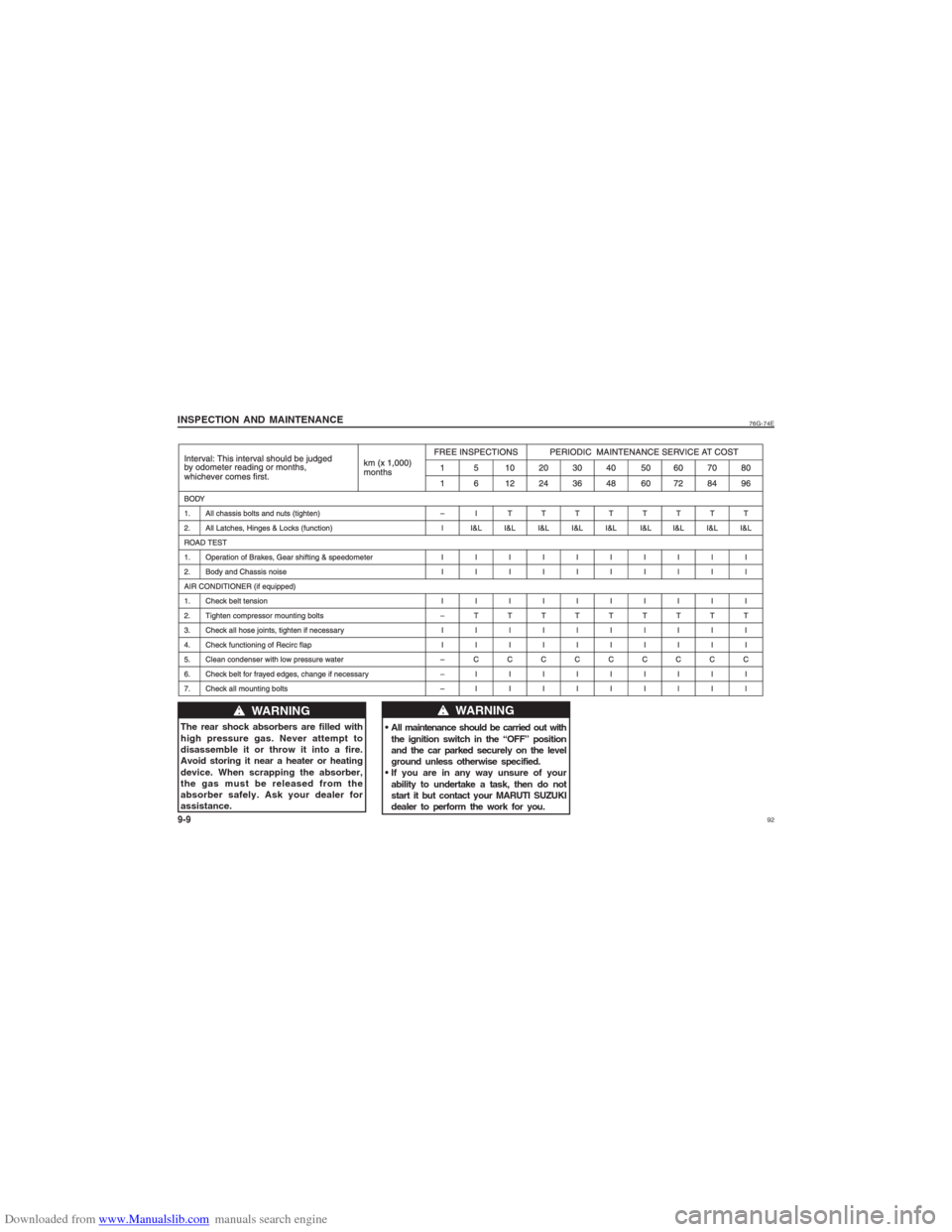
INSPECTION AND MAINTENANCE9-9
Page 102 of 139
Downloaded from www.Manualslib.com manuals search engine 10376G-74E
76G-09-020
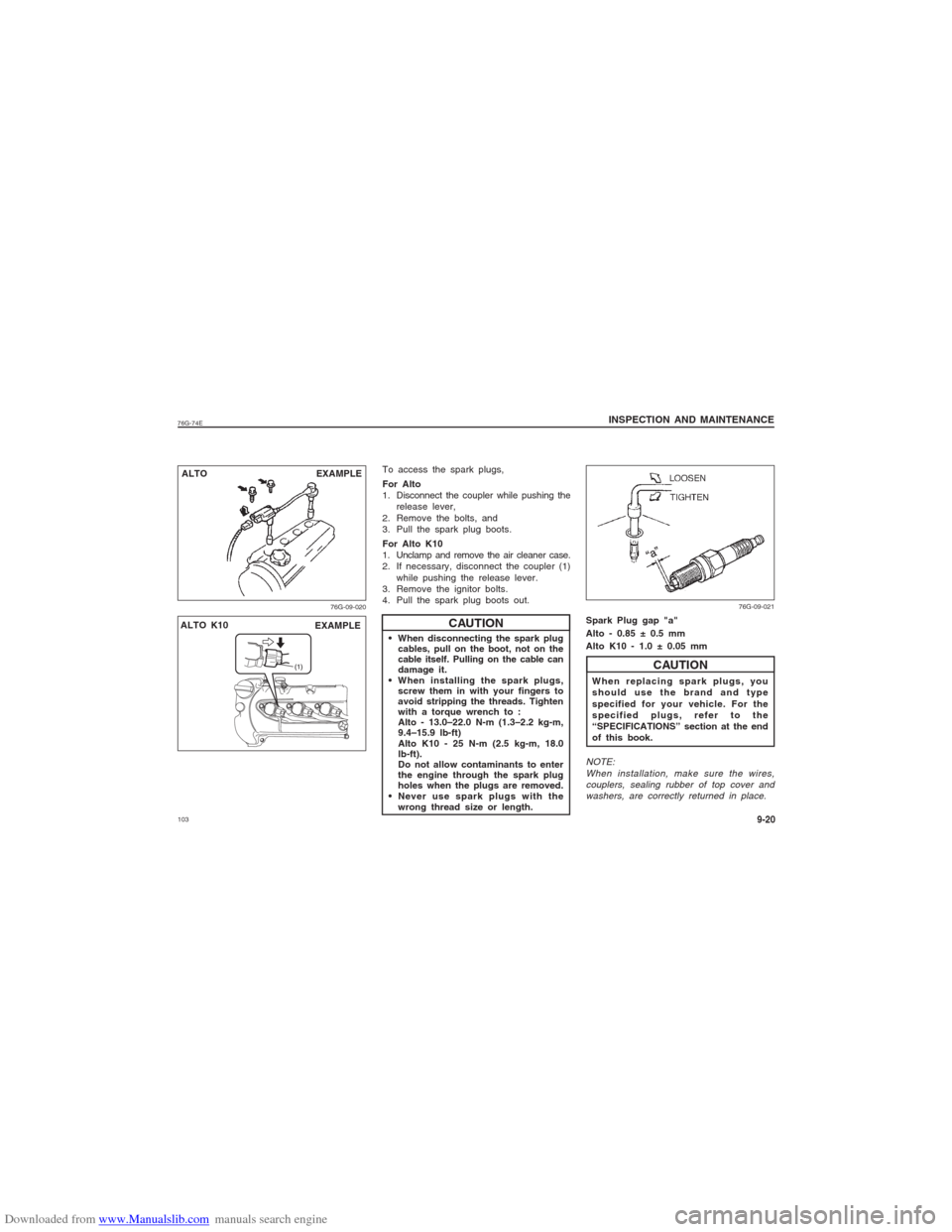
ALTO K10EXAMPLETo access the spark plugs,
For Alto
1. Disconnect the coupler while pushing the
release lever,
2. Remove the bolts, and
3. Pull the spark plug boots.
For Alto K10
1. Unclamp and remove the air cleaner case.
2. If necessary, disconnect the coupler (1)
while pushing the release lever.
3. Remove the ignitor bolts.
4. Pull the spark plug boots out.
CAUTION
76G-09-021
Spark Plug gap "a"
Alto - 0.85 ± 0.5 mm
Alto K10 - 1.0 ± 0.05 mm
INSPECTION AND MAINTENANCE
9-20
ALTO
EXAMPLE
When disconnecting the spark plug
cables, pull on the boot, not on the
cable itself. Pulling on the cable can
damage it.
When installing the spark plugs,
screw them in with your fingers to
avoid stripping the threads. Tighten
with a torque wrench to :
Alto - 13.0–22.0 N-m (1.3–2.2 kg-m,
9.4–15.9 lb-ft)
Alto K10 - 25 N-m (2.5 kg-m, 18.0
lb-ft).
Do not allow contaminants to enter
the engine through the spark plug
holes when the plugs are removed.
Never use spark plugs with the
wrong thread size or length.
CAUTION
When replacing spark plugs, you
should use the brand and type
specified for your vehicle. For the
specified plugs, refer to the
“SPECIFICATIONS” section at the end
of this book.NOTE:
When installation, make sure the wires,
couplers, sealing rubber of top cover and
washers, are correctly returned in place.
Page 105 of 139
Downloaded from www.Manualslib.com manuals search engine 106
76G-74E
INSPECTION AND MAINTENANCE9-23NOTE:
When measuring the distance between the
brake pedal and floor wall, be sure not to
include any floor covering other than
silencer mat in the measurement.If you experience any of the following
problems with your vehicle’s brake
system, have the vehicle inspected
immediately by your MARUTI SUZUKI
dealer.
Poor braking performance
Uneven braking (Brakes not working
uniformly on all wheels.)
Excessive pedal travel
Brake dragging
Excessive noise
Pedal pulsation (Pedal pulsates
when depressed.)
w ww w
w WARNING
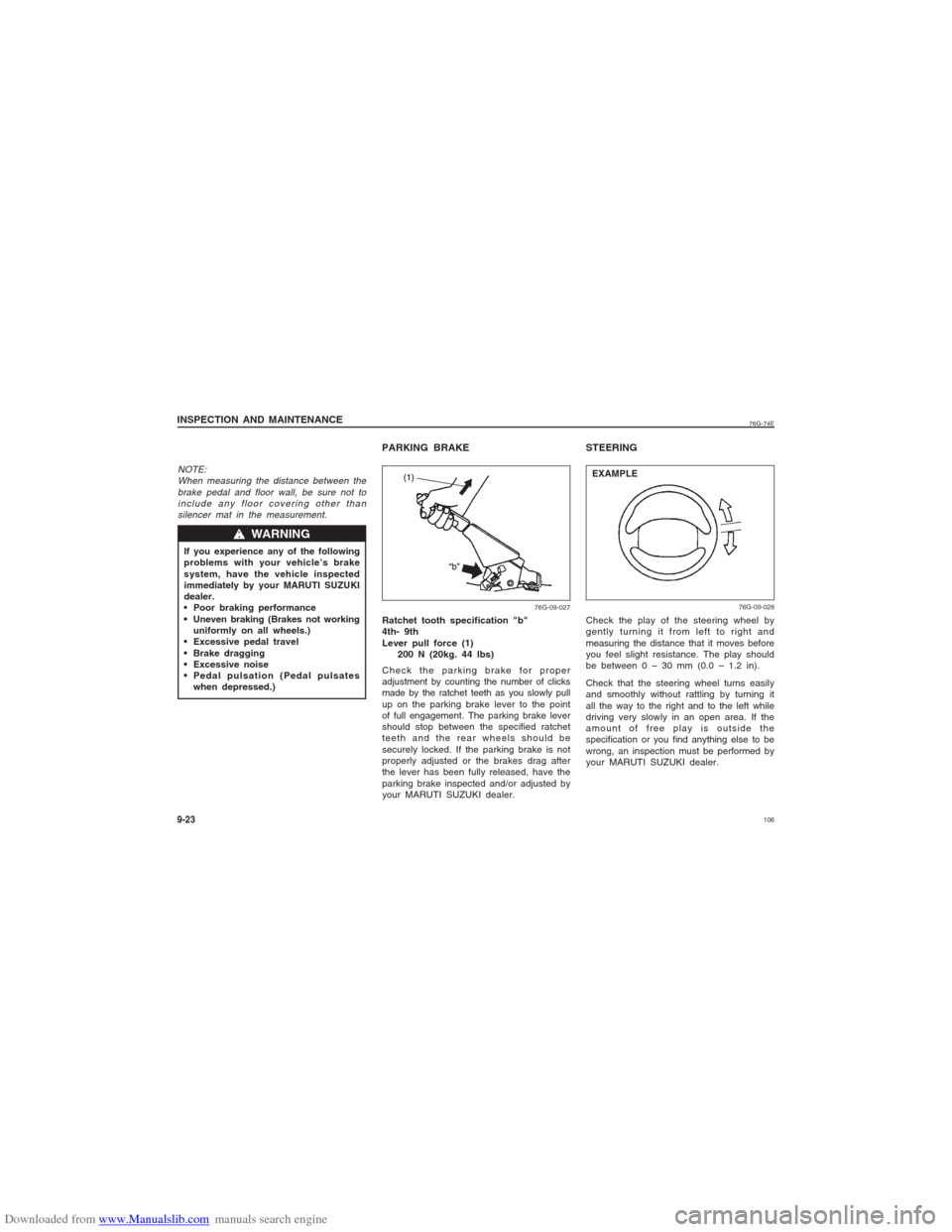
Ratchet tooth specification "b"
4th- 9th
Lever pull force (1)
200 N (20kg. 44 lbs)
Check the parking brake for proper
adjustment by counting the number of clicks
made by the ratchet teeth as you slowly pull
up on the parking brake lever to the point
of full engagement. The parking brake lever
should stop between the specified ratchet
teeth and the rear wheels should be
securely locked. If the parking brake is not
properly adjusted or the brakes drag after
the lever has been fully released, have the
parking brake inspected and/or adjusted by
your MARUTI SUZUKI dealer.
76G-09-027
STEERINGCheck the play of the steering wheel by
gently turning it from left to right and
measuring the distance that it moves before
you feel slight resistance. The play should
be between 0 – 30 mm (0.0 – 1.2 in).
Check that the steering wheel turns easily
and smoothly without rattling by turning it
all the way to the right and to the left while
driving very slowly in an open area. If the
amount of free play is outside the
specification or you find anything else to be
wrong, an inspection must be performed by
your MARUTI SUZUKI dealer.
76G-09-028
EXAMPLE
PARKING BRAKE
Page 124 of 139
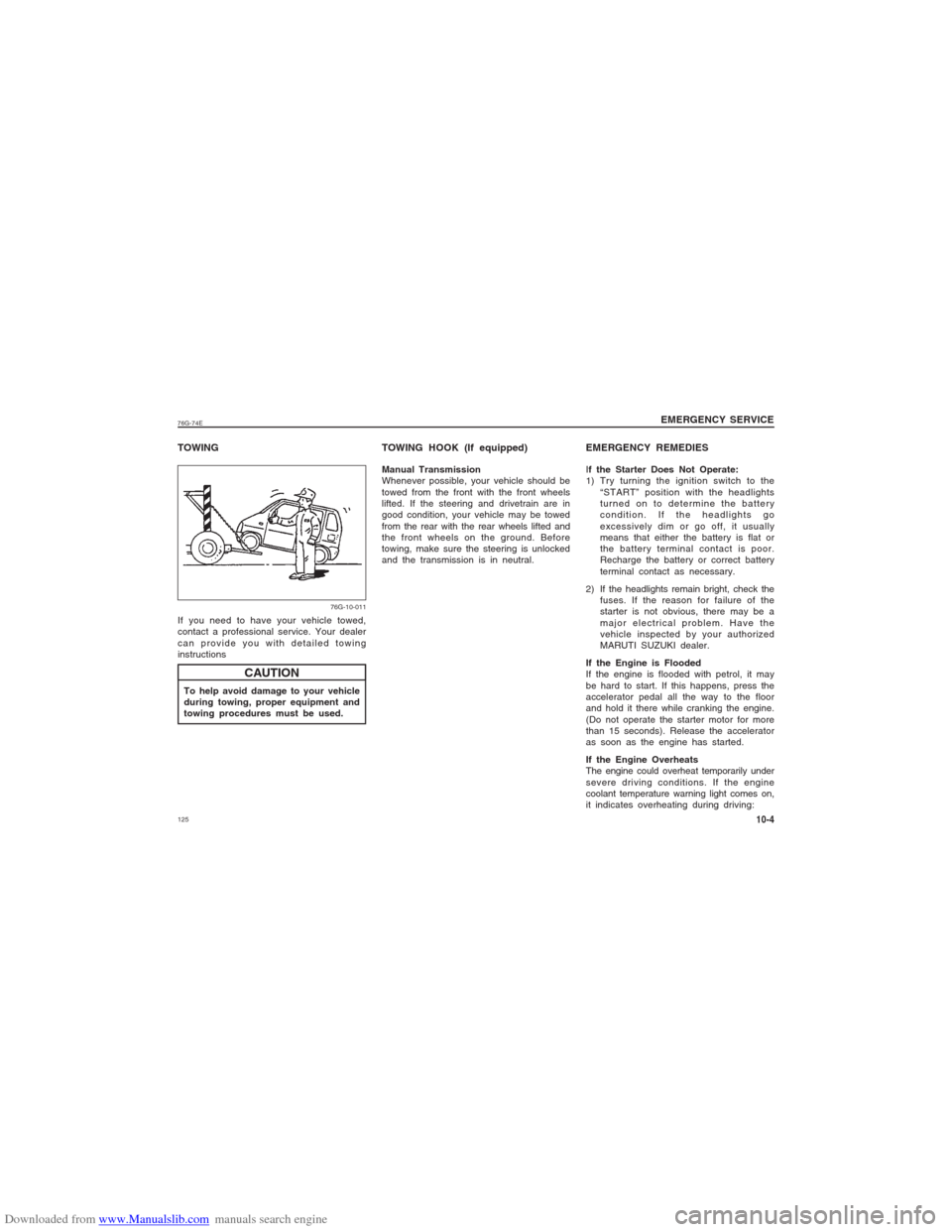
Downloaded from www.Manualslib.com manuals search engine 12576G-74ETOWINGIf you need to have your vehicle towed,
contact a professional service. Your dealer
can provide you with detailed towing
instructions
To help avoid damage to your vehicle
during towing, proper equipment and
towing procedures must be used.
EMERGENCY REMEDIESEMERGENCY SERVICE
10-4
CAUTION
Manual Transmission
Whenever possible, your vehicle should be
towed from the front with the front wheels
lifted. If the steering and drivetrain are in
good condition, your vehicle may be towed
from the rear with the rear wheels lifted and
the front wheels on the ground. Before
towing, make sure the steering is unlocked
and the transmission is in neutral.If the Starter Does Not Operate:
1) Try turning the ignition switch to the
“START” position with the headlights
turned on to determine the battery
condition. If the headlights go
excessively dim or go off, it usually
means that either the battery is flat or
the battery terminal contact is poor.
Recharge the battery or correct battery
terminal contact as necessary.
2) If the headlights remain bright, check the
fuses. If the reason for failure of the
starter is not obvious, there may be a
major electrical problem. Have the
vehicle inspected by your authorized
MARUTI SUZUKI dealer.
If the Engine is Flooded
If the engine is flooded with petrol, it may
be hard to start. If this happens, press the
accelerator pedal all the way to the floor
and hold it there while cranking the engine.
(Do not operate the starter motor for more
than 15 seconds). Release the accelerator
as soon as the engine has started.
If the Engine Overheats
The engine could overheat temporarily under
severe driving conditions. If the engine
coolant temperature warning light comes on,
it indicates overheating during driving:TOWING HOOK (If equipped)
76G-10-011