water SUZUKI ALTO 2007 6.G User Guide
[x] Cancel search | Manufacturer: SUZUKI, Model Year: 2007, Model line: ALTO, Model: SUZUKI ALTO 2007 6.GPages: 139, PDF Size: 2.63 MB
Page 94 of 139
Downloaded from www.Manualslib.com manuals search engine 9576G-74E
INSPECTION AND MAINTENANCE
9-12
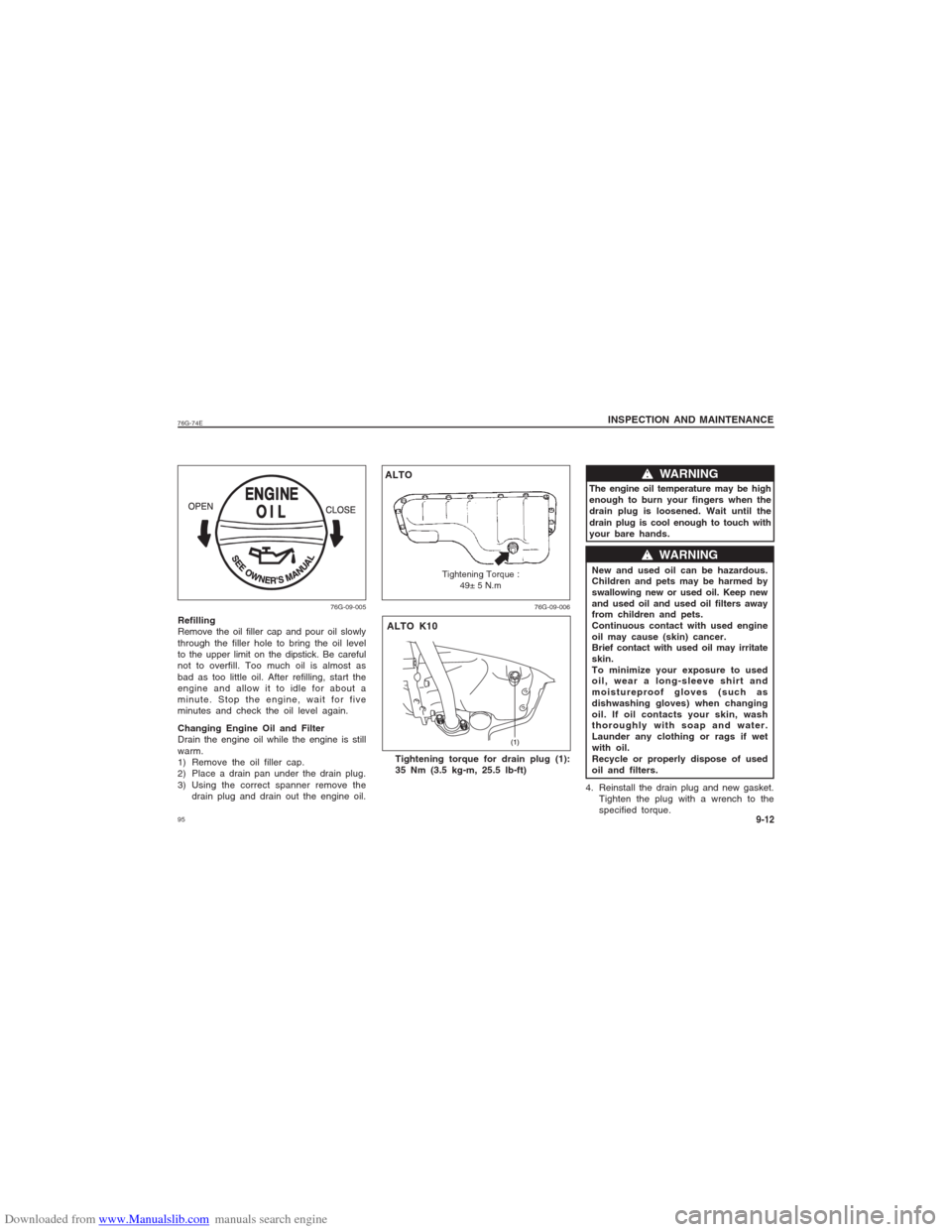
Refilling
Remove the oil filler cap and pour oil slowly
through the filler hole to bring the oil level
to the upper limit on the dipstick. Be careful
not to overfill. Too much oil is almost as
bad as too little oil. After refilling, start the
engine and allow it to idle for about a
minute. Stop the engine, wait for five
minutes and check the oil level again.
Changing Engine Oil and Filter
Drain the engine oil while the engine is still
warm.
1) Remove the oil filler cap.
2) Place a drain pan under the drain plug.
3) Using the correct spanner remove the
drain plug and drain out the engine oil.
The engine oil temperature may be high
enough to burn your fingers when the
drain plug is loosened. Wait until the
drain plug is cool enough to touch with
your bare hands.
w ww w
w WARNING
New and used oil can be hazardous.
Children and pets may be harmed by
swallowing new or used oil. Keep new
and used oil and used oil filters away
from children and pets.
Continuous contact with used engine
oil may cause (skin) cancer.
Brief contact with used oil may irritate
skin.
To minimize your exposure to used
oil, wear a long-sleeve shirt and
moistureproof gloves (such as
dishwashing gloves) when changing
oil. If oil contacts your skin, wash
thoroughly with soap and water.
Launder any clothing or rags if wet
with oil.
Recycle or properly dispose of used
oil and filters.
4. Reinstall the drain plug and new gasket.
Tighten the plug with a wrench to the
specified torque.
w ww w
w WARNING
76G-09-005 76G-09-006
Tightening torque for drain plug (1):
35 Nm (3.5 kg-m, 25.5 lb-ft)ALTO
ALTO K10
Tightening Torque :
49± 5 N.m
Page 98 of 139
Downloaded from www.Manualslib.com manuals search engine 9976G-74E
INSPECTION AND MAINTENANCE
9-16
CAUTION
To avoid damaging your cooling sys-
tem:
Always use a high quality ethylene
glycol base non-silicate type cool-
ant diluted with distilled water at
the correct mixture concentration.
Make sure that the proper mix is 30/
70 coolant to distilled water.
Concentrations greater than 70/30
coolant to distilled water will cause
over heating conditions.
Do not use straight coolant nor
plain water.
Do not add extra inhibitors or addi-
tives. They may not be compatible
with your cooling system.
Do not mix different types of base
coolants. Doing so may result in
accelerated seal wear and/or the
possibility of severe overheating
and extensive engine damage.Coolant Level Check
Check the coolant level at the reservoir
tank, not at the radiator. With the engine
cool, the coolant level should be between
the “FULL” and “LOW” marks.
Adding Coolant
If the coolant level is below the “LOW”
mark, more coolant should be added.
Remove the reservoir tank cap and add
coolant until the reservoir tank level reaches
the “FULL” mark. Never fill the reservoir
tank above the “FULL” mark.
CAUTION
The mixture you use should con-
tain 50% concentration of anti-
freeze.
If the lowest ambient temperature
in your area is expected to be –
35°C (–31°F) or below, use higher
concentrations up to 60% following
the instructions on the antifreeze
container.
When putting the cap on the reser-
voir tank, line up the arrow on the
cap and the arrow on the tank. Fail-
ure to follow this can result in cool-
ant leakage.
Page 99 of 139
Downloaded from www.Manualslib.com manuals search engine 100
76G-74E
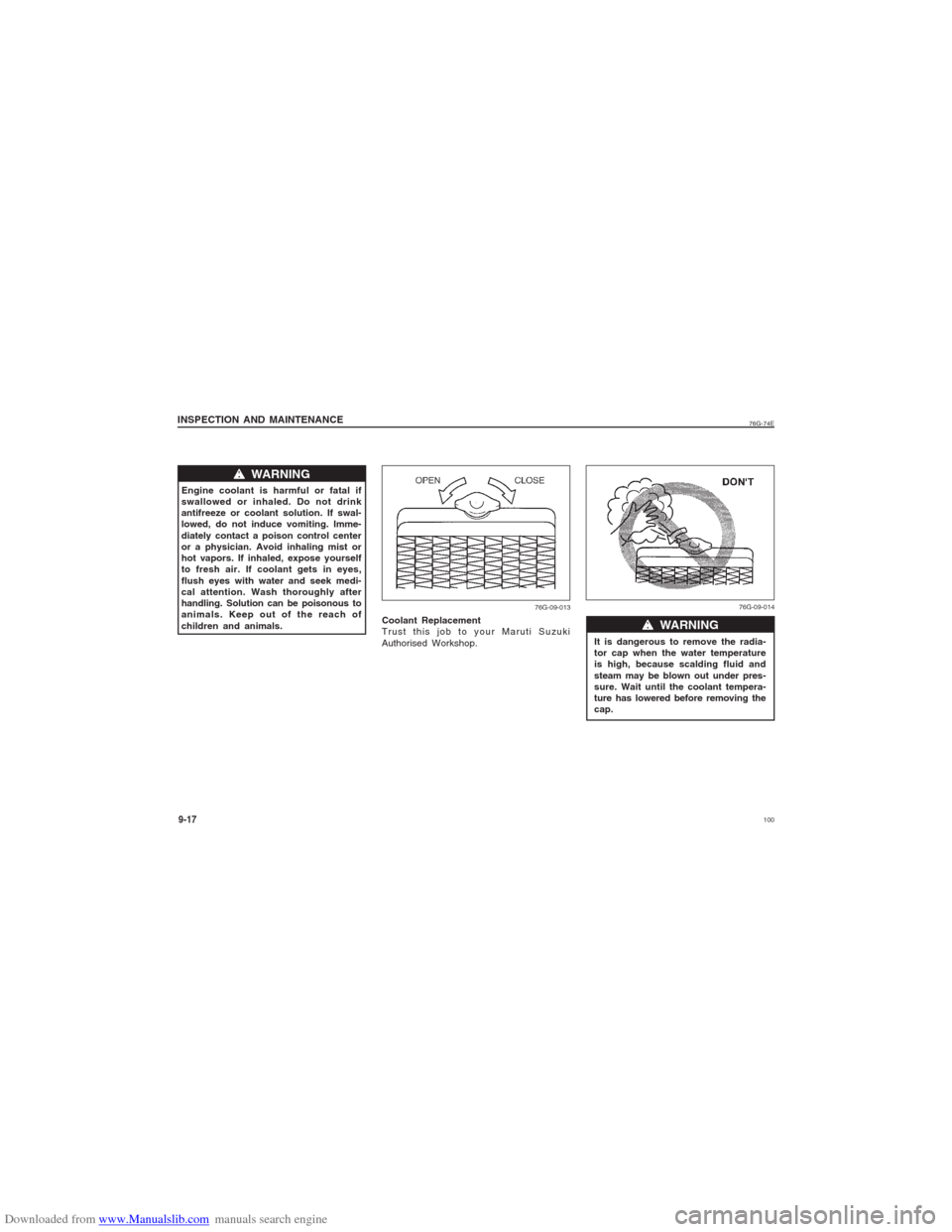
Coolant Replacement
Trust this job to your Maruti Suzuki
Authorised Workshop.
76G-09-013
w ww w
w WARNING
76G-09-014
It is dangerous to remove the radia-
tor cap when the water temperature
is high, because scalding fluid and
steam may be blown out under pres-
sure. Wait until the coolant tempera-
ture has lowered before removing the
cap.
w ww w
w WARNING
Engine coolant is harmful or fatal if
swallowed or inhaled. Do not drink
antifreeze or coolant solution. If swal-
lowed, do not induce vomiting. Imme-
diately contact a poison control center
or a physician. Avoid inhaling mist or
hot vapors. If inhaled, expose yourself
to fresh air. If coolant gets in eyes,
flush eyes with water and seek medi-
cal attention. Wash thoroughly after
handling. Solution can be poisonous to
animals. Keep out of the reach of
children and animals.9-17INSPECTION AND MAINTENANCE
Page 100 of 139
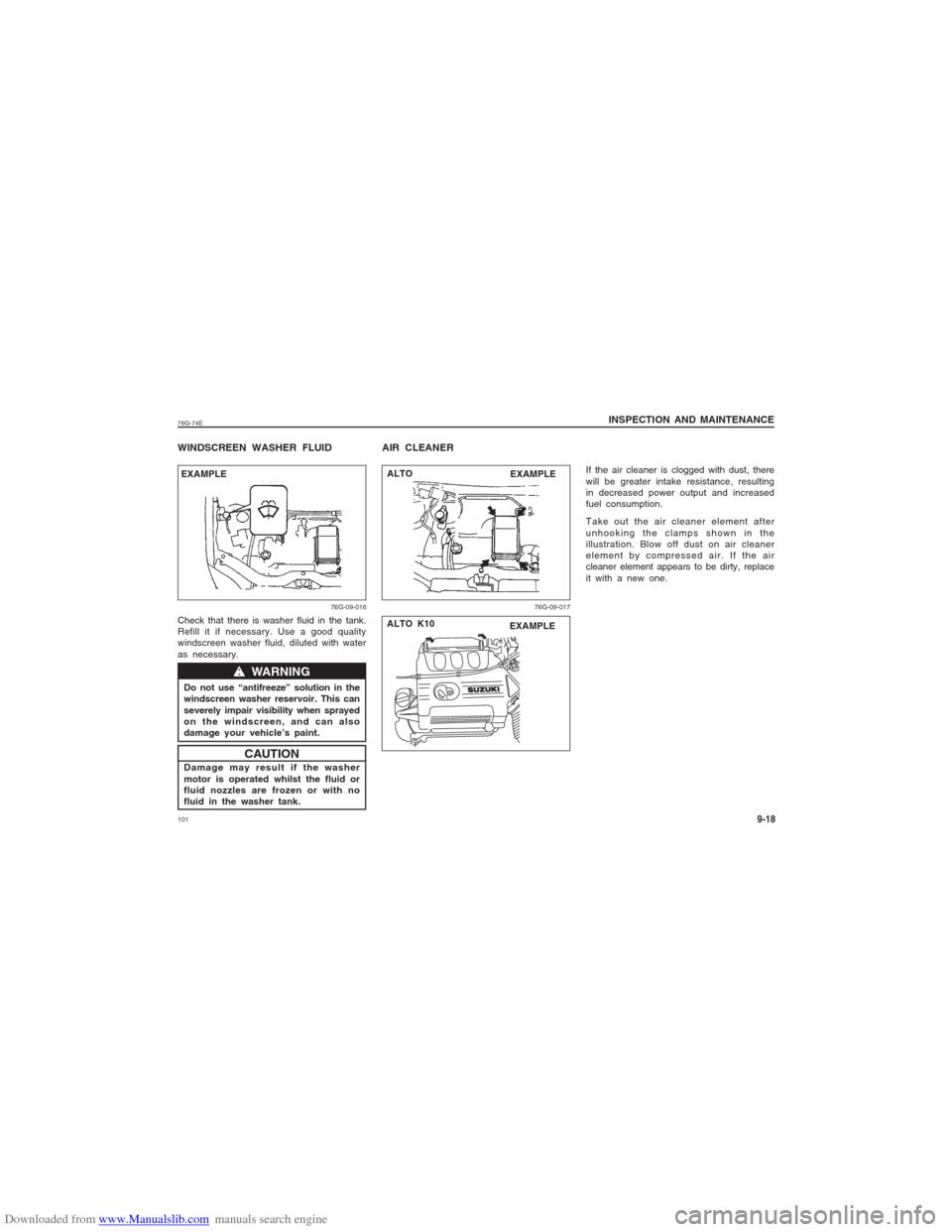
Downloaded from www.Manualslib.com manuals search engine 10176G-74EWINDSCREEN WASHER FLUIDCheck that there is washer fluid in the tank.
Refill it if necessary. Use a good quality
windscreen washer fluid, diluted with water
as necessary.
Do not use “antifreeze” solution in the
windscreen washer reservoir. This can
severely impair visibility when sprayed
on the windscreen, and can also
damage your vehicle’s paint.
Damage may result if the washer
motor is operated whilst the fluid or
fluid nozzles are frozen or with no
fluid in the washer tank.
w ww w
w WARNINGCAUTION
76G-09-016
AIR CLEANER
If the air cleaner is clogged with dust, there
will be greater intake resistance, resulting
in decreased power output and increased
fuel consumption.
Take out the air cleaner element after
unhooking the clamps shown in the
illustration. Blow off dust on air cleaner
element by compressed air. If the air
cleaner element appears to be dirty, replace
it with a new one.
76G-09-017
ALTO K10
INSPECTION AND MAINTENANCE
9-18
EXAMPLEALTO
EXAMPLE
EXAMPLE
Page 111 of 139
Downloaded from www.Manualslib.com manuals search engine 112
76G-74E
INSPECTION AND MAINTENANCE9-29To avoid harm to yourself or damage
to your vehicle or battery, follow the
jump starting instructions in the
EMERGENCY SERVICE section of this
manual if it is necessary to jump start
your vehicle.
The level of the battery solution must be
kept between the “MAX” and the “MIN” level
lines at all times. If the level is found to be
below the “MIN” level line, add distilled
water to the “MAX” level line. You should
periodically check the battery, battery
terminals, and battery hold-down bracket for
corrosion. Remove corrosion using a stiff
brush and ammonia mixed with water, or
baking soda mixed with water. After
removing corrosion, rinse with clean water.
If your vehicle is not going to be driven for
a month or longer, disconnect the cable from
the negative terminal of the battery to help
prevent discharge.
w ww w
w WARNING
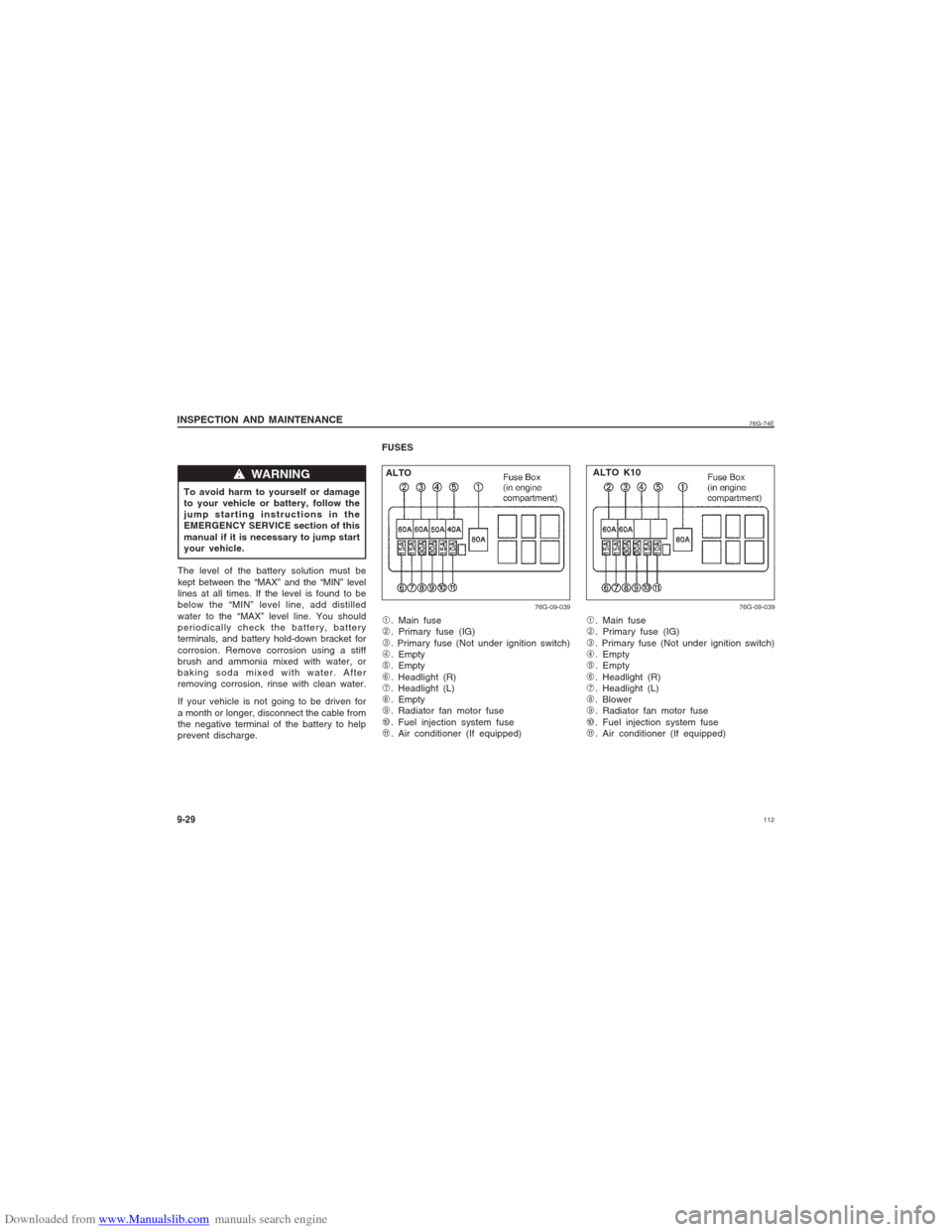
FUSES
1. Main fuse
2. Primary fuse (IG)
3. Primary fuse (Not under ignition switch)
4. Empty
5. Empty
6. Headlight (R)
7. Headlight (L)
8. Empty
9. Radiator fan motor fuse
0. Fuel injection system fuse
c. Air conditioner (If equipped)
76G-09-039
1. Main fuse
2. Primary fuse (IG)
3. Primary fuse (Not under ignition switch)
4. Empty
5. Empty
6. Headlight (R)
7. Headlight (L)
8. Blower
9. Radiator fan motor fuse
0. Fuel injection system fuse
c. Air conditioner (If equipped)
76G-09-039
ALTOALTO K10
Page 125 of 139
Downloaded from www.Manualslib.com manuals search engine 126
76G-74E
engine until these problems have been
corrected.
3) If you do not find a leak, carefully add
coolant to the reservoir and then the
radiator, if necessary. (Refer to “ENGINE
COOLANT” in the “INSPECTION AND
MAINTENANCE” section.)
It is dangerous to remove the radiator
cap when the water temperature is
high, because scalding fluid and
steam may be blown out under
pressure. The cap should only be
taken off when the coolant
temperature has lowered.
To help prevent personal injury, keep
hands, tools and clothing away from
the engine cooling fan and air-
conditioner fan (if equipped). These
electric fans can automatically turn on
without warning.
EMERGENCY SERVICE10-5
w ww w
w WARNINGw ww w
w WARNING
1) Turn off the air conditioner, if equipped.
2) Take the vehicle to a safe place and
park.
3) Let the engine run at normal idle speed
for a few minutes until engine coolant
temperature warning light goes off.
If you see or hear escaping steam,
stop the vehicle in a safe place and
immediately turn off the engine to let
it cool. Do not open the bonnet when
steam is present. When the steam can
no longer be seen or heard, open the
hood to see if the coolant is still
boiling. If it is, you must wait until it
stops boiling before you proceed.
If the engine coolant temperature warning
light does not goes off:
1) Turn off the engine and check that the
water pump belt and pulleys are not
damaged or slipping. If any abnormality
is found, correct it.
2) Check the coolant level in the reservoir.
If it is found to be lower than the “LOW”
line, look for leaks at the radiator, water
pump, and radiator and heater hoses. If
you locate any leaks that may have
caused the overheating, do not run the
w ww w
w WARNING
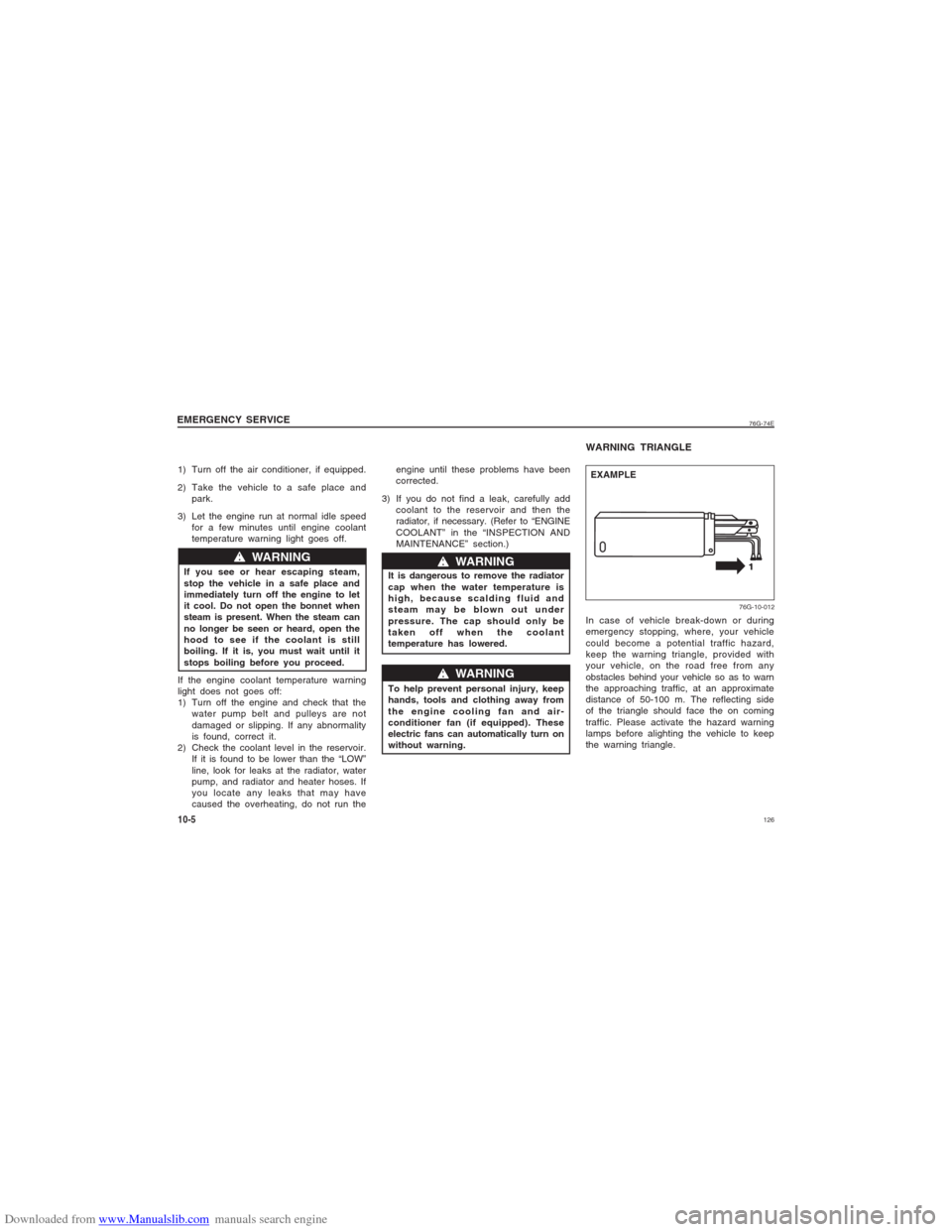
WARNING TRIANGLEIn case of vehicle break-down or during
emergency stopping, where, your vehicle
could become a potential traffic hazard,
keep the warning triangle, provided with
your vehicle, on the road free from any
obstacles behind your vehicle so as to warn
the approaching traffic, at an approximate
distance of 50-100 m. The reflecting side
of the triangle should face the on coming
traffic. Please activate the hazard warning
lamps before alighting the vehicle to keep
the warning triangle.
176G-10-012
EXAMPLE
Page 130 of 139
Downloaded from www.Manualslib.com manuals search engine 13176G-74EStore your vehicle in a dry, well-
ventilated area.
Do not park your vehicle in a damp, poorly
ventilated area. If you often wash your
vehicle in the garage or if you frequently
drive it in when wet, your garage may be
damp. The high humidity in the garage may
cause or accelerate corrosion. A wet vehicle
may corrode even in a heated garage if the
ventilation is poor.
Do not apply additional undercoating
or rust preventive coating on or
around exhaust system components
such as the exhaust pipes, etc. A fire
could be started if the undercoating
substance becomes overheated.
Cover your vehicle
If you cannot regularly park your vehicle in
a garage, we recommend you use a vehicle
cover.
VEHICLE CLEANING
cleaner for tougher stains. If you use a
fabric cleaner, carefully follow the
manufacturer’s instructions and precautions.
Seat Belts
Clean seat belts with a mild soap and
water. Do not use bleach or dye on the
belts. They may weaken the fabric in the
belts.
Vinyl floor mats
Ordinary dirt can be removed from vinyl with
water or mild soap. Use a brush to help
loosen dirt. After the dirt is loosened, rinse
the mat thoroughly with water and dry it in
the shade.
Carpets
Remove dirt and soil as much as possible
with a vacuum cleaner. Using a mild soap
solution, rub stained areas with a clean
damp cloth. To remove soap, rub the areas
again with a cloth dampened with water.
Repeat this until the stain is removed, or
use a commercial carpet cleaner for tougher
stains. If you use a carpet cleaner, carefully
follow the manufacturer’s instructions and
precautions.
w ww w
w WARNING
When cleaning the interior or exterior
of the vehicle, NEVER USE flammable
solvents such as lacquer thinners,
petrol, benzene or cleaning materials
such as bleach or strong household
detergents. The materials could cause
personal injury or damage to the
vehicle.
Cleaning the Interior
Vinyl upholstery
Prepare a solution of soap or mild detergent
mixed with warm water. Apply the solution
to the vinyl with a sponge or soft cloth and
let it soak for a few minutes to loosen dirt.
Rub the surface with a clean, damp cloth
to remove dirt and the soap solution. If
some dirt still remains on the surface,
repeat this procedure.
Fabric upholstery
Remove loose dirt with a vacuum cleaner.
Using a mild soap solution, rub stained
areas with a clean damp cloth. To remove
soap, rub the areas again with a cloth
dampened with water. Repeat this until the
stain is removed, or use a commercial fabric
w ww w
w WARNING
BODY WORK CARE
11-2
Page 131 of 139
Downloaded from www.Manualslib.com manuals search engine 132
76G-74E
Cleaning the Exterior
It is important that your vehicle be
kept clean and free from dirt. Failure
to keep your vehicle clean may result
in fading of the paint or corrosion to
various parts of the vehicle body.
Washing
Never attempt to wash and wax your
vehicle with the engine running.
When cleaning the underside of the
body and fender, where there may
be sharp-edged parts, you should
wear gloves and a longsleeved shirt
to protect your hands and arms
from being cut.
After washing your vehicle, carefully
test the brakes before driving to
make sure they have maintained
their normal effectiveness.When washing the vehicle, follow the
instructions below:
1) Flush the underside of body and wheel
housings with pressurized water to
remove mud and debris. Use plenty of
water.
When washing the vehicle, avoid
directing steam or hot water of more
than 80
0C (176
0F) on plastic parts.
2) Remove dirt and mud from the body
exterior with running water. You may use
a soft sponge or brush. Do not use hard
materials which can scratch the paint.
3) Wash the entire exterior with a mild
detergent or car wash soap using a
sponge or soft cloth. The sponge or
cloth should be frequently soaked in the
soap solution.
When using a commercial car wash
product, observe the cautions
specified by the manufacturer. Never
use strong household detergents or
soaps.
BODY WORK CARE11-3
w ww w
w WARNING
CAUTION
4) Once the dirt has been completely
removed, rinse off the detergent with
running water.
5) After rinsing, wipe off the vehicle body
with a wet chamois or cloth and allow
it to dry in the shade.
6) Check carefully for damage to painted
surfaces. If there is any damage,
“Touchup” the damage following the
procedure below:
a) Clean all damaged spots and allow
them to dry.
b) Stir the paint and “touchup” the
damaged spots lightly using a small
brush.
c) Allow the paint to dry completely.
Waxing
After washing the vehicle, waxing and
polishing are recommended to further
protect and beautify the paint.
Only use waxes and polishes of good
quality.
When using waxes and polishes,
observe the precautions specified by the
manufacturers.
CAUTION
CAUTION