Fuel SUZUKI ALTO 2014 User Guide
[x] Cancel search | Manufacturer: SUZUKI, Model Year: 2014, Model line: ALTO, Model: SUZUKI ALTO 2014Pages: 139, PDF Size: 2.22 MB
Page 44 of 139
4576G-74E
INSTRUMENT PANEL
5-8
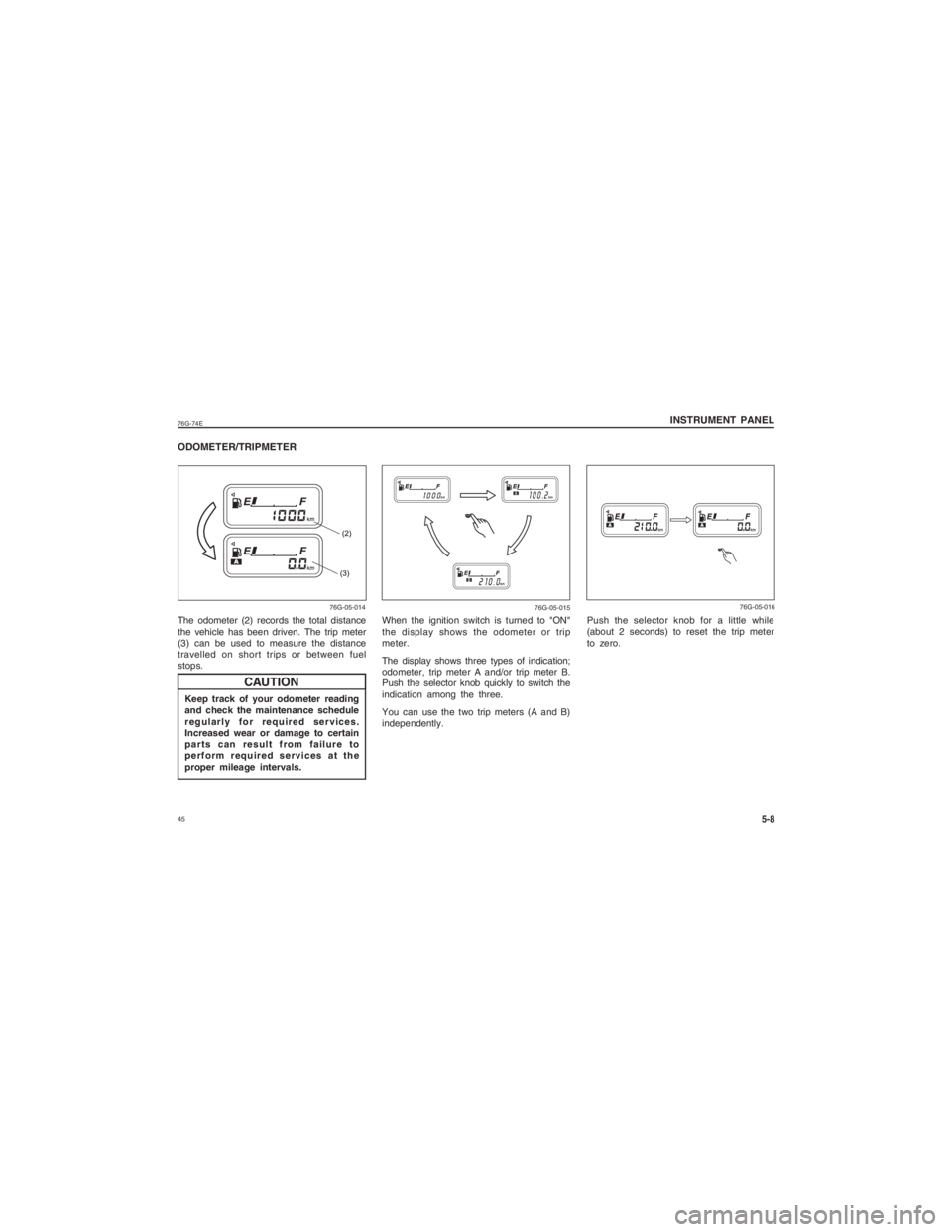
Push the selector knob for a little while
(about 2 seconds) to reset the trip meter
to zero.
76G-05-016
When the ignition switch is turned to "ON"
the display shows the odometer or trip
meter.
The display shows three types of indication;
odometer, trip meter A and/or trip meter B.
Push the selector knob quickly to switch the
indication among the three.
You can use the two trip meters (A and B)
independently.
76G-05-015
76G-05-014
ODOMETER/TRIPMETERThe odometer (2) records the total distance
the vehicle has been driven. The trip meter
(3) can be used to measure the distance
travelled on short trips or between fuel
stops.Keep track of your odometer reading
and check the maintenance schedule
regularly for required services.
Increased wear or damage to certain
parts can result from failure to
perform required services at the
proper mileage intervals.
CAUTION
Page 45 of 139
46
76G-74E
INSTRUMENT PANEL5-9
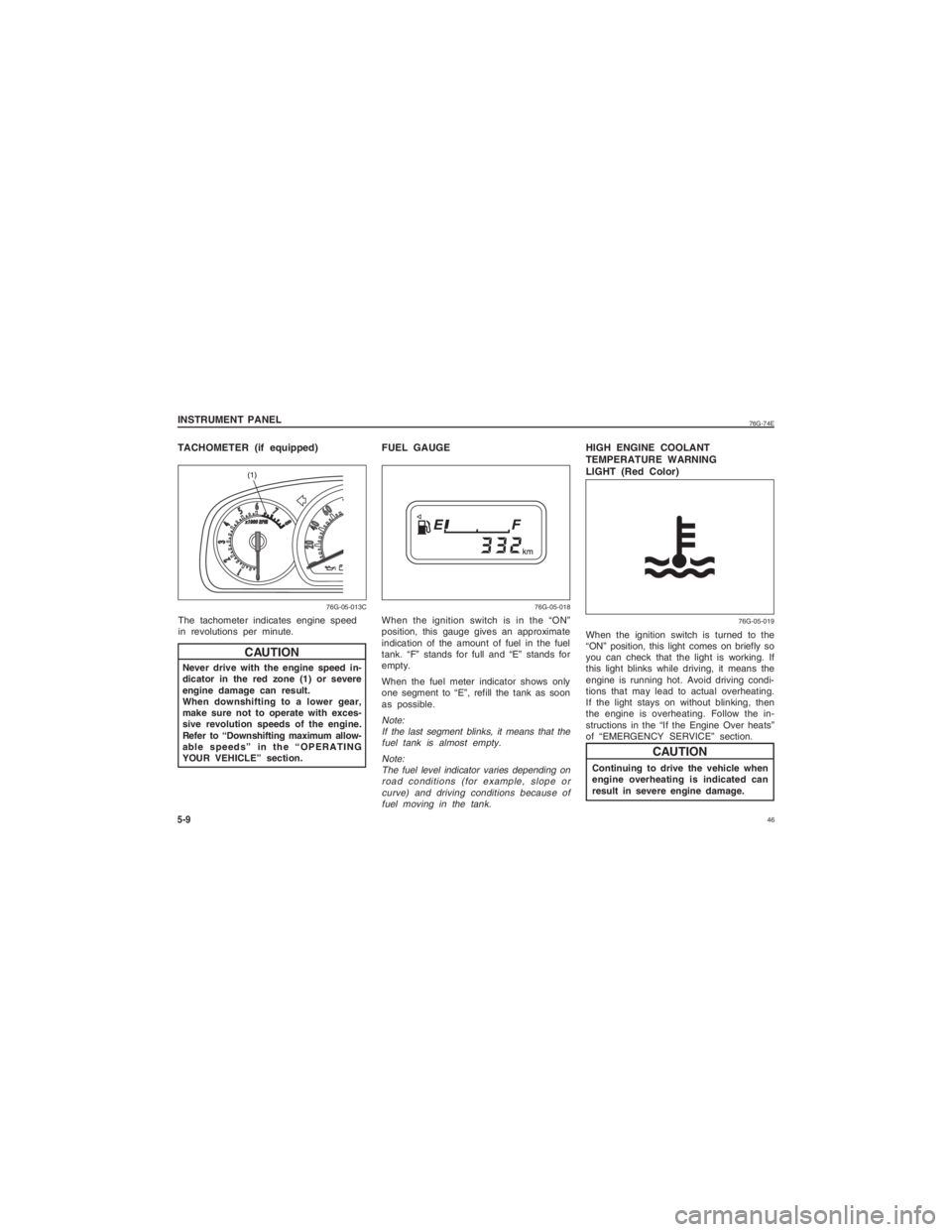
HIGH ENGINE COOLANT
TEMPERATURE WARNING
LIGHT (Red Color)When the ignition switch is turned to the
“ON” position, this light comes on briefly so
you can check that the light is working. If
this light blinks while driving, it means the
engine is running hot. Avoid driving condi-
tions that may lead to actual overheating.
If the light stays on without blinking, then
the engine is overheating. Follow the in-
structions in the “If the Engine Over heats”
of “EMERGENCY SERVICE” section.Continuing to drive the vehicle when
engine overheating is indicated can
result in severe engine damage.
CAUTION
76G-05-019
FUEL GAUGEWhen the ignition switch is in the “ON”
position, this gauge gives an approximate
indication of the amount of fuel in the fuel
tank. “F” stands for full and “E” stands for
empty.
When the fuel meter indicator shows only
one segment to “E”, refill the tank as soon
as possible.Note:If the last segment blinks, it means that the
fuel tank is almost empty.
Note:The fuel level indicator varies depending onroad conditions (for example, slope orcurve) and driving conditions because of
fuel moving in the tank.
76G-05-018
The tachometer indicates engine speed
in revolutions per minute.
76G-05-013C
Never drive with the engine speed in-
dicator in the red zone (1) or severe
engine damage can result.
When downshifting to a lower gear,
make sure not to operate with exces-
sive revolution speeds of the engine.
Refer to “Downshifting maximum allow-
able speeds” in the “OPERATING
YOUR VEHICLE” section.
CAUTION
TACHOMETER (if equipped)
Page 53 of 139
54
76G-74E
Defrosting
Move the function lever/knob to “DEFROST”
and the air intake lever to “FRESH AIR”,
the temperature control lever/knob to the
desired temperature position, and the fan
switch to “HIGH” Moving the temperature
control lever/knob to a higher temperature
position increases defrosting efficiency.
When the windscreen has become clear,
move the fan switch to the desired fan
speed position.
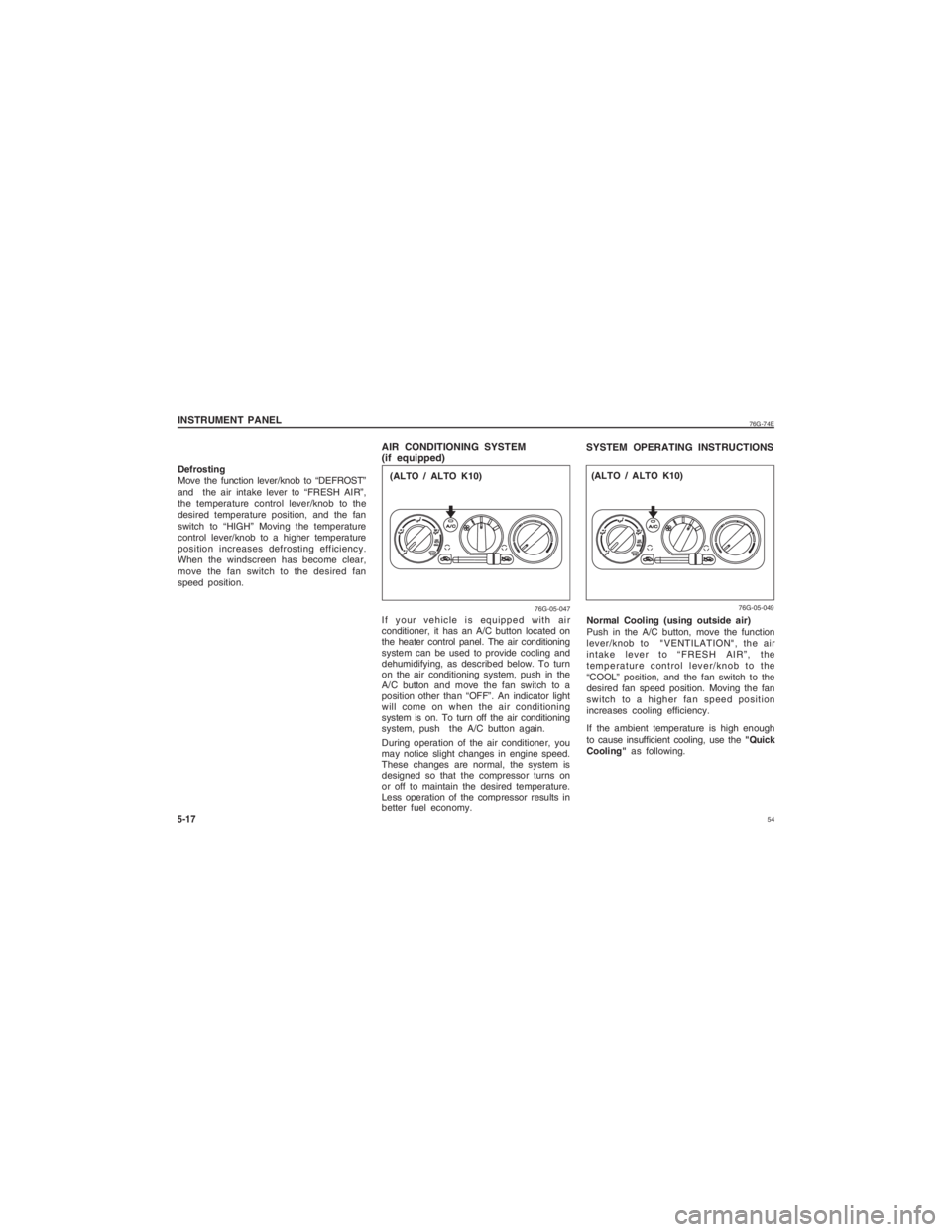
AIR CONDITIONING SYSTEM
(if equipped)If your vehicle is equipped with air
conditioner, it has an A/C button located on
the heater control panel. The air conditioning
system can be used to provide cooling and
dehumidifying, as described below. To turn
on the air conditioning system, push in the
A/C button and move the fan switch to a
position other than “OFF”. An indicator light
will come on when the air conditioning
system is on. To turn off the air conditioning
system, push the A/C button again.
During operation of the air conditioner, you
may notice slight changes in engine speed.
These changes are normal, the system is
designed so that the compressor turns on
or off to maintain the desired temperature.
Less operation of the compressor results in
better fuel economy.
5-17INSTRUMENT PANEL
76G-05-047
(ALTO / ALTO K10)
SYSTEM OPERATING INSTRUCTIONSNormal Cooling (using outside air)
Push in the A/C button, move the function
lever/knob to "VENTILATION", the air
intake lever to “FRESH AIR”, the
temperature control lever/knob to the
“COOL” position, and the fan switch to the
desired fan speed position. Moving the fan
switch to a higher fan speed position
increases cooling efficiency.
If the ambient temperature is high enough
to cause insufficient cooling, use the "Quick
Cooling" as following.
76G-05-049
(ALTO / ALTO K10)
Page 56 of 139

5776G-74E
OTHER CONTROLS AND EQUIPMENT
6
OTHER CONTROLS AND EQUIPMENT
Parking Brake Lever
........................................................................\
.................. 6-1
Pedals ........................................................................\
........................................... 6-2
Gear Lever ........................................................................\
................................... 6-3
Fuel Filler Cap ........................................................................\
............................ 6-3
Folding Rear Seats ........................................................................\
.................... 6-5
Sun Visor ........................................................................\
..................................... 6-5
Interior Light Switch........................................................................\
.................. 6-6
Assist Grips ........................................................................\
................................ 6-6
Bonnet ........................................................................\
........................................... 6-6
Frame Hooks (if equipped) ........................................................................\
...... 6-7
Cup Holder (if equipped) ........................................................................\
......... 6-8
Tyre Changing Tools ........................................................................\
................. 6-8
High Mount Stop Lamp ........................................................................\
............ 6-9
Page 59 of 139
60
76G-74E
FUEL FILLER CAP
6-3
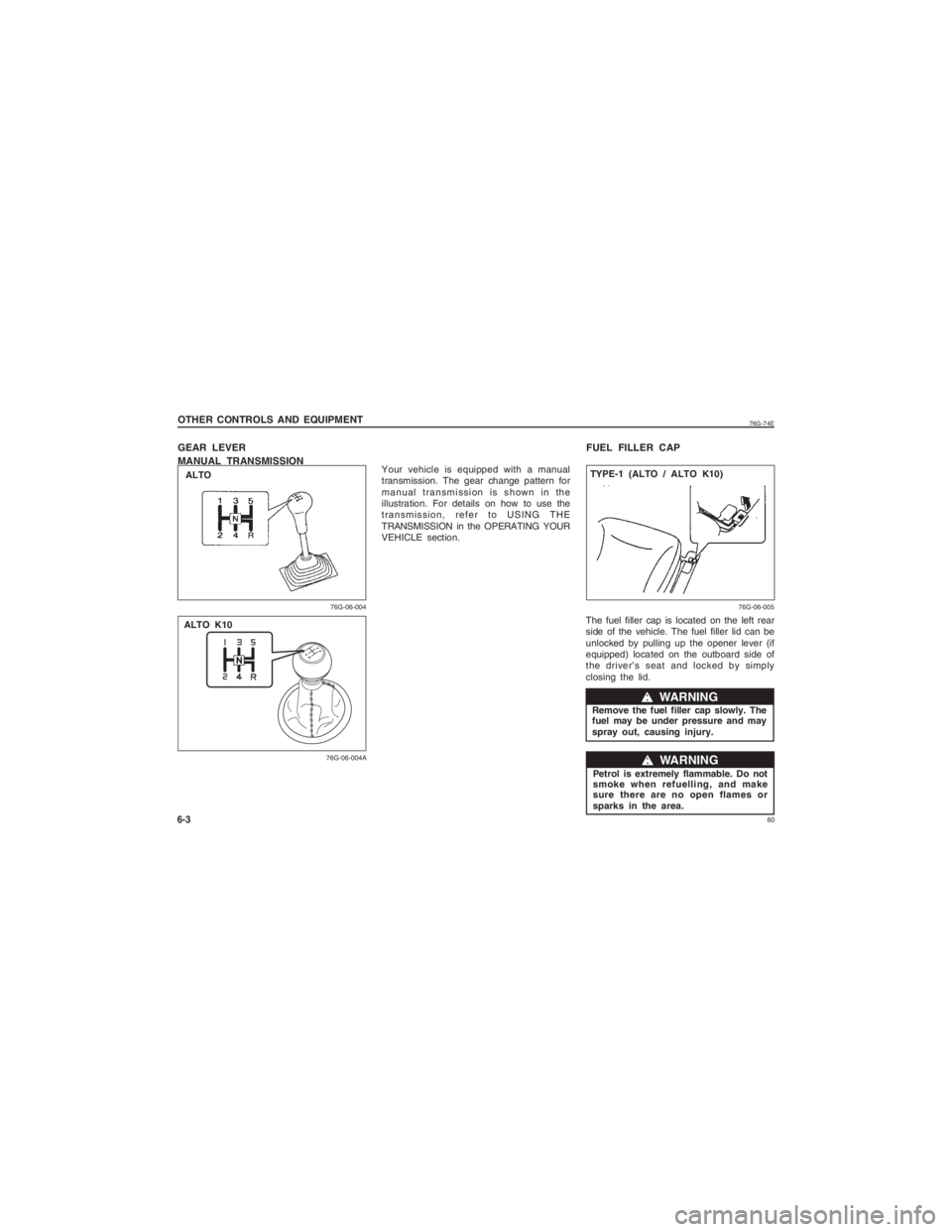
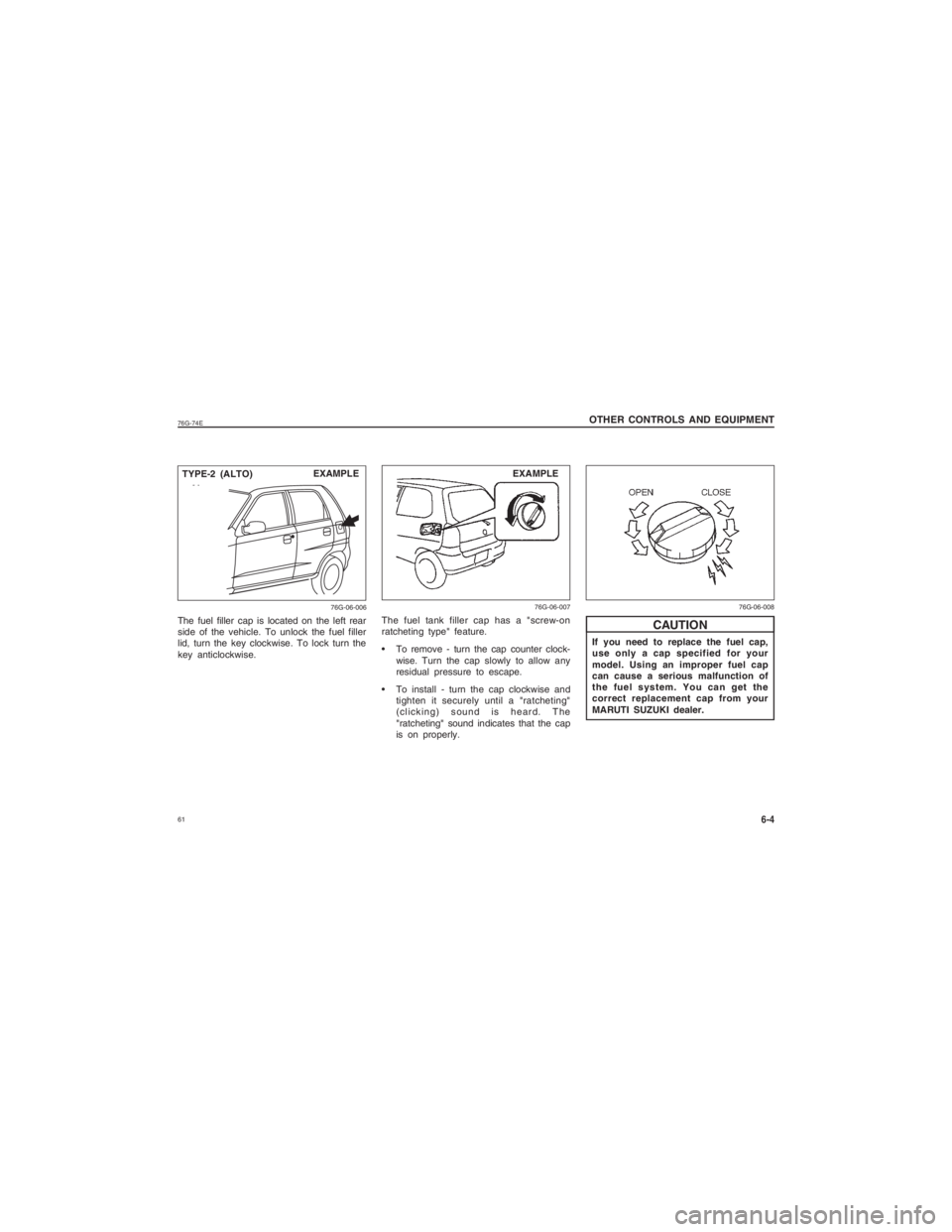
The fuel filler cap is located on the left rear
side of the vehicle. The fuel filler lid can be
unlocked by pulling up the opener lever (if
equipped) located on the outboard side of
the driver’s seat and locked by simply
closing the lid.
ww ww
w WARNING
OTHER CONTROLS AND EQUIPMENT
ww
ww
w WARNING
GEAR LEVER
Your vehicle is equipped with a manual
transmission. The gear change pattern for
manual transmission is shown in the
illustration. For details on how to use the
transmission, refer to USING THE
TRANSMISSION in the OPERATING YOUR
VEHICLE section.
76G-06-004 76G-06-005
MANUAL TRANSMISSIONALTO
76G-06-004A
ALTO K10TYPE-1 (ALTO / ALTO K10)
Remove the fuel filler cap slowly. The
fuel may be under pressure and may
spray out, causing injury.Petrol is extremely flammable. Do not
smoke when refuelling, and make
sure there are no open flames or
sparks in the area.
Page 60 of 139
6176G-74E
6-4
OTHER CONTROLS AND EQUIPMENTIf you need to replace the fuel cap,
use only a cap specified for your
model. Using an improper fuel cap
can cause a serious malfunction of
the fuel system. You can get the
correct replacement cap from your
MARUTI SUZUKI dealer.
The fuel tank filler cap has a "screw-on
ratcheting type" feature.
To remove - turn the cap counter clock-
wise. Turn the cap slowly to allow any
residual pressure to escape.
To install - turn the cap clockwise and tighten it securely until a "ratcheting"
(clicking) sound is heard. The
"ratcheting" sound indicates that the cap
is on properly.
CAUTION
76G-06-007 76G-06-008
The fuel filler cap is located on the left rear
side of the vehicle. To unlock the fuel filler
lid, turn the key clockwise. To lock turn the
key anticlockwise.
76G-06-006
TYPE-2 (ALTO)EXAMPLE EXAMPLE
Page 68 of 139

6976G-74E
OPERATING YOUR VEHICLE
7
OPERATING YOUR VEHICLE
Exhaust Gas Warning
........................................................................\
............... 7-1
Daily Inspection Checklist ........................................................................\
........ 7-1
Starting the Engine ........................................................................\
................... 7-2
Using the Transmission ........................................................................\
............ 7-3
Braking ........................................................................\
......................................... 7-4
Running-in ........................................................................\
.................................... 7-5
Catalytic Converter ........................................................................\
.................... 7-5
Improving Fuel Economy ........................................................................\
......... 7-6
Trailer Towing ........................................................................\
............................. 7-7
Page 70 of 139
7176G-74E
Before starting the engine:
1) Make sure the parking brake is appliedfully.
2) Manual Transmission - Shift into “N” (neutral) and depress the clutch pedal all
the way to the floor. Hold it while starting
the engine.
Make sure that the parking brake is
applied fully and the transmission is
in Neutral before attempting to start
the engine.
Stop turning the starter immediately after the engine has started or the
starter system can be damaged.
Do not crank the engine for more than 15 seconds at a time. If the
engine doesn’t start on the first try,
wait about 15 seconds before trying
again.
7-2
STARTING THE ENGINE
ww ww
w WARNING
OPERATING YOUR VEHICLE
Once a week, or each time you fill your fuel
tank, perform the following under-bonnet
checks:
1) Engine oil level.
2) Coolant level.
3) Brake fluid level.
4) Windscreen washer fluid level.
5) Battery solution level.
6) Bonnet latch operation.
Pull the bonnet release handle inside the
vehicle. Make sure that you can not
open the hood all the way without
releasing the secondary latch. Be sure
to close the hood securely after checking
for proper operation. See "All Latches,
Hinges & Locks" of "PERIODIC
MAINTENANCE SCHEDULE" in the
"INSPECTION AND MAINTENANCE"
section for lubrication schedule.
Make sure the bonnet is fully closed
and latched before driving. If it is not,
it can fly up unexpectedly during
driving, obstructing your view and
resulting in an accident.
ww ww
w WARNING
Starting a Cold Engine
Engine which is started after 6 hours should
be treated as cold engine.
For Electronic fuel injection models
With your foot off the accelerator pedal,
crank the engine by turning the ignition
key to “START”. Release the key when
the engine starts.
If the engine does not start after 15 seconds of cranking, wait about 15
seconds, then press down the
accelerator pedal to 1/3 of its travel and
try cranking the engine again. Release
the key and accelerator pedal when the
engine starts.
If the engine still does not start, try holding the accelerator pedal all the way
to the floor while cranking. This should
clear the engine if it is flooded.
Starting a Warm Engine
For Electronic fuel injection models:
Use the same procedure as for “Starting a
Cold Engine”.
CAUTION
Page 73 of 139
74
76G-74E
7-5OPERATING YOUR VEHICLERUNNING-IN
The future performance and reliability
of the engine depends on the care
and restraint exercised during its early
life. It is especially important to
observe the following precautions
during the initial 1000 km of vehicle
operation.
After starting, do not race theengine. Warm it up gradually.
Avoid prolonged vehicle operation at a constant speed. Moving parts will
bed in better if you vary your speed.
Do not exceed 100 km/h.
Start off from a stop slowly. Avoid full throttle starts.
If possible, avoid hard braking, especially during the first 300 km
of driving.
Do not drive slowly with the transmission in a high gear.
Drive the vehicle at moderate engine speeds.
CAUTION
Even without reserve power in the
brake system, you can still stop the
vehicle by pressing the brake pedal
harder than normally required.
However, the stopping distance may
be longer.
On loose surface where the wheels
can easily loose traction (such as
gravel, etc.), the stopping distance
required for your vehicle may be
greater than for a comparable vehicle
with a conventional brake system.
Allow for extra stopping distance
when driving on loose surfaces.
ww ww
w WARNINGww
ww
w WARNING
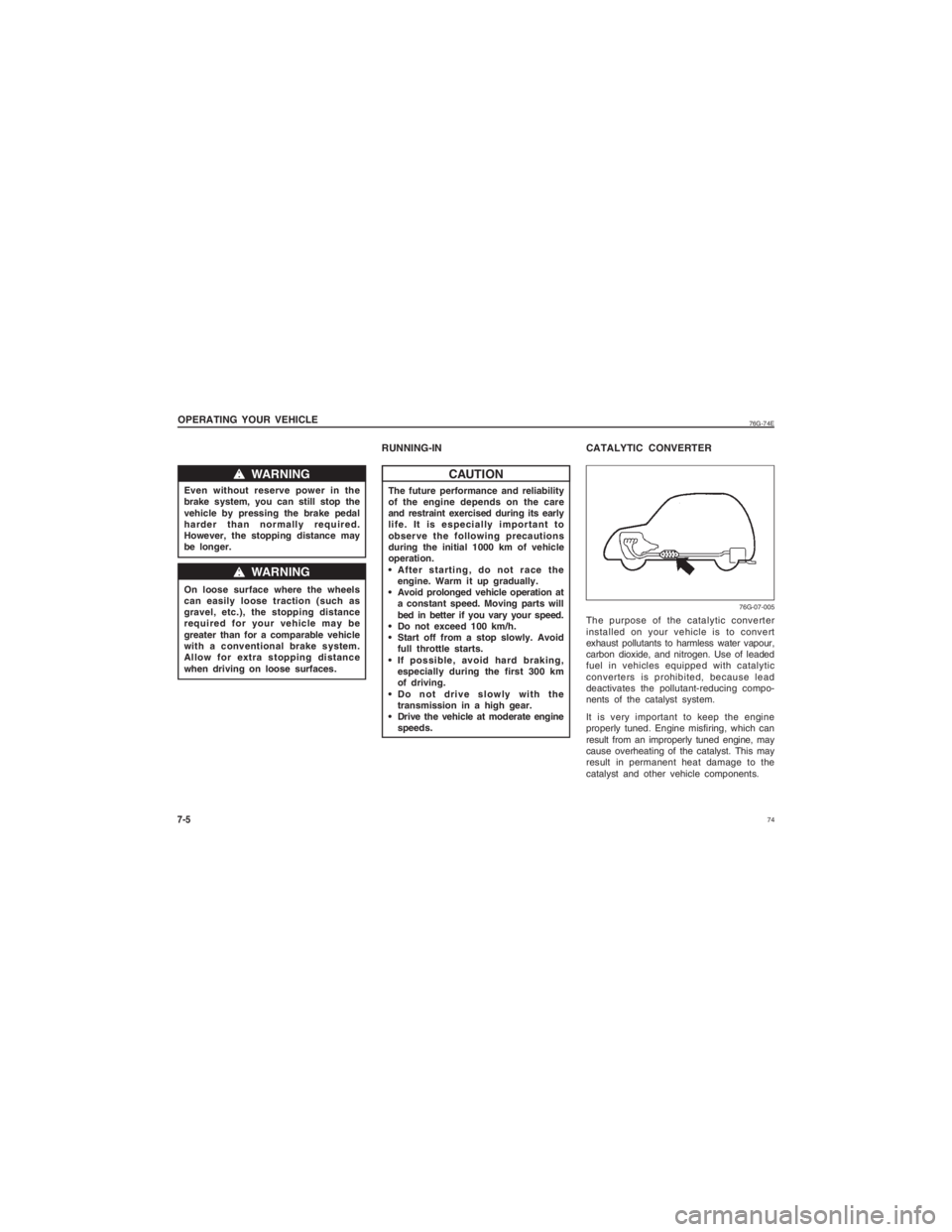
CATALYTIC CONVERTERThe purpose of the catalytic converter
installed on your vehicle is to convert
exhaust pollutants to harmless water vapour,
carbon dioxide, and nitrogen. Use of leaded
fuel in vehicles equipped with catalytic
converters is prohibited, because lead
deactivates the pollutant-reducing compo-
nents of the catalyst system.
It is very important to keep the engine
properly tuned. Engine misfiring, which can
result from an improperly tuned engine, may
cause overheating of the catalyst. This may
result in permanent heat damage to the
catalyst and other vehicle components.
76G-07-005
Page 74 of 139
7576G-74E
7-6
OPERATING YOUR VEHICLE
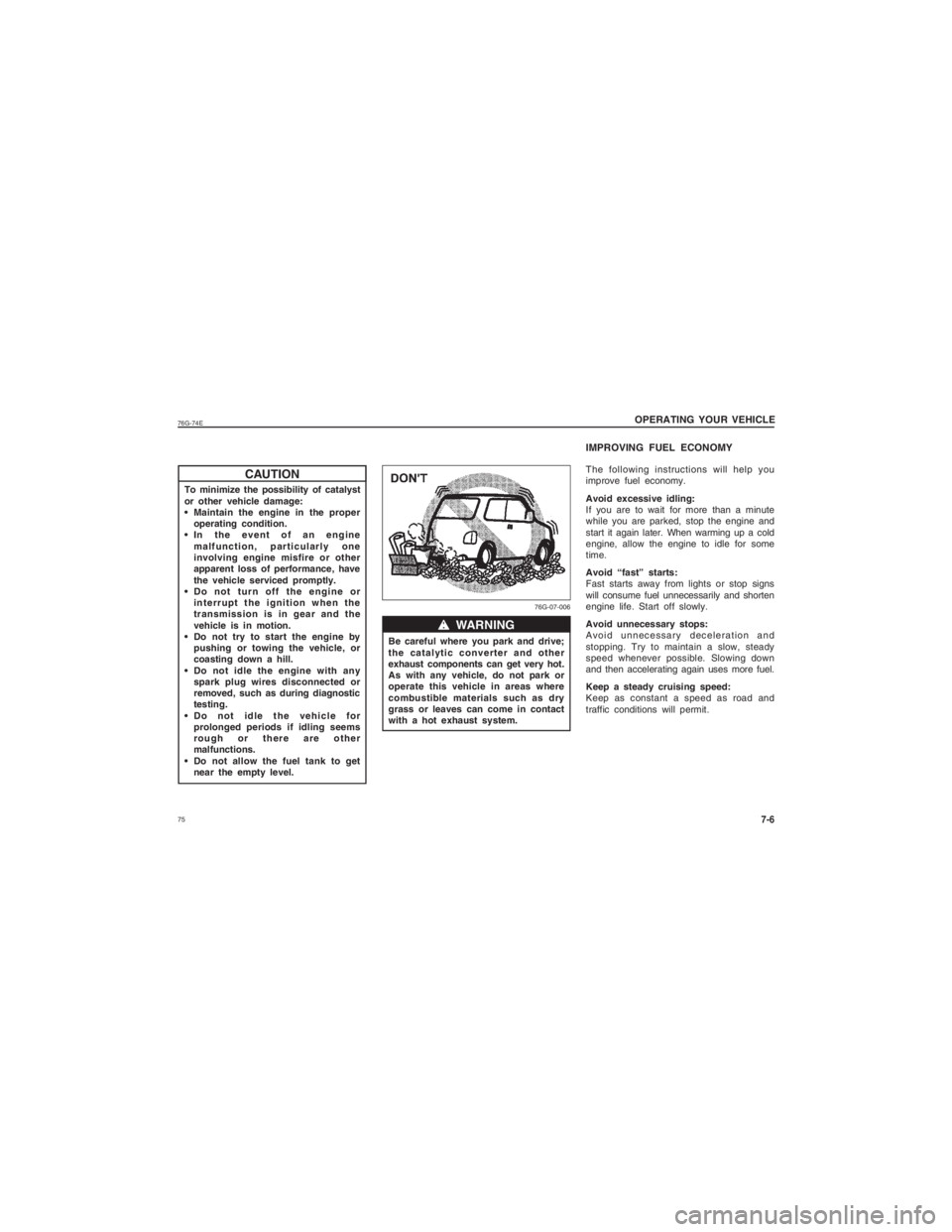
Be careful where you park and drive;
the catalytic converter and other
exhaust components can get very hot.
As with any vehicle, do not park or
operate this vehicle in areas where
combustible materials such as dry
grass or leaves can come in contact
with a hot exhaust system.
ww ww
w WARNING
To minimize the possibility of catalyst
or other vehicle damage:
Maintain the engine in the proper
operating condition.
In the event of an engine
malfunction, particularly one
involving engine misfire or other
apparent loss of performance, have
the vehicle serviced promptly.
Do not turn off the engine or interrupt the ignition when the
transmission is in gear and the
vehicle is in motion.
Do not try to start the engine by pushing or towing the vehicle, or
coasting down a hill.
Do not idle the engine with any spark plug wires disconnected or
removed, such as during diagnostic
testing.
Do not idle the vehicle for
prolonged periods if idling seems
rough or there are other
malfunctions.
Do not allow the fuel tank to get
near the empty level.
CAUTION
IMPROVING FUEL ECONOMYThe following instructions will help you
improve fuel economy.
Avoid excessive idling:
If you are to wait for more than a minute
while you are parked, stop the engine and
start it again later. When warming up a cold
engine, allow the engine to idle for some
time.
Avoid “fast” starts:
Fast starts away from lights or stop signs
will consume fuel unnecessarily and shorten
engine life. Start off slowly.
Avoid unnecessary stops:
Avoid unnecessary deceleration and
stopping. Try to maintain a slow, steady
speed whenever possible. Slowing down
and then accelerating again uses more fuel.
Keep a steady cruising speed:
Keep as constant a speed as road and
traffic conditions will permit.
76G-07-006