Led SUZUKI ALTO 2015 User Guide
[x] Cancel search | Manufacturer: SUZUKI, Model Year: 2015, Model line: ALTO, Model: SUZUKI ALTO 2015Pages: 139, PDF Size: 2.22 MB
Page 88 of 139
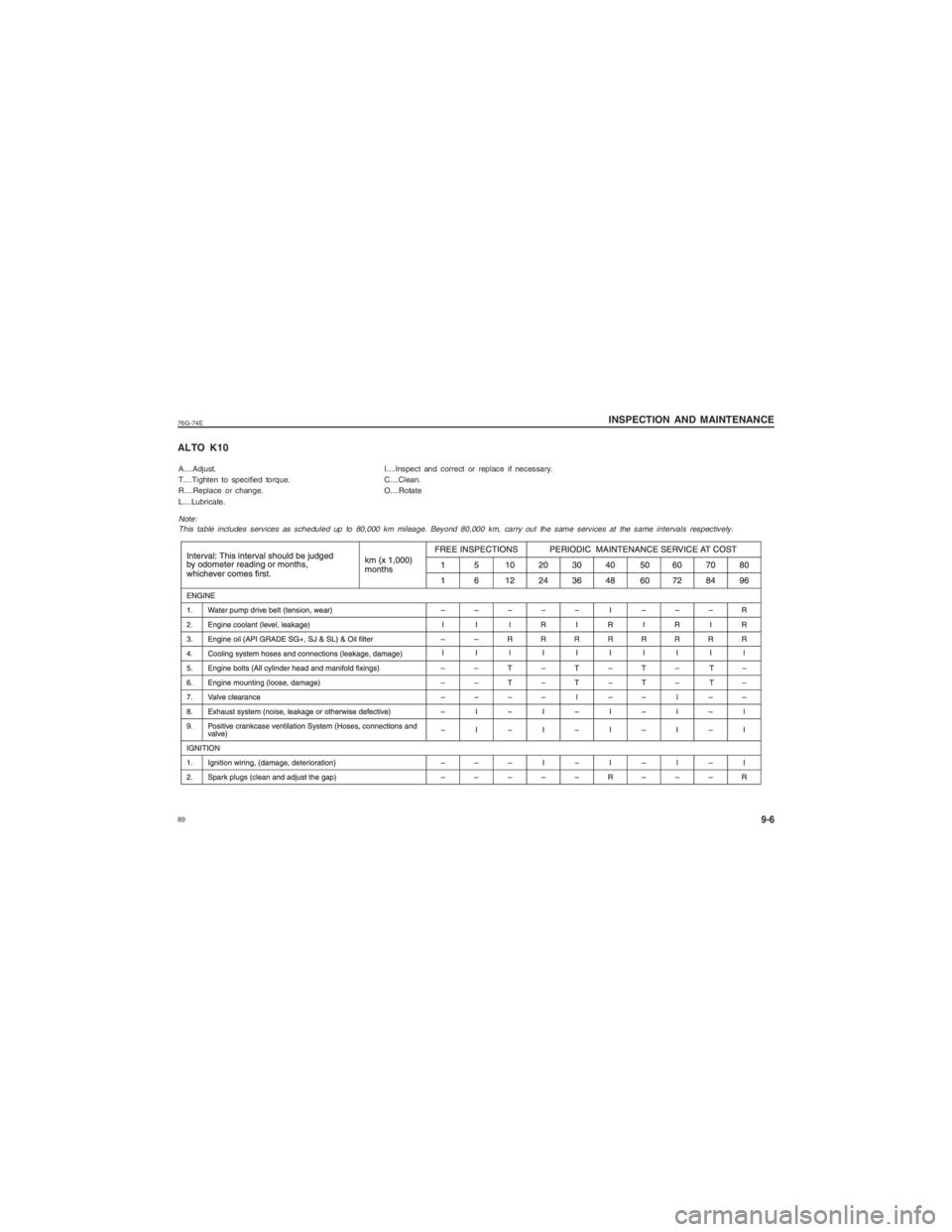
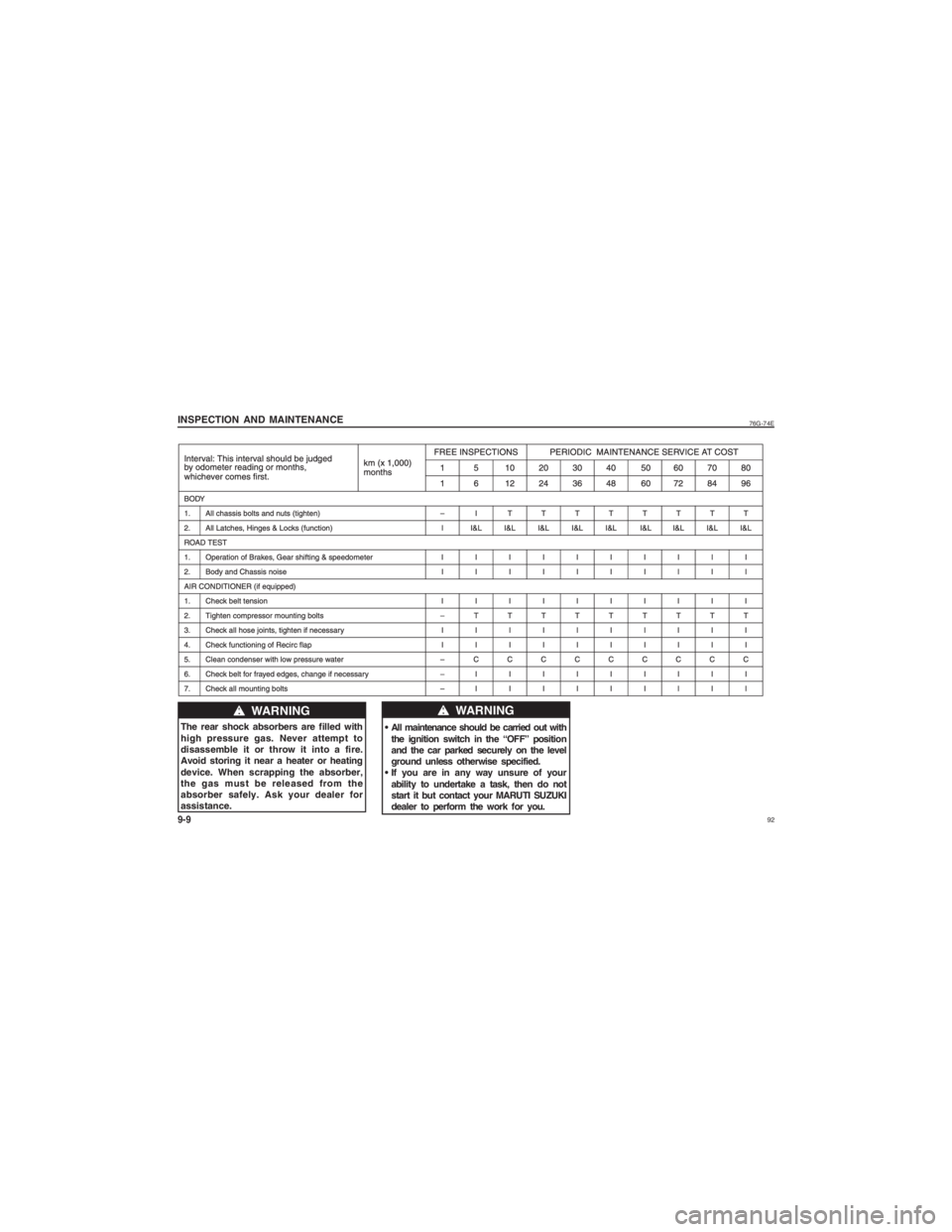
8976G-74EA....Adjust. I....Inspect and correct or replace if necessary.
T....Tighten to specified torque. C....Clean.
R....Replace or change. O....Rotate
L....Lubricate.Note: This table includes services as scheduled up to 80,000 km mileage. Beyon\
d 80,000 km, carry out the same services at the same in tervals respectively.
INSPECTION AND MAINTENANCE
9-6
ALTO K10
Page 91 of 139
92
76G-74E
ww ww
w WARNING
The rear shock absorbers are filled with
high pressure gas. Never attempt to
disassemble it or throw it into a fire.
Avoid storing it near a heater or heating
device. When scrapping the absorber,
the gas must be released from the
absorber safely. Ask your dealer for
assistance. All maintenance should be carried out with
the ignition switch in the “OFF” position
and the car parked securely on the level
ground unless otherwise specified.
If you are in any way unsure of your
ability to undertake a task, then do not
start it but contact your MARUTI SUZUKI
dealer to perform the work for you.
ww ww
w WARNING
INSPECTION AND MAINTENANCE9-9
Page 98 of 139
9976G-74E
INSPECTION AND MAINTENANCE
9-16
CAUTION
To avoid damaging your cooling sys-
tem:
Always use a high quality ethyleneglycol base non-silicate type cool-
ant diluted with distilled water at
the correct mixture concentration.
Make sure that the proper mix is 30/ 70 coolant to distilled water.
Concentrations greater than 70/30
coolant to distilled water will cause
over heating conditions.
Do not use straight coolant nor plain water.
Do not add extra inhibitors or addi-
tives. They may not be compatible
with your cooling system.
Do not mix different types of base coolants. Doing so may result in
accelerated seal wear and/or the
possibility of severe overheating
and extensive engine damage. Coolant Level Check
Check the coolant level at the reservoir
tank, not at the radiator. With the engine
cool, the coolant level should be between
the “FULL” and “LOW” marks.
Adding Coolant
If the coolant level is below the “LOW”
mark, more coolant should be added.
Remove the reservoir tank cap and add
coolant until the reservoir tank level reaches
the “FULL” mark. Never fill the reservoir
tank above the “FULL” mark.
CAUTION
The mixture you use should con-
tain 50% concentration of anti-
freeze.
If the lowest ambient temperature
in your area is expected to be –
35°C (–31°F) or below, use higher
concentrations up to 60% following
the instructions on the antifreeze
container.
When putting the cap on the reser- voir tank, line up the arrow on the
cap and the arrow on the tank. Fail-
ure to follow this can result in cool-
ant leakage.
Page 99 of 139
100
76G-74E
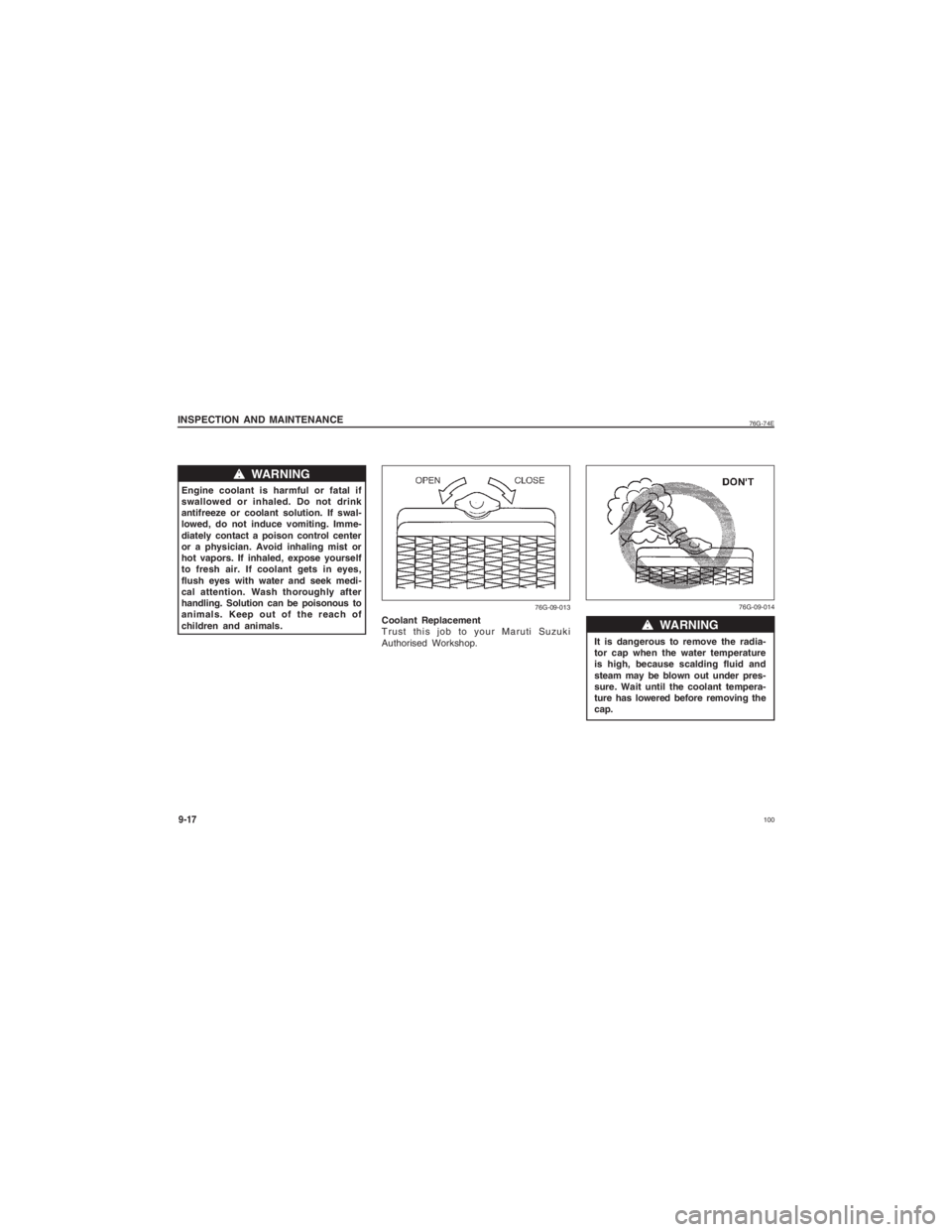
Coolant Replacement
Trust this job to your Maruti Suzuki
Authorised Workshop.
76G-09-013
ww ww
w WARNING
76G-09-014
It is dangerous to remove the radia-
tor cap when the water temperature
is high, because scalding fluid and
steam may be blown out under pres-
sure. Wait until the coolant tempera-
ture has lowered before removing the
cap.
ww ww
w WARNING
Engine coolant is harmful or fatal if
swallowed or inhaled. Do not drink
antifreeze or coolant solution. If swal-
lowed, do not induce vomiting. Imme-
diately contact a poison control center
or a physician. Avoid inhaling mist or
hot vapors. If inhaled, expose yourself
to fresh air. If coolant gets in eyes,
flush eyes with water and seek medi-
cal attention. Wash thoroughly after
handling. Solution can be poisonous to
animals. Keep out of the reach of
children and animals.9-17INSPECTION AND MAINTENANCE
Page 111 of 139
112
76G-74E
INSPECTION AND MAINTENANCE9-29To avoid harm to yourself or damage
to your vehicle or battery, follow the
jump starting instructions in the
EMERGENCY SERVICE section of this
manual if it is necessary to jump start
your vehicle.
The level of the battery solution must be
kept between the “MAX” and the “MIN” level
lines at all times. If the level is found to be
below the “MIN” level line, add distilled
water to the “MAX” level line. You should
periodically check the battery, battery
terminals, and battery hold-down bracket for
corrosion. Remove corrosion using a stiff
brush and ammonia mixed with water, or
baking soda mixed with water. After
removing corrosion, rinse with clean water.
If your vehicle is not going to be driven for
a month or longer, disconnect the cable from
the negative terminal of the battery to help
prevent discharge.
ww ww
w WARNING
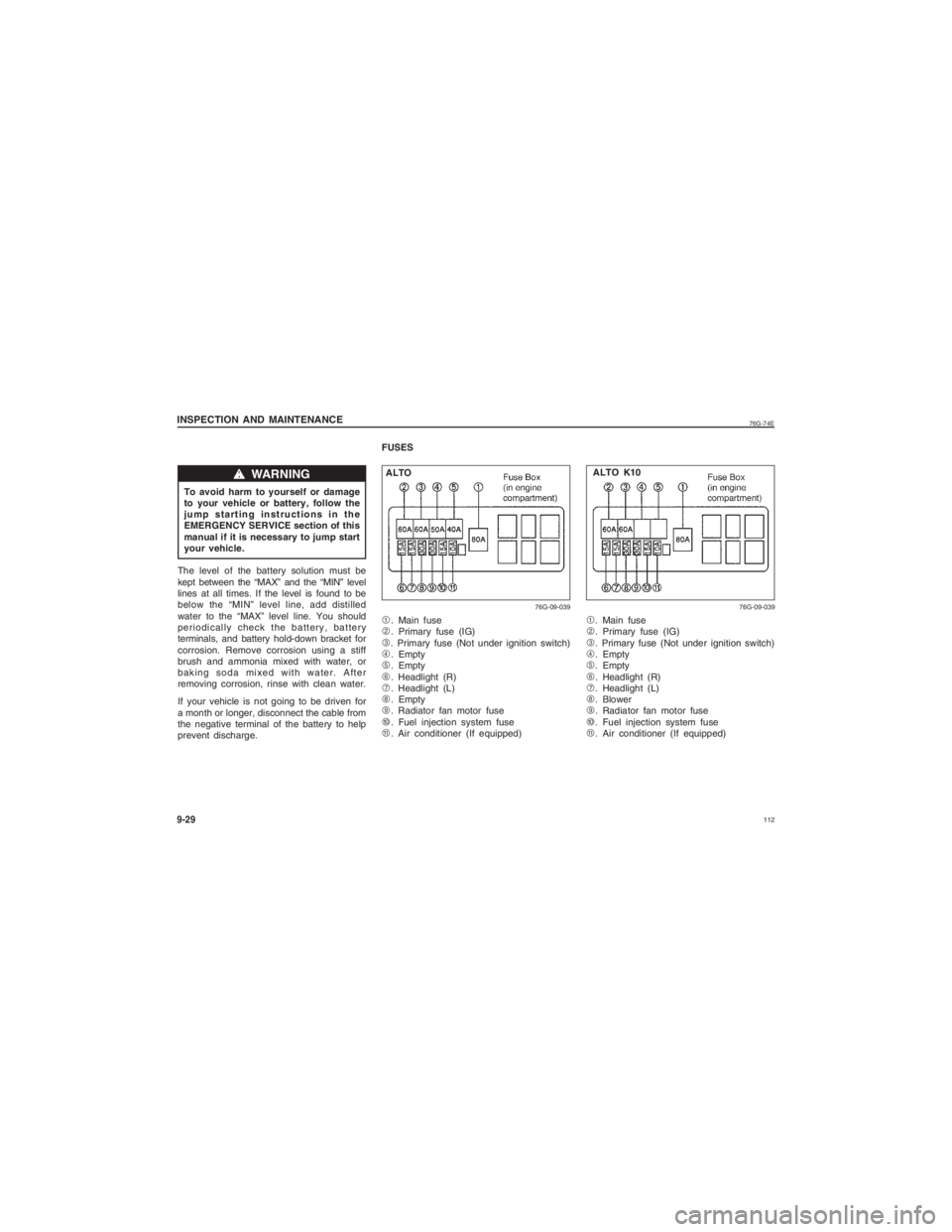
FUSES
1 . Main fuse
2 . Primary fuse (IG)
3 . Primary fuse (Not under ignition switch)
4 . Empty
5 . Empty
6 . Headlight (R)
7 . Headlight (L)
8 . Empty
9 . Radiator fan motor fuse
0 . Fuel injection system fuse
c . Air conditioner (If equipped)
76G-09-039
1. Main fuse
2 . Primary fuse (IG)
3 . Primary fuse (Not under ignition switch)
4 . Empty
5 . Empty
6 . Headlight (R)
7 . Headlight (L)
8 . Blower
9 . Radiator fan motor fuse
0 . Fuel injection system fuse
c . Air conditioner (If equipped)
76G-09-039
ALTO ALTO K10
Page 114 of 139
11576G-74E
INSPECTION AND MAINTENANCE
9-32
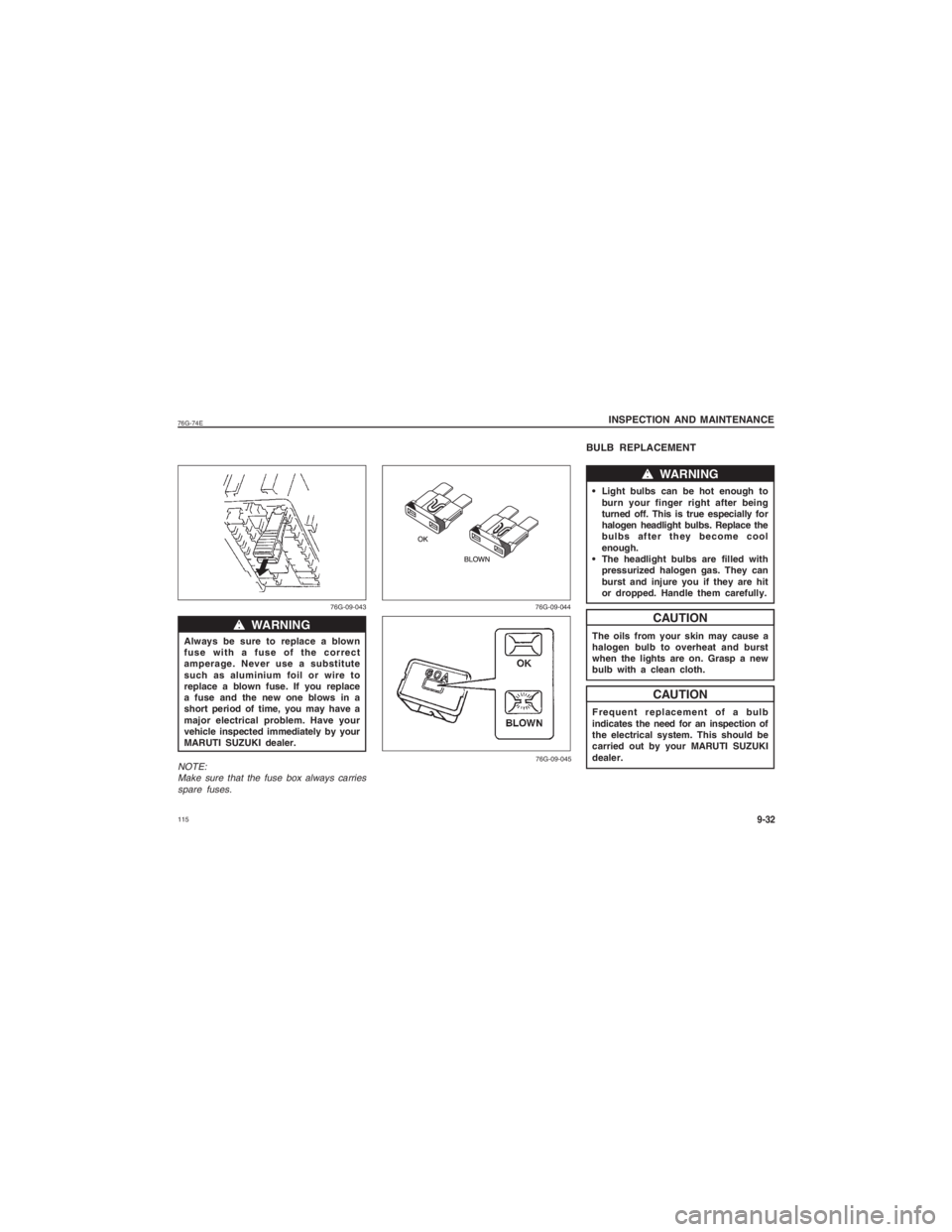
Always be sure to replace a blown
fuse with a fuse of the correct
amperage. Never use a substitute
such as aluminium foil or wire to
replace a blown fuse. If you replace
a fuse and the new one blows in a
short period of time, you may have a
major electrical problem. Have your
vehicle inspected immediately by your
MARUTI SUZUKI dealer.NOTE:Make sure that the fuse box always carriesspare fuses.
ww ww
w WARNING
76G-09-043
BULB REPLACEMENT Light bulbs can be hot enough to
burn your finger right after being
turned off. This is true especially for
halogen headlight bulbs. Replace the
bulbs after they become cool
enough.
The headlight bulbs are filled with pressurized halogen gas. They can
burst and injure you if they are hit
or dropped. Handle them carefully.
The oils from your skin may cause a
halogen bulb to overheat and burst
when the lights are on. Grasp a new
bulb with a clean cloth.
Frequent replacement of a bulb
indicates the need for an inspection of
the electrical system. This should be
carried out by your MARUTI SUZUKI
dealer.
CAUTIONCAUTIONww ww
w WARNING
76G-09-044
76G-09-045
Page 122 of 139
12376G-74E
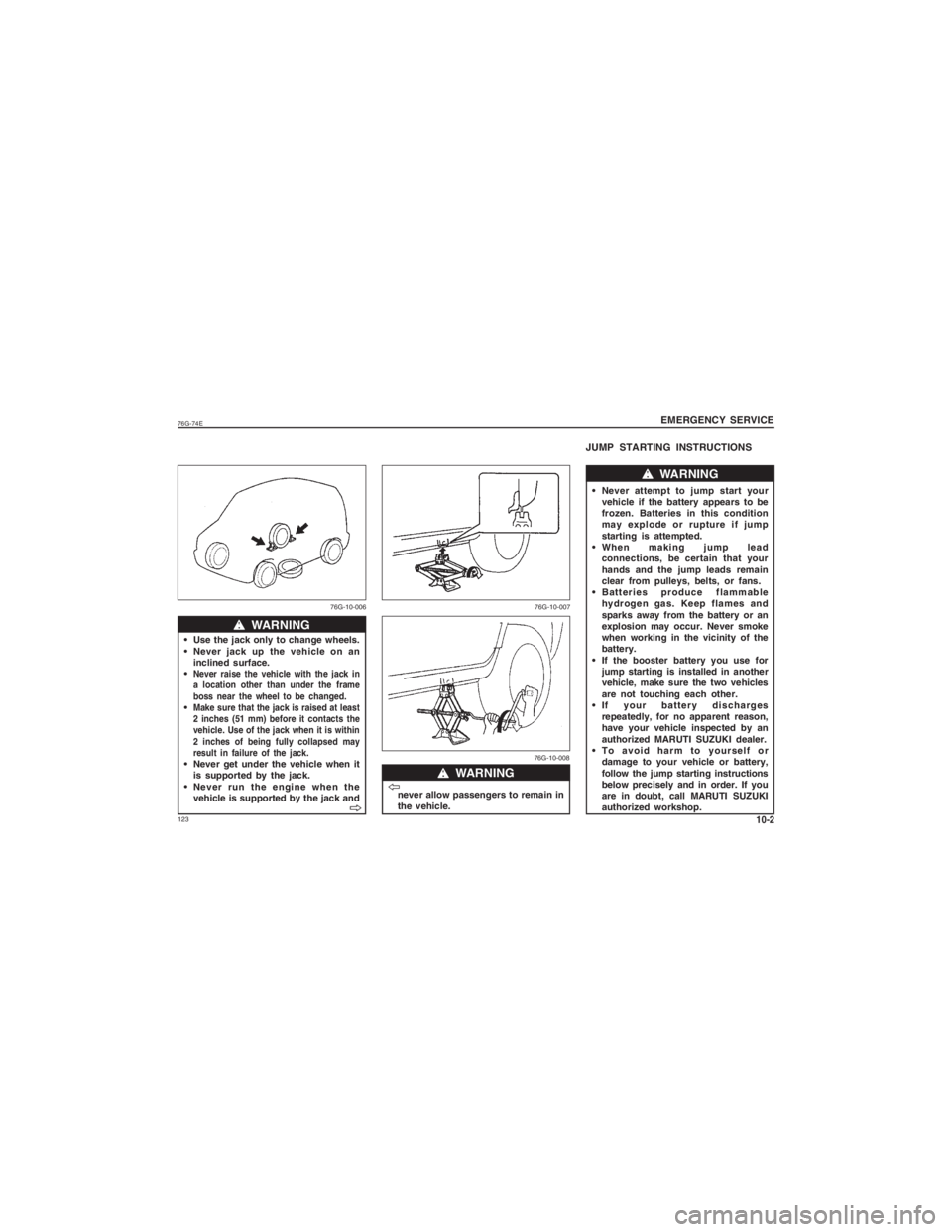
never allow passengers to remain in
the vehicle.
JUMP STARTING INSTRUCTIONS Never attempt to jump start yourvehicle if the battery appears to be
frozen. Batteries in this condition
may explode or rupture if jump
starting is attempted.
When making jump lead connections, be certain that your
hands and the jump leads remain
clear from pulleys, belts, or fans.
Batteries produce flammable hydrogen gas. Keep flames and
sparks away from the battery or an
explosion may occur. Never smoke
when working in the vicinity of the
battery.
If the booster battery you use for jump starting is installed in another
vehicle, make sure the two vehicles
are not touching each other.
If your battery discharges repeatedly, for no apparent reason,
have your vehicle inspected by an
authorized MARUTI SUZUKI dealer.
To avoid harm to yourself or damage to your vehicle or battery,
follow the jump starting instructions
below precisely and in order. If you
are in doubt, call MARUTI SUZUKI
authorized workshop.
ww ww
w WARNING
ww
ww
w WARNING
EMERGENCY SERVICE
10-2
VV
VV
V
Use the jack only to change wheels.
Never jack up the vehicle on an
inclined surface.
Never raise the vehicle with the jack in
a location other than under the frame
boss near the wheel to be changed.Make sure that the jack is raised at least
2 inches (51 mm) before it contacts the
vehicle. Use of the jack when it is within
2 inches of being fully collapsed may
result in failure of the jack. Never get under the vehicle when it is supported by the jack.
Never run the engine when the vehicle is supported by the jack and
ww ww
w WARNING
VV
VV
V
76G-10-006 76G-10-007
76G-10-008
Page 123 of 139
124
76G-74E
Vehicle equipped with electronic fuelinjection system will not start by
pushing or towing as the fuel pump
will not work in this condition. This
starting method could also result in
permanent damage to the catalytic
converter. Use jump leads to start a
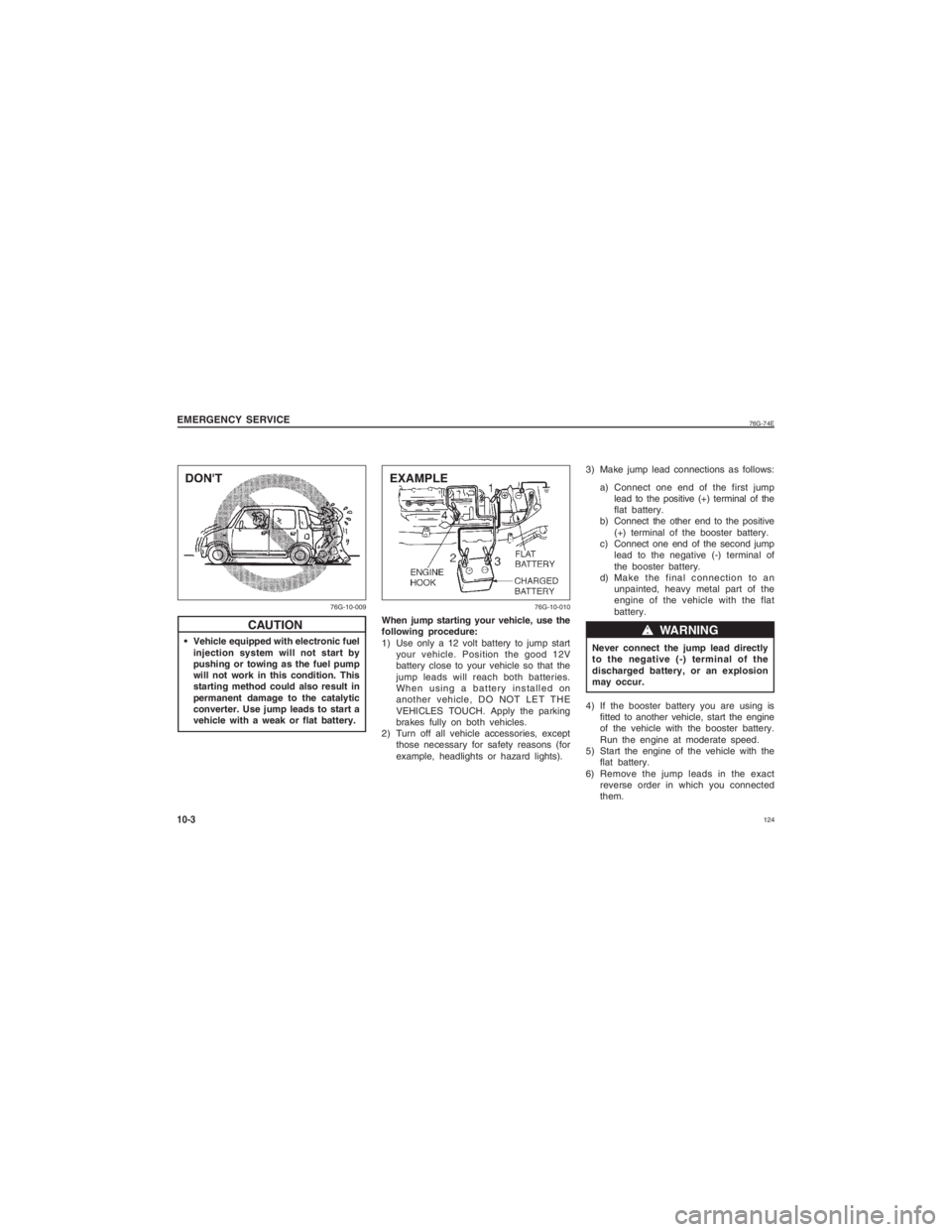
vehicle with a weak or flat battery. When jump starting your vehicle, use the
following procedure:
1) Use only a 12 volt battery to jump start
your vehicle. Position the good 12V
battery close to your vehicle so that the
jump leads will reach both batteries.
When using a battery installed on
another vehicle, DO NOT LET THE
VEHICLES TOUCH. Apply the parking
brakes fully on both vehicles.
2) Turn off all vehicle accessories, except those necessary for safety reasons (for
example, headlights or hazard lights). 3) Make jump lead connections as follows:
a) Connect one end of the first jumplead to the positive (+) terminal of the
flat battery.
b) Connect the other end to the positive
(+) terminal of the booster battery.
c) Connect one end of the second jump lead to the negative (-) terminal of
the booster battery.
d) Make the final connection to an unpainted, heavy metal part of the
engine of the vehicle with the flat
battery.
Never connect the jump lead directly
to the negative (-) terminal of the
discharged battery, or an explosion
may occur.
4) If the booster battery you are using is fitted to another vehicle, start the engine
of the vehicle with the booster battery.
Run the engine at moderate speed.
5) Start the engine of the vehicle with the flat battery.
6) Remove the jump leads in the exact reverse order in which you connected
them.EMERGENCY SERVICE10-3
ww ww
w WARNING
CAUTION
76G-10-009 76G-10-010
Page 124 of 139
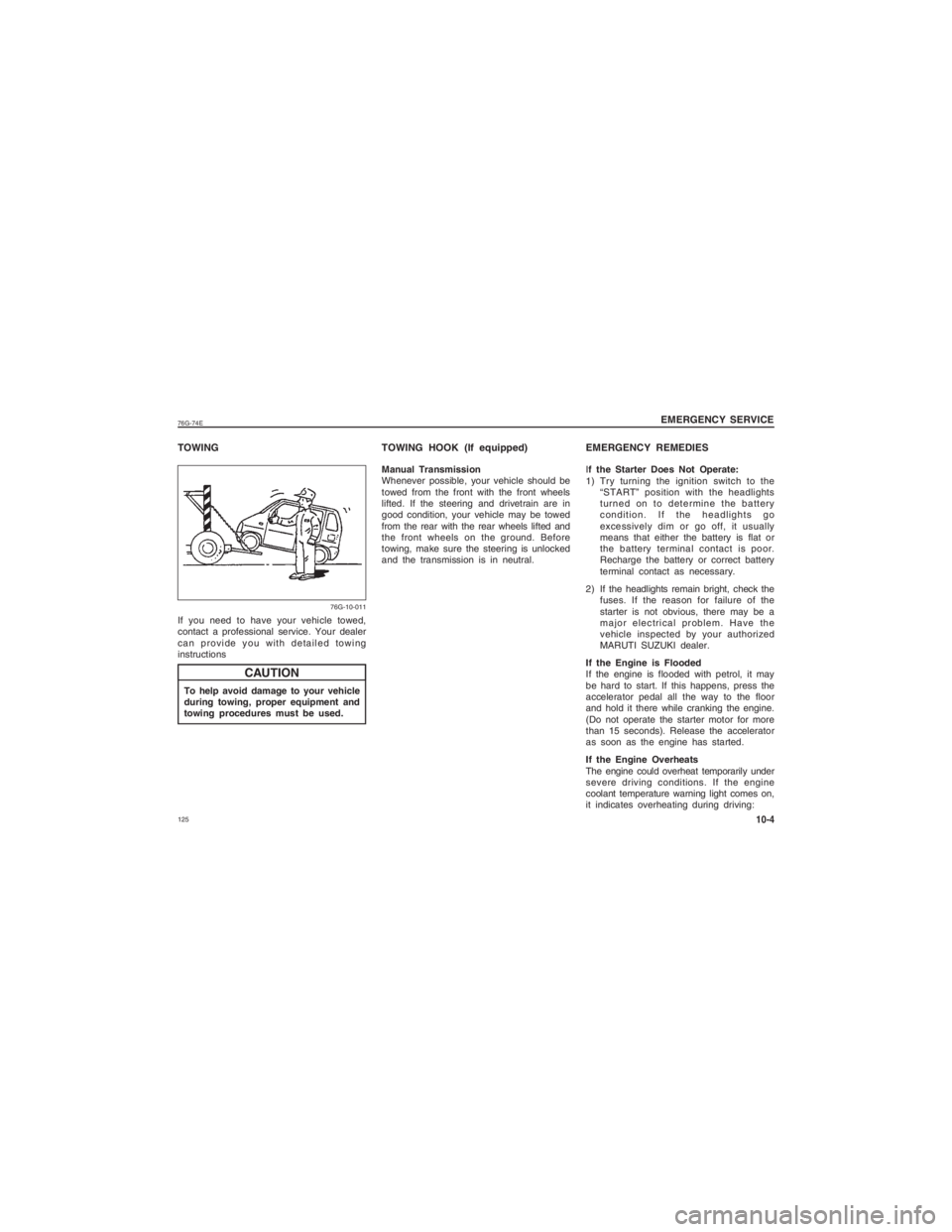
12576G-74ETOWINGIf you need to have your vehicle towed,
contact a professional service. Your dealer
can provide you with detailed towing
instructionsTo help avoid damage to your vehicle
during towing, proper equipment and
towing procedures must be used.
EMERGENCY REMEDIES EMERGENCY SERVICE
10-4
CAUTION
Manual Transmission
Whenever possible, your vehicle should be
towed from the front with the front wheels
lifted. If the steering and drivetrain are in
good condition, your vehicle may be towed
from the rear with the rear wheels lifted and
the front wheels on the ground. Before
towing, make sure the steering is unlocked
and the transmission is in neutral. I
f the Starter Does Not Operate:
1) Try turning the ignition switch to the
“START” position with the headlights
turned on to determine the battery
condition. If the headlights go
excessively dim or go off, it usually
means that either the battery is flat or
the battery terminal contact is poor.
Recharge the battery or correct battery
terminal contact as necessary.
2) If the headlights remain bright, check the fuses. If the reason for failure of the
starter is not obvious, there may be a
major electrical problem. Have the
vehicle inspected by your authorized
MARUTI SUZUKI dealer.
If the Engine is Flooded
If the engine is flooded with petrol, it may
be hard to start. If this happens, press the
accelerator pedal all the way to the floor
and hold it there while cranking the engine.
(Do not operate the starter motor for more
than 15 seconds). Release the accelerator
as soon as the engine has started.
If the Engine Overheats
The engine could overheat temporarily under
severe driving conditions. If the engine
coolant temperature warning light comes on,
it indicates overheating during driving:TOWING HOOK (If equipped)
76G-10-011
Page 129 of 139
130
76G-74E
CORROSION PREVENTION
the vehicle which are not well ventilated
to permit quick drying.
This information illustrates the necessity of
keeping your vehicle (particularly the
underbody) as clean and dry as possible.
It is equally important to repair any damage
to the paint or protective coatings as soon
as possible.
How to Help Prevent Corrosion
Wash your vehicle frequently
The best way to preserve the finish on your
vehicle and to help avoid corrosion is to
keep it clean with frequent washing.
Wash your vehicle regularly during the
winter and immediately after the winter.
Keep your vehicle, particularly the
underside, as clean and dry as possible.
If you frequently drive on salted roads, your
vehicle should be washed at least once a
month during the winter. If you live near the
ocean, your vehicle should be washed at
least once a month throughout the year.
For washing instructions, refer to the
“VEHICLE CLEANING” section.
Remove foreign material deposits
Foreign material such as salts, chemicals,
road oil or tar, tree sap, bird droppings and
industrial fall-out may damage the finish of
your vehicle if it is left on painted surfaces.
Remove these types of deposits as quickly as possible. If these deposits are difficult to
wash off, an additional cleaner may be
required. Be sure that any cleaner you use
is not harmful to painted surfaces and is
specifically intended for your purposes.
Follow the manufacturer’s directions when
using these special cleaners.
Repair finish damage
Carefully examine your vehicle for damage
to the painted surfaces. Should you find any
chips or scratches in the paint, touch them
up immediately to prevent corrosion from
starting. If the chips or scratches have gone
through to the bare metal, have a qualified
body shop make the repair.
Keep Passenger and luggage
compartments clean.
Moisture, dirt or mud can accumulate under
the floor mats and may cause corrosion.
Occasionally, check under these mats to
ensure that this area is clean and dry. More
frequent checks are necessary if the vehicle
is used off road or in wet weather.
Certain cargos such as chemicals, fertilizers,
cleaners, salts, etc., are extremely corrosive
by nature. These products should be
transported in sealed containers. If a spill
or leak does occur, clean and dry the area
immediately.
It is important to take good care of your
vehicle to protect it from corrosion.
Listed below are instructions for how to
maintain your vehicle to prevent corrosion.
Please read and follow these instructions
carefully.
Important Information About Corrosion
Common causes of corrosion
1) Accumulation of road salt, dirt, moisture,
or chemicals in hard to reach areas of
the vehicle underbody or frame.
2) Chipping, scratches and any damage to treated or painted metal surfaces
resulting from minor accidents or
abrasion by stones and gravel.
Environmental conditions which
accelerate corrosion
1) Road salt, dust control chemicals, sea air or industrial pollution will all
accelerate the corrosion of metal.
2) High humidity will increase the rate of corrosion particularly when the
temperature range is just above the
freezing point.
3) Moisture in certain areas of a vehicle for an extended period of time may promote
corrosion even though other body
sections may be completely dry.
4) High temperatures will cause an
accelerated rate of corrosion to parts of
BODY WORK CARE11-1