Led SUZUKI ALTO 2015 Owners Manual
[x] Cancel search | Manufacturer: SUZUKI, Model Year: 2015, Model line: ALTO, Model: SUZUKI ALTO 2015Pages: 139, PDF Size: 2.22 MB
Page 7 of 139
\
,
warrants that each new Maruti Suzuki vehicle distributed in India
by Maruti Suzuki and sold b")
759K,76G,844-74E
2
WARRANTY POLICYMaruti Suzuki India Limited (hereinafter called “Maruti Suzuki”)\
,
warrants that each new Maruti Suzuki vehicle distributed in India
by Maruti Suzuki and sold by an authorised Maruti Suzuki dealer
will be free, under normal use and service, from any defects in
material and workmanship at the time of manufacture SUBJECT
TO THE FOLLOWING TERMS AND CONDITIONS:
(1) Qualification:To qualify for this warranty:
(a) The Maruti Suzuki vehicle must be delivered by Maruti Suzuki authorised dealer and set-up, serviced by Maruti
Suzuki authorised dealer/service station.
(b) The warranty registration card in respect of each vehicle must be completed by the dealer at the time of delivery
of the vehicle and dealer should retain the same.
(2) Term: The term of the warranty shall be twenty four (24) monthsor 40,000 kilometers (whichever occurs first) from the date
of delivery to the first owner.
(3) Maruti Suzuki Warranty Obligation: If any defect(s) should be found in a Maruti Suzuki vehiclewithin the term stipulated above, Maruti Suzuki only obligation
is to repair or replace at its sole discretion any part shown
to be defective, with a new part or the equivalent at no cost
to the owner for parts or labour, when Maruti Suzuki
acknowledges that such a defect is attributable to faulty material
or workmanship at the time of manufacture. The owner is
responsible for any repair or replacements which are not covered by this warranty.
(4) Limitation:
This warranty shall not apply to:
(a) normal maintenance service required other than the three free services, including without limitation, oil and fluid
changes, headlight aiming, fastener retightening, wheel
balancing, wheel alignment and tyre rotation, cleaning of
injectors, adjustments of carburettor, ignition timing, clutch
and valve clearance.
(b) the replacement of normal wear parts including without limitation, bulbs, battery, tyres and tubes, spark plugs, belts,
hoses, filters, wiper blades, brushes, contact points, fuses,
clutch disc, brake shoes, brake pads, cable and all rubber
parts (except oil seal and glass run).
(c) any vehicle which has been used for competition or racing.
(d) any repairs or replacement required as a result of accidents or collision.
(e) any defects caused by misuse, negligence, abnormal use or insufficient care.
(f) any vehicle which has been modified or altered, including without limitation, the installation of performance
accessories.
(g) any vehicle on which parts or accessories not approved by Maruti Suzuki have been used.
(h) any vehicle which has not been operated in accordance
with the operating instructions in the Maruti Suzuki Owner’s
Manual.
(i) any vehicle which has not received, during the warranty term, the service inspections prescribed in the Maruti
Suzuki Owner’s Manual.
(j) any vehicle which has been assembled, disassembled,
WARRANTY POLICY
2-1
Page 13 of 139
14
76G-74E
3-1BEFORE DRIVING
FUEL RECOMMENDATIONYou must use unleaded petrol with an
octane number (RON) of 91 or higher.Use of leaded fuel in vehicle equipped
with catalytic converter is prohibited,
because lead deactivates the pollutant
reducing components of catalytic
converter and may result in permanent
damage to catalytic converter. Be careful not to spill fuel containing
alcohol while refuelling. If fuel is
spilled on the vehicle body, wipe it up
immediately. Fuels containing alcohol
can cause paint damage, which is not
covered under New Vehicle Limited
Warranty.
The fuel tank has an air space to
allow for fuel expansion in hot
weather. If you continue to add fuel
after the filler nozzle has automatically
shut off or an initial blowback occurs,
the air chamber will become full.
Exposure to heat when fully fuelled in
this manner will result in leakage due
to fuel expansion. To prevent such
fuel leakage, stop filling after the filler
nozzle has automatically shut off, or
when using an alternative non
automatic system, initial vent
blowback occurs.
Petrol/Ethanol Blends
Blends of unleaded petrol and ethanol (grain
alcohol), also known as gasohol, are
commercially available in some areas.
Blends of this type may be used in your
vehicle if they are no more than 5% ethanol.
Make sure this petrol-ethanol blend has
octane ratings no lower than those
recommended for petrol.
Petrol/Methanol Blends
Blends of unleaded petrol and methanol
(wood alcohol) are also commercially
available in some areas. DO NOT USE
fuels containing more than 5% methanol
under any circumstances. Fuel system
damage or vehicle performance problems
resulting from the use of such fuels are not
the responsibility of MARUTI SUZUKI and
may not be covered under Warranty.
Fuels containing 5% or less methanol may
be suitable for use in your vehicle if they
contain cosolvents and corrosion inhibitors.
NOTE:
If you are not satisfied with the driveabilityor fuel economy of your vehicle when youare using a petrol/alcohol blend, you should
switch back to unleaded petrol containing noalcohol.
CAUTION
CAUTIONCAUTION
Page 42 of 139
4376G-74E
INSTRUMENT PANEL
5-6
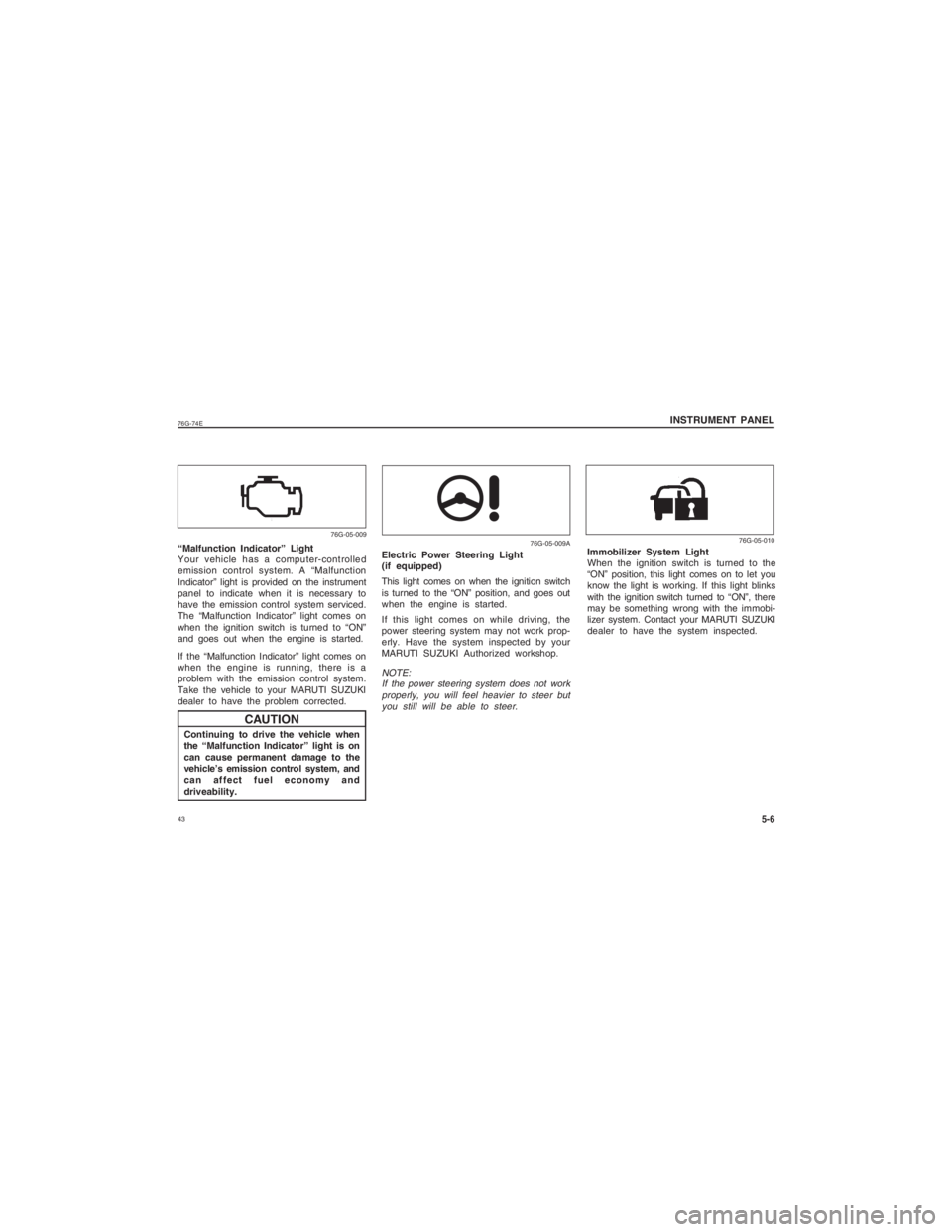
Immobilizer System Light
When the ignition switch is turned to the
“ON” position, this light comes on to let you
know the light is working. If this light blinks
with the ignition switch turned to “ON”, there
may be something wrong with the immobi-
lizer system. Contact your MARUTI SUZUKI
dealer to have the system inspected.
76G-05-010
Electric Power Steering Light
(if equipped)
This light comes on when the ignition switch
is turned to the “ON” position, and goes out
when the engine is started.
If this light comes on while driving, the
power steering system may not work prop-
erly. Have the system inspected by your
MARUTI SUZUKI Authorized workshop.NOTE:If the power steering system does not workproperly, you will feel heavier to steer butyou still will be able to steer.
76G-05-009A
“Malfunction Indicator” Light
Your vehicle has a computer-controlled
emission control system. A “Malfunction
Indicator” light is provided on the instrument
panel to indicate when it is necessary to
have the emission control system serviced.
The “Malfunction Indicator” light comes on
when the ignition switch is turned to “ON”
and goes out when the engine is started.
If the “Malfunction Indicator” light comes on
when the engine is running, there is a
problem with the emission control system.
Take the vehicle to your MARUTI SUZUKI
dealer to have the problem corrected.
Continuing to drive the vehicle when
the “Malfunction Indicator” light is on
can cause permanent damage to the
vehicle’s emission control system, and
can affect fuel economy and
driveability.
CAUTION
76G-05-009
Page 44 of 139
4576G-74E
INSTRUMENT PANEL
5-8
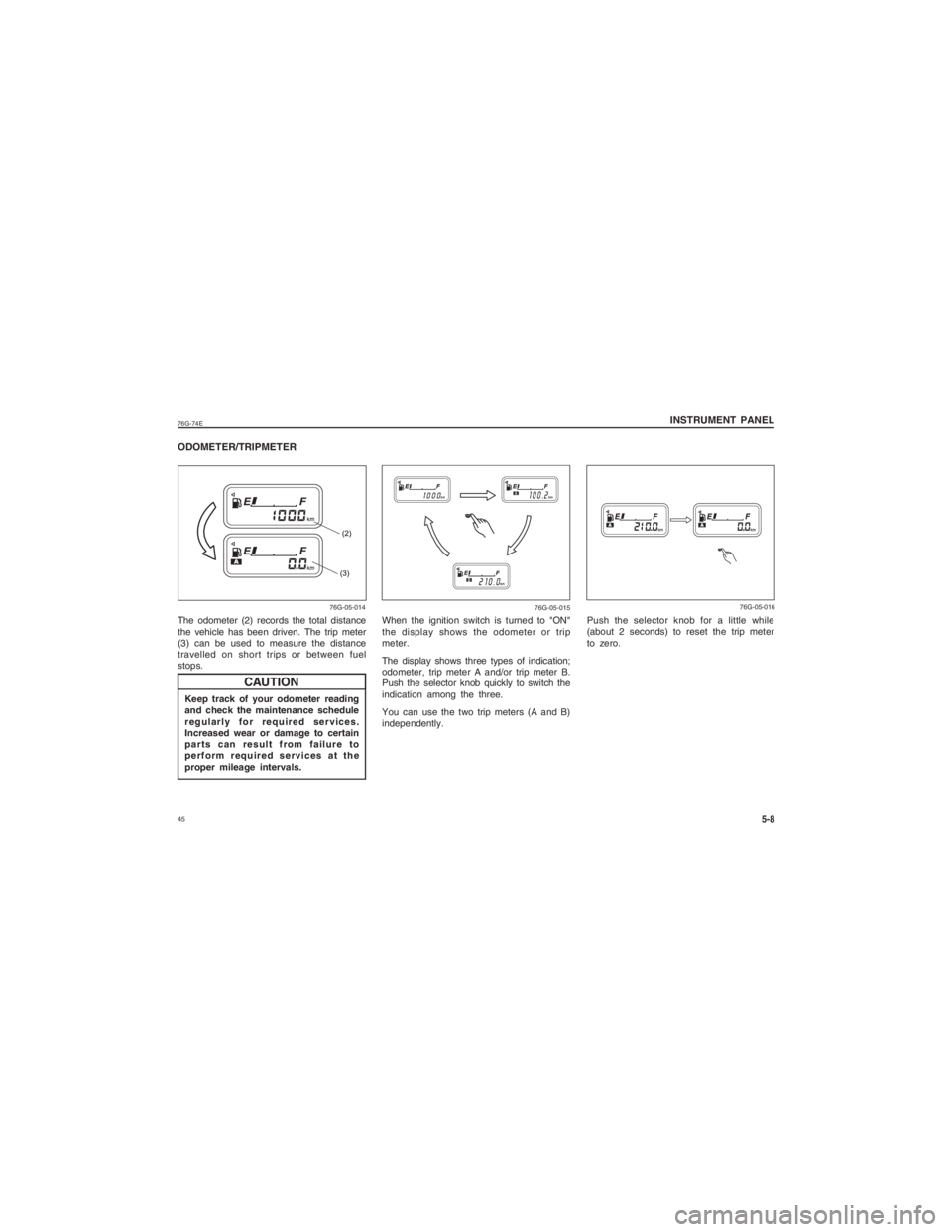
Push the selector knob for a little while
(about 2 seconds) to reset the trip meter
to zero.
76G-05-016
When the ignition switch is turned to "ON"
the display shows the odometer or trip
meter.
The display shows three types of indication;
odometer, trip meter A and/or trip meter B.
Push the selector knob quickly to switch the
indication among the three.
You can use the two trip meters (A and B)
independently.
76G-05-015
76G-05-014
ODOMETER/TRIPMETERThe odometer (2) records the total distance
the vehicle has been driven. The trip meter
(3) can be used to measure the distance
travelled on short trips or between fuel
stops.Keep track of your odometer reading
and check the maintenance schedule
regularly for required services.
Increased wear or damage to certain
parts can result from failure to
perform required services at the
proper mileage intervals.
CAUTION
Page 48 of 139
4976G-74E
INSTRUMENT PANEL
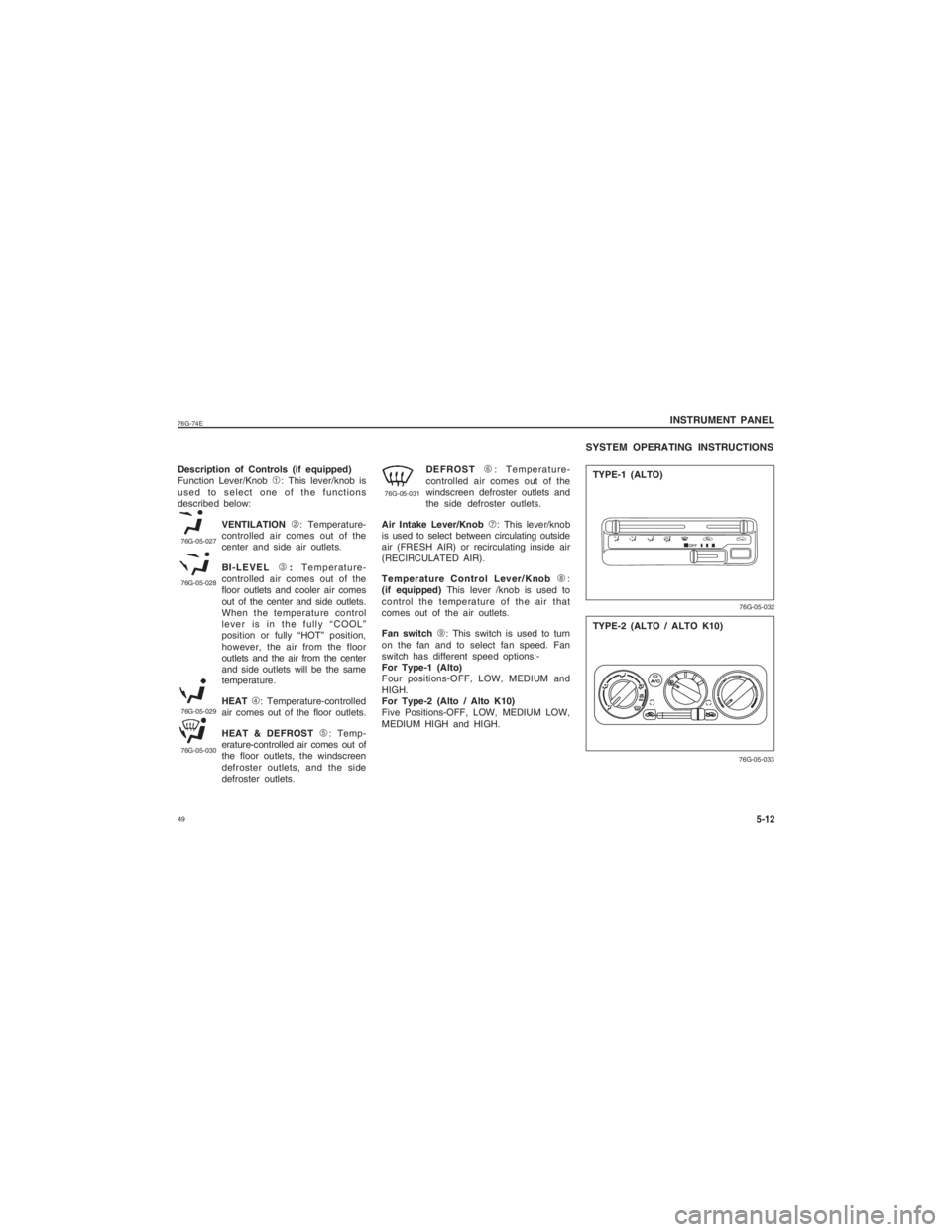
Description of Controls (if equipped)
Function Lever/Knob 1: This lever/knob is
used to select one of the functions
described below:
VENTILATION 2: Temperature-
controlled air comes out of the
center and side air outlets.
BI-LEVEL 3: Temperature-
controlled air comes out of the
floor outlets and cooler air comes
out of the center and side outlets.
When the temperature control
lever is in the fully “COOL”
position or fully “HOT” position,
however, the air from the floor
outlets and the air from the center
and side outlets will be the same
temperature.
HEAT 4: Temperature-controlled
air comes out of the floor outlets.
HEAT & DEFROST 5: Temp-
erature-controlled air comes out of
the floor outlets, the windscreen
defroster outlets, and the side
defroster outlets. DEFROST
6: Temperature-
controlled air comes out of the
windscreen defroster outlets and
the side defroster outlets.
Air Intake Lever/Knob 7 : This lever/knob
is used to select between circulating outside
air (FRESH AIR) or recirculating inside air
(RECIRCULATED AIR).
Temperature Control Lever/Knob 8 :
(if equipped) This lever /knob is used to
control the temperature of the air that
comes out of the air outlets.
Fan switch 9 : This switch is used to turn
on the fan and to select fan speed. Fan
switch has different speed options:-
For Type-1 (Alto)
Four positions-OFF, LOW, MEDIUM and
HIGH.
For Type-2 (Alto / Alto K10)
Five Positions-OFF, LOW, MEDIUM LOW,
MEDIUM HIGH and HIGH.
SYSTEM OPERATING INSTRUCTIONS
5-12
76G-05-032
76G-05-031
76G-05-027
76G-05-028
76G-05-029
76G-05-030 76G-05-033
TYPE-1 (ALTO)
TYPE-2 (ALTO / ALTO K10)
Page 54 of 139
5576G-74E
INSTRUMENT PANEL
5-18
76G-05-051
(ALTO / ALTO K10)
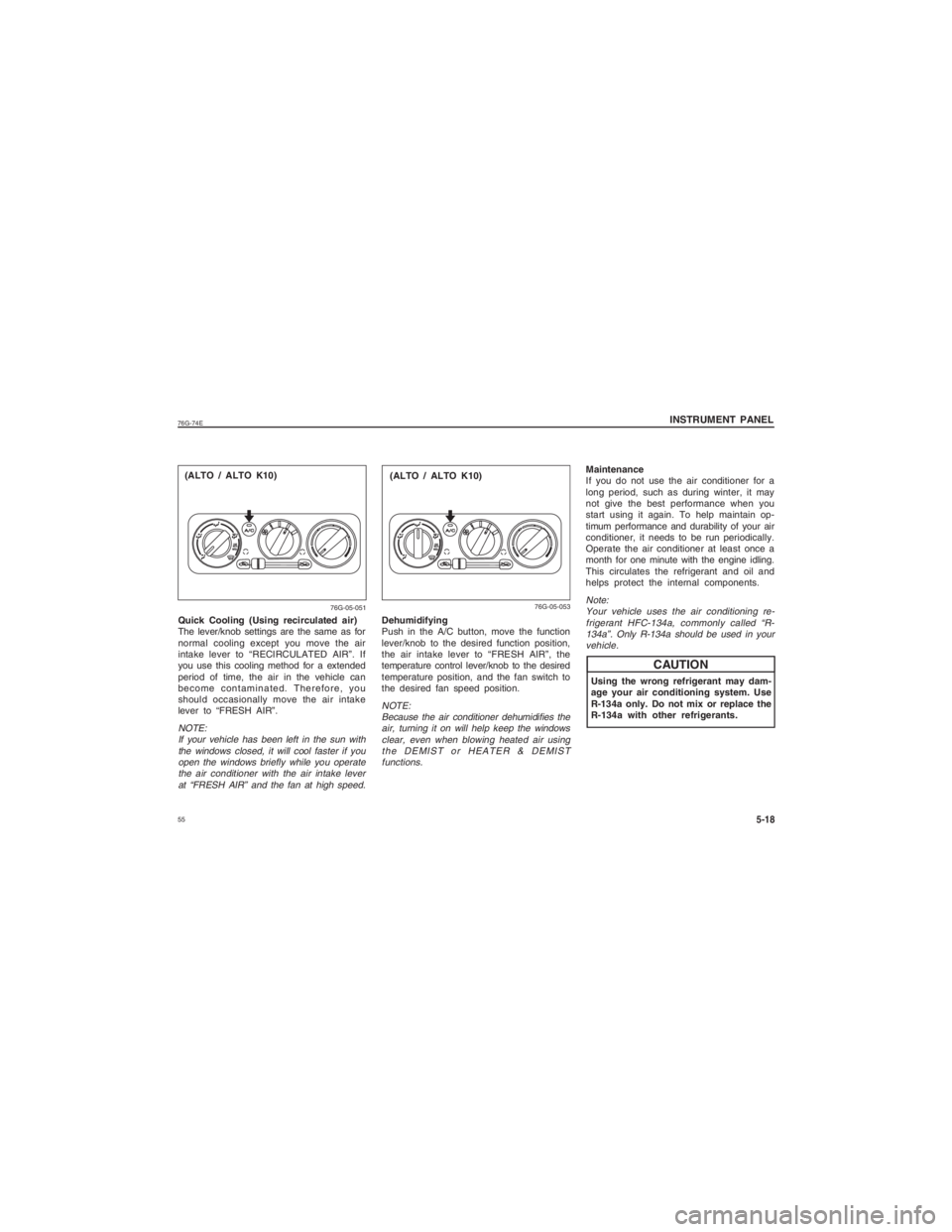
Quick Cooling (Using recirculated air)
The lever/knob settings are the same as for
normal cooling except you move the air
intake lever to “RECIRCULATED AIR”. If
you use this cooling method for a extended
period of time, the air in the vehicle can
become contaminated. Therefore, you
should occasionally move the air intake
lever to “FRESH AIR”.NOTE: If your vehicle has been left in the sun with
the windows closed, it will cool faster if youopen the windows briefly while you operatethe air conditioner with the air intake leverat “FRESH AIR” and the fan at high speed.
Dehumidifying
Push in the A/C button, move the function
lever/knob to the desired function position,
the air intake lever to “FRESH AIR”, the
temperature control lever/knob to the desired
temperature position, and the fan switch to
the desired fan speed position.NOTE:
Because the air conditioner dehumidifies theair, turning it on will help keep the windowsclear, even when blowing heated air using
the DEMIST or HEATER & DEMISTfunctions.
76G-05-053
(ALTO / ALTO K10) Maintenance
If you do not use the air conditioner for a
long period, such as during winter, it may
not give the best performance when you
start using it again. To help maintain op-
timum performance and durability of your air
conditioner, it needs to be run periodically.
Operate the air conditioner at least once a
month for one minute with the engine idling.
This circulates the refrigerant and oil and
helps protect the internal components.
Note:
Your vehicle uses the air conditioning re-frigerant HFC-134a, commonly called “R-134a”. Only R-134a should be used in your
vehicle.
CAUTION
Using the wrong refrigerant may dam-
age your air conditioning system. Use
R-134a only. Do not mix or replace the
R-134a with other refrigerants.
Page 61 of 139
62
76G-74E
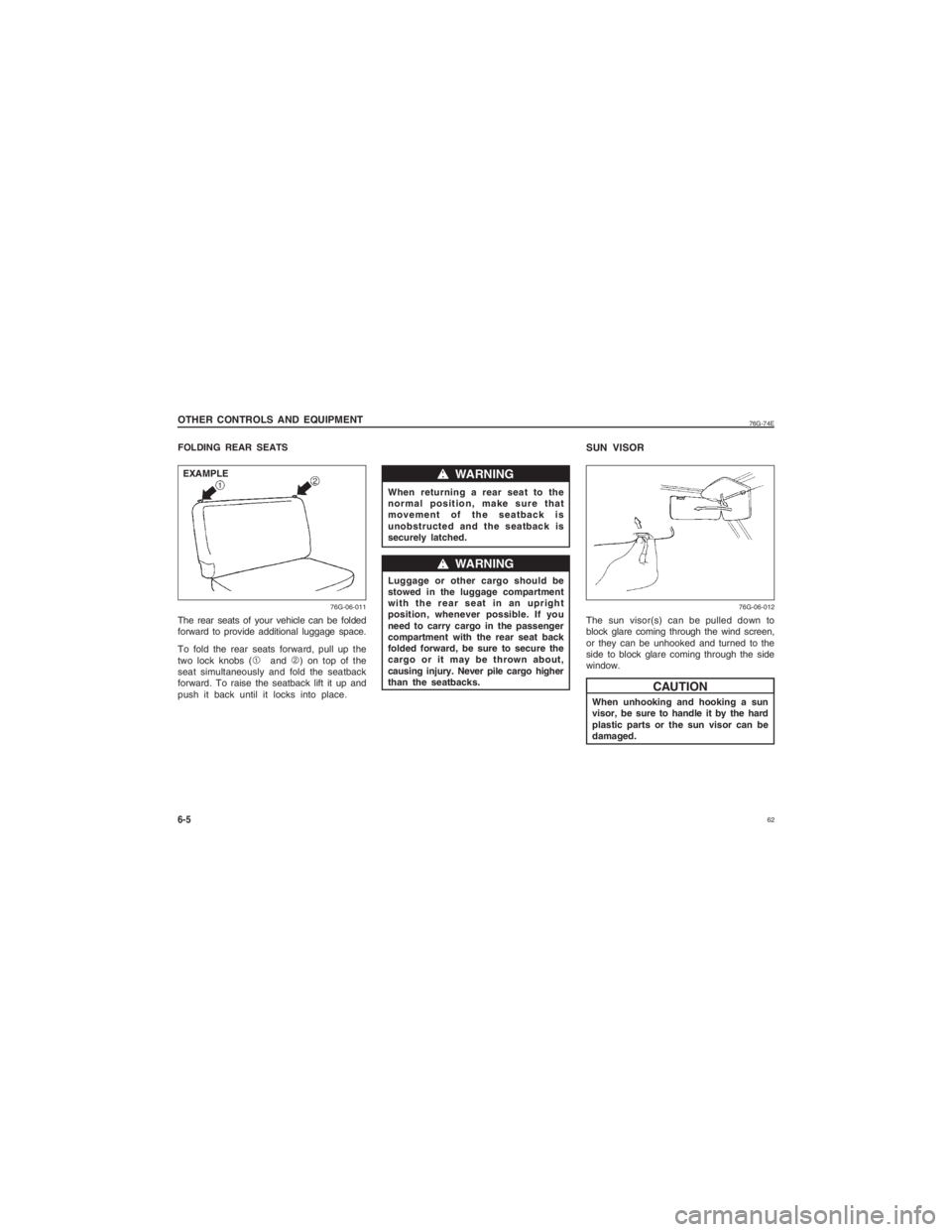
6-5OTHER CONTROLS AND EQUIPMENTThe rear seats of your vehicle can be folded
forward to provide additional luggage space.
To fold the rear seats forward, pull up the
two lock knobs (1 and 2) on top of the
seat simultaneously and fold the seatback
forward. To raise the seatback lift it up and
push it back until it locks into place. When returning a rear seat to the
normal position, make sure that
movement of the seatback is
unobstructed and the seatback is
securely latched.
ww ww
w WARNING
76G-06-011
EXAMPLE
Luggage or other cargo should be
stowed in the luggage compartment
with the rear seat in an upright
position, whenever possible. If you
need to carry cargo in the passenger
compartment with the rear seat back
folded forward, be sure to secure the
cargo or it may be thrown about,
causing injury. Never pile cargo higher
than the seatbacks.
ww ww
w WARNING
SUN VISORThe sun visor(s) can be pulled down to
block glare coming through the wind screen,
or they can be unhooked and turned to the
side to block glare coming through the side
window.
When unhooking and hooking a sun
visor, be sure to handle it by the hard
plastic parts or the sun visor can be
damaged.
CAUTION
76G-06-012
FOLDING REAR SEATS
Page 72 of 139
7376G-74E
7-4
OPERATING YOUR VEHICLE
BRAKINGww ww
w WARNING
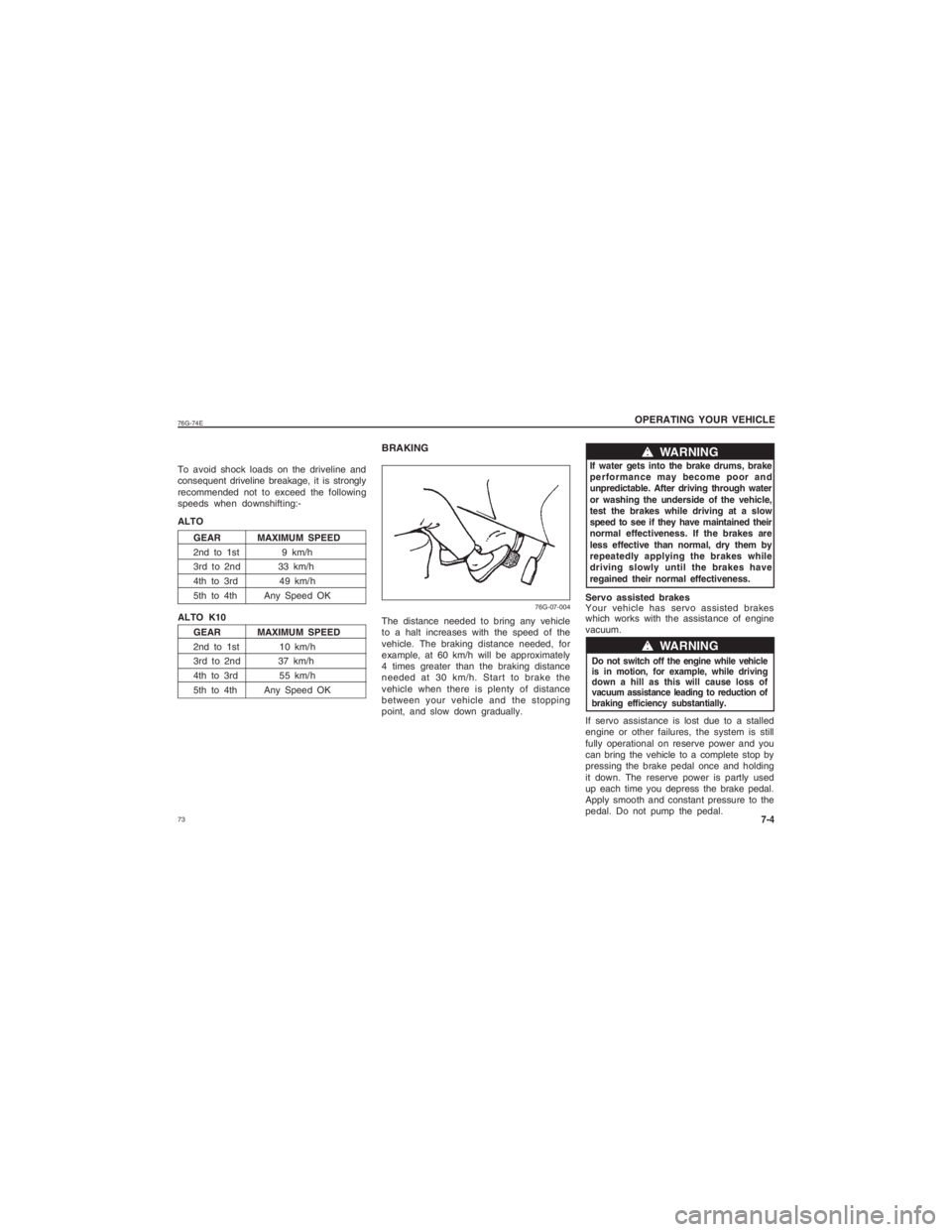
The distance needed to bring any vehicle
to a halt increases with the speed of the
vehicle. The braking distance needed, for
example, at 60 km/h will be approximately
4 times greater than the braking distance
needed at 30 km/h. Start to brake the
vehicle when there is plenty of distance
between your vehicle and the stopping
point, and slow down gradually.
If water gets into the brake drums, brake
performance may become poor and
unpredictable. After driving through water
or washing the underside of the vehicle,
test the brakes while driving at a slow
speed to see if they have maintained their
normal effectiveness. If the brakes are
less effective than normal, dry them by
repeatedly applying the brakes while
driving slowly until the brakes have
regained their normal effectiveness.Servo assisted brakes
Your vehicle has servo assisted brakes
which works with the assistance of engine
vacuum.Do not switch off the engine while vehicle
is in motion, for example, while driving
down a hill as this will cause loss of
vacuum assistance leading to reduction of
braking efficiency substantially.If servo assistance is lost due to a stalled
engine or other failures, the system is still
fully operational on reserve power and you
can bring the vehicle to a complete stop by
pressing the brake pedal once and holding
it down. The reserve power is partly used
up each time you depress the brake pedal.
Apply smooth and constant pressure to the
pedal. Do not pump the pedal.
ww ww
w WARNING
76G-07-004
To avoid shock loads on the driveline and
consequent driveline breakage, it is strongly
recommended not to exceed the following
speeds when downshifting:-
GEAR MAXIMUM SPEED
2nd to 1st 9 km/h
3rd to 2nd 33 km/h
4th to 3rd 49 km/h
5th to 4th Any Speed OK
ALTO
ALTO K10
GEAR MAXIMUM SPEED
2nd to 1st 10 km/h
3rd to 2nd 37 km/h
4th to 3rd 55 km/h
5th to 4th Any Speed OK
Page 73 of 139
74
76G-74E
7-5OPERATING YOUR VEHICLERUNNING-IN
The future performance and reliability
of the engine depends on the care
and restraint exercised during its early
life. It is especially important to
observe the following precautions
during the initial 1000 km of vehicle
operation.
After starting, do not race theengine. Warm it up gradually.
Avoid prolonged vehicle operation at a constant speed. Moving parts will
bed in better if you vary your speed.
Do not exceed 100 km/h.
Start off from a stop slowly. Avoid full throttle starts.
If possible, avoid hard braking, especially during the first 300 km
of driving.
Do not drive slowly with the transmission in a high gear.
Drive the vehicle at moderate engine speeds.
CAUTION
Even without reserve power in the
brake system, you can still stop the
vehicle by pressing the brake pedal
harder than normally required.
However, the stopping distance may
be longer.
On loose surface where the wheels
can easily loose traction (such as
gravel, etc.), the stopping distance
required for your vehicle may be
greater than for a comparable vehicle
with a conventional brake system.
Allow for extra stopping distance
when driving on loose surfaces.
ww ww
w WARNINGww
ww
w WARNING
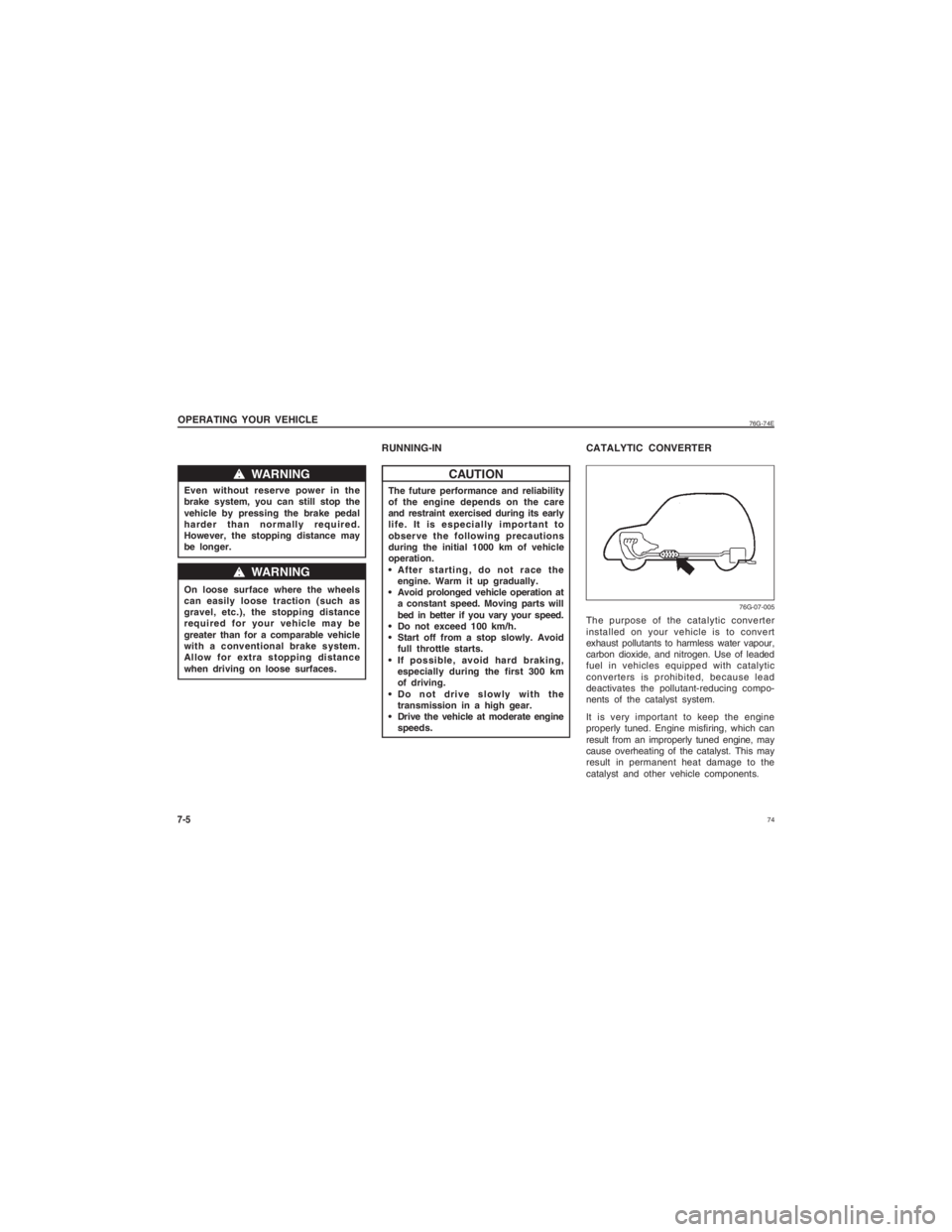
CATALYTIC CONVERTERThe purpose of the catalytic converter
installed on your vehicle is to convert
exhaust pollutants to harmless water vapour,
carbon dioxide, and nitrogen. Use of leaded
fuel in vehicles equipped with catalytic
converters is prohibited, because lead
deactivates the pollutant-reducing compo-
nents of the catalyst system.
It is very important to keep the engine
properly tuned. Engine misfiring, which can
result from an improperly tuned engine, may
cause overheating of the catalyst. This may
result in permanent heat damage to the
catalyst and other vehicle components.
76G-07-005
Page 84 of 139
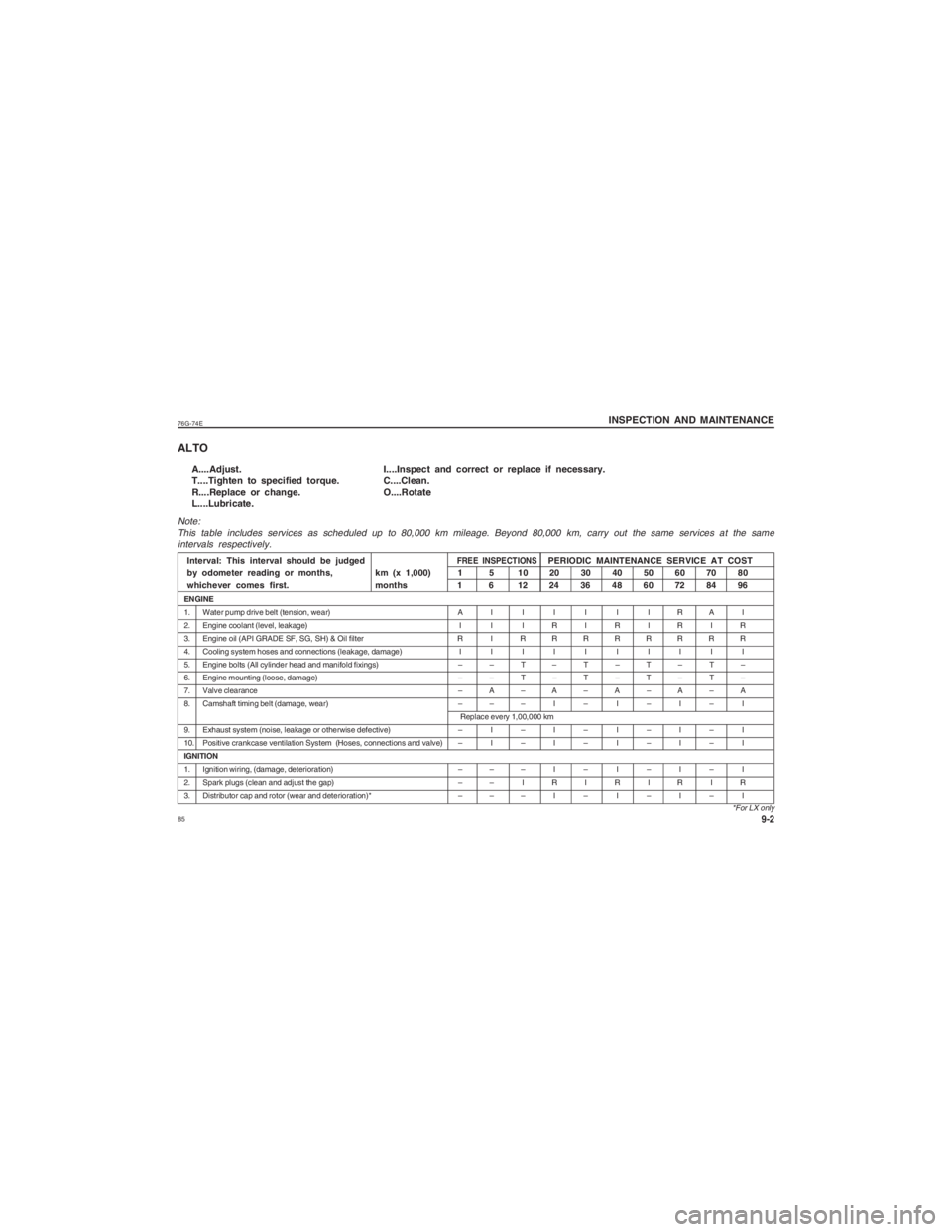
8576G-74E
INSPECTION AND MAINTENANCE
9-2
A....Adjust. I....Inspect and correct or replace if necessary.
T....Tighten to specified torque. C....Clean.
R....Replace or change. O....Rotate
L....Lubricate.
Note:
This table includes services as scheduled up to 80,000 km mileage. Beyon\
d 80,000 km, carry out the same services at the sameintervals respectively.Interval: This interval should be judged
FREE INSPECTIONS
PERIODIC MAINTENANCE SERVICE AT COST
by odometer reading or months, km (x 1,000) 1 5 10 20 30 40 50 60 70 80
whichever comes first. months 1 6 12 24 36 48 60 72 84 96
ENGINE
1. Water pump drive belt (tension, wear) A I I I I I I R A I
2. Engine coolant (level, leakage) I I I R I R I R I R
3. Engine oil (API GRADE SF, SG, SH) & Oil filter R I R R R R R R R R
4. Cooling system hoses and connections (leakage, damage) I I I I I I I I I I
5. Engine bolts (All cylinder head and manifold fixings) – – T – T – T – T –
6. Engine mounting (loose, damage) – – T – T – T – T –
7. Valve clearance – A – A – A – A – A
8. Camshaft timing belt (damage, wear) – – – I – I – I – I
Replace every 1,00,000 km
9. Exhaust system (noise, leakage or otherwise defective) – I – I – I – I – I
10. Positive crankcase ventilation System (Hoses, connections and valve) – I – I – I – I – I
IGNITION
1. Ignition wiring, (damage, deterioration) – – – I – I – I – I
2. Spark plugs (clean and adjust the gap) – – I R I R I R I R
3. Distributor cap and rotor (wear and deterioration)* – – – I – I – I – I
*For LX only
ALTO