light SUZUKI ALTO 2017 Owner's Manual
[x] Cancel search | Manufacturer: SUZUKI, Model Year: 2017, Model line: ALTO, Model: SUZUKI ALTO 2017Pages: 139, PDF Size: 2.22 MB
Page 62 of 139
6376G-74E
6-6
OTHER CONTROLS AND EQUIPMENT
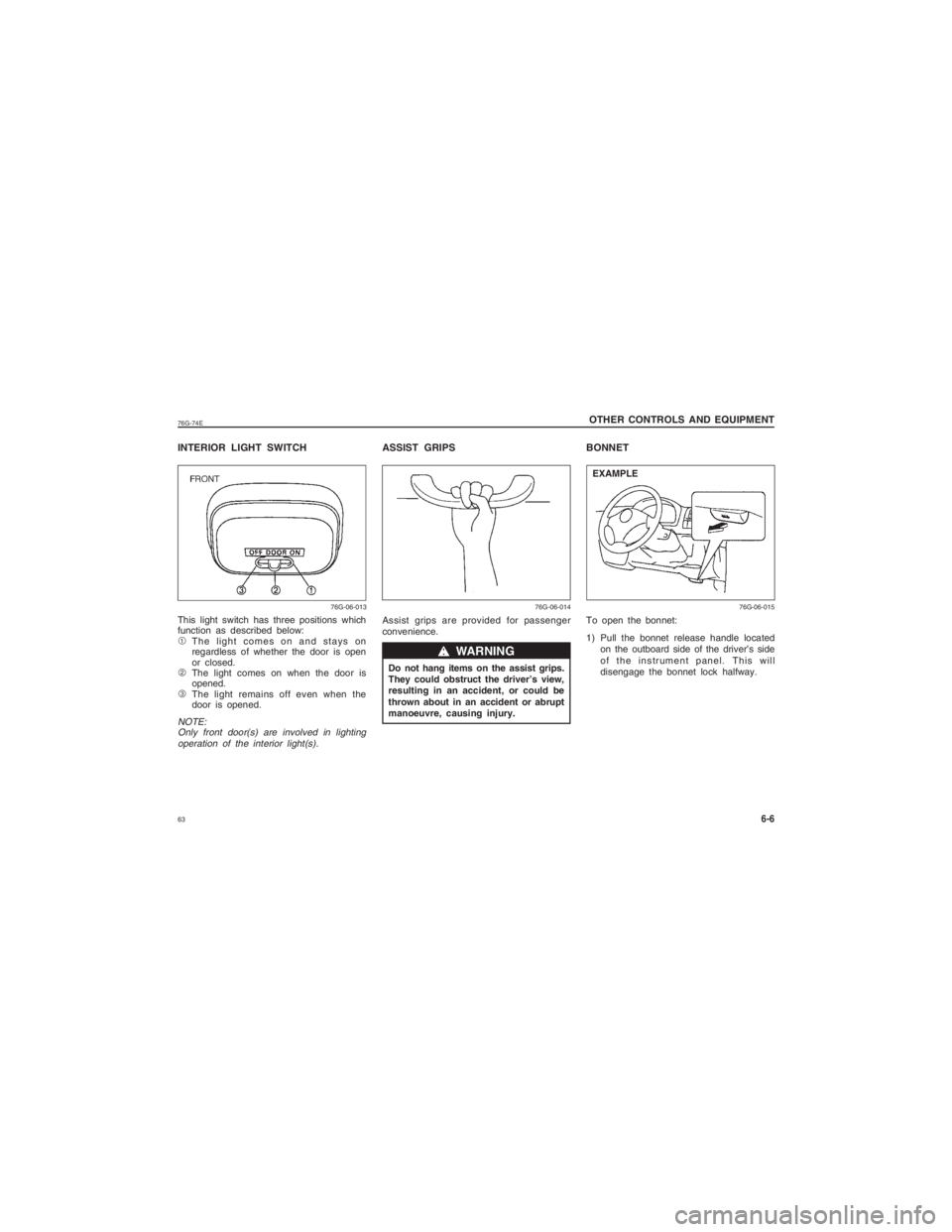
INTERIOR LIGHT SWITCH
This light switch has three positions which
function as described below:
1 The light comes on and stays on
regardless of whether the door is open
or closed.
2 The light comes on when the door is
opened.
3 The light remains off even when the
door is opened.NOTE:
Only front door(s) are involved in lighting
operation of the interior light(s).
76G-06-013
ASSIST GRIPSAssist grips are provided for passenger
convenience.
Do not hang items on the assist grips.
They could obstruct the driver’s view,
resulting in an accident, or could be
thrown about in an accident or abrupt
manoeuvre, causing injury.
ww ww
w WARNING
BONNETTo open the bonnet:
1) Pull the bonnet release handle located
on the outboard side of the driver’s side
of the instrument panel. This will
disengage the bonnet lock halfway.
76G-06-014 76G-06-015
EXAMPLE
Page 69 of 139
70
76G-74E
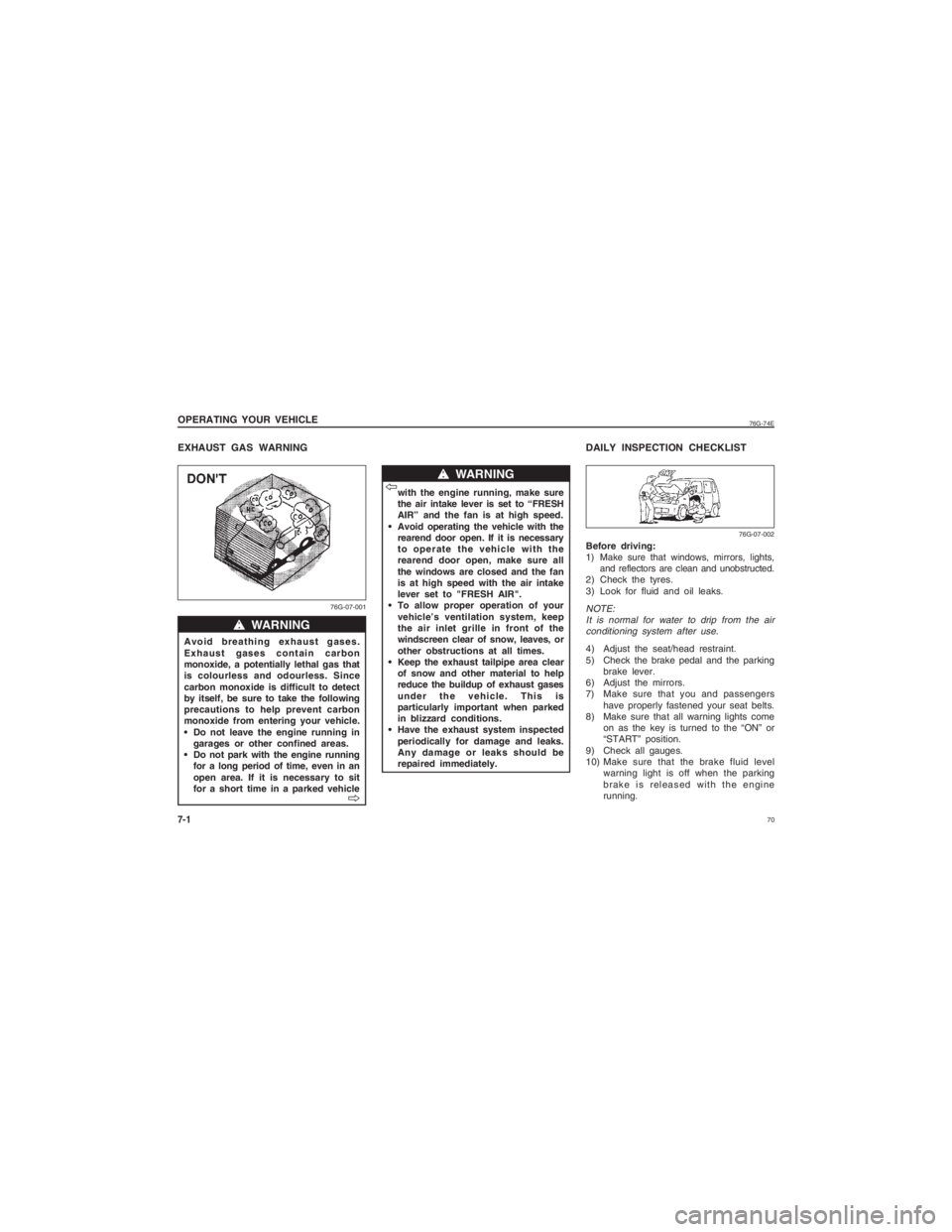
EXHAUST GAS WARNING
with the engine running, make sure
the air intake lever is set to “FRESH
AIR” and the fan is at high speed.
Avoid operating the vehicle with the rearend door open. If it is necessary
to operate the vehicle with the
rearend door open, make sure all
the windows are closed and the fan
is at high speed with the air intake
lever set to "FRESH AIR".
To allow proper operation of your vehicle’s ventilation system, keep
the air inlet grille in front of the
windscreen clear of snow, leaves, or
other obstructions at all times.
Keep the exhaust tailpipe area clear of snow and other material to help
reduce the buildup of exhaust gases
under the vehicle. This is
particularly important when parked
in blizzard conditions.
Have the exhaust system inspected
periodically for damage and leaks.
Any damage or leaks should be
repaired immediately.
DAILY INSPECTION CHECKLIST
ww ww
w WARNING
7-1
ww
ww
w WARNING
Before driving:
1)
Make sure that windows, mirrors, lights,
and reflectors are clean and unobstructed.
2) Check the tyres.
3) Look for fluid and oil leaks.NOTE:
It is normal for water to drip from the air
conditioning system after use.4) Adjust the seat/head restraint.
5) Check the brake pedal and the parking brake lever.
6) Adjust the mirrors.
7) Make sure that you and passengers have properly fastened your seat belts.
8) Make sure that all warning lights come on as the key is turned to the “ON” or
“START” position.
9) Check all gauges.
10) Make sure that the brake fluid level warning light is off when the parking
brake is released with the engine
running.
OPERATING YOUR VEHICLEAvoid breathing exhaust gases.
Exhaust gases contain carbon
monoxide, a potentially lethal gas that
is colourless and odourless. Since
carbon monoxide is difficult to detect
by itself, be sure to take the following
precautions to help prevent carbon
monoxide from entering your vehicle.
Do not leave the engine running ingarages or other confined areas.
Do not park with the engine running for a long period of time, even in an
open area. If it is necessary to sit
for a short time in a parked vehicle
VV VV
V
VV
VV
V
76G-07-001 76G-07-002
Page 74 of 139
7576G-74E
7-6
OPERATING YOUR VEHICLE
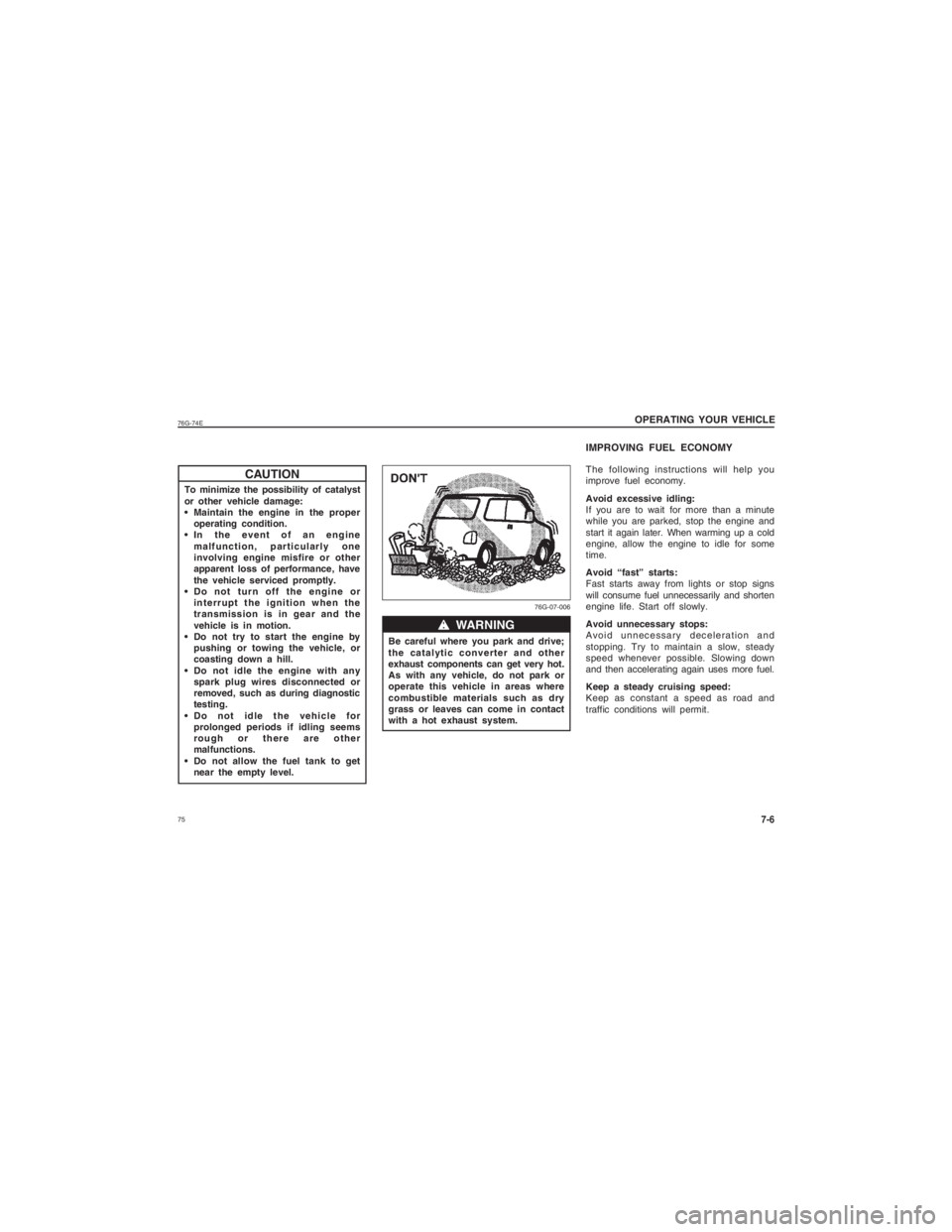
Be careful where you park and drive;
the catalytic converter and other
exhaust components can get very hot.
As with any vehicle, do not park or
operate this vehicle in areas where
combustible materials such as dry
grass or leaves can come in contact
with a hot exhaust system.
ww ww
w WARNING
To minimize the possibility of catalyst
or other vehicle damage:
Maintain the engine in the proper
operating condition.
In the event of an engine
malfunction, particularly one
involving engine misfire or other
apparent loss of performance, have
the vehicle serviced promptly.
Do not turn off the engine or interrupt the ignition when the
transmission is in gear and the
vehicle is in motion.
Do not try to start the engine by pushing or towing the vehicle, or
coasting down a hill.
Do not idle the engine with any spark plug wires disconnected or
removed, such as during diagnostic
testing.
Do not idle the vehicle for
prolonged periods if idling seems
rough or there are other
malfunctions.
Do not allow the fuel tank to get
near the empty level.
CAUTION
IMPROVING FUEL ECONOMYThe following instructions will help you
improve fuel economy.
Avoid excessive idling:
If you are to wait for more than a minute
while you are parked, stop the engine and
start it again later. When warming up a cold
engine, allow the engine to idle for some
time.
Avoid “fast” starts:
Fast starts away from lights or stop signs
will consume fuel unnecessarily and shorten
engine life. Start off slowly.
Avoid unnecessary stops:
Avoid unnecessary deceleration and
stopping. Try to maintain a slow, steady
speed whenever possible. Slowing down
and then accelerating again uses more fuel.
Keep a steady cruising speed:
Keep as constant a speed as road and
traffic conditions will permit.
76G-07-006
Page 79 of 139
80
76G-74E
DO’S AND DON’TS FOR SAFE
DRIVINGExercise care in handling your vehicle. Be
conscious of not only your own safety but
also the safety of others on the road, and
thus enjoy the best and most comfortable
driving experience.
This section contains basic rules for safe
driving. Read it carefully for good
understanding of the content so that you
can enjoy safe and pleasant driving in your
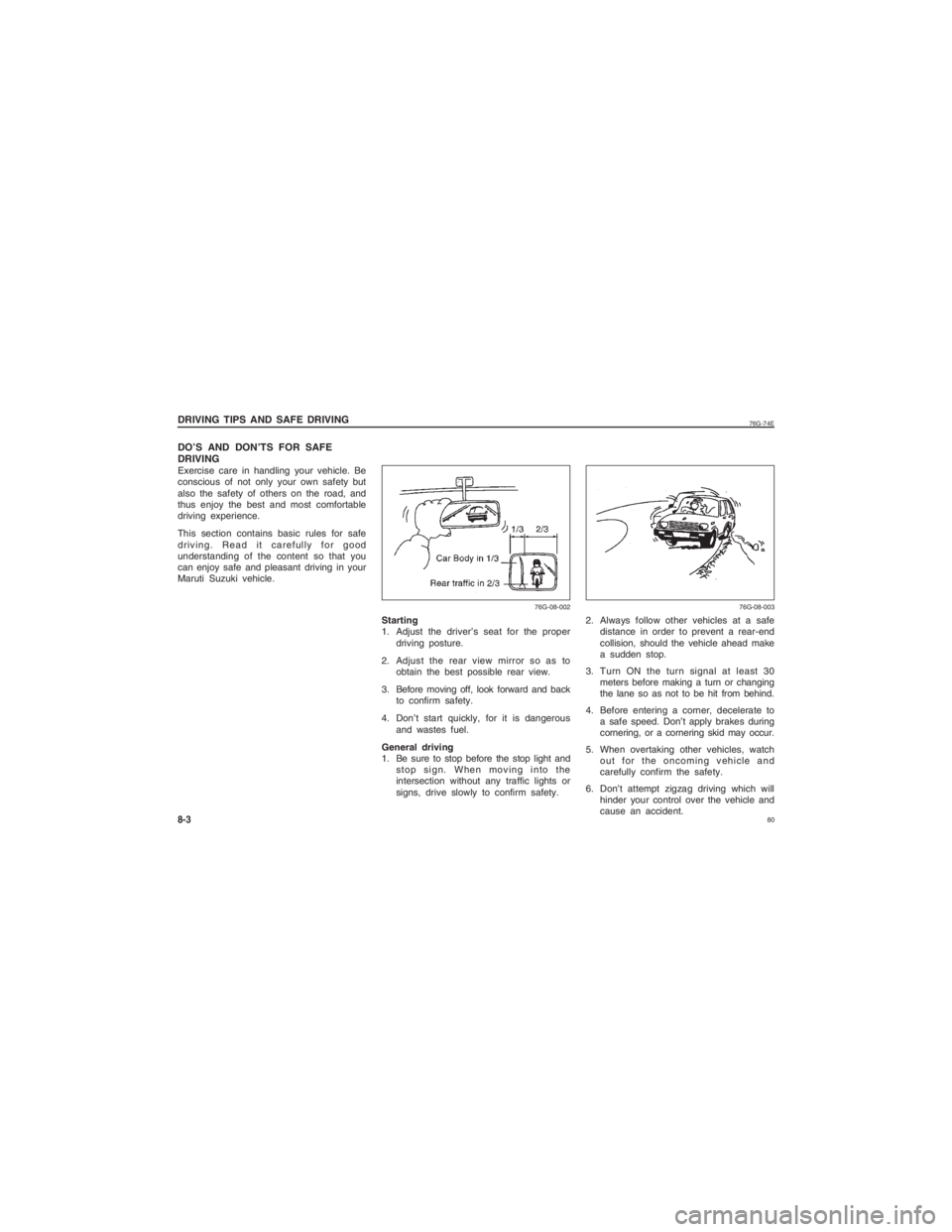
Maruti Suzuki vehicle.Starting
1. Adjust the driver’s seat for the properdriving posture.
2. Adjust the rear view mirror so as to obtain the best possible rear view.
3. Before moving off, look forward and back to confirm safety.
4. Don’t start quickly, for it is dangerous and wastes fuel.
General driving
1. Be sure to stop before the stop light and stop sign. When moving into the
intersection without any traffic lights or
signs, drive slowly to confirm safety.8-3DRIVING TIPS AND SAFE DRIVING
2. Always follow other vehicles at a safedistance in order to prevent a rear-end
collision, should the vehicle ahead make
a sudden stop.
3. Turn ON the turn signal at least 30 meters before making a turn or changing
the lane so as not to be hit from behind.
4. Before entering a corner, decelerate to a safe speed. Don’t apply brakes during
cornering, or a cornering skid may occur.
5. When overtaking other vehicles, watch out for the oncoming vehicle and
carefully confirm the safety.
6. Don’t attempt zigzag driving which will hinder your control over the vehicle and
cause an accident.
76G-08-002 76G-08-003
Page 81 of 139
82
76G-74E
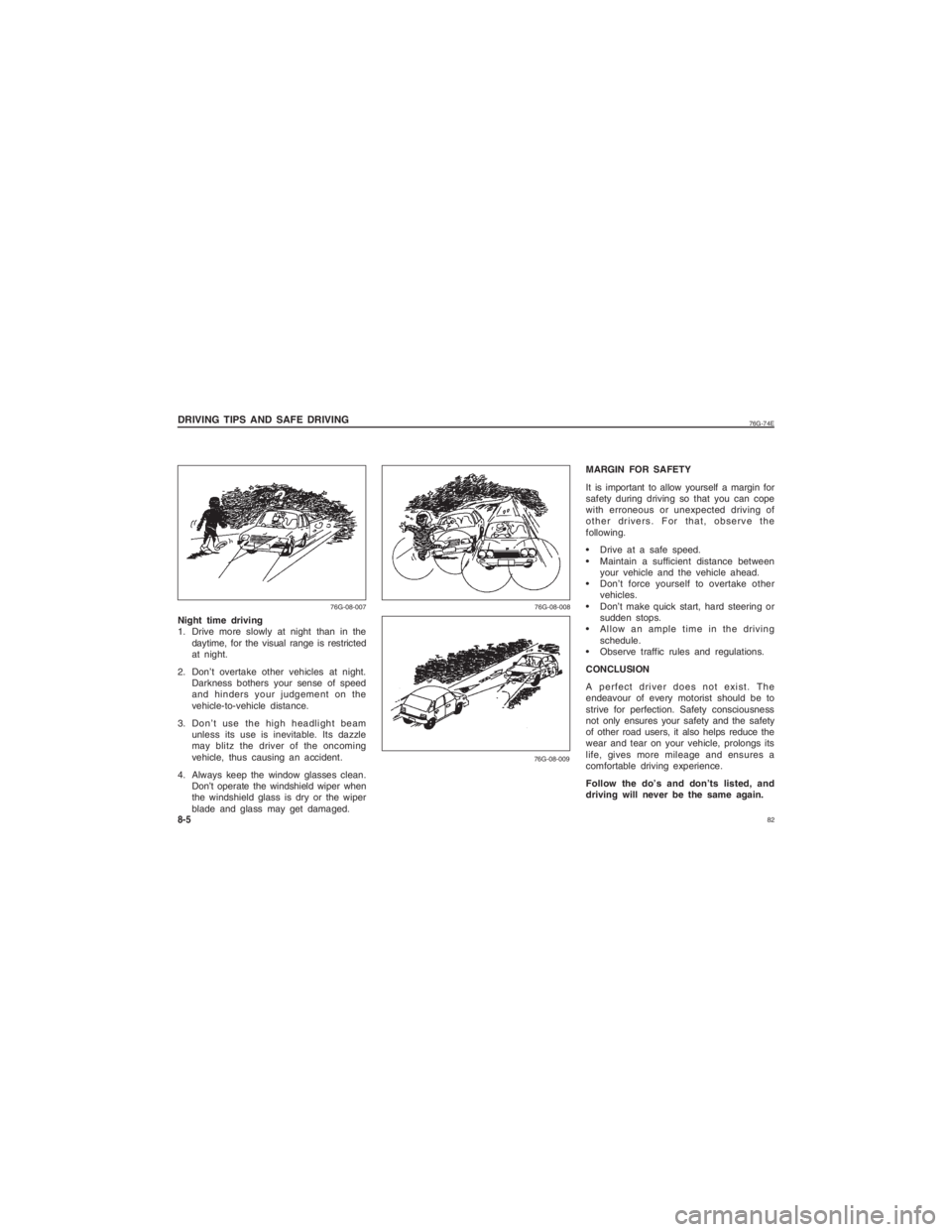
Night time driving
1. Drive more slowly at night than in thedaytime, for the visual range is restricted
at night.
2. Don’t overtake other vehicles at night. Darkness bothers your sense of speed
and hinders your judgement on the
vehicle-to-vehicle distance.
3. Don’t use the high headlight beam unless its use is inevitable. Its dazzle
may blitz the driver of the oncoming
vehicle, thus causing an accident.
4. Always keep the window glasses clean. Don’t operate the windshield wiper when
the windshield glass is dry or the wiper
blade and glass may get damaged.8-5DRIVING TIPS AND SAFE DRIVING
MARGIN FOR SAFETY
It is important to allow yourself a margin for
safety during driving so that you can cope
with erroneous or unexpected driving of
other drivers. For that, observe the
following.
Drive at a safe speed.
Maintain a sufficient distance between
your vehicle and the vehicle ahead.
Don’t force yourself to overtake other vehicles.
Don’t make quick start, hard steering or sudden stops.
Allow an ample time in the driving
schedule.
Observe traffic rules and regulations.
CONCLUSION
A perfect driver does not exist. The
endeavour of every motorist should be to
strive for perfection. Safety consciousness
not only ensures your safety and the safety
of other road users, it also helps reduce the
wear and tear on your vehicle, prolongs its
life, gives more mileage and ensures a
comfortable driving experience.
Follow the do’s and don’ts listed, and
driving will never be the same again.
76G-08-007 76G-08-008
76G-08-009
Page 86 of 139
8776G-74E
INSPECTION AND MAINTENANCE
9-4
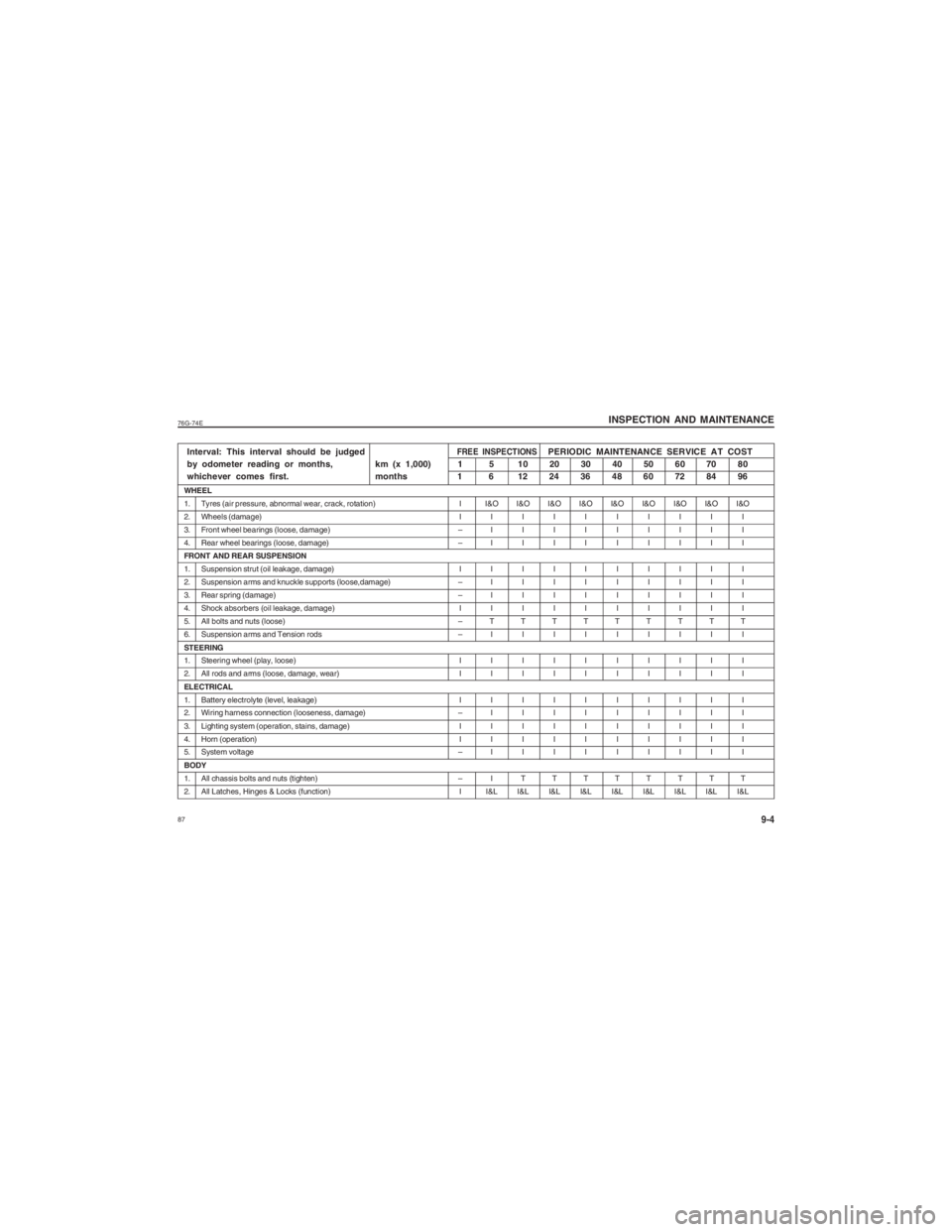
Interval: This interval should be judged
FREE INSPECTIONS
PERIODIC MAINTENANCE SERVICE AT COST
by odometer reading or months, km (x 1,000) 1 5 10 20 30 40 50 60 70 80
whichever comes first. months 1 6 12 24 36 48 60 72 84 96
WHEEL
1. Tyres (air pressure, abnormal wear, crack, rotation) I I&O I&O I&O I&O I&O I&O I&O I&O I&O
2. Wheels (damage) I I I I I I I I I I
3. Front wheel bearings (loose, damage) – I I I I I I I I I
4. Rear wheel bearings (loose, damage) – I I I I I I I I I
FRONT AND REAR SUSPENSION
1. Suspension strut (oil leakage, damage) I I I I I I I I I I
2. Suspension arms and knuckle supports (loose,damage) – I I I I I I I I I
3. Rear spring (damage) – I I I I I I I I I
4. Shock absorbers (oil leakage, damage) I I I I I I I I I I
5. All bolts and nuts (loose) – T T T T T T T T T
6. Suspension arms and Tension rods – I I I I I I I I I
STEERING
1. Steering wheel (play, loose) I I I I I I I I I I
2. All rods and arms (loose, damage, wear) I I I I I I I I I I
ELECTRICAL
1. Battery electrolyte (level, leakage) I I I I I I I I I I
2. Wiring harness connection (looseness, damage) – I I I I I I I I I
3. Lighting system (operation, stains, damage) I I I I I I I I I I
4. Horn (operation) I I I I I I I I I I
5. System voltage – I I I I I I I I I
BODY
1. All chassis bolts and nuts (tighten) – I T T T T T T T T
2. All Latches, Hinges & Locks (function) I I&L I&L I&L I&L I&L I&L I&L I&L I&L
Page 103 of 139
104
76G-74E
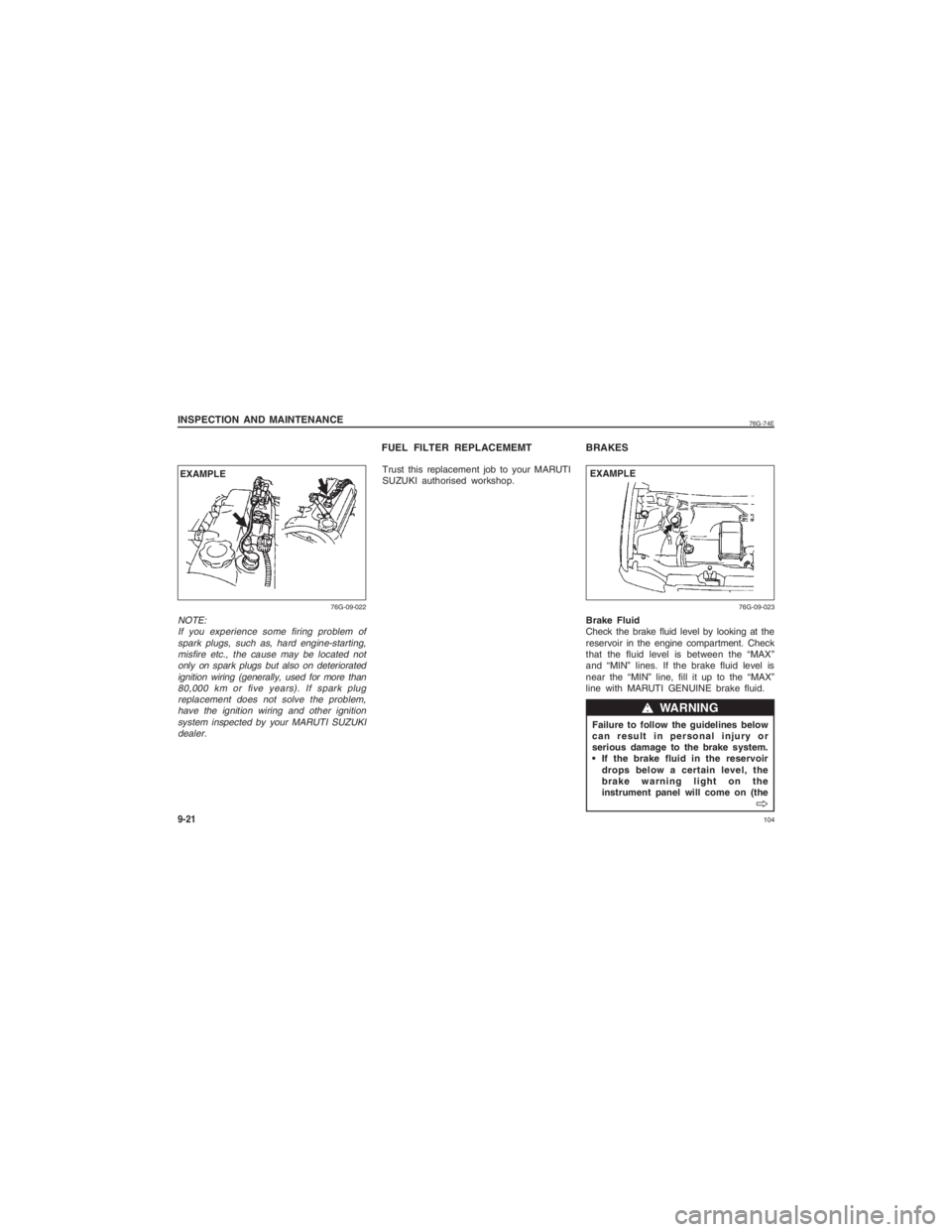
INSPECTION AND MAINTENANCE9-21NOTE:If you experience some firing problem of
spark plugs, such as, hard engine-starting,misfire etc., the cause may be located notonly on spark plugs but also on deteriorated
ignition wiring (generally, used for more than80,000 km or five years). If spark plugreplacement does not solve the problem,
have the ignition wiring and other ignitionsystem inspected by your MARUTI SUZUKIdealer.
76G-09-022
BRAKESBrake Fluid
Check the brake fluid level by looking at the
reservoir in the engine compartment. Check
that the fluid level is between the “MAX”
and “MIN” lines. If the brake fluid level is
near the “MIN” line, fill it up to the “MAX”
line with MARUTI GENUINE brake fluid.
Failure to follow the guidelines below
can result in personal injury or
serious damage to the brake system.
If the brake fluid in the reservoir drops below a certain level, the
brake warning light on the
instrument panel will come on (the
ww ww
w WARNING
VV
VV
V
76G-09-023
EXAMPLE EXAMPLE
FUEL FILTER REPLACEMEMTTrust this replacement job to your MARUTI
SUZUKI authorised workshop.
Page 104 of 139
10576G-74E
parking brake must be fully
disengaged with ignition switch in
"ON" position). Should the light
come on, immediately ask your
MARUTI SUZUKI dealer to inspect
the brake system.
A rapid fluid loss indicates a leak in
the brake system which should be
inspected by your MARUTI SUZUKI
dealer immediately.
Brake fluid can harm your eyes and
damage painted surfaces. Use
caution when refilling the reservoir.
ww ww
w WARNING
VV
VV
V
76G-09-024
INSPECTION AND MAINTENANCE
9-22
Do not use any fluid other than
MARUTI GENUINE brake fluid. Do
not use reclaimed fluid or fluid that
has been stored in old or open
containers. It is essential that
foreign particles and other liquids
are kept out of the brake fluid
reservoir.
The brake fluid should be replaced
every two years or 20,000 km.NOTE: With disc brakes, the fluid level can beexpected to gradually fall as the brake padswear.
ww ww
w WARNINGCAUTION
76G-09-025
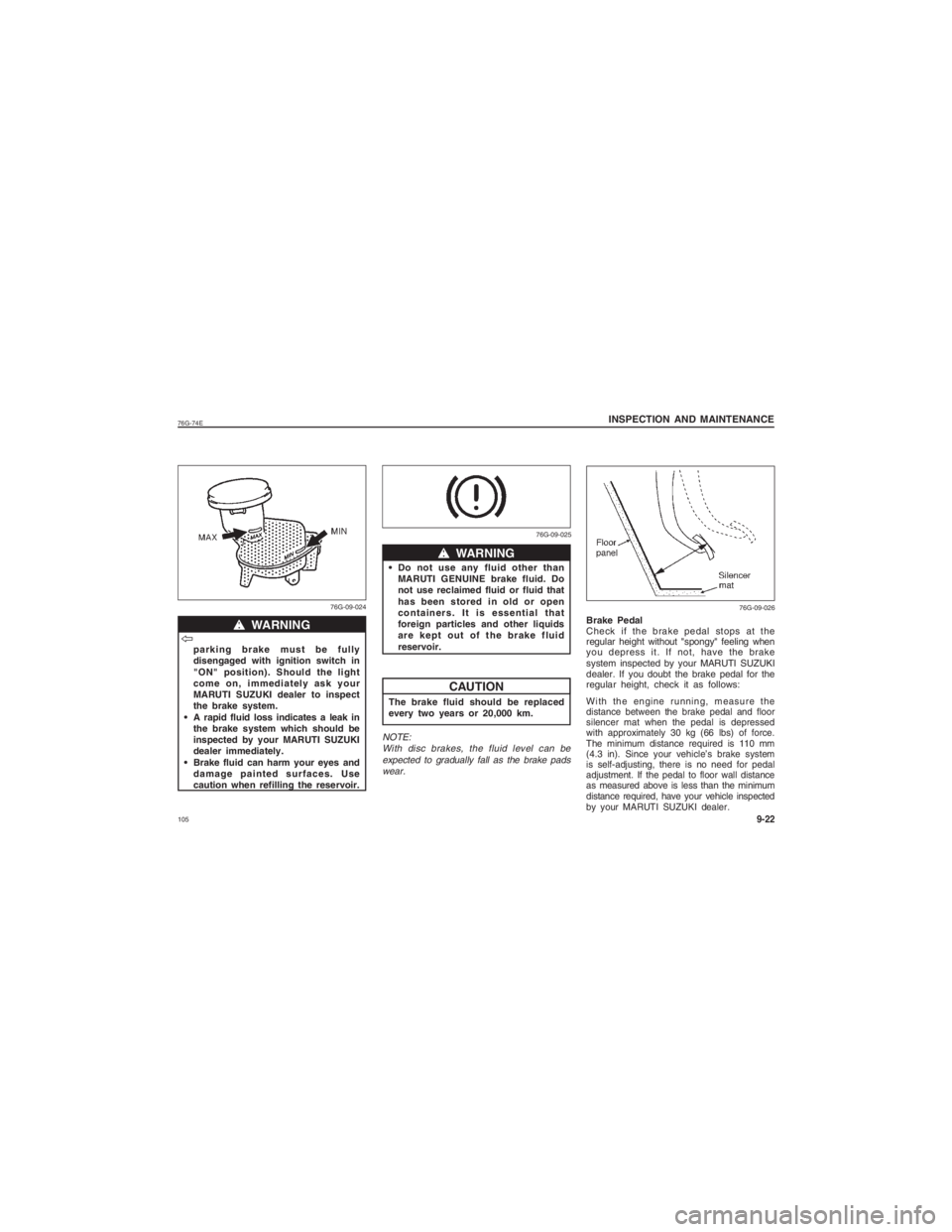
Brake Pedal
Check if the brake pedal stops at the
regular height without "spongy" feeling when
you depress it. If not, have the brake
system inspected by your MARUTI SUZUKI
dealer. If you doubt the brake pedal for the
regular height, check it as follows:With the engine running, measure the
distance between the brake pedal and floor
silencer mat when the pedal is depressed
with approximately 30 kg (66 lbs) of force.
The minimum distance required is 110 mm
(4.3 in). Since your vehicle’s brake system
is self-adjusting, there is no need for pedal
adjustment. If the pedal to floor wall distance
as measured above is less than the minimum
distance required, have your vehicle inspected
by your MARUTI SUZUKI dealer.
76G-09-026
Page 105 of 139
106
76G-74E
INSPECTION AND MAINTENANCE9-23NOTE:When measuring the distance between the
brake pedal and floor wall, be sure not toinclude any floor covering other thansilencer mat in the measurement.If you experience any of the following
problems with your vehicle’s brake
system, have the vehicle inspected
immediately by your MARUTI SUZUKI
dealer.
Poor braking performance
Uneven braking (Brakes not working uniformly on all wheels.)
Excessive pedal travel
Brake dragging
Excessive noise
Pedal pulsation (Pedal pulsates
when depressed.)
ww ww
w WARNING
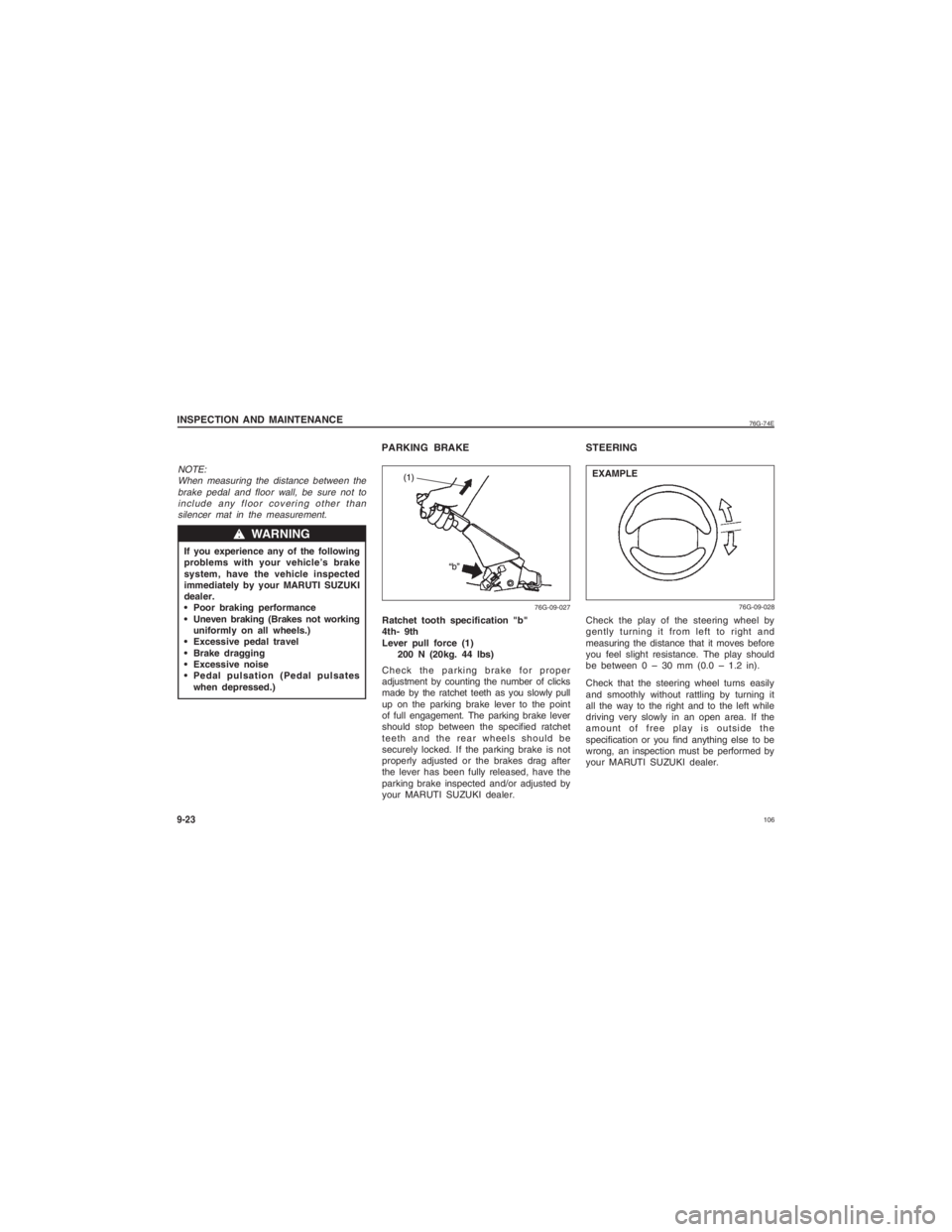
Ratchet tooth specification "b"
4th- 9th
Lever pull force (1)
200 N (20kg. 44 lbs)
Check the parking brake for proper
adjustment by counting the number of clicks
made by the ratchet teeth as you slowly pull
up on the parking brake lever to the point
of full engagement. The parking brake lever
should stop between the specified ratchet
teeth and the rear wheels should be
securely locked. If the parking brake is not
properly adjusted or the brakes drag after
the lever has been fully released, have the
parking brake inspected and/or adjusted by
your MARUTI SUZUKI dealer.
76G-09-027
STEERINGCheck the play of the steering wheel by
gently turning it from left to right and
measuring the distance that it moves before
you feel slight resistance. The play should
be between 0 – 30 mm (0.0 – 1.2 in).
Check that the steering wheel turns easily
and smoothly without rattling by turning it
all the way to the right and to the left while
driving very slowly in an open area. If the
amount of free play is outside the
specification or you find anything else to be
wrong, an inspection must be performed by
your MARUTI SUZUKI dealer.
76G-09-028
EXAMPLE
PARKING BRAKE
Page 106 of 139
10776G-74E
9-24
INSPECTION AND MAINTENANCE
CLUTCH PEDAL
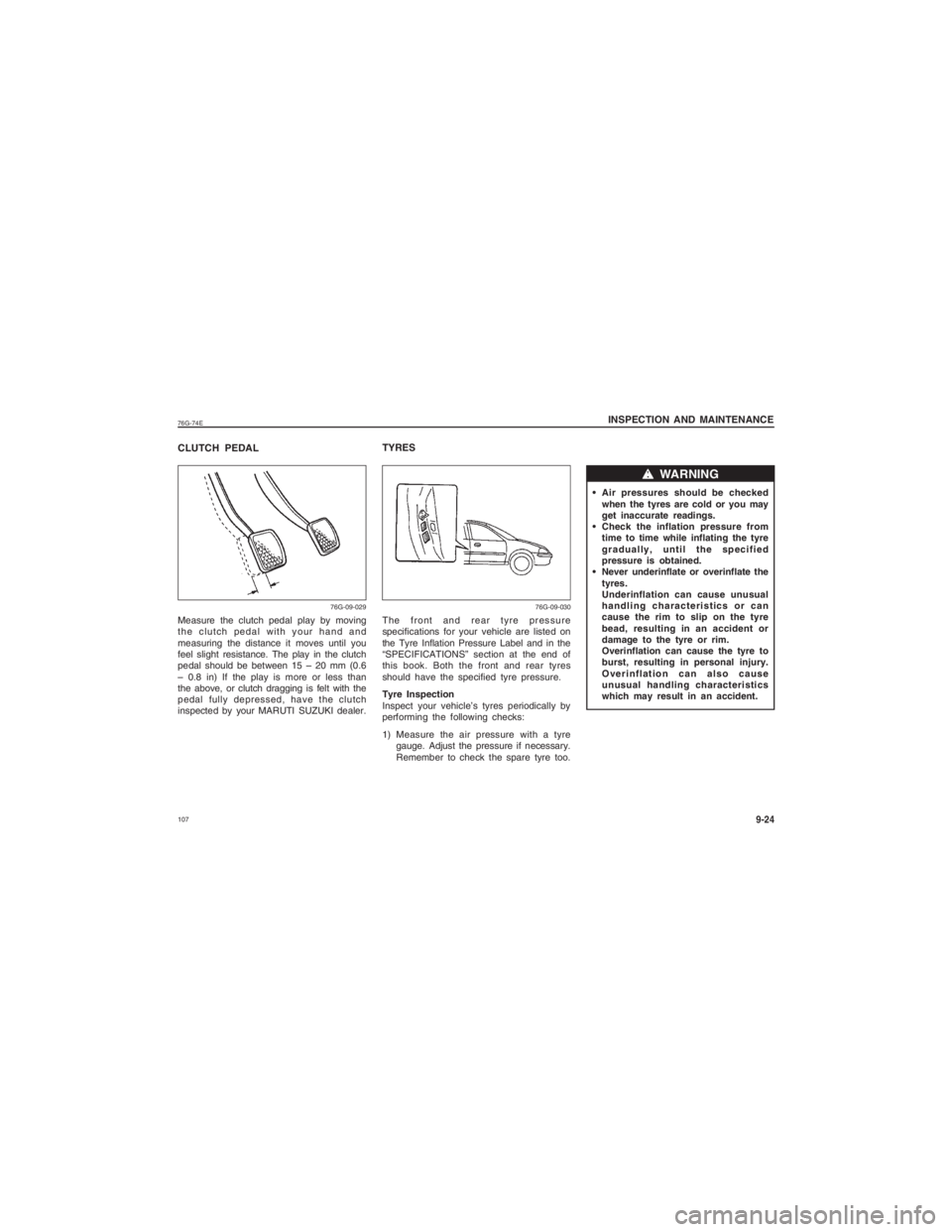
Measure the clutch pedal play by moving
the clutch pedal with your hand and
measuring the distance it moves until you
feel slight resistance. The play in the clutch
pedal should be between 15 – 20 mm (0.6
– 0.8 in) If the play is more or less than
the above, or clutch dragging is felt with the
pedal fully depressed, have the clutch
inspected by your MARUTI SUZUKI dealer.
76G-09-029
TYRESThe front and rear tyre pressure
specifications for your vehicle are listed on
the Tyre Inflation Pressure Label and in the
“SPECIFICATIONS” section at the end of
this book. Both the front and rear tyres
should have the specified tyre pressure.
Tyre Inspection
Inspect your vehicle’s tyres periodically by
performing the following checks:
1) Measure the air pressure with a tyre gauge. Adjust the pressure if necessary.
Remember to check the spare tyre too.
76G-09-030
Air pressures should be checkedwhen the tyres are cold or you may
get inaccurate readings.
Check the inflation pressure from time to time while inflating the tyre
gradually, until the specified
pressure is obtained.
Never underinflate or overinflate the tyres.
Underinflation can cause unusual
handling characteristics or can
cause the rim to slip on the tyre
bead, resulting in an accident or
damage to the tyre or rim.
Overinflation can cause the tyre to
burst, resulting in personal injury.
Overinflation can also cause
unusual handling characteristics
which may result in an accident.
ww ww
w WARNING