Brake SUZUKI BALENO 1999 1.G User Guide
[x] Cancel search | Manufacturer: SUZUKI, Model Year: 1999, Model line: BALENO, Model: SUZUKI BALENO 1999 1.GPages: 65, PDF Size: 3.28 MB
Page 33 of 65
60G-74E
OPERATING YOUR VEHICLE
Once a week, or each time you fill your fuel
tank, perform the following under-bonnet
checks:
1) Engine oil level.
2) Coolant level.
3) Brake fluid level.
4) Power steering (if equipped) fluid level.
5) Windscreen washer fluid level.
6) Battery solution level.
7) Bonnet latch operation.
Pull the bonnet release handle inside the
vehicle. Make sure that you can not open
the hood all the way without releasing the
secondary latch. Be sure to close the hood
securely after checking for proper
operation. See "All Latches, Hinges &
Locks" of "PERIODIC MAINTENANCE
SCHEDULE" in the "INSPECTION AND
MAINTENANCE" section for lubrication
schedule.
Make sure the bonnet is fully closed
and latched before driving. If it is not,
it can fly up unexpectedly during
driving, obstructing your view and
resulting in an accident.
STARTING THE ENGINE
Before starting the engine:
1) Make sure the parking brake is applied
fully.
2) Manual Transmission - Shift into "N"
(neutral) and depress the clutch pedal all
the way to the floor. Hold it while starting
the engine.
Make sure that the parking brake is
applied fully and the transmission is in
Neutral before attempting to start the
engine.
CAUTION
Stop turning the starter immediately
after the engine has started or the
starter system can be damaged.
Do not crank the engine for more
than 15 seconds at a time. If the
engine doesn't start on the first try,
wait about 15 seconds before trying
again.
Starting a Cold Engine
Engine which is started after 6 hours should
be treated as cold engine.
For Electronic fuel injection models
• With your foot off the accelerator pedal,
crank the engine by turning the ignition
key to "START1. Release the key when the
engine starts.
• If the engine does not start after 15
seconds of cranking, wait about 15
seconds, then press down the accelerator
pedal to 1/3 of its travel and try cranking
the engine again. Release the key and
accelerator pedal when the engine starts.
• If the engine still does not start, try holding
the accelerator pedal all the way to the
floor while cranking. This should clear the
engine if it is flooded.
Starting a Warm Engine
For Electronic fuel injection models:
Use the same procedure as for "Starting a cold
Engine".
67
7-2
OPERATING YOUR VECHILE
60G-74E
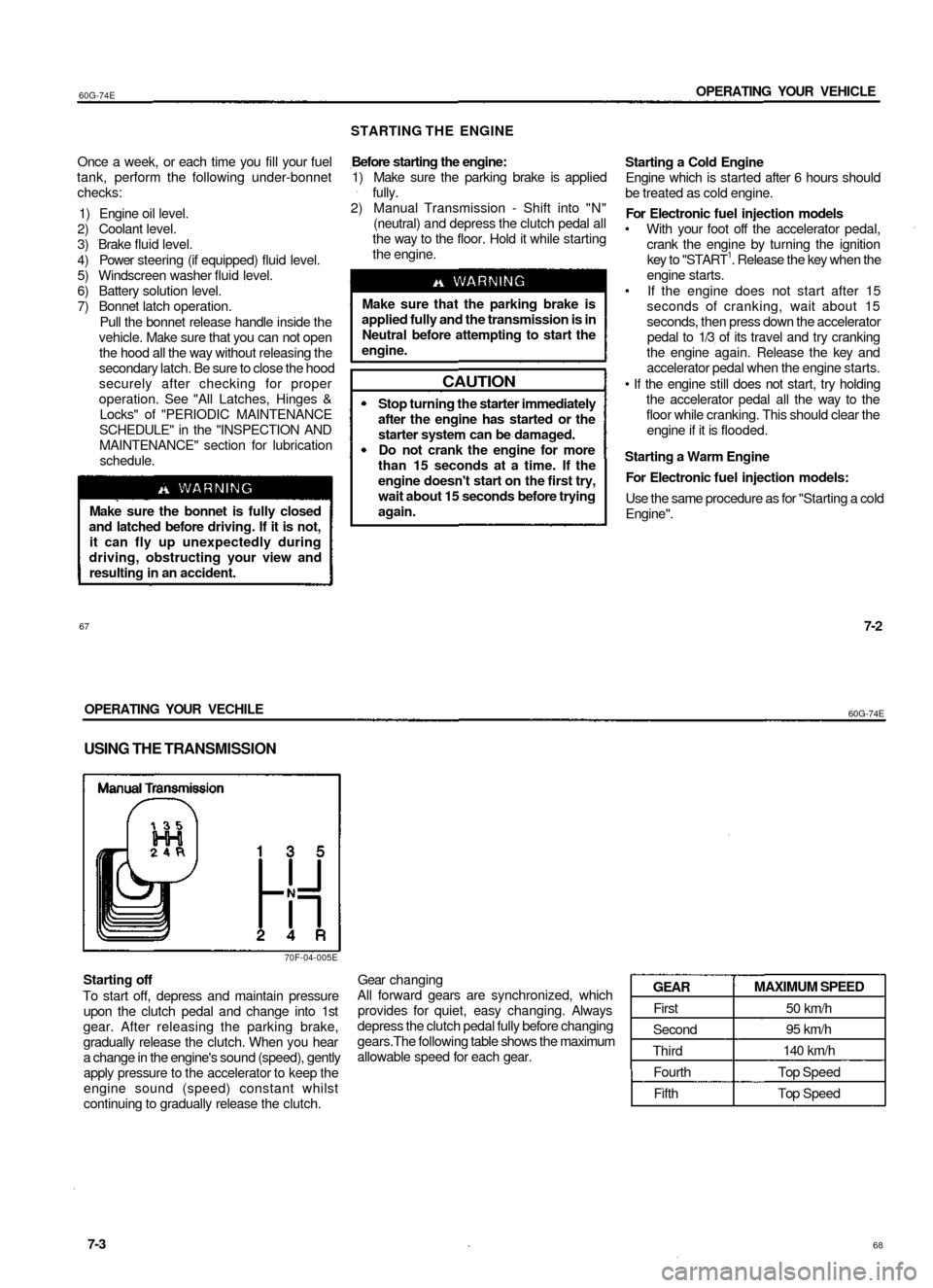
USING THE TRANSMISSION
70F-04-005E
Starting off
To start off, depress and maintain pressure
upon the clutch pedal and change into 1st
gear. After releasing the parking brake,
gradually release the clutch. When you hear
a change in the engine's sound (speed), gently
apply pressure to the accelerator to keep the
engine sound (speed) constant whilst
continuing to gradually release the clutch.
Gear changing
All forward gears are synchronized, which
provides for quiet, easy changing. Always
depress the clutch pedal fully before changing
gears.The following table shows the maximum
allowable speed for each gear.
GEAR
First
Second
Third
Fourth
Fifth
MAXIMUM SPEED
50 km/h
95 km/h
140 km/h
Top Speed
Top Speed
7-3
68
Page 34 of 65
60G-74E
OPERATING YOUR VEHICLE
Reduce your speed and change
down to a lower gear before going
down a long or steep hill. A lower
gear will allow the engine to provide
braking. Avoid riding the brakes or
they may overheat, resulting in brake
failure.
When driving on slippery roads, be
sure to slow down before changing
down. Excessive and or sudden
changes in engine speed may cause
loss of traction, which could cause
you to lose control.
Make sure that the vehicle is
completely stationary before you
change into reverse.
CAUTION
To help avoid clutch damage, do not
use the clutch pedal as a footrest
while driving or use the clutch to
keep the vehicle stationary on a hill.
Depress the clutch fully when
changing gear.
When changing gears or starting off,
do not race the engine. Racing the
engine can shorten engine life and
prevent smooth operation.
BRAKING
The distance needed to bring any vehicle to a
halt increases with the speed of the vehicle.
The braking distance needed, for example, at
60 km/h will be approximately 4 times greater
than the braking distance needed at 20 km/h.
Start to brake the vehicle when there is plenty
of distance between your vehicle and the
stopping point, and slow down gradually.
69
7-4
OPERATING YOUR VECHILE
60G-74E
RUNNING-IN
Servo assisted brakes
Your vehicle has servo assisted brakes which
works with the assistance of engine vacuum.
Do not switch off the engine while
vehicle is in motion, for example, while
driving down a hill as this will cause
loss of vacuum assistance leading to
reduction of braking efficiency
substantially.
If servo assistance is lost due to a stalled
engine or other failures, the system is still fully
operational on reserve power and you can
bring the vehicle to a complete stop by
pressing the brake pedal once and holding it
down. The reserve power is partly used up
each time you depress the brake pedal. Apply
smooth and constant pressure to the pedal.
Do not pump the pedal.
Even without reserve power in the
brake system, you can still stop the
vehicle by pressing the brake pedal
harder than normally required.
However, the stopping distance may be
lonaer.
On loose surface where the wheels can
easily loose traction (such as gravel,
etc.), the stopping distance required for
your vehicle may be greater than for a
comparable vehicle with a conventional
brake system. Allow for extra stopping
distance when driving on loose
surfaces.
CAUTION
The future performance and reliability
of the engine depends on the care and
restraint exercised during its early life.
It is especially important to observe the
following precautions during the initial
1000 km of vehicle operation.
• After starting, do not race the
engine. Warm it up gradually.
• Avoid prolonged vehicle operation at
a constant speed. Moving parts will
bed in better if you vary your speed.
• Do not exceed 100 km/h.
• Start off from a stop slowly. Avoid
full throttle starts.
• If possible, avoid hard braking,
especially during the first 300 km of
driving.
• Do not drive slowly with the
transmission in a high gear.
• Drive the vehicle at moderate engine
speeds.
7-5
70
If water gets into the brake drums,
brake performance may become poor
and unpredictable. After driving
through water or washing the
underside of the vehicle, test the brakes
while driving at a slow speed to see if
they have maintained their normal
effectiveness. If the brakes are less
effective than normal, dry them by
repeatedly applying the brakes while
driving slowly until the brakes have
regained their normal effectiveness.
Page 36 of 65
60G-74E
DRIVING TIPS AND SAFE DRIVING
DRIVING TIPS AND SAFE DRIVING
High Speed Driving 8-1
Driving on Hills 8-1
Driving on Slippery Roads 8-2
Driving on Wet Roads 8-2
Do's and Don'ts for Safe Driving 8-3
73
DRIVING TIPS AND SAFE DRIVING
60G-74E
70F-06-001
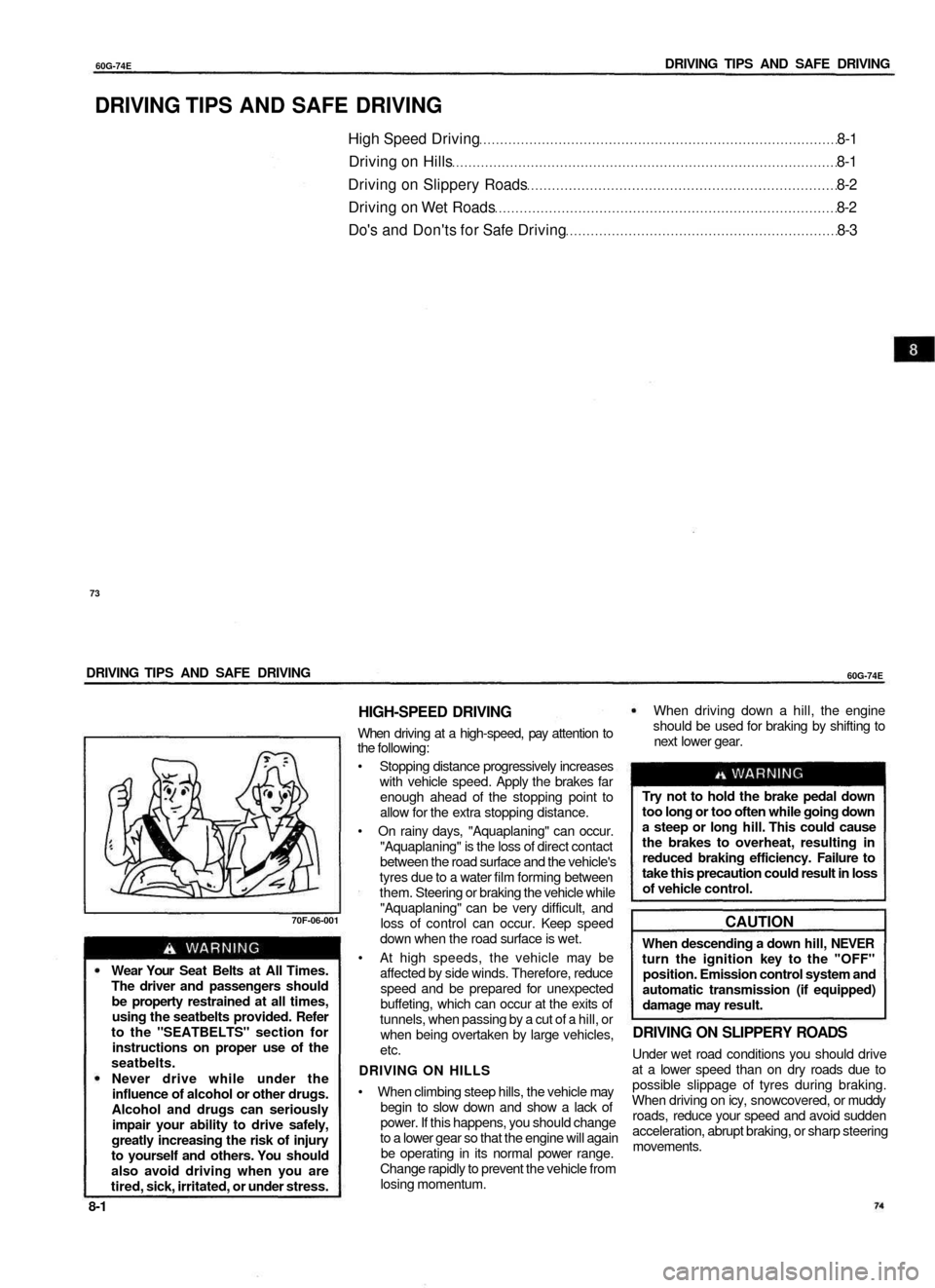
Wear Your Seat Belts at All Times.
The driver and passengers should
be property restrained at all times,
using the seatbelts provided. Refer
to the "SEATBELTS" section for
instructions on proper use of the
seatbelts.
Never drive while under the
influence of alcohol or other drugs.
Alcohol and drugs can seriously
impair your ability to drive safely,
greatly increasing the risk of injury
to yourself and others. You should
also avoid driving when you are
tired, sick, irritated, or under stress.
HIGH-SPEED DRIVING
When driving at a high-speed, pay attention to
the following:
• Stopping distance progressively increases
with vehicle speed. Apply the brakes far
enough ahead of the stopping point to
allow for the extra stopping distance.
• On rainy days, "Aquaplaning" can occur.
"Aquaplaning" is the loss of direct contact
between the road surface and the vehicle's
tyres due to a water film forming between
them. Steering or braking the vehicle while
"Aquaplaning" can be very difficult, and
loss of control can occur. Keep speed
down when the road surface is wet.
• At high speeds, the vehicle may be
affected by side winds. Therefore, reduce
speed and be prepared for unexpected
buffeting, which can occur at the exits of
tunnels, when passing by a cut of a hill, or
when being overtaken by large vehicles,
etc.
DRIVING ON HILLS
• When climbing steep hills, the vehicle may
begin to slow down and show a lack of
power. If this happens, you should change
to a lower gear so that the engine will again
be operating in its normal power range.
Change rapidly to prevent the vehicle from
losing momentum.
When driving down a hill, the engine
should be used for braking by shifting to
next lower gear.
Try not to hold the brake pedal down
too long or too often while going down
a steep or long hill. This could cause
the brakes to overheat, resulting in
reduced braking efficiency. Failure to
take this precaution could result in loss
of vehicle control.
CAUTION
When descending a down hill, NEVER
turn the ignition key to the "OFF"
position. Emission control system and
automatic transmission (if equipped)
damage may result.
DRIVING ON SLIPPERY ROADS
Under wet road conditions you should drive
at a lower speed than on dry roads due to
possible slippage of tyres during braking.
When driving on icy, snowcovered, or muddy
roads, reduce your speed and avoid sudden
acceleration, abrupt braking, or sharp steering
movements.
8-1
Page 37 of 65
60G-74E
DRIVING TIPS AND SAFE DRIVING
Snow Chains
If you must use snow chains to increase tyre
traction, observe the following precautions:
• Choose a safe place away from traffic to
install the chains.
• When installing the chains carefully follow
the manufacturer's instructions.
• Install the chains on the front tyres.
• With the chains on, drive only at slow and
moderate speeds.
• If Your Vehicle Gets Stuck
If your vehicle gets stuck in snow, mud, or
sand, follow the directions below:
1) Change back and forth between first gear
and reverse. This will create a rocking
motion which may give you enough
momentum to free the vehicle. Press
gently on the accelerator to keep wheel
spin to a minimum. Remove your foot from
the accelerator while changing gear.
Do not race the engine. Excessive wheel
spin will cause the tyres to dig deeper,
making it more difficult to free the vehicle.
2) If your vehicle remains stuck after a few
minutes of rocking, get another vehicle to
pull you out.
Do not allow anyone to stand near the
vehicle when you are rocking it, and do
not spin the wheels faster than an
indicated 40 km/h on the speedometer.
Personal injury and/or vehicle damage
may result from spinning the wheels
too fast.
CAUTION
Do not continue rocking the vehicle for
more than a few minutes. Prolonged
rocking can cause engine overheating
or transmission damage.
DRIVING ON WET ROADS
CAUTION
When driving on wet roads, avoid driv-
ing through large amount of standing
water on the road. Large amount of
water entering the engine compart-
ment may cause damage to the engine
and or electrical components.
If stuck in deep water, do not start till
water level drops.
Water Is incompressible substance,
water inside engine is harmful to
the engine."
Make sure your tyres are in good
condition and always maintain the
specified tyre pressure. Refer to
"TYRES" in the "INSPECTION AND
MAINTENANCE" section for details.
Do not use tyres other than those
specified by MARUTI. never use
different sizes or types of tyres on
the front and rear wheels. For
information regarding the specified
tyres, refer to ^"SPECIFICATIONS"
section.
Never use oversized tyres or special
shock absorbers and springs to
raise (jack up) your vehicle.This will
change the handling characteristics.
After driving through water, test the
brakes while driving at a slow speed
to see if they have maintained their
normal effectiveness. If the brakes
are less effective than normal, dry
them by repeatedly applying the
brakes while driving slowly until the
brakes have regained their normal
effectiveness.
75
8-2
DRIVING TIPS AND SAFE DRIVING
60G-74E
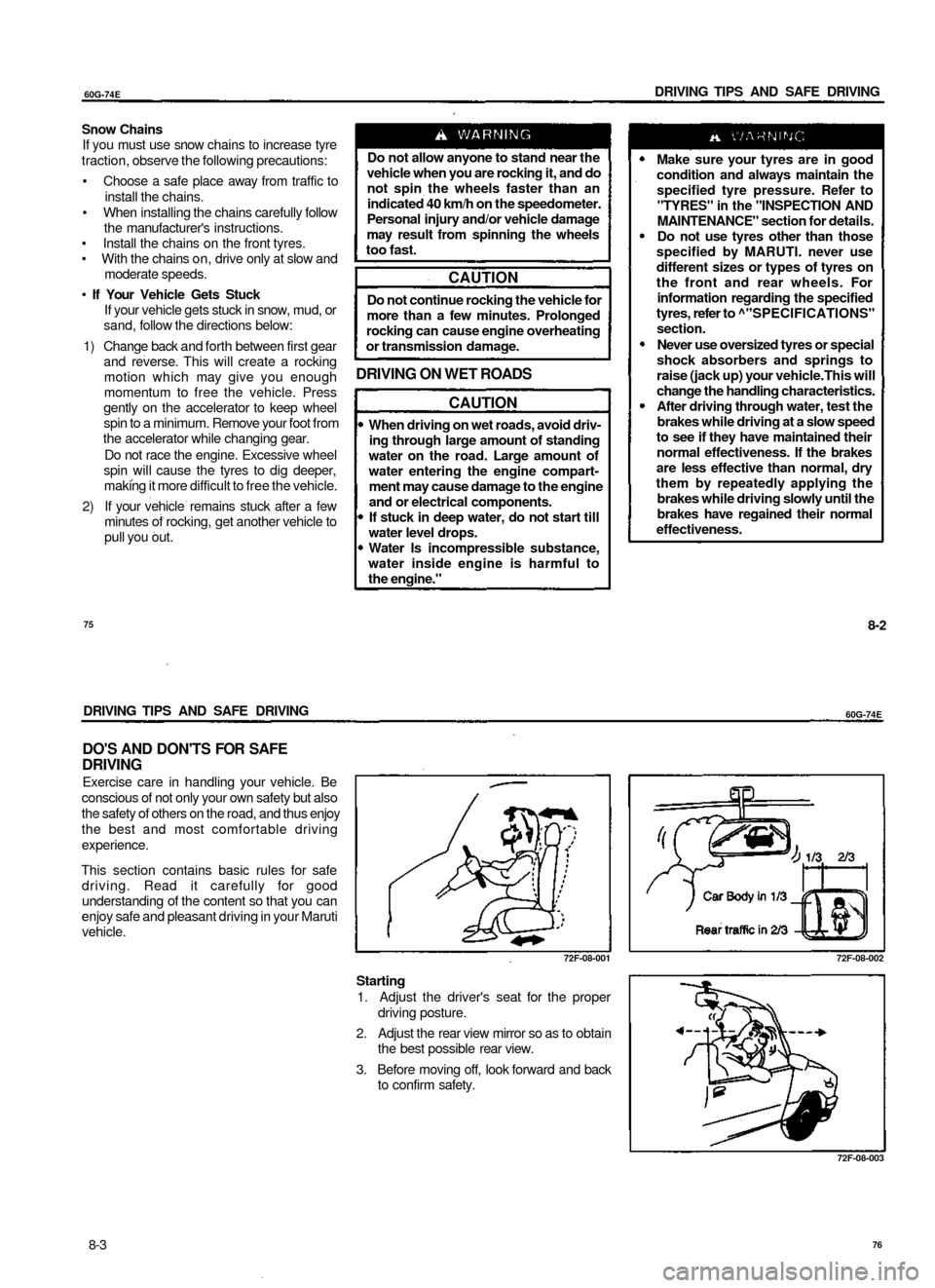
DO'S AND DON'TS FOR SAFE
DRIVING
Exercise care in handling your vehicle. Be
conscious of not only your own safety but also
the safety of others on the road, and thus enjoy
the best and most comfortable driving
experience.
This section contains basic rules for safe
driving. Read it carefully for good
understanding of the content so that you can
enjoy safe and pleasant driving in your Maruti
vehicle.
72F-08-001
Starting
1. Adjust the driver's seat for the proper
driving posture.
2. Adjust the rear view mirror so as to obtain
the best possible rear view.
3. Before moving off, look forward and back
to confirm safety.
72F-08-002
72F-08-003
8-3
76
Page 38 of 65
60G-74E
DRIVING TIPS AND SAFE DRIVING
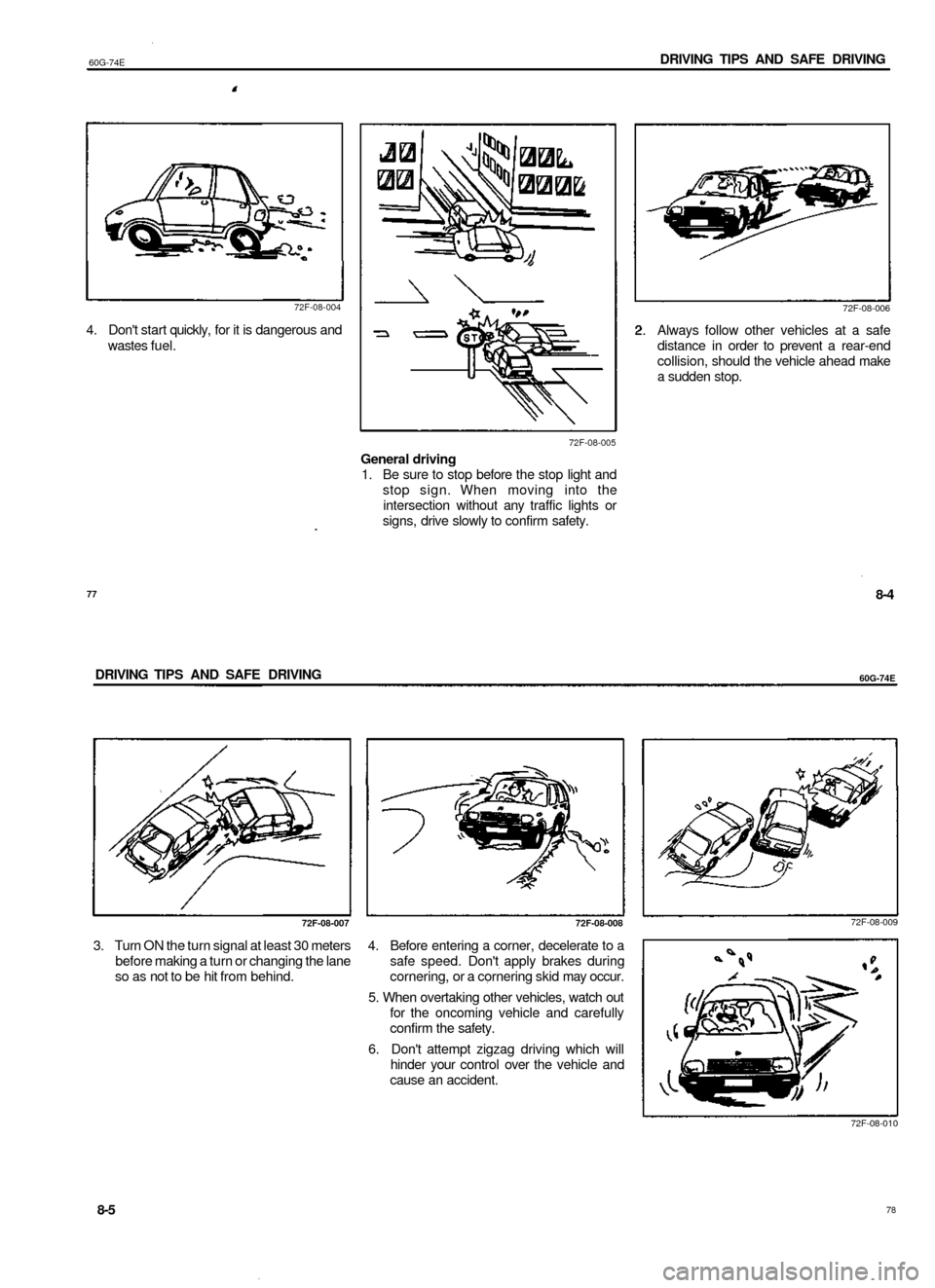
72F-08-004
4. Don't start quickly, for it is dangerous and
wastes fuel.
72F-08-006
72F-08-005
General driving
1. Be sure to stop before the stop light and
stop sign. When moving into the
intersection without any traffic lights or
signs, drive slowly to confirm safety.
Always follow other vehicles at a safe
distance in order to prevent a rear-end
collision, should the vehicle ahead make
a sudden stop.
77
8-4
DRIVING TIPS AND SAFE DRIVING
60G-74E
72F-08-007 72F-08-008
72F-08-009
3.
Turn ON the turn signal at least 30 meters
before making a turn or changing the lane
so as not to be hit from behind.
4. Before entering a corner, decelerate to a
safe speed. Don't apply brakes during
cornering, or a cornering skid may occur.
5. When overtaking other vehicles, watch out
for the oncoming vehicle and carefully
confirm the safety.
6. Don't attempt zigzag driving which will
hinder your control over the vehicle and
cause an accident.
72F-08-010
8-5
78
Page 39 of 65
60G-74E
DRIVING TIPS AND SAFE DRIVING
72F-08-011
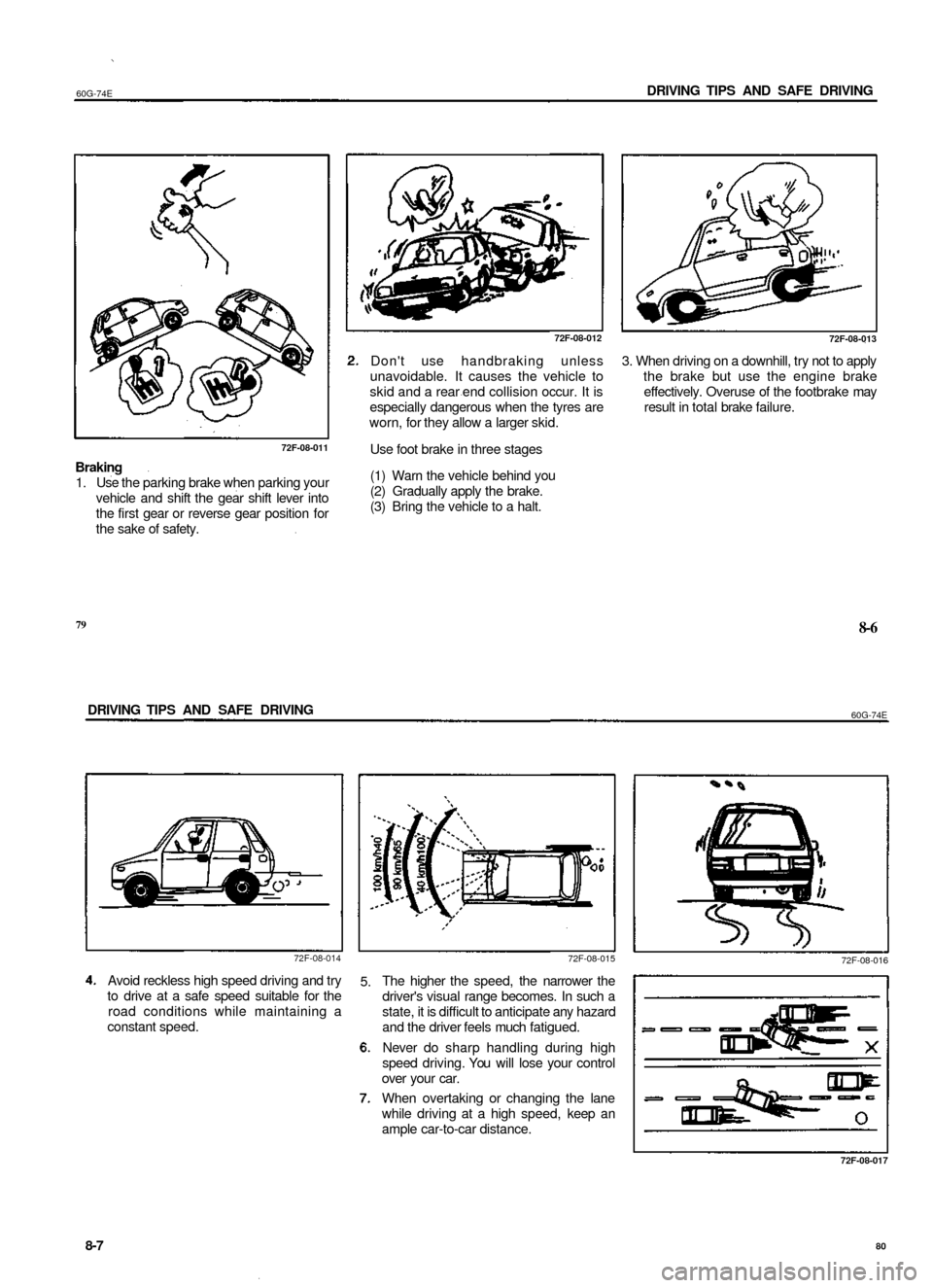
Braking
1. Use the parking brake when parking your
vehicle and shift the gear shift lever into
the first gear or reverse gear position for
the sake of safety.
72F-08-012
Don't use handbraking unless
unavoidable. It causes the vehicle to
skid and a rear end collision occur. It is
especially dangerous when the tyres are
worn, for they allow a larger skid.
Use foot brake in three stages
(1) Warn the vehicle behind you
(2) Gradually apply the brake.
(3) Bring the vehicle to a halt.
3. When driving on a downhill, try not to apply
the brake but use the engine brake
effectively. Overuse of the footbrake may
result in total brake failure.
79
8-6
DRIVING TIPS AND SAFE DRIVING
60G-74E
72F-08-014
Avoid reckless high speed driving and try
to drive at a safe speed suitable for the
road conditions while maintaining a
constant speed.
5.
72F-08-015
The higher the speed, the narrower the
driver's visual range becomes. In such a
state, it is difficult to anticipate any hazard
and the driver feels much fatigued.
Never do sharp handling during high
speed driving. You will lose your control
over your car.
When overtaking or changing the lane
while driving at a high speed, keep an
ample car-to-car distance.
72F-08-017
8-7
80
72F-08-013
72F-08-016
Page 41 of 65
60G-74E
INSPECTION AND MAINTENANCE
INSPECTION AND MAINTENANCE
Periodic Maintenance Schedule.. 9-2
Engine Oil and Filter 9-7
Gear OH 9-10
Engine Coolant 9-11
Windscreen Washer Fluid 9-13
Air Cleaner 9-13
Spark Plugs 9-14
Brakes 9-15
Steering 9-17
Power Steering (if equipped) 9-18
Clutch Pedal 9-18
Tyres... 9-19
Battery 9-22
Fuses 9-23
Bulb Replacement , 9-25
Wiper Blades 9-29
83
INSPECTION AND MAINTENANCE
60G-74E
70F-05-002
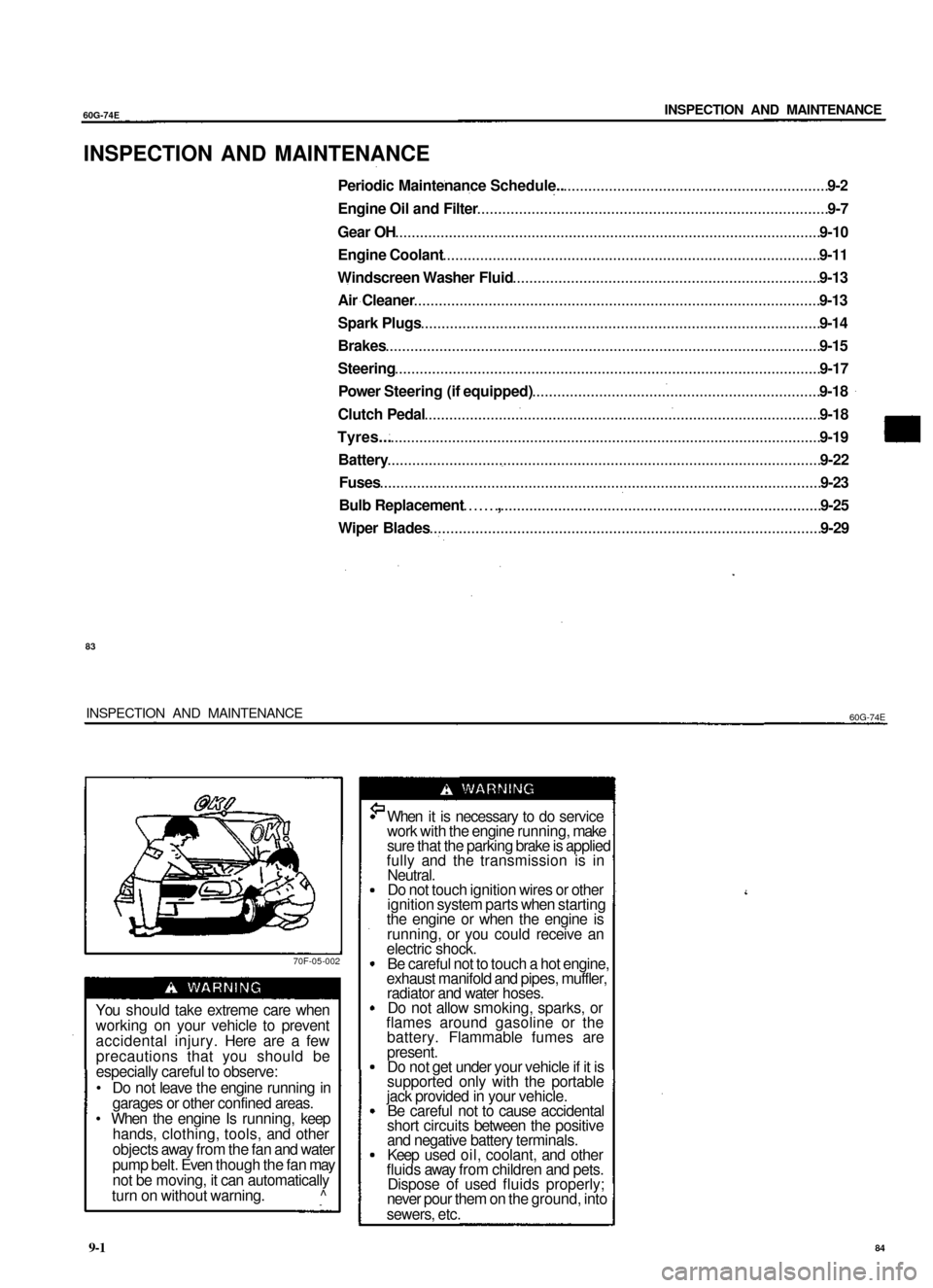
You should take extreme care when
working on your vehicle to prevent
accidental injury. Here are a few
precautions that you should be
especially careful to observe:
• Do not leave the engine running in
garages or other confined areas.
• When the engine Is running, keep
hands, clothing, tools, and other
objects away from the fan and water
pump belt. Even though the fan may
not be moving, it can automatically
turn on without warning. ^
When it is necessary to do service
work with the engine running, make
sure that the parking brake is applied
fully and the transmission is in
Neutral.
Do not touch ignition wires or other
ignition system parts when starting
the engine or when the engine is
running, or you could receive an
electric shock.
Be careful not to touch a hot engine,
exhaust manifold and pipes, muffler,
radiator and water hoses.
Do not allow smoking, sparks, or
flames around gasoline or the
battery. Flammable fumes are
present.
Do not get under your vehicle if it is
supported only with the portable
jack provided in your vehicle.
Be careful not to cause accidental
short circuits between the positive
and negative battery terminals.
Keep used oil, coolant, and other
fluids away from children and pets.
Dispose of used fluids properly;
never pour them on the ground, into
sewers, etc.
9-1
84
Page 43 of 65
60G-74E
INSPECTION AND MAINTENANCE
Interval: This interval should be Judged
by odometer reading or months,
whichever comes first.
km (x 1,000)
months
FUEL
1. Air cleaner Paved-road
Dusty condition
2. Accelerator cable and Throttle shafts
3. Fuel tank cap, fuel lines & connections(leakage,damage)
4. Fuel filter (leakage)
CLUTCH AND TRANSMISSION
1. Clutch pedal (play)
2. Clutch slipping (dragging or excessive damage)
3. Manual Transmission/Transfer and Differential oil (level, leakage)
DRIVE SHAFTS
1. Drive shafts boots (bent of boots damage)
BRAKE
1. Brake fluid (level, leakage)
2. Brake pedal (pedal-to-wall clearance)
3. Parking brake lever and cable (play, damage)
4. a. Brake discs and pads, (wear)
b. Brake drums & shoes
5. Master cylinder and wheel cylinder or calliper (oil leakage.boot kit)
6. Brake hoses and pipes (leakage, damage)
FREE
1
1
INSPECTIONS
5
6
10
12
Clean every 5,000 km. F
PERIODIC MAINTENANCE
20
24
30
36
40
48
Replace every 40,000 krr
50
60
SERVICE
60
72
AT
70
84
COST
80
96
Clean every 2,500 km or as required. Replace every 40,000 km. More frequent
replacement if dust condition is severe.
-
-
I
I
I
I
-
I
I
I
-
-
I
I
I&L
I
I
I
I
I
I
I
I
I
I
-
I
I
I&L
-
I
I
I
I
I
I
I
I
I
I
I
I
I&L
-
I
I
I
R
I
R
I
I
I
I
I
I
I&L
-
I
I
I
I
I
I
I
I
I
I
I
I
I&L
I
R
I
I
R
I
R
I
I
I
I
R
I
I&L
-
I
I
I
I
I
I
I
I
I
I
I
I
I&L
-
I
I
I
R
I
R
I
I
I
I
I
I
I&L
-
I
I
I
I
I
I
I
I
I
I
I
I
I&L
I
R
I
I
R
I
R
I
I
I
I
R
I
87
9-4
INSPECTION AND MAINTENANCE
60G-74E
Interval: This Interval should be judged
by odometer reading or months,
whichever comes first
km (x 1,000)
months
WHEEL
1. Tyres (air pressure, abnormal wear, crack, ROTATION)
2. Wheels (damage)
3. Front wheel bearings (loose, damage)
4. Rear wheel bearings (loose, damage)
FRONT AND REAR SUSPENSION
1. Suspension strut (oil leakage, damage)
2. Suspension arms and knuckle supports (loose.damage)
3. Rear spring (damage)
4. Shock absorbers (oil leakage, damage)
5. All bolts and nuts (loose)
6. Suspension arms and Tension rods
STEERING
1. Steering wheel (play, loose)
2. Power steering fluid (level, leakage)/connections
3. All rods and arms (loose, damage, wear)
ELECTRICAL
1. Battery electrolyte (level, leakage)
2. Wiring harness connection (looseness, damage)
3. Lighting system (operation, stains, damage)
4. Horn (operation)
5. System voltage
BODY
1. All chassis bolts and nuts (tighten)
2. All Latches, Hinges & Locks (function)
FREE
1
1
INSPECTIONS
5
6
Rotate and
I
-
-
I
-
-
I
-
-
I
I
I
I
-
I
I
-
-
I
I
I
I
I
I
I
I
T
I
I
I
I
I
I
I
I
I
I
I&L
10
12
PERIODIC
20
24
inspect every 5,000
I
I
I
I
I
I
I
T
I
I
I
I
I
I
I
I
I
T
I&L
I
I
I
I
I
I
I
T
I
I
I
I
I
I
I
I
I
T
I&L
30
36
km
I
I
I
I
I
I
I
T
I
I
I
I
I
I
I
I
I
T
I&L
MAINTENANCE
40
48
I
I
I
I
I
I
I
T
I
I
I
I
I
I
I
I
I
T
I&L
50
60
I
I
I
I
I
I
I
T
I
I
I
I
I
I
I
I
I
T
I&L
SERVICE
60
72
I
I
I
I
I
I
I
T
I
I
I
I
I
I
I
I
I
T
I&L
AT
70
84
I
I
I
I
I
I
I
T
I
I
I
I
I
I
I
I
I
T
I&L
COST
80
96
I
I
I
I
I
I
I
T
I
I
I
I
I
I
I
I
I
T
I&L
9-5
88
Page 44 of 65
60G-74E
INSPECTION AND MAINTENANCE
Interval: This Interval should be judged
by odometer reading or months,
whichever comes first.
km (x 1,000)
months
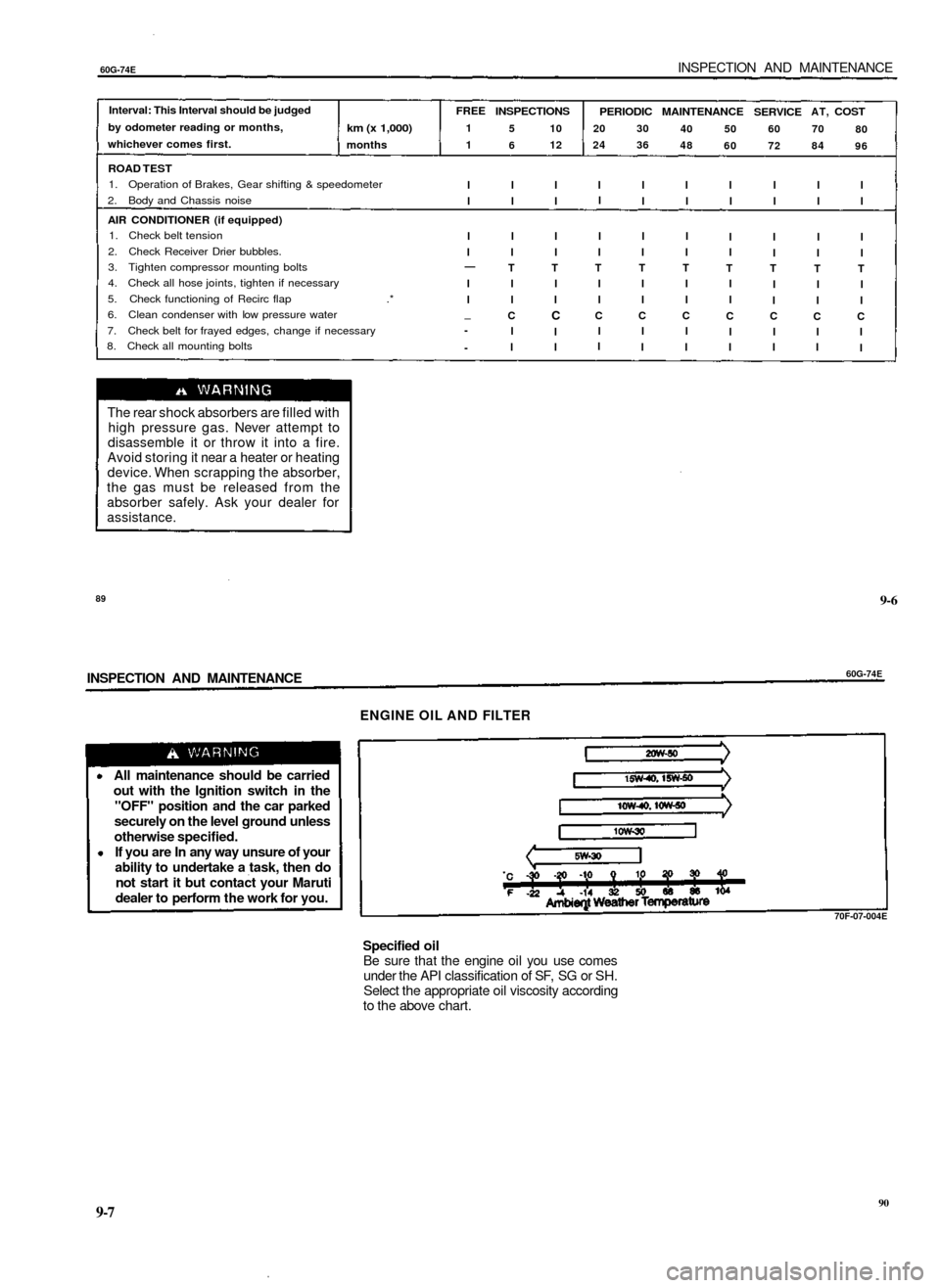
ROAD TEST
1. Operation of Brakes, Gear shifting & speedometer
2. Body and Chassis noise
AIR CONDITIONER (if equipped)
1. Check belt tension
2. Check Receiver Drier bubbles.
3. Tighten compressor mounting bolts
4. Check all hose joints, tighten if necessary
5. Check functioning of Recirc flap .*
6. Clean condenser with low pressure water
7. Check belt for frayed edges, change if necessary
8. Check all mounting bolts
FREE
1
1
I
I
I
I
—
I
I
_
-
-
INSPECTIONS
5
6
I
I
I
I
T
I
I
C
I
I
10
12
I
I
I
I
T
I
I
C
I
I
PERIODIC
20
24
I
I
I
I
T
I
I
C
I
I
30
36
I
I
I
I
T
I
I
C
I
I
MAINTENANCE
40
48
I
I
I
I
T
I
I
C
I
I
50
60
I
I
I
I
T
I
I
C
I
I
SERVICE
60
72
I
I
I
I
T
I
I
C
I
I
AT,
70
84
I
I
I
I
T
I
I
C
I
I
COST
80
96
I
I
I
I
T
I
I
C
I
I
The rear shock absorbers are filled with
high pressure gas. Never attempt to
disassemble it or throw it into a fire.
Avoid storing it near a heater or heating
device. When scrapping the absorber,
the gas must be released from the
absorber safely. Ask your dealer for
assistance.
89
9-6
INSPECTION AND MAINTENANCE
60G-74E
All maintenance should be carried
out with the Ignition switch in the
"OFF" position and the car parked
securely on the level ground unless
otherwise specified.
If you are In any way unsure of your
ability to undertake a task, then do
not start it but contact your Maruti
dealer to perform the work for you.
ENGINE OIL AND FILTER
Specified oil
Be sure that the engine oil you use comes
under the API classification of SF, SG or SH.
Select the appropriate oil viscosity according
to the above chart.
9-7
90
70F-07-004E
Page 46 of 65
60G-74E
INSPECTION AND MAINTENANCE
GEAR OIL
CAUTION
To prevent oil leakage, make sure that
the oil filter is tight, but do not
overtighten it.
Refill with oil and check for leaks.
1) Pour 3.1 litres of oil through the filler hole
and install the filler cap.
2) Start the engine and look carefully for
leaks at the oil filter and drain plug. Run
the engine at various speeds for at least 5
minutes.
3) Stop the engine and wait for 5 minutes.
Check the oil level again and add oil if
necessary. Check for leaks again.
CAUTION
When replacing the oil filter, it is
recommended that you use a genuine
MARUTI replacement filter.
60G-09-006
CAUTION
Oil leaks from around the oil filter or
drain plug indicate incorrect
installation or gasket damage. If you
find any leaks or are not sure that the
fitter has been properly tightened, have
the vehicle inspected by your MARUTI
dealer.
70F-07-012E
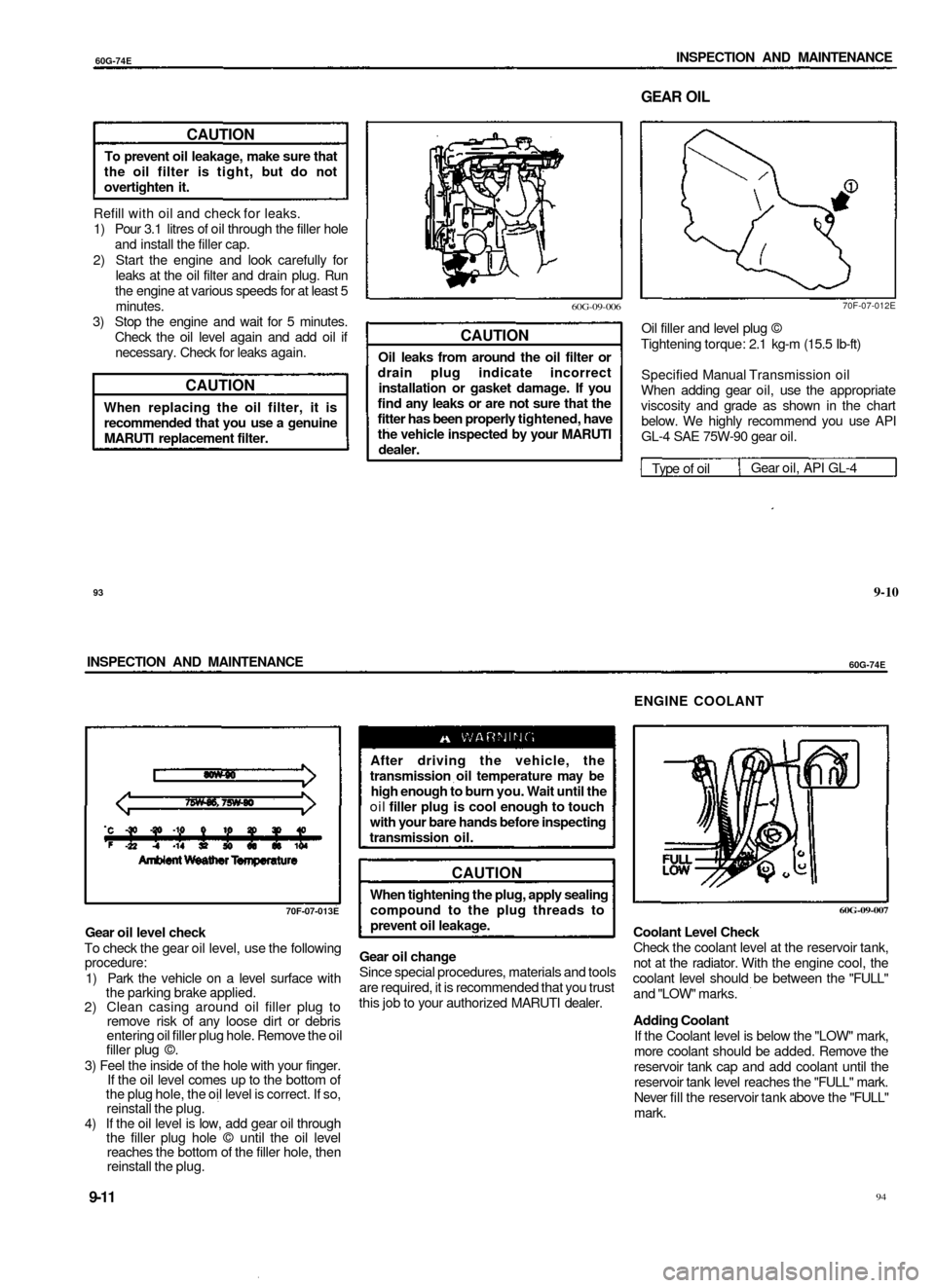
Oil filler and level plug ©
Tightening torque: 2.1 kg-m (15.5 Ib-ft)
Specified Manual Transmission oil
When adding gear oil, use the appropriate
viscosity and grade as shown in the chart
below. We highly recommend you use API
GL-4 SAE 75W-90 gear oil.
Type of oil
Gear oil, API GL-4
93
9-10
INSPECTION AND MAINTENANCE
60G-74E
ENGINE COOLANT
70F-07-013E
Gear oil level check
To check the gear oil level, use the following
procedure:
1) Park the vehicle on a level surface with
the parking brake applied.
2) Clean casing around oil filler plug to
remove risk of any loose dirt or debris
entering oil filler plug hole. Remove the oil
filler plug ©.
3) Feel the inside of the hole with your finger.
If the oil level comes up to the bottom of
the plug hole, the oil level is correct. If so,
reinstall the plug.
4) If the oil level is low, add gear oil through
the filler plug hole © until the oil level
reaches the bottom of the filler hole, then
reinstall the plug.
After driving the vehicle, the
transmission oil temperature may be
high enough to burn you. Wait until the
oil filler plug is cool enough to touch
with your bare hands before inspecting
transmission oil.
CAUTION
When tightening the plug, apply sealing
compound to the plug threads to
prevent oil leakage.
Gear oil change
Since special procedures, materials and tools
are required, it is recommended that you trust
this job to your authorized MARUTI dealer.
60G-09-007
Coolant Level Check
Check the coolant level at the reservoir tank,
not at the radiator. With the engine cool, the
coolant level should be between the "FULL"
and "LOW" marks.
Adding Coolant
If the Coolant level is below the "LOW" mark,
more coolant should be added. Remove the
reservoir tank cap and add coolant until the
reservoir tank level reaches the "FULL" mark.
Never fill the reservoir tank above the "FULL"
mark.
9-11
94