Oil SUZUKI BALENO 1999 1.G User Guide
[x] Cancel search | Manufacturer: SUZUKI, Model Year: 1999, Model line: BALENO, Model: SUZUKI BALENO 1999 1.GPages: 65, PDF Size: 3.28 MB
Page 31 of 65
OTHER CONTROLS AND EQUIPMENTS
60G-74E
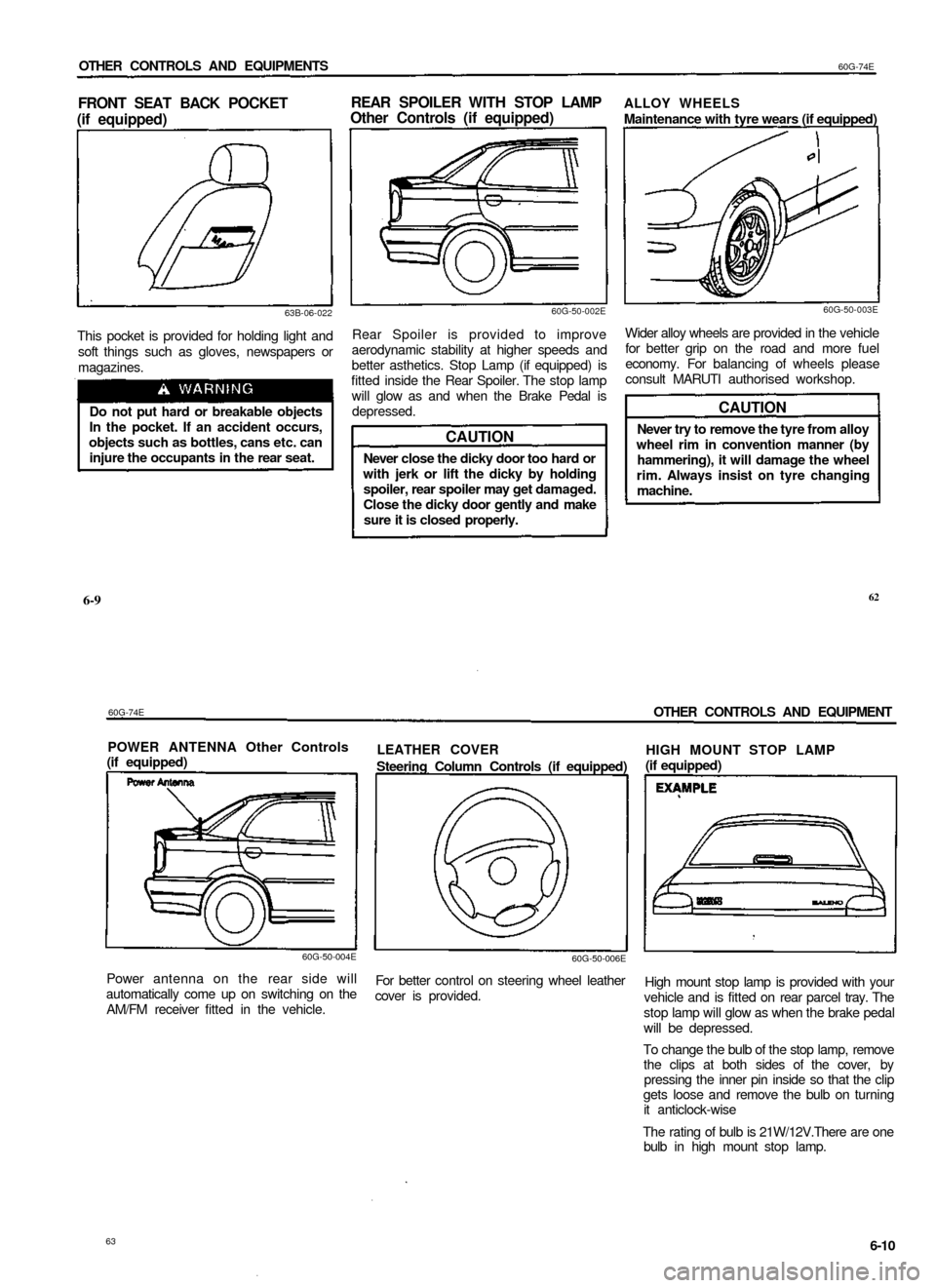
FRONT SEAT BACK POCKET
(if equipped)
REAR SPOILER WITH STOP LAMP
Other Controls (if equipped)
63B-06-022
This pocket is provided for holding light and
soft things such as gloves, newspapers or
magazines.
Do not put hard or breakable objects
In the pocket. If an accident occurs,
objects such as bottles, cans etc. can
injure the occupants in the rear seat.
60G-50-002E
Rear Spoiler is provided to improve
aerodynamic stability at higher speeds and
better asthetics. Stop Lamp (if equipped) is
fitted inside the Rear Spoiler. The stop lamp
will glow as and when the Brake Pedal is
depressed.
CAUTION
Never close the dicky door too hard or
with jerk or lift the dicky by holding
spoiler, rear spoiler may get damaged.
Close the dicky door gently and make
sure it is closed properly.
ALLOY WHEELS
Maintenance with tyre wears (if equipped)
60G-50-003E
Wider alloy wheels are provided in the vehicle
for better grip on the road and more fuel
economy. For balancing of wheels please
consult MARUTI authorised workshop.
CAUTION
Never try to remove the tyre from alloy
wheel rim in convention manner (by
hammering), it will damage the wheel
rim. Always insist on tyre changing
machine.
6-9
62
60G-74E
OTHER CONTROLS AND EQUIPMENT
POWER ANTENNA Other Controls
(if equipped)
LEATHER COVER
Steering Column Controls (if equipped)
60G-50-004E
60G-50-006E
Power antenna on the rear side will
automatically come up on switching on the
AM/FM receiver fitted in the vehicle.
For better control on steering wheel leather
cover is provided.
HIGH MOUNT STOP LAMP
(if equipped)
High mount stop lamp is provided with your
vehicle and is fitted on rear parcel tray. The
stop lamp will glow as when the brake pedal
will be depressed.
To change the bulb of the stop lamp, remove
the clips at both sides of the cover, by
pressing the inner pin inside so that the clip
gets loose and remove the bulb on turning
it anticlock-wise
The rating of bulb is 21W/12V.There are one
bulb in high mount stop lamp.
63
6-10
Page 32 of 65
S0G-74E
OPERATING YOUR VEHICLE
OPERATING YOUR VEHICLE
Exhaust Gas Warning 7-1
Daily Inspection Checklist 7-1
Starting the Engine 7-2
Using the Transmission 7-3
Braking 7-4
Running-in 7-5
Catalytic Converter (if equipped) 7-6
Improving Fuel Economy 7-7
Trailer Towing 7-7
OPERATING YOUR VECHILE
60G-74E
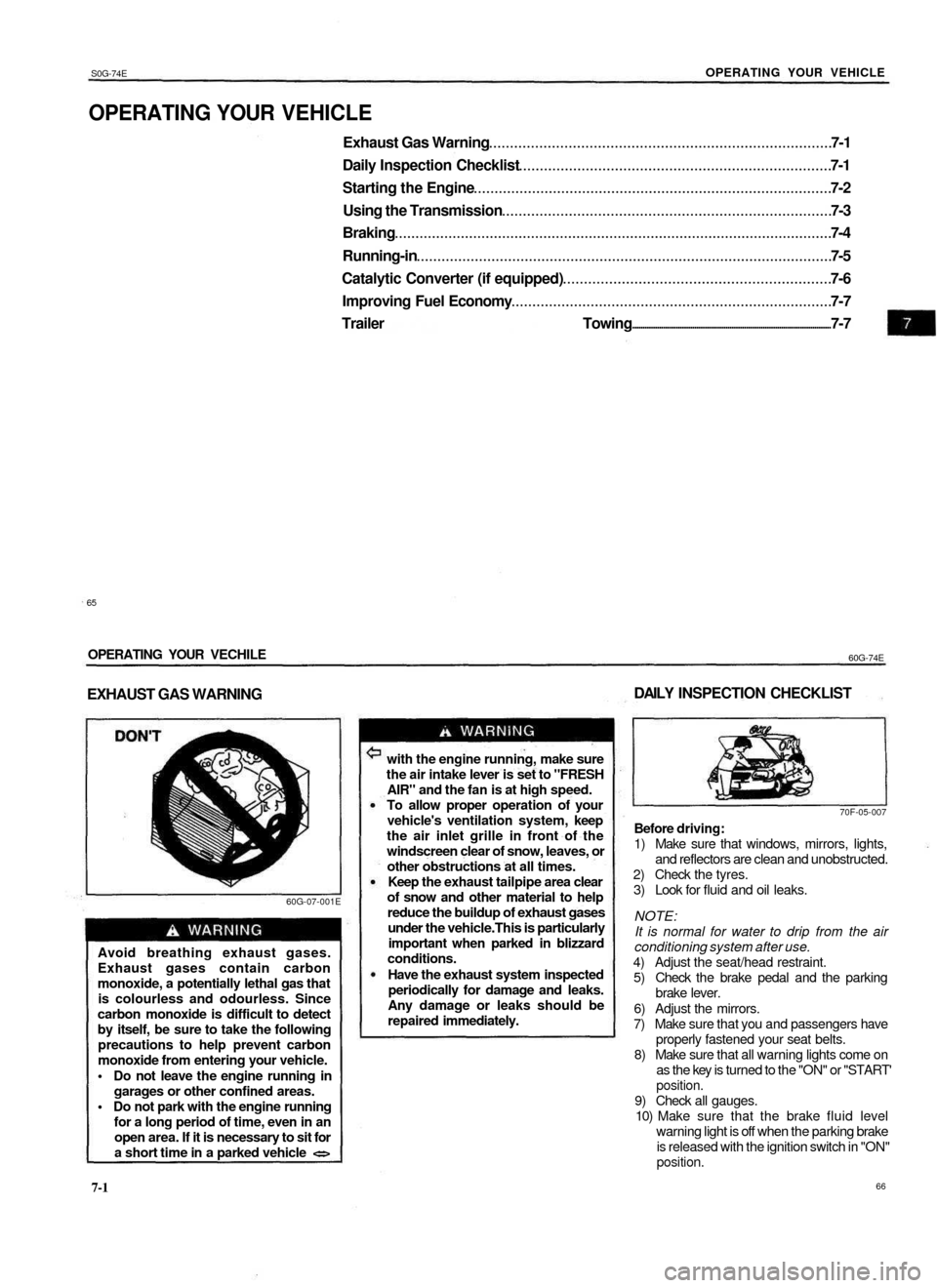
EXHAUST GAS WARNING
DAILY INSPECTION CHECKLIST
60G-07-001E
Avoid breathing exhaust gases.
Exhaust gases contain carbon
monoxide, a potentially lethal gas that
is colourless and odourless. Since
carbon monoxide is difficult to detect
by itself, be sure to take the following
precautions to help prevent carbon
monoxide from entering your vehicle.
• Do not leave the engine running in
garages or other confined areas.
• Do not park with the engine running
for a long period of time, even in an
open area. If it is necessary to sit for
a short time in a parked vehicle <=>
with the engine running, make sure
the air intake lever is set to "FRESH
AIR" and the fan is at high speed.
To allow proper operation of your
vehicle's ventilation system, keep
the air inlet grille in front of the
windscreen clear of snow, leaves, or
other obstructions at all times.
Keep the exhaust tailpipe area clear
of snow and other material to help
reduce the buildup of exhaust gases
under the vehicle.This is particularly
important when parked in blizzard
conditions.
Have the exhaust system inspected
periodically for damage and leaks.
Any damage or leaks should be
repaired immediately.
7-1
70F-05-007
Before driving:
1) Make sure that windows, mirrors, lights,
and reflectors are clean and unobstructed.
2) Check the tyres.
3) Look for fluid and oil leaks.
NOTE:
It is normal for water to drip from the air
conditioning system after use.
4) Adjust the seat/head restraint.
5) Check the brake pedal and the parking
brake lever.
6) Adjust the mirrors.
7) Make sure that you and passengers have
properly fastened your seat belts.
8) Make sure that all warning lights come on
as the key is turned to the "ON" or "START'
position.
9) Check all gauges.
10) Make sure that the brake fluid level
warning light is off when the parking brake
is released with the ignition switch in "ON"
position.
66
65
Page 33 of 65
60G-74E
OPERATING YOUR VEHICLE
Once a week, or each time you fill your fuel
tank, perform the following under-bonnet
checks:
1) Engine oil level.
2) Coolant level.
3) Brake fluid level.
4) Power steering (if equipped) fluid level.
5) Windscreen washer fluid level.
6) Battery solution level.
7) Bonnet latch operation.
Pull the bonnet release handle inside the
vehicle. Make sure that you can not open
the hood all the way without releasing the
secondary latch. Be sure to close the hood
securely after checking for proper
operation. See "All Latches, Hinges &
Locks" of "PERIODIC MAINTENANCE
SCHEDULE" in the "INSPECTION AND
MAINTENANCE" section for lubrication
schedule.
Make sure the bonnet is fully closed
and latched before driving. If it is not,
it can fly up unexpectedly during
driving, obstructing your view and
resulting in an accident.
STARTING THE ENGINE
Before starting the engine:
1) Make sure the parking brake is applied
fully.
2) Manual Transmission - Shift into "N"
(neutral) and depress the clutch pedal all
the way to the floor. Hold it while starting
the engine.
Make sure that the parking brake is
applied fully and the transmission is in
Neutral before attempting to start the
engine.
CAUTION
Stop turning the starter immediately
after the engine has started or the
starter system can be damaged.
Do not crank the engine for more
than 15 seconds at a time. If the
engine doesn't start on the first try,
wait about 15 seconds before trying
again.
Starting a Cold Engine
Engine which is started after 6 hours should
be treated as cold engine.
For Electronic fuel injection models
• With your foot off the accelerator pedal,
crank the engine by turning the ignition
key to "START1. Release the key when the
engine starts.
• If the engine does not start after 15
seconds of cranking, wait about 15
seconds, then press down the accelerator
pedal to 1/3 of its travel and try cranking
the engine again. Release the key and
accelerator pedal when the engine starts.
• If the engine still does not start, try holding
the accelerator pedal all the way to the
floor while cranking. This should clear the
engine if it is flooded.
Starting a Warm Engine
For Electronic fuel injection models:
Use the same procedure as for "Starting a cold
Engine".
67
7-2
OPERATING YOUR VECHILE
60G-74E
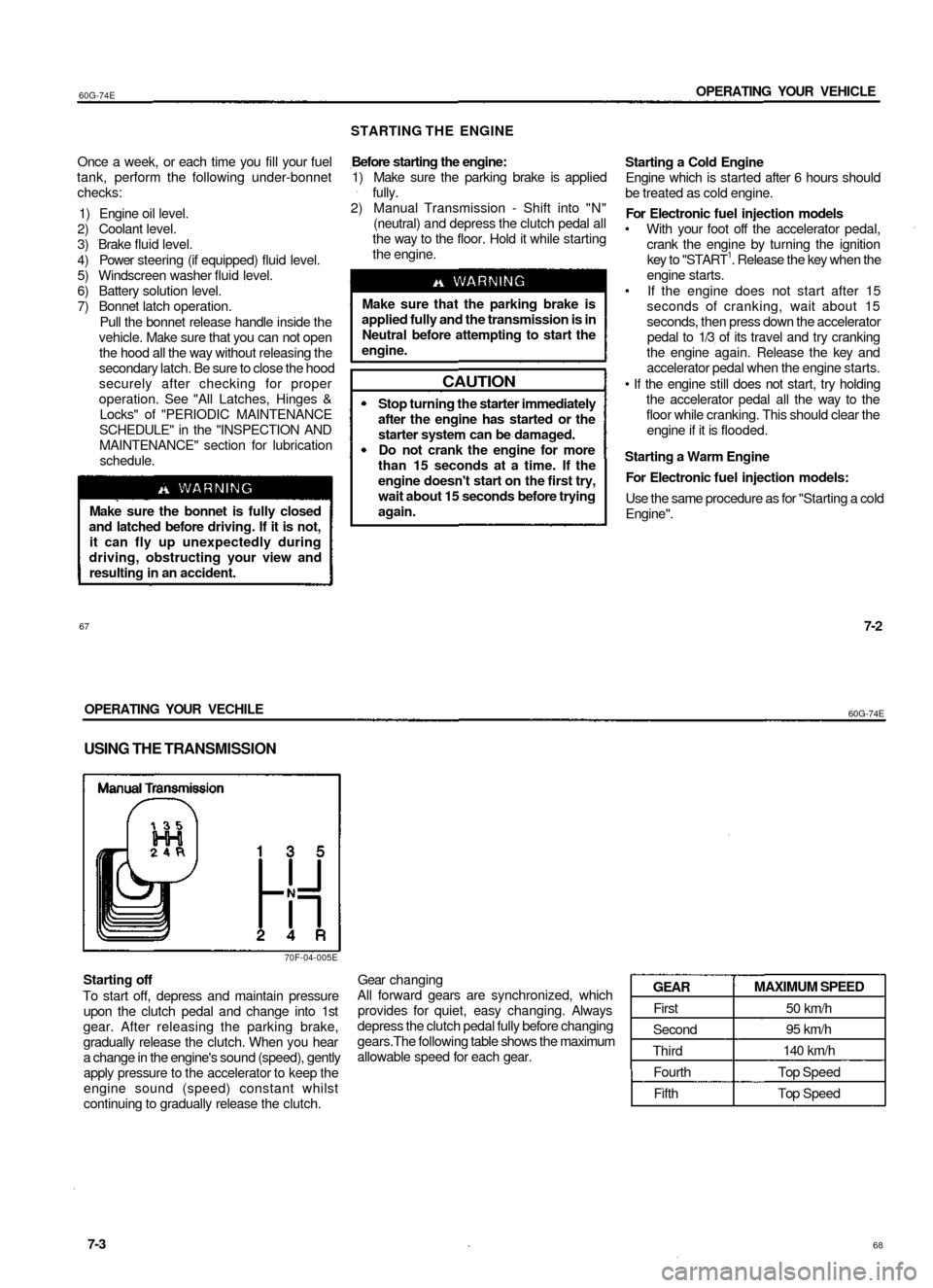
USING THE TRANSMISSION
70F-04-005E
Starting off
To start off, depress and maintain pressure
upon the clutch pedal and change into 1st
gear. After releasing the parking brake,
gradually release the clutch. When you hear
a change in the engine's sound (speed), gently
apply pressure to the accelerator to keep the
engine sound (speed) constant whilst
continuing to gradually release the clutch.
Gear changing
All forward gears are synchronized, which
provides for quiet, easy changing. Always
depress the clutch pedal fully before changing
gears.The following table shows the maximum
allowable speed for each gear.
GEAR
First
Second
Third
Fourth
Fifth
MAXIMUM SPEED
50 km/h
95 km/h
140 km/h
Top Speed
Top Speed
7-3
68
Page 41 of 65
60G-74E
INSPECTION AND MAINTENANCE
INSPECTION AND MAINTENANCE
Periodic Maintenance Schedule.. 9-2
Engine Oil and Filter 9-7
Gear OH 9-10
Engine Coolant 9-11
Windscreen Washer Fluid 9-13
Air Cleaner 9-13
Spark Plugs 9-14
Brakes 9-15
Steering 9-17
Power Steering (if equipped) 9-18
Clutch Pedal 9-18
Tyres... 9-19
Battery 9-22
Fuses 9-23
Bulb Replacement , 9-25
Wiper Blades 9-29
83
INSPECTION AND MAINTENANCE
60G-74E
70F-05-002
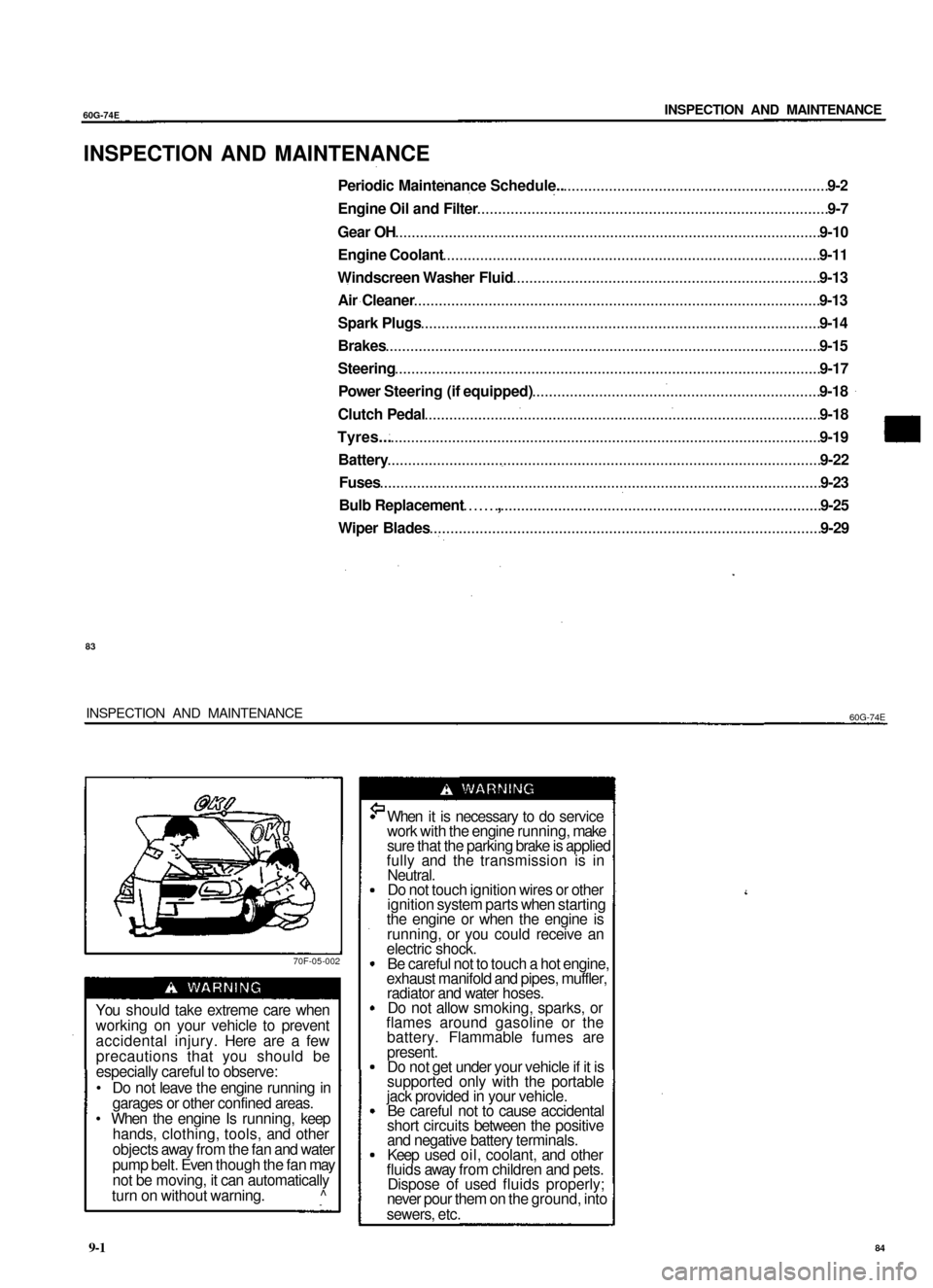
You should take extreme care when
working on your vehicle to prevent
accidental injury. Here are a few
precautions that you should be
especially careful to observe:
• Do not leave the engine running in
garages or other confined areas.
• When the engine Is running, keep
hands, clothing, tools, and other
objects away from the fan and water
pump belt. Even though the fan may
not be moving, it can automatically
turn on without warning. ^
When it is necessary to do service
work with the engine running, make
sure that the parking brake is applied
fully and the transmission is in
Neutral.
Do not touch ignition wires or other
ignition system parts when starting
the engine or when the engine is
running, or you could receive an
electric shock.
Be careful not to touch a hot engine,
exhaust manifold and pipes, muffler,
radiator and water hoses.
Do not allow smoking, sparks, or
flames around gasoline or the
battery. Flammable fumes are
present.
Do not get under your vehicle if it is
supported only with the portable
jack provided in your vehicle.
Be careful not to cause accidental
short circuits between the positive
and negative battery terminals.
Keep used oil, coolant, and other
fluids away from children and pets.
Dispose of used fluids properly;
never pour them on the ground, into
sewers, etc.
9-1
84
Page 42 of 65
60G-74E
INSPECTION AND MAINTENANCE
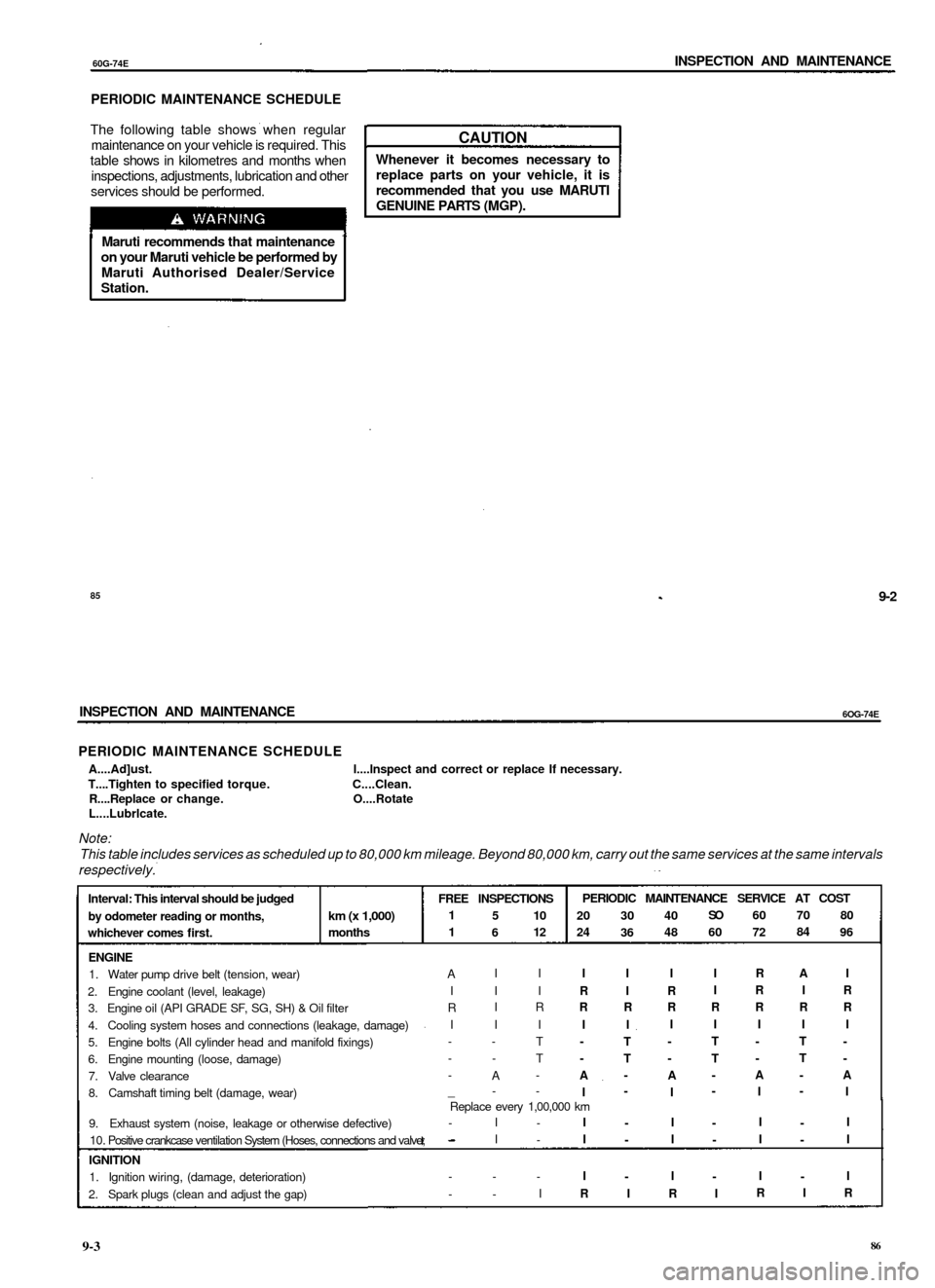
PERIODIC MAINTENANCE SCHEDULE
The following table shows when regular
maintenance on your vehicle is required. This
table shows in kilometres and months when
inspections, adjustments, lubrication and other
services should be performed.
Maruti recommends that maintenance
on your Maruti vehicle be performed by
Maruti Authorised Dealer/Service
Station.
CAUTION
Whenever it becomes necessary to
replace parts on your vehicle, it is
recommended that you use MARUTI
GENUINE PARTS (MGP).
85
9-2
INSPECTION AND MAINTENANCE
6OG-74E
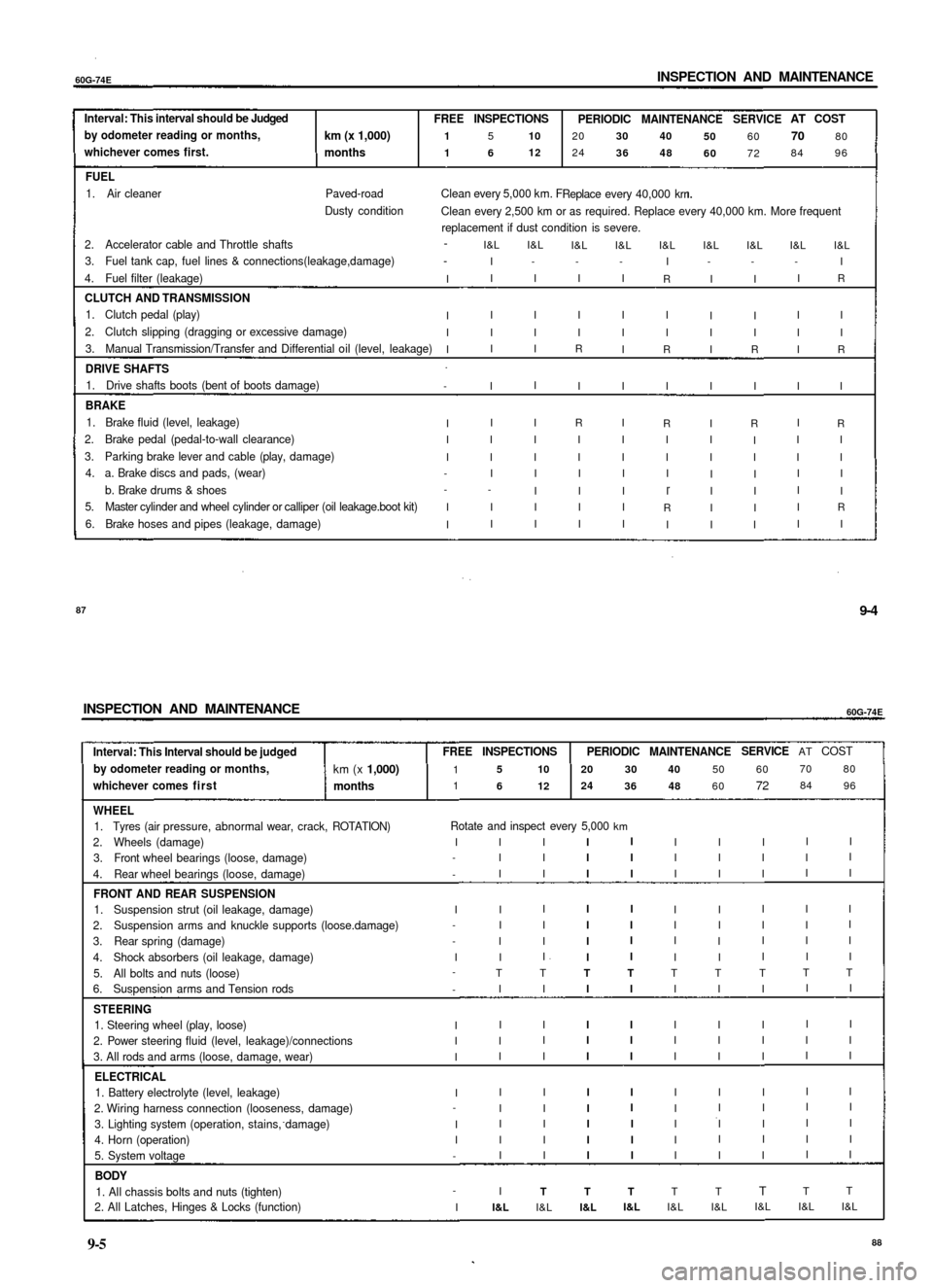
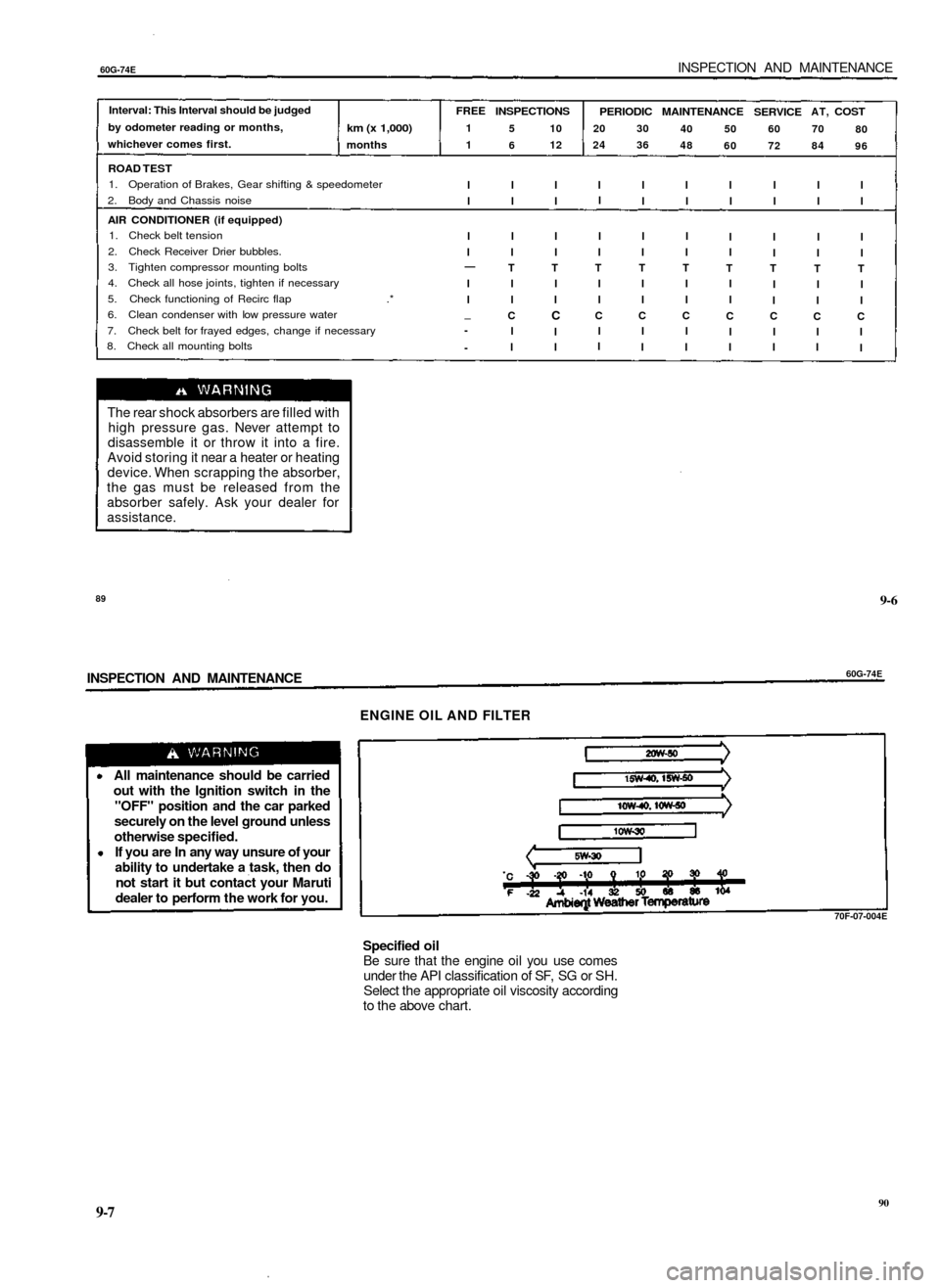
PERIODIC MAINTENANCE SCHEDULE
A....Ad]ust. l....lnspect and correct or replace If necessary.
T....Tighten to specified torque. C....CIean.
R....Replace or change. O....Rotate
L....Lubrlcate.
Note:
This table includes services as scheduled up to 80,000 km mileage. Beyond 80,000 km, carry out the same services at the same intervals
respectively.
Interval: This interval should be judged
by odometer reading or months,
whichever comes first.
km (x 1,000)
months
ENGINE
1. Water pump drive belt (tension, wear)
2. Engine coolant (level, leakage)
3. Engine oil (API GRADE SF, SG, SH) & Oil filter
4. Cooling system hoses and connections (leakage, damage)
5. Engine bolts (All cylinder head and manifold fixings)
6. Engine mounting (loose, damage)
7. Valve clearance
8. Camshaft timing belt (damage, wear)
9. Exhaust system (noise, leakage or otherwise defective)
10. Positive crankcase ventilation System (Hoses, connections and valve;
IGNITION
1. Ignition wiring, (damage, deterioration)
2. Spark plugs (clean and adjust the gap)
FREE INSPECTIONS
1
1
A
I
R
I
-
-
-
_
5
6
I
I
I
I
-
-
A
-
10
12
I
I
R
I
T
T
-
-
PERIODIC MAINTENANCE SERVICE AT COST
20
24
I
R
R
I
-
-
A
I
Replace every 1,00,000 km
-
-
-
I
I
-
-
-
-
-
I
I
I
I
R
30
36
I
I
R
I
T
T
-
-
-
-
-
I
40
48
I
R
R
I
-
-
A
I
I
I
I
R
SO
60
I
I
R
I
T
T
-
-
-
-
-
I
60
72
R
R
R
I
-
-
A
I
I
I
I
R
70
84
A
I
R
I
T
T
-
-
-
-
-
I
80
96
I
R
R
I
-
-
A
I
I
I
I
R
9-3
86
Page 43 of 65
60G-74E
INSPECTION AND MAINTENANCE
Interval: This interval should be Judged
by odometer reading or months,
whichever comes first.
km (x 1,000)
months
FUEL
1. Air cleaner Paved-road
Dusty condition
2. Accelerator cable and Throttle shafts
3. Fuel tank cap, fuel lines & connections(leakage,damage)
4. Fuel filter (leakage)
CLUTCH AND TRANSMISSION
1. Clutch pedal (play)
2. Clutch slipping (dragging or excessive damage)
3. Manual Transmission/Transfer and Differential oil (level, leakage)
DRIVE SHAFTS
1. Drive shafts boots (bent of boots damage)
BRAKE
1. Brake fluid (level, leakage)
2. Brake pedal (pedal-to-wall clearance)
3. Parking brake lever and cable (play, damage)
4. a. Brake discs and pads, (wear)
b. Brake drums & shoes
5. Master cylinder and wheel cylinder or calliper (oil leakage.boot kit)
6. Brake hoses and pipes (leakage, damage)
FREE
1
1
INSPECTIONS
5
6
10
12
Clean every 5,000 km. F
PERIODIC MAINTENANCE
20
24
30
36
40
48
Replace every 40,000 krr
50
60
SERVICE
60
72
AT
70
84
COST
80
96
Clean every 2,500 km or as required. Replace every 40,000 km. More frequent
replacement if dust condition is severe.
-
-
I
I
I
I
-
I
I
I
-
-
I
I
I&L
I
I
I
I
I
I
I
I
I
I
-
I
I
I&L
-
I
I
I
I
I
I
I
I
I
I
I
I
I&L
-
I
I
I
R
I
R
I
I
I
I
I
I
I&L
-
I
I
I
I
I
I
I
I
I
I
I
I
I&L
I
R
I
I
R
I
R
I
I
I
I
R
I
I&L
-
I
I
I
I
I
I
I
I
I
I
I
I
I&L
-
I
I
I
R
I
R
I
I
I
I
I
I
I&L
-
I
I
I
I
I
I
I
I
I
I
I
I
I&L
I
R
I
I
R
I
R
I
I
I
I
R
I
87
9-4
INSPECTION AND MAINTENANCE
60G-74E
Interval: This Interval should be judged
by odometer reading or months,
whichever comes first
km (x 1,000)
months
WHEEL
1. Tyres (air pressure, abnormal wear, crack, ROTATION)
2. Wheels (damage)
3. Front wheel bearings (loose, damage)
4. Rear wheel bearings (loose, damage)
FRONT AND REAR SUSPENSION
1. Suspension strut (oil leakage, damage)
2. Suspension arms and knuckle supports (loose.damage)
3. Rear spring (damage)
4. Shock absorbers (oil leakage, damage)
5. All bolts and nuts (loose)
6. Suspension arms and Tension rods
STEERING
1. Steering wheel (play, loose)
2. Power steering fluid (level, leakage)/connections
3. All rods and arms (loose, damage, wear)
ELECTRICAL
1. Battery electrolyte (level, leakage)
2. Wiring harness connection (looseness, damage)
3. Lighting system (operation, stains, damage)
4. Horn (operation)
5. System voltage
BODY
1. All chassis bolts and nuts (tighten)
2. All Latches, Hinges & Locks (function)
FREE
1
1
INSPECTIONS
5
6
Rotate and
I
-
-
I
-
-
I
-
-
I
I
I
I
-
I
I
-
-
I
I
I
I
I
I
I
I
T
I
I
I
I
I
I
I
I
I
I
I&L
10
12
PERIODIC
20
24
inspect every 5,000
I
I
I
I
I
I
I
T
I
I
I
I
I
I
I
I
I
T
I&L
I
I
I
I
I
I
I
T
I
I
I
I
I
I
I
I
I
T
I&L
30
36
km
I
I
I
I
I
I
I
T
I
I
I
I
I
I
I
I
I
T
I&L
MAINTENANCE
40
48
I
I
I
I
I
I
I
T
I
I
I
I
I
I
I
I
I
T
I&L
50
60
I
I
I
I
I
I
I
T
I
I
I
I
I
I
I
I
I
T
I&L
SERVICE
60
72
I
I
I
I
I
I
I
T
I
I
I
I
I
I
I
I
I
T
I&L
AT
70
84
I
I
I
I
I
I
I
T
I
I
I
I
I
I
I
I
I
T
I&L
COST
80
96
I
I
I
I
I
I
I
T
I
I
I
I
I
I
I
I
I
T
I&L
9-5
88
Page 44 of 65
60G-74E
INSPECTION AND MAINTENANCE
Interval: This Interval should be judged
by odometer reading or months,
whichever comes first.
km (x 1,000)
months
ROAD TEST
1. Operation of Brakes, Gear shifting & speedometer
2. Body and Chassis noise
AIR CONDITIONER (if equipped)
1. Check belt tension
2. Check Receiver Drier bubbles.
3. Tighten compressor mounting bolts
4. Check all hose joints, tighten if necessary
5. Check functioning of Recirc flap .*
6. Clean condenser with low pressure water
7. Check belt for frayed edges, change if necessary
8. Check all mounting bolts
FREE
1
1
I
I
I
I
—
I
I
_
-
-
INSPECTIONS
5
6
I
I
I
I
T
I
I
C
I
I
10
12
I
I
I
I
T
I
I
C
I
I
PERIODIC
20
24
I
I
I
I
T
I
I
C
I
I
30
36
I
I
I
I
T
I
I
C
I
I
MAINTENANCE
40
48
I
I
I
I
T
I
I
C
I
I
50
60
I
I
I
I
T
I
I
C
I
I
SERVICE
60
72
I
I
I
I
T
I
I
C
I
I
AT,
70
84
I
I
I
I
T
I
I
C
I
I
COST
80
96
I
I
I
I
T
I
I
C
I
I
The rear shock absorbers are filled with
high pressure gas. Never attempt to
disassemble it or throw it into a fire.
Avoid storing it near a heater or heating
device. When scrapping the absorber,
the gas must be released from the
absorber safely. Ask your dealer for
assistance.
89
9-6
INSPECTION AND MAINTENANCE
60G-74E
All maintenance should be carried
out with the Ignition switch in the
"OFF" position and the car parked
securely on the level ground unless
otherwise specified.
If you are In any way unsure of your
ability to undertake a task, then do
not start it but contact your Maruti
dealer to perform the work for you.
ENGINE OIL AND FILTER
Specified oil
Be sure that the engine oil you use comes
under the API classification of SF, SG or SH.
Select the appropriate oil viscosity according
to the above chart.
9-7
90
70F-07-004E
Page 45 of 65
60G-74E
INSPECTION AND MAINTENANCE
60G-09-002E
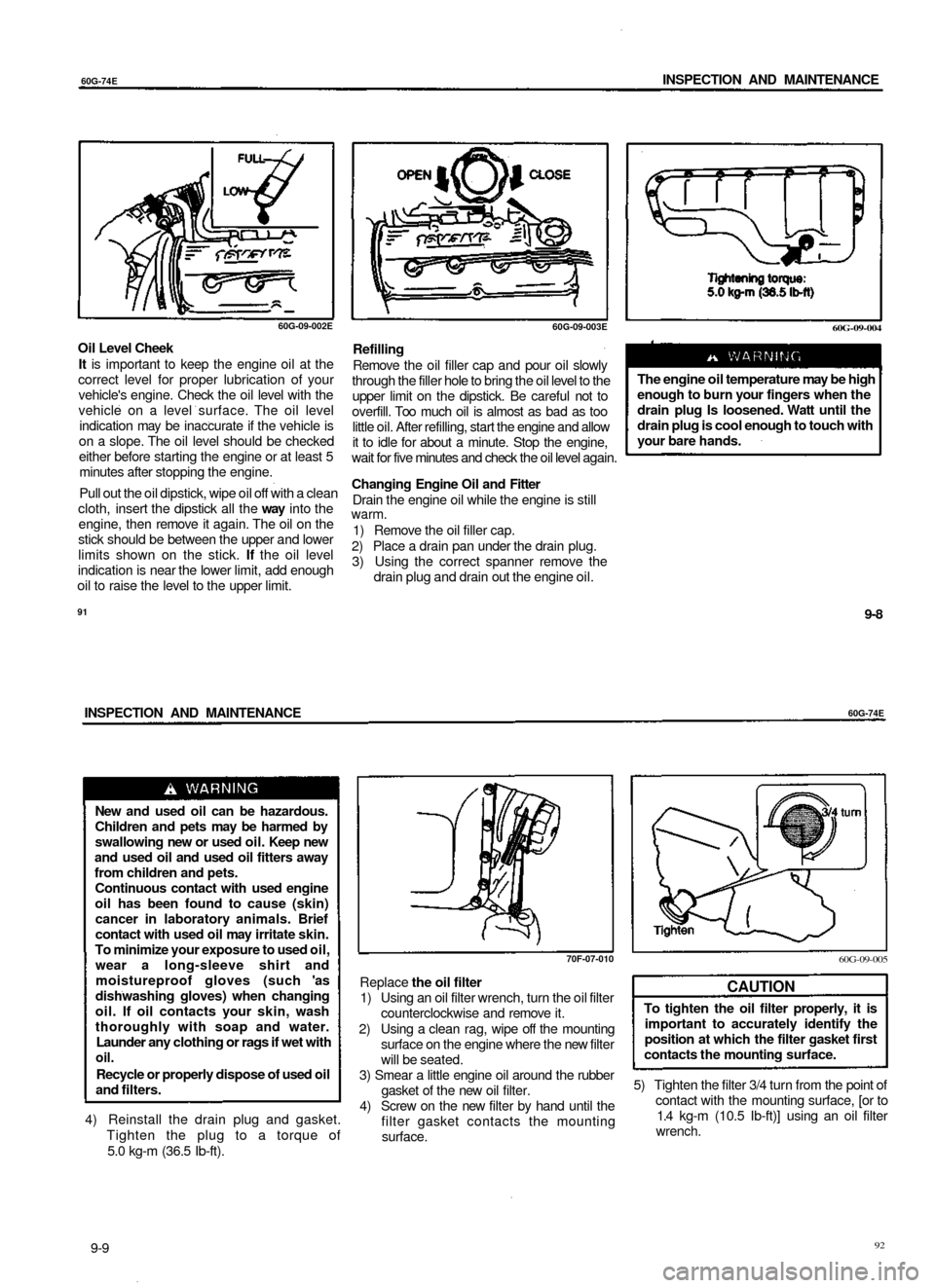
Oil Level Cheek
It is important to keep the engine oil at the
correct level for proper lubrication of your
vehicle's engine. Check the oil level with the
vehicle on a level surface. The oil level
indication may be inaccurate if the vehicle is
on a slope. The oil level should be checked
either before starting the engine or at least 5
minutes after stopping the engine.
Pull out the oil dipstick, wipe oil off with a clean
cloth, insert the dipstick all the way into the
engine, then remove it again. The oil on the
stick should be between the upper and lower
limits shown on the stick. If the oil level
indication is near the lower limit, add enough
oil to raise the level to the upper limit.
91
60G-09-003E
Refilling
Remove the oil filler cap and pour oil slowly
through the filler hole to bring the oil level to the
upper limit on the dipstick. Be careful not to
overfill. Too much oil is almost as bad as too
little oil. After refilling, start the engine and allow
it to idle for about a minute. Stop the engine,
wait for five minutes and check the oil level again.
Changing Engine Oil and Fitter
Drain the engine oil while the engine is still
warm.
1) Remove the oil filler cap.
2) Place a drain pan under the drain plug.
3) Using the correct spanner remove the
drain plug and drain out the engine oil.
60G-09-004
The engine oil temperature may be high
enough to burn your fingers when the
drain plug Is loosened. Watt until the
drain plug is cool enough to touch with
your bare hands.
9-8
INSPECTION AND MAINTENANCE
60G-74E
New and used oil can be hazardous.
Children and pets may be harmed by
swallowing new or used oil. Keep new
and used oil and used oil fitters away
from children and pets.
Continuous contact with used engine
oil has been found to cause (skin)
cancer in laboratory animals. Brief
contact with used oil may irritate skin.
To minimize your exposure to used oil,
wear a long-sleeve shirt and
moistureproof gloves (such 'as
dishwashing gloves) when changing
oil. If oil contacts your skin, wash
thoroughly with soap and water.
Launder any clothing or rags if wet with
oil.
Recycle or properly dispose of used oil
and filters.
4) Reinstall the drain plug and gasket.
Tighten the plug to a torque of
5.0 kg-m (36.5 Ib-ft).
70F-07-010
Replace the oil filter
1) Using an oil filter wrench, turn the oil filter
counterclockwise and remove it.
2) Using a clean rag, wipe off the mounting
surface on the engine where the new filter
will be seated.
3) Smear a little engine oil around the rubber
gasket of the new oil filter.
4) Screw on the new filter by hand until the
filter gasket contacts the mounting
surface.
60G-09-005
CAUTION
To tighten the oil filter properly, it is
important to accurately identify the
position at which the filter gasket first
contacts the mounting surface.
5) Tighten the filter 3/4 turn from the point of
contact with the mounting surface, [or to
1.4 kg-m (10.5 Ib-ft)] using an oil filter
wrench.
9-9
92
Page 46 of 65
60G-74E
INSPECTION AND MAINTENANCE
GEAR OIL
CAUTION
To prevent oil leakage, make sure that
the oil filter is tight, but do not
overtighten it.
Refill with oil and check for leaks.
1) Pour 3.1 litres of oil through the filler hole
and install the filler cap.
2) Start the engine and look carefully for
leaks at the oil filter and drain plug. Run
the engine at various speeds for at least 5
minutes.
3) Stop the engine and wait for 5 minutes.
Check the oil level again and add oil if
necessary. Check for leaks again.
CAUTION
When replacing the oil filter, it is
recommended that you use a genuine
MARUTI replacement filter.
60G-09-006
CAUTION
Oil leaks from around the oil filter or
drain plug indicate incorrect
installation or gasket damage. If you
find any leaks or are not sure that the
fitter has been properly tightened, have
the vehicle inspected by your MARUTI
dealer.
70F-07-012E
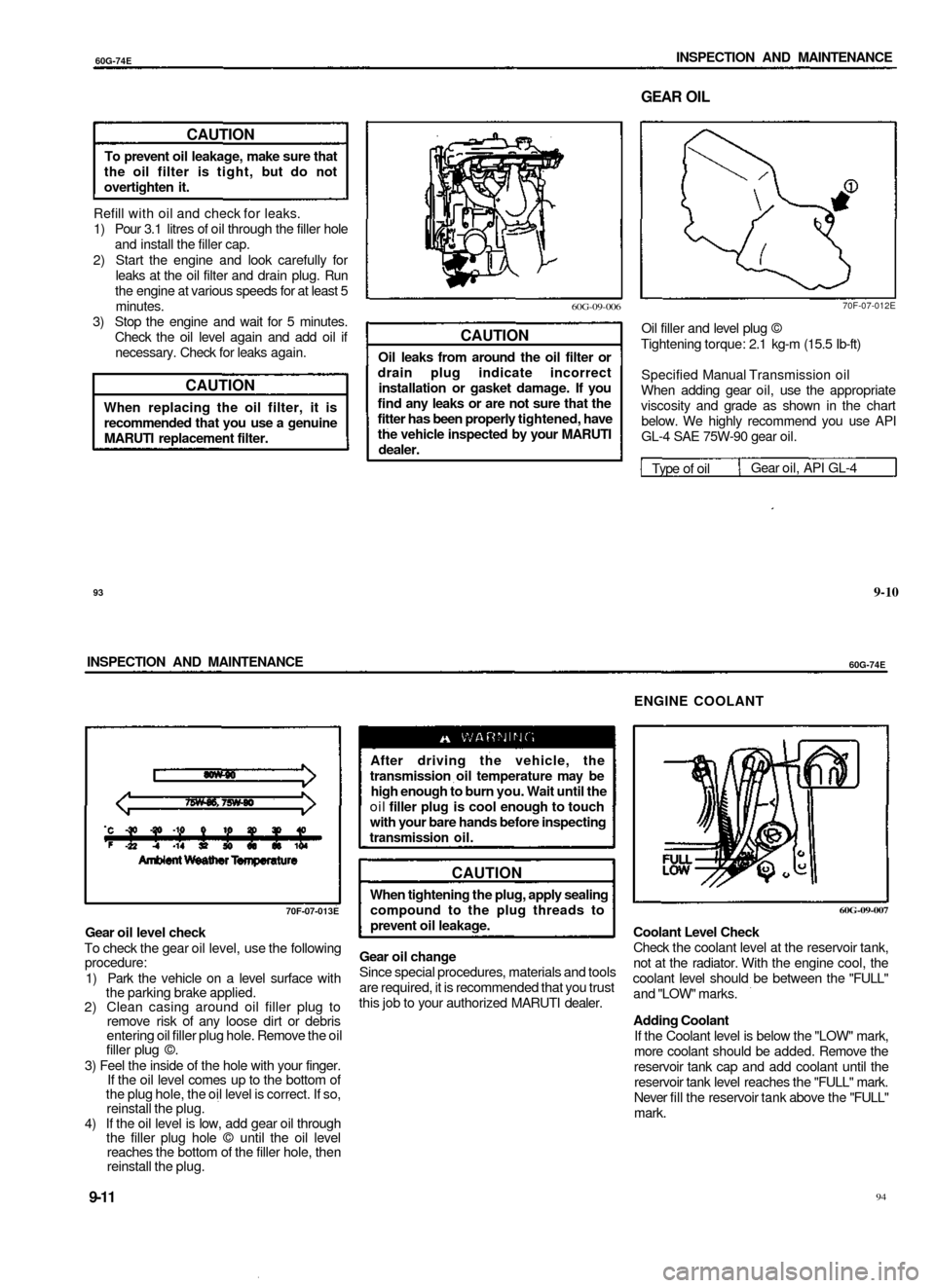
Oil filler and level plug ©
Tightening torque: 2.1 kg-m (15.5 Ib-ft)
Specified Manual Transmission oil
When adding gear oil, use the appropriate
viscosity and grade as shown in the chart
below. We highly recommend you use API
GL-4 SAE 75W-90 gear oil.
Type of oil
Gear oil, API GL-4
93
9-10
INSPECTION AND MAINTENANCE
60G-74E
ENGINE COOLANT
70F-07-013E
Gear oil level check
To check the gear oil level, use the following
procedure:
1) Park the vehicle on a level surface with
the parking brake applied.
2) Clean casing around oil filler plug to
remove risk of any loose dirt or debris
entering oil filler plug hole. Remove the oil
filler plug ©.
3) Feel the inside of the hole with your finger.
If the oil level comes up to the bottom of
the plug hole, the oil level is correct. If so,
reinstall the plug.
4) If the oil level is low, add gear oil through
the filler plug hole © until the oil level
reaches the bottom of the filler hole, then
reinstall the plug.
After driving the vehicle, the
transmission oil temperature may be
high enough to burn you. Wait until the
oil filler plug is cool enough to touch
with your bare hands before inspecting
transmission oil.
CAUTION
When tightening the plug, apply sealing
compound to the plug threads to
prevent oil leakage.
Gear oil change
Since special procedures, materials and tools
are required, it is recommended that you trust
this job to your authorized MARUTI dealer.
60G-09-007
Coolant Level Check
Check the coolant level at the reservoir tank,
not at the radiator. With the engine cool, the
coolant level should be between the "FULL"
and "LOW" marks.
Adding Coolant
If the Coolant level is below the "LOW" mark,
more coolant should be added. Remove the
reservoir tank cap and add coolant until the
reservoir tank level reaches the "FULL" mark.
Never fill the reservoir tank above the "FULL"
mark.
9-11
94
Page 52 of 65
60G-74E
INSPECTION AND MAINTENANCE
BATTERY
60G-09-022E
When installing the cover, make sure that it is
positioned so that it does not cover or foul the
air valve.
60G-09-038
Batteries produce flammable hydrogen
gas. Keep flames and sparks away from
the battery or an explosion may occur.
Never smoke when working in the
vicinity of the battery .
When checking or servicing the battery,
disconnect the negative cable. Be
careful not to cause a short circuit by
allowing metal objects to contact the
battery posts and the vehicle at the
same time.
To avoid harm to yourself or damage
to your vehicle or battery, follow the
jump starting instructions in the
EMERGENCY SERVICE section of this
manual if it is necessary to jump start
your vehicle.
The level of the battery solution must be kept
between the "UPPER" and the "LOWER" level
lines at all times. If the level is found to be
below the "LOWER" level line, add distilled
water to the "UPPER" level line. You should
periodically check the battery, battery
terminals, and battery holddown bracket for
corrosion. Remove corrosion using a stiff
brush and ammonia mixed with water, or
baking soda mixed with water. After removing
corrosion, rinse with clean water.
If your vehicle is not going to be driven for a
month or longer, disconnect the cable from
the negative terminal of the battery to help
prevent discharge.
105
9-22
INSPECTION AND MAINTENANCE
60G-74E
FUSES
60G-09-024E
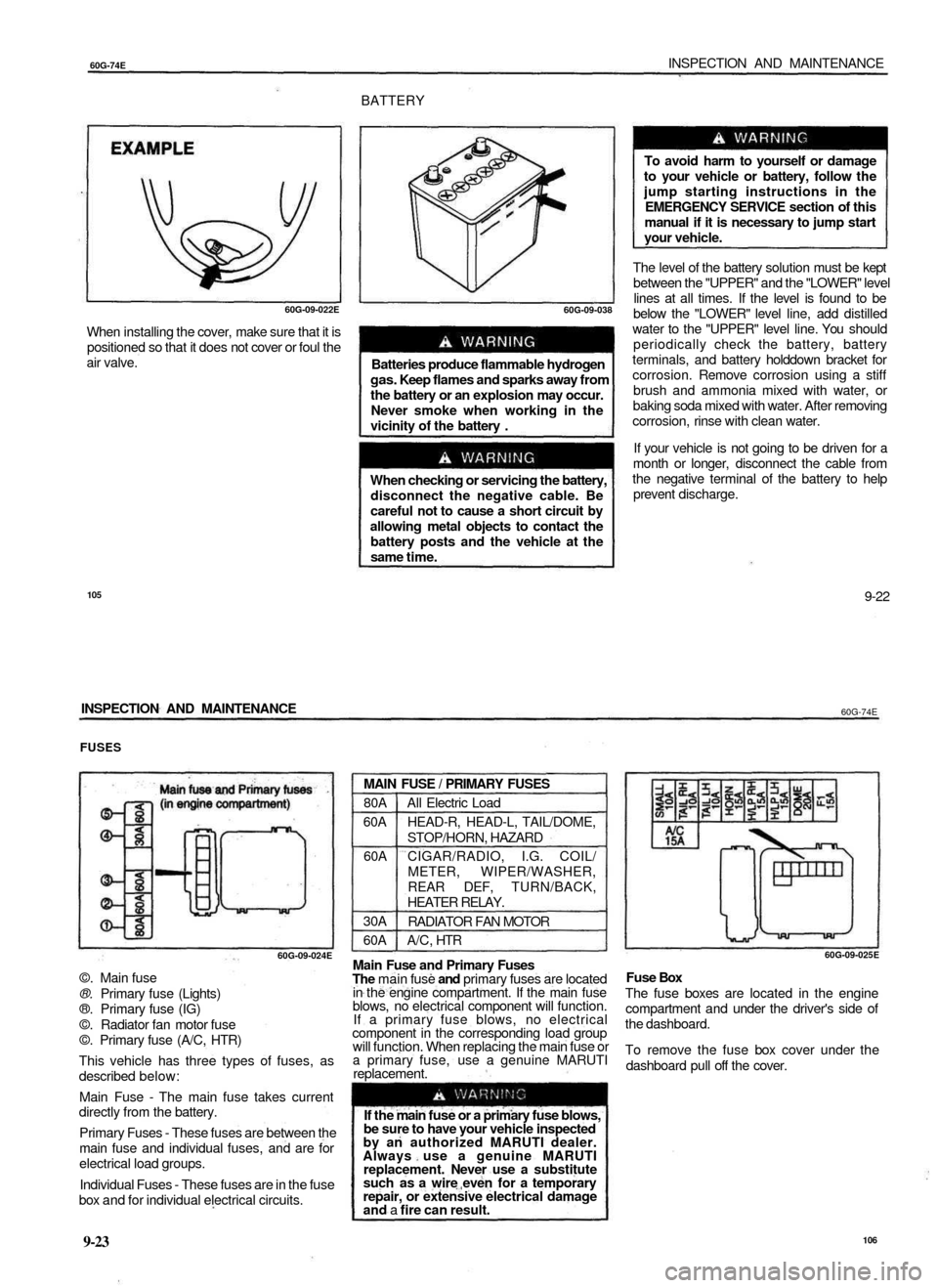
©. Main fuse
®. Primary fuse (Lights)
®. Primary fuse (IG)
©. Radiator fan motor fuse
©. Primary fuse (A/C, HTR)
This vehicle has three types of fuses, as
described below:
Main Fuse - The main fuse takes current
directly from the battery.
Primary Fuses - These fuses are between the
main fuse and individual fuses, and are for
electrical load groups.
Individual Fuses - These fuses are in the fuse
box and for individual electrical circuits.
MAIN FUSE / PRIMARY FUSES
80A
60A
60A
30A
60A
All Electric Load
HEAD-R, HEAD-L, TAIL/DOME,
STOP/HORN, HAZARD
CIGAR/RADIO, I.G. COIL/
METER, WIPER/WASHER,
REAR DEF, TURN/BACK,
HEATER RELAY.
RADIATOR FAN MOTOR
A/C, HTR
Main Fuse and Primary Fuses
The main fuse and primary fuses are located
in the engine compartment. If the main fuse
blows, no electrical component will function.
If a primary fuse blows, no electrical
component in the corresponding load group
will function. When replacing the main fuse or
a primary fuse, use a genuine MARUTI
replacement.
If the main fuse or a primary fuse blows,
be sure to have your vehicle inspected
by an authorized MARUTI dealer.
Always use a genuine MARUTI
replacement. Never use a substitute
such as a wire even for a temporary
repair, or extensive electrical damage
and a fire can result.
60G-09-025E
Fuse Box
The fuse boxes are located in the engine
compartment and under the driver's side of
the dashboard.
To remove the fuse box cover under the
dashboard pull off the cover.
9-23
106