light SUZUKI BALENO 1999 1.G Owner's Manual
[x] Cancel search | Manufacturer: SUZUKI, Model Year: 1999, Model line: BALENO, Model: SUZUKI BALENO 1999 1.GPages: 65, PDF Size: 3.28 MB
Page 40 of 65
60G-74E
DRIVING TIPS AND SAFE DRIVING
72F-08-018
72F-08-019
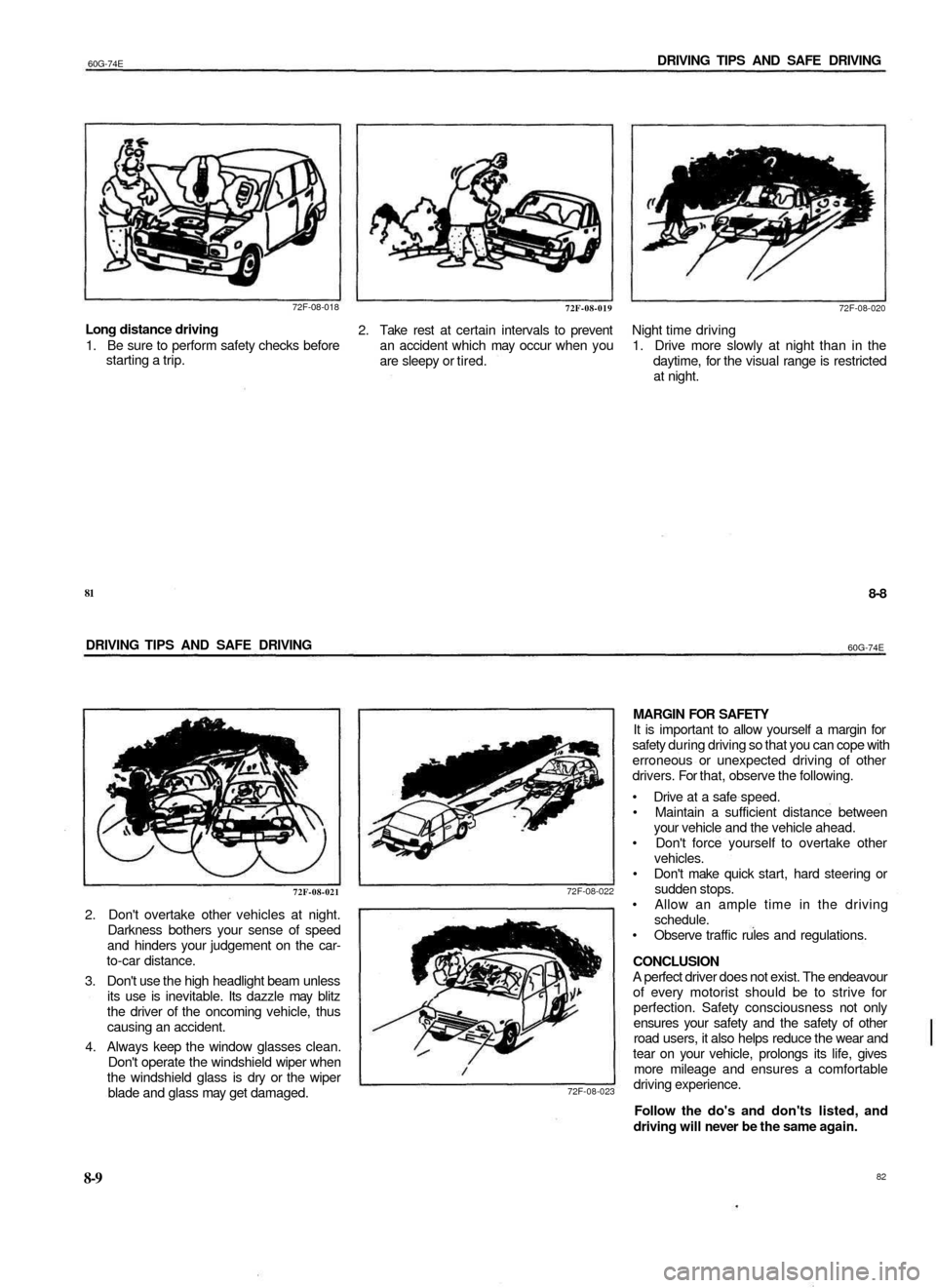
Long distance driving
1. Be sure to perform safety checks before
starting a trip.
2. Take rest at certain intervals to prevent
an accident which may occur when you
are sleepy or tired.
72F-08-020
Night time driving
1. Drive more slowly at night than in the
daytime, for the visual range is restricted
at night.
81
8-8
DRIVING TIPS AND SAFE DRIVING
60G-74E
72F-08-021
2. Don't overtake other vehicles at night.
Darkness bothers your sense of speed
and hinders your judgement on the car-
to-car distance.
3. Don't use the high headlight beam unless
its use is inevitable. Its dazzle may blitz
the driver of the oncoming vehicle, thus
causing an accident.
4. Always keep the window glasses clean.
Don't operate the windshield wiper when
the windshield glass is dry or the wiper
blade and glass may get damaged.
72F-08-022
72F-08-023
MARGIN FOR SAFETY
It is important to allow yourself a margin for
safety during driving so that you can cope with
erroneous or unexpected driving of other
drivers. For that, observe the following.
• Drive at a safe speed.
• Maintain a sufficient distance between
your vehicle and the vehicle ahead.
• Don't force yourself to overtake other
vehicles.
• Don't make quick start, hard steering or
sudden stops.
• Allow an ample time in the driving
schedule.
• Observe traffic rules and regulations.
CONCLUSION
A perfect driver does not exist. The endeavour
of every motorist should be to strive for
perfection. Safety consciousness not only
ensures your safety and the safety of other
road users, it also helps reduce the wear and
tear on your vehicle, prolongs its life, gives
more mileage and ensures a comfortable
driving experience.
Follow the do's and don'ts listed, and
driving will never be the same again.
8-9
82
Page 43 of 65
60G-74E
INSPECTION AND MAINTENANCE
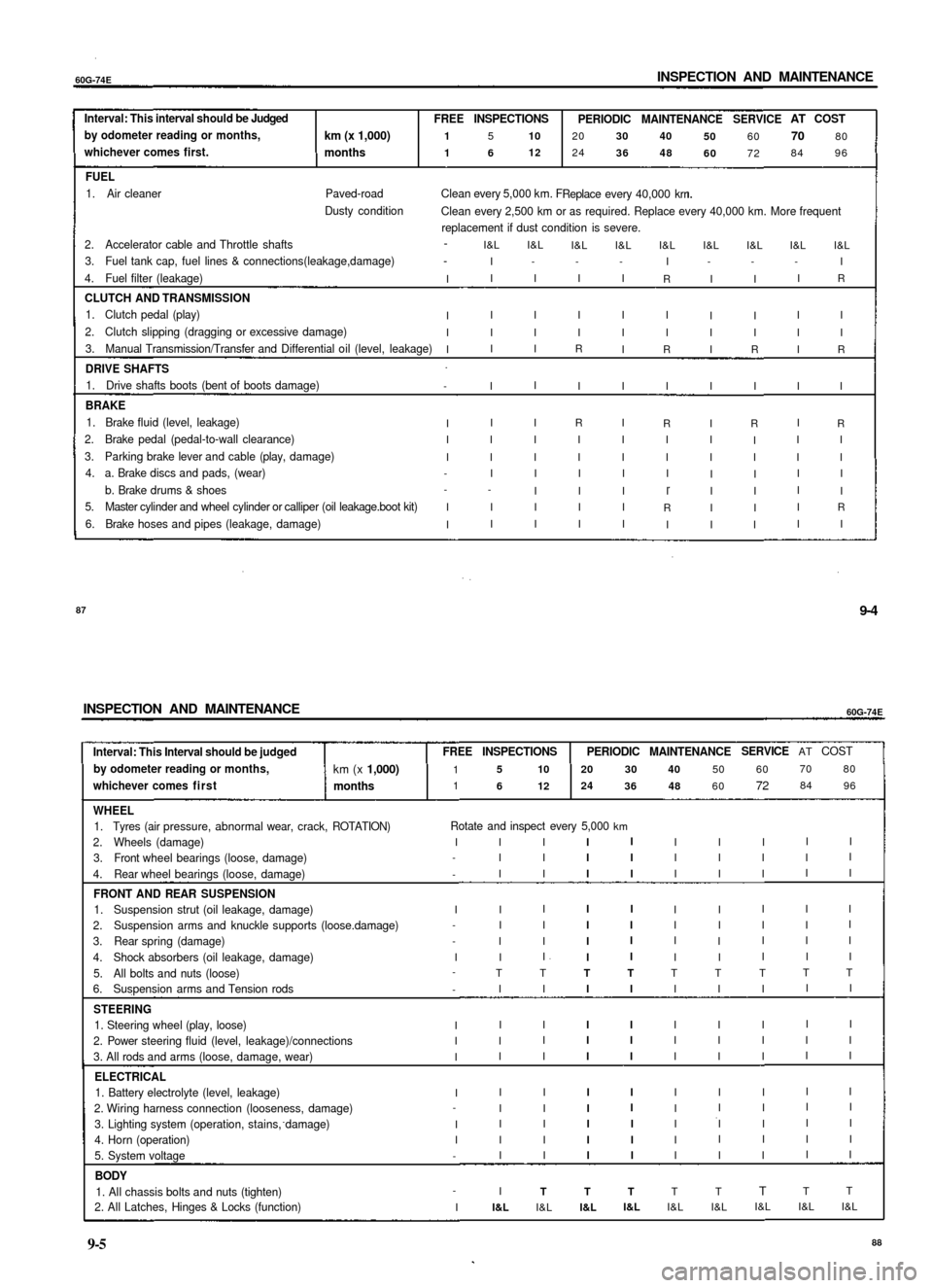
Interval: This interval should be Judged
by odometer reading or months,
whichever comes first.
km (x 1,000)
months
FUEL
1. Air cleaner Paved-road
Dusty condition
2. Accelerator cable and Throttle shafts
3. Fuel tank cap, fuel lines & connections(leakage,damage)
4. Fuel filter (leakage)
CLUTCH AND TRANSMISSION
1. Clutch pedal (play)
2. Clutch slipping (dragging or excessive damage)
3. Manual Transmission/Transfer and Differential oil (level, leakage)
DRIVE SHAFTS
1. Drive shafts boots (bent of boots damage)
BRAKE
1. Brake fluid (level, leakage)
2. Brake pedal (pedal-to-wall clearance)
3. Parking brake lever and cable (play, damage)
4. a. Brake discs and pads, (wear)
b. Brake drums & shoes
5. Master cylinder and wheel cylinder or calliper (oil leakage.boot kit)
6. Brake hoses and pipes (leakage, damage)
FREE
1
1
INSPECTIONS
5
6
10
12
Clean every 5,000 km. F
PERIODIC MAINTENANCE
20
24
30
36
40
48
Replace every 40,000 krr
50
60
SERVICE
60
72
AT
70
84
COST
80
96
Clean every 2,500 km or as required. Replace every 40,000 km. More frequent
replacement if dust condition is severe.
-
-
I
I
I
I
-
I
I
I
-
-
I
I
I&L
I
I
I
I
I
I
I
I
I
I
-
I
I
I&L
-
I
I
I
I
I
I
I
I
I
I
I
I
I&L
-
I
I
I
R
I
R
I
I
I
I
I
I
I&L
-
I
I
I
I
I
I
I
I
I
I
I
I
I&L
I
R
I
I
R
I
R
I
I
I
I
R
I
I&L
-
I
I
I
I
I
I
I
I
I
I
I
I
I&L
-
I
I
I
R
I
R
I
I
I
I
I
I
I&L
-
I
I
I
I
I
I
I
I
I
I
I
I
I&L
I
R
I
I
R
I
R
I
I
I
I
R
I
87
9-4
INSPECTION AND MAINTENANCE
60G-74E
Interval: This Interval should be judged
by odometer reading or months,
whichever comes first
km (x 1,000)
months
WHEEL
1. Tyres (air pressure, abnormal wear, crack, ROTATION)
2. Wheels (damage)
3. Front wheel bearings (loose, damage)
4. Rear wheel bearings (loose, damage)
FRONT AND REAR SUSPENSION
1. Suspension strut (oil leakage, damage)
2. Suspension arms and knuckle supports (loose.damage)
3. Rear spring (damage)
4. Shock absorbers (oil leakage, damage)
5. All bolts and nuts (loose)
6. Suspension arms and Tension rods
STEERING
1. Steering wheel (play, loose)
2. Power steering fluid (level, leakage)/connections
3. All rods and arms (loose, damage, wear)
ELECTRICAL
1. Battery electrolyte (level, leakage)
2. Wiring harness connection (looseness, damage)
3. Lighting system (operation, stains, damage)
4. Horn (operation)
5. System voltage
BODY
1. All chassis bolts and nuts (tighten)
2. All Latches, Hinges & Locks (function)
FREE
1
1
INSPECTIONS
5
6
Rotate and
I
-
-
I
-
-
I
-
-
I
I
I
I
-
I
I
-
-
I
I
I
I
I
I
I
I
T
I
I
I
I
I
I
I
I
I
I
I&L
10
12
PERIODIC
20
24
inspect every 5,000
I
I
I
I
I
I
I
T
I
I
I
I
I
I
I
I
I
T
I&L
I
I
I
I
I
I
I
T
I
I
I
I
I
I
I
I
I
T
I&L
30
36
km
I
I
I
I
I
I
I
T
I
I
I
I
I
I
I
I
I
T
I&L
MAINTENANCE
40
48
I
I
I
I
I
I
I
T
I
I
I
I
I
I
I
I
I
T
I&L
50
60
I
I
I
I
I
I
I
T
I
I
I
I
I
I
I
I
I
T
I&L
SERVICE
60
72
I
I
I
I
I
I
I
T
I
I
I
I
I
I
I
I
I
T
I&L
AT
70
84
I
I
I
I
I
I
I
T
I
I
I
I
I
I
I
I
I
T
I&L
COST
80
96
I
I
I
I
I
I
I
T
I
I
I
I
I
I
I
I
I
T
I&L
9-5
88
Page 48 of 65
60G-74E
INSPECTION AND MAINTENANCE
SPARK PLUGS
60G-09-010E
CAUTION
The air cleaner element should be
replaced every 40,000 km. More
frequent replacement is necessary
when you drive under dusty conditions.
60G-09-011E
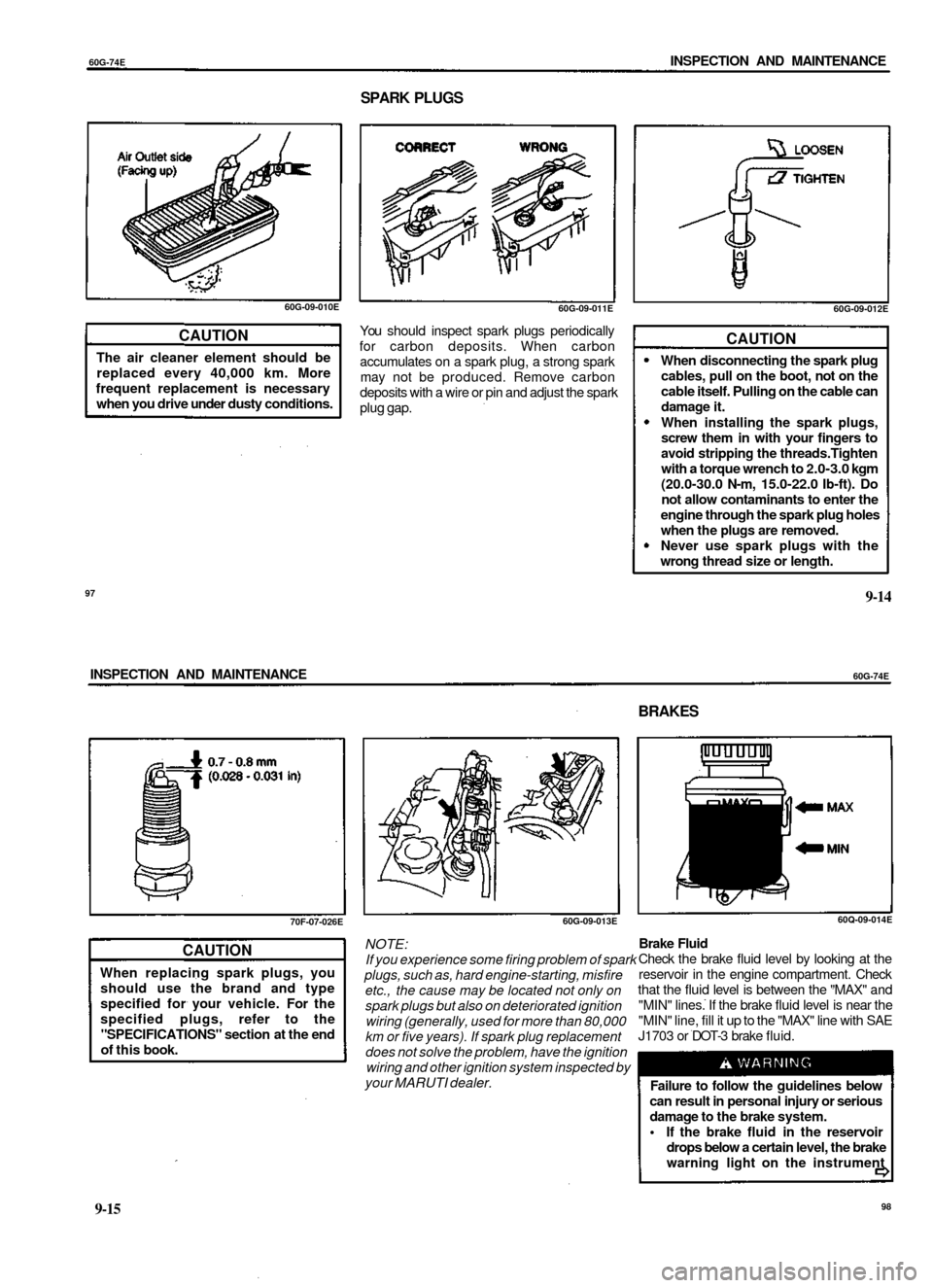
You should inspect spark plugs periodically
for carbon deposits. When carbon
accumulates on a spark plug, a strong spark
may not be produced. Remove carbon
deposits with a wire or pin and adjust the spark
plug gap.
60G-09-012E
CAUTION
When disconnecting the spark plug
cables, pull on the boot, not on the
cable itself. Pulling on the cable can
damage it.
When installing the spark plugs,
screw them in with your fingers to
avoid stripping the threads.Tighten
with a torque wrench to 2.0-3.0 kgm
(20.0-30.0 N-m, 15.0-22.0 Ib-ft). Do
not allow contaminants to enter the
engine through the spark plug holes
when the plugs are removed.
Never use spark plugs with the
wrong thread size or length.
97
9-14
INSPECTION AND MAINTENANCE
60G-74E
BRAKES
70F-07-026E
CAUTION
When replacing spark plugs, you
should use the brand and type
specified for your vehicle. For the
specified plugs, refer to the
"SPECIFICATIONS" section at the end
of this book.
60G-09-013E
NOTE:
If you experience some firing problem of spark
plugs, such as, hard engine-starting, misfire
etc., the cause may be located not only on
spark plugs but also on deteriorated ignition
wiring (generally, used for more than 80,000
km or five years). If spark plug replacement
does not solve the problem, have the ignition
wiring and other ignition system inspected by
your MARUTI dealer.
60Q-09-014E
Brake Fluid
Check the brake fluid level by looking at the
reservoir in the engine compartment. Check
that the fluid level is between the "MAX" and
"MIN" lines. If the brake fluid level is near the
"MIN" line, fill it up to the "MAX" line with SAE
J1703 or DOT-3 brake fluid.
Failure to follow the guidelines below
can result in personal injury or serious
damage to the brake system.
• If the brake fluid in the reservoir
drops below a certain level, the brake
warning light on the instrument
9-15
98
Page 49 of 65
60G-74E
INSPECTION AND MAINTENANCE
70F-07-029
Do not use any fluid other than SAE
J1703 or DOT-3 brake fluid. Do not
use reclaimed fluid or fluid that has
been stored in old or open
containers. It is essential that foreign
particles and other liquids are kept
out of the brake fluid reservoir.
CAUTION
The brake fluid should be replaced
every two years or 20,000 km.
panel will come on (the engine must
be running with the parking brake
fully disengaged). Should the light
come on, immediately ask your
MARUTI dealer to inspect the brake
system.
A rapid fluid loss Indicates a leak in
the brake system which should be
inspected by your MARUTI dealer
immediately.
Brake fluid can harm your eyes and
damage painted surfaces. Use
caution when refilling the reservoir.
NOTE:
With disc brakes, the fluid level can be
expected to gradually fall as the brake pads
wear.
99
70F-07-030
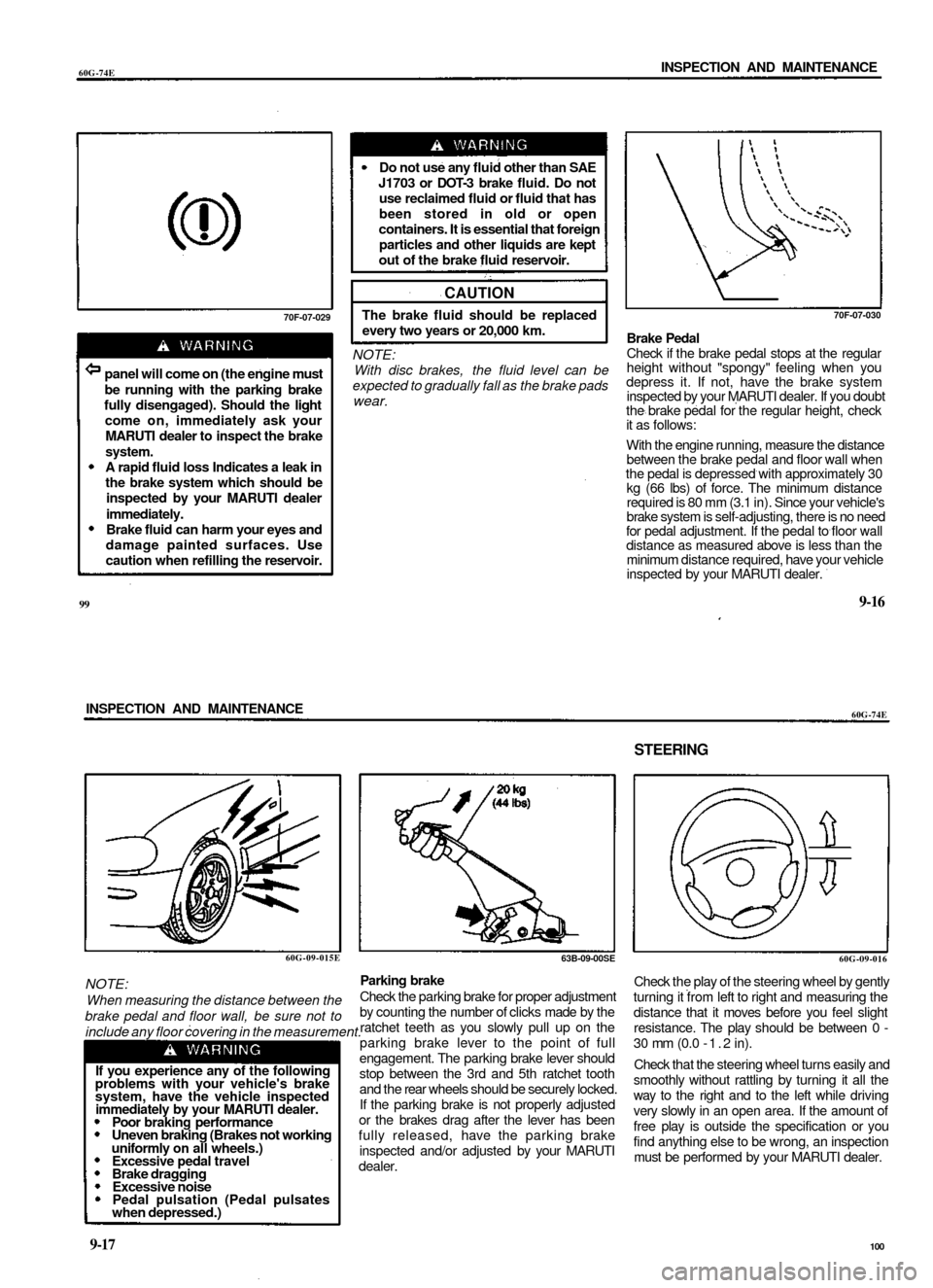
Brake Pedal
Check if the brake pedal stops at the regular
height without "spongy" feeling when you
depress it. If not, have the brake system
inspected by your MARUTI dealer. If you doubt
the brake pedal for the regular height, check
it as follows:
With the engine running, measure the distance
between the brake pedal and floor wall when
the pedal is depressed with approximately 30
kg (66 lbs) of force. The minimum distance
required is 80 mm (3.1 in). Since your vehicle's
brake system is self-adjusting, there is no need
for pedal adjustment. If the pedal to floor wall
distance as measured above is less than the
minimum distance required, have your vehicle
inspected by your MARUTI dealer.
9-16
INSPECTION AND MAINTENANCE
60G-74E
STEERING
60G-09-015E
NOTE:
When measuring the distance between the
brake pedal and floor wall, be sure not to
include any floor covering in the measurement.
If you experience any of the following
problems with your vehicle's brake
system, have the vehicle inspected
immediately by your MARUTI dealer.
Poor braking performance
Uneven braking (Brakes not working
uniformly on all wheels.)
Excessive pedal travel
Brake dragging
Excessive noise
Pedal pulsation (Pedal pulsates
when depressed.)
63B-09-00SE
Parking brake
Check the parking brake for proper adjustment
by counting the number of clicks made by the
ratchet teeth as you slowly pull up on the
parking brake lever to the point of full
engagement. The parking brake lever should
stop between the 3rd and 5th ratchet tooth
and the rear wheels should be securely locked.
If the parking brake is not properly adjusted
or the brakes drag after the lever has been
fully released, have the parking brake
inspected and/or adjusted by your MARUTI
dealer.
60G-09-016
Check the play of the steering wheel by gently
turning it from left to right and measuring the
distance that it moves before you feel slight
resistance. The play should be between 0 -
30
mm
(0.0 -1.2 in).
Check that the steering wheel turns easily and
smoothly without rattling by turning it all the
way to the right and to the left while driving
very slowly in an open area. If the amount of
free play is outside the specification or you
find anything else to be wrong, an inspection
must be performed by your MARUTI dealer.
9-17
100
Page 50 of 65
60G-74E
INSPECTION AND MAINTENANCE
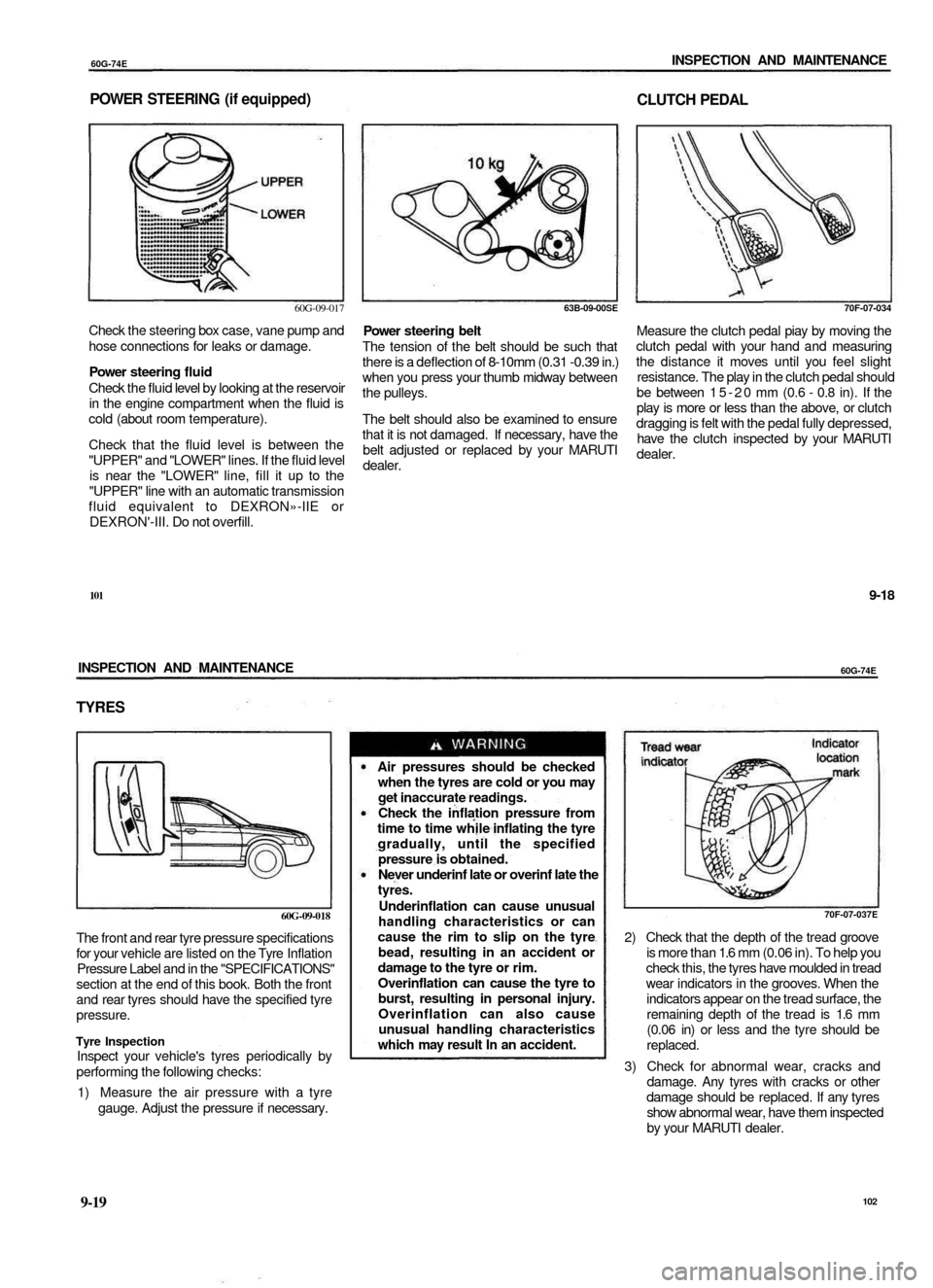
POWER STEERING (if equipped)
CLUTCH PEDAL
60G-09-017
Check the steering box case, vane pump and
hose connections for leaks or damage.
Power steering fluid
Check the fluid level by looking at the reservoir
in the engine compartment when the fluid is
cold (about room temperature).
Check that the fluid level is between the
"UPPER" and "LOWER" lines. If the fluid level
is near the "LOWER" line, fill it up to the
"UPPER" line with an automatic transmission
fluid equivalent to DEXRON»-IIE or
DEXRON'-III. Do not overfill.
63B-09-00SE
Power steering belt
The tension of the belt should be such that
there is a deflection of 8-10mm (0.31 -0.39 in.)
when you press your thumb midway between
the pulleys.
The belt should also be examined to ensure
that it is not damaged. If necessary, have the
belt adjusted or replaced by your MARUTI
dealer.
70F-07-034
Measure the clutch pedal piay by moving the
clutch pedal with your hand and measuring
the distance it moves until you feel slight
resistance. The play in the clutch pedal should
be between 15-20 mm (0.6 - 0.8 in). If the
play is more or less than the above, or clutch
dragging is felt with the pedal fully depressed,
have the clutch inspected by your MARUTI
dealer.
101
9-18
INSPECTION AND MAINTENANCE
60G-74E
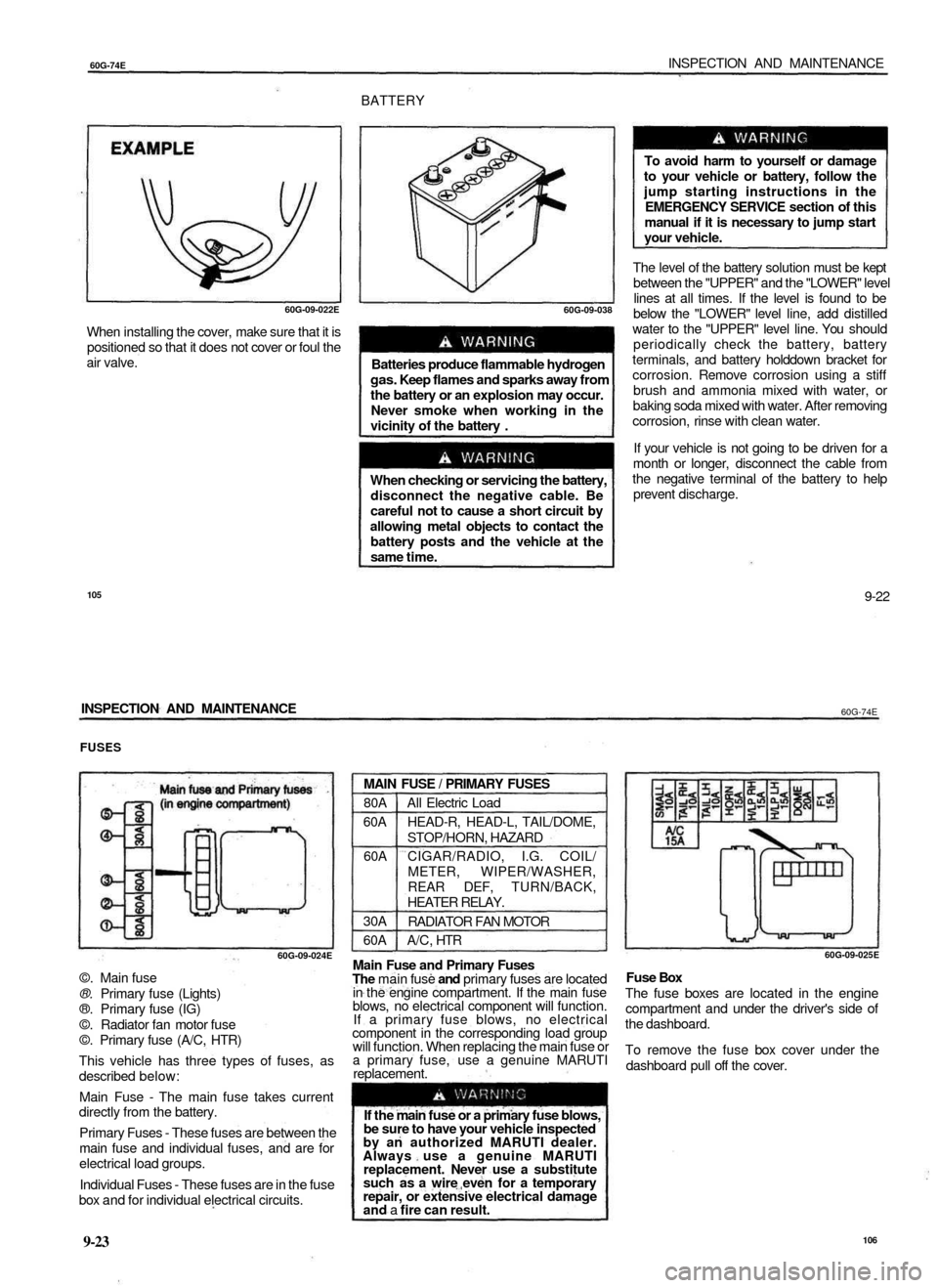
TYRES
60G-09-018
The front and rear tyre pressure specifications
for your vehicle are listed on the Tyre Inflation
Pressure Label and in the "SPECIFICATIONS"
section at the end of this book. Both the front
and rear tyres should have the specified tyre
pressure.
Tyre Inspection
Inspect your vehicle's tyres periodically by
performing the following checks:
1) Measure the air pressure with a tyre
gauge. Adjust the pressure if necessary.
Air pressures should be checked
when the tyres are cold or you may
get inaccurate readings.
Check the inflation pressure from
time to time while inflating the tyre
gradually, until the specified
pressure is obtained.
Never underinf late or overinf late the
tyres.
Underinflation can cause unusual
handling characteristics or can
cause the rim to slip on the tyre
bead, resulting in an accident or
damage to the tyre or rim.
Overinflation can cause the tyre to
burst, resulting in personal injury.
Overinflation can also cause
unusual handling characteristics
which may result In an accident.
70F-07-037E
2) Check that the depth of the tread groove
is more than 1.6 mm (0.06 in). To help you
check this, the tyres have moulded in tread
wear indicators in the grooves. When the
indicators appear on the tread surface, the
remaining depth of the tread is 1.6 mm
(0.06 in) or less and the tyre should be
replaced.
3) Check for abnormal wear, cracks and
damage. Any tyres with cracks or other
damage should be replaced. If any tyres
show abnormal wear, have them inspected
by your MARUTI dealer.
9-19
102
Page 52 of 65
60G-74E
INSPECTION AND MAINTENANCE
BATTERY
60G-09-022E
When installing the cover, make sure that it is
positioned so that it does not cover or foul the
air valve.
60G-09-038
Batteries produce flammable hydrogen
gas. Keep flames and sparks away from
the battery or an explosion may occur.
Never smoke when working in the
vicinity of the battery .
When checking or servicing the battery,
disconnect the negative cable. Be
careful not to cause a short circuit by
allowing metal objects to contact the
battery posts and the vehicle at the
same time.
To avoid harm to yourself or damage
to your vehicle or battery, follow the
jump starting instructions in the
EMERGENCY SERVICE section of this
manual if it is necessary to jump start
your vehicle.
The level of the battery solution must be kept
between the "UPPER" and the "LOWER" level
lines at all times. If the level is found to be
below the "LOWER" level line, add distilled
water to the "UPPER" level line. You should
periodically check the battery, battery
terminals, and battery holddown bracket for
corrosion. Remove corrosion using a stiff
brush and ammonia mixed with water, or
baking soda mixed with water. After removing
corrosion, rinse with clean water.
If your vehicle is not going to be driven for a
month or longer, disconnect the cable from
the negative terminal of the battery to help
prevent discharge.
105
9-22
INSPECTION AND MAINTENANCE
60G-74E
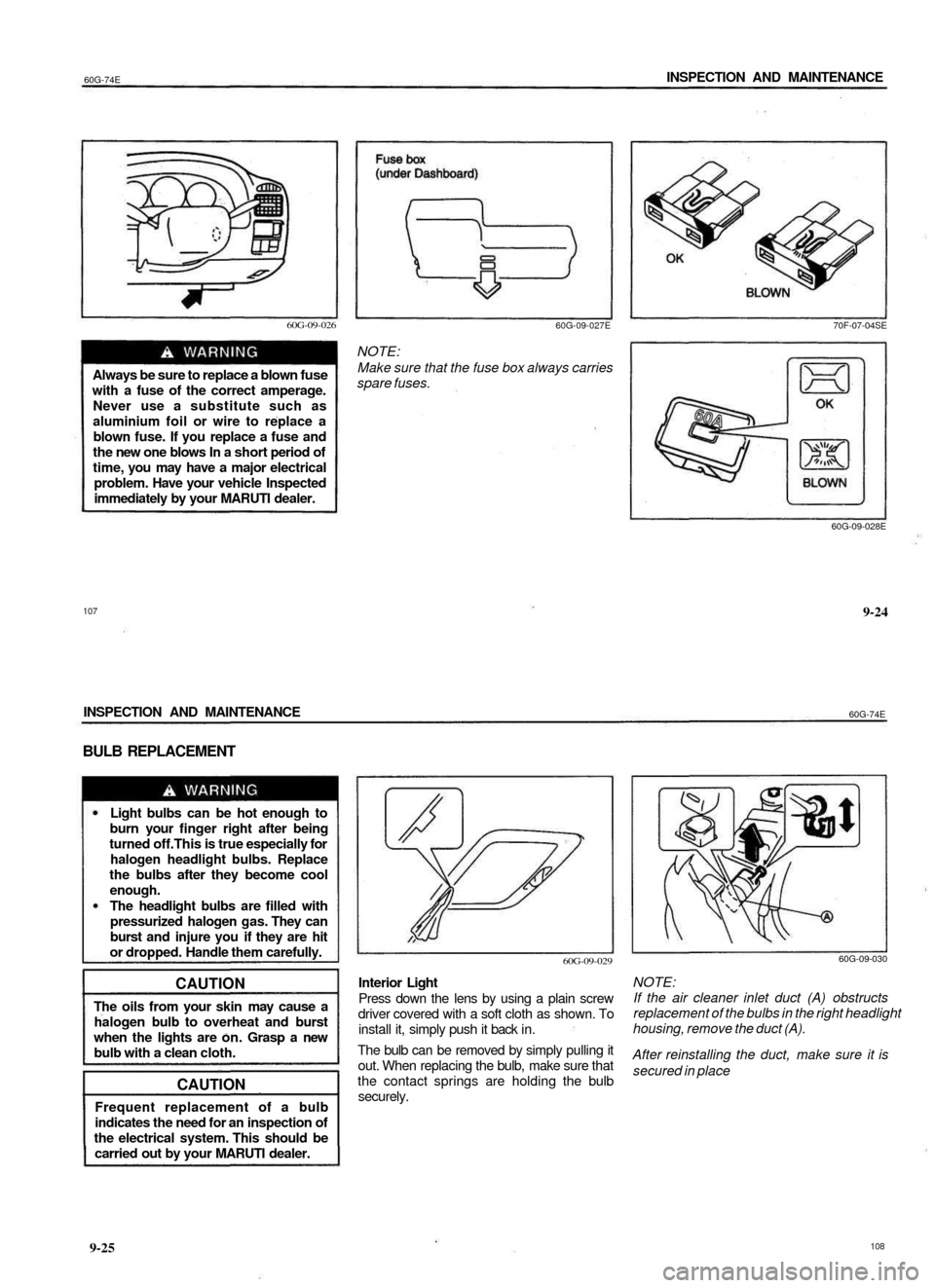
FUSES
60G-09-024E
©. Main fuse
®. Primary fuse (Lights)
®. Primary fuse (IG)
©. Radiator fan motor fuse
©. Primary fuse (A/C, HTR)
This vehicle has three types of fuses, as
described below:
Main Fuse - The main fuse takes current
directly from the battery.
Primary Fuses - These fuses are between the
main fuse and individual fuses, and are for
electrical load groups.
Individual Fuses - These fuses are in the fuse
box and for individual electrical circuits.
MAIN FUSE / PRIMARY FUSES
80A
60A
60A
30A
60A
All Electric Load
HEAD-R, HEAD-L, TAIL/DOME,
STOP/HORN, HAZARD
CIGAR/RADIO, I.G. COIL/
METER, WIPER/WASHER,
REAR DEF, TURN/BACK,
HEATER RELAY.
RADIATOR FAN MOTOR
A/C, HTR
Main Fuse and Primary Fuses
The main fuse and primary fuses are located
in the engine compartment. If the main fuse
blows, no electrical component will function.
If a primary fuse blows, no electrical
component in the corresponding load group
will function. When replacing the main fuse or
a primary fuse, use a genuine MARUTI
replacement.
If the main fuse or a primary fuse blows,
be sure to have your vehicle inspected
by an authorized MARUTI dealer.
Always use a genuine MARUTI
replacement. Never use a substitute
such as a wire even for a temporary
repair, or extensive electrical damage
and a fire can result.
60G-09-025E
Fuse Box
The fuse boxes are located in the engine
compartment and under the driver's side of
the dashboard.
To remove the fuse box cover under the
dashboard pull off the cover.
9-23
106
Page 53 of 65
60G-74E
INSPECTION AND MAINTENANCE
60G-09-026
Always be sure to replace a blown fuse
with a fuse of the correct amperage.
Never use a substitute such as
aluminium foil or wire to replace a
blown fuse. If you replace a fuse and
the new one blows In a short period of
time, you may have a major electrical
problem. Have your vehicle Inspected
immediately by your MARUTI dealer.
60G-09-027E
NOTE:
Make sure that the fuse box always carries
spare fuses.
70F-07-04SE
60G-09-028E
107
9-24
INSPECTION AND MAINTENANCE
60G-74E
BULB REPLACEMENT
Light bulbs can be hot enough to
burn your finger right after being
turned off.This is true especially for
halogen headlight bulbs. Replace
the bulbs after they become cool
enough.
The headlight bulbs are filled with
pressurized halogen gas. They can
burst and injure you if they are hit
or dropped. Handle them carefully.
CAUTION
The oils from your skin may cause a
halogen bulb to overheat and burst
when the lights are on. Grasp a new
bulb with a clean cloth.
CAUTION
Frequent replacement of a bulb
indicates the need for an inspection of
the electrical system. This should be
carried out by your MARUTI dealer.
60G-09-029
Interior Light
Press down the lens by using a plain screw
driver covered with a soft cloth as shown. To
install it, simply push it back in.
The bulb can be removed by simply pulling it
out. When replacing the bulb, make sure that
the contact springs are holding the bulb
securely.
60G-09-030
NOTE:
If the air cleaner inlet duct (A) obstructs
replacement of the bulbs in the right headlight
housing, remove the duct (A).
After reinstalling the duct, make sure it is
secured in place
9-25
108
Page 54 of 65
60G-74E
INSPECTION AND MAINTENANCE
60G-09-031
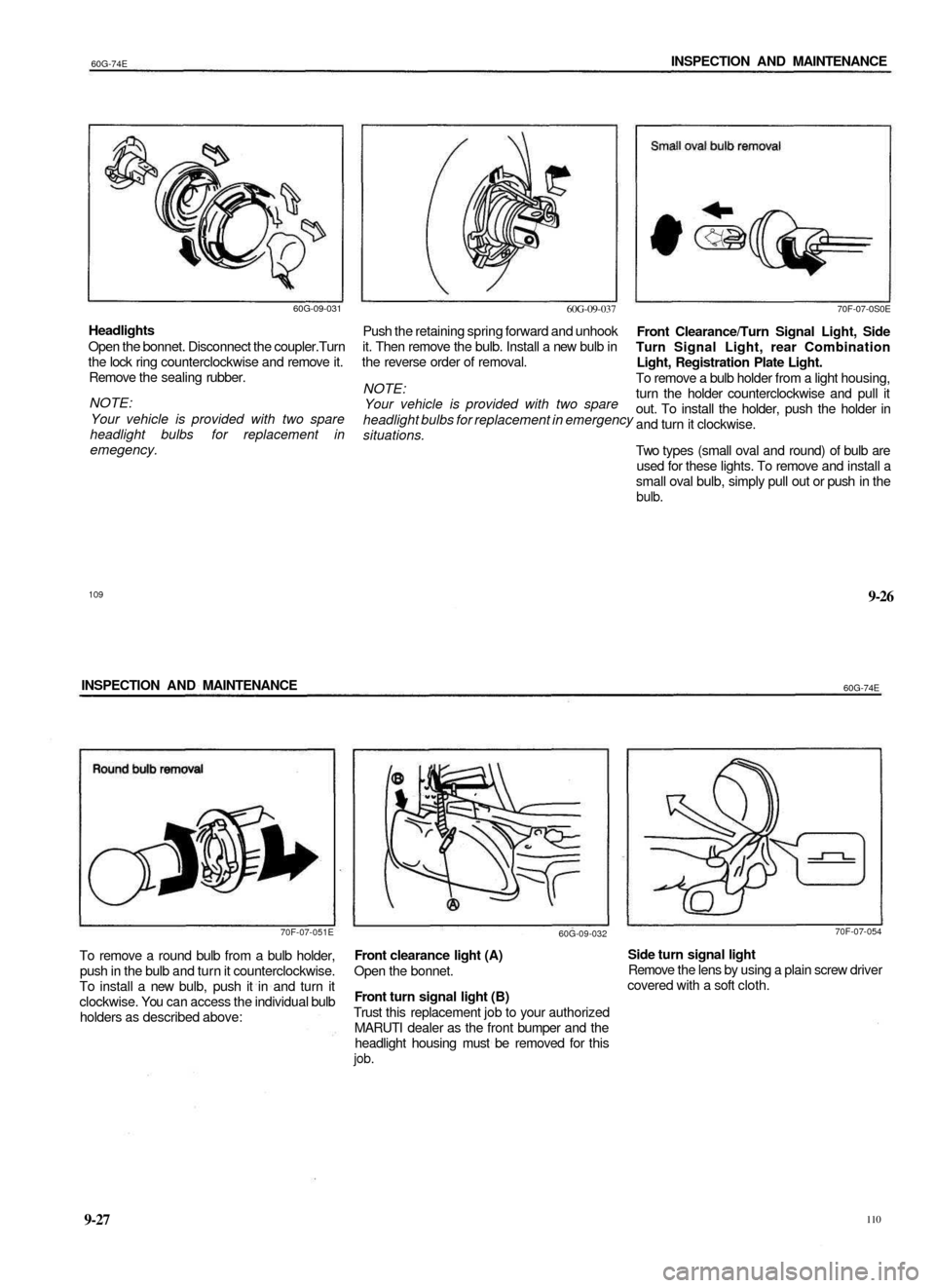
Headlights
Open the bonnet. Disconnect the coupler.Turn
the lock ring counterclockwise and remove it.
Remove the sealing rubber.
NOTE:
Your vehicle is provided with two spare
headlight bulbs for replacement in
emegency.
60G-09-037
Push the retaining spring forward and unhook
it. Then remove the bulb. Install a new bulb in
the reverse order of removal.
NOTE:
Your vehicle is provided with two spare
headlight bulbs for replacement in emergency
situations.
70F-07-0S0E
Front Clearance/Turn Signal Light, Side
Turn Signal Light, rear Combination
Light, Registration Plate Light.
To remove a bulb holder from a light housing,
turn the holder counterclockwise and pull it
out. To install the holder, push the holder in
and turn it clockwise.
Two types (small oval and round) of bulb are
used for these lights. To remove and install a
small oval bulb, simply pull out or push in the
bulb.
109
9-26
INSPECTION AND MAINTENANCE
60G-74E
70F-07-051E
To remove a round bulb from a bulb holder,
push in the bulb and turn it counterclockwise.
To install a new bulb, push it in and turn it
clockwise. You can access the individual bulb
holders as described above:
60G-09-032
Front clearance light (A)
Open the bonnet.
Front turn signal light (B)
Trust this replacement job to your authorized
MARUTI dealer as the front bumper and the
headlight housing must be removed for this
job.
70F-07-054
Side turn signal light
Remove the lens by using a plain screw driver
covered with a soft cloth.
9-27
110
Page 55 of 65
60G-74E
INSPECTION AND MAINTENANCE
60G-09-033
60G-09-034
60G-09-035
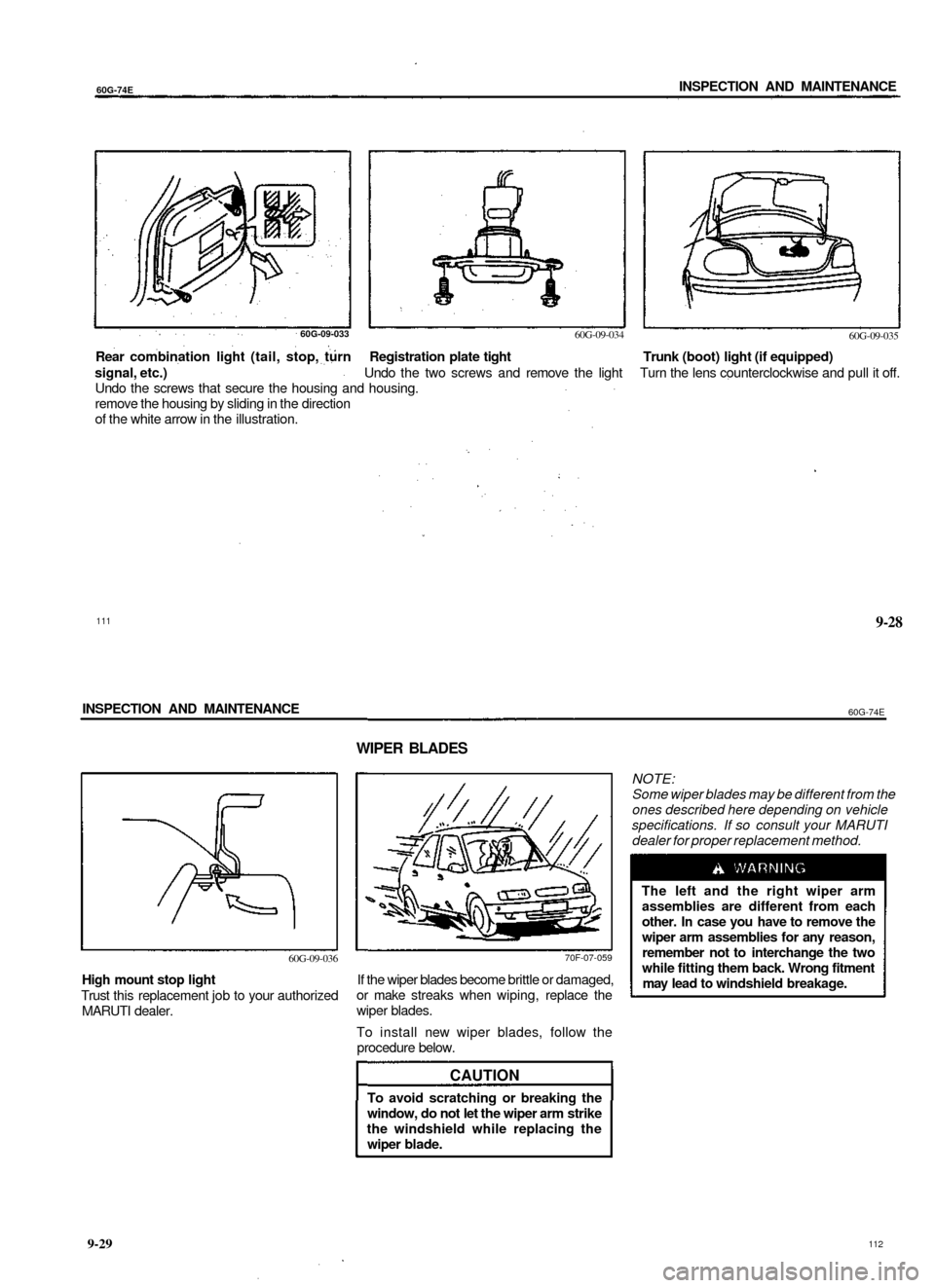
Rear combination light (tail, stop, turn Registration plate tight Trunk (boot) light (if equipped)
signal, etc.) Undo the two screws and remove the light Turn the lens counterclockwise and pull it off.
Undo the screws that secure the housing and housing.
remove the housing by sliding in the direction
of the white arrow in the illustration.
111
9-28
INSPECTION AND MAINTENANCE
60G-74E
WIPER BLADES
60G-09-036
High mount stop light
Trust this replacement job to your authorized
MARUTI dealer.
70F-07-059
If the wiper blades become brittle or damaged,
or make streaks when wiping, replace the
wiper blades.
To install new wiper blades, follow the
procedure below.
CAUTION
To avoid scratching or breaking the
window, do not let the wiper arm strike
the windshield while replacing the
wiper blade.
NOTE:
Some wiper blades may be different from the
ones described here depending on vehicle
specifications. If so consult your MARUTI
dealer for proper replacement method.
The left and the right wiper arm
assemblies are different from each
other. In case you have to remove the
wiper arm assemblies for any reason,
remember not to interchange the two
while fitting them back. Wrong fitment
may lead to windshield breakage.
9-29
112
Page 59 of 65
EMERGENCY SERVICE
60G-74E
CAUTION
Vehicle equipped with electronic fuel
injection system will not start by
pushing or towing as the fuel pump
will not work in this condition. This
starting method could also result in
permanent damage to the catalytic
converter. Use jump leads to start a
vehicle with a weak or flat battery.
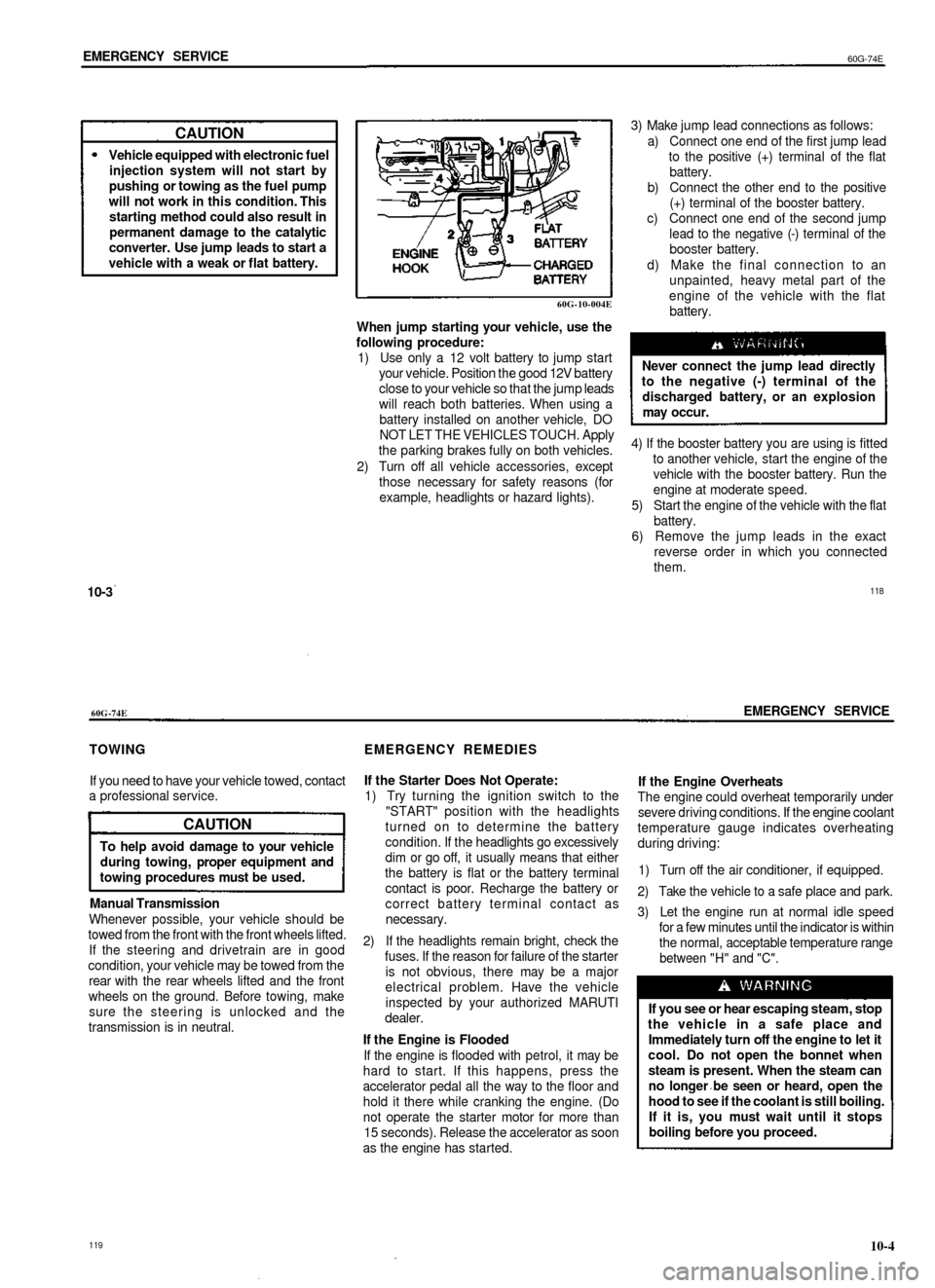
60G-10-004E
When jump starting your vehicle, use the
following procedure:
1) Use only a 12 volt battery to jump start
your vehicle. Position the good 12V battery
close to your vehicle so that the jump leads
will reach both batteries. When using a
battery installed on another vehicle, DO
NOT LET THE VEHICLES TOUCH. Apply
the parking brakes fully on both vehicles.
2) Turn off all vehicle accessories, except
those necessary for safety reasons (for
example, headlights or hazard lights).
3) Make jump lead connections as follows:
a) Connect one end of the first jump lead
to the positive (+) terminal of the flat
battery.
b) Connect the other end to the positive
(+) terminal of the booster battery.
c) Connect one end of the second jump
lead to the negative (-) terminal of the
booster battery.
d) Make the final connection to an
unpainted, heavy metal part of the
engine of the vehicle with the flat
battery.
Never connect the jump lead directly
to the negative (-) terminal of the
discharged battery, or an explosion
may occur.
10-3
4) If the booster battery you are using is fitted
to another vehicle, start the engine of the
vehicle with the booster battery. Run the
engine at moderate speed.
5) Start the engine of the vehicle with the flat
battery.
6) Remove the jump leads in the exact
reverse order in which you connected
them.
118
60G-74E
EMERGENCY SERVICE
TOWING
If you need to have your vehicle towed, contact
a professional service.
CAUTION
To help avoid damage to your vehicle
during towing, proper equipment and
towing procedures must be used.
Manual Transmission
Whenever possible, your vehicle should be
towed from the front with the front wheels lifted.
If the steering and drivetrain are in good
condition, your vehicle may be towed from the
rear with the rear wheels lifted and the front
wheels on the ground. Before towing, make
sure the steering is unlocked and the
transmission is in neutral.
EMERGENCY REMEDIES
If the Starter Does Not Operate:
1) Try turning the ignition switch to the
"START" position with the headlights
turned on to determine the battery
condition. If the headlights go excessively
dim or go off, it usually means that either
the battery is flat or the battery terminal
contact is poor. Recharge the battery or
correct battery terminal contact as
necessary.
2) If the headlights remain bright, check the
fuses. If the reason for failure of the starter
is not obvious, there may be a major
electrical problem. Have the vehicle
inspected by your authorized MARUTI
dealer.
If the Engine is Flooded
If the engine is flooded with petrol, it may be
hard to start. If this happens, press the
accelerator pedal all the way to the floor and
hold it there while cranking the engine. (Do
not operate the starter motor for more than
15 seconds). Release the accelerator as soon
as the engine has started.
If the Engine Overheats
The engine could overheat temporarily under
severe driving conditions. If the engine coolant
temperature gauge indicates overheating
during driving:
1) Turn off the air conditioner, if equipped.
2) Take the vehicle to a safe place and park.
3) Let the engine run at normal idle speed
for a few minutes until the indicator is within
the normal, acceptable temperature range
between "H" and "C".
If you see or hear escaping steam, stop
the vehicle in a safe place and
Immediately turn off the engine to let it
cool. Do not open the bonnet when
steam is present. When the steam can
no longer be seen or heard, open the
hood to see if the coolant is still boiling.
If it is, you must wait until it stops
boiling before you proceed.
119
10-4