maintenance SUZUKI CELERIO 2014 User Guide
[x] Cancel search | Manufacturer: SUZUKI, Model Year: 2014, Model line: CELERIO, Model: SUZUKI CELERIO 2014Pages: 201, PDF Size: 5.82 MB
Page 71 of 201
3-1
OPERATING YOUR VEHICLE
76MH1-74E
76MH1-74E
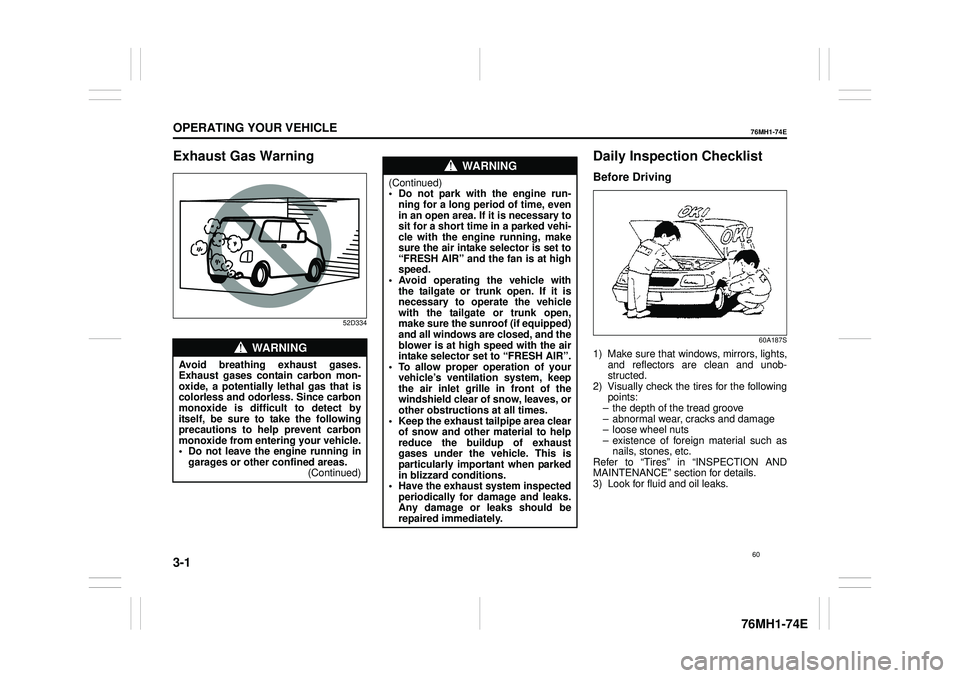
Exhaust Gas Warning
52D334
Daily Inspection Checklist
Before Driving
60A187S
1) Make sure that windows, mirrors, lights, and reflectors are clean and unob-structed. 2) Visually check the tires for the following points:– the depth of the tread groove – abnormal wear, cracks and damage – loose wheel nuts– existence of foreign material such as nails, stones, etc. Refer to “Tires” in “INSPECTION ANDMAINTENANCE” section for details. 3) Look for fluid and oil leaks.
WA R N I N G
Avoid breathing exhaust gases. Exhaust gases contain carbon mon- oxide, a potentially lethal gas that is colorless and odorless. Since carbonmonoxide is difficult to detect by itself, be sure to take the following precautions to help prevent carbonmonoxide from entering your vehicle. • Do not leave the engine running in garages or other confined areas.(Continued)
WA R N I N G
(Continued)• Do not park with the engine run- ning for a long period of time, even in an open area. If it is necessary to sit for a short time in a parked vehi- cle with the engine running, make sure the air intake selector is set to “FRESH AIR” and the fan is at highspeed. • Avoid operating the vehicle with the tailgate or trunk open. If it isnecessary to operate the vehicle with the tailgate or trunk open, make sure the sunroof (if equipped)and all windows are closed, and the blower is at high speed with the air intake selector set to “FRESH AIR”.• To allow proper operation of your vehicle’s ventilation system, keep the air inlet grille in front of thewindshield clear of snow, leaves, or other obstructions at all times. • Keep the exhaust tailpipe area clearof snow and other material to help reduce the buildup of exhaust gases under the vehicle. This isparticularly important when parked in blizzard conditions. • Have the exhaust system inspectedperiodically for damage and leaks. Any damage or leaks should be repaired immediately.
60
Page 72 of 201
3-2
OPERATING YOUR VEHICLE
76MH1-74E
76MH1-74E
NOTE: It is normal for water to drip from the air conditioning system after use.
4) Make sure the hood is fully closed and latched.5) Check the headlights, turn signal lights, brake lights and horn for proper opera- tion.6) Adjust the seat and head restraint (if equipped). 7) Check the brake pedal and the parkingbrake lever. 8) Adjust the mirrors. 9) Make sure that you and all passengershave properly fastened your seat belts. 10)Make sure that all warning lights come on as the key is turned to the “ON” posi-tion. 11)Check all gauges. 12)Make sure that the BRAKE SYSTEMWARNING light turns off when the parking brake is released.
Once a week, or each time you fill your fuel tank, perform the following under-hood checks:
1) Engine oil level 2) Coolant level3) Brake fluid level 4) Windshield washer fluid level 5) Battery solution level6) Hood latch operation Pull the hood release handle inside the vehicle. Make sure that you cannotopen the hood all the way without
releasing the secondary latch. Be sure to close the hood securely after check- ing for proper latch operation. See “Alllatches, hinges & locks” of “CHASSIS AND BODY” in the “Periodic Mainte- nance Schedule” in the “INSPECTIONAND MAINTENANCE” section for lubri- cation schedule.
Once a month, or each time you fill your fuel tank, check the tire pressure using a tire pressure gauge. Also check the tirepressure of the spare tire.
Engine Oil Consumption
It is normal for the engine to consume some engine oil during normal vehicle operation.
The amount of engine oil consumed depends on the viscosity of the oil, thequality of the oil and the conditions the vehicle is driven under. More oil is consumed during high-speeddriving and when there is frequent acceler- ation and deceleration. Under high loads, your engine also will consume more oil.A new engine also consumes more oil, since its pistons, piston rings and cylinder
walls have not yet become conditioned. New engines reach the normal level of oil consumption only after approximately 5000km (3000 miles) driving.
Oil consumption: Max. 1.0 L per 1000 km (1 Qt. per 600 miles)
When judging the amount of oil consump- tion, note that the oil may become diluted and make it difficult to accurately judge thetrue oil level. As an example, if a vehicle is used for repeated short trips, and consumes a nor-mal amount of oil, the dipstick may not show any drop in the oil level at all, even after 1000 km (600 miles) or more of driv-ing. This is because the oil is gradually becoming diluted with fuel or moisture, making it appear that the oil level has notchanged. You should also be aware that the diluting ingredients evaporate out when the vehicleis subsequently driven at high speeds, such as on an expressway, making it appear that oil is excessively consumedafter high-speed driving.
WA R N I N G
Make sure the hood is fully closed and latched before driv ing. If it is not, it can fly up unexpectedly duringdriving, obstructing your view and resulting in an accident.
61
Page 92 of 201
4-4
DRIVING TIPS
76MH1-74E
76MH1-74E
are the correct size for your vehicle’s tires. Also make sure that there is enough clear- ance between the fenders and the chainsas installed on the tires.
Install the chains on the front tires tightly, according to the chain manufacturer’s instructions. Retight en the chains after driving about 1.0 km (1/2 mile) if neces-sary. With the chains installed, drive slowly.
If Your Vehicle Gets StuckIf your vehicle gets stuck in snow, mud, orsand, follow the directions below:
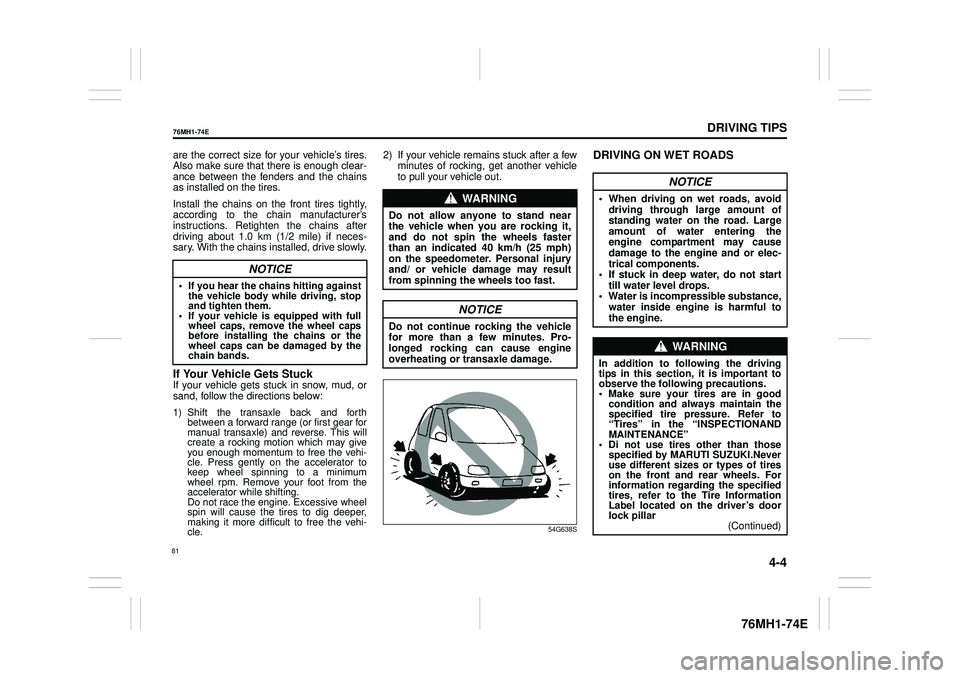
1) Shift the transaxle back and forth between a forward range (or first gear formanual transaxle) and reverse. This willcreate a rocking motion which may giveyou enough momentum to free the vehi- cle. Press gently on the accelerator to keep wheel spinning to a minimumwheel rpm. Remove your foot from theaccelerator while shifting. Do not race the engine. Excessive wheelspin will cause the tires to dig deeper,making it more difficult to free the vehi- cle.
2) If your vehicle remains stuck after a few minutes of rocking, get another vehicle to pull your vehicle out.
54G638S
DRIVING ON WET ROADS
NOTICE
• If you hear the chains hitting against the vehicle body while driving, stopand tighten them.• If your vehicle is equipped with fullwheel caps, remove the wheel caps before installing the chains or the wheel caps can be damaged by thechain bands.
WA R N I N G
Do not allow anyone to stand near the vehicle when you are rocking it,and do not spin the wheels faster than an indicated 40 km/h (25 mph) on the speedometer. Personal injuryand/ or vehicle damage may result from spinning the wheels too fast.
NOTICE
Do not continue rocking the vehicle for more than a few minutes. Pro-longed rocking can cause engine overheating or transaxle damage.
NOTICE
• When driving on wet roads, avoid driving through large amount of standing water on the road. Large amount of water entering theengine compartment may cause damage to the engine and or elec- trical components.• If stuck in deep water, do not start till water level drops. • Water is incompressible substance,water inside engine is harmful to the engine.
WA R N I N G
In addition to following the driving tips in this section, it is important to observe the following precautions. • Make sure your tires are in good condition and always maintain the specified tire pressure. Refer to“Tires” in the “INSPECTIONAND MAINTENANCE” • Di not use tires other than thosespecified by MARUTI SUZUKI.Never use different sizes or types of tires on the front and rear wheels. Forinformation regard ing the specified tires, refer to the Tire Information Label located on the driver’s doorlock pillar(Continued)
81
Page 109 of 201
5-13
OTHER CONTROLS AND EQUIPMENT
76MH1-74E
76MH1-74E
faster if you open the windows briefly while you operate the air conditioner with the air intake selector at “FRESH AIR”and the blower at high speed.
DehumidifyingSet the air flow selector to a desired air flow selector position, the temperature selector to the desired temperature position and theblower speed selector to the desired blower speed position. Also select “FRESH AIR” and turn on the “A/C” switch.
NOTE:Because the air conditioner dehumidifiesthe air, turning it on will help keep the win- dows clear, even when blowing heated air using the “DEFROST” or “HEAT &DEFROST” functions.
76MH0A090
NOTE:If you need maximum defrosting:• set the air flow selector to “DEFROST”,
• set the blower speed selector to HIGH, • adjust the temperature selector to the HOT end, • turn on the “A/C” switch, and• adjust the side outlets so the air blows on the side windows.
MaintenanceIf you do not use the air conditioner for a long period, such as during winter, it may not give the best performance when youstart using it again. To help maintain opti- mum performance and durability of your air conditioner, it needs to be run periodically.Operate the air conditioner at least once a month for one minute with the engine idling. This circulates the refrigerant and oiland helps protect the internal components.
NOTE: Your vehicle uses the air conditioning refrigerant HFC-134a, commonly called “R-134a”. R-134a replaced R-12 around1993 for automotive applications. Other refrigerants are available, including recy- cled R-12, but only R-134a should be usedin your vehicle.
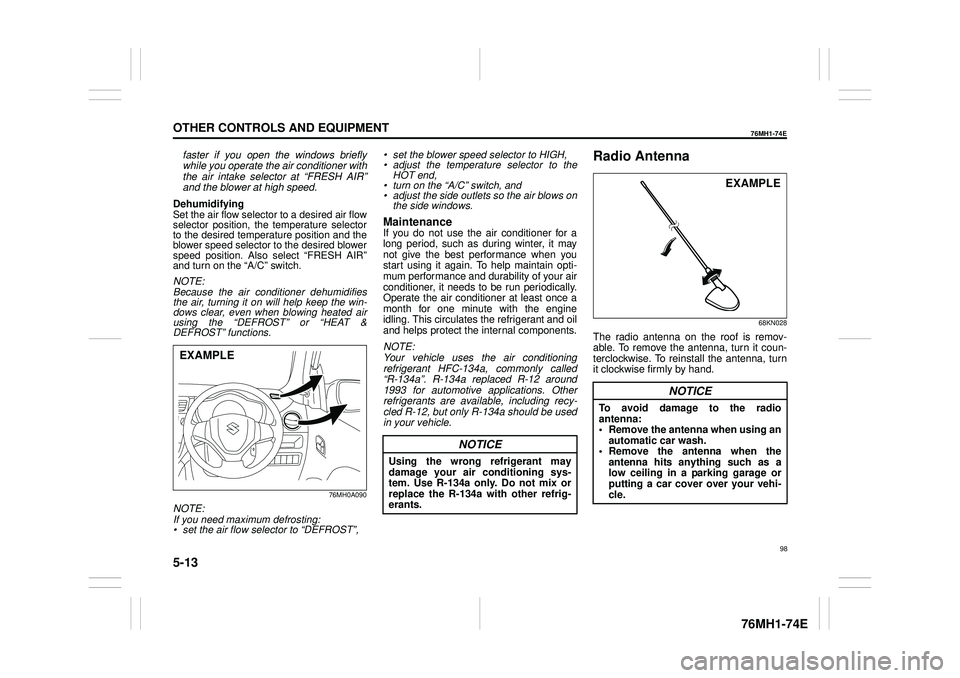
Radio Antenna
68KN028
The radio antenna on the roof is remov-able. To remove the antenna, turn it coun-terclockwise. To reinstall the antenna, turn it clockwise firmly by hand.
EXAMPLE
NOTICE
Using the wrong refrigerant may damage your air conditioning sys- tem. Use R-134a only. Do not mix or replace the R-134a with other refrig-erants.
NOTICE
To avoid damage to the radio antenna: • Remove the antenna when using anautomatic car wash. • Remove the antenna when the antenna hits anything such as alow ceiling in a parking garage or putting a car cover over your vehi- cle.
EXAMPLE
98
Page 149 of 201
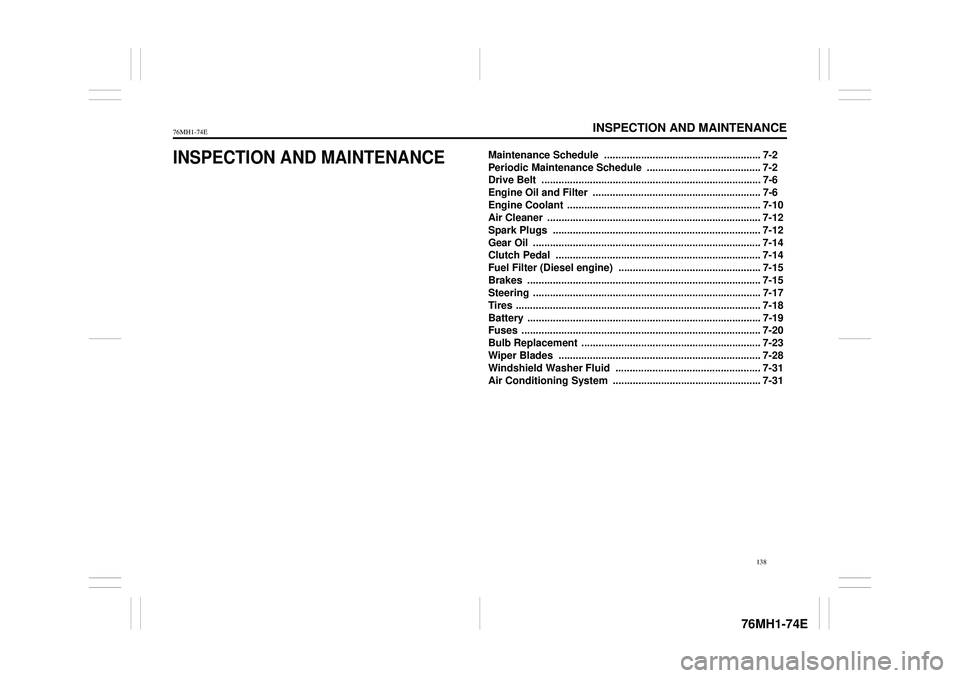
INSPECTION AND MAINTENANCE
76MH1-74E
76MH1-74E
138
INSPECTION AND MAINTENANCEMaintenance Schedule ....................................................... 7-2
Periodic Maintenance Schedule . ....................................... 7-2
Drive Belt ............................................................................. 7-6
Engine Oil and Filter ........................................................... 7-6
Engine Coolant .................................................................... 7-10
Air Cleaner ........................................................................... 7-12
Spark Plugs ......................................................................... 7-12
Gear Oil ................................................................................ 7-14
Clutch Pedal ........................................................................ 7-14
Fuel Filter (Diesel engine) .................................................. 7-15
Brakes .......... ........................................................................ 7-15
Steering ................................................................................ 7-17
Tires ...................................................................................... 7-18
Battery .................................................................................. 7-19
Fuses .................................................................................... 7-20
Bulb Replacement ............................................................... 7-23
Wiper Blades ....................................................................... 7-28
Windshield Washer Fluid ................................................... 7-31
Air Conditioning System .................................................... 7-31
Page 150 of 201
7-1
INSPECTION AND MAINTENANCE
76MH1-74E
76MH1-74E
60A187S
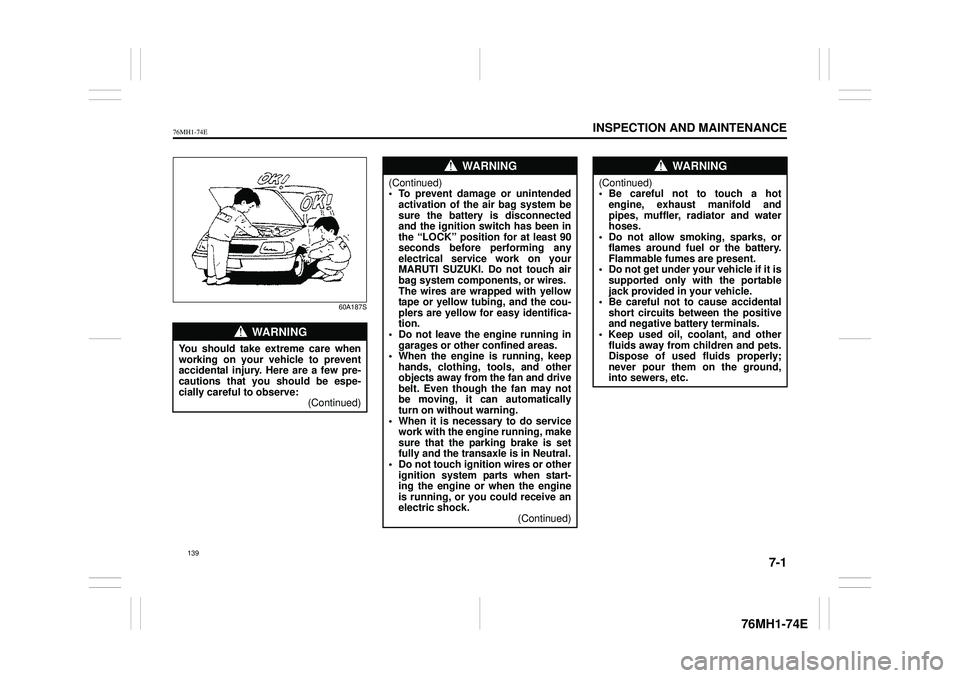
WA R N I N G
You should take extreme care when working on your vehicle to preventaccidental injury. Here are a few pre- cautions that you should be espe- cially careful to observe:(Continued)
WA R N I N G
(Continued)• To prevent damage or unintendedactivation of the air bag system be sure the battery is disconnected and the ignition switch has been inthe “LOCK” position for at least 90 seconds before performing any electrical service work on yourMARUTI SUZUKI. Do not touch air bag system components, or wires. The wires are wrapped with yellowtape or yellow tubing, and the cou- plers are yellow for easy identifica- tion.• Do not leave the engine running in garages or other confined areas. • When the engine is running, keephands, clothing, tools, and other objects away from the fan and drive belt. Even though the fan may notbe moving, it can automatically turn on without warning. • When it is necessary to do servicework with the engine running, make sure that the parking brake is set fully and the transaxle is in Neutral.• Do not touch ignition wires or other ignition system parts when start- ing the engine or when the engineis running, or you could receive an electric shock. (Continued)
WA R N I N G
(Continued)• Be careful not to touch a hotengine, exhaust manifold and pipes, muffler, radiator and water hoses.• Do not allow smoking, sparks, or flames around fuel or the battery. Flammable fumes are present.• Do not get under your vehicle if it is supported only with the portable jack provided in your vehicle.• Be careful not to cause accidental short circuits be tween the positive and negative battery terminals.• Keep used oil, coolant, and other fluids away from children and pets. Dispose of used fluids properly;never pour them on the ground, into sewers, etc.
139
Page 151 of 201
7-2
INSPECTION AND MAINTENANCE
76MH1-74E
76MH1-74E
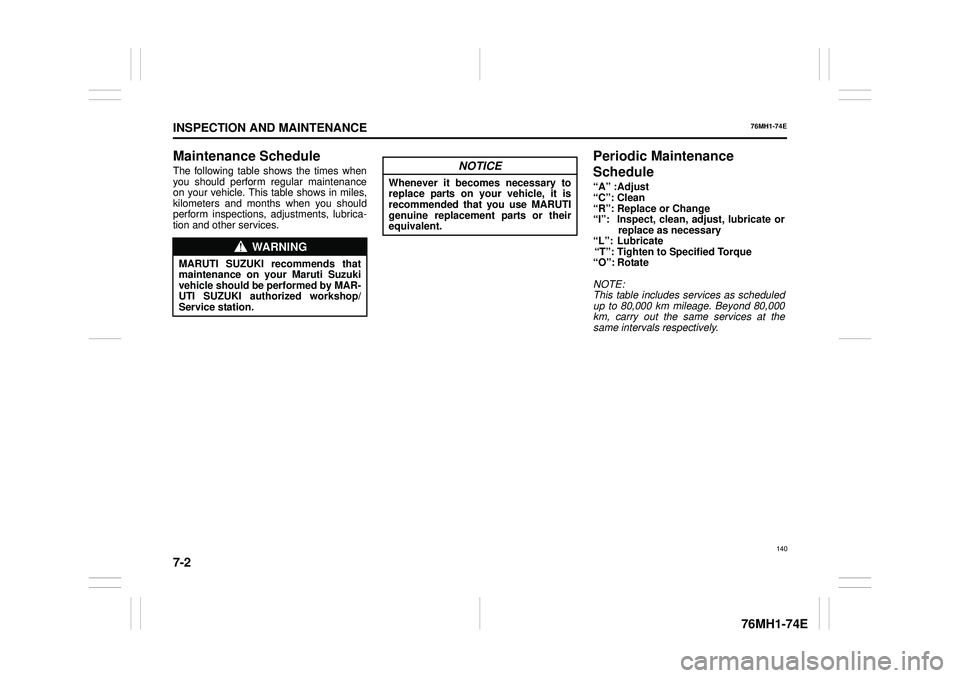
Maintenance Schedule
The following table shows the times when you should perform regular maintenanceon your vehicle. This table shows in miles, kilometers and months when you should perform inspections, adjustments, lubrica-tion and other services.
Periodic Maintenance
Schedule
“A” :Adjust “C”: Clean “R”: Replace or Change “I”: Inspect, clean, adjust, lubricate orreplace as necessary “L”: Lubricate “T”: Tighten to Specified Torque “O”: Rotate
NOTE: This table includes services as scheduled up to 80,000 km mileage. Beyond 80,000 km, carry out the same services at thesame intervals respectively.
WA R N I N G
MARUTI SUZUKI recommends thatmaintenance on your Maruti Suzuki vehicle should be performed by MAR- UTI SUZUKI authorized workshop/Service station.
NOTICE
Whenever it becomes necessary toreplace parts on your vehicle, it isrecommended that you use MARUTI genuine replacement parts or their equivalent.
140
Page 152 of 201
7-3
INSPECTION AND MAINTENANCE
76MH1-74E
76MH1-74E
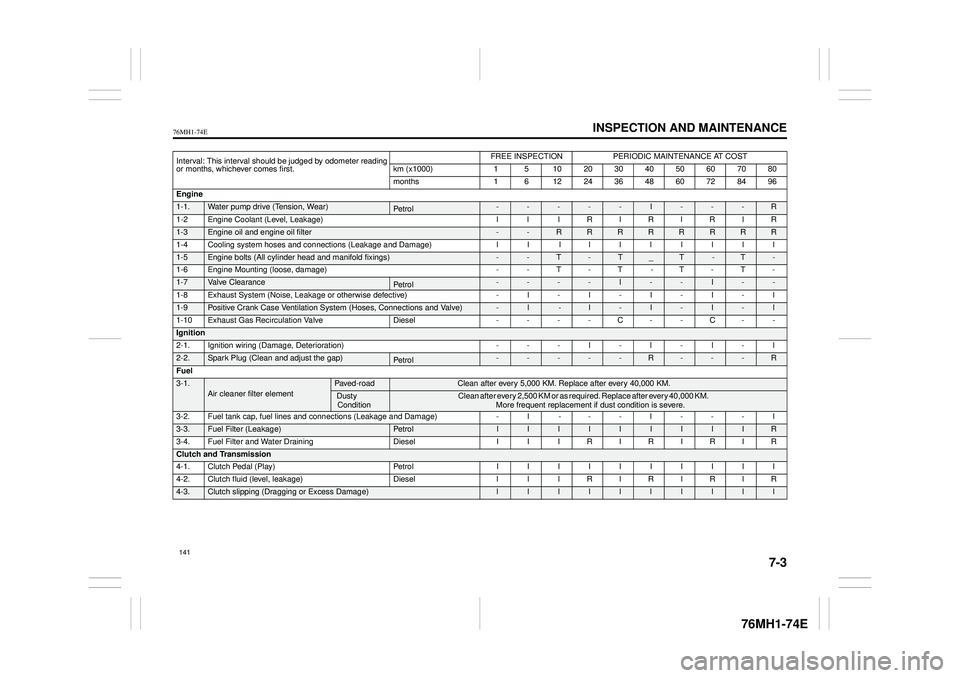
Interval: This interval should be judged by odometer reading or months, whichever comes first.
FREE INSPECTIONPERIODIC MAINTENANCE AT COST
km (x1000) 1 5 10 20 30 40 50 60 70 80
months 1 6 12 24 36 48 60 72 84 96
Engine
1-1.Water pump drive (Tension, Wear)Pe tro l-----I---R
1-2Engine Coolant (Level, Leakage) l l lRlRlRlR
1-3Engine oil and engine oil filter --RRRRRRRR
1-4 Cooling system hoses and connections (Leakage and Damage) l l l l llllll
1-5Engine bolts (All cylinder head and manifold fixings)--T-T_T -T-
1-6 Engine Mounting (loose, damage) - - T - T - T - T -
1-7Valve ClearancePe tro l----I--I--
1-8Exhaust System (Noise, Leakage or otherwise defective)
-l -l-I-I-l
1-10 Exhaust Gas Recirculation Valve Diesel - - - - C - - C - -
Ignition
2-1.Ignition wiring (Damage, Deterioration)---l-l-l-l
2-2.Spark Plug (Clean and adjust the gap)-----R---R
Fuel
3-1.Air cleaner filter elementPaved-road Clean after every 5,000 KM. Replace after every 40,000 KM.
Dusty Condition C l e a n a f t e r e v e r y 2 , 5 0 0 K M o r a s r e q u i r e d . R e p l a c e a f t e r e v e r y 4 0 , 0 0 0 K M . More frequent replacement if dust condition is severe.
3-2.Fuel tank cap, fuel lines and connections (Leakage and Damage)-l ---l---l
3-3.Fuel Filter (Leakage)Pe tro lIIIIIIIIIR
3-4.Fuel Filter and Water DrainingDieselIIIRIRIRIR
Clutch and Transmission
4-1.Clutch Pedal (Play)IIIIIIIIII
4-2.Clutch fluid (level, leakage)DiesellllRlRlRlR
4-3.Clutch slipping (Dragging or Excess Damage)llllllllll
141
Page 153 of 201
7-4
INSPECTION AND MAINTENANCE
76MH1-74E
76MH1-74E
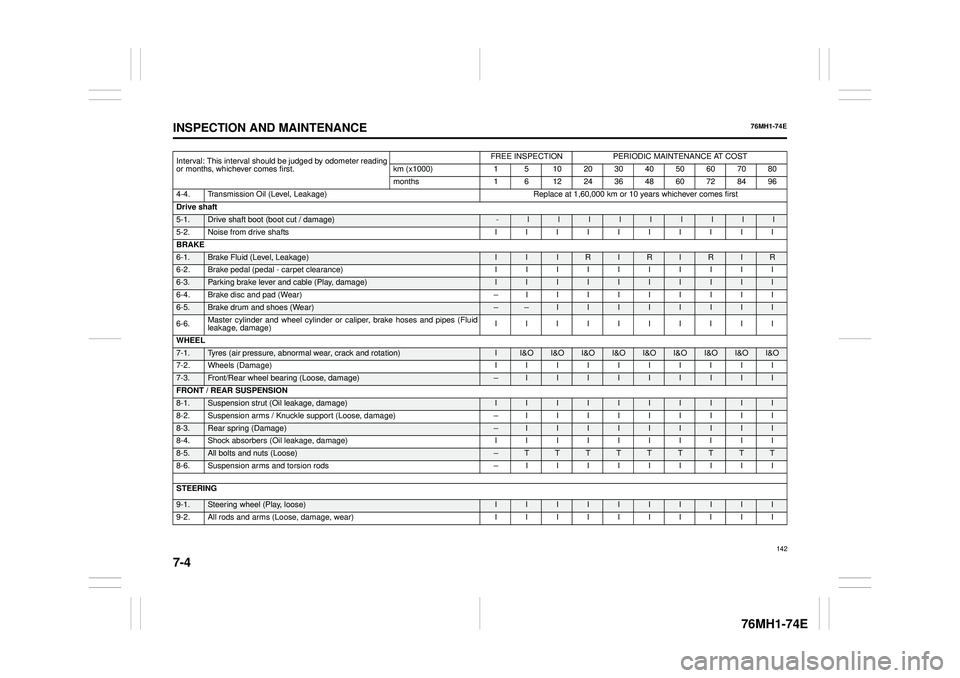
Interval: This interval should be judged by odometer reading or months, whichever comes first.
FREE INSPECTIONPERIODIC MAINTENANCE AT COST
km (x1000) 1 5 10 20 30 40 50 60 70 80
months 1 6 12 24 36 48 60 72 84 96
4-4. Transmission Oil (Level, Leakage)Replace at 1,60,000 km or 10 years whichever comes first
Drive shaft
5-1.Drive shaft boot (boot cut / damage)-lllllllll
5-2. Noise from drive shafts I I I I I I I I I I
BRAKE
6-1. Brake Fluid (Level, Leakage) I I I R I R I R I R
6-2. Brake pedal (pedal - carpet clearance) I I I I I I I I I I
6-3. Parking brake lever and cable (Play, damage) I I I I I I I I I I
6-4. Brake disc and pad (Wear) – I I I I I I I I I
6-5.Brake drum and shoes (Wear) – – I I I I I I I I
6-6. Master cylinder and wheel cylinder or caliper, brake hoses and pipes (Fluid leakage, damage) IIIIIIIIII
WHEEL
7-1. Tyres (air pressure, abnormal wear, crack and rotation) II&O I&OI&OI&OI&OI&OI&O I&OI&O
7-2. Wheels (Damage) I I I I I I I I I I
7-3. Front/Rear wheel bearing (Loose, damage) –I I I I I I I I I
FRONT / REAR SUSPENSION
8-1. Suspension strut (Oil leakage, damage) I I I I I I I I I I
8-2. Suspension arms / Knuckle supp ort (Loose, damage) – I I I I I I I I I
8-3. Rear spring (Damage) – I I I I I I I I I
8-4. Shock absorbers (Oil leakage, damage) I I I I I I I I I I
8-5.All bolts and nuts (Loose)– T T T T T T T T T
8-6. Suspension arms and torsion rods – I I I I I I I I I
STEERING 9-1.Steering wheel (Play, loose) I I I I I I I I I I
9-2. All rods and arms (Loose, damage, wear) I I I I I I I I I I
142
Page 154 of 201
7-5
INSPECTION AND MAINTENANCE
76MH1-74E
76MH1-74E
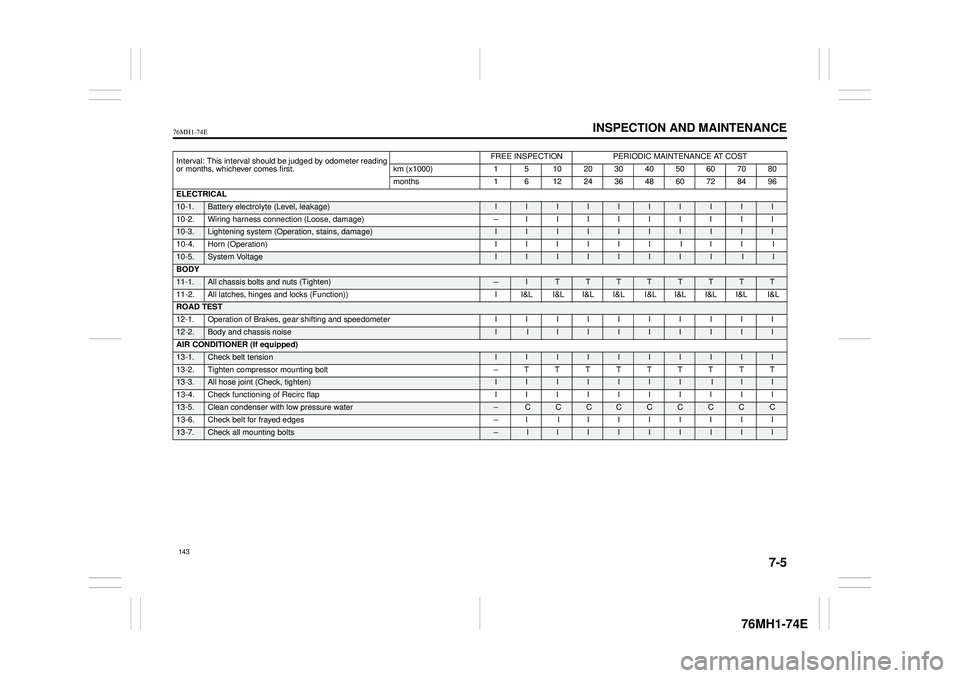
Interval: This interval should be judged by odometer reading or months, whichever comes first.
FREE INSPECTIONPERIODIC MAINTENANCE AT COST
km (x1000) 1 5 10 20 30 40 50 60 70 80
months 1 6 12 24 36 48 60 72 84 96
ELECTRICAL
10-1. Battery electrolyte (Level, leakage) I I I I I I I I I I
10-2. Wiring harness connection (Loose, damage) – I I I I I I I I I
10-3. Lightening system (Operat ion, stains, damage) I I I I I I I I I I
10-4. Horn (Operation) I I I I I I I I I I
10-5.System Voltage II I I I I I I I I
BODY
11-1. All chassis bolts and nuts (Tighten) – I T T T T T T T T
11-2. All latches, hinges and locks (Function)) I I&L I&L I&L I&L I&L I&L I&L I&L I&L
ROAD TEST
12-1. Operation of Brakes, gear shifting and speedometer I I I I I I I I I I
12-2.Body and chassis noise I I I I I I I I I I
AIR CONDITIONER (If equipped)
13-1. Check belt tension I I I I I I I I I I
13-2. Tighten compressor mounting bolt – T T T T T T T T T
13-3. All hose joint (Check, tighten) I I I I II I I I I
13-4. Check functioning of Recirc flap I I I I I I I I I I
13-5. Clean condenser with low pressure water – C C CCC C C C C
13-6. Check belt for frayed edges – I I I I I I I I I
13-7.Check all mounting bolts – I I I I I I I I I
143