wheel SUZUKI CELERIO 2015 Owner's Manual
[x] Cancel search | Manufacturer: SUZUKI, Model Year: 2015, Model line: CELERIO, Model: SUZUKI CELERIO 2015Pages: 201, PDF Size: 5.82 MB
Page 167 of 201
7-18
INSPECTION AND MAINTENANCE
76MH1-74E
76MH1-74E
Tires
68KH075
The front and rear tire pressure specifica- tions for your vehicle are listed on the TireInformation Label. Both the front and rear tires should have the specified tire pres- sure.Note that the value does not apply to the compact spare tire, if equipped.
Tire InspectionInspect your vehicle’s tires at least once a month by performing the following checks:
1) Measure the air pressure with a tire gauge. Adjust the pressure if neces- sary. Remember to check the spare tire, too.
52KM110
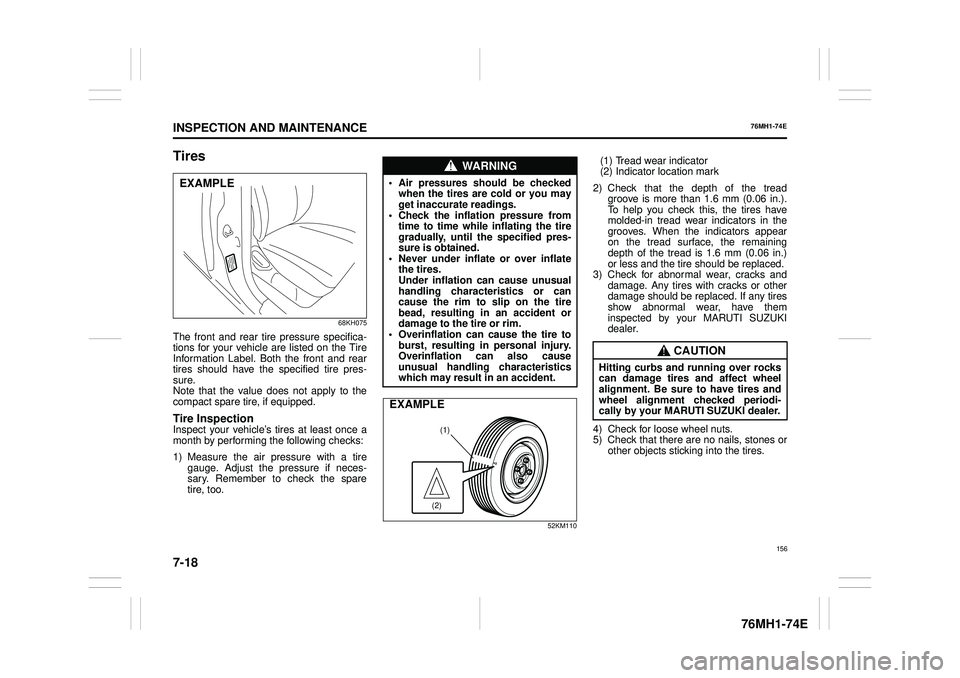
(1) Tread wear indicator(2) Indicator location mark
2) Check that the depth of the tread groove is more than 1.6 mm (0.06 in.).To help you check this, the tires have molded-in tread wear indicators in the grooves. When the indicators appearon the tread surface, the remaining depth of the tread is 1.6 mm (0.06 in.) or less and the tire should be replaced.3) Check for abnormal wear, cracks and damage. Any tires with cracks or other damage should be replaced. If any tiresshow abnormal wear, have them inspected by your MARUTI SUZUKI dealer.
4) Check for loose wheel nuts. 5) Check that there are no nails, stones orother objects sticking into the tires.
EXAMPLE
WA R N I N G
• Air pressures should be checkedwhen the tires are cold or you mayget inaccurate readings. • Check the inflation pressure from time to time whil e inflating the tire gradually, until the specified pres- sure is obtained. • Never under inflate or over inflatethe tires. Under inflation can cause unusual handling characteristics or cancause the rim to slip on the tire bead, resulting in an accident or damage to the tire or rim.• Overinflation can cause the tire to burst, resulting in personal injury. Overinflation can also causeunusual handling characteristics which may result in an accident.
(1)
(2)
EXAMPLE
CAUTION
Hitting curbs and running over rocks can damage tires and affect wheelalignment. Be sure to have tires and wheel alignment checked periodi- cally by your MARUTI SUZUKI dealer.
156
Page 168 of 201
7-19
INSPECTION AND MAINTENANCE
76MH1-74E
76MH1-74E
Tire Rotation
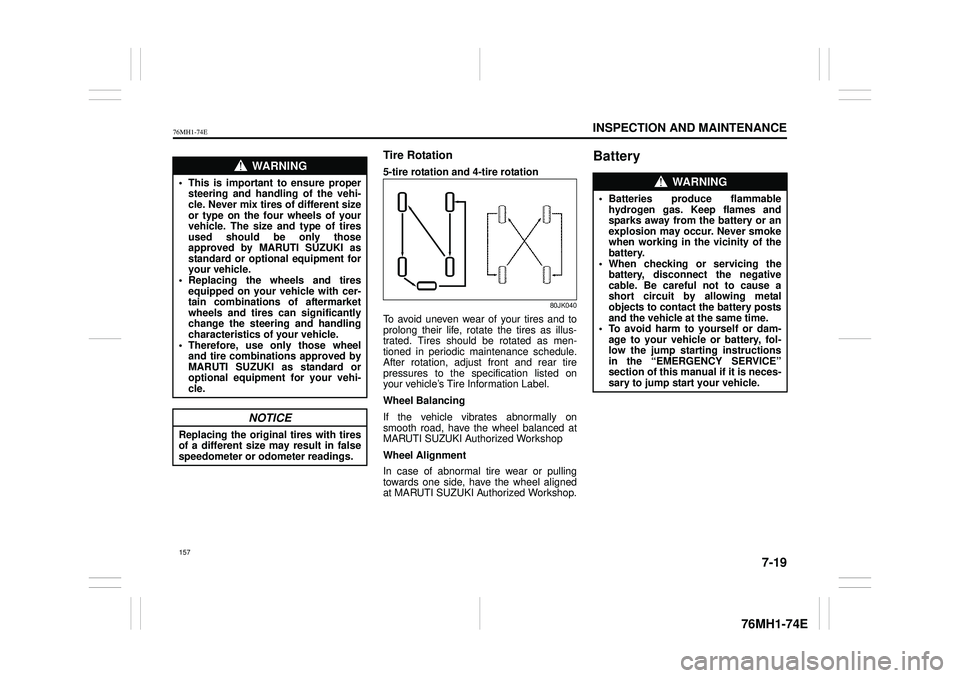
5-tire rotation and 4-tire rotation
80JK040
To avoid uneven wear of your tires and to prolong their life, rotate the tires as illus- trated. Tires should be rotated as men-tioned in periodic maintenance schedule. After rotation, adjust front and rear tire pressures to the specification listed onyour vehicle’s Tire Information Label.
Wheel Balancing
If the vehicle vibrates abnormally on smooth road, have the wheel balanced atMARUTI SUZUKI Authorized Workshop
Wheel Alignment
In case of abnormal tire wear or pulling towards one side, have the wheel aligned at MARUTI SUZUKI Authorized Workshop.
BatteryWA R N I N G
• This is important to ensure propersteering and handling of the vehi-cle. Never mix tires of different size or type on the four wheels of your vehicle. The size and type of tiresused should be only those approved by MARUTI SUZUKI as standard or optional equipment foryour vehicle. • Replacing the wheels and tires equipped on your vehicle with cer-tain combinations of aftermarket wheels and tires can significantly change the steering and handlingcharacteristics of your vehicle. • Therefore, use only those wheel and tire combinations approved byMARUTI SUZUKI as standard or optional equipment for your vehi- cle.
NOTICE
Replacing the original tires with tires of a different size may result in false speedometer or odometer readings.
WA R N I N G
• Batteries produce flammable hydrogen gas. Keep flames and sparks away from the battery or an explosion may occur. Never smokewhen working in the vicinity of the battery. • When checking or servicing thebattery, disconnect the negative cable. Be careful not to cause a short circuit by allowing metalobjects to contact the battery posts and the vehicle at the same time. • To avoid harm to yourself or dam-age to your vehicl e or battery, fol- low the jump starting instructions in the “EMERGENCY SERVICE”section of this manual if it is neces- sary to jump start your vehicle.
157
Page 174 of 201
7-25
INSPECTION AND MAINTENANCE
76MH1-74E
76MH1-74E
76MH0A008
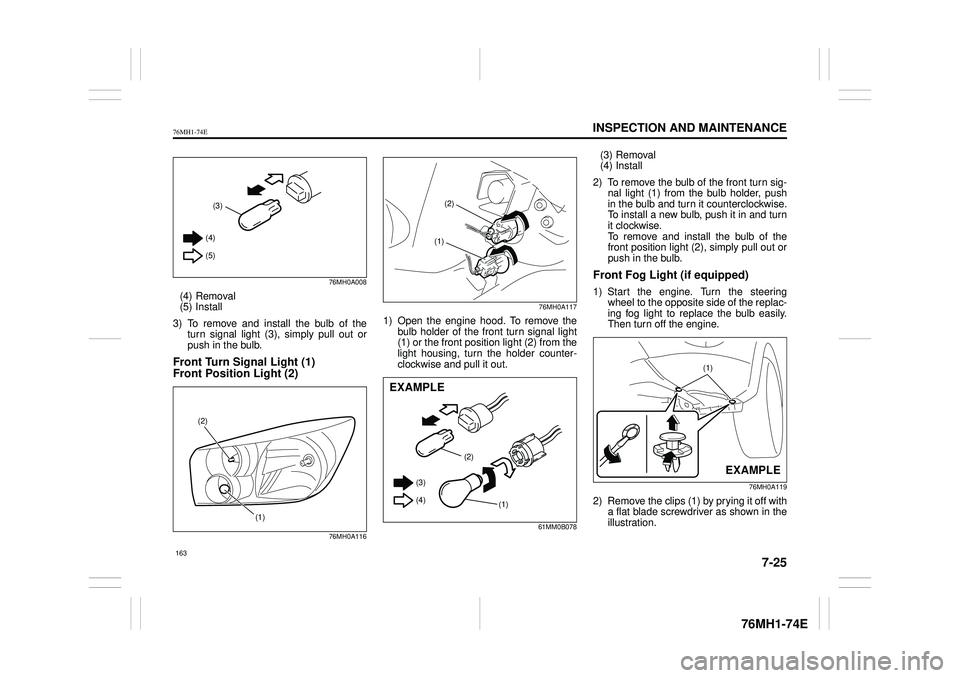
(4) Removal (5) Install
3) To remove and install the bulb of the turn signal light (3), simply pull out orpush in the bulb.
Front Turn Signal Light (1)
Front Position Light (2)
76MH0A116
76MH0A117
1) Open the engine hood. To remove the bulb holder of the front turn signal light (1) or the front position light (2) from thelight housing, turn the holder counter- clockwise and pull it out.
61MM0B078
(3) Removal(4) Install
2) To remove the bulb of the front turn sig- nal light (1) from the bulb holder, push in the bulb and turn it counterclockwise.To install a new bulb, push it in and turn it clockwise. To remove and install the bulb of thefront position light (2), simply pull out or push in the bulb.
Front Fog Light (if equipped)
1) Start the engine. Turn the steeringwheel to the opposite side of the replac- ing fog light to replace the bulb easily.Then turn off the engine.
76MH0A119
2) Remove the clips (1) by prying it off witha flat blade screwdriver as shown in theillustration.
(3)
(4)
(5)
(1)
(2)
(2)
(1)
(2)
(1)
(3)
(4)
EXAMPLE
(1)
EXAMPLE
163
Page 181 of 201
EMERGENCY SERVICE
76MH1-74E
76MH1-74E
170
EMERGENCY SERVICETire Changing Tool ............................................................. 8-1
Jacking Instructions ........................................................... 8-1
Changing Wheels ................................................................ 8-3
Jump Starting Instructions ................................................ 8-4
Towing .................................................................................. 8-5
If the Starter Does Not Operate .......................................... 8-6
If the Engine is Flooded ...................................................... 8-6
If the Engine Overheats ...................................................... 8-6
Page 182 of 201
8-1
EMERGENCY SERVICE
76MH1-74E
76MH1-74E
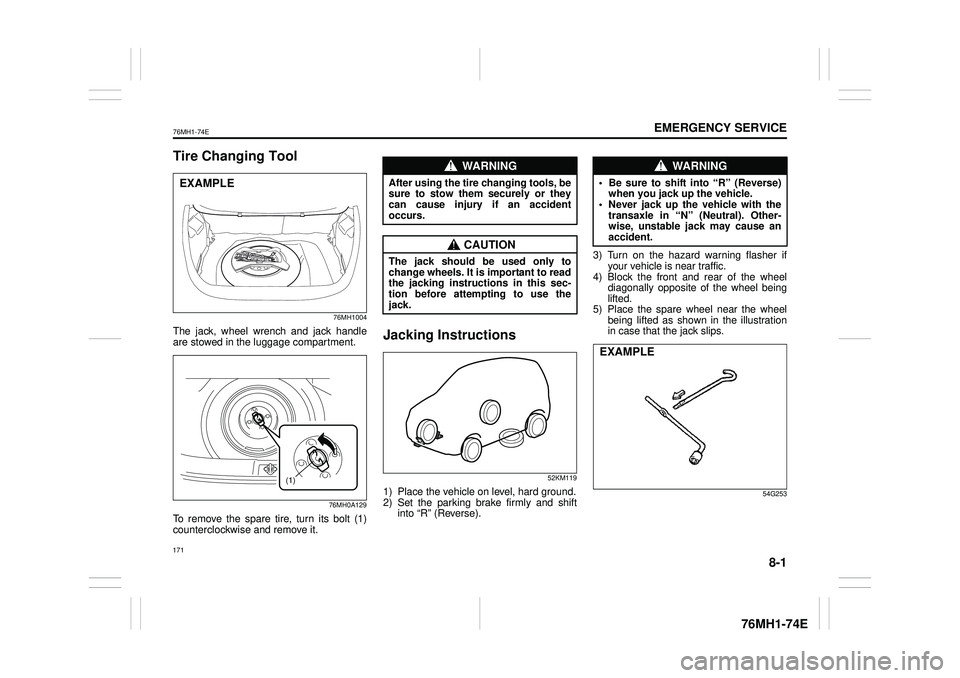
Tire Changing Tool
76MH1004
The jack, wheel wrench and jack handle are stowed in the luggage compartment.
76MH0A129
To remove the spare tire, turn its bolt (1) counterclockwise and remove it.
Jacking Instructions
52KM119
1) Place the vehicle on level, hard ground. 2) Set the parking brake firmly and shift into “R” (Reverse).
3) Turn on the hazard warning flasher if your vehicle is near traffic. 4) Block the front and rear of the wheel diagonally opposite of the wheel beinglifted. 5) Place the spare wheel near the wheel being lifted as shown in the illustrationin case that the jack slips.
54G253
EXAMPLE
(1)
WA R N I N G
After using the tire changing tools, besure to stow them securely or theycan cause injury if an accident occurs.
CAUTION
The jack should be used only to change wheels. It is important to readthe jacking instructions in this sec- tion before attemp ting to use the jack.
WA R N I N G
• Be sure to shift into “R” (Reverse) when you jack up the vehicle.• Never jack up the vehicle with the transaxle in “N” (Neutral). Other- wise, unstable jack may cause anaccident.
EXAMPLE
171
Page 183 of 201
8-2
EMERGENCY SERVICE
76MH1-74E
76MH1-74E
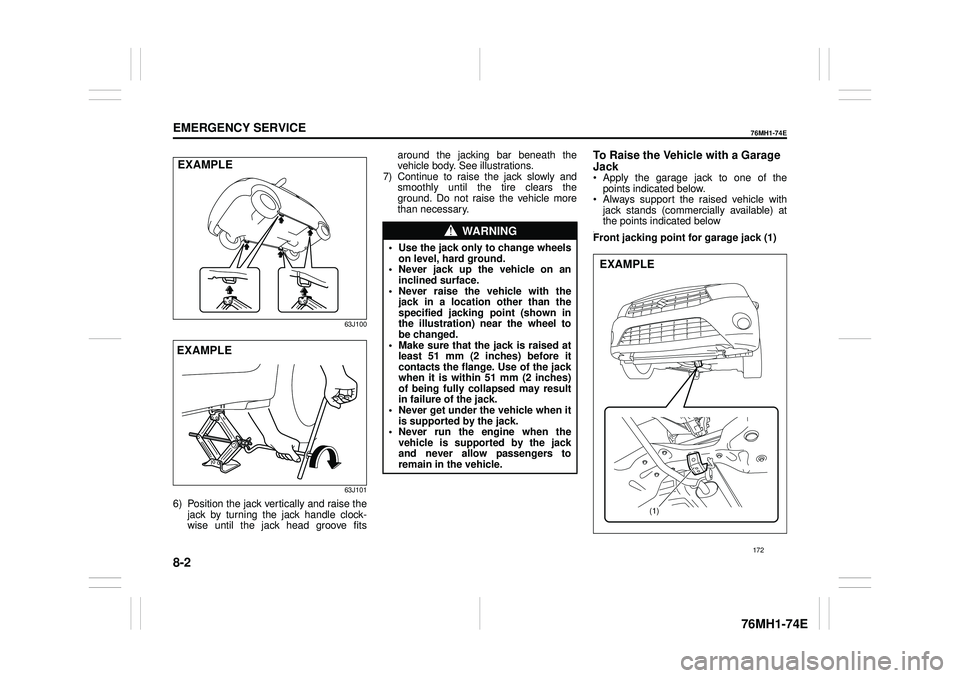
63J100
63J101
6) Position the jack vertically and raise the jack by turning the jack handle clock- wise until the jack head groove fits
around the jacking bar beneath the vehicle body. See illustrations. 7) Continue to raise the jack slowly andsmoothly until the tire clears the ground. Do not raise the vehicle more than necessary.
To Raise the Vehicle with a Garage
Jack Apply the garage jack to one of the points indicated below. Always support the raised vehicle with jack stands (commercially available) at the points indicated below.Front jacking point for garage jack (1)
EXAMPLE
EXAMPLE
WA R N I N G
• Use the jack only to change wheelson level, hard ground.• Never jack up the vehicle on an inclined surface. • Never raise the vehicle with thejack in a location other than the specified jacking point (shown in the illustration) near the wheel tobe changed. • Make sure that the jack is raised at least 51 mm (2 inches) before itcontacts the flange. Use of the jack when it is within 51 mm (2 inches) of being fully collapsed may resultin failure of the jack. • Never get under the vehicle when it is supported by the jack.• Never run the engine when the vehicle is supported by the jack and never allow passengers toremain in the vehicle.
(1)
EXAMPLE
172
Page 184 of 201
8-3
EMERGENCY SERVICE
76MH1-74E
76MH1-74E
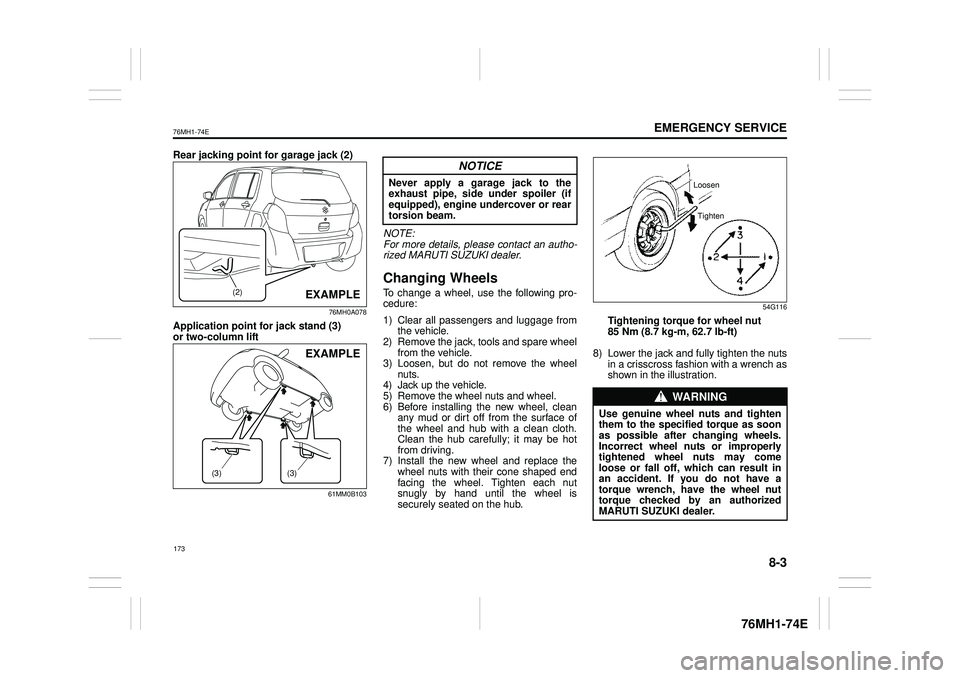
Rear jacking point for garage jack (2)
76MH0A078
Application point for jack stand (3) or two-column lift
61MM0B103
NOTE:For more details, please contact an autho- rized MARUTI SUZUKI dealer.
Changing Wheels
To change a wheel, use the following pro-cedure:
1) Clear all passengers and luggage from the vehicle. 2) Remove the jack, tools and spare wheel from the vehicle.3) Loosen, but do not remove the wheel nuts. 4) Jack up the vehicle.5) Remove the wheel nuts and wheel. 6) Before installing the new wheel, clean any mud or dirt off from the surface ofthe wheel and hub with a clean cloth. Clean the hub carefully; it may be hot from driving.7) Install the new wheel and replace the wheel nuts with their cone shaped end facing the wheel. Tighten each nutsnugly by hand until the wheel is securely seated on the hub.
54G116
Tightening torque for wheel nut85 Nm (8.7 kg -m, 62.7 lb-ft)
8) Lower the jack and fully tighten the nuts in a crisscross fashion with a wrench as shown in the illustration.
(2)EXAMPLE
(3)(3)
EXAMPLE
NOTICE
Never apply a garage jack to theexhaust pipe, side under spoiler (ifequipped), engine undercover or rear torsion beam.
WA R N I N G
Use genuine wheel nuts and tighten them to the specified torque as soonas possible after changing wheels. Incorrect wheel nuts or improperly tightened wheel nuts may comeloose or fall off, which can result in an accident. If you do not have a torque wrench, have the wheel nuttorque checked by an authorized MARUTI SUZUKI dealer.
Loosen
Tighten
173
Page 185 of 201

8-4
EMERGENCY SERVICE
76MH1-74E
76MH1-74E
Full Wheel Cover (if equipped)
60G309
Insert a piece of cloth between the spokes of the wheel cover and try to pull the cover outward (as shown in figure). Take out thedetached wheel cover from the wheel rim. For installation first match the slot at the wheel cover with the air filling nozzle of the wheel. Apply equal pressure at the circum- ference of the wheel cover to fix it in thewheel rim.
74LHT0860
When installing the cover, make sure that itis positioned so that it does not cover orfoul the air valve.
Jump Starting Instructions
When Jump Starting Your Vehicle,
Use the Following Procedure:1) Use only a 12-volt battery to jump start your vehicle. Position the good 12-volt battery close to your vehicle so that thejump leads will reach both batteries. When using a battery installed on another vehicle, DO NOT LET THEVEHICLES TOUCH. Set the parking brakes fully on both vehicles. 2) Turn off all vehicle accessories, exceptthose necessary for safety reasons (for example, headlights or hazard lights).
54MN259
EXAMPLE
EXAMPLE
WA R N I N G
• Never attempt to jump start your vehicle if the battery appears to be frozen. Batteries in this condition may explode or rupture if jumpstarting is attempted. • When making jump lead connec- tions, be certain that your handsand the jump leads remain clear from pulleys, belts, or fans. • Batteries produce flammablehydrogen gas. Keep flames and sparks away from the battery or an explosion may occur. Never smokewhen working in the vicinity of the battery. • If the booster battery you use forjump starting is installed in another vehicle, make sure the two vehicles are not touching each other.• If your battery discharges repeat- edly, for no apparent reason, have your vehicle inspected by anauthorized MARUTI SUZUKI dealer. • To avoid harm to yourself or dam- age to your vehicl e or battery, fol- low the jump starting instructions below precisely and in order. If you are in doubt, call for qualifiedroad service.
NOTICE
Your vehicle should not be started bypushing or towing. This startingmethod could result in permanent damage to the ca talytic converter. Use jump leads to start a vehicle witha weak or flat battery.
(2)
(1)
(3)2 3
4
1
EXAMPLE
174
Page 186 of 201
8-5
EMERGENCY SERVICE
76MH1-74E
76MH1-74E
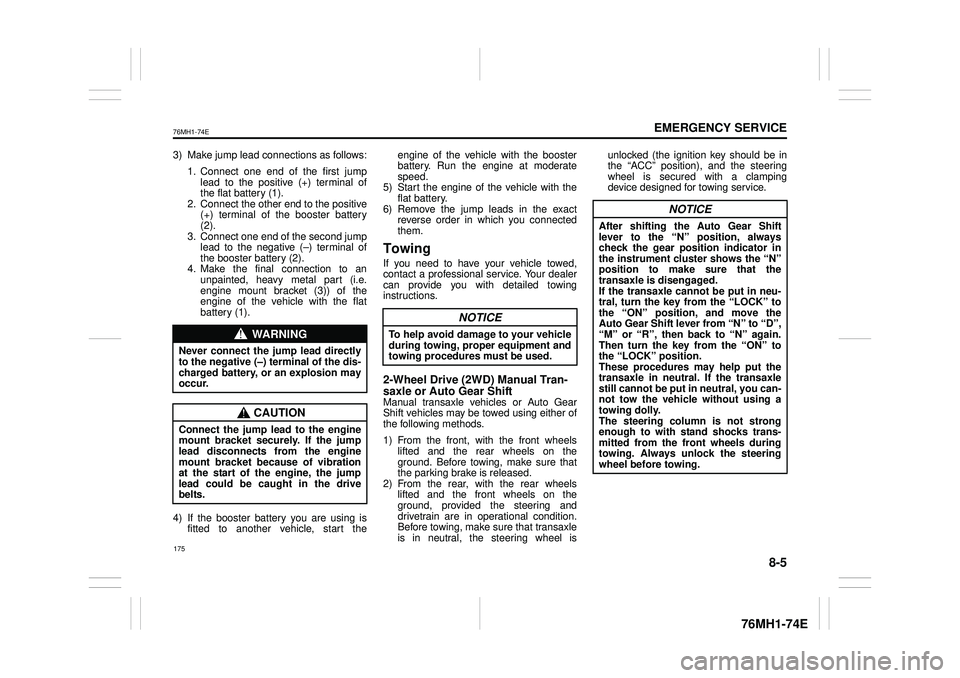
3) Make jump lead connections as follows:
1. Connect one end of the first jump lead to the positive (+) terminal of the flat battery (1). 2. Connect the other end to the positive(+) terminal of the booster battery (2). 3. Connect one end of the second jumplead to the negative (–) terminal of the booster battery (2). 4. Make the final connection to anunpainted, heavy metal part (i.e. engine mount bracket (3)) of the engine of the vehicle with the flatbattery (1).
4) If the booster battery you are using is fitted to another vehicle, start the
engine of the vehicle with the booster battery. Run the engine at moderate speed.5) Start the engine of the vehicle with the flat battery. 6) Remove the jump leads in the exactreverse order in which you connected them.
Towing
If you need to have your vehicle towed, contact a professional service. Your dealercan provide you with detailed towing instructions.
2-Wheel Drive (2WD) Manual Tran- saxle or Auto Gear ShiftManual transaxle vehicles or Auto Gear Shift vehicles may be towed using either of the following methods.
1) From the front, with the front wheels lifted and the rear wheels on the ground. Before towing, make sure thatthe parking brake is released. 2) From the rear, with the rear wheels lifted and the front wheels on theground, provided the steering and drivetrain are in operational condition. Before towing, make sure that transaxleis in neutral, the steering wheel is
unlocked (the ignition key should be in the “ACC” position), and the steering wheel is secured with a clampingdevice designed for towing service.
WA R N I N G
Never connect the jump lead directlyto the negative (–) terminal of the dis- charged battery, or an explosion may occur.
CAUTION
Connect the jump le ad to the engine mount bracket securely. If the jump lead disconnects from the engine mount bracket because of vibrationat the start of the engine, the jump lead could be caught in the drive belts.
NOTICE
To help avoid damage to your vehicle during towing, proper equipment and towing procedures must be used.
NOTICE
After shifting the Auto Gear Shiftlever to the “N” position, always check the gear position indicator in the instrument cluster shows the “N”position to make sure that the transaxle is disengaged. If the transaxle cannot be put in neu-tral, turn the key from the “LOCK” to the “ON” position, and move the Auto Gear Shift lever from “N” to “D”,“M” or “R”, then back to “N” again. Then turn the key from the “ON” to the “LOCK” position.These procedures may help put the transaxle in neutral. If the transaxle still cannot be put in neutral, you can-not tow the vehicle without using a towing dolly. The steering column is not strongenough to with stand shocks trans- mitted from the fr ont wheels during towing. Always unlock the steeringwheel before towing.
175
Page 192 of 201
9-3
APPEARANCE CARE
76MH1-74E
76MH1-74E
Caring for Aluminum Wheels
NOTE: • Do not use an acidic or alkaline deter- gent to wash aluminum wheels. These types of detergent will cause permanentspots, discoloration and cracks on fin- ished surfaces. • Do not use a bristle brush and soap con-taining an abrasive material. These will damage finished surfaces.
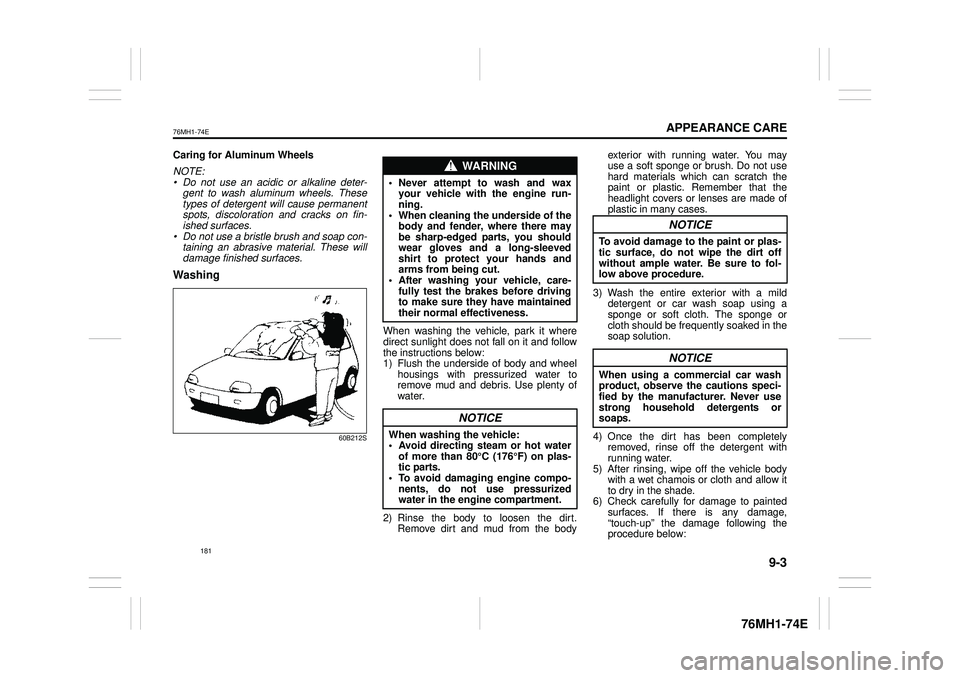
Washing
60B212S
When washing the vehicle, park it wheredirect sunlight does not fall on it and follow the instructions below:1) Flush the underside of body and wheel housings with pressurized water to remove mud and debris. Use plenty ofwater.
2) Rinse the body to loosen the dirt. Remove dirt and mud from the body
exterior with running water. You may use a soft sponge or brush. Do not use hard materials which can scratch thepaint or plastic. Remember that the headlight covers or lenses are made of plastic in many cases.
3) Wash the entire exterior with a mild detergent or car wash soap using a sponge or soft cloth. The sponge or cloth should be frequently soaked in thesoap solution.
4) Once the dirt has been completely removed, rinse off the detergent with running water. 5) After rinsing, wipe off the vehicle bodywith a wet chamois or cloth and allow it to dry in the shade. 6) Check carefully for damage to paintedsurfaces. If there is any damage, “touch-up” the damage following the procedure below:
WA R N I N G
• Never attempt to wash and waxyour vehicle with the engine run-ning. • When cleaning the underside of the body and fender, where there maybe sharp-edged parts, you should wear gloves and a long-sleeved shirt to protect your hands andarms from being cut. • After washing your vehicle, care- fully test the brakes before drivingto make sure they have maintained their normal effectiveness.
NOTICE
When washing the vehicle: • Avoid directing steam or hot water of more than 80