ECU SUZUKI CELERIO 2015 Owner's Guide
[x] Cancel search | Manufacturer: SUZUKI, Model Year: 2015, Model line: CELERIO, Model: SUZUKI CELERIO 2015Pages: 201, PDF Size: 5.82 MB
Page 148 of 201

6-2
VEHICLE LOADING AND TOWING
76MH1-74E
76MH1-74E
TOWING INSTRUCTION TABLE
76MH022
A: 2WD VEHICLES WITH MANUAL TRANSAXLE OR AUTO GEAR SHIFT 1) Secure the front wheels on a towingdolly according to the instructions pro- vided by the dolly manufacturer. 2) Release the parking brake.
76MH023
B: 2WD VEHICLES WITH MANUAL TRANSAXLE OR AUTO GEAR SHIFT 1) Shift the gearshift lever into neutral. 2) Turn the ignition key to the
Page 166 of 201
7-17
INSPECTION AND MAINTENANCE
76MH1-74E
76MH1-74E
NOTE: When measuring the distance between the brake pedal and floor wall, be sure not toinclude the floor mat or rubber on the floor wall in your measurement.
60G104S
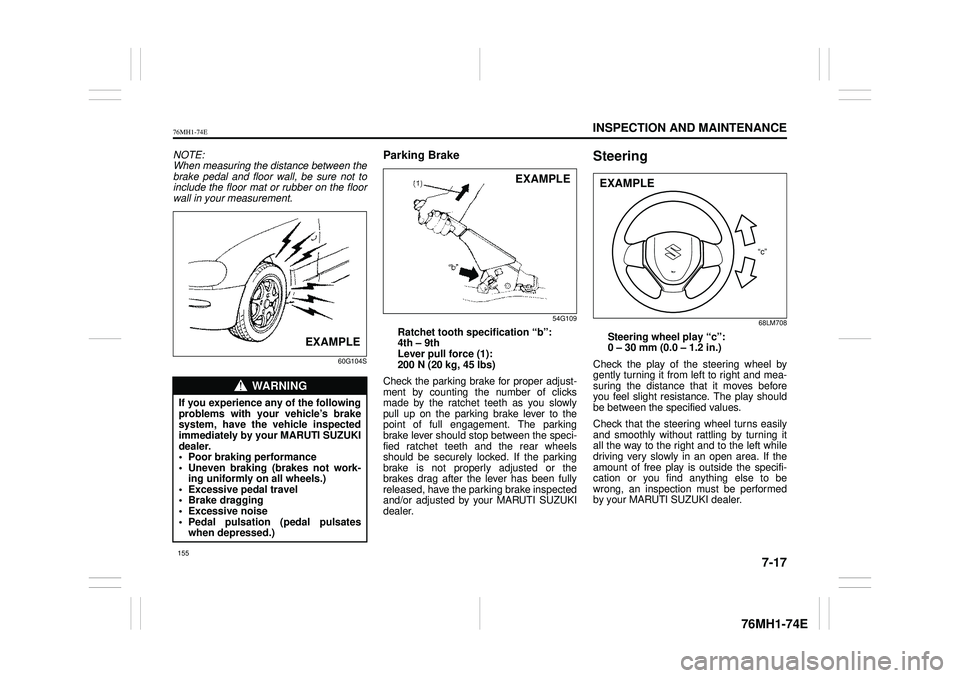
Parking Brake
54G109
Ratchet tooth speci fication “b”: 4th – 9th Lever pull force (1): 200 N (20 kg, 45 lbs)
Check the parking brake for proper adjust- ment by counting the number of clicksmade by the ratchet teeth as you slowly pull up on the parking brake lever to the point of full engagement. The parkingbrake lever should stop between the speci- fied ratchet teeth and the rear wheels should be securely locked. If the parkingbrake is not properly adjusted or the brakes drag after the lever has been fully released, have the parking brake inspectedand/or adjusted by your MARUTI SUZUKI dealer.
Steering
68LM708
Steering wheel play “c”: 0 – 30 mm (0.0 – 1.2 in.)
Check the play of the steering wheel by gently turning it from left to right and mea-suring the distance that it moves before you feel slight resistance. The play should be between the specified values.
Check that the steering wheel turns easily and smoothly without rattling by turning itall the way to the right and to the left while driving very slowly in an open area. If the amount of free play is outside the specifi-cation or you find anything else to be wrong, an inspection must be performed by your MARUTI SUZUKI dealer.
WA R N I N G
If you experience any of the following problems with your vehicle’s brake system, have the vehicle inspectedimmediately by your MARUTI SUZUKI dealer. • Poor braking performance• Uneven braking (brakes not work- ing uniformly on all wheels.) • Excessive pedal travel• Brake dragging • Excessive noise • Pedal pulsation (pedal pulsateswhen depressed.)
EXAMPLE
EXAMPLE
“c”
EXAMPLE
155
Page 169 of 201
7-20
INSPECTION AND MAINTENANCE
76MH1-74E
76MH1-74E
76MH0A136
For maintenance-free battery (cap-less type), you need not add water. For tradi-tional type battery, which has water filler caps, the level of the battery solution must be kept between the “MAX” and the “MIN”level lines at all times. If the level is found tobe below the “MIN” level line, add distilledwater to the “MAX” level line. You shouldperiodically check the battery, battery termi- nals, and battery hold-down bracket for cor- rosion. Remove corrosion using a stiff brushand ammonia mixed with water, or bakingsoda mixed with water. After removing cor-rosion, rinse with clean water.
If your vehicle is not going to be driven for amonth or longer, disconnect the cable fromthe negative terminal of the battery to help prevent discharge.
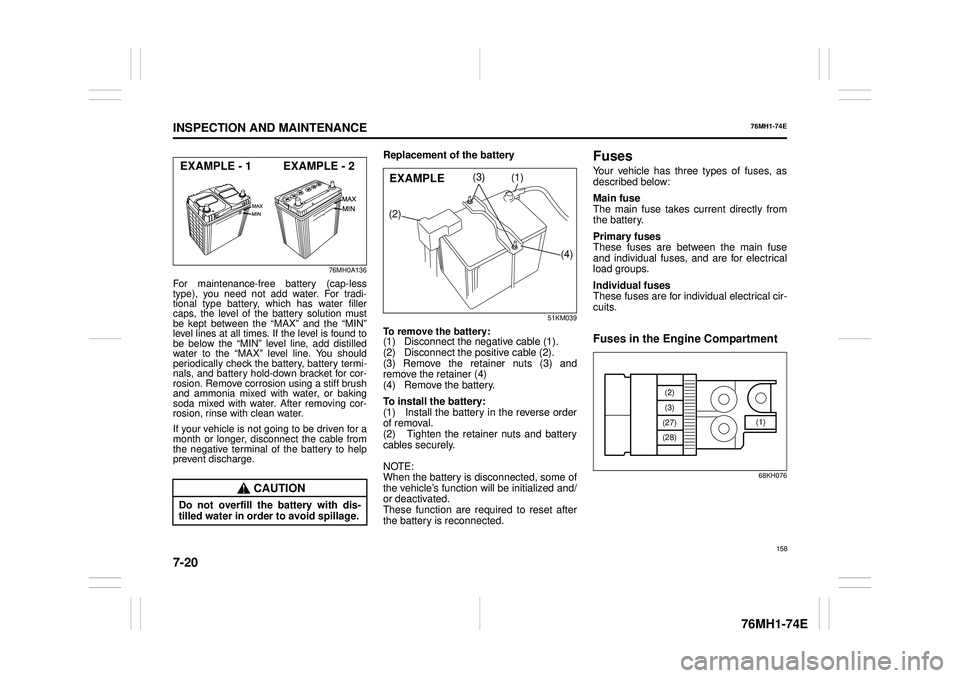
Replacement of the battery
51KM039
To remove the battery: (1) Disconnect the negative cable (1). (2) Disconnect the positive cable (2). (3) Remove the retainer nuts (3) andremove the retainer (4) (4) Remove the battery.
To install the battery: (1) Install the battery in the reverse order of removal. (2) Tighten the retainer nuts and battery cables securely.
NOTE: When the battery is disconnected, some of the vehicle’s function will be initialized and/or deactivated. These function are required to reset after the battery is reconnected.
Fuses
Your vehicle has three types of fuses, asdescribed below:
Main fuse The main fuse takes current directly fromthe battery.
Primary fuses These fuses are between the main fuse and individual fuses, and are for electrical load groups.
Individual fuses These fuses are for individual electrical cir-cuits.
Fuses in the Engine Compartment
68KH076
CAUTION
Do not overfill th e battery with dis- tilled water in order to avoid spillage.
EXAMPLE - 1 EXAMPLE - 2(1)
(2)
(3)
(4)
EXAMPLE
(1)
(2)
(3)
(27)
(28)
158
Page 179 of 201
7-30
INSPECTION AND MAINTENANCE
76MH1-74E
76MH1-74E
54G135
(1) Retainer
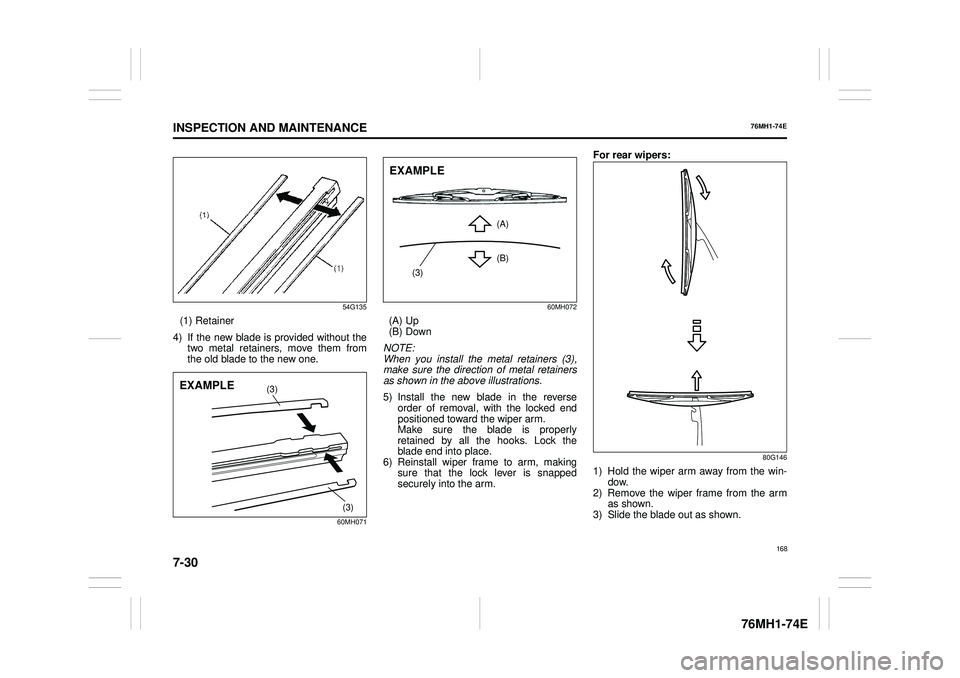
4) If the new blade is provided without the two metal retainers, move them from the old blade to the new one.
60MH071
60MH072
(A) Up (B) Down
NOTE: When you install the metal retainers (3), make sure the direction of metal retainersas shown in the above illustrations.
5) Install the new blade in the reverse order of removal, with the locked end positioned toward the wiper arm. Make sure the blade is properlyretained by all the hooks. Lock the blade end into place. 6) Reinstall wiper frame to arm, makingsure that the lock lever is snapped securely into the arm.
For rear wipers:
80G146
1) Hold the wiper arm away from the win- dow. 2) Remove the wiper frame from the armas shown. 3) Slide the blade out as shown.
(3)
(3)
EXAMPLE
(3)
(A)
(B)
EXAMPLE
168
Page 182 of 201
8-1
EMERGENCY SERVICE
76MH1-74E
76MH1-74E
Tire Changing Tool
76MH1004
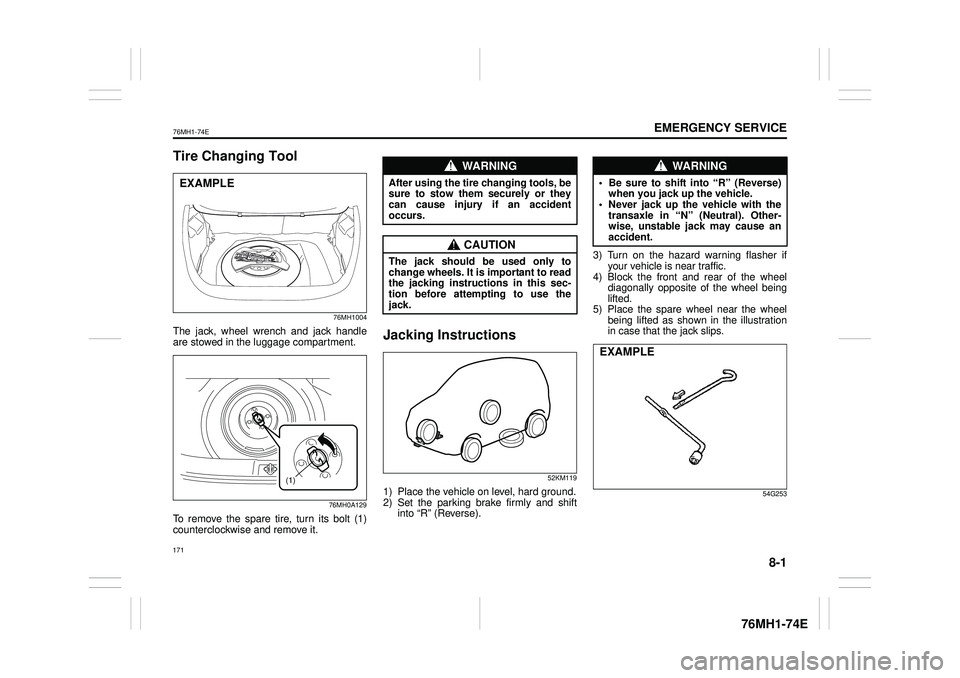
The jack, wheel wrench and jack handle are stowed in the luggage compartment.
76MH0A129
To remove the spare tire, turn its bolt (1) counterclockwise and remove it.
Jacking Instructions
52KM119
1) Place the vehicle on level, hard ground. 2) Set the parking brake firmly and shift into “R” (Reverse).
3) Turn on the hazard warning flasher if your vehicle is near traffic. 4) Block the front and rear of the wheel diagonally opposite of the wheel beinglifted. 5) Place the spare wheel near the wheel being lifted as shown in the illustrationin case that the jack slips.
54G253
EXAMPLE
(1)
WA R N I N G
After using the tire changing tools, besure to stow them securely or theycan cause injury if an accident occurs.
CAUTION
The jack should be used only to change wheels. It is important to readthe jacking instructions in this sec- tion before attemp ting to use the jack.
WA R N I N G
• Be sure to shift into “R” (Reverse) when you jack up the vehicle.• Never jack up the vehicle with the transaxle in “N” (Neutral). Other- wise, unstable jack may cause anaccident.
EXAMPLE
171
Page 184 of 201
8-3
EMERGENCY SERVICE
76MH1-74E
76MH1-74E
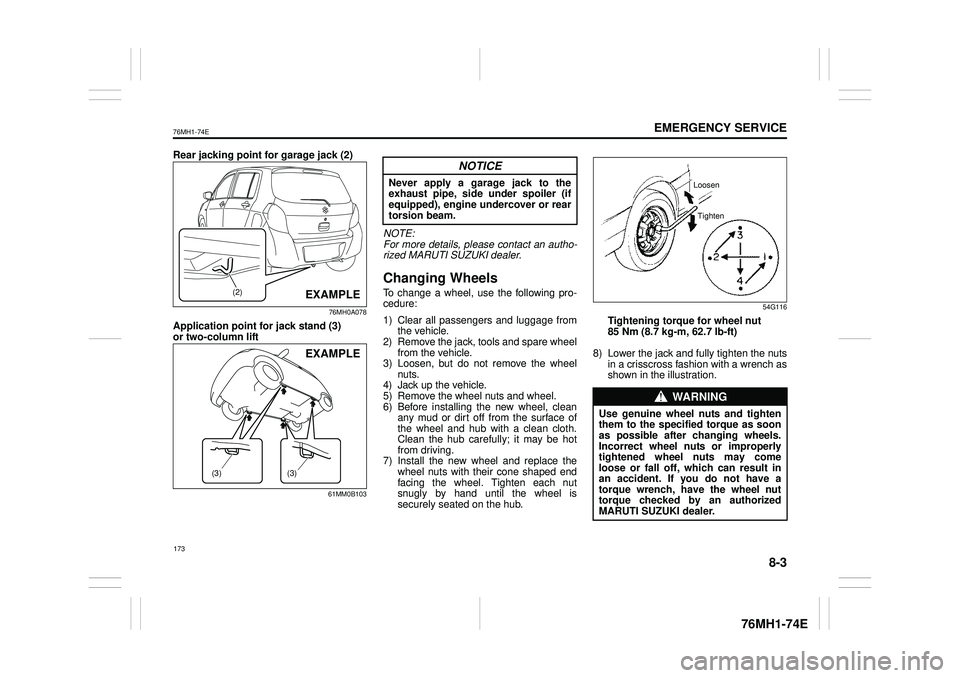
Rear jacking point for garage jack (2)
76MH0A078
Application point for jack stand (3) or two-column lift
61MM0B103
NOTE:For more details, please contact an autho- rized MARUTI SUZUKI dealer.
Changing Wheels
To change a wheel, use the following pro-cedure:
1) Clear all passengers and luggage from the vehicle. 2) Remove the jack, tools and spare wheel from the vehicle.3) Loosen, but do not remove the wheel nuts. 4) Jack up the vehicle.5) Remove the wheel nuts and wheel. 6) Before installing the new wheel, clean any mud or dirt off from the surface ofthe wheel and hub with a clean cloth. Clean the hub carefully; it may be hot from driving.7) Install the new wheel and replace the wheel nuts with their cone shaped end facing the wheel. Tighten each nutsnugly by hand until the wheel is securely seated on the hub.
54G116
Tightening torque for wheel nut85 Nm (8.7 kg -m, 62.7 lb-ft)
8) Lower the jack and fully tighten the nuts in a crisscross fashion with a wrench as shown in the illustration.
(2)EXAMPLE
(3)(3)
EXAMPLE
NOTICE
Never apply a garage jack to theexhaust pipe, side under spoiler (ifequipped), engine undercover or rear torsion beam.
WA R N I N G
Use genuine wheel nuts and tighten them to the specified torque as soonas possible after changing wheels. Incorrect wheel nuts or improperly tightened wheel nuts may comeloose or fall off, which can result in an accident. If you do not have a torque wrench, have the wheel nuttorque checked by an authorized MARUTI SUZUKI dealer.
Loosen
Tighten
173
Page 186 of 201
8-5
EMERGENCY SERVICE
76MH1-74E
76MH1-74E
3) Make jump lead connections as follows:
1. Connect one end of the first jump lead to the positive (+) terminal of the flat battery (1). 2. Connect the other end to the positive(+) terminal of the booster battery (2). 3. Connect one end of the second jumplead to the negative (–) terminal of the booster battery (2). 4. Make the final connection to anunpainted, heavy metal part (i.e. engine mount bracket (3)) of the engine of the vehicle with the flatbattery (1).
4) If the booster battery you are using is fitted to another vehicle, start the
engine of the vehicle with the booster battery. Run the engine at moderate speed.5) Start the engine of the vehicle with the flat battery. 6) Remove the jump leads in the exactreverse order in which you connected them.
Towing
If you need to have your vehicle towed, contact a professional service. Your dealercan provide you with detailed towing instructions.
2-Wheel Drive (2WD) Manual Tran- saxle or Auto Gear ShiftManual transaxle vehicles or Auto Gear Shift vehicles may be towed using either of the following methods.
1) From the front, with the front wheels lifted and the rear wheels on the ground. Before towing, make sure thatthe parking brake is released. 2) From the rear, with the rear wheels lifted and the front wheels on theground, provided the steering and drivetrain are in operational condition. Before towing, make sure that transaxleis in neutral, the steering wheel is
unlocked (the ignition key should be in the “ACC” position), and the steering wheel is secured with a clampingdevice designed for towing service.
WA R N I N G
Never connect the jump lead directlyto the negative (–) terminal of the dis- charged battery, or an explosion may occur.
CAUTION
Connect the jump le ad to the engine mount bracket securely. If the jump lead disconnects from the engine mount bracket because of vibrationat the start of the engine, the jump lead could be caught in the drive belts.
NOTICE
To help avoid damage to your vehicle during towing, proper equipment and towing procedures must be used.
NOTICE
After shifting the Auto Gear Shiftlever to the “N” position, always check the gear position indicator in the instrument cluster shows the “N”position to make sure that the transaxle is disengaged. If the transaxle cannot be put in neu-tral, turn the key from the “LOCK” to the “ON” position, and move the Auto Gear Shift lever from “N” to “D”,“M” or “R”, then back to “N” again. Then turn the key from the “ON” to the “LOCK” position.These procedures may help put the transaxle in neutral. If the transaxle still cannot be put in neutral, you can-not tow the vehicle without using a towing dolly. The steering column is not strongenough to with stand shocks trans- mitted from the fr ont wheels during towing. Always unlock the steeringwheel before towing.
175