Control SUZUKI CELERIO 2015 Owners Manual
[x] Cancel search | Manufacturer: SUZUKI, Model Year: 2015, Model line: CELERIO, Model: SUZUKI CELERIO 2015Pages: 201, PDF Size: 5.82 MB
Page 12 of 201
76MH1-74E
1
TABLE OF CONTENTSFUEL RECOMMENDATION1
BEFORE DRIVING2
OPERATING YOUR VEHICLE3
DRIVING TIPS4
OTHER CONTROLS AND EQUIPMENT5
VEHICLE LOADING AND TOWING6
INSPECTION AND MAINTENANCE7
EMERGENCY SERVICE8
APPEARANCE CARE9
GENERAL INFORMATION10
SPECIFICATIONS11
SERVICE NETWORK12
76MH1-74E
Page 20 of 201
0-8
76MH1-74E
55KS0-74E
10.All maintenance actions (as specified in the Owner’s Manualand Service Booklet) need to be followed and recorded in the manual for emission warranty.
11.The customer needs to produce the PUC (Pollution UnderControl) certificate valid for the period preceeding the testduring which the failure is discovered. The receipts (for themaintenance of the vehicle as per specification in Owner’sManual and Service Booklet from the date of original purchaseof the vehicle) will also be required.
Conditions under which the Emission Warranty is not APPLICABLE
1. In the absence of valid PUC certificate.
2. Vehicle not serviced from Maruti Suzuki authorised workshopas per the schedule specified in the Owner’s Manual.
3. Vehicle subjected to abnormal use (accident, motor race, ral-lies or for the purpose of establishing the records etc).
4. Use of non MGP (Maruti Geniune Part).
5. Vehicle tampered in an unauthorised manner.
6. Tampering with odometer so that the actual kilometer readingcan not be read.
7. Use of adulterated fuel and/or unspecified oils (Engine oil,Transmission oil and Brake oil etc).
Annexure - A
List of parts covered under Emission Warranty 1. Fuel Injection Assembly, Pressure Regulator, Throttle Body
Assembly.
2. Electronic Control Module (ECM).
3. Intake Manifold.
4. EGR valve.
5. Distributor and internal parts.
6. Ignition Coil.
7. Canister Assembly.
8. Vapour Liquid Seperator.
9. Fuel Tank and Filler Cap.
10. PCV (Positive Crankcase Ventilation) Valve.
11. Oil Filler Cap.
12. Catalytic Convertor.
13. Exhaust Manifold.
14. All Fuel Injection System related SENSORS.
15. High Pressure Fuel Pump.
16. Glow Plug.
17. Glow Plug Controller.
9
Page 22 of 201
76MH1-74E
BEFORE DRIVINGKeys ...................................................................................... 2-1
Door Locks .......................................................................... 2-2
Keyless Entry System Transmitte r (if equipped) ............. 2-5
Security System (if equipped) ............................................ 2-7
Windows .............................................................................. 2-10
Mirrors .................................................................................. 2-11
Front Seats .......................................................................... 2-13
Rear Seats ............................................................................ 2-13
Seat Belts and Child Restraint Systems ........................... 2-15
Supplemental Restraint System (air bags)
(if equipped) ......................................................................... 2-23
Instrument Cluster .............................................................. 2-28
Speedometer ....................................................................... 2-29
Tachometer (if equipped) ................................................... 2-29
Brightness Control .............................................................. 2-29
Information Display ............................................................. 2-30
Fuel Gauge ........................................................................... 2-31
Warning and Indicator Lights ............................................ 2-37
Lighting Control Lever ........................................................ 2-42
Front Fog Light Switch (if equipped) ................................ 2-43
Headlight Leveling Switch .................................................. 2-43
Turn Signal Control Lever .................................................. 2-44
Hazard Warning Switch ...................................................... 2-45
Windshield Wiper and Washer L ever ................................ 2-45
Tilt Steering Lock Lever (if equipped) ............................... 2-47
Horn ...................................................................................... 2-47
Heated Rear Window Switch (if equipped) ....................... 2-47
11
76MH1-74E
Page 32 of 201
2-10
BEFORE DRIVING
76MH1-74E
76MH1-74E
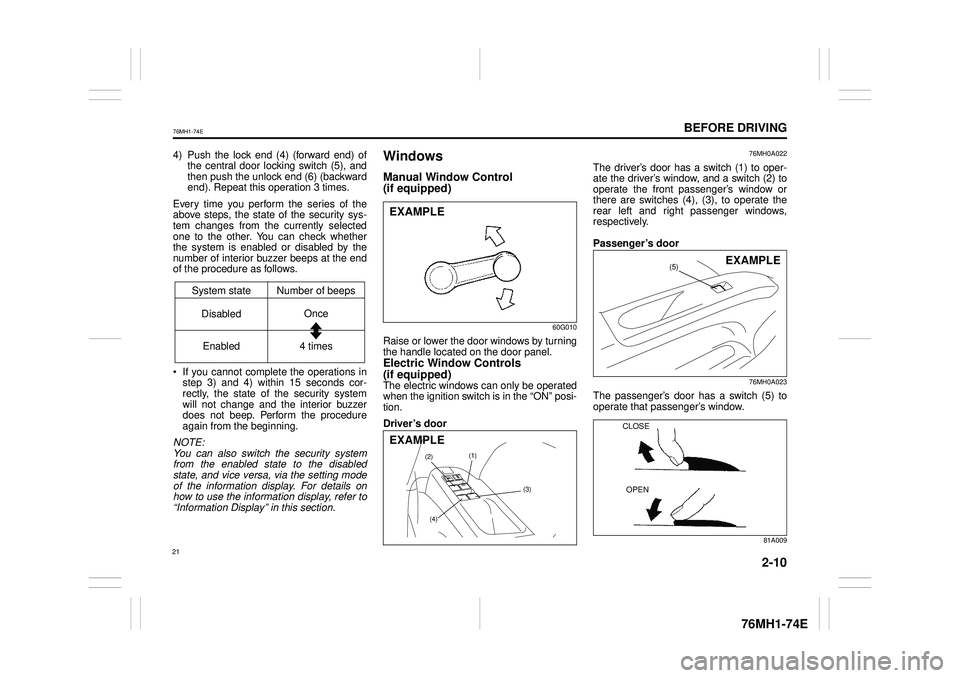
4) Push the lock end (4) (forward end) ofthe central door locking switch (5), and then push the unlock end (6) (backwardend). Repeat this operation 3 times.
Every time you perform the series of theabove steps, the state of the security sys- tem changes from the currently selected one to the other. You can check whetherthe system is enabled or disabled by the number of interior buzzer beeps at the end of the procedure as follows.
If you cannot complete the operations instep 3) and 4) within 15 seconds cor- rectly, the state of the security systemwill not change and the interior buzzer does not beep. Perform the procedure again from the beginning.
NOTE: You can also switch the security systemfrom the enabled state to the disabled state, and vice versa, via the setting mode of the information display. For details onhow to use the information display, refer to“Information Display” in this section.
Windows
Manual Window Control
(if equipped)
60G010
Raise or lower the door windows by turning the handle located on the door panel.
Electric Window Controls
(if equipped)The electric windows can only be operated when the ignition switch is in the “ON” posi- tion.
Driver’s door
76MH0A022
The driver’s door has a switch (1) to oper- ate the driver’s window, and a switch (2) tooperate the front passenger’s window or there are switches (4), (3), to operate the rear left and right passenger windows,respectively.
Passenger’s door
76MH0A023
The passenger’s door has a switch (5) to operate that passenger’s window.
81A009
System state Number of beeps
DisabledOnce
Enabled 4 times
EXAMPLE
(1)(2)
(3)
(4)
EXAMPLE
(5)EXAMPLE
CLOSE
OPEN
21
Page 34 of 201
2-12
BEFORE DRIVING
76MH1-74E
76MH1-74E
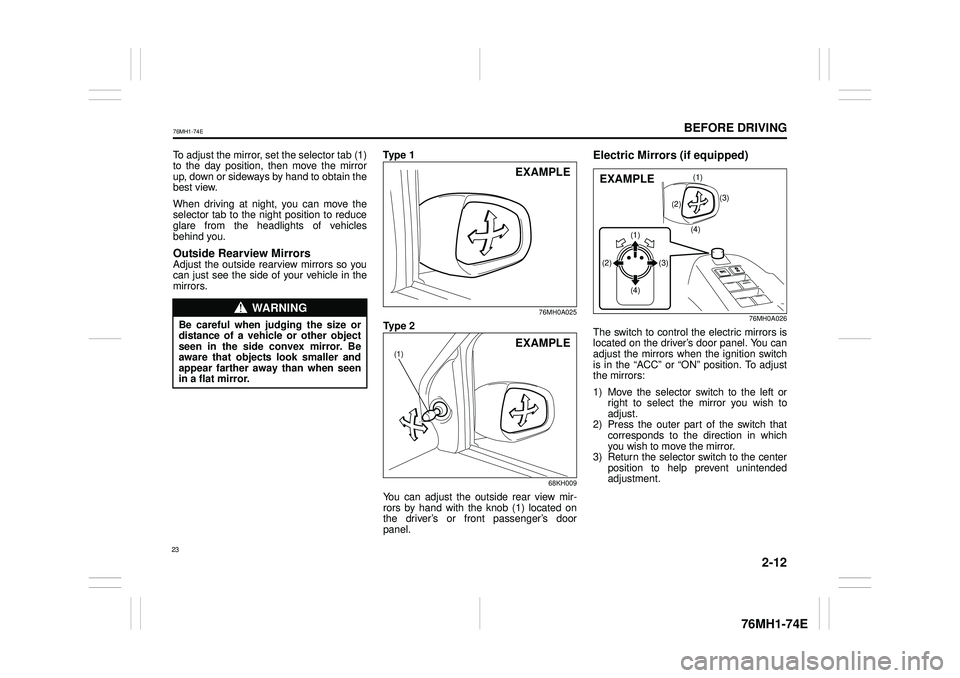
To adjust the mirror, set the selector tab (1) to the day position, then move the mirror up, down or sideways by hand to obtain thebest view.
When driving at night, you can move the selector tab to the night position to reduce glare from the headlights of vehicles behind you.
Outside Rearview MirrorsAdjust the outside rearview mirrors so you can just see the side of your vehicle in themirrors.
Ty p e 1
76MH0A025
Ty p e 2
68KH009
You can adjust the outside rear view mir-rors by hand with the knob (1) located on the driver’s or front passenger’s doorpanel.
Electric Mirrors (if equipped)
76MH0A026
The switch to control the electric mirrors islocated on the driver’s door panel. You can adjust the mirrors when the ignition switch is in the “ACC” or “ON” position. To adjustthe mirrors:
1) Move the selector switch to the left orright to select the mirror you wish to adjust.2) Press the outer part of the switch thatcorresponds to the direction in whichyou wish to move the mirror.3) Return the selector switch to the centerposition to help prevent unintendedadjustment.
WA R N I N G
Be careful when judging the size or distance of a vehicle or other objectseen in the side convex mirror. Be aware that objects look smaller and appear farther away than when seenin a flat mirror.
EXAMPLE
(1)EXAMPLE
(2)
(4)
(3)
(1)
(1)
(3)(2)
(4)
EXAMPLE
23
Page 35 of 201
2-13
BEFORE DRIVING
76MH1-74E
76MH1-74E
Front Seats
Seat Adjustment
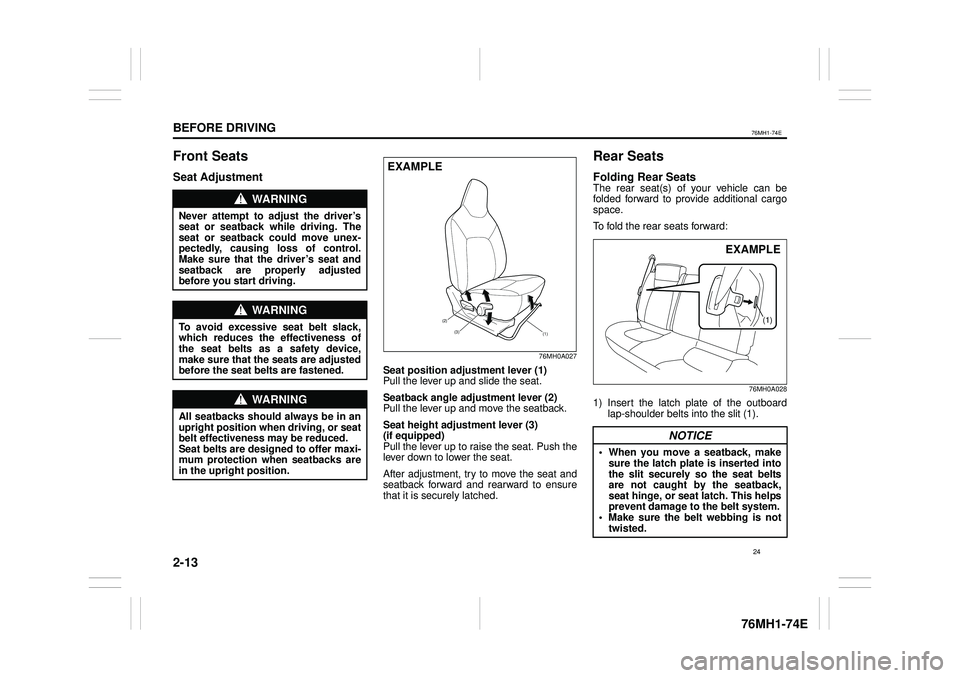
76MH0A027
Seat position adjustment lever (1) Pull the lever up and slide the seat.
Seatback angle adjustment lever (2) Pull the lever up and move the seatback.
Seat height adjustment lever (3) (if equipped) Pull the lever up to raise the seat. Push the lever down to lower the seat.
After adjustment, try to move the seat and seatback forward and rearward to ensurethat it is securely latched.
Rear Seats
Folding Rear SeatsThe rear seat(s) of your vehicle can befolded forward to provide additional cargospace.
To fold the rear seats forward:
76MH0A028
1) Insert the latch plate of the outboardlap-shoulder belts into the slit (1).
WA R N I N G
Never attempt to adjust the driver’s seat or seatback while driving. The seat or seatback could move unex- pectedly, causing loss of control.Make sure that the driver’s seat and seatback are properly adjusted before you start driving.
WA R N I N G
To avoid excessive seat belt slack,which reduces the effectiveness of the seat belts as a safety device, make sure that the seats are adjustedbefore the seat belts are fastened.
WA R N I N G
All seatbacks should always be in an upright position when driving, or seat belt effectiveness may be reduced.Seat belts are designed to offer maxi- mum protection when seatbacks are in the upright position.
(2)(3)(1)
EXAMPLE
NOTICE
• When you move a seatback, makesure the latch plate is inserted intothe slit securely so the seat beltsare not caught by the seatback, seat hinge, or seat latch. This helps prevent damage to the belt system.• Make sure the belt webbing is nottwisted.
(1)
EXAMPLE
24
Page 45 of 201
2-23
BEFORE DRIVING
76MH1-74E
76MH1-74E
Supplemental Restraint
System (air bags)
(if equipped)
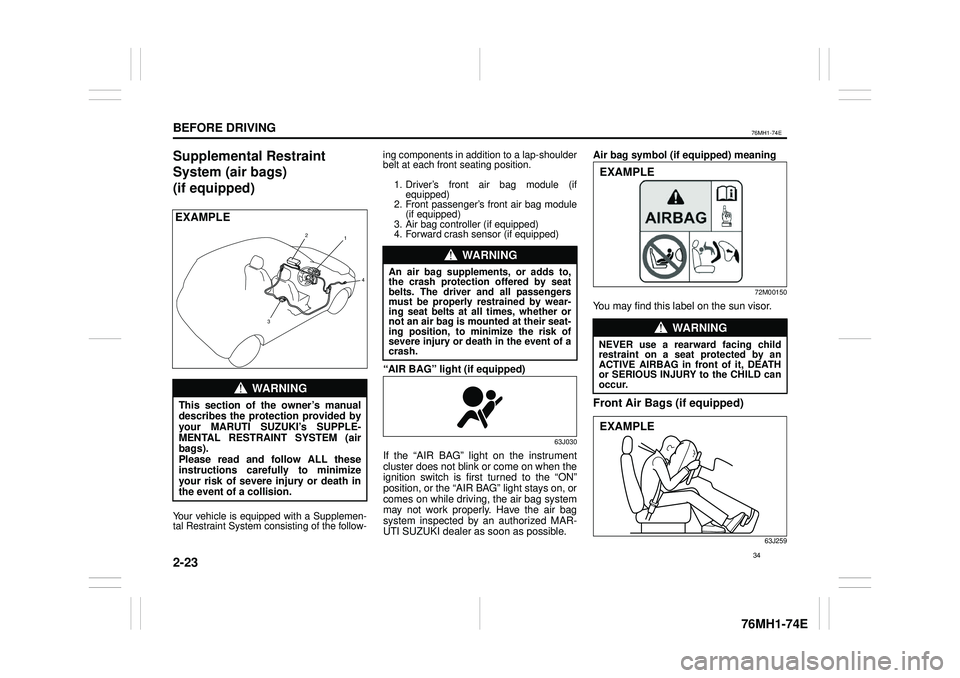
Your vehicle is equipped with a Supplemen- tal Restraint System consisting of the follow-
ing components in addition to a lap-shoulderbelt at each front seating position.
1. Driver’s front air bag module (ifequipped)2. Front passenger’s front air bag module(if equipped)3. Air bag controller (if equipped)4. Forward crash sensor (if equipped)
Page 48 of 201
2-26
BEFORE DRIVING
76MH1-74E
76MH1-74E
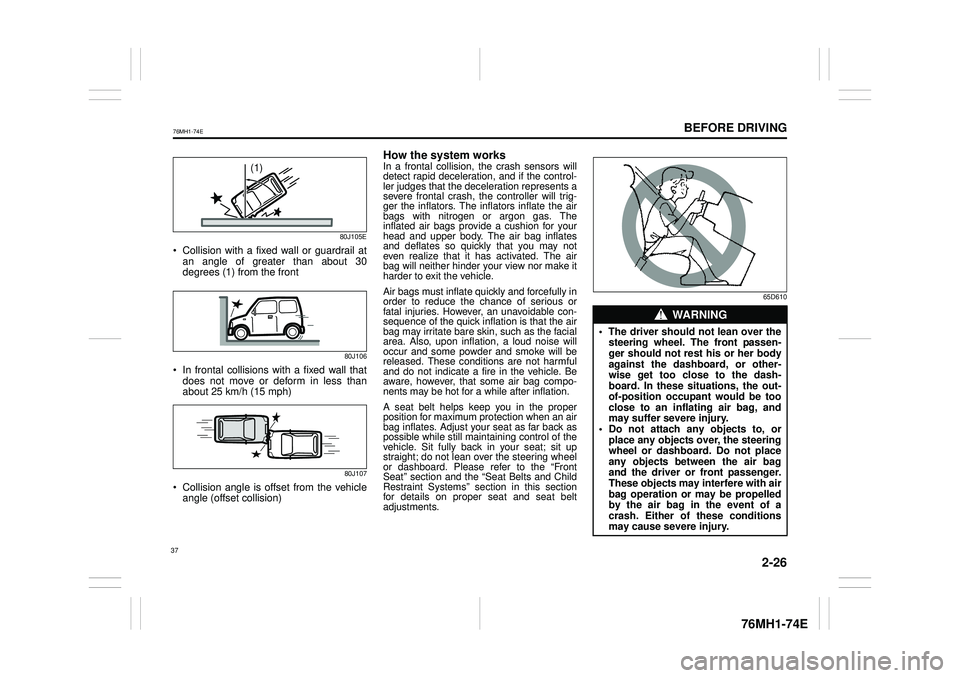
80J105E
Collision with a fixed wall or guardrail atan angle of greater than about 30 degrees (1) from the front
80J106
In frontal collisions with a fixed wall thatdoes not move or deform in less thanabout 25 km/h (15 mph)
80J107
Collision angle is offset from the vehicleangle (offset collision)
How the system worksIn a frontal collision, the crash sensors will detect rapid deceleration, and if the control-ler judges that the deceleration represents asevere frontal crash, the controller will trig- ger the inflators. The inflators inflate the airbags with nitrogen or argon gas. The inflated air bags provide a cushion for yourhead and upper body. The air bag inflatesand deflates so quickly that you may noteven realize that it has activated. The airbag will neither hinder your view nor make itharder to exit the vehicle.
Air bags must inflate quickly and forcefully in order to reduce the chance of serious or fatal injuries. However, an unavoidable con-sequence of the quick inflation is that the airbag may irritate bare skin, such as the facialarea. Also, upon inflation, a loud noise willoccur and some powder and smoke will be released. These conditions are not harmful and do not indicate a fire in the vehicle. Beaware, however, that some air bag compo-nents may be hot for a while after inflation.
A seat belt helps keep you in the proper position for maximum protection when an airbag inflates. Adjust your seat as far back aspossible while still maintaining control of the vehicle. Sit fully back in your seat; sit upstraight; do not lean over the steering wheel or dashboard. Please refer to the “FrontSeat” section and the “Seat Belts and ChildRestraint Systems” section in this sectionfor details on proper seat and seat belt adjustments.
65D610
(1)
WA R N I N G
• The driver should not lean over thesteering wheel. The front passen- ger should not rest his or her body against the dashboard, or other- wise get too close to the dash-board. In these situations, the out- of-position occupant would be too close to an inflating air bag, andmay suffer severe injury.• Do not attach any objects to, orplace any objects over, the steeringwheel or dashboard. Do not place any objects between the air bag and the driver or front passenger.These objects may interfere with air bag operation or may be propelled by the air bag in the event of acrash. Either of these conditions may cause severe injury.
37
Page 49 of 201
2-27
BEFORE DRIVING
76MH1-74E
76MH1-74E
Note that even though your vehicle may be moderately damaged in a frontal collision,the collision may not have been severe enough to trigger the air bags to inflate. If your vehicle sustains ANY front-end dam-age, have the air bag system inspected by an authorized MARUTI SUZUKI dealer to ensure it is in proper working order.
Your vehicle is equipped with a diagnostic module which records information aboutthe air bag system if the air bags deploy ina crash. The module records informationabout overall system status, which sensorsactivated the deployment, and for a certain vehicle only, whether the driver’s seat belt was in use.
Servicing the air bag system If the air bags inflate, have the air bags andrelated components replaced by an autho- rized MARUTI SUZUKI dealer as soon as possible.
If your vehicle ever gets in deep water and the driver’s floor is submerged, the air bagcontroller could be damaged. If it does, have the air bag system inspected by theMARUTI SUZUKI dealer as soon as possi- ble.
Special procedures are required for servic- ing or replacing an air bag. For that reason, only an authorized MARUTI SUZUKI dealer should be allowed to service orreplace your air bags. Please remind any-
one who services your vehicle that it has air bags.
Service on or around air bag components or wiring must be performed only by an authorized MARUTI SUZUKI dealer.Improper service could result in unin- tended air bag deployment or could render the air bag inoperative. Either of these twoconditions may result in severe injury.
To prevent damage or unintended inflation of the air bag system, be sure the batteryis disconnected and the ignition switch hasbeen in the “LOCK” position for at least 90seconds before performing any electrical service work on your vehicle. Do not touch air bag system components or wires. Thewires are wrapped with yellow tape or yel- low tubing, and the couplers are yellow for easy identification.
Scrapping a vehicle that has an uninflated air bag can be hazardous. Ask your dealer,body repair shop or scrap yard for help with disposal.
38
Page 51 of 201

2-29
BEFORE DRIVING
76MH1-74E
76MH1-74E
Speedometer
The speedometer indicates vehicle speed.
Tachometer (if equipped)
The tachometer indicates engine speed in revolutions per minute.
Fuel Gauge
With tachometer
76MH0A037
Without tachometer
76MH0A038
When the ignition switch is in the “ON” position, this gauge gives an approximate indication of the amount of fuel in the fueltank. “F” stands for full and “E” stands for empty.
If the fuel meter indicator shows only one segment to “E”, refill the tank as soon aspossible.
NOTE: If the last segment blinks, it means that thefuel is almost empty.
If the low fuel warning light (1) comes on, fill the fuel tank immediately.
NOTE:The activation point of the low fuel warning light (1) varies depending on road condi- tions (for example, slope or curve) anddriving conditions because of fuel moving in the tank.
Refer to “Low Fuel Warning Light” in“Warning and Indicator Lights” in this sec- tion for details.
The mark (2) indicates that the fuel filler door is located on the left side of the vehi-cle.
Brightness Control
76MH0A039
When the ignition switch is turned to the“ON” position, the pointer lights come on.
Your vehicle has a system to automaticallydim the brightness of the instrument panellights when the position lights or headlights are on.
When the position lights and/or headlights are ON, you can control the meter illumina- tion intensity.
NOTICE
Never drive the vehicle with theengine revving in the red zone, orsevere engine damage can result. Keep the engine speed below the red zone even when downshifting to alower gear position. Refer to “Down- shifting maximum allowable speeds” in the “OPERATING YOUR VEHICLE”section.
(1)(2)
EXAMPLE
(1)
(2)
EXAMPLE(1)
EXAMPLE
40