brake SUZUKI CELERIO 2016 User Guide
[x] Cancel search | Manufacturer: SUZUKI, Model Year: 2016, Model line: CELERIO, Model: SUZUKI CELERIO 2016Pages: 201, PDF Size: 5.82 MB
Page 75 of 201

3-5
OPERATING YOUR VEHICLE
76MH1-74E
76MH1-74E
NOTE: (For Auto Gear Shift Model)For details on how to use the gearshift lever to park the vehicle, refer to “Parking” in “Auto Gear Shift” in this section.
Parking Brake Reminder Buzzer (if
equipped)A buzzer sounds intermittently to remind you to release the parking brake if youstart the vehicle without releasing the park- ing brake. Make sure that the parking brake is fully released and the brake sys-tem warning light turns off.
Pedal
Manual transaxle
80J2121
Auto Gear Shift
80J2122
Clutch Pedal (1)
(For manual transaxle)The clutch pedal is used to disengage the drive to the wheels when starting theengine, stopping, or shifting the gearshift lever. Depressing the pedal disengages the clutch.
Brake Pedal (2)Your MARUTI SUZUKI vehicle is equipped with front disc brakes and rear drum brakes. Depressing the brake pedalapplies both sets of brakes.
You may hear occasional brake squeal when you apply the brakes. This is a nor- mal condition caused by environmental factors such as co ld, wet, snow, etc.
WA R N I N G
When parking the vehicle in extremely cold weather, the followingprocedure should be used: 1) Set the parking brake. 2) Manual transaxl e - turn off the engine, then shift into reverse or first gear. Auto Gear Shift – shift into reverseor first gear and check the gear position indicato r in the instru- ment cluster to ma ke sure that the transaxle is engaged in 1st or reverse, then turn off the engine. 3) Get out of the vehicle and putchocks under the wheels. 4) Release the parking brake. When you return to your vehicle,you must remember to first set the parking brake, then remove the wheel chocks.
(2)(1)
(3)
EXAMPLE
(3)
(2)
EXAMPLE
WA R N I N G
Do not drive with your foot resting onthe clutch pedal. It could result inexcessive clutch wear, clutch dam- age, or unexpected loss of engine braking.
WA R N I N G
If brake squeal is excessive andoccurs each time the brakes areapplied, you should have the brakes checked by your MARUTI SUZUKI dealer.
64
Page 76 of 201

3-6
OPERATING YOUR VEHICLE
76MH1-74E
76MH1-74E
Accelerator Pedal (3)This pedal controls the speed of the engine. Depressing the accelerator pedal increases power output and speed.
Starting the Engine
Before Starting the Engine
76MH021
1) Make sure the parking brake is set fully.2) Manual transaxle
Page 78 of 201
3-8
OPERATING YOUR VEHICLE
76MH1-74E
76MH1-74E
Auto Gear ShiftAuto Gear Shift is a 5-speed forward/ reverse transaxle. Auto Gear Shift has the basic features of conventional manual transaxle, but clutchoperation and transaxle gear shifting are controlled electronically.
NOTE: When you open the driver’s door, the Auto Gear Shift systems run automatically and you may hear an operating noise. Thissound does not indicate a malfunction.
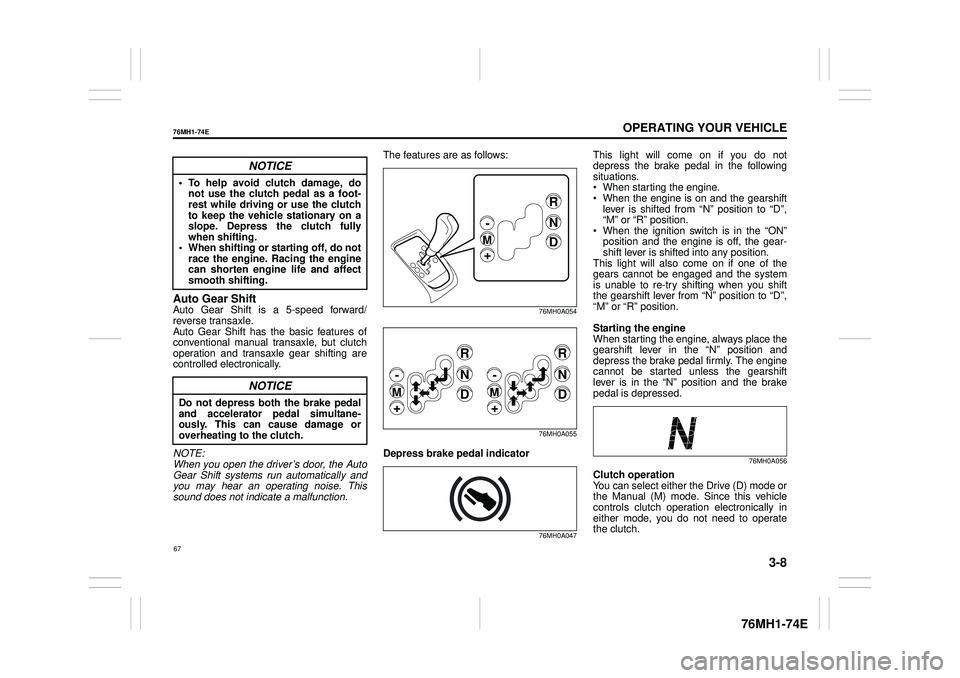
The features are as follows:
76MH0A054
76MH0A055
Depress brake pedal indicator
76MH0A047
This light will come on if you do not depress the brake pedal in the following situations. When starting the engine. When the engine is on and the gearshift lever is shifted from “N” position to “D”,“M” or “R” position. When the ignition switch is in the “ON” position and the engine is off, the gear-shift lever is shifte d into any position. This light will also come on if one of the gears cannot be engaged and the systemis unable to re-try shifting when you shift the gearshift lever from “N” position to “D”, “M” or “R” position.
Starting the engine When starting the engine, always place thegearshift lever in the “N” position and depress the brake pedal firmly. The engine cannot be started unless the gearshiftlever is in the “N” position and the brake pedal is depressed.
76MH0A056
Clutch operationYou can select either the Drive (D) mode or the Manual (M) mode. Since this vehiclecontrols clutch operation electronically in either mode, you do not need to operate the clutch.
NOTICE
• To help avoid clutch damage, donot use the clutch pedal as a foot-rest while driving or use the clutch to keep the vehicle stationary on a slope. Depress the clutch fullywhen shifting. • When shifting or starting off, do not race the engine. Racing the enginecan shorten engine life and affect smooth shifting.
NOTICE
Do not depress both the brake pedaland accelerator pedal simultane- ously. This can cause damage oroverheating to the clutch.
R
N
D
-
M
+
R
N
D
-
M
+
R
N
D
-
M
+
67
Page 79 of 201

3-9
OPERATING YOUR VEHICLE
76MH1-74E
76MH1-74E
Creeping function This vehicle has a creeping function that helps the vehicle to start smoothly byengaging the clutch. When the gearshift lever is in any of the positions “D”, “M” or “R”, and you release your foot from thebrake pedal, the vehicle starts slowly with- out depressing the accelerator pedal. The creeping function is disabled if you depressthe brake pedal or pull up the parking brake lever.
NOTE: If the driver’s door is opened and/or the parking brake lever is engaged with thegear in the “M”, “D” or “R” position, the creeping function will not operate.
Parking and Stopping the vehicle Auto Gear Shift does not have a parking position. The vehicle can be parked withthe gearshift lever in any position. When stopping the vehicle, the gear will be shifted to 1st.
Drive (D) mode When the Drive (D) mode is activated, the most appropriate gear position is automati- cally selected upon operation of the accel- erator pedal and variation of vehicle speed.
Normal driving: 1) Start the engine as instructed in
Page 80 of 201
3-10
OPERATING YOUR VEHICLE
76MH1-74E
76MH1-74E
Starting off on an uphill/downhill:
Uphill1) Apply the parking brake firmly so that the vehicle does not roll backwards.2) Shift the gearshift lever to the “D” posi-tion while depressing the brake pedal.Make sure that the gear position indica-tor in the instrumental cluster displays1st gear. 3) Release the brake pedal and depress the accelerator pedal gradually, andwhen the vehicle starts to move, releasethe parking brake and depress the accel-erator pedal to start off.
Downhill 1) Depress the brake pedal and shift the gearshift lever to the “D” position. Make sure that the gear is in 1st by checkingthe gear position indicator. 2) Release the brake pedal and depress the accelerator pedal slowly. Even if theaccelerator pedal is not depressed, the clutch will be engaged when the vehicle speed increases.
Using engine braking: When driving on a downhill slope, down- shifting is recommended. So you can useengine braking. By placing the gearshift lever in the “M” position, the Manual (M) mode is selected,and you can shift to a lower gear manually. For details of downshift operation, refer to “Upshift and downshift” in the “Manual (M)mode”.
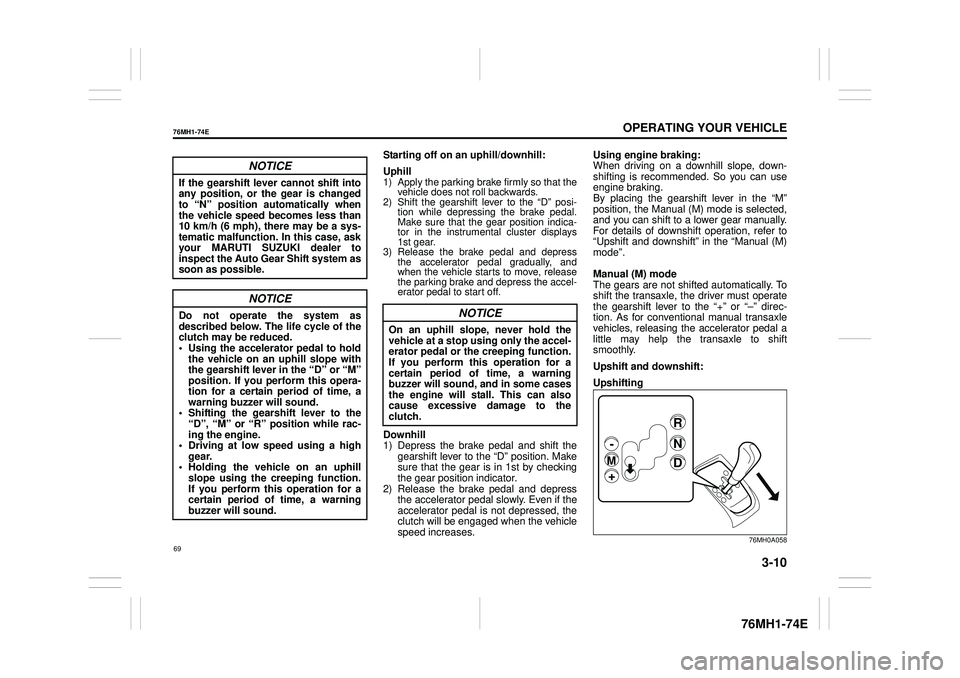
Manual (M) mode The gears are not shifted automatically. To shift the transaxle, the driver must operate the gearshift lever to the “+” or “–” direc-tion. As for conventional manual transaxle vehicles, releasing the accelerator pedal a little may help the transaxle to shift smoothly.
Upshift and downshift:
Upshifting
76MH0A058
NOTICE
If the gearshift lever cannot shift into any position, or the gear is changedto “N” position automatically when the vehicle speed becomes less than 10 km/h (6 mph), there may be a sys-tematic malfunction. In this case, ask your MARUTI SUZUKI dealer to inspect the Auto Gear Shift system assoon as possible.
NOTICE
Do not operate the system as described below. The life cycle of the clutch may be reduced.• Using the accelerator pedal to hold the vehicle on an uphill slope with the gearshift lever in the “D” or “M”position. If you perform this opera- tion for a certain period of time, a warning buzzer will sound.• Shifting the gearsh ift lever to the “D”, “M” or “R” position while rac- ing the engine.• Driving at low speed using a high gear. • Holding the vehicle on an uphillslope using the creeping function. If you perform this operation for a certain period of time, a warningbuzzer will sound.
NOTICE
On an uphill slope, never hold thevehicle at a stop using only the accel-erator pedal or the creeping function. If you perform this operation for a certain period of time, a warningbuzzer will sound, and in some cases the engine will stall. This can also cause excessive damage to theclutch.R
N
D
-
M
+
69
Page 81 of 201
3-11
OPERATING YOUR VEHICLE
76MH1-74E
76MH1-74E
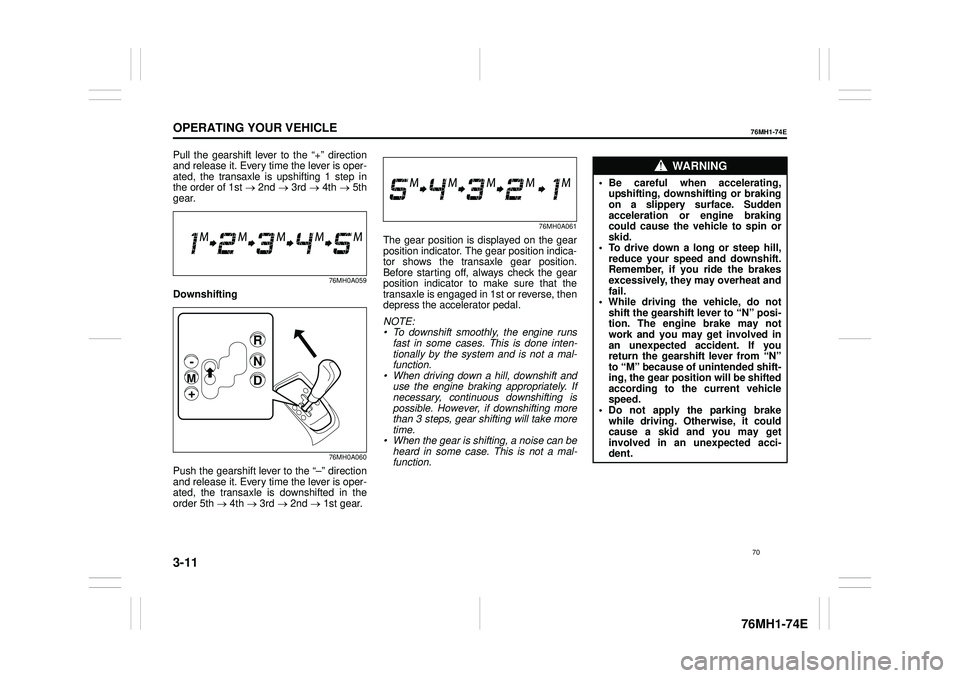
Pull the gearshift lever to the “+” direction and release it. Every time the lever is oper- ated, the transaxle is upshifting 1 step inthe order of 1st 2nd 3rd 4th 5th gear.
76MH0A059
Downshifting
76MH0A060
Push the gearshift lever to the “–” directionand release it. Every time the lever is oper- ated, the transaxle is downshifted in theorder 5th 4th 3rd 2nd 1st gear.
76MH0A061
The gear position is displayed on the gear position indicator. The gear position indica- tor shows the transaxle gear position.Before starting off, always check the gear position indicator to make sure that the transaxle is engaged in 1st or reverse, thendepress the accelerator pedal.
NOTE: • To downshift smoothly, the engine runs fast in some cases. This is done inten- tionally by the system and is not a mal-function. • When driving down a hill, downshift and use the engine braking appropriately. Ifnecessary, continuous downshifting is possible. However, if downshifting more than 3 steps, gear shifting will take moretime. • When the gear is shifting, a noise can be heard in some case. This is not a mal-function.
R
N
D
-
M
+
WA R N I N G
• Be careful when accelerating,upshifting, downshifting or brakingon a slippery surface. Sudden acceleration or engine braking could cause the vehicle to spin orskid. • To drive down a long or steep hill, reduce your speed and downshift.Remember, if you ride the brakes excessively, they may overheat and fail.• While driving the vehicle, do not shift the gearshift lever to “N” posi- tion. The engine brake may notwork and you may get involved in an unexpected accident. If you return the gearshif t lever from “N” to “M” because of unintended shift- ing, the gear position will be shifted according to the current vehiclespeed. • Do not apply the parking brake while driving. Otherwise, it couldcause a skid and you may get involved in an unexpected acci- dent.
70
Page 83 of 201

3-13
OPERATING YOUR VEHICLE
76MH1-74E
76MH1-74E
Starting off on an uphill/downhill slope:
Uphill 1) Apply the parking brake firmly so that the vehicle does not roll backwards. 2) Shift the gearshift lever to the “M” posi-tion while depressing the brake pedal. Make sure that the gear position indica- tor in the instrument al cluster displays 1st gear. 3) Release the brake pedal and depress the accelerator pedal gradually, andwhen the vehicle starts to move, release the parking brake and depress the accelerator pedal to start off.
Downhill 1) Depress the brake pedal and shift thegearshift lever to the “M” position. Check the gear position indicator to make sure that the gear is in 1st.2) Release the brake pedal and depress the accelerator pedal slowly. Even though the accelerator pedal is notdepressed, the clutch will be engaged when the vehicle speed increases.
Backing up After the vehicle has stopped completely, depress the brake pedal and shift the gear-shift lever to the “R” position. Depress the accelerator pedal slowly as when starting off in 1st gear. Before backing up, makesure that reverse gear is selected by checking the gear position indicator.
76MH0A062
NOTE: • If reverse gear cannot be engaged even though the gearshift lever has been shifted from the “N” to the “R” position,the system will re-try shifting automati- cally. This will take some time, noise may be heard from the gears, and shift-ing gear shock may occur. However, they do not indicate a malfunction. • The “N” indicator will flash, the depressbrake pedal indicator will come on and a warning buzzer (long pulse sound) will sound if any of the following casesoccur; – If you shift the gearshift lever from the “N” to the “R” position without depress-ing the brake pedal – If the system is unable to re-try shifting You should depress the brake pedal andshift the gearshift lever to “N” position,
then shift to “R” position again a few sec- onds later. • The system will not allow shifting to the“R” position if the vehicle speed is over about 3 km/h (2 mph). If the gearshift lever is operated under this condition,the “N” indicator in the instrument cluster will blink. However, when the vehicle speed drops below about 3 km/h (2mph), the gear will be shifted to reverse. Make sure that the vehicle has stopped completely before shifting to the “R”position.
Stopping The vehicle can be stopped by depressing the brake pedal regardless of the gearposition. This is because the clutch is auto- matically disengaged to prevent the engine from stopping. If the gearshift lever is in the “D” position, the gear will be downshifted to 1st when the vehicle stops.
NOTICE
On an uphill slope, never hold thevehicle at a stop using only the accel-erator pedal or creeping function. If you perform this operation for a cer- tain period of time, a warning buzzerwill sound, and in some cases the engine will stall. This can also cause excessive damage to the clutch.
NOTICE
On a downhill slope, never hold thevehicle at a stop using only the accel- erator pedal or the creeping function. If you perform this operation for acertain period of time, a warning buzzer will sound, and in some cases the engine will stall. This can alsocause excessive damage to the clutch.
72
Page 84 of 201

3-14
OPERATING YOUR VEHICLE
76MH1-74E
76MH1-74E
If the gearshift lever is in the “M” posi- tion, the gear will be downshifted to 1st when the vehicle stops.
Parking Unlike an automatic transaxle, Auto GearShift does not have a parking position. The vehicle can be parked with the gearshift lever in any position.1) Apply the parking brake firmly. 2) While depressing the brake pedal, shift the gearshift lever to the “R” position ona downhill slope, and to the 1st position in the drive (D) mode or the “M(1)” posi- tion in the manual (M) mode on anuphill slope and confirm the gear posi- tion by checking the gear position indi- cator.3) Stop the engine.
NOTE: • After the engine is stopped, the gear in the transaxle does not change even ifyou shift the gearshift lever in any posi- tion. Always shift the gearshift lever before stop the engine.• Check the transaxle gear position by looking at the gear position indicator, then turn the ignition switch off to stopthe engine. Release the brake pedal after a few seconds. The gearshift lever will be locked in the position it was inwhen the ignition switch was turned off.
Parking cancel Depress the brake pedal, turn the ignition switch to the “ON” position, and shift thegearshift lever to the “N” position. The gear will be disengaged.
WA R N I N G
• When stopping, for example, at a traffic light, be su re to depress the brake pedal firmly. For your safety, apply the parking brake, too, when stopping on a hill.• When racing the engine, make sure that the gear is in the “N” position by checking the gear position indi- cator. If the accelerator is operated with the gear in any other position, the vehicle may move resulting inan unexpected accident. • Do not leave your vehicle unat- tended while the engine is running.• When leaving the vehicle, stop the engine and park the vehicle with a gear engaged. If you need to leavethe vehicle with the engine running, apply the parking brakes firmly, and shift the gearshift lever to the“N” position. Otherwise, the vehi- cle may move unexpectedly and may cause an accident.
NOTICE
• On a slope, never hold the vehicleat a stop using only the acceleratorpedal or the creeping function. If you perform this operation for a certain period of time, a warningbuzzer will sound, and in some cases the engine will stall. This can also cause excessive damage tothe clutch. • If the gearshift lever is operated more than necessary, the systemmay not allow operation of the gearshift lever for a certain period of time, and the gear may not beshifted appropriately. Therefore, do not operate the gearshift lever if not necessary.
WA R N I N G
• If the gear is not engaged properlyand completely be fore the ignition switch is turned off, the vehicle may not be parked with the gearengaged. Always confirm the gear position by checking the gear posi- tion indicator when parking.• On a downhill slope, the gear should be put in reverse, and in 1st gear on an uphill slope. Otherwise,the vehicle may move, and cause an unexpected accident. If the gear is left in the “N” position, the vehi-cle cannot be parked with a gear engaged.
73
Page 85 of 201

3-15
OPERATING YOUR VEHICLE
76MH1-74E
76MH1-74E
Warning functions A warning buzzer will sound or the indica- tor will blink under the following conditions.
Warning buzzer The clutch is heated due to excessiveload. The creeping function is being activated for a long period of time.
The ignition switch is turned to the “LOCK” position with the gear in 2nd, 3rd, 4th or 5th. In this case, turn the igni- tion switch to the “ON” position and shiftthe gearshift lever in the “N” position, shift it to the “D” or “M” or “R” position, then turn the ignition switch to “LOCK”. During a stop, the driver’s door is opened with the gearshift lever in the “R”, “D” or “M” positi on while the engine is running.
“N” indicato r blinking When the gear indicator lamp blinks “N”, you should depress the brake pedal and shift the gearshift lever to “N” position.
“1st” indicator blinking
When the gear indicator lamp blinks “1st”, you should depress the brake pedal and shift the gearshift lever to “N” position, thenshift to “D” or “M” position again a few sec- onds later.
“R” indicator blinking When the gear indicator lamp blinks “R”, you should depress the brake pedal andshift the gearshift lever to “N” position, then shift to “R” position again a few seconds later.
Braking
60G165S
The distance needed to bring any vehicleto a halt increases with the speed of the vehicle. The braking distance needed, for example, at 60 km/h (37 mph) will beapproximately 4 times greater than the braking distance needed at 30 km/h (19 mph). Start to brake the vehicle when thereis plenty of distance between your vehicle
and the stopping point, and slow down gradually.
Power-Assisted BrakesYour vehicle has power-assisted brakes. If power assistance is lost due to a stalledengine or other failur es, the system is still fully operational on reserve power and you can bring the vehicle to a complete stop bypressing the brake pedal once and holding it down. The reserve power is partly used up when you depress the brake pedal andreduces each time the pedal is pressed. Apply smooth and even pressure to the pedal. Do not pump the pedal.
NOTICE
In the above cases, pull over to theside of the road and stop the engine,and then ask your MARUTI SUZUKI dealer to inspect your vehicle. Other- wise, the clutch disc may be dam-aged.EXAMPLE
WA R N I N G
If water gets into the brake drums, brake performance may become poorand unpredictable. After driving through water or washingthe underside of the vehicle, test thebrakes while driving at a slow speedto see if they have maintained their normal effectiveness. If the brakes are less effective than normal, dry themby repeatedly applying the brakeswhile driving slowly until the brakeshave regained their normal effective-ness.
74
Page 86 of 201
3-16
OPERATING YOUR VEHICLE
76MH1-74E
76MH1-74E
Brake Assist System (if equipped)When you slam the brakes on, the brake assist system judges as an emergencystop and provides more powerful braking for a driver who cannot hold down the brake pedal firmly.
NOTE: If you quickly and forcefully depress thebrakes, you may hear a clicking sound in the brake pedal. This is normal and indi- cates that the brake a ssist system is acti- vated properly.
Anti-Lock Brake System (ABS)
(if equipped)ABS will help you avoid skidding by elec- tronically controlling braking pressure. It will also help you maintain steering controlwhen braking on slippery surfaces or when braking hard. The ABS works automatically, so you donot need any special braking technique. Just push the brake pedal down without pumping. The ABS will operate whenever itsenses that the wheels are locking up. You
may feel the brake pedal moves a little while the ABS is operating.
NOTE: The ABS will not work if vehicle speed is under about 10 km/h (6 mph).
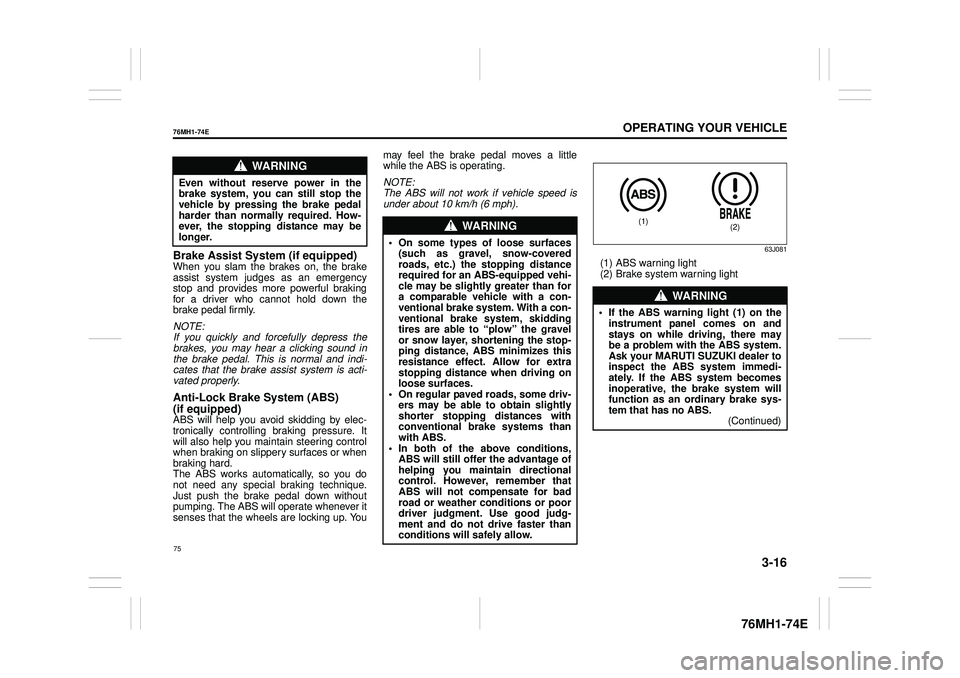
63J081
(1) ABS warning light (2) Brake system warning light
WA R N I N G
Even without reserve power in the brake system, you can still stop thevehicle by pressing the brake pedal harder than normally required. How- ever, the stopping distance may belonger.WA R N I N G
• On some types of loose surfaces(such as gravel, snow-coveredroads, etc.) the stopping distance required for an ABS-equipped vehi- cle may be slightly greater than fora comparable vehicle with a con- ventional brake system. With a con- ventional brake system, skiddingtires are able to “plow” the gravel or snow layer, shortening the stop- ping distance, ABS minimizes thisresistance effect. Allow for extra stopping distance when driving on loose surfaces.• On regular paved roads, some driv- ers may be able to obtain slightly shorter stopping distances withconventional brake systems than with ABS. • In both of the above conditions,ABS will still offer the advantage of helping you maintain directional control. However, remember thatABS will not compensate for bad road or weather conditions or poor driver judgment. Use good judg-ment and do not drive faster than conditions will safely allow.
WA R N I N G
• If the ABS warning light (1) on the instrument panel comes on and stays on while driving, there maybe a problem with the ABS system. Ask your MARUTI SUZUKI dealer to inspect the ABS system immedi-ately. If the ABS system becomes inoperative, the brake system will function as an ordinary brake sys-tem that has no ABS. (Continued)
(1)(2)
75