brake SUZUKI CELERIO 2016 Owner's Guide
[x] Cancel search | Manufacturer: SUZUKI, Model Year: 2016, Model line: CELERIO, Model: SUZUKI CELERIO 2016Pages: 201, PDF Size: 5.82 MB
Page 165 of 201
7-16
INSPECTION AND MAINTENANCE
76MH1-74E
76MH1-74E
“MAX” and “MIN” lines. If the brake fluid level is near the “MIN” line, fill it up to the “MAX” line with Maruti genuine brake fluid.
NOTE: With disc brakes, the fluid level can beexpected to gradually fall as the brake pads wear.
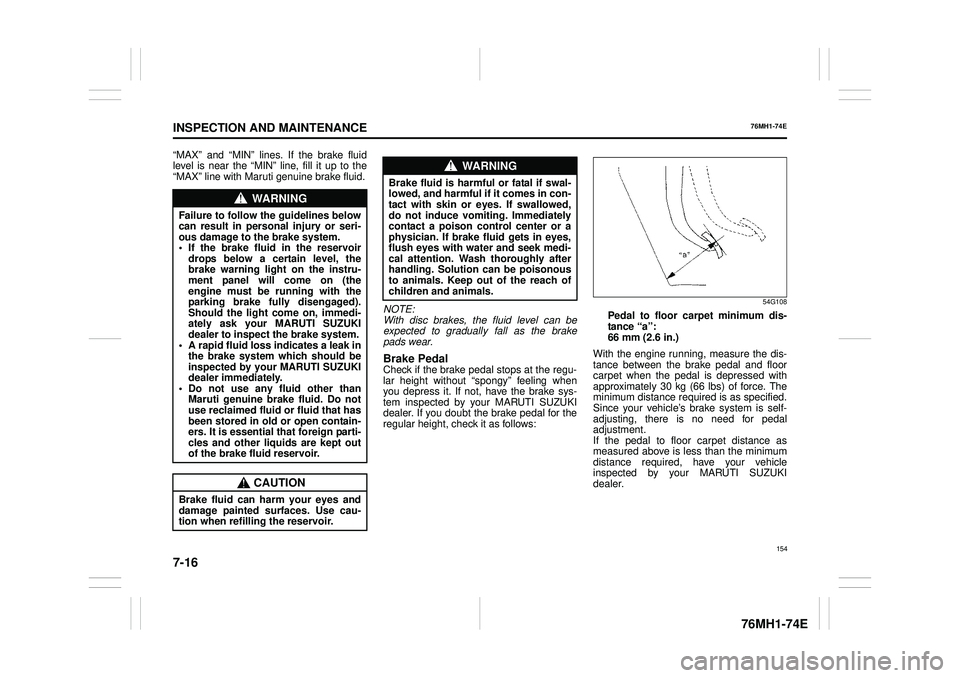
Brake PedalCheck if the brake peda l stops at the regu- lar height without “spongy” feeling when you depress it. If not, have the brake sys- tem inspected by your MARUTI SUZUKIdealer. If you doubt the brake pedal for the regular height, check it as follows:
54G108
Pedal to floor car pet minimum dis- tance “a”: 66 mm (2.6 in.)
With the engine running, measure the dis- tance between the brake pedal and floorcarpet when the pedal is depressed with approximately 30 kg (66 lbs) of force. The minimum distance required is as specified.Since your vehicle’s brake system is self- adjusting, there is no need for pedal adjustment. If the pedal to floor carpet distance as measured above is less than the minimum distance required, have your vehicleinspected by your MARUTI SUZUKI dealer.
WA R N I N G
Failure to follow the guidelines below can result in personal injury or seri-ous damage to the brake system. • If the brake fluid in the reservoir drops below a certain level, thebrake warning light on the instru- ment panel will come on (the engine must be running with theparking brake fully disengaged). Should the light come on, immedi- ately ask your MARUTI SUZUKIdealer to inspect the brake system. • A rapid fluid loss indicates a leak in the brake system which should beinspected by your MARUTI SUZUKI dealer immediately. • Do not use any fluid other thanMaruti genuine brake fluid. Do not use reclaimed fluid or fluid that has been stored in old or open contain-ers. It is essential that foreign parti- cles and other liquids are kept out of the brake fluid reservoir.
CAUTION
Brake fluid can harm your eyes anddamage painted surfaces. Use cau- tion when refilling the reservoir.
WA R N I N G
Brake fluid is harmful or fatal if swal- lowed, and harmful if it comes in con-tact with skin or e yes. If swallowed, do not induce vomiting. Immediately contact a poison control center or aphysician. If brake fluid gets in eyes, flush eyes with water and seek medi- cal attention. Wash thoroughly afterhandling. Solution can be poisonous to animals. Keep out of the reach of children and animals.
154
Page 166 of 201
7-17
INSPECTION AND MAINTENANCE
76MH1-74E
76MH1-74E
NOTE: When measuring the distance between the brake pedal and floor wall, be sure not toinclude the floor mat or rubber on the floor wall in your measurement.
60G104S
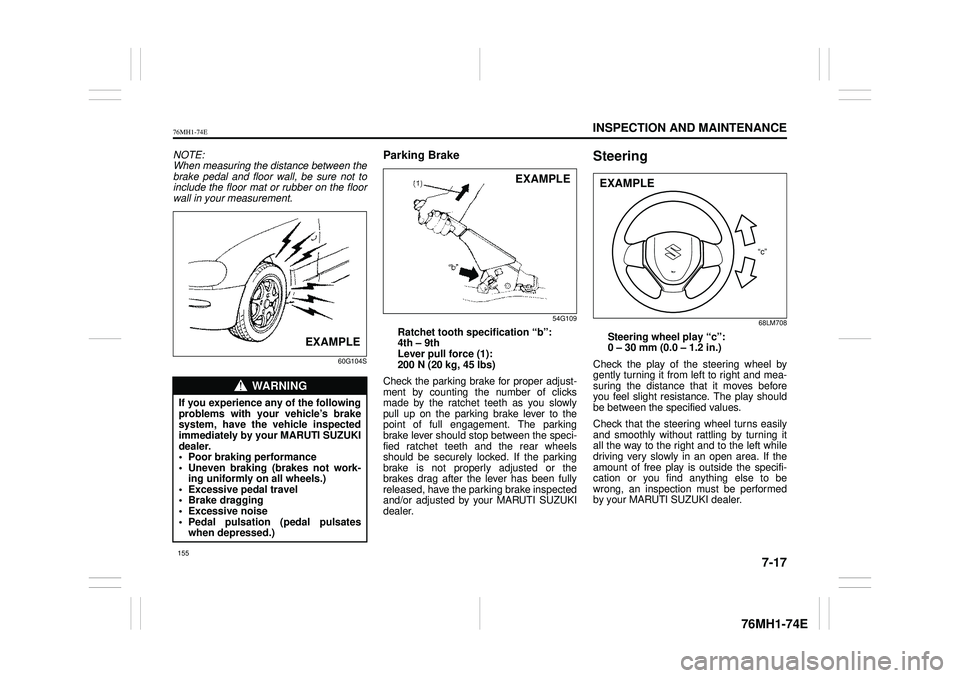
Parking Brake
54G109
Ratchet tooth speci fication “b”: 4th – 9th Lever pull force (1): 200 N (20 kg, 45 lbs)
Check the parking brake for proper adjust- ment by counting the number of clicksmade by the ratchet teeth as you slowly pull up on the parking brake lever to the point of full engagement. The parkingbrake lever should stop between the speci- fied ratchet teeth and the rear wheels should be securely locked. If the parkingbrake is not properly adjusted or the brakes drag after the lever has been fully released, have the parking brake inspectedand/or adjusted by your MARUTI SUZUKI dealer.
Steering
68LM708
Steering wheel play “c”: 0 – 30 mm (0.0 – 1.2 in.)
Check the play of the steering wheel by gently turning it from left to right and mea-suring the distance that it moves before you feel slight resistance. The play should be between the specified values.
Check that the steering wheel turns easily and smoothly without rattling by turning itall the way to the right and to the left while driving very slowly in an open area. If the amount of free play is outside the specifi-cation or you find anything else to be wrong, an inspection must be performed by your MARUTI SUZUKI dealer.
WA R N I N G
If you experience any of the following problems with your vehicle’s brake system, have the vehicle inspectedimmediately by your MARUTI SUZUKI dealer. • Poor braking performance• Uneven braking (brakes not work- ing uniformly on all wheels.) • Excessive pedal travel• Brake dragging • Excessive noise • Pedal pulsation (pedal pulsateswhen depressed.)
EXAMPLE
EXAMPLE
“c”
EXAMPLE
155
Page 175 of 201
7-26
INSPECTION AND MAINTENANCE
76MH1-74E
76MH1-74E
76MH0A120
3) Open the end of the cover inside the fender.
80JM071
4) Disconnect the coupler by pushing the lock release. Turn the bulb holder coun- terclockwise and remove it.
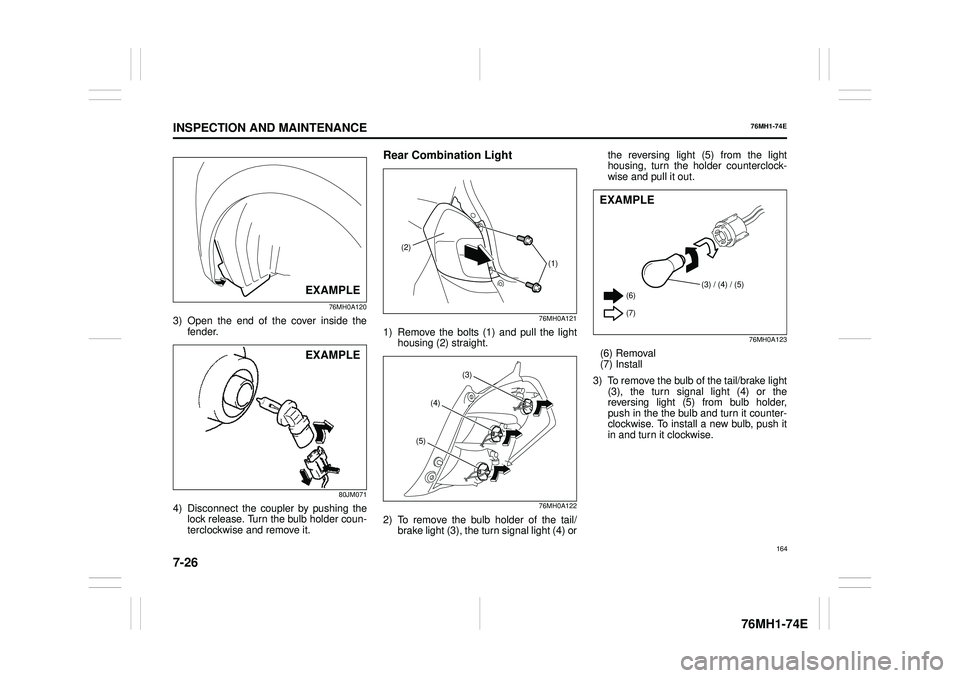
Rear Combination Light
76MH0A121
1) Remove the bolts (1) and pull the light housing (2) straight.
76MH0A122
2) To remove the bulb holder of the tail/brake light (3), the turn signal light (4) or
the reversing light (5) from the light housing, turn the holder counterclock- wise and pull it out.
76MH0A123
(6) Removal (7) Install
3) To remove the bulb of the tail/brake light (3), the turn signal light (4) or the reversing light (5) from bulb holder,push in the the bulb and turn it counter- clockwise. To install a new bulb, push it in and turn it clockwise.
EXAMPLE
EXAMPLE
(2)
(1)
(3)
(4)
(5)
(3) / (4) / (5) (6)
(7)
EXAMPLE
164
Page 182 of 201
8-1
EMERGENCY SERVICE
76MH1-74E
76MH1-74E
Tire Changing Tool
76MH1004
The jack, wheel wrench and jack handle are stowed in the luggage compartment.
76MH0A129
To remove the spare tire, turn its bolt (1) counterclockwise and remove it.
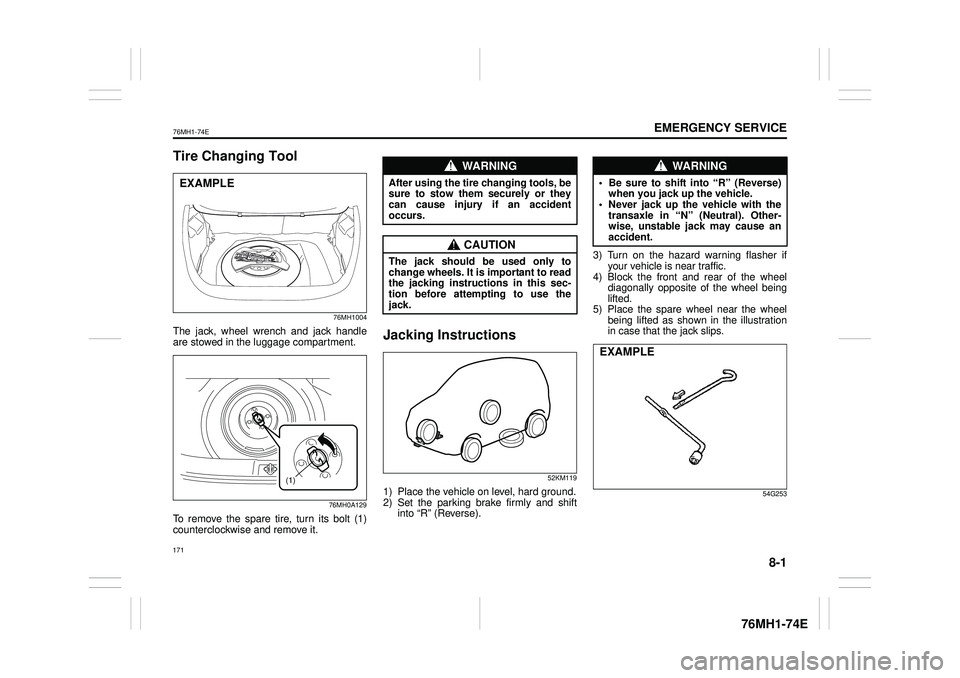
Jacking Instructions
52KM119
1) Place the vehicle on level, hard ground. 2) Set the parking brake firmly and shift into “R” (Reverse).
3) Turn on the hazard warning flasher if your vehicle is near traffic. 4) Block the front and rear of the wheel diagonally opposite of the wheel beinglifted. 5) Place the spare wheel near the wheel being lifted as shown in the illustrationin case that the jack slips.
54G253
EXAMPLE
(1)
WA R N I N G
After using the tire changing tools, besure to stow them securely or theycan cause injury if an accident occurs.
CAUTION
The jack should be used only to change wheels. It is important to readthe jacking instructions in this sec- tion before attemp ting to use the jack.
WA R N I N G
• Be sure to shift into “R” (Reverse) when you jack up the vehicle.• Never jack up the vehicle with the transaxle in “N” (Neutral). Other- wise, unstable jack may cause anaccident.
EXAMPLE
171
Page 185 of 201

8-4
EMERGENCY SERVICE
76MH1-74E
76MH1-74E
Full Wheel Cover (if equipped)
60G309
Insert a piece of cloth between the spokes of the wheel cover and try to pull the cover outward (as shown in figure). Take out thedetached wheel cover from the wheel rim. For installation first match the slot at the wheel cover with the air filling nozzle of the wheel. Apply equal pressure at the circum- ference of the wheel cover to fix it in thewheel rim.
74LHT0860
When installing the cover, make sure that itis positioned so that it does not cover orfoul the air valve.
Jump Starting Instructions
When Jump Starting Your Vehicle,
Use the Following Procedure:1) Use only a 12-volt battery to jump start your vehicle. Position the good 12-volt battery close to your vehicle so that thejump leads will reach both batteries. When using a battery installed on another vehicle, DO NOT LET THEVEHICLES TOUCH. Set the parking brakes fully on both vehicles. 2) Turn off all vehicle accessories, exceptthose necessary for safety reasons (for example, headlights or hazard lights).
54MN259
EXAMPLE
EXAMPLE
WA R N I N G
• Never attempt to jump start your vehicle if the battery appears to be frozen. Batteries in this condition may explode or rupture if jumpstarting is attempted. • When making jump lead connec- tions, be certain that your handsand the jump leads remain clear from pulleys, belts, or fans. • Batteries produce flammablehydrogen gas. Keep flames and sparks away from the battery or an explosion may occur. Never smokewhen working in the vicinity of the battery. • If the booster battery you use forjump starting is installed in another vehicle, make sure the two vehicles are not touching each other.• If your battery discharges repeat- edly, for no apparent reason, have your vehicle inspected by anauthorized MARUTI SUZUKI dealer. • To avoid harm to yourself or dam- age to your vehicl e or battery, fol- low the jump starting instructions below precisely and in order. If you are in doubt, call for qualifiedroad service.
NOTICE
Your vehicle should not be started bypushing or towing. This startingmethod could result in permanent damage to the ca talytic converter. Use jump leads to start a vehicle witha weak or flat battery.
(2)
(1)
(3)2 3
4
1
EXAMPLE
174
Page 186 of 201
8-5
EMERGENCY SERVICE
76MH1-74E
76MH1-74E
3) Make jump lead connections as follows:
1. Connect one end of the first jump lead to the positive (+) terminal of the flat battery (1). 2. Connect the other end to the positive(+) terminal of the booster battery (2). 3. Connect one end of the second jumplead to the negative (–) terminal of the booster battery (2). 4. Make the final connection to anunpainted, heavy metal part (i.e. engine mount bracket (3)) of the engine of the vehicle with the flatbattery (1).
4) If the booster battery you are using is fitted to another vehicle, start the
engine of the vehicle with the booster battery. Run the engine at moderate speed.5) Start the engine of the vehicle with the flat battery. 6) Remove the jump leads in the exactreverse order in which you connected them.
Towing
If you need to have your vehicle towed, contact a professional service. Your dealercan provide you with detailed towing instructions.
2-Wheel Drive (2WD) Manual Tran- saxle or Auto Gear ShiftManual transaxle vehicles or Auto Gear Shift vehicles may be towed using either of the following methods.
1) From the front, with the front wheels lifted and the rear wheels on the ground. Before towing, make sure thatthe parking brake is released. 2) From the rear, with the rear wheels lifted and the front wheels on theground, provided the steering and drivetrain are in operational condition. Before towing, make sure that transaxleis in neutral, the steering wheel is
unlocked (the ignition key should be in the “ACC” position), and the steering wheel is secured with a clampingdevice designed for towing service.
WA R N I N G
Never connect the jump lead directlyto the negative (–) terminal of the dis- charged battery, or an explosion may occur.
CAUTION
Connect the jump le ad to the engine mount bracket securely. If the jump lead disconnects from the engine mount bracket because of vibrationat the start of the engine, the jump lead could be caught in the drive belts.
NOTICE
To help avoid damage to your vehicle during towing, proper equipment and towing procedures must be used.
NOTICE
After shifting the Auto Gear Shiftlever to the “N” position, always check the gear position indicator in the instrument cluster shows the “N”position to make sure that the transaxle is disengaged. If the transaxle cannot be put in neu-tral, turn the key from the “LOCK” to the “ON” position, and move the Auto Gear Shift lever from “N” to “D”,“M” or “R”, then back to “N” again. Then turn the key from the “ON” to the “LOCK” position.These procedures may help put the transaxle in neutral. If the transaxle still cannot be put in neutral, you can-not tow the vehicle without using a towing dolly. The steering column is not strongenough to with stand shocks trans- mitted from the fr ont wheels during towing. Always unlock the steeringwheel before towing.
175
Page 192 of 201
9-3
APPEARANCE CARE
76MH1-74E
76MH1-74E
Caring for Aluminum Wheels
NOTE: • Do not use an acidic or alkaline deter- gent to wash aluminum wheels. These types of detergent will cause permanentspots, discoloration and cracks on fin- ished surfaces. • Do not use a bristle brush and soap con-taining an abrasive material. These will damage finished surfaces.
Washing
60B212S
When washing the vehicle, park it wheredirect sunlight does not fall on it and follow the instructions below:1) Flush the underside of body and wheel housings with pressurized water to remove mud and debris. Use plenty ofwater.
2) Rinse the body to loosen the dirt. Remove dirt and mud from the body
exterior with running water. You may use a soft sponge or brush. Do not use hard materials which can scratch thepaint or plastic. Remember that the headlight covers or lenses are made of plastic in many cases.
3) Wash the entire exterior with a mild detergent or car wash soap using a sponge or soft cloth. The sponge or cloth should be frequently soaked in thesoap solution.
4) Once the dirt has been completely removed, rinse off the detergent with running water. 5) After rinsing, wipe off the vehicle bodywith a wet chamois or cloth and allow it to dry in the shade. 6) Check carefully for damage to paintedsurfaces. If there is any damage, “touch-up” the damage following the procedure below:
WA R N I N G
• Never attempt to wash and waxyour vehicle with the engine run-ning. • When cleaning the underside of the body and fender, where there maybe sharp-edged parts, you should wear gloves and a long-sleeved shirt to protect your hands andarms from being cut. • After washing your vehicle, care- fully test the brakes before drivingto make sure they have maintained their normal effectiveness.
NOTICE
When washing the vehicle: • Avoid directing steam or hot water of more than 80
Page 198 of 201
11-3
SPECIFICATIONS
76MH1-74E
76MH1-74E
ITEM: Lights WATTAGE BULB No.
Headlight 12V 60/55W H4
Front fog light (if equipped) 12V 35W H8
Position light 12V 5W W5W
Turn signal light Front 12V 21W PY21W
Rear 12V 21W PY21W
Side turn signal light 12V 5W WY5W
LED –
Brake/tail light 12V 21/5W P21/5W
High mount stop light 12V 5W W5W
Reversing light 12V 21W P21W
License plate light 12V 5W W5W
Interior light 12V 10W –