fuel SUZUKI CELERIO 2016 Owner's Manual
[x] Cancel search | Manufacturer: SUZUKI, Model Year: 2016, Model line: CELERIO, Model: SUZUKI CELERIO 2016Pages: 201, PDF Size: 5.82 MB
Page 90 of 201

4-2
DRIVING TIPS
76MH1-74E
76MH1-74E
54G584S
Improving Fuel Economy
The following instructions will help you improve fuel economy.
Avoid excessive idling If you are to wait for more than a minutewhile you are parked, stop the engine and start it again later. When warming up a cold engine, do not allow the engine to idleor apply full throttle until the engine has reached operating temperature. Allow the engine to warm up by driving.
Avoid “fast” starts Fast starts away from lights or stop signs will consume fuel unnecessarily andshorten engine life. Start off slowly.
Avoid unnecessary stops Avoid unnecessary deceleration and stop- ping. Try to maintain a slow, steady speed whenever possible. Slowing down and thenaccelerating again uses more fuel.
Keep a steady cruising speed Keep as constant a speed as road and traf- fic conditions will permit.
Keep the air cleaner clean
60A183S
If the air cleaner is clogged with dust, there will be greater intake resistance, resulting in decreased power output and increased fuel consumption.
NOTICE
To avoid damaging catalyst or othervehicle damage:• Maintain the engine in the properoperating condition.• In the event of an engine malfunc-tion, particularly one involving engine misfiring or other apparent loss of performance, have the vehi-cle serviced promptly.• Do not turn off the engine or inter-rupt the ignition when the transaxleis in gear and the vehicle is in motion.• Do not try to start the engine bypushing or towing the vehicle, orcoasting down a hill.• Do not idle the engine with anyspark plug wires disconnected orremoved, such as during diagnos- tic testing.• Do not idle the vehicle for pro-longed periods if idling seemsrough or there are other malfunc-tions.• Do not allow the fuel tank to getnear the empty level.• Avoid driving your vehicle atexcessively high engine speed inor around the red zone of thetachometer (if equipped).
WA R N I N G
Be careful in areas where you parkand drive; the catalytic converter and other exhaust components can get very hot. As with any vehicle, do not park or operate this vehicle in areas where combustible materials such asdry grass or leaves can come in con- tact with a hot exhaust system.
EXAMPLE
79
Page 91 of 201
4-3
DRIVING TIPS
76MH1-74E
76MH1-74E
Keep weight to a minimum The heavier the load, the more fuel the vehicle consumes. Take out any luggageor cargo when it is not necessary.
Keep tire pressures correct Underinflation of the tires can waste fuel due to increased running resistance of the tires. Keep your tires inflated to the correctpressure shown on the label on the driver’s side door or the driver’s door lock pillar.
Highway Driving
When driving at highway speeds, pay attention to the following: Stopping distance progressively increases with vehicle speed. Apply the brakes far enough ahead of the stoppingpoint to allow for the extra stopping dis- tance. On rainy days, “Hydroplaning” can occur.“Hydroplaning” is the loss of direct con- tact between the road surface and the vehicle’s tires due to a water film formingbetween them. Steering or braking the vehicle while “Hydroplaning” can be very difficult, and loss of control can occur.Keep speed down when the road surface is wet. At high speeds, the vehicle may beaffected by side winds. Therefore, reduce speed and be prepared for unex- pected buffeting, which can occur at theexits of tunnels, when passing by a cut of a hill, or when being overtaken by large vehicles, etc.
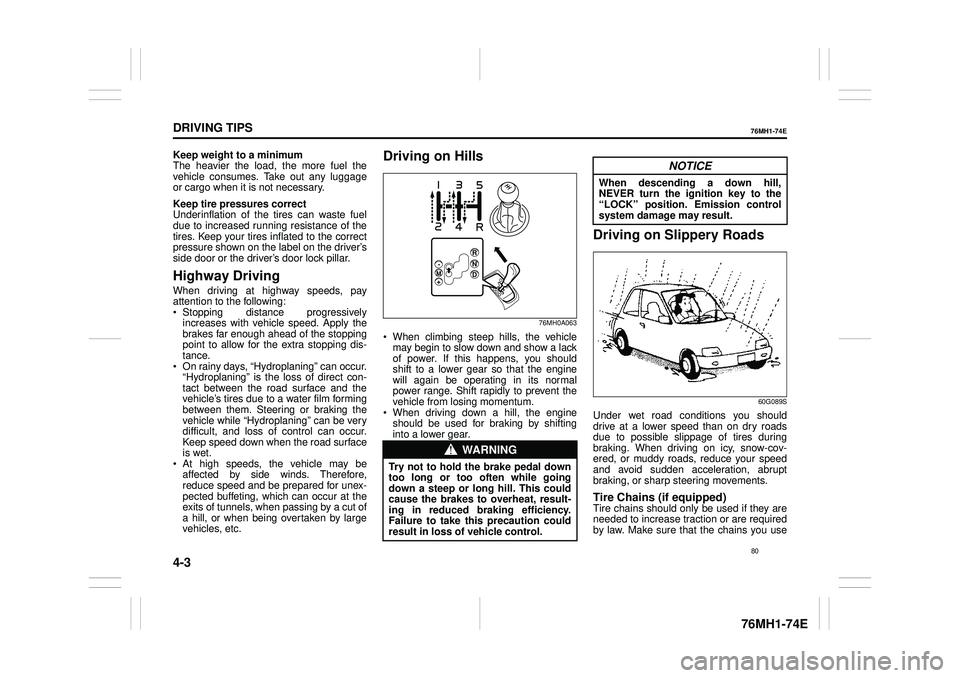
Driving on Hills
76MH0A063
When climbing steep hills, the vehiclemay begin to slow down and show a lackof power. If this happens, you should shift to a lower gear so that the engine will again be operating in its normalpower range. Shift rapidly to prevent the vehicle from losing momentum. When driving down a hill, the engineshould be used for braking by shifting into a lower gear.
Driving on Slippery Roads
60G089S
Under wet road conditions you should drive at a lower speed than on dry roadsdue to possible slippage of tires during braking. When driving on icy, snow-cov- ered, or muddy roads, reduce your speedand avoid sudden acceleration, abrupt braking, or sharp steering movements.
Tire Chains (if equipped)Tire chains should only be used if they are needed to increase traction or are required by law. Make sure that the chains you use
WA R N I N G
Try not to hold the brake pedal down too long or too often while goingdown a steep or long hill. This could cause the brakes to overheat, result- ing in reduced braking efficiency.Failure to take this precaution could result in loss of vehicle control.
R N D -M+
NOTICE
When descending a down hill, NEVER turn the igni tion key to the “LOCK” position. Emission control system damage may result.
80
Page 96 of 201
OTHER CONTROLS AND EQUIPMENT
76MH1-74E
76MH1-74E
OTHER CONTROLS AND EQUIPMENTFuel Filler Cap ..................................................................... 5-1
Engine Hood ........................................................................ 5-2
Sun Visor ............................................................................. 5-3
Interior Light ........................................................................ 5-4
Accessory Socket ........ ....................................................... 5-5
AUX/USB Socket (if equipped) ........................................... 5-5
Assist Grips (if equipped) .................................................. 5-5
Glove Box ............................................................................ 5-6
Cup Holder and Storage Area ............................................ 5-6
Floor Mats (if equipped) ..................................................... 5-7
Luggage Compartment Hooks ........................................... 5-8
Luggage Compartment Cover (if equipped) ..................... 5-8
Frame Hooks ....................................................................... 5-9
Manual Heating and Air Conditioning System ................. 5-10
Radio Antenna ..................................................................... 5-13
Audio System (if equipped) ................................................ 5-14
85
Page 97 of 201

5-1
OTHER CONTROLS AND EQUIPMENT
76MH1-74E
76MH1-74E
Fuel Filler Cap
76MH0A064
74LHT0511
The fuel filler cap is lo cated on the left rear side of the vehicle. The fuel filler door can be unlocked by pulling up the opener leverlocated on the outboard side of the driver’s seat and locked by simply closing the door.
68KN048
To remove the fuel filler cap: 1) Open the fuel filler door. 2) Remove the cap by turning it counter- clockwise.
76MH0A065
NOTE: If the cap holder (1) is equipped with the fuel filler door, hold the fuel filler cap whenrefueling.
To reinstall the fuel filler cap: 1) Turn the cap clockwise until you hear several clicks. 2) Close the fuel filler door.
EXAMPLE
EXAMPLE
CAUTION
Remove the fuel fill er cap slowly. The fuel may be under pressure and mayspray out, causing injury.
Open Close
EXAMPLE
WA R N I N G
Fuel is extremely flammable. Do notsmoke when refueling, and makesure there are no open flames or sparks in the area.
(1)
EXAMPLE
86
Page 98 of 201
5-2
OTHER CONTROLS AND EQUIPMENT
76MH1-74E
76MH1-74E
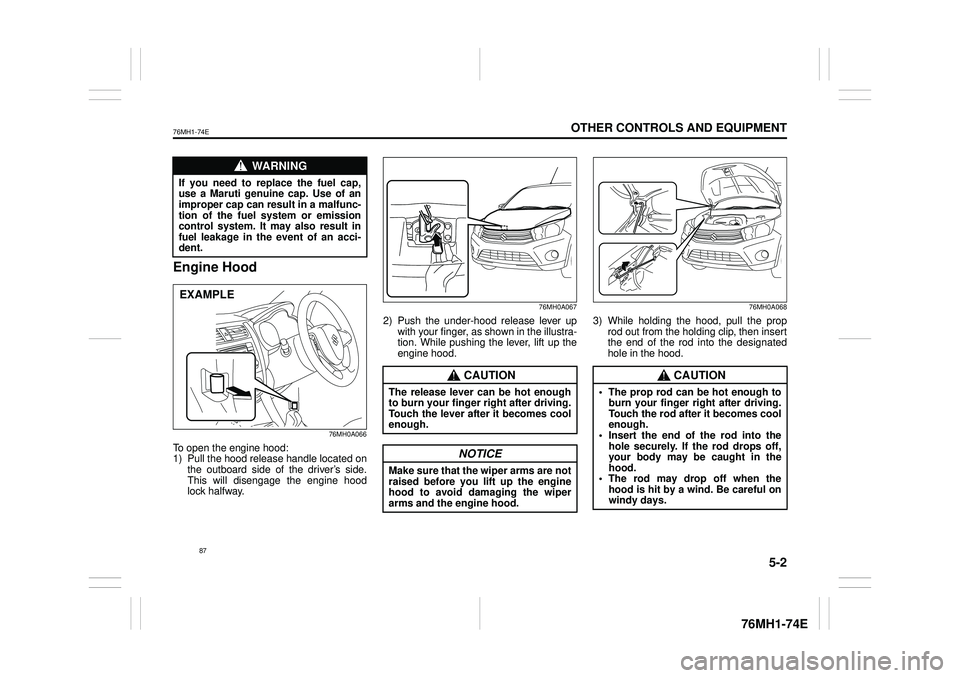
Engine Hood
76MH0A066
To open the engine hood: 1) Pull the hood release handle located onthe outboard side of the driver’s side. This will disengage the engine hood lock halfway.
76MH0A067
2) Push the under-hood release lever up with your finger, as shown in the illustra- tion. While pushing the lever, lift up theengine hood.
76MH0A068
3) While holding the hood, pull the prop rod out from the holding clip, then insert the end of the rod into the designatedhole in the hood.
WA R N I N G
If you need to replace the fuel cap,use a Maruti genuine cap. Use of animproper cap can result in a malfunc- tion of the fuel system or emission control system. It may also result infuel leakage in the event of an acci- dent.
EXAMPLE
CAUTION
The release lever can be hot enough to burn your finger right after driving. Touch the lever after it becomes cool enough.
NOTICE
Make sure that the wiper arms are notraised before you lift up the engine hood to avoid damaging the wiper arms and the engine hood.
CAUTION
• The prop rod can be hot enough toburn your finger right after driving. Touch the rod after it becomes cool enough.• Insert the end of the rod into the hole securely. If the rod drops off, your body may be caught in thehood. • The rod may drop off when the hood is hit by a wind. Be careful onwindy days.
87
Page 108 of 201

5-12
OTHER CONTROLS AND EQUIPMENT
76MH1-74E
76MH1-74E
Air conditioning switch (5) To turn on the air conditioning system, set the blower speed selector to a positionother than “OFF” and push in the “A/C” switch. With this “A/C” switch operation, a indicator light will come on when the airconditioning system is on. To turn off the air conditioning system, push the “A/C” switch again.
During operation of the air conditioner, you may notice slight changes in enginespeed. These changes are normal, the system is designed so that the compressor turns on or off to maintain the desired tem-perature.
Less operation of the compressor results in better fuel economy.
System Operating Instructions
Natural ventilationSelect “VENTILATION” and “FRESH AIR”, the temperature selector to the desired temperature position, and the blowerspeed selector to “OFF”. Fresh air will flow through the vehicle during driving.
Forced ventilation The control settings are the same as for natural ventilation except you set theblower speed selector to a position other than “OFF”.
Normal heating (using outside air) Select “HEAT” and “FRESH AIR”, the tem- perature selector to the desired tempera-ture position and the blower speed selector
to the desired blower speed position. Set- ting the blower speed selector to a higher blower speed position increases heatingefficiency.
Quick heating (using recirculated air) The control settings are the same as for normal heating except you select “RECIR- CULATED AIR”. If you use this heatingmethod for an extended period of time, the air in the vehicle can become contami- nated and the windows can become misty.Therefore, use this method only for quick heating and change to the normal heating method as soon as possible.
Head cooled/Feet warmed heating Select “BI-LEVEL” and “FRESH AIR”, thetemperature selector to the desired tem- perature position, and the blower speed selector to the desired blower speed posi-tion. Unless the temperature selector is in the fully COLD position or fully HOT posi- tion, the air that comes out of the centerand side outlets will be cooler than the air that comes out of the floor outlets.
Normal cooling Set the air flow selector to “VENTILA- TION”, the temperatur e selector to the desired temperature position and the blower speed selector to the desired blower speed position, and turn on the “A/C” switch. Setting the blower speed selec- tor to a higher blower speed position increases cooling efficiency.
You can switch the air intake selector to either “FRESH AIR” or “RECIRCULATED AIR” as you desire. Choosing “RECIRCU-LATED AIR” increases cooling efficiency.
Quick cooling (using recirculated air) The control settings are the same as for normal cooling except you select “RECIR- CULATED AIR” and the highest blowerspeed.
NOTE: • To turn on the air conditioning system, push in the “A/C” switch and set the blower speed selector to a position otherthan “OFF”. With this “A/C” switch opera- tion, an indicator light will come on when the air conditioning system is on. To turnoff the air conditioning system, push the “A/C” switch again. • During operation of the air conditioner,you may notice slight changes in engine speed. These changes are normal, the system is designed so that the compres-sor turns on or of f to maintain the desired temperature. Less operation of the compressor result s in better fuel economy.
NOTE: • If you select “RECIRCULATED AIR” for an extended period of time, the air in the vehicle can become contaminated.Therefore, you should occasionally select “FRESH AIR”. • If your vehicle has been left in the sunwith the windows closed, it will cool
97
Page 147 of 201
6-1
VEHICLE LOADING AND TOWING
76MH1-74E
76MH1-74E
Vehicle Loading
Your vehicle was designed for specific weight capacities. The weight capacities ofyour vehicle are indicated by the Gross Vehicle Weight Rating (GVWR) and the Permissible maximum Axle Weight (PAW,front and rear). The GVWR and PAW (front and rear) are listed in the “SPECIFICA- TIONS” section.
GVWR – Maximum permissible overall weight of the fully loaded vehicle (includingall the occupants, accessories and cargo plus the trailer nose weight if towing a trailer).PAW – (Front and Rear) Maximum permis- sible weight on an individual axle.
Actual weight of the loaded vehicle and actual loads at the front and rear axles can only be determined by weighing the vehi-cle. Compare these weights to the GVWR and PAW (front and rear). If the gross vehi- cle weight or the load on either axleexceeds these ratings, you must remove enough weight to bring the load down to the rated capacity.
Trailer Towing
Your MARUTI SUZUKI was originallydesigned to carry people and a normal amount of cargo, not to tow a trailer.MAR- UTI SUZUKI does not recommend you useyour vehicle to tow a trailer. Towing a trailer can adversely affect handling, durability, and fuel economy.
Towing Your Vehicle
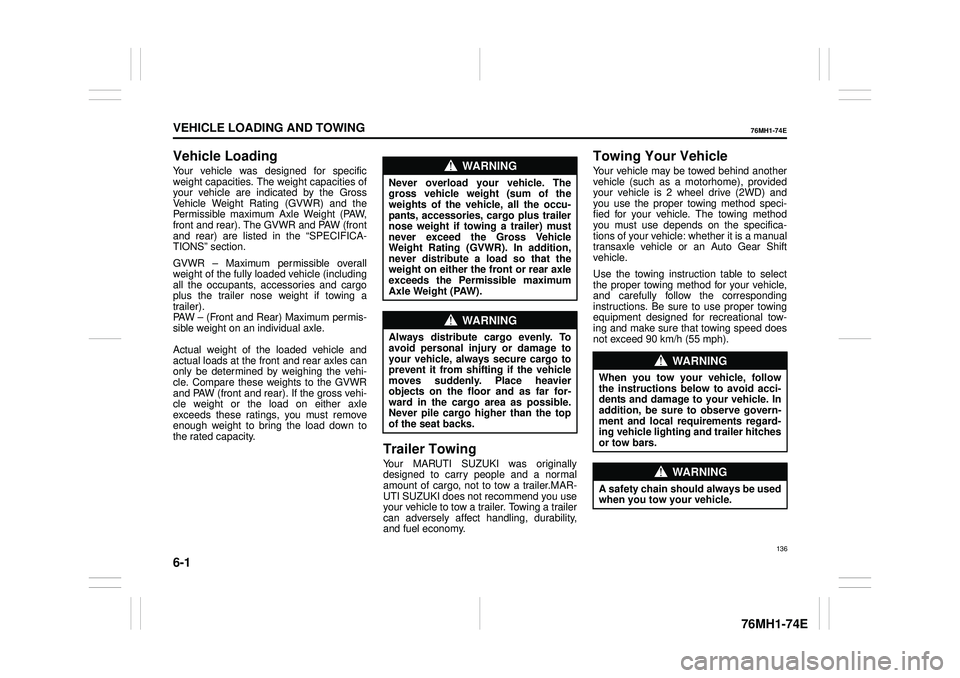
Your vehicle may be towed behind anothervehicle (such as a motorhome), providedyour vehicle is 2 wheel drive (2WD) and you use the proper towing method speci- fied for your vehicle. The towing methodyou must use depends on the specifica- tions of your vehicle: whether it is a manual transaxle vehicle or an Auto Gear Shiftvehicle.
Use the towing instruction table to select the proper towing method for your vehicle, and carefully follow the corresponding instructions. Be sure to use proper towingequipment designed for recreational tow- ing and make sure that towing speed does not exceed 90 km/h (55 mph).
WA R N I N G
Never overload your vehicle. Thegross vehicle weight (sum of theweights of the vehicle, all the occu- pants, accessories, cargo plus trailer nose weight if towing a trailer) mustnever exceed the Gross Vehicle Weight Rating (GVWR). In addition, never distribute a load so that theweight on either th e front or rear axle exceeds the Permissible maximum Axle Weight (PAW).
WA R N I N G
Always distribute cargo evenly. Toavoid personal injury or damage to your vehicle, always secure cargo to prevent it from shifting if the vehiclemoves suddenly. Place heavier objects on the floor and as far for- ward in the cargo area as possible.Never pile cargo higher than the top of the seat backs.
WA R N I N G
When you tow your vehicle, follow the instructions below to avoid acci-dents and damage to your vehicle. In addition, be sure to observe govern- ment and local requirements regard-ing vehicle lighting and trailer hitches or tow bars.
WA R N I N G
A safety chain should always be used when you tow your vehicle.
136
Page 149 of 201
INSPECTION AND MAINTENANCE
76MH1-74E
76MH1-74E
138
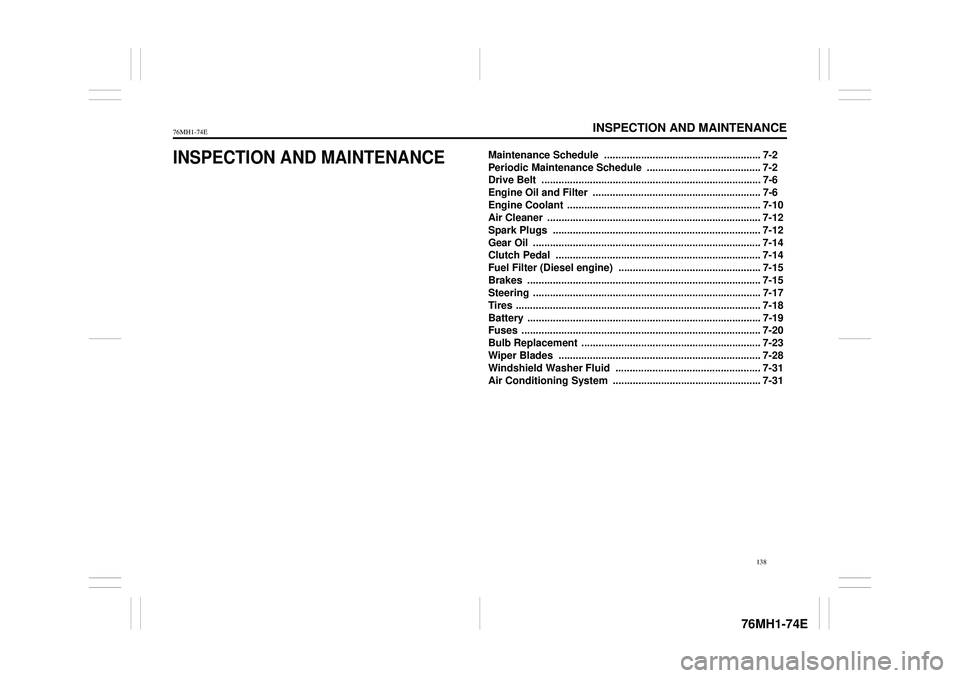
INSPECTION AND MAINTENANCEMaintenance Schedule ....................................................... 7-2
Periodic Maintenance Schedule . ....................................... 7-2
Drive Belt ............................................................................. 7-6
Engine Oil and Filter ........................................................... 7-6
Engine Coolant .................................................................... 7-10
Air Cleaner ........................................................................... 7-12
Spark Plugs ......................................................................... 7-12
Gear Oil ................................................................................ 7-14
Clutch Pedal ........................................................................ 7-14
Fuel Filter (Diesel engine) .................................................. 7-15
Brakes .......... ........................................................................ 7-15
Steering ................................................................................ 7-17
Tires ...................................................................................... 7-18
Battery .................................................................................. 7-19
Fuses .................................................................................... 7-20
Bulb Replacement ............................................................... 7-23
Wiper Blades ....................................................................... 7-28
Windshield Washer Fluid ................................................... 7-31
Air Conditioning System .................................................... 7-31
Page 150 of 201
7-1
INSPECTION AND MAINTENANCE
76MH1-74E
76MH1-74E
60A187S
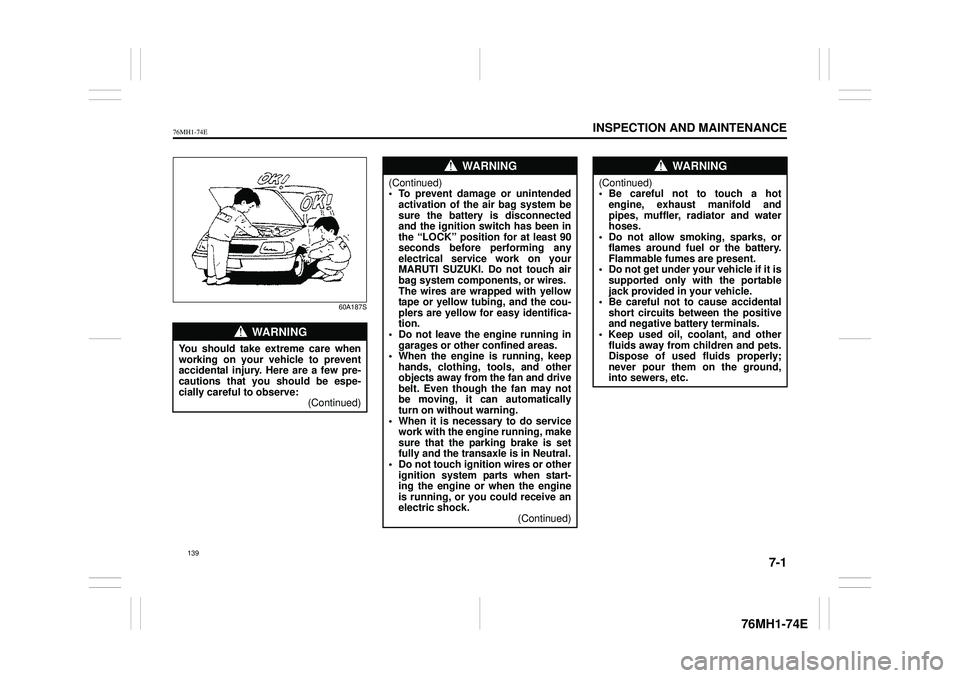
WA R N I N G
You should take extreme care when working on your vehicle to preventaccidental injury. Here are a few pre- cautions that you should be espe- cially careful to observe:(Continued)
WA R N I N G
(Continued)• To prevent damage or unintendedactivation of the air bag system be sure the battery is disconnected and the ignition switch has been inthe “LOCK” position for at least 90 seconds before performing any electrical service work on yourMARUTI SUZUKI. Do not touch air bag system components, or wires. The wires are wrapped with yellowtape or yellow tubing, and the cou- plers are yellow for easy identifica- tion.• Do not leave the engine running in garages or other confined areas. • When the engine is running, keephands, clothing, tools, and other objects away from the fan and drive belt. Even though the fan may notbe moving, it can automatically turn on without warning. • When it is necessary to do servicework with the engine running, make sure that the parking brake is set fully and the transaxle is in Neutral.• Do not touch ignition wires or other ignition system parts when start- ing the engine or when the engineis running, or you could receive an electric shock. (Continued)
WA R N I N G
(Continued)• Be careful not to touch a hotengine, exhaust manifold and pipes, muffler, radiator and water hoses.• Do not allow smoking, sparks, or flames around fuel or the battery. Flammable fumes are present.• Do not get under your vehicle if it is supported only with the portable jack provided in your vehicle.• Be careful not to cause accidental short circuits be tween the positive and negative battery terminals.• Keep used oil, coolant, and other fluids away from children and pets. Dispose of used fluids properly;never pour them on the ground, into sewers, etc.
139
Page 152 of 201
7-3
INSPECTION AND MAINTENANCE
76MH1-74E
76MH1-74E
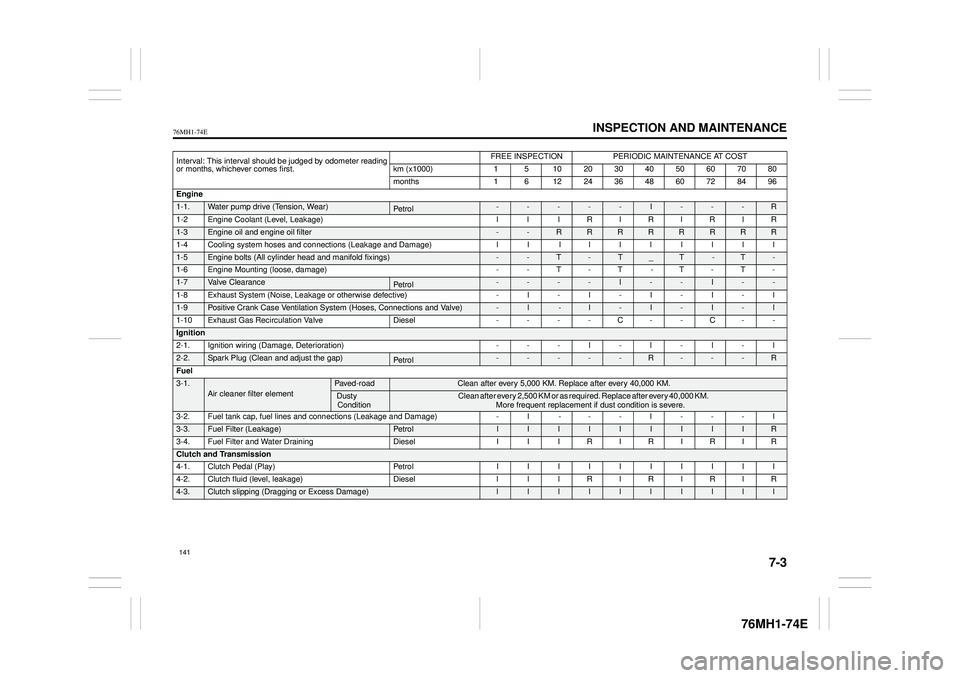
Interval: This interval should be judged by odometer reading or months, whichever comes first.
FREE INSPECTIONPERIODIC MAINTENANCE AT COST
km (x1000) 1 5 10 20 30 40 50 60 70 80
months 1 6 12 24 36 48 60 72 84 96
Engine
1-1.Water pump drive (Tension, Wear)Pe tro l-----I---R
1-2Engine Coolant (Level, Leakage) l l lRlRlRlR
1-3Engine oil and engine oil filter --RRRRRRRR
1-4 Cooling system hoses and connections (Leakage and Damage) l l l l llllll
1-5Engine bolts (All cylinder head and manifold fixings)--T-T_T -T-
1-6 Engine Mounting (loose, damage) - - T - T - T - T -
1-7Valve ClearancePe tro l----I--I--
1-8Exhaust System (Noise, Leakage or otherwise defective)
-l -l-I-I-l
1-10 Exhaust Gas Recirculation Valve Diesel - - - - C - - C - -
Ignition
2-1.Ignition wiring (Damage, Deterioration)---l-l-l-l
2-2.Spark Plug (Clean and adjust the gap)-----R---R
Fuel
3-1.Air cleaner filter elementPaved-road Clean after every 5,000 KM. Replace after every 40,000 KM.
Dusty Condition C l e a n a f t e r e v e r y 2 , 5 0 0 K M o r a s r e q u i r e d . R e p l a c e a f t e r e v e r y 4 0 , 0 0 0 K M . More frequent replacement if dust condition is severe.
3-2.Fuel tank cap, fuel lines and connections (Leakage and Damage)-l ---l---l
3-3.Fuel Filter (Leakage)Pe tro lIIIIIIIIIR
3-4.Fuel Filter and Water DrainingDieselIIIRIRIRIR
Clutch and Transmission
4-1.Clutch Pedal (Play)IIIIIIIIII
4-2.Clutch fluid (level, leakage)DiesellllRlRlRlR
4-3.Clutch slipping (Dragging or Excess Damage)llllllllll
141