Cool SUZUKI CELERIO 2017 Owners Manual
[x] Cancel search | Manufacturer: SUZUKI, Model Year: 2017, Model line: CELERIO, Model: SUZUKI CELERIO 2017Pages: 201, PDF Size: 5.82 MB
Page 13 of 201
0-1
76MH1-74E
FOREWORD
This manual is an essential part of your
vehicle and should remain with the vehicle
when resold or otherwise transferred to a
new owner or operator. Please read this
manual carefully before operating your
new MARUTI SUZUKI and review the
manual from time to time. It contains
important information on safety, operation
and maintenance. You are invited to avail
the three Free Inspection Services as
described in the manual. Three free
inspection coupons are attached to this
manual. Please show this manual to your
dealer while you take your MARUTI
SUZUKI for any Service.
To prolong the life of your vehicle and
reduce maintenance cost, the periodic
maintenance must be carried out accord-
ing to “PERIODIC MAINTENANCE
SCHEDULE” described in “INSPECTION
AND MAINTENANCE” section of this man-
ual. It is essential for preventing trouble
and accidents to ensure your satisfaction
and safety.
Daily inspection and care as per “DAILY
INSPECTION CHECKLIST” described in
the “INSPECTION AND MAINTENANCE”
section of this manual is essential for pro-
longing the life of the vehicle and for safe
driving.
MARUTI SUZUKI INDIA LIMITED believes
in conservation and protection of Earth’s
natural resources.
To that end, we encourage every vehicle
owner to recycle, trade-in or properly dis-
pose of, as appropriate, used Engine Oil,
coolant and other fluids, batteries and
tyres etc.
MARUTI SUZUKI INDIA LIMITED
All information in this manual is based on the latest product information avail-able at the time of publication. Due toimprovements or other changes, theremay be discrepancies between informa-tion in this manual and your vehicle.MARUTI SUZUKI INDIA LIMITEDreserves the right to make productionchanges at any time, without notice andwithout incurring any obligation tomake the same or similar changes tovehicles previously built or sold.
This vehicle may not comply with stan-dards or regulations of other countries.Before attempting to register this vehi-cle in any other country, check all appli-cable regulations and make any neces-sary modifications.
2
Page 61 of 201
2-39
BEFORE DRIVING
76MH1-74E
76MH1-74E
If one of these happens, have the system inspected by your MARUTI SUZUKI dealer. If the ABS becomes inoperative, the brake system will function as an ordinary brake system that does not have this ABS sys-tem.
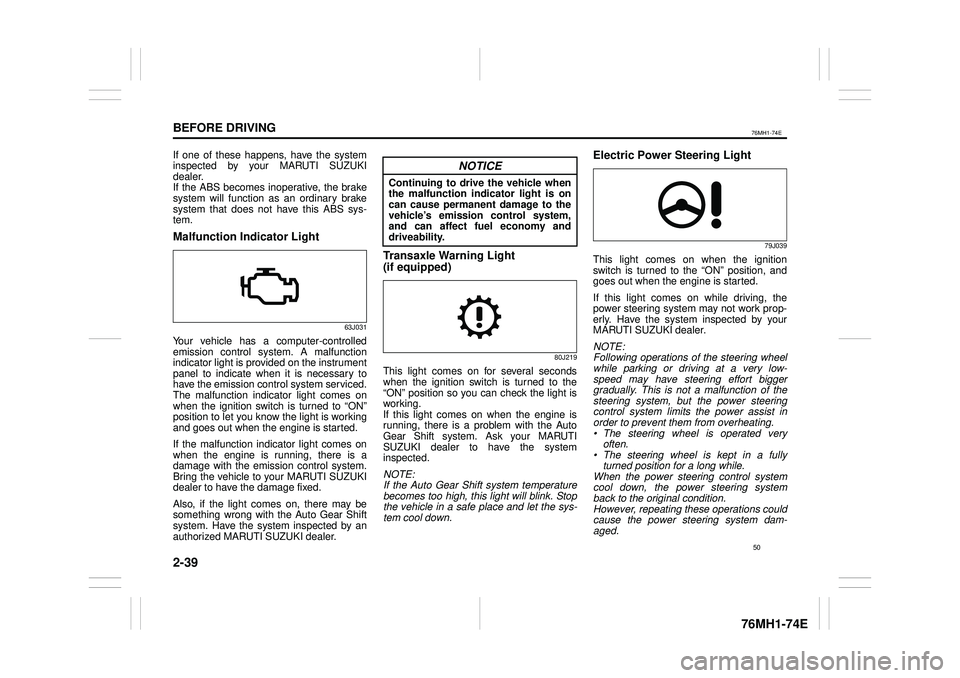
Malfunction Indicator Light
63J031
Your vehicle has a computer-controlledemission control system. A malfunctionindicator light is provided on the instrument panel to indicate when it is necessary to have the emission control system serviced.The malfunction indicator light comes on when the ignition switch is turned to “ON” position to let you know the light is workingand goes out when the engine is started.
If the malfunction indicator light comes on when the engine is running, there is a damage with the emission control system.Bring the vehicle to your MARUTI SUZUKI dealer to have the damage fixed.
Also, if the light comes on, there may be something wrong with the Auto Gear Shift system. Have the system inspected by an authorized MARUTI SUZUKI dealer.
Transaxle Warning Light
(if equipped)
80J219
This light comes on for several seconds when the ignition switch is turned to the “ON” position so you can check the light isworking. If this light comes on when the engine is running, there is a problem with the AutoGear Shift system. Ask your MARUTI SUZUKI dealer to have the system inspected.
NOTE: If the Auto Gear Shift system temperaturebecomes too high, this light will blink. Stop the vehicle in a safe place and let the sys- tem cool down.
Electric Power Steering Light
79J039
This light comes on when the ignitionswitch is turned to the “ON” position, and goes out when the engine is started.
If this light comes on while driving, the power steering system may not work prop- erly. Have the system inspected by yourMARUTI SUZUKI dealer.
NOTE: Following operations of the steering wheel while parking or driving at a very low- speed may have steering effort biggergradually. This is not a malfunction of the steering system, but the power steering control system limits the power assist inorder to prevent them from overheating. • The steering wheel is operated veryoften.• The steering wheel is kept in a fullyturned position for a long while. When the power steering control system cool down, the power steering system back to the original condition. However, repeating these operations couldcause the power steering system dam-aged.
NOTICE
Continuing to drive the vehicle whenthe malfunction indicator light is oncan cause permanent damage to the vehicle’s emission control system, and can affect fuel economy anddriveability.
50
Page 62 of 201
2-40
BEFORE DRIVING
76MH1-74E
76MH1-74E
NOTE: If the power steering system does not work properly, you will feel heavier to steer butyou still will be able to steer.
NOTE: If the steering is operated, you may hear a noise. This is normal and indicates that the power steering system works properly.
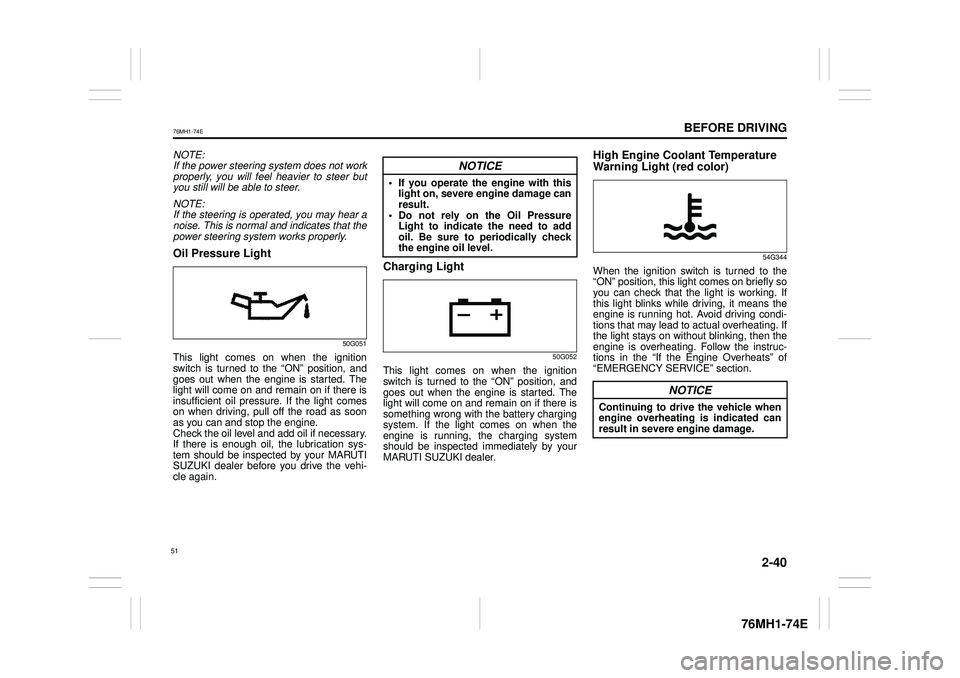
Oil Pressure Light
50G051
This light comes on when the ignition switch is turned to the “ON” position, and goes out when the engine is started. Thelight will come on and remain on if there is insufficient oil pressure. If the light comes on when driving, pull off the road as soonas you can and stop the engine. Check the oil level and add oil if necessary. If there is enough oil, the lubrication sys-tem should be inspected by your MARUTI SUZUKI dealer before you drive the vehi- cle again.
Charging Light
50G052
This light comes on when the ignitionswitch is turned to the “ON” position, and goes out when the engine is started. The light will come on and remain on if there issomething wrong with the battery charging system. If the light comes on when theengine is running, the charging system should be inspected immediately by your MARUTI SUZUKI dealer.
High Engine Coolant Temperature
Warning Light (red color)
54G344
When the ignition switch is turned to the “ON” position, this light comes on briefly soyou can check that the light is working. If this light blinks while driving, it means the engine is running hot. Avoid driving condi-tions that may lead to actual overheating. If the light stays on without blinking, then the engine is overheating. Follow the instruc-tions in the “If the Engine Overheats” of “EMERGENCY SERVICE” section.
NOTICE
• If you operate the engine with thislight on, severe engine damage can result.• Do not rely on the Oil PressureLight to indicate the need to addoil. Be sure to periodically check the engine oil level.
NOTICE
Continuing to drive the vehicle whenengine overheating is indicated can result in severe engine damage.
51
Page 64 of 201
2-42
BEFORE DRIVING
76MH1-74E
76MH1-74E
NOTE: If the security system indicator blinks whenthe ignition switch is in the “ON” position, there may be something wrong with the security system. Ask your MARUTI SUZUKI dealer to inspect the system.
Depress Brake Pedal Indicator (if equipped)
76MH0A047
Refer to “Auto Gear Shift” in the “OPERAT- ING YOUR VEHICLE” section for details.
Fuel Filter Warning Light (For Diesel Engine Model)
60A541
This light comes on for several seconds when the ignition switch is turned to the “ON” position so you can check the light is working.
If the light comes on when driving, there is a possibility to have water in the fuel filter.Drain water as soon as possible. For
details of draining water, refer to “Fuel Fil- ter” in the “INSPECTION AND MAINTE- NANCE” section.
Glow Plug Indicator Light (For Diesel Engine Model)
60A543
If the coolant temperature is cool enough, this light comes on when the ignition switch is turned to the “ON” position and goes out when the glow plug is heated enough forengine starting.
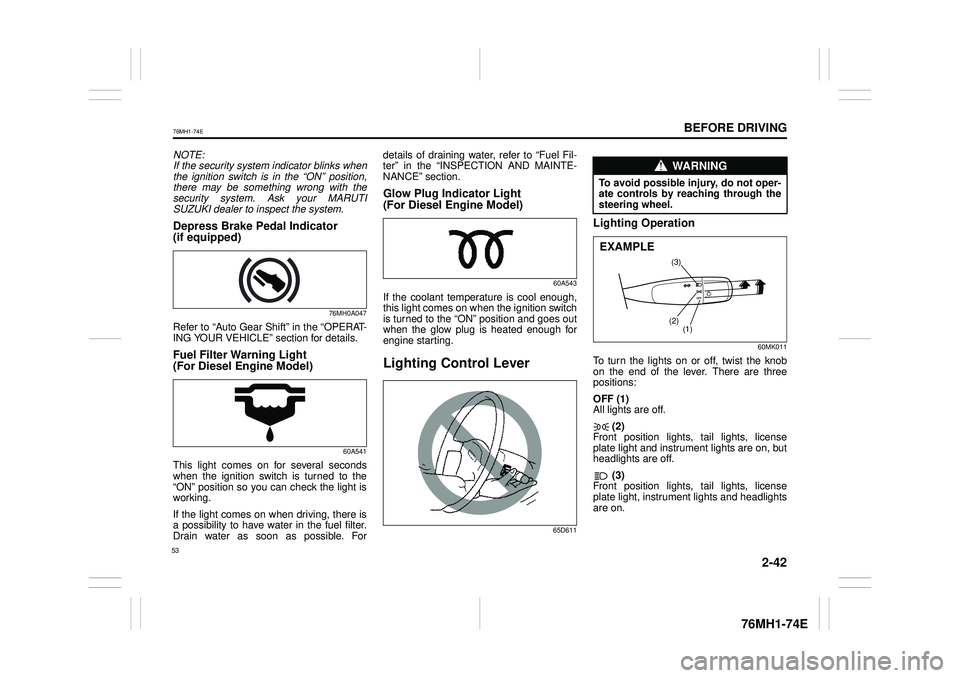
Lighting Control Lever
65D611
Lighting Operation
60MK011
To turn the lights on or off, twist the knobon the end of the lever. There are threepositions:
OFF (1) All lights are off.
(2)Front position lights, tail lights, license plate light and instrument lights are on, but headlights are off.
(3)Front position lights, tail lights, licenseplate light, instrument lights and headlights are on.
WA R N I N G
To avoid possible injury, do not oper- ate controls by reaching through thesteering wheel.
(3)
(2)(1)
EXAMPLE
53
Page 72 of 201
3-2
OPERATING YOUR VEHICLE
76MH1-74E
76MH1-74E
NOTE: It is normal for water to drip from the air conditioning system after use.
4) Make sure the hood is fully closed and latched.5) Check the headlights, turn signal lights, brake lights and horn for proper opera- tion.6) Adjust the seat and head restraint (if equipped). 7) Check the brake pedal and the parkingbrake lever. 8) Adjust the mirrors. 9) Make sure that you and all passengershave properly fastened your seat belts. 10)Make sure that all warning lights come on as the key is turned to the “ON” posi-tion. 11)Check all gauges. 12)Make sure that the BRAKE SYSTEMWARNING light turns off when the parking brake is released.
Once a week, or each time you fill your fuel tank, perform the following under-hood checks:
1) Engine oil level 2) Coolant level3) Brake fluid level 4) Windshield washer fluid level 5) Battery solution level6) Hood latch operation Pull the hood release handle inside the vehicle. Make sure that you cannotopen the hood all the way without
releasing the secondary latch. Be sure to close the hood securely after check- ing for proper latch operation. See “Alllatches, hinges & locks” of “CHASSIS AND BODY” in the “Periodic Mainte- nance Schedule” in the “INSPECTIONAND MAINTENANCE” section for lubri- cation schedule.
Once a month, or each time you fill your fuel tank, check the tire pressure using a tire pressure gauge. Also check the tirepressure of the spare tire.
Engine Oil Consumption
It is normal for the engine to consume some engine oil during normal vehicle operation.
The amount of engine oil consumed depends on the viscosity of the oil, thequality of the oil and the conditions the vehicle is driven under. More oil is consumed during high-speeddriving and when there is frequent acceler- ation and deceleration. Under high loads, your engine also will consume more oil.A new engine also consumes more oil, since its pistons, piston rings and cylinder
walls have not yet become conditioned. New engines reach the normal level of oil consumption only after approximately 5000km (3000 miles) driving.
Oil consumption: Max. 1.0 L per 1000 km (1 Qt. per 600 miles)
When judging the amount of oil consump- tion, note that the oil may become diluted and make it difficult to accurately judge thetrue oil level. As an example, if a vehicle is used for repeated short trips, and consumes a nor-mal amount of oil, the dipstick may not show any drop in the oil level at all, even after 1000 km (600 miles) or more of driv-ing. This is because the oil is gradually becoming diluted with fuel or moisture, making it appear that the oil level has notchanged. You should also be aware that the diluting ingredients evaporate out when the vehicleis subsequently driven at high speeds, such as on an expressway, making it appear that oil is excessively consumedafter high-speed driving.
WA R N I N G
Make sure the hood is fully closed and latched before driv ing. If it is not, it can fly up unexpectedly duringdriving, obstructing your view and resulting in an accident.
61
Page 98 of 201
5-2
OTHER CONTROLS AND EQUIPMENT
76MH1-74E
76MH1-74E
Engine Hood
76MH0A066
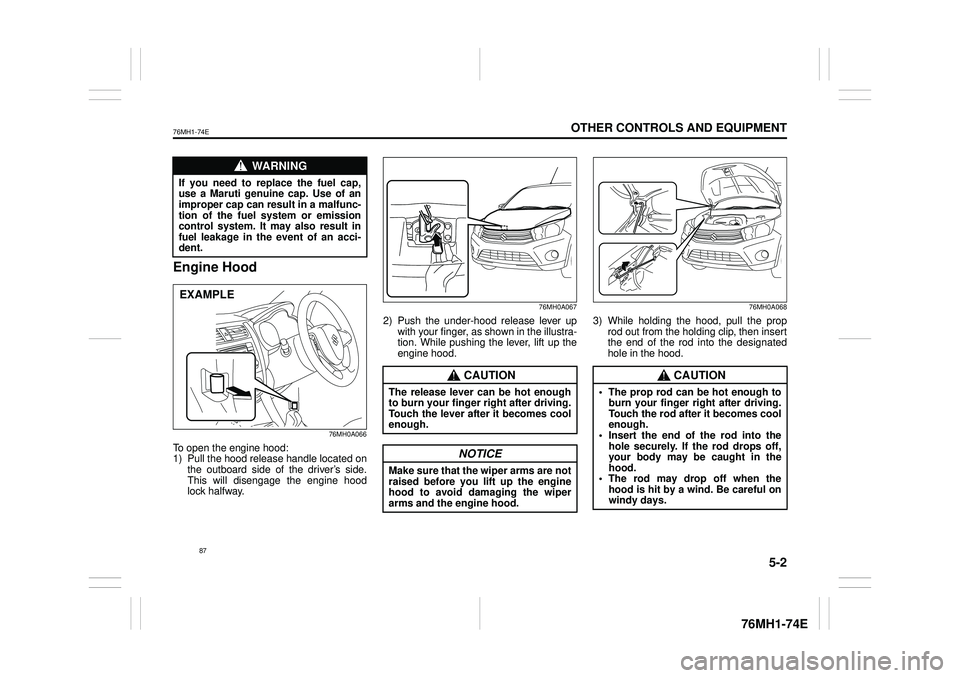
To open the engine hood: 1) Pull the hood release handle located onthe outboard side of the driver’s side. This will disengage the engine hood lock halfway.
76MH0A067
2) Push the under-hood release lever up with your finger, as shown in the illustra- tion. While pushing the lever, lift up theengine hood.
76MH0A068
3) While holding the hood, pull the prop rod out from the holding clip, then insert the end of the rod into the designatedhole in the hood.
WA R N I N G
If you need to replace the fuel cap,use a Maruti genuine cap. Use of animproper cap can result in a malfunc- tion of the fuel system or emission control system. It may also result infuel leakage in the event of an acci- dent.
EXAMPLE
CAUTION
The release lever can be hot enough to burn your finger right after driving. Touch the lever after it becomes cool enough.
NOTICE
Make sure that the wiper arms are notraised before you lift up the engine hood to avoid damaging the wiper arms and the engine hood.
CAUTION
• The prop rod can be hot enough toburn your finger right after driving. Touch the rod after it becomes cool enough.• Insert the end of the rod into the hole securely. If the rod drops off, your body may be caught in thehood. • The rod may drop off when the hood is hit by a wind. Be careful onwindy days.
87
Page 107 of 201

5-11
OTHER CONTROLS AND EQUIPMENT
76MH1-74E
76MH1-74E
Bi-level (b)
76MH0A084
Temperature-controlled air comes out of the floor outlets and cooler air comes out of the center and side outlets. When thetemperature selector (1) is in the fully COLD position or fully HOT position, how- ever, the air from the floor outlets and theair from the center and side outlets will be the same temperature.
Heat (c)
76MH0A085
Temperature-controlled air comes out of the floor outlets and the side outlets, also comes out of the windshield defroster out-lets and also comes slightly out of the side defroster outlets.
Heat & defrost (d)
76MH0A087
Temperature-controlled air comes out of the floor outlets, the windshield defroster outlets, the side defroster outlets and theside outlets.
Defrost (e)
76MH0A088
Temperature-controlled air comes out of the windshield defroster outlets, the side defroster outlets and the side outlets.
Air intake selector (4)
76MH0A089
This selector is used to select the following modes.
Fresh Air (f) When this mode is selected by moving the lever to right, outside air is used.
Recirculated Air (g) When this mode is selected by moving thelever to left, outside air is shut out and inside air is recirculat ed. This mode is suit- able when driving through dusty or pollutedair such as in a tunnel, or when attempting to quickly cool down the interior.
NOTE: If you select “RECIRCULATED AIR” for an extended period of time, the air in the vehi-cle can become contam inated. Therefore, you should occasionally select “FRESH AIR”.
(g) (f)
96
Page 108 of 201

5-12
OTHER CONTROLS AND EQUIPMENT
76MH1-74E
76MH1-74E
Air conditioning switch (5) To turn on the air conditioning system, set the blower speed selector to a positionother than “OFF” and push in the “A/C” switch. With this “A/C” switch operation, a indicator light will come on when the airconditioning system is on. To turn off the air conditioning system, push the “A/C” switch again.
During operation of the air conditioner, you may notice slight changes in enginespeed. These changes are normal, the system is designed so that the compressor turns on or off to maintain the desired tem-perature.
Less operation of the compressor results in better fuel economy.
System Operating Instructions
Natural ventilationSelect “VENTILATION” and “FRESH AIR”, the temperature selector to the desired temperature position, and the blowerspeed selector to “OFF”. Fresh air will flow through the vehicle during driving.
Forced ventilation The control settings are the same as for natural ventilation except you set theblower speed selector to a position other than “OFF”.
Normal heating (using outside air) Select “HEAT” and “FRESH AIR”, the tem- perature selector to the desired tempera-ture position and the blower speed selector
to the desired blower speed position. Set- ting the blower speed selector to a higher blower speed position increases heatingefficiency.
Quick heating (using recirculated air) The control settings are the same as for normal heating except you select “RECIR- CULATED AIR”. If you use this heatingmethod for an extended period of time, the air in the vehicle can become contami- nated and the windows can become misty.Therefore, use this method only for quick heating and change to the normal heating method as soon as possible.
Head cooled/Feet warmed heating Select “BI-LEVEL” and “FRESH AIR”, thetemperature selector to the desired tem- perature position, and the blower speed selector to the desired blower speed posi-tion. Unless the temperature selector is in the fully COLD position or fully HOT posi- tion, the air that comes out of the centerand side outlets will be cooler than the air that comes out of the floor outlets.
Normal cooling Set the air flow selector to “VENTILA- TION”, the temperatur e selector to the desired temperature position and the blower speed selector to the desired blower speed position, and turn on the “A/C” switch. Setting the blower speed selec- tor to a higher blower speed position increases cooling efficiency.
You can switch the air intake selector to either “FRESH AIR” or “RECIRCULATED AIR” as you desire. Choosing “RECIRCU-LATED AIR” increases cooling efficiency.
Quick cooling (using recirculated air) The control settings are the same as for normal cooling except you select “RECIR- CULATED AIR” and the highest blowerspeed.
NOTE: • To turn on the air conditioning system, push in the “A/C” switch and set the blower speed selector to a position otherthan “OFF”. With this “A/C” switch opera- tion, an indicator light will come on when the air conditioning system is on. To turnoff the air conditioning system, push the “A/C” switch again. • During operation of the air conditioner,you may notice slight changes in engine speed. These changes are normal, the system is designed so that the compres-sor turns on or of f to maintain the desired temperature. Less operation of the compressor result s in better fuel economy.
NOTE: • If you select “RECIRCULATED AIR” for an extended period of time, the air in the vehicle can become contaminated.Therefore, you should occasionally select “FRESH AIR”. • If your vehicle has been left in the sunwith the windows closed, it will cool
97
Page 149 of 201
INSPECTION AND MAINTENANCE
76MH1-74E
76MH1-74E
138
INSPECTION AND MAINTENANCEMaintenance Schedule ....................................................... 7-2
Periodic Maintenance Schedule . ....................................... 7-2
Drive Belt ............................................................................. 7-6
Engine Oil and Filter ........................................................... 7-6
Engine Coolant .................................................................... 7-10
Air Cleaner ........................................................................... 7-12
Spark Plugs ......................................................................... 7-12
Gear Oil ................................................................................ 7-14
Clutch Pedal ........................................................................ 7-14
Fuel Filter (Diesel engine) .................................................. 7-15
Brakes .......... ........................................................................ 7-15
Steering ................................................................................ 7-17
Tires ...................................................................................... 7-18
Battery .................................................................................. 7-19
Fuses .................................................................................... 7-20
Bulb Replacement ............................................................... 7-23
Wiper Blades ....................................................................... 7-28
Windshield Washer Fluid ................................................... 7-31
Air Conditioning System .................................................... 7-31
Page 150 of 201
7-1
INSPECTION AND MAINTENANCE
76MH1-74E
76MH1-74E
60A187S
WA R N I N G
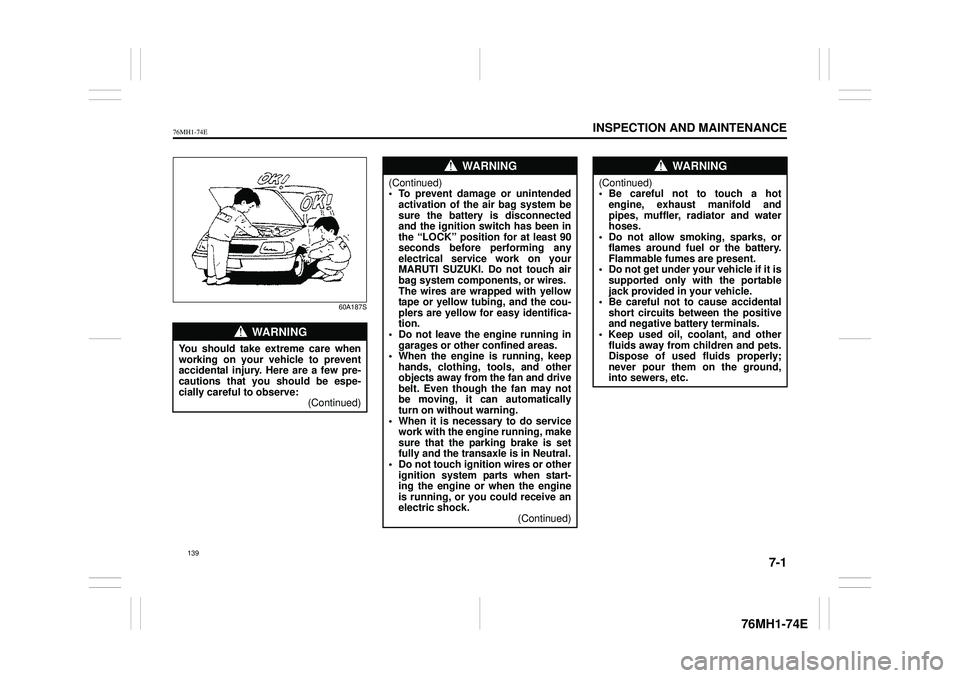
You should take extreme care when working on your vehicle to preventaccidental injury. Here are a few pre- cautions that you should be espe- cially careful to observe:(Continued)
WA R N I N G
(Continued)• To prevent damage or unintendedactivation of the air bag system be sure the battery is disconnected and the ignition switch has been inthe “LOCK” position for at least 90 seconds before performing any electrical service work on yourMARUTI SUZUKI. Do not touch air bag system components, or wires. The wires are wrapped with yellowtape or yellow tubing, and the cou- plers are yellow for easy identifica- tion.• Do not leave the engine running in garages or other confined areas. • When the engine is running, keephands, clothing, tools, and other objects away from the fan and drive belt. Even though the fan may notbe moving, it can automatically turn on without warning. • When it is necessary to do servicework with the engine running, make sure that the parking brake is set fully and the transaxle is in Neutral.• Do not touch ignition wires or other ignition system parts when start- ing the engine or when the engineis running, or you could receive an electric shock. (Continued)
WA R N I N G
(Continued)• Be careful not to touch a hotengine, exhaust manifold and pipes, muffler, radiator and water hoses.• Do not allow smoking, sparks, or flames around fuel or the battery. Flammable fumes are present.• Do not get under your vehicle if it is supported only with the portable jack provided in your vehicle.• Be careful not to cause accidental short circuits be tween the positive and negative battery terminals.• Keep used oil, coolant, and other fluids away from children and pets. Dispose of used fluids properly;never pour them on the ground, into sewers, etc.
139