air SUZUKI CELERIO 2019 Service Manual
[x] Cancel search | Manufacturer: SUZUKI, Model Year: 2019, Model line: CELERIO, Model: SUZUKI CELERIO 2019Pages: 201, PDF Size: 5.82 MB
Page 160 of 201
7-11
INSPECTION AND MAINTENANCE
76MH1-74E
76MH1-74E
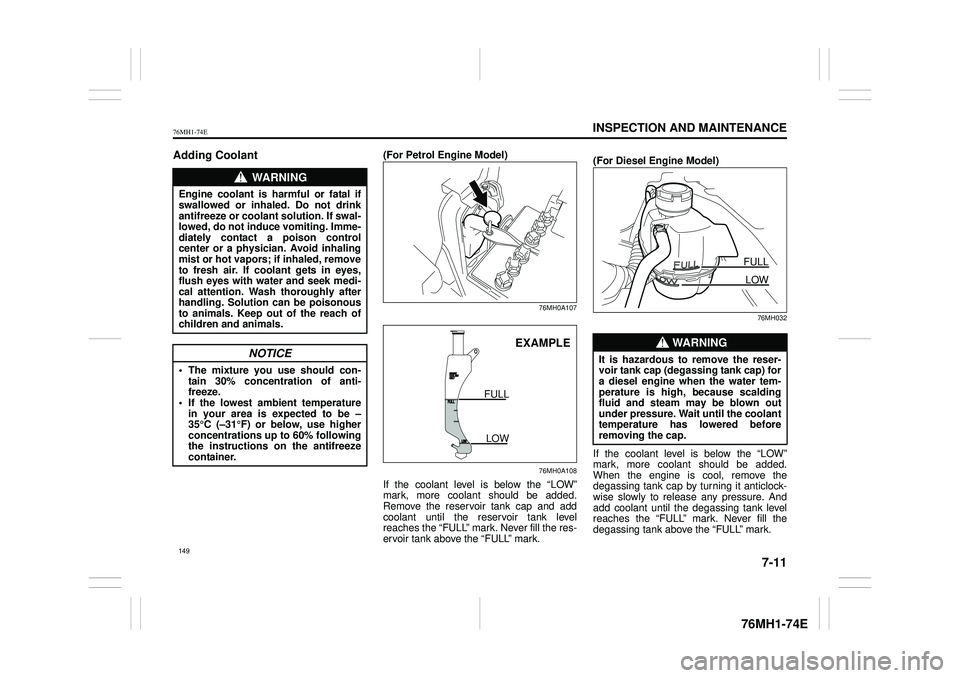
Adding Coolant(For Petrol Engine Model)
76MH0A107
76MH0A108
If the coolant level is below the “LOW” mark, more coolant should be added. Remove the reservoir tank cap and add coolant until the reservoir tank level reaches the “FULL” mark. Never fill the res- ervoir tank above the “FULL” mark.
(For Diesel Engine Model)
76MH032
If the coolant level is below the “LOW” mark, more coolant should be added. When the engine is cool, remove the degassing tank cap by turning it anticlock-wise slowly to release any pressure. And add coolant until the degassing tank level reaches the “FULL” mark. Never fill thedegassing tank above the “FULL” mark.
WA R N I N G
Engine coolant is harmful or fatal if swallowed or inhaled. Do not drink antifreeze or coolant solution. If swal-lowed, do not induce vomiting. Imme- diately contact a poison control center or a physician. Avoid inhalingmist or hot vapors; if inhaled, remove to fresh air. If coolant gets in eyes, flush eyes with water and seek medi-cal attention. Wash thoroughly after handling. Solution can be poisonous to animals. Keep out of the reach ofchildren and animals.
NOTICE
• The mixture you use should con- tain 30% concentration of anti- freeze.• If the lowest am bient temperature in your area is expected to be – 35°C (–31°F) or below, use higherconcentrations up to 60% following the instructions on the antifreeze container.
EXAMPLE
FULL
LOW
WA R N I N G
It is hazardous to remove the reser- voir tank cap (degassing tank cap) for a diesel engine when the water tem- perature is high, because scaldingfluid and steam may be blown out under pressure. Wait until the coolant temperature has lowered beforeremoving the cap.
FULL
LOW
149
Page 161 of 201
7-12
INSPECTION AND MAINTENANCE
76MH1-74E
76MH1-74E
Coolant ReplacementSince special procedures are required, we recommend you take your vehicle to your MARUTI SUZUKI dealer for coolant replacement.
Air Cleaner
If the air cleaner is clogged with dust, therewill be greater intake resistance, resulting in decreased power output and increased fuel consumption.
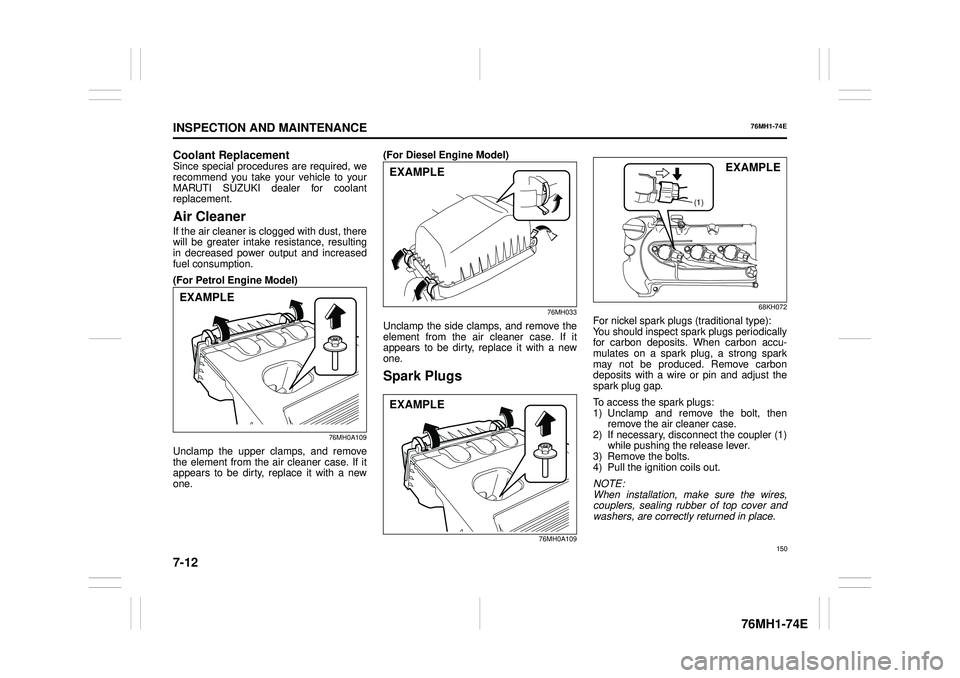
(For Petrol Engine Model)
76MH0A109
Unclamp the upper clamps, and remove the element from the air cleaner case. If itappears to be dirty, replace it with a new one.
(For Diesel Engine Model)
76MH033
Unclamp the side clamps, and remove the element from the air cleaner case. If it appears to be dirty, replace it with a newone.
Spark Plugs
76MH0A109
68KH072
For nickel spark plugs (traditional type): You should inspect spark plugs periodically for carbon deposits. When carbon accu-mulates on a spark plug, a strong spark may not be produced. Remove carbon deposits with a wire or pin and adjust thespark plug gap.
To access the spark plugs: 1) Unclamp and remove the bolt, then remove the air cleaner case. 2) If necessary, disconnect the coupler (1)while pushing the release lever. 3) Remove the bolts. 4) Pull the ignition coils out.
NOTE: When installation, make sure the wires,couplers, sealing rubber of top cover and washers, are correctly returned in place.
EXAMPLE
EXAMPLE
EXAMPLE
(1)
EXAMPLE
150
Page 167 of 201
7-18
INSPECTION AND MAINTENANCE
76MH1-74E
76MH1-74E
Tires
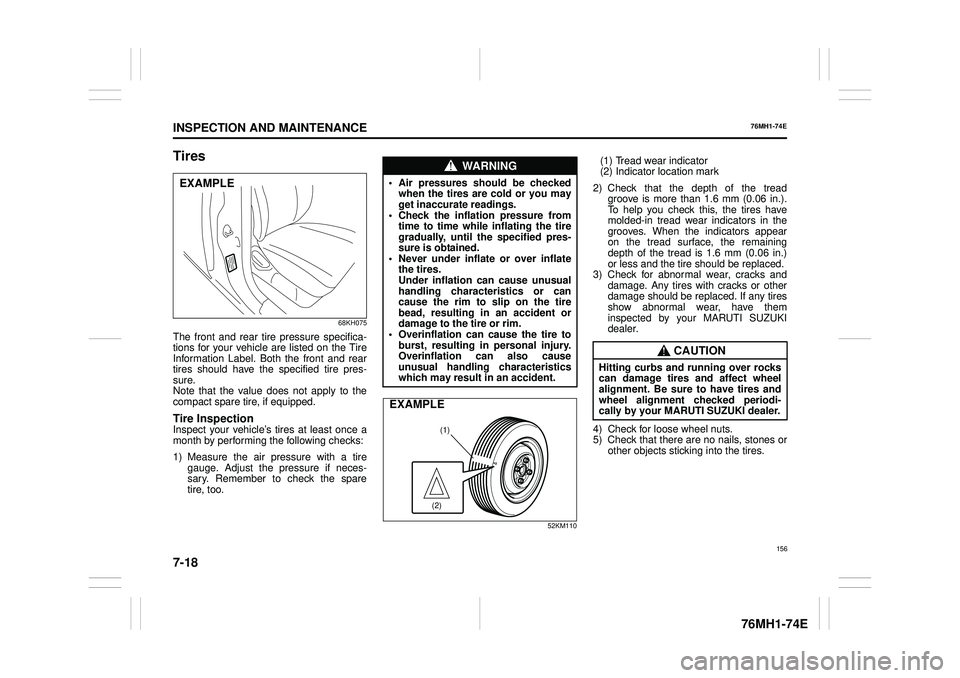
68KH075
The front and rear tire pressure specifica- tions for your vehicle are listed on the TireInformation Label. Both the front and rear tires should have the specified tire pres- sure.Note that the value does not apply to the compact spare tire, if equipped.
Tire InspectionInspect your vehicle’s tires at least once a month by performing the following checks:
1) Measure the air pressure with a tire gauge. Adjust the pressure if neces- sary. Remember to check the spare tire, too.
52KM110
(1) Tread wear indicator(2) Indicator location mark
2) Check that the depth of the tread groove is more than 1.6 mm (0.06 in.).To help you check this, the tires have molded-in tread wear indicators in the grooves. When the indicators appearon the tread surface, the remaining depth of the tread is 1.6 mm (0.06 in.) or less and the tire should be replaced.3) Check for abnormal wear, cracks and damage. Any tires with cracks or other damage should be replaced. If any tiresshow abnormal wear, have them inspected by your MARUTI SUZUKI dealer.
4) Check for loose wheel nuts. 5) Check that there are no nails, stones orother objects sticking into the tires.
EXAMPLE
WA R N I N G
• Air pressures should be checkedwhen the tires are cold or you mayget inaccurate readings. • Check the inflation pressure from time to time whil e inflating the tire gradually, until the specified pres- sure is obtained. • Never under inflate or over inflatethe tires. Under inflation can cause unusual handling characteristics or cancause the rim to slip on the tire bead, resulting in an accident or damage to the tire or rim.• Overinflation can cause the tire to burst, resulting in personal injury. Overinflation can also causeunusual handling characteristics which may result in an accident.
(1)
(2)
EXAMPLE
CAUTION
Hitting curbs and running over rocks can damage tires and affect wheelalignment. Be sure to have tires and wheel alignment checked periodi- cally by your MARUTI SUZUKI dealer.
156
Page 171 of 201
7-22
INSPECTION AND MAINTENANCE
76MH1-74E
76MH1-74E
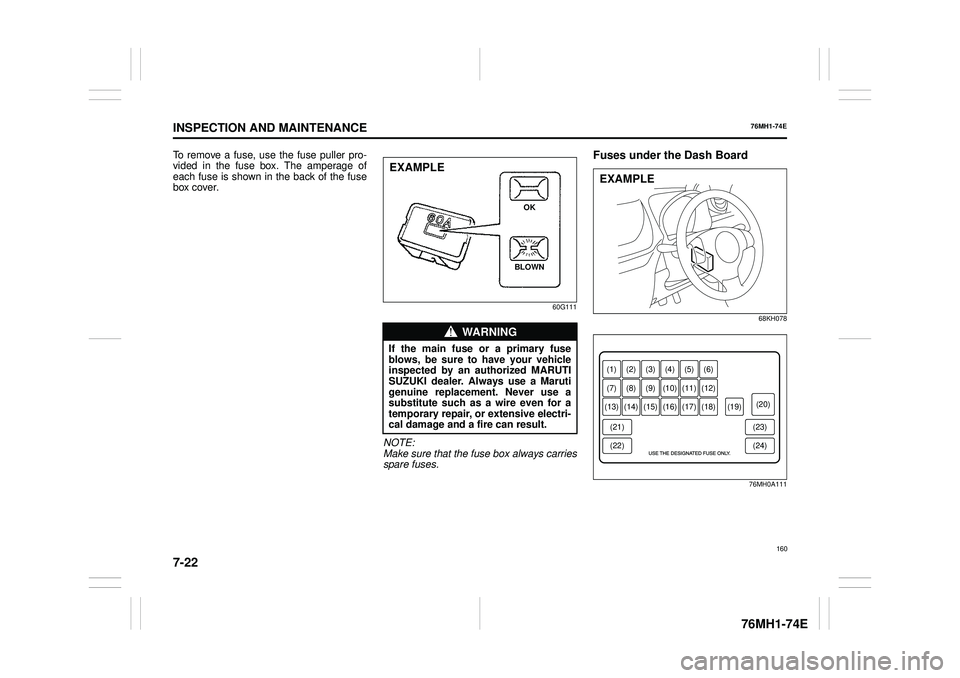
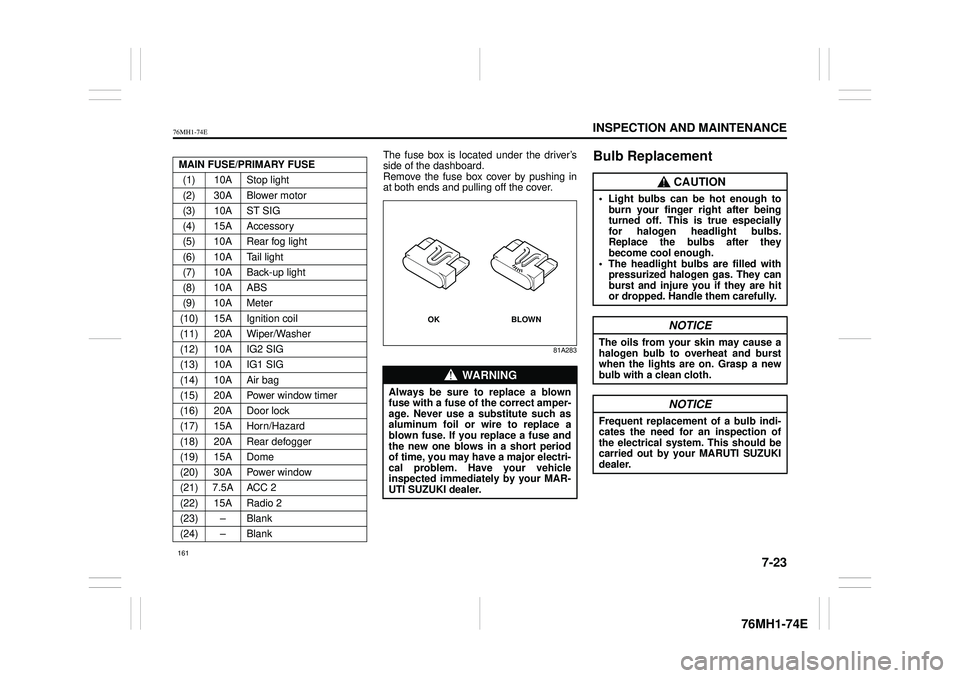
To remove a fuse, use the fuse puller pro- vided in the fuse box. The amperage of each fuse is shown in the back of the fuse box cover.
60G111
NOTE:Make sure that the fuse box always carriesspare fuses.
Fuses under the Dash Board
68KH078
76MH0A111
WA R N I N G
If the main fuse or a primary fuse blows, be sure to have your vehicleinspected by an authorized MARUTI SUZUKI dealer. Always use a Maruti genuine replacement. Never use asubstitute such as a wire even for a temporary repair, or extensive electri- cal damage and a fire can result.
EXAMPLE
BLOWN
OK
EXAMPLE
(7) (8) (9) (10) (11) (12)
(19) (14)(13) (15) (16) (17) (18) (20)
(23)
(24)
(21)
(22)
(1) (2) (3) (4) (5) (6)
160
Page 172 of 201
7-23
INSPECTION AND MAINTENANCE
76MH1-74E
76MH1-74E
The fuse box is located under the driver’s side of the dashboard. Remove the fuse box cover by pushing inat both ends and pulling off the cover.
81A283
Bulb ReplacementMAIN FUSE/PRIMARY FUSE
(1) 10A Stop light
(2) 30A Blower motor
(3) 10A ST SIG
(4) 15A Accessory
(5) 10A Rear fog light
(6) 10A Tail light
(7) 10A Back-up light
(8) 10A ABS
(9) 10A Meter
(10) 15A Ignition coil
(11) 20A Wiper/Washer
(12) 10A IG2 SIG
(13) 10A IG1 SIG
(14) 10A Air bag
(15) 20A Power window timer
(16) 20A Door lock
(17) 15A Horn/Hazard
(18) 20A Rear defogger
(19) 15A Dome
(20) 30A Power window
(21) 7.5A ACC 2
(22) 15A Radio 2
(23) – Blank
(24) – Blank
WA R N I N G
Always be sure to replace a blown fuse with a fuse of the correct amper- age. Never use a substitute such as aluminum foil or wire to replace ablown fuse. If you replace a fuse and the new one blows in a short period of time, you may have a major electri-cal problem. Have your vehicle inspected immediately by your MAR- UTI SUZUKI dealer.
BLOWN OK
CAUTION
• Light bulbs can be hot enough toburn your finger right after being turned off. This is true especially for halogen headlight bulbs.Replace the bulbs after they become cool enough. • The headlight bulbs are filled withpressurized halogen gas. They can burst and injure you if they are hit or dropped. Handle them carefully.
NOTICE
The oils from your skin may cause ahalogen bulb to overheat and burst when the lights are on. Grasp a new bulb with a clean cloth.
NOTICE
Frequent replacement of a bulb indi-cates the need for an inspection of the electrical system. This should be carried out by your MARUTI SUZUKIdealer.
161
Page 180 of 201
7-31
INSPECTION AND MAINTENANCE
76MH1-74E
76MH1-74E
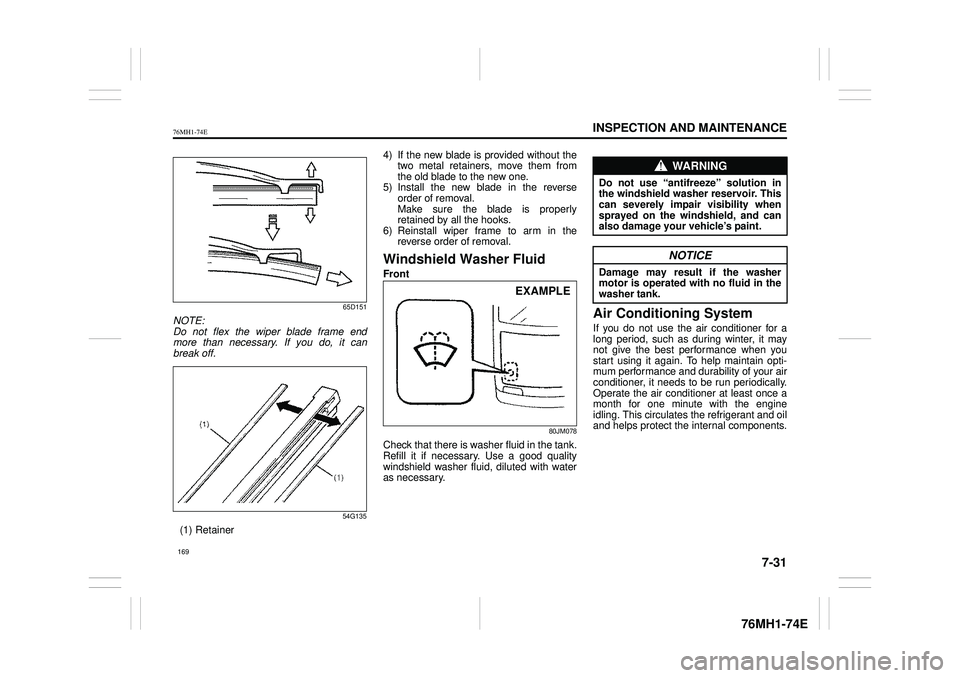
65D151
NOTE: Do not flex the wiper blade frame end more than necessary. If you do, it canbreak off.
54G135
(1) Retainer
4) If the new blade is provided without the two metal retainers, move them from the old blade to the new one.5) Install the new blade in the reverse order of removal. Make sure the blade is properlyretained by all the hooks. 6) Reinstall wiper frame to arm in the reverse order of removal.
Windshield Washer Fluid
Front
80JM078
Check that there is washer fluid in the tank.Refill it if necessary. Use a good quality windshield washer fluid, diluted with water as necessary.
Air Conditioning System
If you do not use the air conditioner for along period, such as during winter, it maynot give the best performance when you start using it again. To help maintain opti- mum performance and durability of your airconditioner, it needs to be run periodically. Operate the air condit ioner at least once a month for one minute with the engineidling. This circulates the refrigerant and oil and helps protect the internal components.
EXAMPLE
WA R N I N G
Do not use “antifreeze” solution in the windshield washer reservoir. Thiscan severely impair visibility when sprayed on the windshield, and can also damage your vehicle’s paint.
NOTICE
Damage may result if the washermotor is operated with no fluid in the washer tank.
169
Page 185 of 201

8-4
EMERGENCY SERVICE
76MH1-74E
76MH1-74E
Full Wheel Cover (if equipped)
60G309
Insert a piece of cloth between the spokes of the wheel cover and try to pull the cover outward (as shown in figure). Take out thedetached wheel cover from the wheel rim. For installation first match the slot at the wheel cover with the air filling nozzle of the wheel. Apply equal pressure at the circum- ference of the wheel cover to fix it in thewheel rim.
74LHT0860
When installing the cover, make sure that itis positioned so that it does not cover orfoul the air valve.
Jump Starting Instructions
When Jump Starting Your Vehicle,
Use the Following Procedure:1) Use only a 12-volt battery to jump start your vehicle. Position the good 12-volt battery close to your vehicle so that thejump leads will reach both batteries. When using a battery installed on another vehicle, DO NOT LET THEVEHICLES TOUCH. Set the parking brakes fully on both vehicles. 2) Turn off all vehicle accessories, exceptthose necessary for safety reasons (for example, headlights or hazard lights).
54MN259
EXAMPLE
EXAMPLE
WA R N I N G
• Never attempt to jump start your vehicle if the battery appears to be frozen. Batteries in this condition may explode or rupture if jumpstarting is attempted. • When making jump lead connec- tions, be certain that your handsand the jump leads remain clear from pulleys, belts, or fans. • Batteries produce flammablehydrogen gas. Keep flames and sparks away from the battery or an explosion may occur. Never smokewhen working in the vicinity of the battery. • If the booster battery you use forjump starting is installed in another vehicle, make sure the two vehicles are not touching each other.• If your battery discharges repeat- edly, for no apparent reason, have your vehicle inspected by anauthorized MARUTI SUZUKI dealer. • To avoid harm to yourself or dam- age to your vehicl e or battery, fol- low the jump starting instructions below precisely and in order. If you are in doubt, call for qualifiedroad service.
NOTICE
Your vehicle should not be started bypushing or towing. This startingmethod could result in permanent damage to the ca talytic converter. Use jump leads to start a vehicle witha weak or flat battery.
(2)
(1)
(3)2 3
4
1
EXAMPLE
174
Page 187 of 201
8-6
EMERGENCY SERVICE
76MH1-74E
76MH1-74E
If the Starter Does Not
Operate
1) Try turning the ignition switch to the “START” position with the headlights turned on to determine the battery con- dition. If the headlights go excessivelydim or go off, it usually means that either the battery is flat or the battery terminal contact is poor. Recharge thebattery or correct battery terminal con- tact as necessary. 2) If the headlights remain bright, checkthe fuses. If the reason for failure of the starter is not obvious, there may be a major electrical problem. Have the vehi-cle inspected by your authorized MAR- UTI SUZUKI dealer.
If the Engine is Flooded
If the engine is flooded with petrol, it may be hard to start. If this happens, press theaccelerator pedal all the way to the floor and hold it there while cranking the engine. For petrol engine model, do not operatethe starter motor for more than 12 sec- onds. For diesel engine model, do not operatethe starter motor for more than 30 sec- onds.
If the Engine Overheats
The engine could overheat temporarily under severe driving conditions. If the highengine coolant temperature warning light comes on as overheating during driving: 1) Turn off the air conditioner, if equipped.2) Take the vehicle to a safe place and park. 3) Let the engine run at the normal idlespeed for a few minutes until the high engine coolant temperature warning light goes off.
If the high engine coolant temperature warning light does not go off: 1) Turn off the engine and check that the water pump belt and pulleys are notdamaged or slipping. If any abnormality is found, correct it.
2) Check the coolant level in the reservoir. If it is found to be lower than the “LOW” line, look for leaks at the radiator, waterpump, and radiator and heater hoses. If you locate any leaks that may have caused the overheating, do not run theengine until these problems have been corrected. 3) If you do not find a leak, carefully addcoolant to the reservoir and then the radiator, if necessary. (Refer to “Engine Coolant” in the “INSPECTION ANDMAINTENANCE” section.)
NOTE: If your engine overheats and you are unsure what to do, contact your MARUTI SUZUKI dealer.
WA R N I N G
If you see or hear escaping steam,stop the vehicle in a safe place andimmediately turn off the engine to let it cool. Do not open the hood when steam is present. When the steamcan no longer be seen or heard, open the hood to see if the coolant is still boiling. If it is, you must wait until itstops boiling before you proceed.
176
Page 188 of 201
8-7
EMERGENCY SERVICE
76MH1-74E
76MH1-74E
65D614
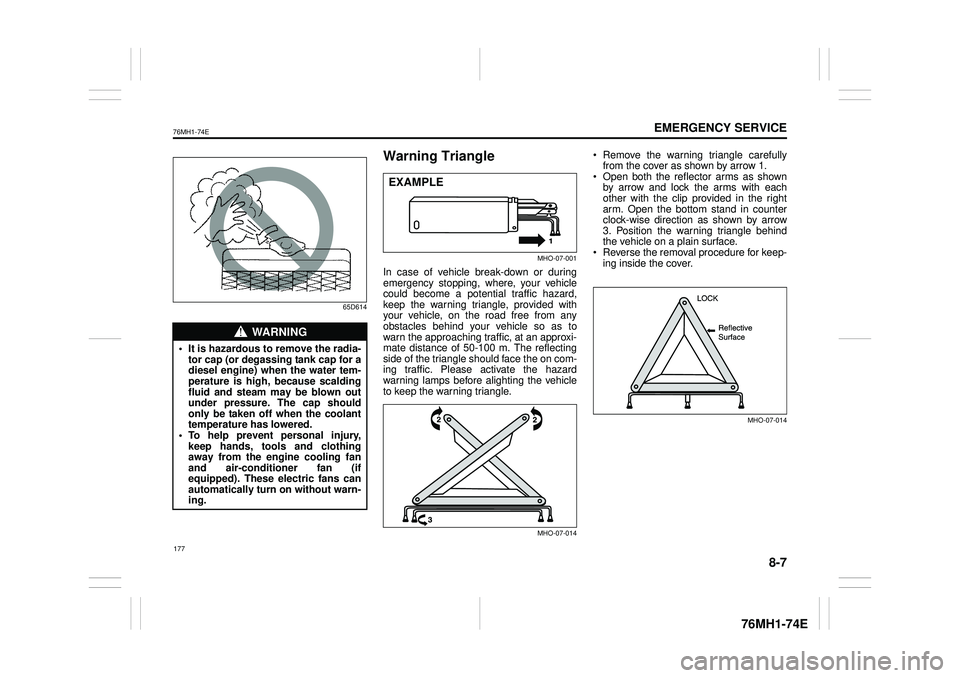
Warning Triangle
MHO-07-001
In case of vehicle break-down or during emergency stopping, where, your vehiclecould become a potential traffic hazard, keep the warning triangle, provided with your vehicle, on the road free from anyobstacles behind your vehicle so as to warn the approaching traffic, at an approxi- mate distance of 50-100 m. The reflecting side of the triangle should face the on com- ing traffic. Please activate the hazardwarning lamps before alighting the vehicle to keep the warning triangle.
MHO-07-014
Remove the warning triangle carefullyfrom the cover as shown by arrow 1. Open both the reflector arms as shownby arrow and lock the arms with each other with the clip provided in the right arm. Open the bottom stand in counterclock-wise direction as shown by arrow 3. Position the warning triangle behind the vehicle on a plain surface. Reverse the removal procedure for keep- ing inside the cover.
MHO-07-014
WA R N I N G
• It is hazardous to remove the radia- tor cap (or degassing tank cap for adiesel engine) when the water tem- perature is high, because scalding fluid and steam may be blown outunder pressure. The cap should only be taken off when the coolant temperature has lowered.• To help prevent personal injury, keep hands, tools and clothing away from the engine cooling fanand air-conditioner fan (if equipped). These electric fans can automatically turn on without warn- ing.
EXAMPLE
177
Page 190 of 201
9-1
APPEARANCE CARE
76MH1-74E
76MH1-74E
APPEARANCE CARE
Corrosion Prevention
It is important to take good care of your vehicle to protect it from corrosion. Listedbelow are instructions for how to maintain your vehicle to prevent corrosion. Please read and follow these instructions carefully.
Important Information About Corrosion
Common causes of corrosion 1) Accumulation of road salt, dirt, mois- ture, or chemicals in hard-to-reachareas of the vehicle underbody or frame. 2) Chipping, scratches and any damage totreated or painted metal surfaces resulting from minor accidents or abra- sion by stones and gravel.
Environmental conditions which accel- erate corrosion1) Road salt, dust control chemicals, sea air or industrial pollution will all acceler- ate the corrosion of metal.2) High humidity will increase the rate of corrosion particularly when the tem- perature range is just above the freez-ing point. 3) Moisture in certain areas of a vehicle for an extended period of time may pro-mote corrosion even though other body sections may be completely dry.
4) High temperatures will cause an accel- erated rate of corrosion to parts of the vehicle which are not well ventilated topermit quick drying.
This information illustrates the necessity of keeping your vehicle (particularly the underbody) as clean and dry as possible. It is equally important to repair any damageto the paint or protective coatings as soon as possible.
How to Help Prevent Corrosion
Wash your vehicle frequentlyThe best way to preserve the finish on your vehicle and to help avoid corrosion is tokeep it clean with frequent washing. Wash your vehicle at least once during the winter and once immediately after the win-ter. Keep your vehicle, particularly the underside, as clean and dry as possible. If you frequently drive on salted roads, yourvehicle should be washed at least once a month during the winter. If you live near the ocean, your vehicle should be washed atleast once a month throughout the year.
For washing instructions, refer to the “Vehi- cle Cleaning” section.
Remove foreign ma terial depositsForeign material such as salts, chemicals, road oil or tar, tree sap, bird droppings andindustrial fall-out may damage the finish of your vehicle if it is left on painted surfaces. Remove these types of deposits as quicklyas possible. If these deposits are difficult to wash off, an additional cleaner may be required. Be sure that any cleaner you use
is not harmful to painted surfaces and is specifically intended for your purposes. Fol- low the manufacturer’s directions when using these special cleaners.
Repair finish damage Carefully examine your vehicle for damage to the painted surfaces. Should you findany chips or scratches in the paint, touch them up immediately to prevent corrosion from starting. If the chips or scratches havegone through to the bare metal, have a qualified body shop make the repair.
Keep passenger and luggage compart- ments cleanMoisture, dirt or mud can accumulate under the floor mats and may cause corrosion. Occasionally, check under these mats toensure that this area is clean and dry. More frequent checks are necessary if the vehicle is used off road or in wet weather.Certain cargos such as chemicals, fertiliz- ers, cleaners, salts, etc. are extremely cor- rosive by nature. These products should betransported in sealed containers. If a spill or leak does occur, clean and dry the area immediately.
Store your vehicle in a dry, well-venti- lated area Do not park your vehicle in a damp, poorlyventilated area. If you often wash your vehicle in the garage or if you frequently drive it in when wet, your garage may bedamp. The high humidity in the garage may cause or accelerate corrosion. A wet vehicle may corrode even in a heatedgarage if the ventilation is poor.
179