ESP SUZUKI ERTIGA 2013 1.G User Guide
[x] Cancel search | Manufacturer: SUZUKI, Model Year: 2013, Model line: ERTIGA, Model: SUZUKI ERTIGA 2013 1.GPages: 207, PDF Size: 5.14 MB
Page 150 of 207
Downloaded from www.Manualslib.com manuals search engine 7-5INSPECTION AND MAINTENANCE
60MK0-14E
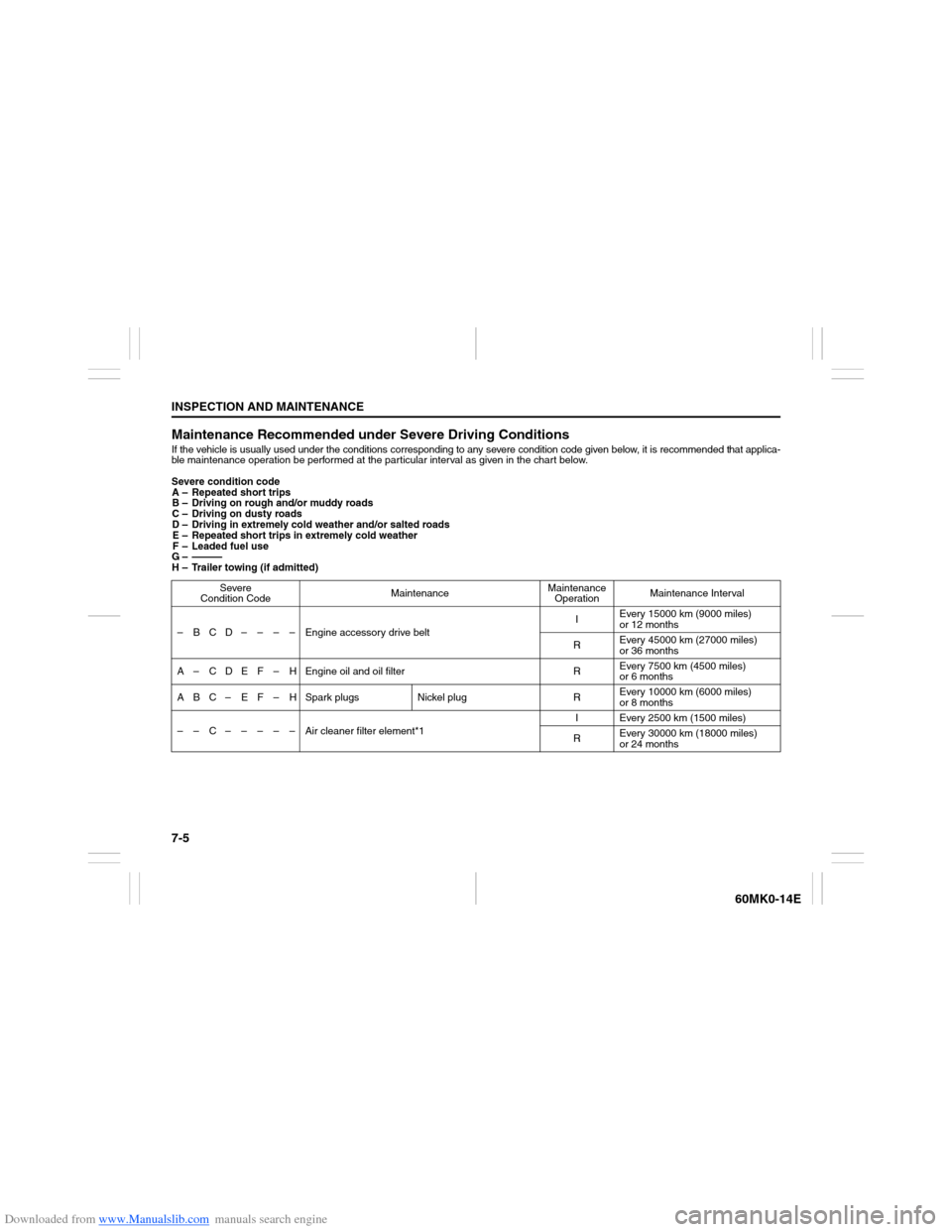
Maintenance Recommended under Severe Driving ConditionsIf the vehicle is usually used under the conditions corresponding to any severe condition code given below, it is recommended that applica-
ble maintenance operation be performed at the particular interval as given in the chart below.
Severe condition code
A – Repeated short trips
B – Driving on rough and/or muddy roads
C – Driving on dusty roads
D – Driving in extremely cold weather and/or salted roads
E – Repeated short trips in extremely cold weather
F – Leaded fuel use
G – ———
H – Trailer towing (if admitted)
Severe
Condition CodeMaintenanceMaintenance
OperationMaintenance Interval
–BCD––––Engine accessory drive beltIEvery 15000 km (9000 miles)
or 12 months
REvery 45000 km (27000 miles)
or 36 months
A – C D E F – H Engine oil and oil filter REvery 7500 km (4500 miles)
or 6 months
A B C – E F – H Spark plugs Nickel plug REvery 10000 km (6000 miles)
or 8 months
––C–––––Air cleaner filter element*1I Every 2500 km (1500 miles)
REvery 30000 km (18000 miles)
or 24 months
Page 169 of 207
Downloaded from www.Manualslib.com manuals search engine 7-24
INSPECTION AND MAINTENANCE
60MK0-14E
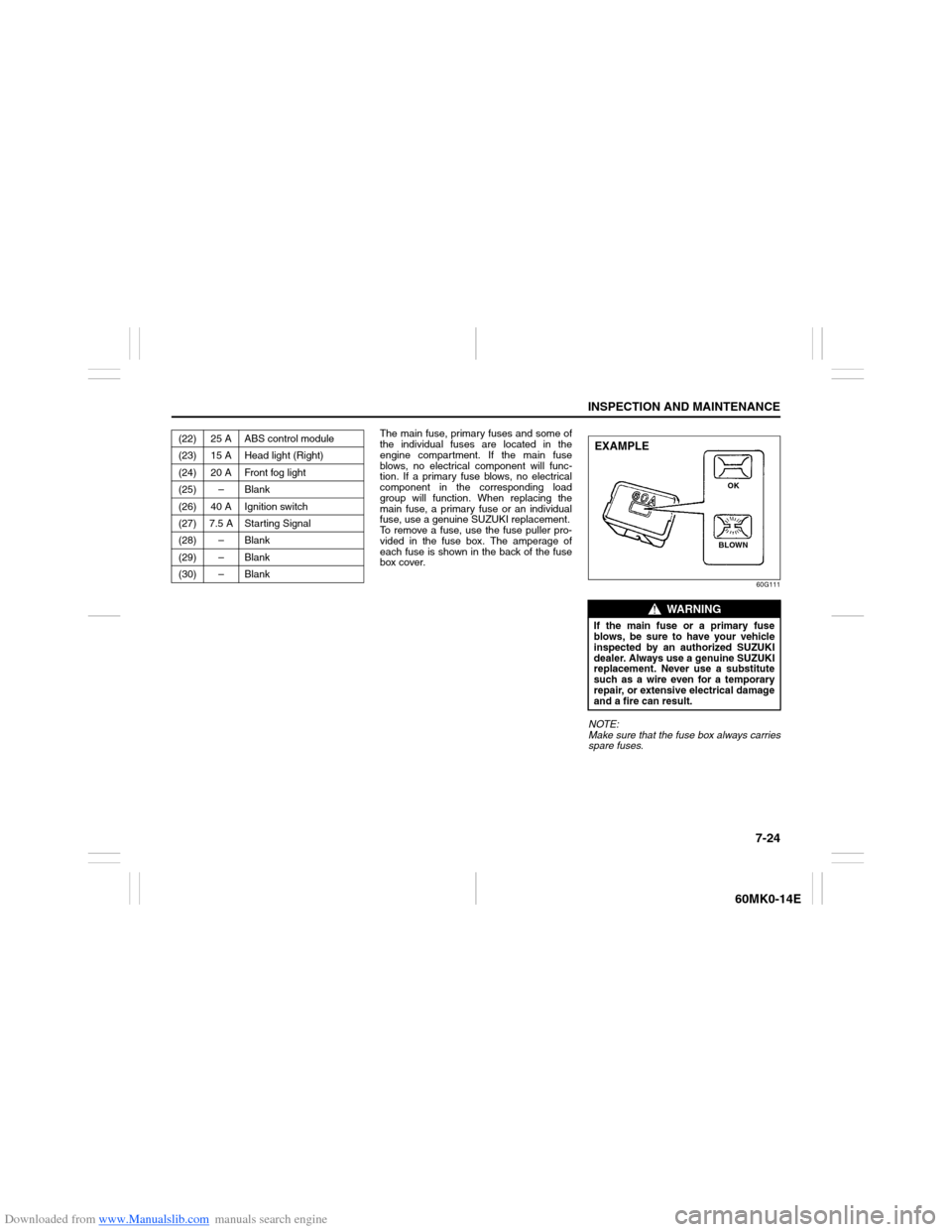
The main fuse, primary fuses and some of
the individual fuses are located in the
engine compartment. If the main fuse
blows, no electrical component will func-
tion. If a primary fuse blows, no electrical
component in the corresponding load
group will function. When replacing the
main fuse, a primary fuse or an individual
fuse, use a genuine SUZUKI replacement.
To remove a fuse, use the fuse puller pro-
vided in the fuse box. The amperage of
each fuse is shown in the back of the fuse
box cover.
60G111
NOTE:
Make sure that the fuse box always carries
spare fuses. (22) 25 A ABS control module
(23) 15 A Head light (Right)
(24) 20 A Front fog light
(25) – Blank
(26) 40 A Ignition switch
(27) 7.5 A Starting Signal
(28) – Blank
(29) – Blank
(30) – Blank
WARNING
If the main fuse or a primary fuse
blows, be sure to have your vehicle
inspected by an authorized SUZUKI
dealer. Always use a genuine SUZUKI
replacement. Never use a substitute
such as a wire even for a temporary
repair, or extensive electrical damage
and a fire can result.EXAMPLE
BLOWNOK
Page 171 of 207
Downloaded from www.Manualslib.com manuals search engine 7-26
INSPECTION AND MAINTENANCE
60MK0-14E
81A283
Headlight AimingSince special procedures are required, we
recommend you take your vehicle to your
SUZUKI dealer for headlight alignment.
Bulb Replacement
WARNING
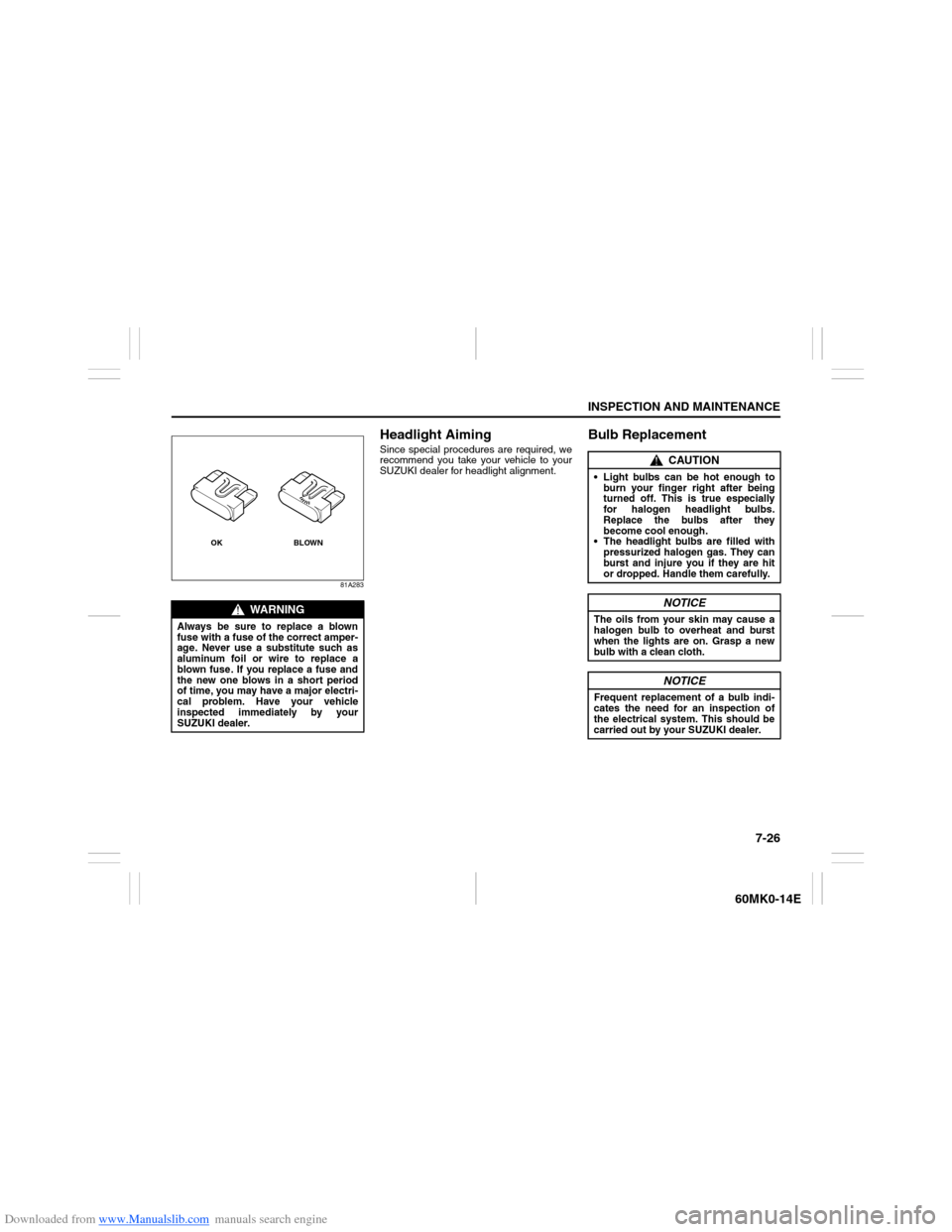
Always be sure to replace a blown
fuse with a fuse of the correct amper-
age. Never use a substitute such as
aluminum foil or wire to replace a
blown fuse. If you replace a fuse and
the new one blows in a short period
of time, you may have a major electri-
cal problem. Have your vehicle
inspected immediately by your
SUZUKI dealer.
BLOWN OK
CAUTION
Light bulbs can be hot enough to
burn your finger right after being
turned off. This is true especially
for halogen headlight bulbs.
Replace the bulbs after they
become cool enough.
The headlight bulbs are filled with
pressurized halogen gas. They can
burst and injure you if they are hit
or dropped. Handle them carefully.
NOTICE
The oils from your skin may cause a
halogen bulb to overheat and burst
when the lights are on. Grasp a new
bulb with a clean cloth.
NOTICE
Frequent replacement of a bulb indi-
cates the need for an inspection of
the electrical system. This should be
carried out by your SUZUKI dealer.
Page 184 of 207
Downloaded from www.Manualslib.com manuals search engine 8-3EMERGENCY SERVICE
60MK0-14E
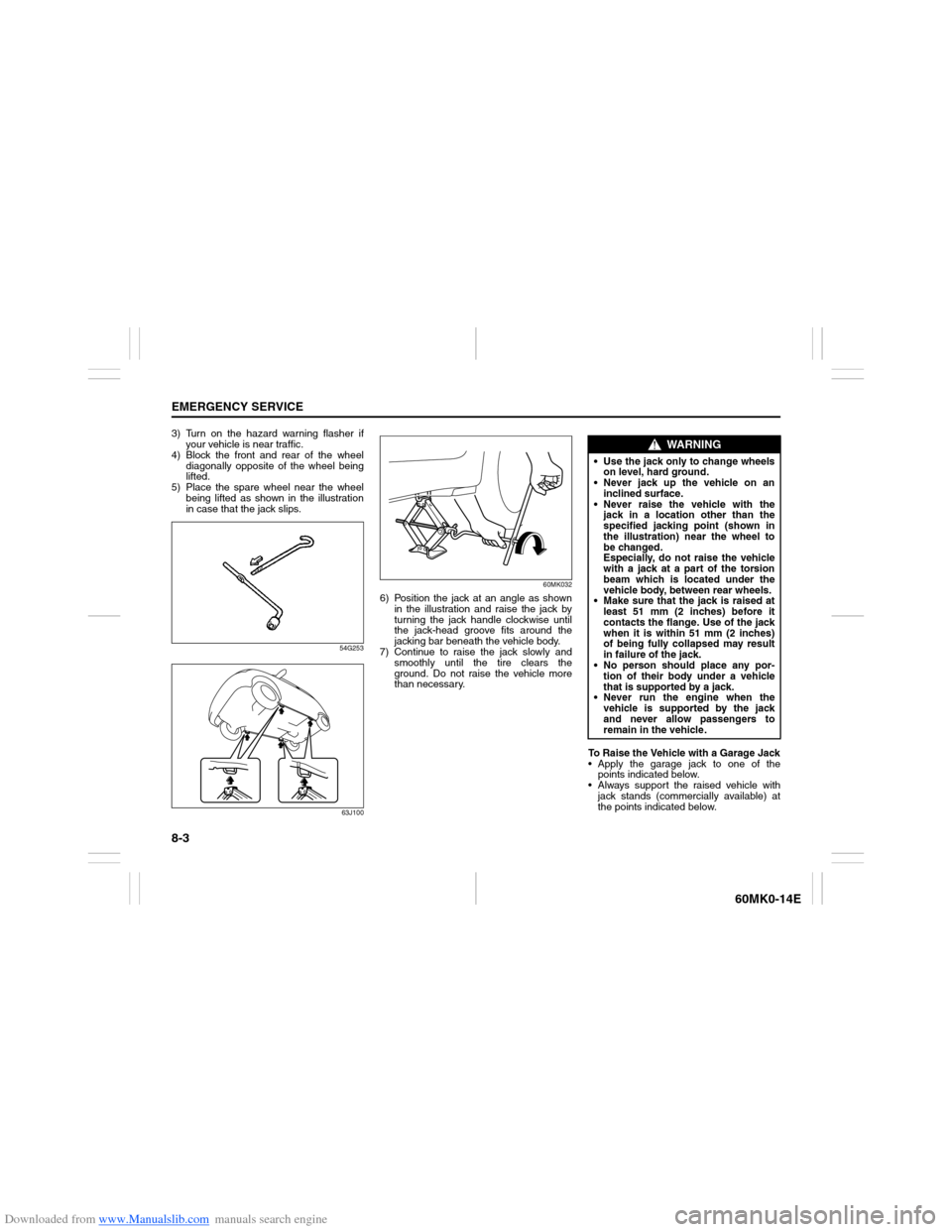
3) Turn on the hazard warning flasher if
your vehicle is near traffic.
4) Block the front and rear of the wheel
diagonally opposite of the wheel being
lifted.
5) Place the spare wheel near the wheel
being lifted as shown in the illustration
in case that the jack slips.
54G253
63J10060MK032
6) Position the jack at an angle as shown
in the illustration and raise the jack by
turning the jack handle clockwise until
the jack-head groove fits around the
jacking bar beneath the vehicle body.
7) Continue to raise the jack slowly and
smoothly until the tire clears the
ground. Do not raise the vehicle more
than necessary.
To Raise the Vehicle with a Garage Jack
Apply the garage jack to one of the
points indicated below.
Always support the raised vehicle with
jack stands (commercially available) at
the points indicated below.
WARNING
Use the jack only to change wheels
on level, hard ground.
Never jack up the vehicle on an
inclined surface.
Never raise the vehicle with the
jack in a location other than the
specified jacking point (shown in
the illustration) near the wheel to
be changed.
Especially, do not raise the vehicle
with a jack at a part of the torsion
beam which is located under the
vehicle body, between rear wheels.
Make sure that the jack is raised at
least 51 mm (2 inches) before it
contacts the flange. Use of the jack
when it is within 51 mm (2 inches)
of being fully collapsed may result
in failure of the jack.
No person should place any por-
tion of their body under a vehicle
that is supported by a jack.
Never run the engine when the
vehicle is supported by the jack
and never allow passengers to
remain in the vehicle.