electric SUZUKI ERTIGA 2013 1.G User Guide
[x] Cancel search | Manufacturer: SUZUKI, Model Year: 2013, Model line: ERTIGA, Model: SUZUKI ERTIGA 2013 1.GPages: 207, PDF Size: 5.14 MB
Page 146 of 207
Downloaded from www.Manualslib.com manuals search engine 7-1INSPECTION AND MAINTENANCE
60MK0-14E
60B128S
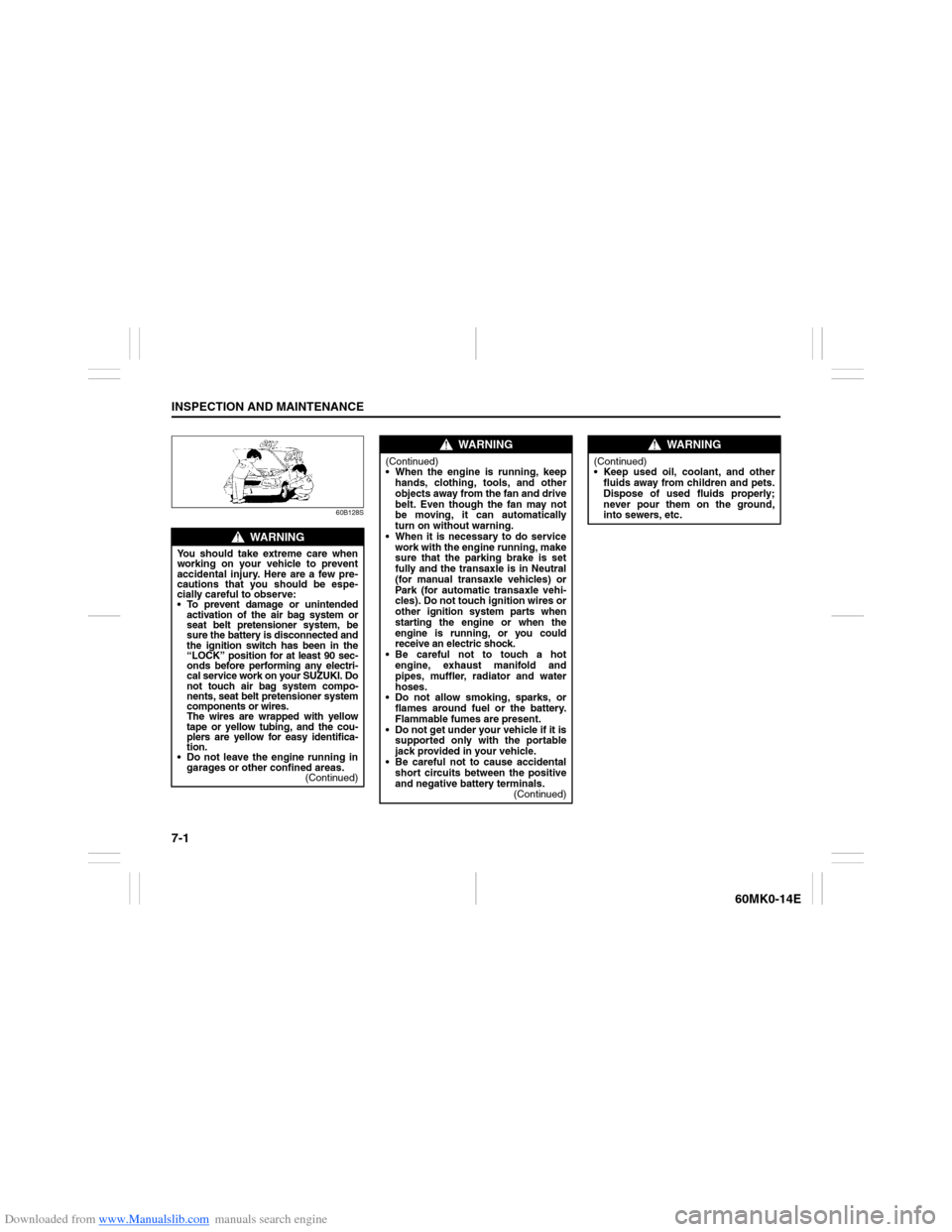
WARNING
You should take extreme care when
working on your vehicle to prevent
accidental injury. Here are a few pre-
cautions that you should be espe-
cially careful to observe:
To prevent damage or unintended
activation of the air bag system or
seat belt pretensioner system, be
sure the battery is disconnected and
the ignition switch has been in the
“LOCK” position for at least 90 sec-
onds before performing any electri-
cal service work on your SUZUKI. Do
not touch air bag system compo-
nents, seat belt pretensioner system
components or wires.
The wires are wrapped with yellow
tape or yellow tubing, and the cou-
plers are yellow for easy identifica-
tion.
Do not leave the engine running in
garages or other confined areas.
(Continued)
WARNING
(Continued)
When the engine is running, keep
hands, clothing, tools, and other
objects away from the fan and drive
belt. Even though the fan may not
be moving, it can automatically
turn on without warning.
When it is necessary to do service
work with the engine running, make
sure that the parking brake is set
fully and the transaxle is in Neutral
(for manual transaxle vehicles) or
Park (for automatic transaxle vehi-
cles). Do not touch ignition wires or
other ignition system parts when
starting the engine or when the
engine is running, or you could
receive an electric shock.
Be careful not to touch a hot
engine, exhaust manifold and
pipes, muffler, radiator and water
hoses.
Do not allow smoking, sparks, or
flames around fuel or the battery.
Flammable fumes are present.
Do not get under your vehicle if it is
supported only with the portable
jack provided in your vehicle.
Be careful not to cause accidental
short circuits between the positive
and negative battery terminals.
(Continued)
WARNING
(Continued)
Keep used oil, coolant, and other
fluids away from children and pets.
Dispose of used fluids properly;
never pour them on the ground,
into sewers, etc.
Page 168 of 207
Downloaded from www.Manualslib.com manuals search engine 7-23INSPECTION AND MAINTENANCE
60MK0-14E
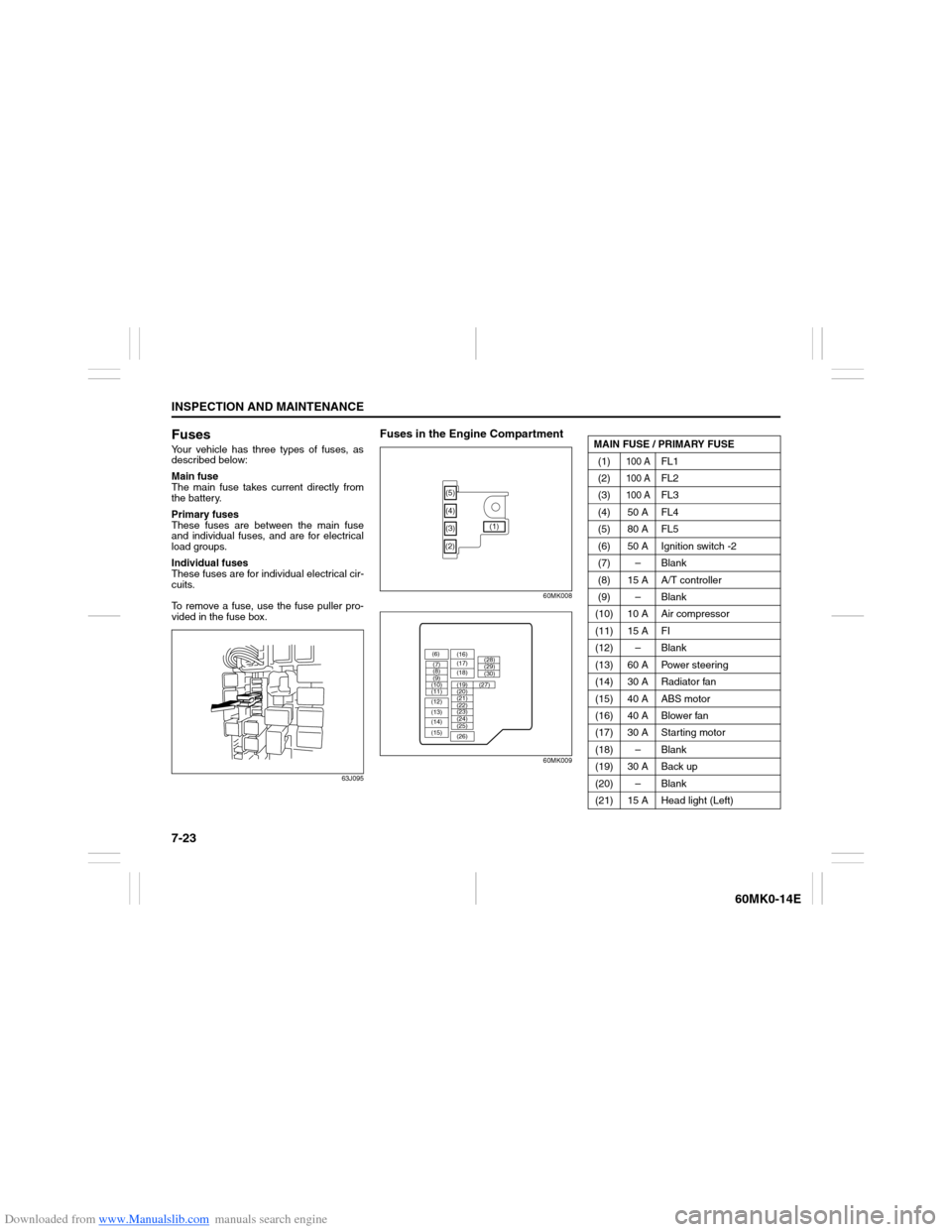
FusesYour vehicle has three types of fuses, as
described below:
Main fuse
The main fuse takes current directly from
the battery.
Primary fuses
These fuses are between the main fuse
and individual fuses, and are for electrical
load groups.
Individual fuses
These fuses are for individual electrical cir-
cuits.
To remove a fuse, use the fuse puller pro-
vided in the fuse box.
63J095
Fuses in the Engine Compartment
60MK008
60MK009
(5)
(3) (4)
(2)(1)
(6)
(7)(8)
(9)
(10)
(11)
(12)
(13)
(14)
(15)(16)
(17)
(19) (18)
(20)
(21)
(22)
(24) (23)
(25)
(26)(27)(28)
(29)
(30)
MAIN FUSE / PRIMARY FUSE
(1)
100 A
FL1
(2)
100 A
FL2
(3)
100 A
FL3
(4) 50 A FL4
(5) 80 A FL5
(6) 50 A Ignition switch -2
(7) – Blank
(8) 15 A A/T controller
(9) – Blank
(10) 10 A Air compressor
(11) 15 A FI
(12) – Blank
(13) 60 A Power steering
(14) 30 A Radiator fan
(15) 40 A ABS motor
(16) 40 A Blower fan
(17) 30 A Starting motor
(18) – Blank
(19) 30 A Back up
(20) – Blank
(21) 15 A Head light (Left)
Page 169 of 207
Downloaded from www.Manualslib.com manuals search engine 7-24
INSPECTION AND MAINTENANCE
60MK0-14E
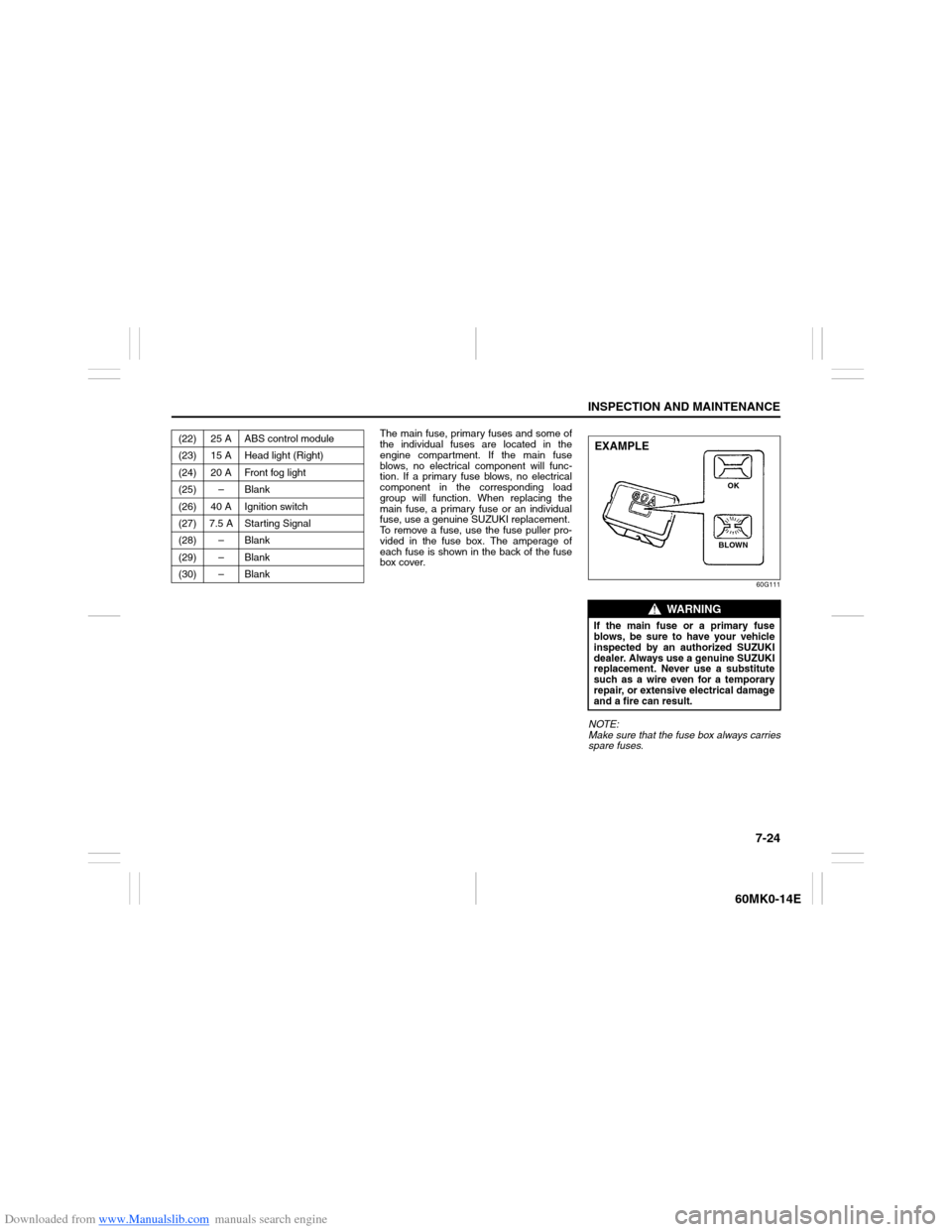
The main fuse, primary fuses and some of
the individual fuses are located in the
engine compartment. If the main fuse
blows, no electrical component will func-
tion. If a primary fuse blows, no electrical
component in the corresponding load
group will function. When replacing the
main fuse, a primary fuse or an individual
fuse, use a genuine SUZUKI replacement.
To remove a fuse, use the fuse puller pro-
vided in the fuse box. The amperage of
each fuse is shown in the back of the fuse
box cover.
60G111
NOTE:
Make sure that the fuse box always carries
spare fuses. (22) 25 A ABS control module
(23) 15 A Head light (Right)
(24) 20 A Front fog light
(25) – Blank
(26) 40 A Ignition switch
(27) 7.5 A Starting Signal
(28) – Blank
(29) – Blank
(30) – Blank
WARNING
If the main fuse or a primary fuse
blows, be sure to have your vehicle
inspected by an authorized SUZUKI
dealer. Always use a genuine SUZUKI
replacement. Never use a substitute
such as a wire even for a temporary
repair, or extensive electrical damage
and a fire can result.EXAMPLE
BLOWNOK
Page 171 of 207
Downloaded from www.Manualslib.com manuals search engine 7-26
INSPECTION AND MAINTENANCE
60MK0-14E
81A283
Headlight AimingSince special procedures are required, we
recommend you take your vehicle to your
SUZUKI dealer for headlight alignment.
Bulb Replacement
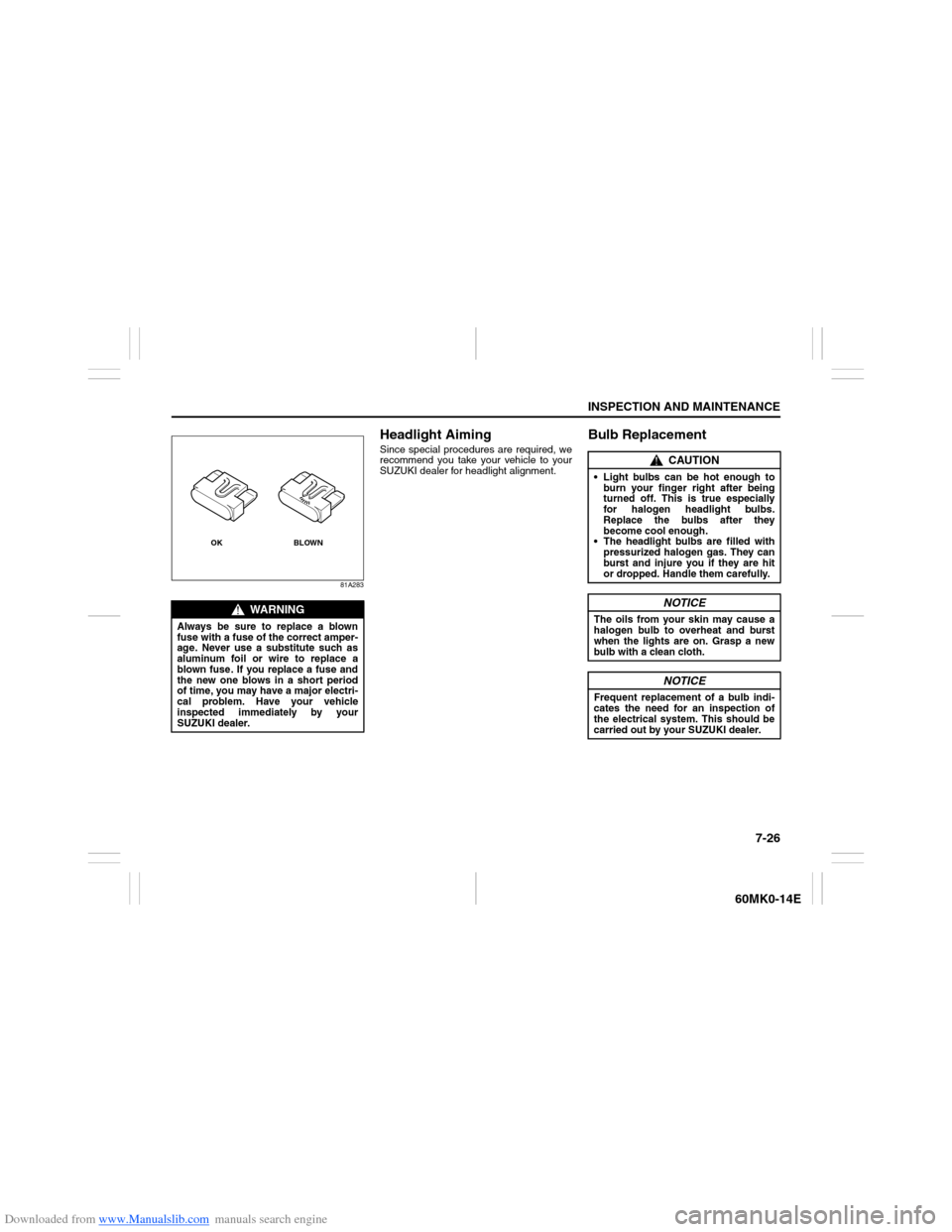
WARNING
Always be sure to replace a blown
fuse with a fuse of the correct amper-
age. Never use a substitute such as
aluminum foil or wire to replace a
blown fuse. If you replace a fuse and
the new one blows in a short period
of time, you may have a major electri-
cal problem. Have your vehicle
inspected immediately by your
SUZUKI dealer.
BLOWN OK
CAUTION
Light bulbs can be hot enough to
burn your finger right after being
turned off. This is true especially
for halogen headlight bulbs.
Replace the bulbs after they
become cool enough.
The headlight bulbs are filled with
pressurized halogen gas. They can
burst and injure you if they are hit
or dropped. Handle them carefully.
NOTICE
The oils from your skin may cause a
halogen bulb to overheat and burst
when the lights are on. Grasp a new
bulb with a clean cloth.
NOTICE
Frequent replacement of a bulb indi-
cates the need for an inspection of
the electrical system. This should be
carried out by your SUZUKI dealer.
Page 189 of 207
Downloaded from www.Manualslib.com manuals search engine 8-8
EMERGENCY SERVICE
60MK0-14E
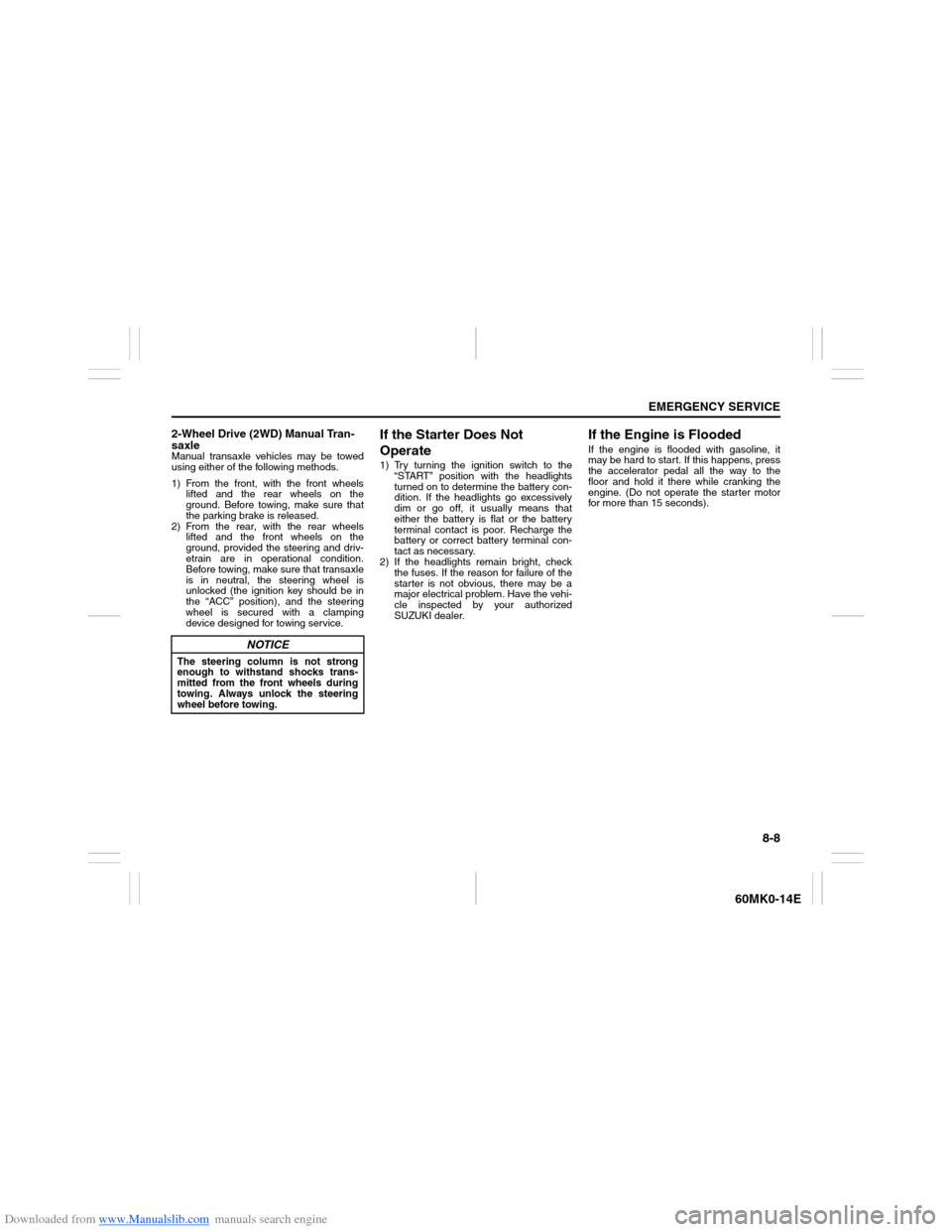
2-Wheel Drive (2WD) Manual Tran-
saxleManual transaxle vehicles may be towed
using either of the following methods.
1) From the front, with the front wheels
lifted and the rear wheels on the
ground. Before towing, make sure that
the parking brake is released.
2) From the rear, with the rear wheels
lifted and the front wheels on the
ground, provided the steering and driv-
etrain are in operational condition.
Before towing, make sure that transaxle
is in neutral, the steering wheel is
unlocked (the ignition key should be in
the “ACC” position), and the steering
wheel is secured with a clamping
device designed for towing service.
If the Starter Does Not
Operate1) Try turning the ignition switch to the
“START” position with the headlights
turned on to determine the battery con-
dition. If the headlights go excessively
dim or go off, it usually means that
either the battery is flat or the battery
terminal contact is poor. Recharge the
battery or correct battery terminal con-
tact as necessary.
2) If the headlights remain bright, check
the fuses. If the reason for failure of the
starter is not obvious, there may be a
major electrical problem. Have the vehi-
cle inspected by your authorized
SUZUKI dealer.
If the Engine is FloodedIf the engine is flooded with gasoline, it
may be hard to start. If this happens, press
the accelerator pedal all the way to the
floor and hold it there while cranking the
engine. (Do not operate the starter motor
for more than 15 seconds).
NOTICE
The steering column is not strong
enough to withstand shocks trans-
mitted from the front wheels during
towing. Always unlock the steering
wheel before towing.
Page 190 of 207
Downloaded from www.Manualslib.com manuals search engine 8-9EMERGENCY SERVICE
60MK0-14E
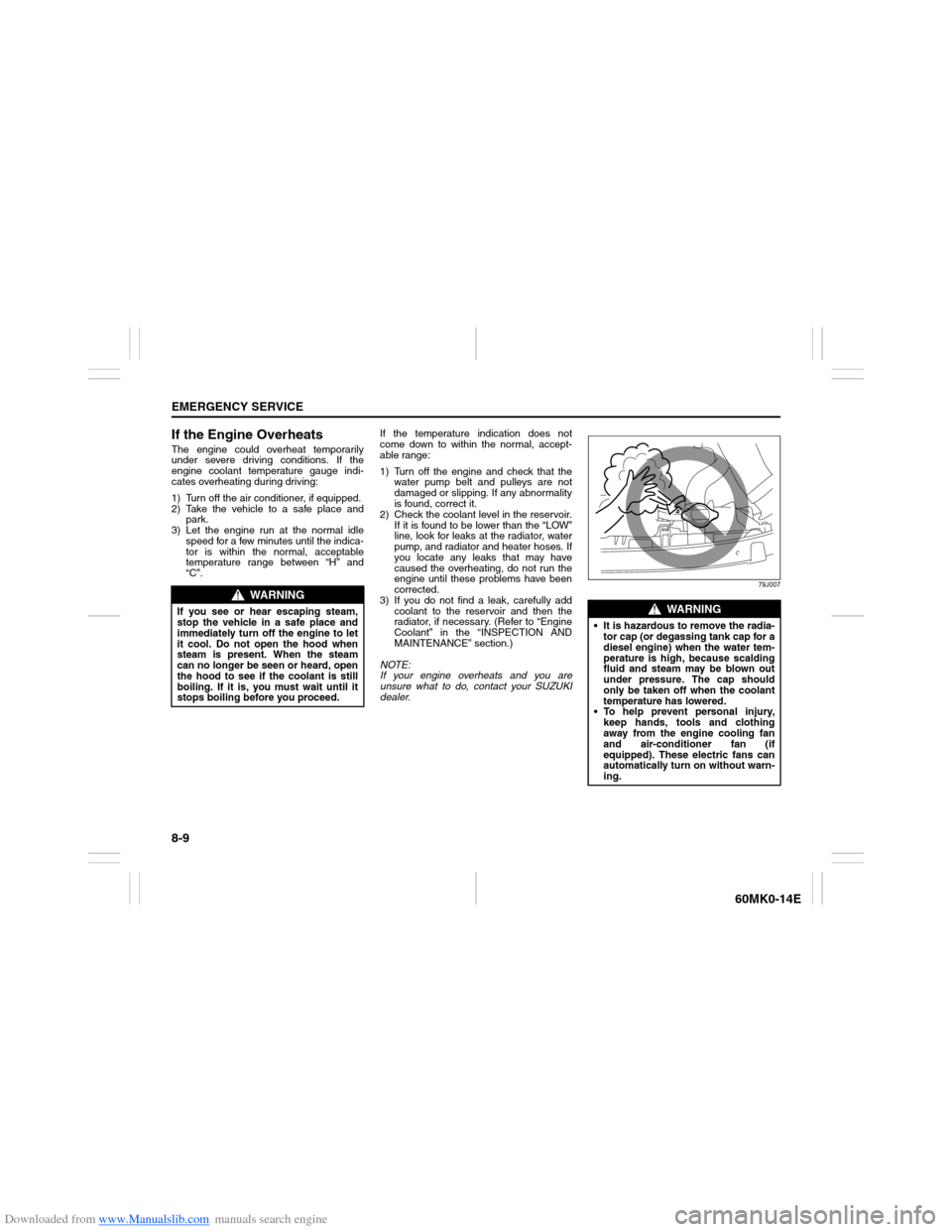
If the Engine OverheatsThe engine could overheat temporarily
under severe driving conditions. If the
engine coolant temperature gauge indi-
cates overheating during driving:
1) Turn off the air conditioner, if equipped.
2) Take the vehicle to a safe place and
park.
3) Let the engine run at the normal idle
speed for a few minutes until the indica-
tor is within the normal, acceptable
temperature range between “H” and
“C”.If the temperature indication does not
come down to within the normal, accept-
able range:
1) Turn off the engine and check that the
water pump belt and pulleys are not
damaged or slipping. If any abnormality
is found, correct it.
2) Check the coolant level in the reservoir.
If it is found to be lower than the “LOW”
line, look for leaks at the radiator, water
pump, and radiator and heater hoses. If
you locate any leaks that may have
caused the overheating, do not run the
engine until these problems have been
corrected.
3) If you do not find a leak, carefully add
coolant to the reservoir and then the
radiator, if necessary. (Refer to “Engine
Coolant” in the “INSPECTION AND
MAINTENANCE” section.)
NOTE:
If your engine overheats and you are
unsure what to do, contact your SUZUKI
dealer.
79J007
WARNING
If you see or hear escaping steam,
stop the vehicle in a safe place and
immediately turn off the engine to let
it cool. Do not open the hood when
steam is present. When the steam
can no longer be seen or heard, open
the hood to see if the coolant is still
boiling. If it is, you must wait until it
stops boiling before you proceed.
WARNING
It is hazardous to remove the radia-
tor cap (or degassing tank cap for a
diesel engine) when the water tem-
perature is high, because scalding
fluid and steam may be blown out
under pressure. The cap should
only be taken off when the coolant
temperature has lowered.
To help prevent personal injury,
keep hands, tools and clothing
away from the engine cooling fan
and air-conditioner fan (if
equipped). These electric fans can
automatically turn on without warn-
ing.
Page 200 of 207
Downloaded from www.Manualslib.com manuals search engine 11-2SPECIFICATIONS
60MK0-14E
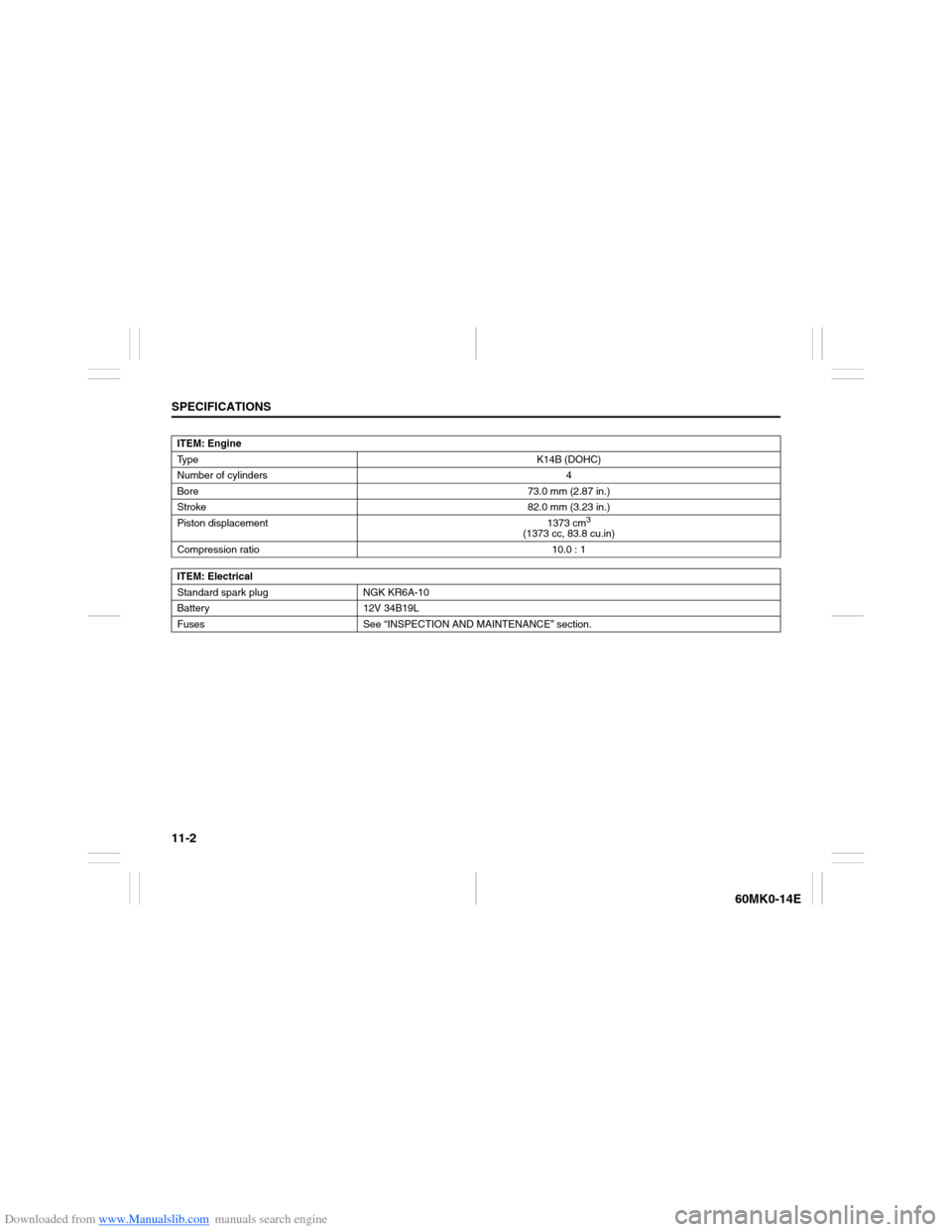
ITEM: Engine
Ty p eK14B (DOHC)
Number of cylinders 4
Bore73.0 mm (2.87 in.)
Stroke 82.0 mm (3.23 in.)
Piston displacement 1373 cm
3
(1373 cc, 83.8 cu.in)
Compression ratio 10.0 : 1
ITEM: Electrical
Standard spark plug NGK KR6A-10
Battery 12V 34B19L
Fuses See “INSPECTION AND MAINTENANCE” section.
Page 204 of 207
Downloaded from www.Manualslib.com manuals search engine 12-2INDEX
60MK0-14E
Driving range........................................................................ 2-49EElectric Power Steering Light ............................................. 2-42
Electric Window Controls ................................................... 2-11
Emergency Locking Retractor (ELR) ................................. 2-22
Engine Coolant .................................................................... 7-11
Engine Hood......................................................................... 5-38
Engine Oil and Filter .............................................................. 7-7
Engine Oil Consumption ....................................................... 3-2
Engine Serial Number ......................................................... 10-1
Exhaust Gas Warning............................................................ 3-1FFloor Mats............................................................................. 5-45
Fluid Control Clutch ............................................................ 7-16
Fluid Level Check ................................................................ 7-16
Folding Rear Seats .............................................................. 2-18
Footrest ................................................................................ 5-45
Frame Hooks ........................................................................ 5-46
Front Air Bags ...................................................................... 2-31
Front Fog Light Switch........................................................ 2-52
Front Seat Back Pocket....................................................... 5-44
Front Seats ........................................................................... 2-14
Fuel Filler Cap ...................................................................... 5-37
Fuel Gauge ........................................................................... 2-44
Fuel Recommendation .......................................................... 1-1
Full Wheel Cover.................................................................... 8-5
Fuses .................................................................................... 7-23
Fuses in the Engine Compartment .................................... 7-23
Fuses under the Dash Board .............................................. 7-25
GGasoline Engine ..................................................................... 1-1
Gasoline/Ethanol blends ....................................................... 1-1
Gear Oil ................................................................................. 7-15
Gear Oil Change ................................................................... 7-15
Gear Oil Level Check ........................................................... 7-15
Gearshift Lever ....................................................................... 3-9
Glove Box ............................................................................. 5-42HHazard Warning Switch ....................................................... 2-53
Head Restraints ........................................................... 2-15, 2-17
Headlight Aiming.................................................................. 7-26
Highway Driving ..................................................................... 4-3
Horn ....................................................................................... 2-56
How the ABS Works............................................................. 3-14IIf the Engine is Flooded......................................................... 8-8
If the Engine Overheats ......................................................... 8-9
If the Starter Does Not Operate............................................. 8-8
If Your Vehicle Gets Stuck .................................................... 4-5
Ignition Key Reminder ........................................................... 2-2
Ignition Switch........................................................................ 3-3
Immobilizer System ............................................................... 2-1
Immobilizer System Light.................................................... 2-41
Improving Fuel Economy ...................................................... 4-2
Information Display.............................................................. 2-46
Inside Rearview Mirror......................................................... 2-13
Installation with a Lap Belt .................................................. 2-29
Installation with Lap-Shoulder Seat Belts ......................... 2-29
Instantaneous Fuel Consumption ...................................... 2-48
Instrument Cluster ............................................................... 2-36