engine SUZUKI FORENZA 2007 Owner's Guide
[x] Cancel search | Manufacturer: SUZUKI, Model Year: 2007, Model line: FORENZA, Model: SUZUKI FORENZA 2007Pages: 225, PDF Size: 4.39 MB
Page 135 of 225
4-11 DRIVING YOUR VEHICLE
85Z03-03E
time and energy. See the next part,
“Freeway Driving.”
Treat a green light as a warning signal. A
traffic light is there because the corner is
busy enough to need it. When a light
turns green, and just before you start to
move, check both ways for vehicles that
have not cleared the intersection or may
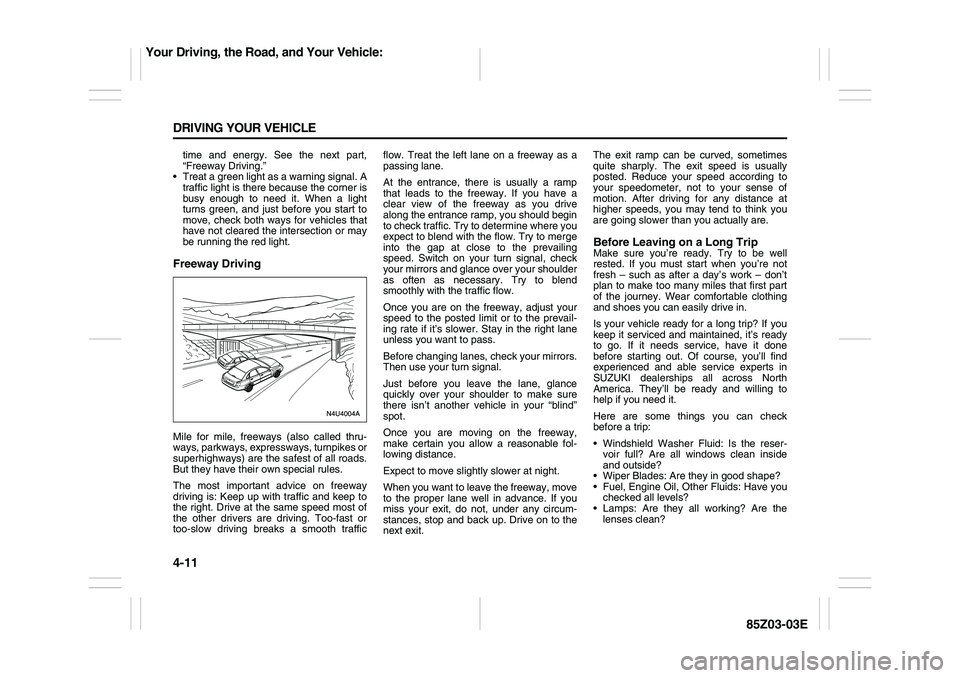
be running the red light.Freeway DrivingMile for mile, freeways (also called thru-
ways, parkways, expressways, turnpikes or
superhighways) are the safest of all roads.
But they have their own special rules.
The most important advice on freeway
driving is: Keep up with traffic and keep to
the right. Drive at the same speed most of
the other drivers are driving. Too-fast or
too-slow driving breaks a smooth trafficflow. Treat the left lane on a freeway as a
passing lane.
At the entrance, there is usually a ramp
that leads to the freeway. If you have a
clear view of the freeway as you drive
along the entrance ramp, you should begin
to check traffic. Try to determine where you
expect to blend with the flow. Try to merge
into the gap at close to the prevailing
speed. Switch on your turn signal, check
your mirrors and glance over your shoulder
as often as necessary. Try to blend
smoothly with the traffic flow.
Once you are on the freeway, adjust your
speed to the posted limit or to the prevail-
ing rate if it’s slower. Stay in the right lane
unless you want to pass.
Before changing lanes, check your mirrors.
Then use your turn signal.
Just before you leave the lane, glance
quickly over your shoulder to make sure
there isn’t another vehicle in your “blind”
spot.
Once you are moving on the freeway,
make certain you allow a reasonable fol-
lowing distance.
Expect to move slightly slower at night.
When you want to leave the freeway, move
to the proper lane well in advance. If you
miss your exit, do not, under any circum-
stances, stop and back up. Drive on to the
next exit.The exit ramp can be curved, sometimes
quite sharply. The exit speed is usually
posted. Reduce your speed according to
your speedometer, not to your sense of
motion. After driving for any distance at
higher speeds, you may tend to think you
are going slower than you actually are.
Before Leaving on a Long TripMake sure you’re ready. Try to be well
rested. If you must start when you’re not
fresh – such as after a day’s work – don’t
plan to make too many miles that first part
of the journey. Wear comfortable clothing
and shoes you can easily drive in.
Is your vehicle ready for a long trip? If you
keep it serviced and maintained, it’s ready
to go. If it needs service, have it done
before starting out. Of course, you’ll find
experienced and able service experts in
SUZUKI dealerships all across North
America. They’ll be ready and willing to
help if you need it.
Here are some things you can check
before a trip:
Windshield Washer Fluid: Is the reser-
voir full? Are all windows clean inside
and outside?
Wiper Blades: Are they in good shape?
Fuel, Engine Oil, Other Fluids: Have you
checked all levels?
Lamps: Are they all working? Are the
lenses clean?
Your Driving, the Road, and Your Vehicle:
Page 136 of 225
4-12 DRIVING YOUR VEHICLE
85Z03-03E
Tires: They are vitally important to a
safe, trouble-free trip. Is the tread good
enough for long-distance driving? Are
the tires all inflated to the recommended
pressure?
Weather Forecasts: What’s the weather
outlook along your route? Should you
delay your trip a short time to avoid a
major storm system?
Maps: Do you have up-to-date maps?Highway HypnosisIs there actually such a condition as “high-
way hypnosis”? Or is it just plain falling
asleep at the wheel? Call it highway hyp-
nosis, lack of awareness, or whatever.
There is something about an easy stretch
of road with the same scenery, along with
the hum of the tires on the road, the drone
of the engine, and the rush of the wind
against the vehicle that can make you
sleepy. Don’t let it happen to you! If it does,
your vehicle can leave the road in less than
a second, and you could crash and be
injured.
What can you do about highway hypnosis?
First, be aware that it can happen.
Then here are some tips:
Make sure your vehicle is well ventilated,
with a comfortably cool interior.
Keep your eyes moving. Scan the road
ahead and to the sides. Check your rear-
view mirrors and your instruments fre-
quently. If you get sleepy, pull off the road into a
rest, service or parking area and take a
nap, get some exercise, or both. For
safety, treat drowsiness on the highway
as an emergency.
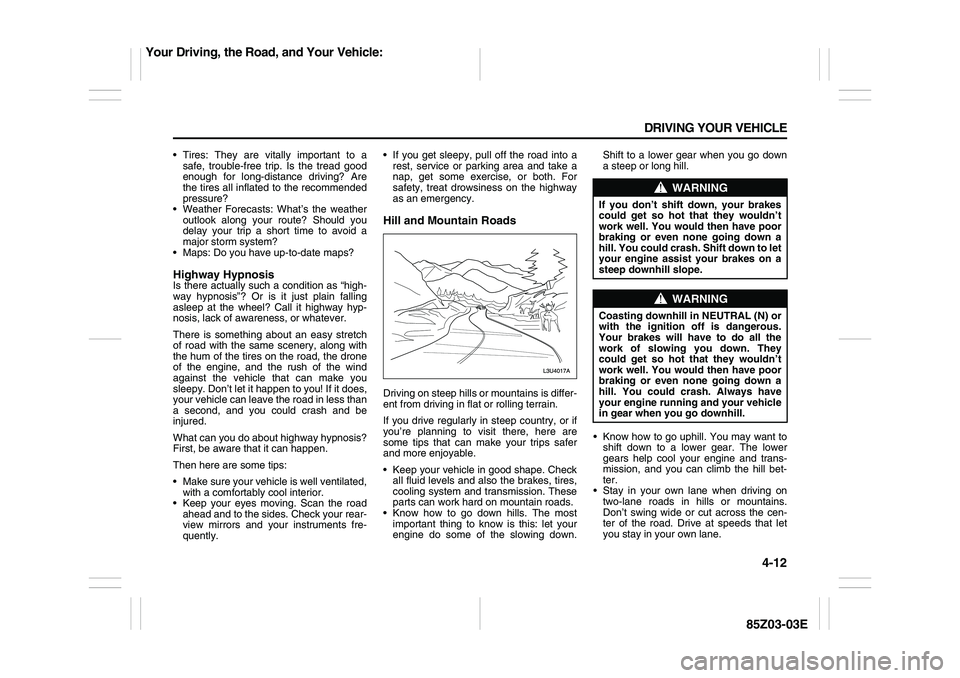
Hill and Mountain RoadsDriving on steep hills or mountains is differ-
ent from driving in flat or rolling terrain.
If you drive regularly in steep country, or if
you’re planning to visit there, here are
some tips that can make your trips safer
and more enjoyable.
Keep your vehicle in good shape. Check
all fluid levels and also the brakes, tires,
cooling system and transmission. These
parts can work hard on mountain roads.
Know how to go down hills. The most
important thing to know is this: let your
engine do some of the slowing down.Shift to a lower gear when you go down
a steep or long hill.
Know how to go uphill. You may want to
shift down to a lower gear. The lower
gears help cool your engine and trans-
mission, and you can climb the hill bet-
ter.
Stay in your own lane when driving on
two-lane roads in hills or mountains.
Don’t swing wide or cut across the cen-
ter of the road. Drive at speeds that let
you stay in your own lane.
WARNING
If you don’t shift down, your brakes
could get so hot that they wouldn’t
work well. You would then have poor
braking or even none going down a
hill. You could crash. Shift down to let
your engine assist your brakes on a
steep downhill slope.
WARNING
Coasting downhill in NEUTRAL (N) or
with the ignition off is dangerous.
Your brakes will have to do all the
work of slowing you down. They
could get so hot that they wouldn’t
work well. You would then have poor
braking or even none going down a
hill. You could crash. Always have
your engine running and your vehicle
in gear when you go downhill.
Your Driving, the Road, and Your Vehicle:
Page 138 of 225
4-14 DRIVING YOUR VEHICLE
85Z03-03E
cle’s stability when you make a hard stop
on a slippery road.) Whether you have an
anti-lock braking system or not, you’ll want
to begin stopping sooner than you would
on dry pavement. Without anti-lock brakes,
if you feel your vehicle begin to slide, let up
on the brakes a little. Push the brake pedal
down steadily to get the most traction you
can.
Remember, unless you have anti-lock, if
you brake so hard that your wheels stop
rolling, you’ll just slide. Brake so your
wheels always keep rolling and you can
still steer.
Whatever your braking system, allow
greater following distance on any slip-
pery road.
Watch for slippery spots. The road might
be fine until you hit a spot that’s covered
with ice. On an otherwise clear road, ice
patches may appear in shaded areas
where the sun can’t reach: around
clumps of trees, behind buildings or
under bridges. Sometimes the surface of
a curve or an overpass may remain icy
when the surrounding roads are clear. If
you see a patch of ice ahead of you,
brake before you are on it. Try not to
brake while you’re actually on the ice,
and avoid sudden steering maneuvers.If You’re Caught in a Blizzard
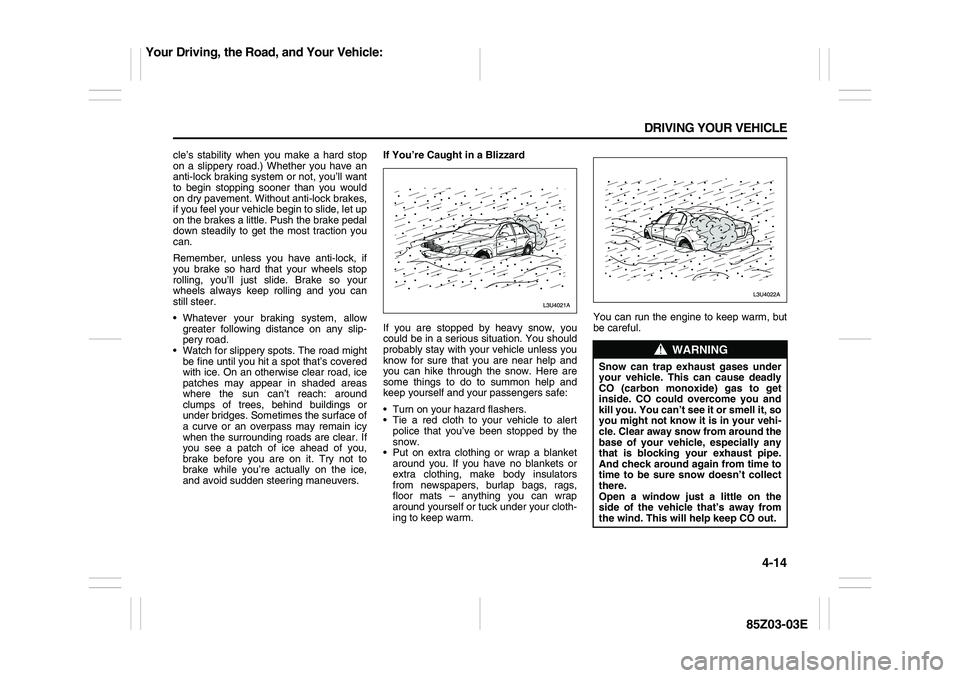
If you are stopped by heavy snow, you
could be in a serious situation. You should
probably stay with your vehicle unless you
know for sure that you are near help and
you can hike through the snow. Here are
some things to do to summon help and
keep yourself and your passengers safe:
Turn on your hazard flashers.
Tie a red cloth to your vehicle to alert
police that you’ve been stopped by the
snow.
Put on extra clothing or wrap a blanket
around you. If you have no blankets or
extra clothing, make body insulators
from newspapers, burlap bags, rags,
floor mats – anything you can wrap
around yourself or tuck under your cloth-
ing to keep warm.You can run the engine to keep warm, but
be careful.
WARNING
Snow can trap exhaust gases under
your vehicle. This can cause deadly
CO (carbon monoxide) gas to get
inside. CO could overcome you and
kill you. You can’t see it or smell it, so
you might not know it is in your vehi-
cle. Clear away snow from around the
base of your vehicle, especially any
that is blocking your exhaust pipe.
And check around again from time to
time to be sure snow doesn’t collect
there.
Open a window just a little on the
side of the vehicle that’s away from
the wind. This will help keep CO out.
Your Driving, the Road, and Your Vehicle:
Page 139 of 225
4-15 DRIVING YOUR VEHICLE
85Z03-03E
Run your engine only as long as you must.
This saves fuel. When you run the engine,
make it go a little faster than just idle. That
is, push the accelerator slightly. This uses
less fuel for the heat that you get and it
keeps the battery charged. You will need a
well-charged battery to restart the vehicle,
and possibly for signaling later on with your
headlamps. Let the heater run for a while.
Then, shut the engine off and close the
window almost all the way to preserve the
heat. Start the engine again and repeat
this only when you feel really uncomfort-
able from the cold. But do it as little as pos-
sible. Preserve the fuel as long as you can.
To help keep warm, you can get out of the
vehicle and do some fairly vigorous exer-
cises every half hour or so until help
comes.
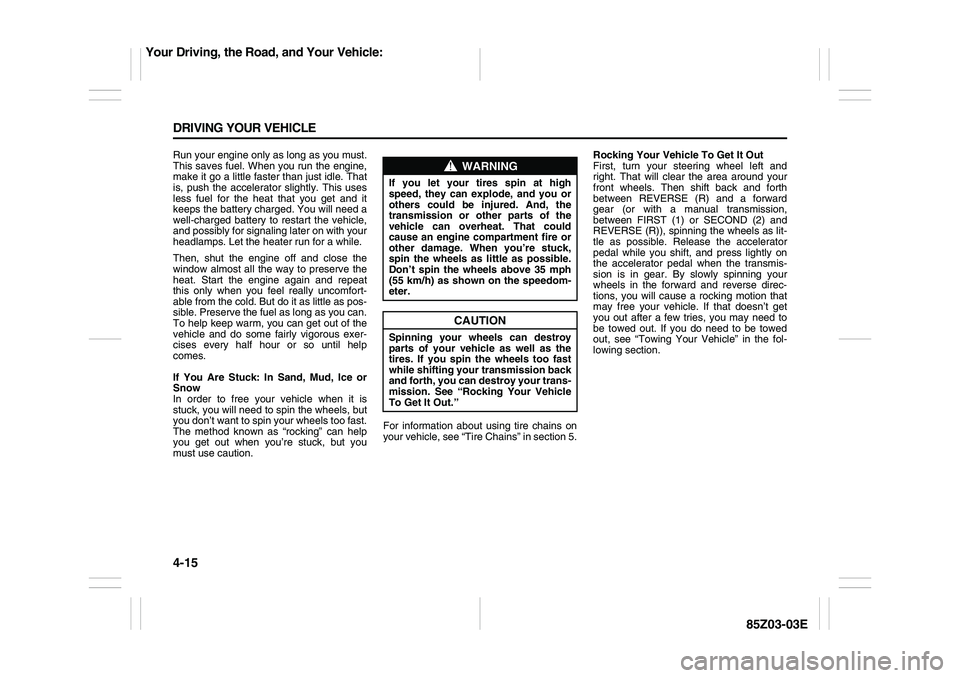
If You Are Stuck: In Sand, Mud, Ice or
Snow
In order to free your vehicle when it is
stuck, you will need to spin the wheels, but
you don’t want to spin your wheels too fast.
The method known as “rocking” can help
you get out when you’re stuck, but you
must use caution.For information about using tire chains on
your vehicle, see “Tire Chains” in section 5.Rocking Your Vehicle To Get It Out
First, turn your steering wheel left and
right. That will clear the area around your
front wheels. Then shift back and forth
between REVERSE (R) and a forward
gear (or with a manual transmission,
between FIRST (1) or SECOND (2) and
REVERSE (R)), spinning the wheels as lit-
tle as possible. Release the accelerator
pedal while you shift, and press lightly on
the accelerator pedal when the transmis-
sion is in gear. By slowly spinning your
wheels in the forward and reverse direc-
tions, you will cause a rocking motion that
may free your vehicle. If that doesn’t get
you out after a few tries, you may need to
be towed out. If you do need to be towed
out, see “Towing Your Vehicle” in the fol-
lowing section.
WARNING
If you let your tires spin at high
speed, they can explode, and you or
others could be injured. And, the
transmission or other parts of the
vehicle can overheat. That could
cause an engine compartment fire or
other damage. When you’re stuck,
spin the wheels as little as possible.
Don’t spin the wheels above 35 mph
(55 km/h) as shown on the speedom-
eter.
CAUTION
Spinning your wheels can destroy
parts of your vehicle as well as the
tires. If you spin the wheels too fast
while shifting your transmission back
and forth, you can destroy your trans-
mission. See “Rocking Your Vehicle
To Get It Out.”
Your Driving, the Road, and Your Vehicle:
Page 145 of 225
5-1 SERVICE AND APPEARANCE CARE
85Z03-03E
ServiceYour SUZUKI dealer knows your vehicle
best and wants you to be happy with it. We
hope you’ll go to your SUZUKI dealer for
all your service needs. You’ll get genuine
SUZUKI parts and SUZUKI trained and
supported service people.
We hope you’ll want to keep your SUZUKI
vehicle all SUZUKI. Doing Your Own Service WorkYour vehicle has an air bag system. Before
attempting to do your own service work,
see “Servicing Your Air Bag-Equipped
Vehicle” in section 1.
You should keep a record with all parts
receipts and list the mileage and the date
of any service work you perform. See
“Maintenance Record” in section 6.
Adding Equipment to the Outside of
Your VehicleThings you might add to the outside of your
vehicle can affect the airflow around it. This
may cause wind noise and affect wind-
shield washer performance. Check with
your SUZUKI dealer before adding equip-
ment to the outside of your vehicle.
FuelUse of the recommended fuel is an impor-
tant part of the proper maintenance of your
vehicle.Gasoline OctaneUse only unleaded gasoline with a posted
octane rating of 87 or higher. In an emer-
gency, you may be able to use a lower
octane rating – as low as 85 – if heavy
knocking does not occur. Refill your tank
with proper fuel as soon as possible. Oth-
erwise, you might damage your engine. If
you are using 87 or higher-octane rating
fuel and you hear heavy knocking, your
engine needs service.California FuelIf your vehicle is certified to meet California
Emission Standards (see the underhood
emission control label), it is designed to
operate on fuels that meet California spec-
ifications. If this fuel is not available in
states adopting California emissions stan-
dards, your vehicle will operate satisfacto-
rily on fuels meeting federal specifications,
but emission control system performance
may be affected. The malfunction indicator
lamp may turn on (see Malfunction Indica-
tor Lamp in section 3) and your vehicle
may fail a smog-check test. If this occurs,
return to your SUZUKI dealer for diagno-
sis.
WARNING
You can be injured and your vehicle
could be damaged if you try to do
service work on a vehicle without
knowing enough about it.
Be sure you have sufficient knowl-
edge, experience, the proper
replacement parts and tools before
you attempt any vehicle mainte-
nance task.
Be sure to use the proper nuts,
bolts and other fasteners.
“English” and “metric” fasteners
can be easily confused. If you use
the wrong fasteners, parts can later
break or fall off. You could be hurt.
Service:
Fuel:
Page 146 of 225
5-2 SERVICE AND APPEARANCE CARE
85Z03-03E
AdditivesTo provide cleaner air, all gasolines in the
United States are now required to contain
additives that will help prevent engine and
fuel system deposits from forming, allow-
ing your emission control system to work
properly. You should not have to add any-
thing to your fuel. However, some gaso-
lines contain only the minimum amount of
additive required to meet U.S. Environ-
mental Protection Agency regulations.
SUZUKI recommends that you buy gaso-
lines that are advertised to help keep fuel
injectors and intake valves clean. If your
vehicle experiences problems due to dirty
injectors or valves, try a different brand of
gasoline.
Gasoline containing oxygenates, such as
ethers and ethanol, and reformulated gas-
olines may be available in your area to
contribute to clean air. SUZUKI recom-
mends that you use these gasolines.
Some gasolines that are not reformulated
for low emissions may contain an octane-
enhancing additive called methylcyclopen-tadienyl manganese tricarbonyl (MMT);
ask the attendant where you buy gasoline
whether the fuel contains MMT. SUZUKI
does not recommend the use of such gas-
olines. Fuels containing MMT can reduce
the life of spark plugs and the performance
of the emission control system may be
affected. The malfunction indicator lamp
may turn on. If this occurs, return to your
SUZUKI dealer for service.
Fuels in Foreign CountriesIf you plan on driving in another country
outside the United States or Canada, the
proper fuel may be hard to find. Never use
leaded gasoline or any other fuel not rec-
ommended in the previous text on fuel.
Costly repairs caused by use of improper
fuel wouldn’t be covered by your warranty.
To check the fuel availability, ask an auto
club, or contact a major oil company that
does business in the country where you’ll
be driving.
Filling Your Tank
CAUTION
Your vehicle was not designed for
fuel that contains methanol. Don’t
use fuel containing methanol. It can
corrode metal parts in your fuel sys-
tem and also damage the plastic and
rubber parts. That damage wouldn’t
be covered under your warranty.
WARNING
Fuel vapor burns violently and a fuel
fire can cause severe injuries. To help
avoid injuries to you and others, read
and follow all the instructions on the
pump island. Turn off your engine
when you are refueling. Don’t smoke
if you’re near fuel or are refueling
your vehicle. Keep sparks, flames
and smoking materials away from
fuel. Don’t leave the fuel pump unat-
tended when refueling your vehicle –
this is against the law in some
places. Keep children away from the
fuel pump; never let children pump
fuel.
Fuel:
Page 148 of 225
5-4 SERVICE AND APPEARANCE CARE
85Z03-03E
Filling a Portable Fuel Container
Checking Things Under the
Hood
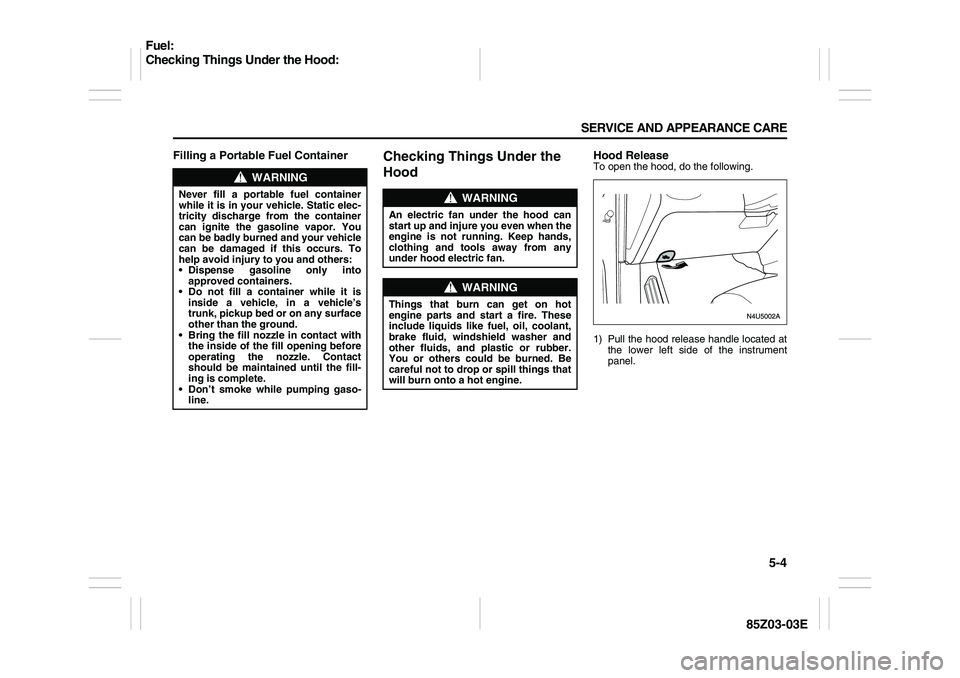
Hood ReleaseTo open the hood, do the following.
1) Pull the hood release handle located at
the lower left side of the instrument
panel.
WARNING
Never fill a portable fuel container
while it is in your vehicle. Static elec-
tricity discharge from the container
can ignite the gasoline vapor. You
can be badly burned and your vehicle
can be damaged if this occurs. To
help avoid injury to you and others:
Dispense gasoline only into
approved containers.
Do not fill a container while it is
inside a vehicle, in a vehicle’s
trunk, pickup bed or on any surface
other than the ground.
Bring the fill nozzle in contact with
the inside of the fill opening before
operating the nozzle. Contact
should be maintained until the fill-
ing is complete.
Don’t smoke while pumping gaso-
line.
WARNING
An electric fan under the hood can
start up and injure you even when the
engine is not running. Keep hands,
clothing and tools away from any
under hood electric fan.
WARNING
Things that burn can get on hot
engine parts and start a fire. These
include liquids like fuel, oil, coolant,
brake fluid, windshield washer and
other fluids, and plastic or rubber.
You or others could be burned. Be
careful not to drop or spill things that
will burn onto a hot engine.
Fuel:
Checking Things Under the Hood:
Page 150 of 225
5-6 SERVICE AND APPEARANCE CARE
85Z03-03E
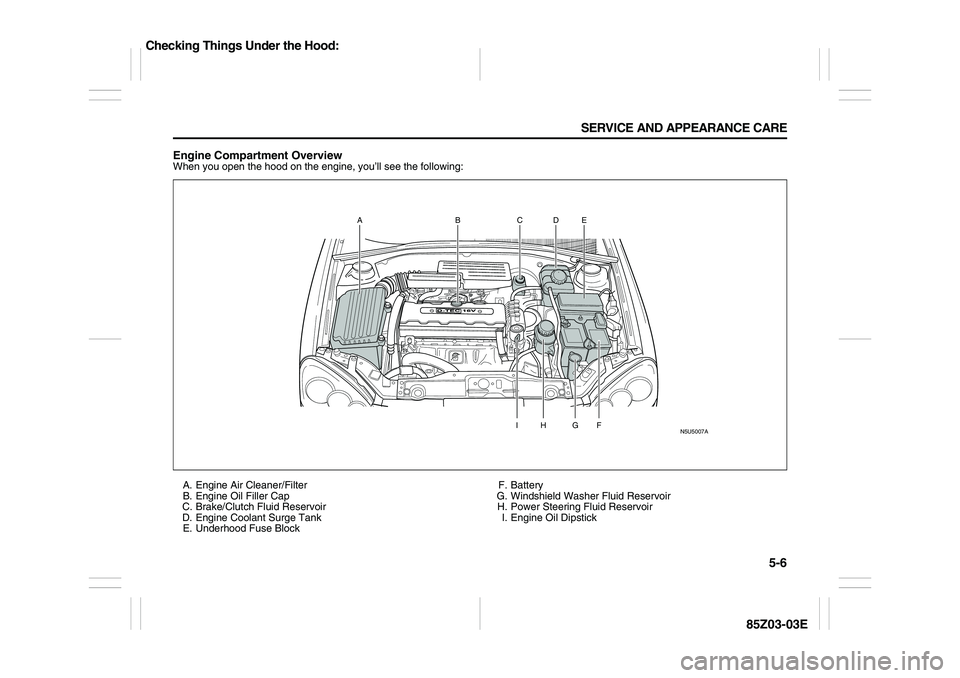
Engine Compartment OverviewWhen you open the hood on the engine, you’ll see the following:
A. Engine Air Cleaner/Filter
B. Engine Oil Filler Cap
C. Brake/Clutch Fluid Reservoir
D. Engine Coolant Surge Tank
E. Underhood Fuse BlockF. Battery
G. Windshield Washer Fluid Reservoir
H. Power Steering Fluid Reservoir
I. Engine Oil Dipstick
N5U5007A
A
B
D
EG
H
I
F
C
Checking Things Under the Hood:
Page 151 of 225
5-7 SERVICE AND APPEARANCE CARE
85Z03-03E
Engine OilIf the oil pressure light appears on the
instrument cluster, it means you need to
check your engine oil level right away.
For more information, see “Oil Pressure
Light” in section 3.
You should check your engine oil level reg-
ularly; this is an added reminder.
Checking Engine Oil
It’s a good idea to check your engine oil
every time you get fuel. In order to get an
accurate reading, the oil must be warm
and the vehicle must be on level ground.Use the engine oil dipstick to check the oil
level. The dipstick’s handle will be a yellow
ring. See “Engine Compartment Overview”
in this section for the location of the engine
oil dipstick.
Turn off the engine and give the oil several
minutes to drain back into the oil pan. If
you don’t, the oil dipstick might not show
the actual level.
Pull out the dipstick and clean it with a
paper towel or cloth, then push it back in all
the way. Remove it again, keeping the tip
down and check the level.
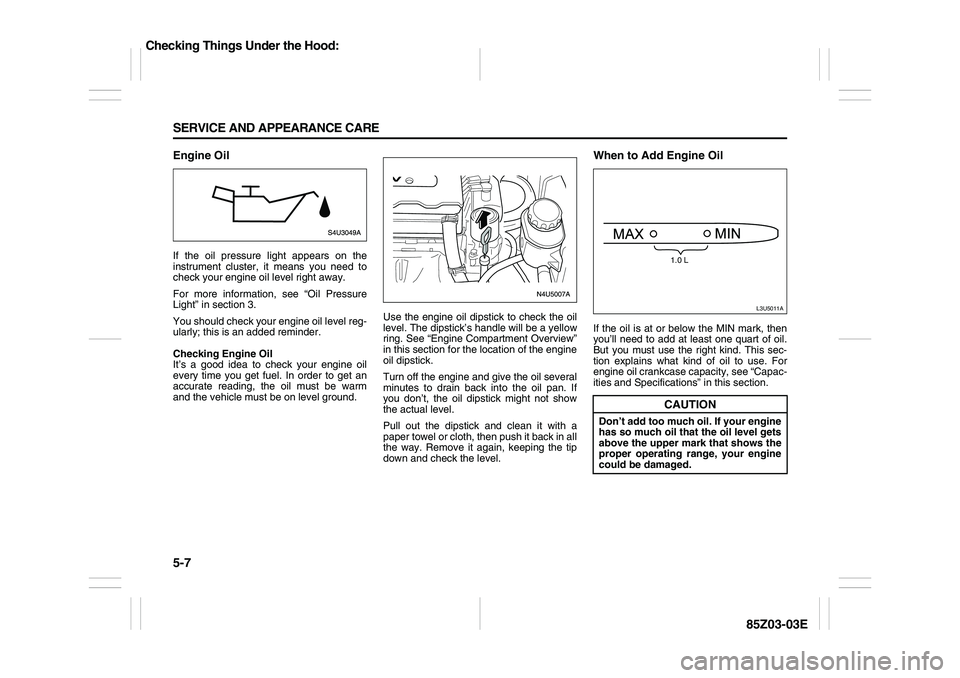
When to Add Engine OilIf the oil is at or below the MIN mark, then
you’ll need to add at least one quart of oil.
But you must use the right kind. This sec-
tion explains what kind of oil to use. For
engine oil crankcase capacity, see “Capac-
ities and Specifications” in this section.
CAUTION
Don’t add too much oil. If your engine
has so much oil that the oil level gets
above the upper mark that shows the
proper operating range, your engine
could be damaged.
L3U5011A
1.0 L
Checking Things Under the Hood:
Page 152 of 225
5-8 SERVICE AND APPEARANCE CARE
85Z03-03E
This (A) is where you add oil. See “Engine
Compartment Overview” on a previous
page in this section for more information
on location.
Be sure to add enough oil to put the level
somewhere in the proper operating range.
Push the dipstick all the way back in when
you’re through.What Kind of Engine Oil to Use
Oils recommended for your vehicle can be
identified by looking for the starburst sym-
bol.
This symbol indicates that the oil has been
certified by the American Petroleum Insti-
tute (API). Do not use any oil which does
not carry this starburst symbol.
If you choose to perform the engine oil
change service yourself, be sure the oil
you use has the starburst symbol on the
front of the oil container. If you have your
oil changed for you, be sure the oil put into
your engine is American Petroleum Insti-
tute certified for gasoline engines.
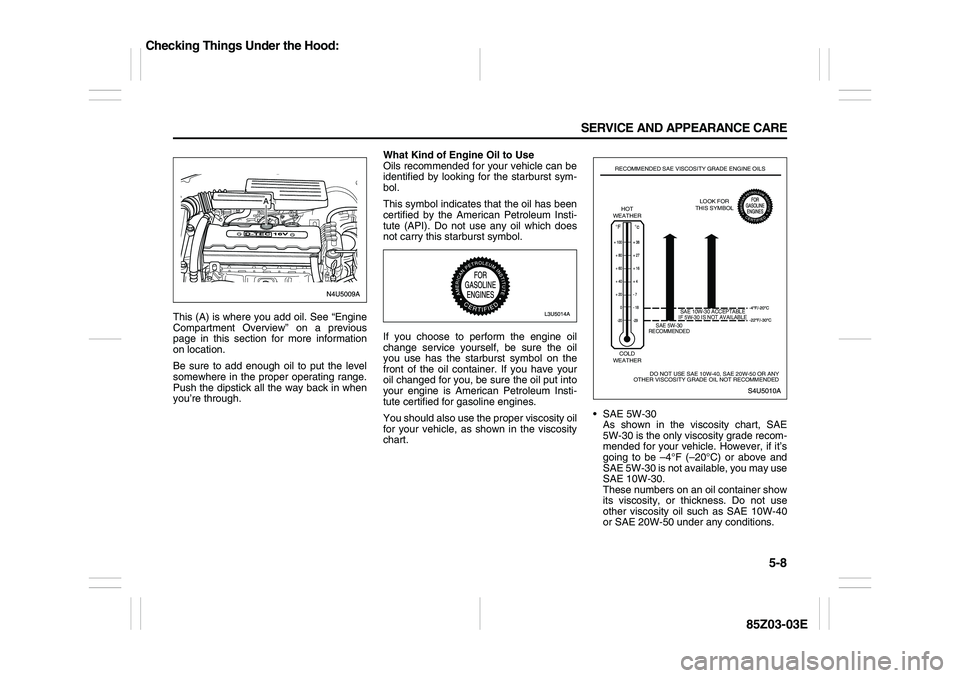
You should also use the proper viscosity oil
for your vehicle, as shown in the viscosity
chart. SAE 5W-30
As shown in the viscosity chart, SAE
5W-30 is the only viscosity grade recom-
mended for your vehicle. However, if it’s
going to be –4°F (–20°C) or above and
SAE 5W-30 is not available, you may use
SAE 10W-30.
These numbers on an oil container show
its viscosity, or thickness. Do not use
other viscosity oil such as SAE 10W-40
or SAE 20W-50 under any conditions.
HOT
WEATHERLOOK FOR
THIS SYMBOL
SAE 10W-30 ACCEPTABLE
IF 5W-30 IS NOT AVAILABLE
SAE 5W-30
RECOMMENDED
COLD
WEATHERRECOMMENDED SAE VISCOSITY GRADE ENGINE OILS
DO NOT USE SAE 10W-40, SAE 20W-50 OR ANY
OTHER VISCOSITY GRADE OIL NOT RECOMMENDED
Checking Things Under the Hood: