Window SUZUKI FORENZA 2008 1.G User Guide
[x] Cancel search | Manufacturer: SUZUKI, Model Year: 2008, Model line: FORENZA, Model: SUZUKI FORENZA 2008 1.GPages: 226, PDF Size: 5.25 MB
Page 59 of 226
2-11FEATURES AND CONTROLS
85Z04-03E
How to Turn Off the System Alarm
If the system alarm is active, it can be
deactivated using the following methods:
Press the Lock or Unlock button on the
remote keyless entry transmitter.
Unlock the driver’s or passenger’s front
door using the key.
Otherwise, the alarm will automatically
stop after 30 seconds. The system will
then lock the doors and reactivate the
theft-deterrent system.
How to Detect a Tamper Condition
If the hazard lamps flash once when the
Lock or Unlock button on your transmitter
is pressed, that means the theft-security
system alarm was triggered while you
were away.
Daily Inspection ChecklistBefore Driving1) Make sure that windows, mirrors, lights
and reflectors are clean and unob-
structed.
2) Visually check the tires for the following
points:
– the depth of the tread groove
– abnormal wear, cracks and damage
– loose wheel nuts
– existence of foreign material such as
nails, stones, etc.
Refer to “Tires” in the “SERVICE AND
APPEARANCE CARE” section for details.
3) Look for oil or other fluid leaks.
NOTE:
It is normal for water to drip from the air
conditioning system after use.
4) Make sure the hood is fully closed and
latched.
5) Check the headlights, turn signal lights,
brake lights and horn for proper opera-
tion.
6) Lock all doors.
7) Adjust the seat and adjustable head
restraints (if equipped).
8) Check the brake pedal.
9) Adjust the mirrors.
10)Make sure that you and all passengers
have properly fastened your safety
belts.11)Make sure that all warning lights come
on as the key is turned to the “ON” or
“START” position.
12)Check all gauges.
13)Make sure that the BRAKE light turns
off when the parking brake is released.
Once a week, or each time you fill your fuel
tank, perform the following under-hood
checks:
1) Engine oil level
2) Coolant level
3) Brake fluid level
4) Power steering (if equipped) fluid level
5) Windshield washer fluid level
6) Hood latch operation
Pull the hood release handle inside the
vehicle. Make sure that you cannot
open the hood all the way without
releasing the secondary latch. Be sure
to close the hood securely after check-
ing for proper latch operation. See the
item “Lubricate Locks, Hinges & Hood
Latch” under “Chassis and Body” in the
“MAINTENANCE SCHEDULE” section
for the lubrication schedule.
WARNING
Make sure the hood is fully closed
and latched before driving. If it is not,
it can fly up unexpectedly during
driving, obstructing your view and
resulting in an accident.
Theft-Deterrent Systems:
Daily Inspection Checklist:
Page 68 of 226
2-20
FEATURES AND CONTROLS
85Z04-03E
Engine Exhaust Running Your Engine While You Are
Parked
It’s better not to park with the engine run-
ning. But if you ever have to, here are
some things to know.
Follow the proper steps to be sure your
vehicle won’t move. See “Shifting Into Park
(P)” or “Parking Your Vehicle (Manual
Transmission)” in this section.
WARNING
Engine exhaust can kill. It contains
the gas carbon monoxide (CO), which
you can’t see or smell. It can cause
unconsciousness and death.
You might have exhaust coming in if:
Your exhaust system sounds
strange or different.
Your vehicle gets rusty underneath.
Your vehicle was damaged in a col-
lision.
Your vehicle was damaged when
driving over high points on the
road or over road debris.
Repairs weren’t done correctly.
Your vehicle or exhaust system had
been modified improperly.
If you ever suspect exhaust is com-
ing into your vehicle:
Drive it only with all the windows
down to blow out any CO; and
Have your vehicle fixed immedi-
ately.
WARNING
Idling the engine with the climate
control system off could allow dan-
gerous exhaust into your vehicle. See
the earlier Warning under “Engine
Exhaust.”
Also, idling in a closed-in place can
let deadly carbon monoxide (CO) into
your vehicle even if the climate con-
trol fan is at the highest setting. One
place this can happen is a garage.
Exhaust – with CO – can come in eas-
ily. NEVER park in a garage with the
engine running.
Another closed-in place can be a bliz-
zard. See “Winter Driving” in the
Index.
WARNING
It is dangerous to get out of your
vehicle if the shift lever is not fully in
PARK (P) or the appropriate position
with the parking brake firmly set.
Your vehicle can roll. To determine
the appropriate position, see “Park-
ing Your Vehicle”. Don’t leave your
vehicle when the engine is running
unless you have to. If you’ve left the
engine running, the vehicle can move
suddenly. You or others could be
injured. To be sure your vehicle won’t
move, even when you’re on fairly
level ground, always set your parking
brake and move the shift lever to
PARK (P) or the appropriate position
as described under “Parking Your
Ve h i cl e ” .
Starting and Operating Your Vehicle:
Mirrors:
Page 70 of 226
2-22
FEATURES AND CONTROLS
85Z04-03E
Outside Convex MirrorYour passenger’s side mirror is convex. A
convex mirror’s surface is curved so you
can see more from the driver’s seat.Outside Heated MirrorsIf your vehicle has this feature, when you
operate the rear window defogger, the
heated driver’s and passenger’s outside
power mirrors are warmed to help clear
them of ice and snow. See “Rear Window
and Outside Mirror Defogger” under “Cli-
mate Control System” in section 3 for more
information.
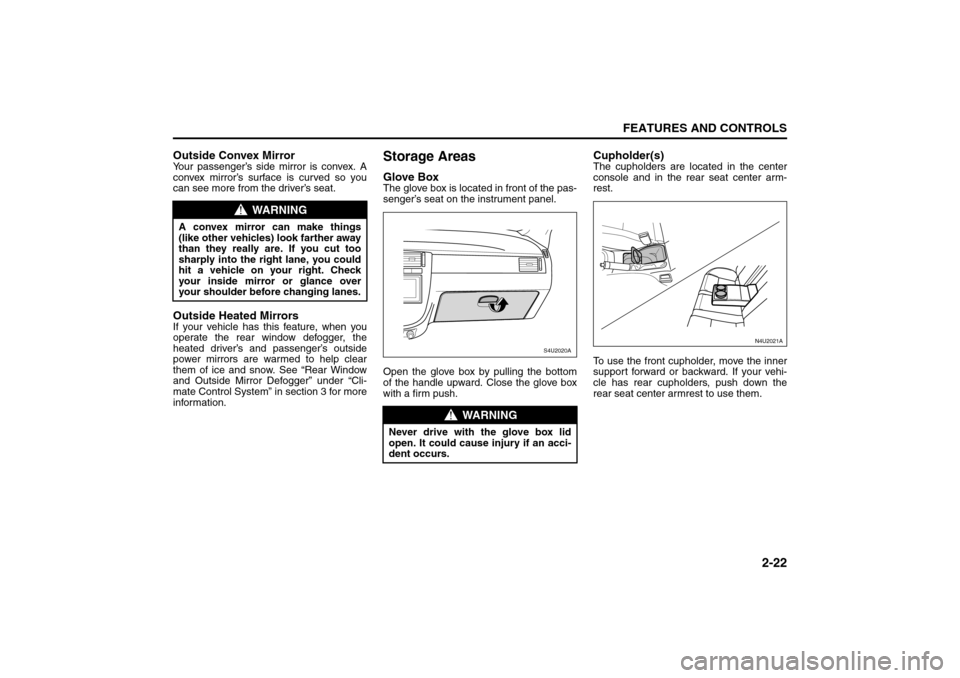
Storage AreasGlove BoxThe glove box is located in front of the pas-
senger’s seat on the instrument panel.
Open the glove box by pulling the bottom
of the handle upward. Close the glove box
with a firm push.
Cupholder(s)The cupholders are located in the center
console and in the rear seat center arm-
rest.
To use the front cupholder, move the inner
support forward or backward. If your vehi-
cle has rear cupholders, push down the
rear seat center armrest to use them.
WARNING
A convex mirror can make things
(like other vehicles) look farther away
than they really are. If you cut too
sharply into the right lane, you could
hit a vehicle on your right. Check
your inside mirror or glance over
your shoulder before changing lanes.
WARNING
Never drive with the glove box lid
open. It could cause injury if an acci-
dent occurs.
S4U2020A
N4U2021A
Storage Areas:
Page 73 of 226
2-25FEATURES AND CONTROLS
85Z04-03E
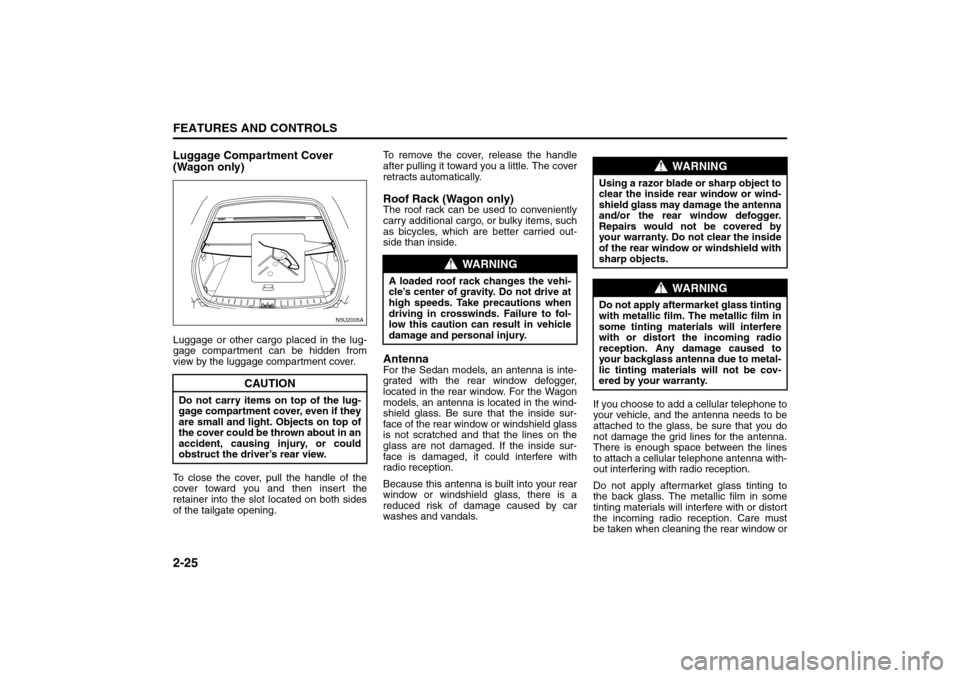
Luggage Compartment Cover
(Wagon only)Luggage or other cargo placed in the lug-
gage compartment can be hidden from
view by the luggage compartment cover.
To close the cover, pull the handle of the
cover toward you and then insert the
retainer into the slot located on both sides
of the tailgate opening.To remove the cover, release the handle
after pulling it toward you a little. The cover
retracts automatically.
Roof Rack (Wagon only)The roof rack can be used to conveniently
carry additional cargo, or bulky items, such
as bicycles, which are better carried out-
side than inside.AntennaFor the Sedan models, an antenna is inte-
grated with the rear window defogger,
located in the rear window. For the Wagon
models, an antenna is located in the wind-
shield glass. Be sure that the inside sur-
face of the rear window or windshield glass
is not scratched and that the lines on the
glass are not damaged. If the inside sur-
face is damaged, it could interfere with
radio reception.
Because this antenna is built into your rear
window or windshield glass, there is a
reduced risk of damage caused by car
washes and vandals.If you choose to add a cellular telephone to
your vehicle, and the antenna needs to be
attached to the glass, be sure that you do
not damage the grid lines for the antenna.
There is enough space between the lines
to attach a cellular telephone antenna with-
out interfering with radio reception.
Do not apply aftermarket glass tinting to
the back glass. The metallic film in some
tinting materials will interfere with or distort
the incoming radio reception. Care must
be taken when cleaning the rear window or
CAUTION
Do not carry items on top of the lug-
gage compartment cover, even if they
are small and light. Objects on top of
the cover could be thrown about in an
accident, causing injury, or could
obstruct the driver’s rear view.
N5U2005A
WARNING
A loaded roof rack changes the vehi-
cle’s center of gravity. Do not drive at
high speeds. Take precautions when
driving in crosswinds. Failure to fol-
low this caution can result in vehicle
damage and personal injury.
WARNING
Using a razor blade or sharp object to
clear the inside rear window or wind-
shield glass may damage the antenna
and/or the rear window defogger.
Repairs would not be covered by
your warranty. Do not clear the inside
of the rear window or windshield with
sharp objects.
WARNING
Do not apply aftermarket glass tinting
with metallic film. The metallic film in
some tinting materials will interfere
with or distort the incoming radio
reception. Any damage caused to
your backglass antenna due to metal-
lic tinting materials will not be cov-
ered by your warranty.
Storage Areas:
Sunroof:
Page 83 of 226
3-7INSTRUMENT PANEL
85Z04-03E
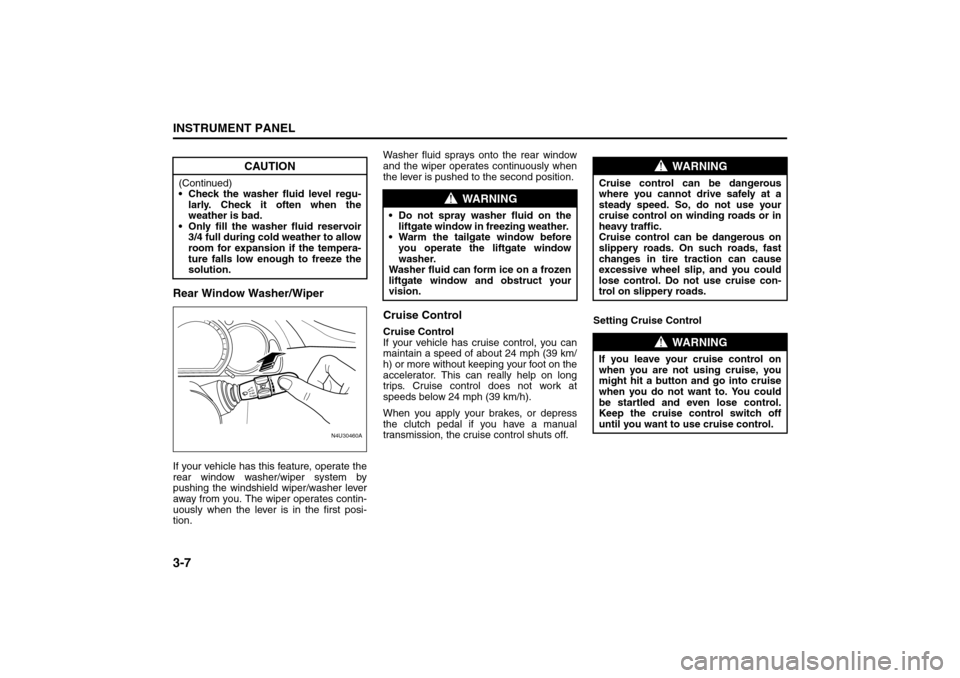
Rear Window Washer/WiperIf your vehicle has this feature, operate the
rear window washer/wiper system by
pushing the windshield wiper/washer lever
away from you. The wiper operates contin-
uously when the lever is in the first posi-
tion.Washer fluid sprays onto the rear window
and the wiper operates continuously when
the lever is pushed to the second position.
Cruise ControlCruise Control
If your vehicle has cruise control, you can
maintain a speed of about 24 mph (39 km/
h) or more without keeping your foot on the
accelerator. This can really help on long
trips. Cruise control does not work at
speeds below 24 mph (39 km/h).
When you apply your brakes, or depress
the clutch pedal if you have a manual
transmission, the cruise control shuts off.Setting Cruise Control
CAUTION
(Continued)
Check the washer fluid level regu-
larly. Check it often when the
weather is bad.
Only fill the washer fluid reservoir
3/4 full during cold weather to allow
room for expansion if the tempera-
ture falls low enough to freeze the
solution.
N4U30460A
FASTSLOW
WARNING
Do not spray washer fluid on the
liftgate window in freezing weather.
Warm the tailgate window before
you operate the liftgate window
washer.
Washer fluid can form ice on a frozen
liftgate window and obstruct your
vision.
WARNING
Cruise control can be dangerous
where you cannot drive safely at a
steady speed. So, do not use your
cruise control on winding roads or in
heavy traffic.
Cruise control can be dangerous on
slippery roads. On such roads, fast
changes in tire traction can cause
excessive wheel slip, and you could
lose control. Do not use cruise con-
trol on slippery roads.
WARNING
If you leave your cruise control on
when you are not using cruise, you
might hit a button and go into cruise
when you do not want to. You could
be startled and even lose control.
Keep the cruise control switch off
until you want to use cruise control.
Instrument Panel Overview:
Page 90 of 226
3-14
INSTRUMENT PANEL
85Z04-03E
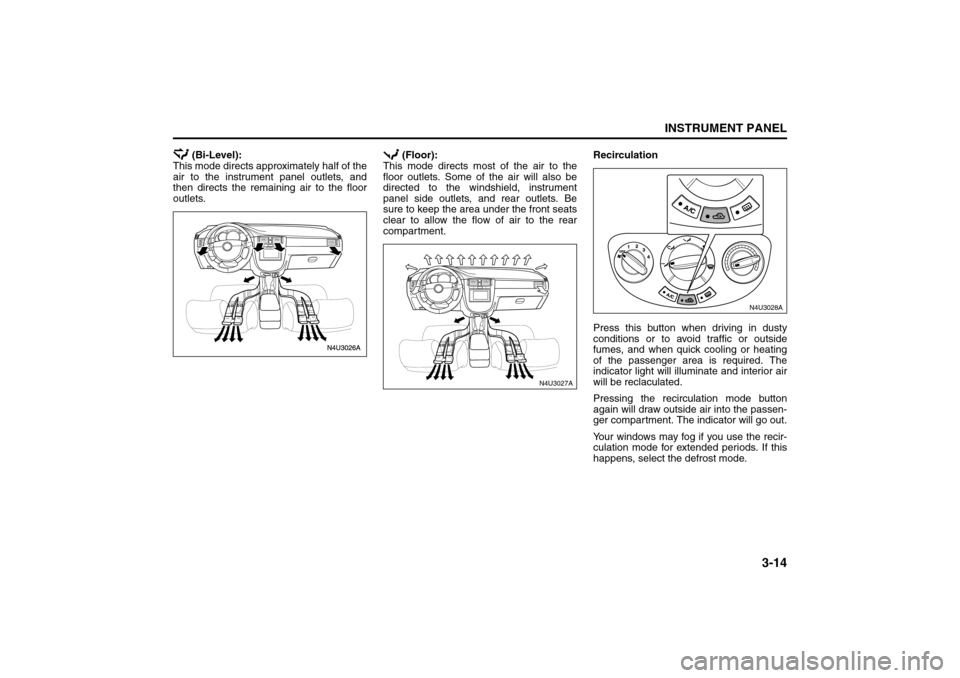
(Bi-Level):
This mode directs approximately half of the
air to the instrument panel outlets, and
then directs the remaining air to the floor
outlets. (Floor):
This mode directs most of the air to the
floor outlets. Some of the air will also be
directed to the windshield, instrument
panel side outlets, and rear outlets. Be
sure to keep the area under the front seats
clear to allow the flow of air to the rear
compartment.Recirculation
Press this button when driving in dusty
conditions or to avoid traffic or outside
fumes, and when quick cooling or heating
of the passenger area is required. The
indicator light will illuminate and interior air
will be reclaculated.
Pressing the recirculation mode button
again will draw outside air into the passen-
ger compartment. The indicator will go out.
Your windows may fog if you use the recir-
culation mode for extended periods. If this
happens, select the defrost mode.
N4U3027AN4U3027A
N4U3028AN4U3028A
Climate Controls:
Page 91 of 226
3-15INSTRUMENT PANEL
85Z04-03E
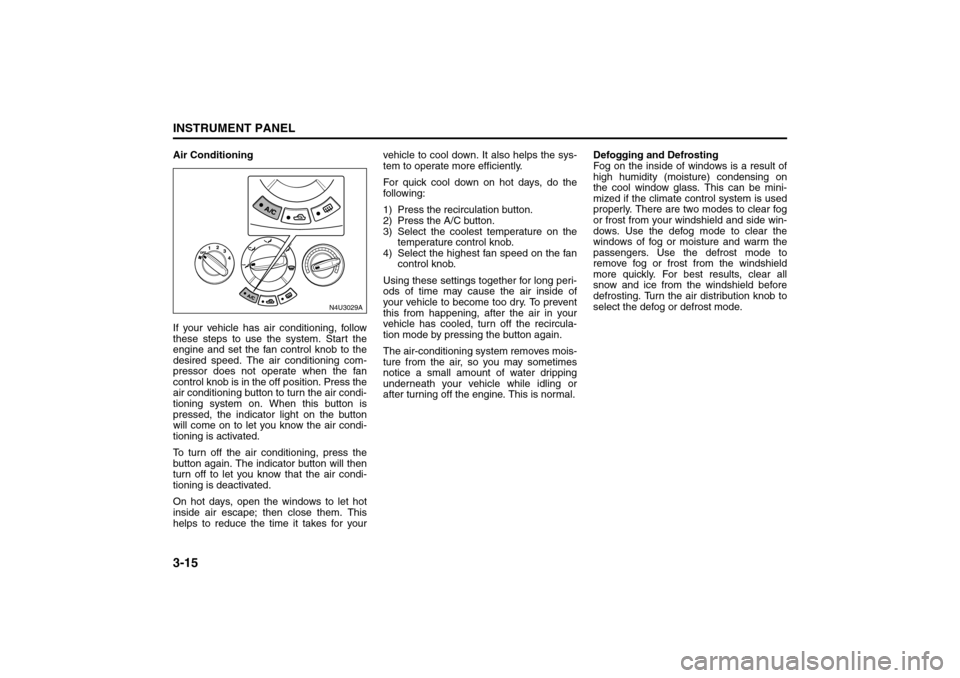
Air Conditioning
If your vehicle has air conditioning, follow
these steps to use the system. Start the
engine and set the fan control knob to the
desired speed. The air conditioning com-
pressor does not operate when the fan
control knob is in the off position. Press the
air conditioning button to turn the air condi-
tioning system on. When this button is
pressed, the indicator light on the button
will come on to let you know the air condi-
tioning is activated.
To turn off the air conditioning, press the
button again. The indicator button will then
turn off to let you know that the air condi-
tioning is deactivated.
On hot days, open the windows to let hot
inside air escape; then close them. This
helps to reduce the time it takes for yourvehicle to cool down. It also helps the sys-
tem to operate more efficiently.
For quick cool down on hot days, do the
following:
1) Press the recirculation button.
2) Press the A/C button.
3) Select the coolest temperature on the
temperature control knob.
4) Select the highest fan speed on the fan
control knob.
Using these settings together for long peri-
ods of time may cause the air inside of
your vehicle to become too dry. To prevent
this from happening, after the air in your
vehicle has cooled, turn off the recircula-
tion mode by pressing the button again.
The air-conditioning system removes mois-
ture from the air, so you may sometimes
notice a small amount of water dripping
underneath your vehicle while idling or
after turning off the engine. This is normal.Defogging and Defrosting
Fog on the inside of windows is a result of
high humidity (moisture) condensing on
the cool window glass. This can be mini-
mized if the climate control system is used
properly. There are two modes to clear fog
or frost from your windshield and side win-
dows. Use the defog mode to clear the
windows of fog or moisture and warm the
passengers. Use the defrost mode to
remove fog or frost from the windshield
more quickly. For best results, clear all
snow and ice from the windshield before
defrosting. Turn the air distribution knob to
select the defog or defrost mode.
N4U3029AN4U3029A
Climate Controls:
Page 92 of 226
3-16
INSTRUMENT PANEL
85Z04-03E
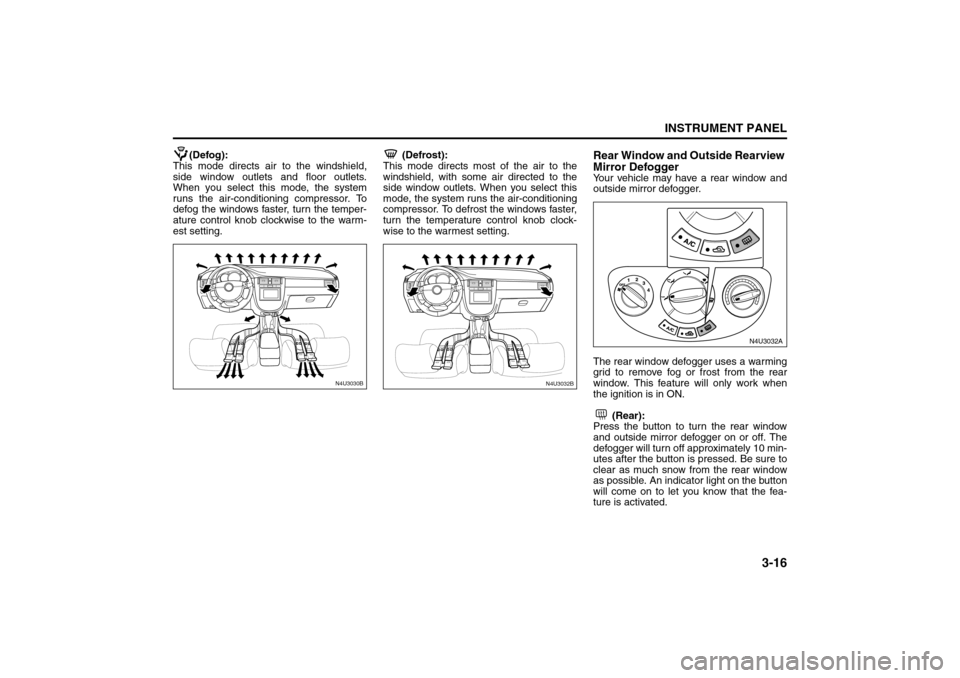
(Defog):
This mode directs air to the windshield,
side window outlets and floor outlets.
When you select this mode, the system
runs the air-conditioning compressor. To
defog the windows faster, turn the temper-
ature control knob clockwise to the warm-
est setting. (Defrost):
This mode directs most of the air to the
windshield, with some air directed to the
side window outlets. When you select this
mode, the system runs the air-conditioning
compressor. To defrost the windows faster,
turn the temperature control knob clock-
wise to the warmest setting.
Rear Window and Outside Rearview
Mirror DefoggerYour vehicle may have a rear window and
outside mirror defogger.
The rear window defogger uses a warming
grid to remove fog or frost from the rear
window. This feature will only work when
the ignition is in ON.
(Rear):
Press the button to turn the rear window
and outside mirror defogger on or off. The
defogger will turn off approximately 10 min-
utes after the button is pressed. Be sure to
clear as much snow from the rear window
as possible. An indicator light on the button
will come on to let you know that the fea-
ture is activated.
N4U3030B
N4U3032B
N4U3032AN4U3032A
Climate Controls:
Page 93 of 226
3-17INSTRUMENT PANEL
85Z04-03E
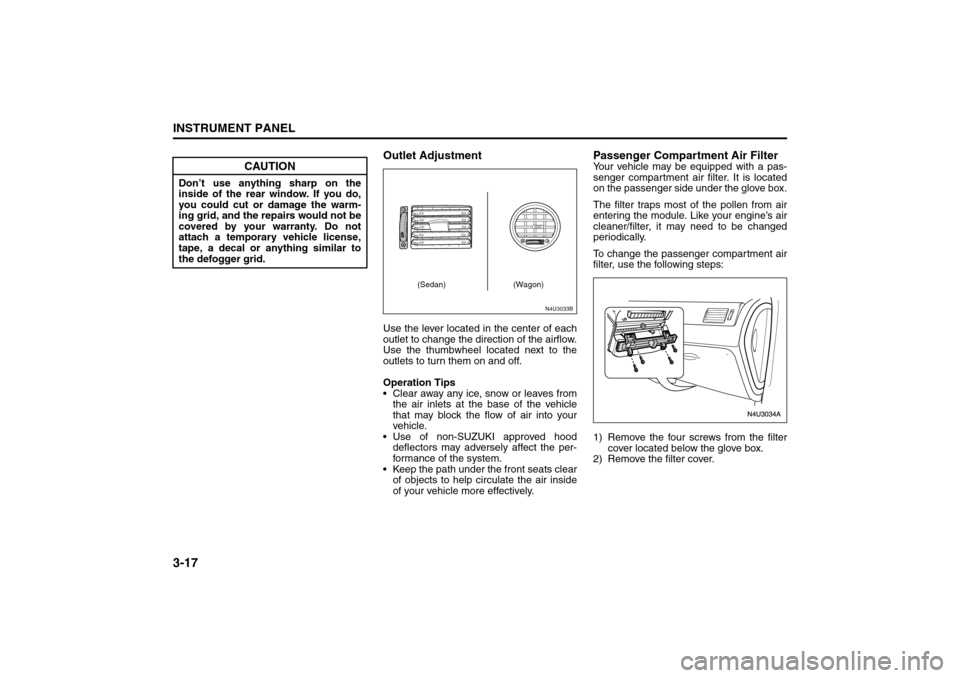
Outlet AdjustmentUse the lever located in the center of each
outlet to change the direction of the airflow.
Use the thumbwheel located next to the
outlets to turn them on and off.
Operation Tips
Clear away any ice, snow or leaves from
the air inlets at the base of the vehicle
that may block the flow of air into your
vehicle.
Use of non-SUZUKI approved hood
deflectors may adversely affect the per-
formance of the system.
Keep the path under the front seats clear
of objects to help circulate the air inside
of your vehicle more effectively.
Passenger Compartment Air FilterYour vehicle may be equipped with a pas-
senger compartment air filter. It is located
on the passenger side under the glove box.
The filter traps most of the pollen from air
entering the module. Like your engine’s air
cleaner/filter, it may need to be changed
periodically.
To change the passenger compartment air
filter, use the following steps:
1) Remove the four screws from the filter
cover located below the glove box.
2) Remove the filter cover.
CAUTION
Don’t use anything sharp on the
inside of the rear window. If you do,
you could cut or damage the warm-
ing grid, and the repairs would not be
covered by your warranty. Do not
attach a temporary vehicle license,
tape, a decal or anything similar to
the defogger grid.
N4U3033B
(Sedan) (Wagon)
Climate Controls:
Page 135 of 226
4-11DRIVING YOUR VEHICLE
85Z04-03E
time and energy. See the next part,
“Freeway Driving.”
Treat a green light as a warning signal. A
traffic light is there because the corner is
busy enough to need it. When a light
turns green, and just before you start to
move, check both ways for vehicles that
have not cleared the intersection or may
be running the red light.Freeway DrivingMile for mile, freeways (also called thru-
ways, parkways, expressways, turnpikes or
superhighways) are the safest of all roads.
But they have their own special rules.
The most important advice on freeway
driving is: Keep up with traffic and keep to
the right. Drive at the same speed most of
the other drivers are driving. Too-fast or
too-slow driving breaks a smooth trafficflow. Treat the left lane on a freeway as a
passing lane.
At the entrance, there is usually a ramp
that leads to the freeway. If you have a
clear view of the freeway as you drive
along the entrance ramp, you should begin
to check traffic. Try to determine where you
expect to blend with the flow. Try to merge
into the gap at close to the prevailing
speed. Switch on your turn signal, check
your mirrors and glance over your shoulder
as often as necessary. Try to blend
smoothly with the traffic flow.
Once you are on the freeway, adjust your
speed to the posted limit or to the prevail-
ing rate if it’s slower. Stay in the right lane
unless you want to pass.
Before changing lanes, check your mirrors.
Then use your turn signal.
Just before you leave the lane, glance
quickly over your shoulder to make sure
there isn’t another vehicle in your “blind”
spot.
Once you are moving on the freeway,
make certain you allow a reasonable fol-
lowing distance.
Expect to move slightly slower at night.
When you want to leave the freeway, move
to the proper lane well in advance. If you
miss your exit, do not, under any circum-
stances, stop and back up. Drive on to the
next exit.The exit ramp can be curved, sometimes
quite sharply. The exit speed is usually
posted. Reduce your speed according to
your speedometer, not to your sense of
motion. After driving for any distance at
higher speeds, you may tend to think you
are going slower than you actually are.
Before Leaving on a Long TripMake sure you’re ready. Try to be well
rested. If you must start when you’re not
fresh – such as after a day’s work – don’t
plan to make too many miles that first part
of the journey. Wear comfortable clothing
and shoes you can easily drive in.
Is your vehicle ready for a long trip? If you
keep it serviced and maintained, it’s ready
to go. If it needs service, have it done
before starting out. Of course, you’ll find
experienced and able service experts in
SUZUKI dealerships all across North
America. They’ll be ready and willing to
help if you need it.
Here are some things you can check
before a trip:
Windshield Washer Fluid: Is the reser-
voir full? Are all windows clean inside
and outside?
Wiper Blades: Are they in good shape?
Fuel, Engine Oil, Other Fluids: Have you
checked all levels?
Lamps: Are they all working? Are the
lenses clean?
Your Driving, the Road, and Your Vehicle: