Window SUZUKI FORENZA 2008 1.G Owner's Manual
[x] Cancel search | Manufacturer: SUZUKI, Model Year: 2008, Model line: FORENZA, Model: SUZUKI FORENZA 2008 1.GPages: 226, PDF Size: 5.25 MB
Page 138 of 226
4-14
DRIVING YOUR VEHICLE
85Z04-03E
cle’s stability when you make a hard stop
on a slippery road.) Whether you have an
anti-lock braking system or not, you’ll want
to begin stopping sooner than you would
on dry pavement. Without anti-lock brakes,
if you feel your vehicle begin to slide, let up
on the brakes a little. Push the brake pedal
down steadily to get the most traction you
can.
Remember, unless you have anti-lock, if
you brake so hard that your wheels stop
rolling, you’ll just slide. Brake so your
wheels always keep rolling and you can
still steer.
Whatever your braking system, allow
greater following distance on any slip-
pery road.
Watch for slippery spots. The road might
be fine until you hit a spot that’s covered
with ice. On an otherwise clear road, ice
patches may appear in shaded areas
where the sun can’t reach: around
clumps of trees, behind buildings or
under bridges. Sometimes the surface of
a curve or an overpass may remain icy
when the surrounding roads are clear. If
you see a patch of ice ahead of you,
brake before you are on it. Try not to
brake while you’re actually on the ice,
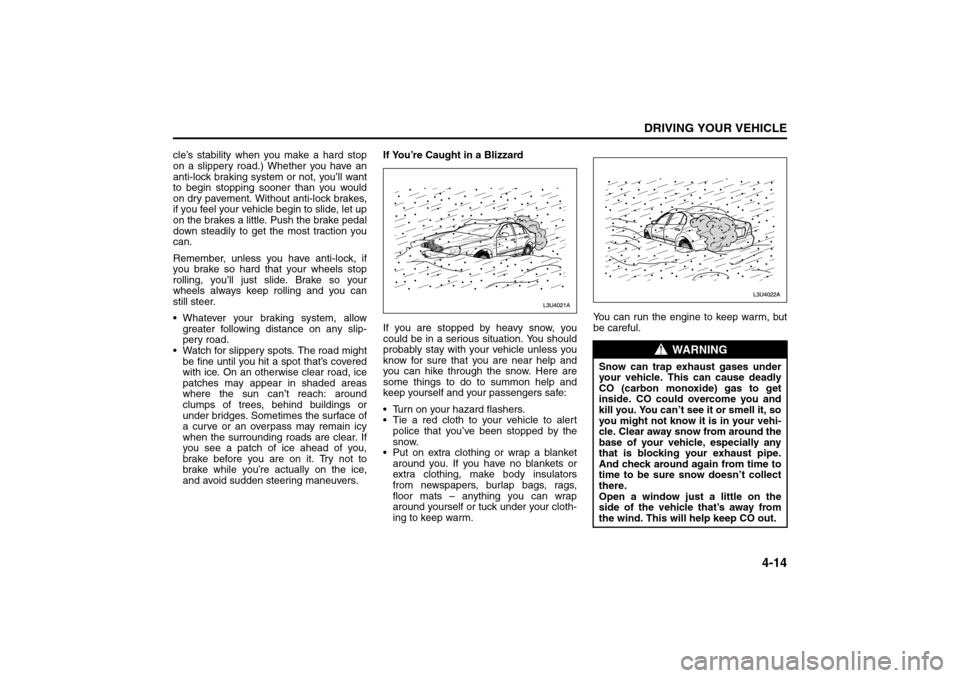
and avoid sudden steering maneuvers.If You’re Caught in a Blizzard
If you are stopped by heavy snow, you
could be in a serious situation. You should
probably stay with your vehicle unless you
know for sure that you are near help and
you can hike through the snow. Here are
some things to do to summon help and
keep yourself and your passengers safe:
Turn on your hazard flashers.
Tie a red cloth to your vehicle to alert
police that you’ve been stopped by the
snow.
Put on extra clothing or wrap a blanket
around you. If you have no blankets or
extra clothing, make body insulators
from newspapers, burlap bags, rags,
floor mats – anything you can wrap
around yourself or tuck under your cloth-
ing to keep warm.You can run the engine to keep warm, but
be careful.
WARNING
Snow can trap exhaust gases under
your vehicle. This can cause deadly
CO (carbon monoxide) gas to get
inside. CO could overcome you and
kill you. You can’t see it or smell it, so
you might not know it is in your vehi-
cle. Clear away snow from around the
base of your vehicle, especially any
that is blocking your exhaust pipe.
And check around again from time to
time to be sure snow doesn’t collect
there.
Open a window just a little on the
side of the vehicle that’s away from
the wind. This will help keep CO out.
Your Driving, the Road, and Your Vehicle:
Page 139 of 226
4-15DRIVING YOUR VEHICLE
85Z04-03E
Run your engine only as long as you must.
This saves fuel. When you run the engine,
make it go a little faster than just idle. That
is, push the accelerator slightly. This uses
less fuel for the heat that you get and it
keeps the battery charged. You will need a
well-charged battery to restart the vehicle,
and possibly for signaling later on with your
headlamps. Let the heater run for a while.
Then, shut the engine off and close the
window almost all the way to preserve the
heat. Start the engine again and repeat
this only when you feel really uncomfort-
able from the cold. But do it as little as pos-
sible. Preserve the fuel as long as you can.
To help keep warm, you can get out of the
vehicle and do some fairly vigorous exer-
cises every half hour or so until help
comes.
If You Are Stuck: In Sand, Mud, Ice or
Snow
In order to free your vehicle when it is
stuck, you will need to spin the wheels, but
you don’t want to spin your wheels too fast.
The method known as “rocking” can help
you get out when you’re stuck, but you
must use caution.For information about using tire chains on
your vehicle, see “Tire Chains” in section 5.Rocking Your Vehicle To Get It Out
First, turn your steering wheel left and
right. That will clear the area around your
front wheels. Then shift back and forth
between REVERSE (R) and a forward
gear (or with a manual transmission,
between FIRST (1) or SECOND (2) and
REVERSE (R)), spinning the wheels as lit-
tle as possible. Release the accelerator
pedal while you shift, and press lightly on
the accelerator pedal when the transmis-
sion is in gear. By slowly spinning your
wheels in the forward and reverse direc-
tions, you will cause a rocking motion that
may free your vehicle. If that doesn’t get
you out after a few tries, you may need to
be towed out. If you do need to be towed
out, see “Towing Your Vehicle” in the fol-
lowing section.
WARNING
If you let your tires spin at high
speed, they can explode, and you or
others could be injured. And, the
transmission or other parts of the
vehicle can overheat. That could
cause an engine compartment fire or
other damage. When you’re stuck,
spin the wheels as little as possible.
Don’t spin the wheels above 35 mph
(55 km/h) as shown on the speedom-
eter.
CAUTION
Spinning your wheels can destroy
parts of your vehicle as well as the
tires. If you spin the wheels too fast
while shifting your transmission back
and forth, you can destroy your trans-
mission. See “Rocking Your Vehicle
To Get It Out.”
Your Driving, the Road, and Your Vehicle:
Page 158 of 226
5-14
SERVICE AND APPEARANCE CARE
85Z04-03E
When replacing the pressure cap, make
sure it is hand-tight.Coolant Surge Tank Pressure Cap
Engine OverheatingYou will find a coolant temperature gauge
on your vehicle’s instrument panel. See
“Engine Coolant Temperature Gauge” in
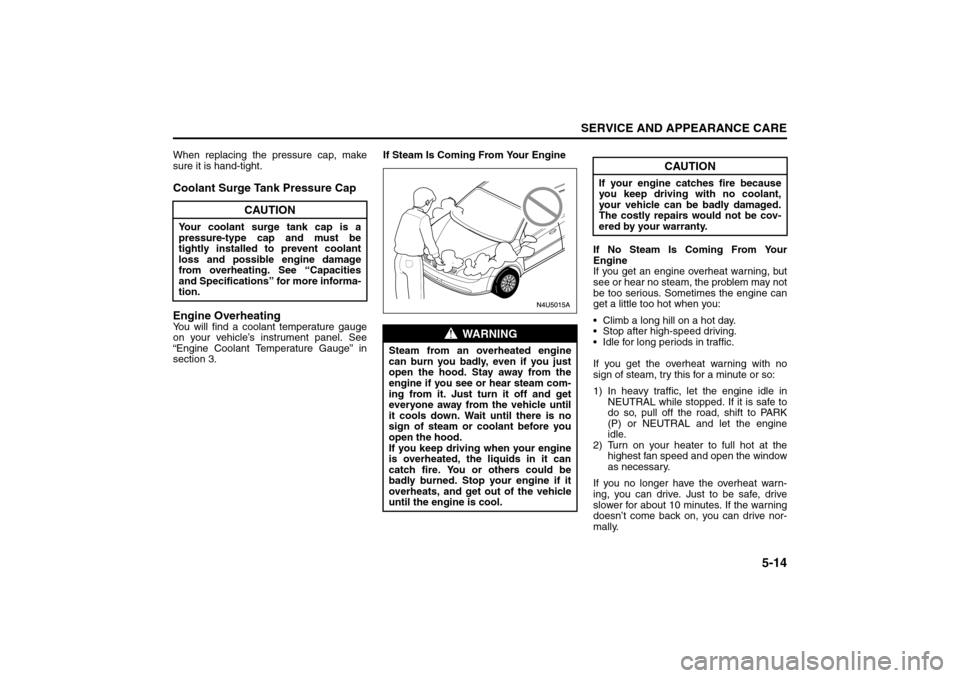
section 3.If Steam Is Coming From Your Engine
If No Steam Is Coming From Your
Engine
If you get an engine overheat warning, but
see or hear no steam, the problem may not
be too serious. Sometimes the engine can
get a little too hot when you:
Climb a long hill on a hot day.
Stop after high-speed driving.
Idle for long periods in traffic.
If you get the overheat warning with no
sign of steam, try this for a minute or so:
1) In heavy traffic, let the engine idle in
NEUTRAL while stopped. If it is safe to
do so, pull off the road, shift to PARK
(P) or NEUTRAL and let the engine
idle.
2) Turn on your heater to full hot at the
highest fan speed and open the window
as necessary.
If you no longer have the overheat warn-
ing, you can drive. Just to be safe, drive
slower for about 10 minutes. If the warning
doesn’t come back on, you can drive nor-
mally.
CAUTION
Your coolant surge tank cap is a
pressure-type cap and must be
tightly installed to prevent coolant
loss and possible engine damage
from overheating. See “Capacities
and Specifications” for more informa-
tion.
WARNING
Steam from an overheated engine
can burn you badly, even if you just
open the hood. Stay away from the
engine if you see or hear steam com-
ing from it. Just turn it off and get
everyone away from the vehicle until
it cools down. Wait until there is no
sign of steam or coolant before you
open the hood.
If you keep driving when your engine
is overheated, the liquids in it can
catch fire. You or others could be
badly burned. Stop your engine if it
overheats, and get out of the vehicle
until the engine is cool.
CAUTION
If your engine catches fire because
you keep driving with no coolant,
your vehicle can be badly damaged.
The costly repairs would not be cov-
ered by your warranty.
Checking Things Under the Hood:
Page 175 of 226
5-31SERVICE AND APPEARANCE CARE
85Z04-03E
Glossary of Tire TerminologyAir Pressure:
The amount of air inside the tire pressing
outward on each square inch of the tire. Air
pressure is expressed in pounds per
square inch (psi) or kilopascal (kPa).
Accessory Weight:
This means the combined weight of
optional accessories. Some examples of
optional accessories are automatic trans-
mission, power steering, power brakes,
power windows, power seats, and air con-
ditioning.
Aspect Ratio:
The relationship of a tire’s height to its
width.
Belt:
A rubber coated layer of cords that is
located between the plies and the tread.
Cords may be made from steel or other
reinforcing materials.
Bead:
The tire bead contains steel wires wrapped
by steel cords that hold the tire onto the
rim.
Bias Ply Tire:
A pneumatic tire in which the plies are laid
at alternate angles less than 90 degrees to
the centerline of the tread.Cold Inflation Pressure:
The amount of air pressure in a tire, mea-
sured in pounds per square inch (psi)
before a tire has built up heat from driving.
Curb Weight:
This means the weight of a motor vehicle
with standard and optional equipment
including the maximum capacity of fuel, oil
and coolant, but without passengers and
cargo.
DOT Markings:
A code molded into the sidewall of a tire
signifying that the tire is in compliance with
the U.S. Department of Transportation
motor vehicle safety standards. The DOT
code includes the Tire Identification Num-
ber (TIN), an alphanumeric designator
which can also identify the tire manufac-
turer, production plant, brand and date of
production.
GVWR:
Gross Vehicle Weight Rating.
This is the maximum permissible overall
weight of the fully loaded vehicle (including
all occupants, accessories and cargo).
GAWR:
Gross Axle Weight Rating.
This is the maximum permissible weight on
an individual axle.
Intended Outboard Sidewall:
The side of an asymmetrical tire that must
always face outward when mounted on a
vehicle.Kilopascal (kPa):
The metric unit for air pressure. There are
6.9 kPa’s to one psi.
Light Truck (LT-Metric) Tire:
A tire used on light duty trucks and some
multipurpose passenger vehicles.
Load Index:
An assigned number ranging from 1 to 279
that corresponds to the load carrying
capacity of a tire.
Maximum Inflation Pressure:
The maximum air pressure to which a cold
tire may be inflated. The maximum air
pressure is molded onto the sidewall.
Maximum Load Rating:
The load rating for a tire at the maximum
permissible inflation pressure for that tire.
Maximum Loaded Vehicle Weight:
The sum of curb weight; accessory weight;
vehicle capacity weight; and production
options weight.
Normal Occupant Weight:
The number of occupants a vehicle is
designed to seat multiplied by 150 pounds
(68 kg).
Occupant Distribution:
Distribution of occupants in a vehicle as
specified in the third column of Table 1
(shown below).
Outward Facing Sidewall:
The side of a asymmetrical tire that has a
particular side that faces outward when
Tires:
Page 189 of 226
5-45SERVICE AND APPEARANCE CARE
85Z04-03E
Appearance CareRemember, cleaning products can be haz-
ardous. Some are toxic. Others can burst
into flames if you strike a match or get
them on a hot part of the vehicle. Some
are dangerous if you breathe their fumes in
a closed space. When you use anything
from a container to clean your vehicle, be
sure to follow the manufacturer’s warnings
and instructions. And always open your
doors or windows when you are cleaning
the inside.
Never use these to clean your vehicle:
Gasoline
Benzene
Naphtha
Carbon Tetrachloride
Acetone
Paint Thinner
Turpentine
Lacquer Thinner
Nail Polish Remover
They can all be hazardous – some more
than others – and they can all damage
your vehicle, too.
Do not use any of these unless this manual
says you can. In many uses, these will
damage your vehicle:
Alcohol
Laundry Soap
Bleach
Reducing Agents
Cleaning the Inside of Your VehicleUse a vacuum cleaner often to get rid of
dust and loose dirt. Wipe vinyl, leather,
plastic and painted surfaces with a clean,
damp cloth.
Cleaning Fabric/Carpet
Your SUZUKI dealer has cleaners for the
cleaning of fabric and carpet. They will
clean normal spots and stains very well.
You can get SUZUKI approved cleaning
products from your SUZUKI dealer. See
“Vehicle Care/Appearance Materials” later
in this section.
Here are some cleaning tips:
Always read the instructions on the
cleaner label.
Clean up stains as soon as you can –
before they set.
Carefully scrape off any excess stain.
Use a clean cloth or sponge, and change
to a clean area often. A soft brush may
be used if stains are stubborn.
If a ring forms on fabric after spot clean-
ing, clean the entire area immediately or
it will set.Using Cleaner on Fabric
1) Vacuum and brush the area to remove
any loose dirt.
2) Always clean a whole trim panel or sec-
tion. Mask surrounding trim along stitch
or welt lines.
3) Follow the directions on the container
label.
4) Apply cleaner with a clean sponge.
Don’t saturate the material and don’t
rub it roughly.
5) As soon as you’ve cleaned the section,
use a sponge to remove any excess
cleaner.
6) Wipe cleaned area with a clean, water-
dampened towel or cloth.
7) Wipe with a clean cloth and let dry.
Specific Fabric Cleaning Problems
Stains caused by such things as catsup,
coffee (black), egg, fruit, fruit juice, milk,
soft drinks, vomit, urine and blood can be
removed as follows:
1) Carefully scrape off excess stain, then
sponge the soiled area with cool water.
2) If a stain remains, follow the cleaner
instructions described earlier.
3) If an odor lingers after cleaning vomit or
urine, treat the area with a water/baking
soda solution: 1 teaspoon (5 ml) of bak-
ing soda to 1 cup (250 ml) of lukewarm
water.
4) Let dry.
Appearance Care:
Page 190 of 226
5-46
SERVICE AND APPEARANCE CARE
85Z04-03E
Stains caused by candy, ice cream, may-
onnaise, chili sauce and unknown stains
can be removed as follows:
1) Carefully scrape off excess stain.
2) First, clean with cool water and allow to
dry completely.
3) If a stain remains, follow the cleaner
instructions described earlier.
Cleaning Vinyl
Use warm water and a clean cloth.
Rub with a clean, damp cloth to remove
dirt. You may have to do this more than
once.
Things like tar, asphalt and shoe polish
will stain if you don’t get them off quickly.
Use a clean cloth and vinyl cleaner. See
your SUZUKI dealer for this product.
Cleaning Leather
Use a soft cloth with lukewarm water and a
mild soap or saddle soap and wipe dry
with a soft cloth. Then, let the leather dry
naturally. Do not use heat to dry.
For stubborn stains, use a leather
cleaner.
Never use oils, varnishes, solvent-based
or abrasive cleaners, furniture polish or
shoe polish on leather.
Soiled or stained leather should be
cleaned immediately. If dirt is allowed to
work into the finish, it can harm the
leather.Cleaning the Top of the Instrument
Panel
Use only mild soap and water to clean the
top surfaces of the instrument panel.
Sprays containing silicones or waxes may
cause annoying reflections in the wind-
shield and even make it difficult to see
through the windshield under certain con-
ditions.
Cleaning Interior Plastic Components
Use only a mild soap and water solution on
a soft cloth or sponge. Commercial clean-
ers may affect the surface finish.
Cleaning Glass Surfaces
Glass should be cleaned often. SUZUKI
Glass Cleaner or a liquid household glass
cleaner will remove normal tobacco smoke
and dust films on interior glass. See
SUZUKI Vehicle Care/Appearance Materi-
als in this section.Care of Safety Belts
Keep belts clean and dry.
Weather-stripsSilicone grease on weather-strips will
make them last longer, seal better, and not
stick or squeak. Apply silicone grease with
a clean cloth at least every six months.
During very cold, damp weather more fre-
quent application may be required. Cleaning the Outside of Your Vehi-
cleThe paint finish on your vehicle provides
beauty, depth of color, gloss retention and
durability.
Washing Your Vehicle
The best way to preserve your vehicle’s fin-
ish is to keep it clean by washing it often
with lukewarm or cold water.
Don’t wash your vehicle in the direct rays
of the sun. Use a car washing soap. Don’t
use strong soaps or chemical detergents.
Be sure to rinse the vehicle well, removing
all soap residue completely. You can get
approved cleaning products from your
CAUTION
Don’t use abrasive cleaners on glass,
because they may cause scratches.
Avoid placing decals on the inside
rear window, since they may have to
be scraped off later. If abrasive clean-
ers are used on the inside of the rear
window, an electric defogger element
may be damaged. Any temporary
license should not be attached
across the defogger grid.
WARNING
Do not bleach or dye safety belts. If
you do, it may severely weaken them.
In a crash, they might not be able to
provide adequate protection. Clean
safety belts only with mild soap and
lukewarm water.
Appearance Care:
Page 194 of 226
5-50
SERVICE AND APPEARANCE CARE
85Z04-03E
Power Windows and Other Power
OptionsCircuit breakers in the fuse block protect
the power windows and other power
accessories. When the current load is too
heavy, the circuit breaker opens, protecting
the circuit until the problem is fixed or goes
away.Fuses and Circuit BreakersThe wiring circuits in your vehicle are pro-
tected from short circuits by a combination
of fuses, circuit breakers and fusible ther-
mal links in the wiring itself.
Look at the silver-colored band inside the
fuse. If the band is broken or melted,
replace the fuse. Be sure you replace a
bad fuse with a new one of the identical
size and rating.
There are spare fuses provided in the
engine compartment fuse block. If you ever
have a problem on the road and don’t have
a spare fuse, you can borrow one that has
the same amperage. Just pick a feature of
your vehicle that you can get along without
– like the radio or cigarette lighter – and
use its fuse, if it is the correct amperage.
Replace it as soon as you can.
There are two fuse blocks in your vehicle:
the instrument panel fuse block and the
engine compartment fuse block.
There is a fuse puller located on the
engine compartment fuse block. It can beused to easily remove fuses from the fuse
block.
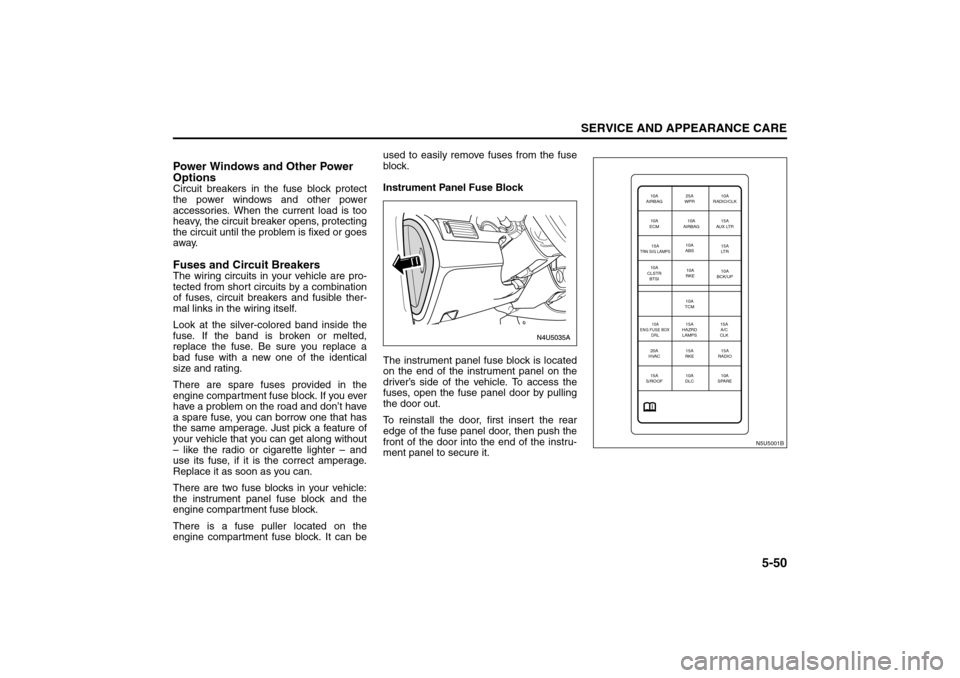
Instrument Panel Fuse Block
The instrument panel fuse block is located
on the end of the instrument panel on the
driver’s side of the vehicle. To access the
fuses, open the fuse panel door by pulling
the door out.
To reinstall the door, first insert the rear
edge of the fuse panel door, then push the
front of the door into the end of the instru-
ment panel to secure it.
N5U5001B
10A
AIRBAG25A
WPR10A
RADIO/CLK
10A
ECM10A
AIRBAG15A
AUX LTR
15ATRN SIG LAMPS
10A
ABS15A
LT R
10A
CLSTR
BTSI10A
BCK/UP
15A
A/C
CLK 10A
TCM10A
RKE
10A
ENG FUSE BOX
DRL
15A
HAZRD
LAMPS
20A
HVAC15A
RKE15A
RADIO
15A
S/ROOF10A
DLC10A
SPARE
Electrical System:
Page 197 of 226
5-53SERVICE AND APPEARANCE CARE
85Z04-03E
Fuses Usages
HEAD LAMPS Head Lamp
ECMEngine Control
Module
I/P FUSEInstrument Panel
Fuse
FUEL PUMP Fuel Pump
A/C Air Conditioning
HORN Horn
HI BEAMHead Lamp
High-Beam
DRIVER’S PWR
WNDWDriver’s Power
Window
STOP LAMPS Stop Lamps
DR/LCK Door Lock
MIR HTD Heated Mirror
FRT FOG Front Fog
ILLUM LTLicense Plate Lamp,
Parking Lamp Left
INJ Injector
Fuses Usages
ENG SNSREVAP Canister Purge
Solenoid, HO2S,
Cooling Fan Relay,
CMP Sensor
LOW BEAM LTHead Lamp
Low-Beam Left
ILLUM RTIllumination
Circuit, Parking Lamp
Right
LOW BEAM RTHead Lamp
Low-Beam Right
SPARE Spare
SPARE Spare
SPARE Spare
BATT PWR Battery Power
ABSAntilock Brake
System
HVAC BLWR HVAC Blower
IGN 2 Ignition 2
IGN 1 Ignition 1
FUSE PLR Fuse Puller
COOL FAN LOW Cooling Fan Low
Fuses Usages
DEFOG Defog
COOL FAN HI Cooling Fan High
PWR WNDW Power Window
Relays Usages
COOL FAN LOW Cooling Fan Low
FRT FOG Front Fog
ILLUM Illumination Relay
A/C CMPRSRAir Conditioning
Compressor
HORN Horn
DEFOG Defog
FUEL PUMP Fuel Pump
MAIN Main Relay
COOL FAN HI Cooling Fan High
PWR WNDW Power Window
HEAD LAMPS Headlamp Relay
Capacities and Specifications:
Page 222 of 226
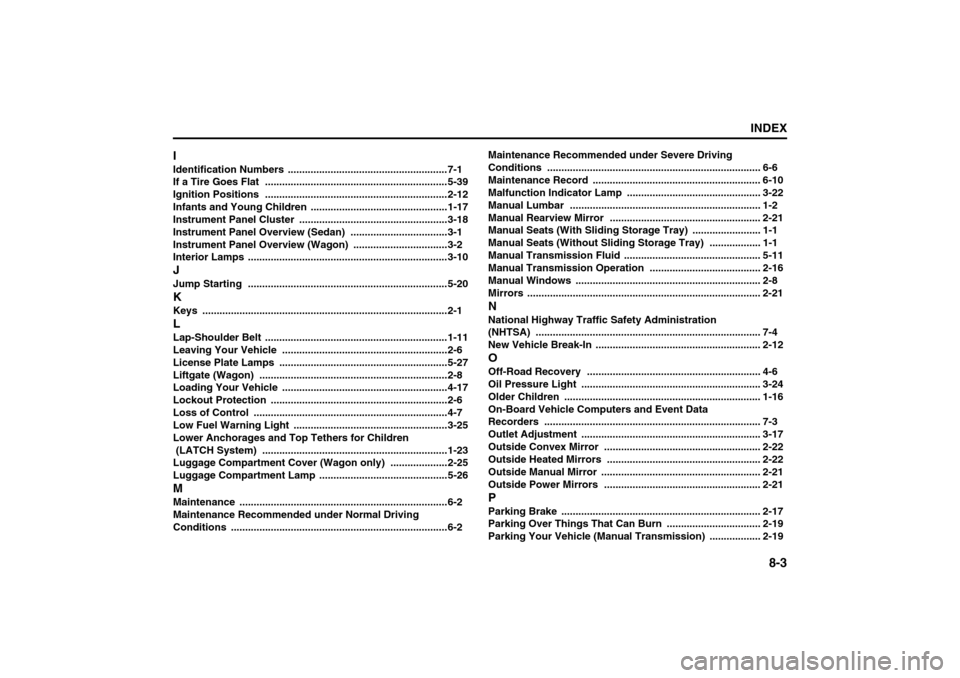
8-3
INDEX85Z04-03E
IIdentification Numbers
........................................................7-1
If a Tire Goes Flat
................................................................5-39
Ignition Positions ................................................................2-12
Infants and Young Children
................................................1-17
Instrument Panel Cluster
....................................................3-18
Instrument Panel Overview (Sedan)
..................................3-1
Instrument Panel Overview (Wagon) .................................3-2
Interior Lamps
......................................................................3-10
JJump Starting
......................................................................5-20
KKeys
......................................................................................2-1
LLap-Shoulder Belt
................................................................1-11
Leaving Your Vehicle
..........................................................2-6
License Plate Lamps ...........................................................5-27
Liftgate (Wagon)
..................................................................2-8
Loading Your Vehicle
..........................................................4-17
Lockout Protection
..............................................................2-6
Loss of Control
....................................................................4-7
Low Fuel Warning Light
......................................................3-25
Lower Anchorages and Top Tethers for Children
(LATCH System)
.................................................................1-23
Luggage Compartment Cover (Wagon only)
....................2-25
Luggage Compartment Lamp
.............................................5-26
MMaintenance
.........................................................................6-2
Maintenance Recommended under Normal Driving
Conditions
............................................................................6-2Maintenance Recommended under Severe Driving
Conditions
........................................................................... 6-6
Maintenance Record
........................................................... 6-10
Malfunction Indicator Lamp
............................................... 3-22
Manual Lumbar
................................................................... 1-2
Manual Rearview Mirror
..................................................... 2-21
Manual Seats (With Sliding Storage Tray)
........................ 1-1
Manual Seats (Without Sliding Storage Tray)
.................. 1-1
Manual Transmission Fluid
................................................ 5-11
Manual Transmission Operation
....................................... 2-16
Manual Windows
................................................................. 2-8
Mirrors
.................................................................................. 2-21
NNational Highway Traffic Safety Administration
(NHTSA)
............................................................................... 7-4
New Vehicle Break-In
.......................................................... 2-12
OOff-Road Recovery
............................................................. 4-6
Oil Pressure Light ............................................................... 3-24
Older Children
..................................................................... 1-16
On-Board Vehicle Computers and Event Data
Recorders
............................................................................ 7-3
Outlet Adjustment
............................................................... 3-17
Outside Convex Mirror
....................................................... 2-22
Outside Heated Mirrors ...................................................... 2-22
Outside Manual Mirror ........................................................ 2-21
Outside Power Mirrors ....................................................... 2-21
PParking Brake
...................................................................... 2-17
Parking Over Things That Can Burn
................................. 2-19
Parking Your Vehicle (Manual Transmission)
.................. 2-19
Page 223 of 226
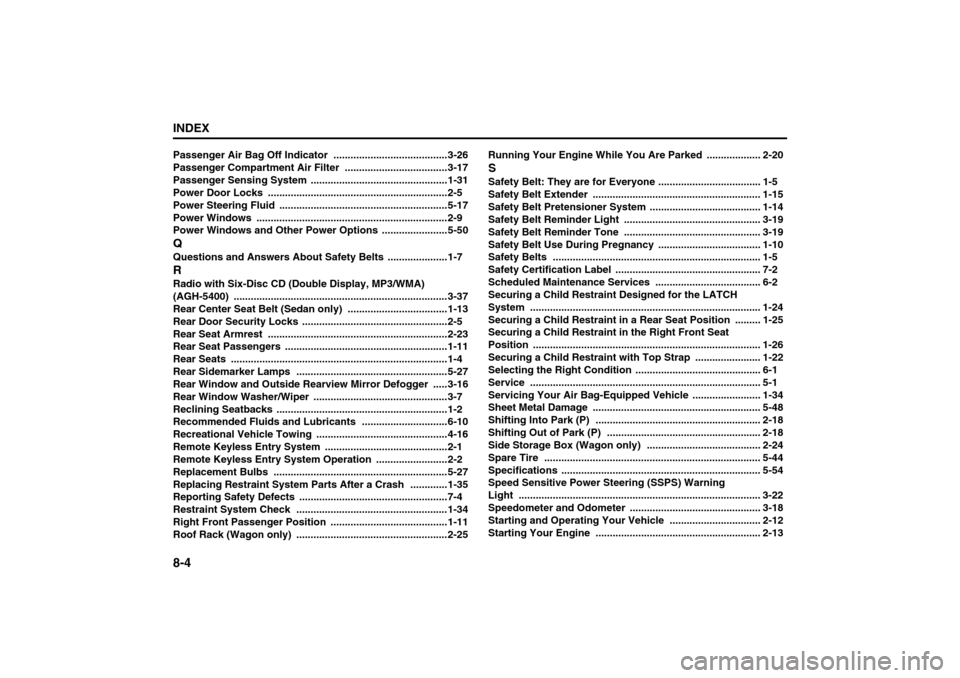
8-4INDEX
85Z04-03E
Passenger Air Bag Off Indicator
........................................3-26
Passenger Compartment Air Filter ....................................3-17
Passenger Sensing System
................................................1-31
Power Door Locks
...............................................................2-5
Power Steering Fluid ...........................................................5-17
Power Windows
...................................................................2-9
Power Windows and Other Power Options
.......................5-50
QQuestions and Answers About Safety Belts
.....................1-7
RRadio with Six-Disc CD (Double Display, MP3/WMA)
(AGH-5400)
...........................................................................3-37
Rear Center Seat Belt (Sedan only)
...................................1-13
Rear Door Security Locks
...................................................2-5
Rear Seat Armrest
...............................................................2-23
Rear Seat Passengers
.........................................................1-11
Rear Seats
............................................................................1-4
Rear Sidemarker Lamps
.....................................................5-27
Rear Window and Outside Rearview Mirror Defogger
.....3-16
Rear Window Washer/Wiper
...............................................3-7
Reclining Seatbacks
............................................................1-2
Recommended Fluids and Lubricants
..............................6-10
Recreational Vehicle Towing
..............................................4-16
Remote Keyless Entry System ...........................................2-1
Remote Keyless Entry System Operation
.........................2-2
Replacement Bulbs
.............................................................5-27
Replacing Restraint System Parts After a Crash
.............1-35
Reporting Safety Defects
....................................................7-4
Restraint System Check .....................................................1-34
Right Front Passenger Position
.........................................1-11
Roof Rack (Wagon only)
.....................................................2-25Running Your Engine While You Are Parked
................... 2-20
SSafety Belt: They are for Everyone .................................... 1-5
Safety Belt Extender
........................................................... 1-15
Safety Belt Pretensioner System
....................................... 1-14
Safety Belt Reminder Light
................................................ 3-19
Safety Belt Reminder Tone ................................................ 3-19
Safety Belt Use During Pregnancy
.................................... 1-10
Safety Belts
......................................................................... 1-5
Safety Certification Label
................................................... 7-2
Scheduled Maintenance Services
..................................... 6-2
Securing a Child Restraint Designed for the LATCH
System
................................................................................. 1-24
Securing a Child Restraint in a Rear Seat Position
......... 1-25
Securing a Child Restraint in the Right Front Seat
Position
................................................................................ 1-26
Securing a Child Restraint with Top Strap
....................... 1-22
Selecting the Right Condition
............................................ 6-1
Service
................................................................................. 5-1
Servicing Your Air Bag-Equipped Vehicle
........................ 1-34
Sheet Metal Damage
........................................................... 5-48
Shifting Into Park (P) .......................................................... 2-18
Shifting Out of Park (P) ...................................................... 2-18
Side Storage Box (Wagon only)
........................................ 2-24
Spare Tire
............................................................................ 5-44
Specifications
...................................................................... 5-54
Speed Sensitive Power Steering (SSPS) Warning
Light
..................................................................................... 3-22
Speedometer and Odometer
.............................................. 3-18
Starting and Operating Your Vehicle
................................ 2-12
Starting Your Engine
.......................................................... 2-13