ignition SUZUKI FORENZA 2008 1.G User Guide
[x] Cancel search | Manufacturer: SUZUKI, Model Year: 2008, Model line: FORENZA, Model: SUZUKI FORENZA 2008 1.GPages: 226, PDF Size: 5.25 MB
Page 65 of 226
2-17FEATURES AND CONTROLS
85Z04-03E
(2). Then, slowly let up on the clutch pedal
as you press the accelerator pedal.
THIRD (3), FOURTH (4) and FIFTH (5):
Shift into THIRD (3), FOURTH (4) and
FIFTH (5), the same way you do for SEC-
OND (2). Slowly let up on the clutch pedal
as you press the accelerator pedal.
To stop, let up on the accelerator pedal and
press the brake pedal. Just before the
vehicle stops, press the clutch pedal and
brake pedal, and shift to NEUTRAL.
NEUTRAL:
Use this position when you start or idle
your engine.
REVERSE (R):
To back up, press down the clutch pedal,
lift up the ring on the shift lever and shift
into REVERSE (R). Let up on the clutch
pedal slowly while pressing the accelerator
pedal.
Also, use REVERSE (R), along with the
parking brake, for parking your vehicle.Shift Speed
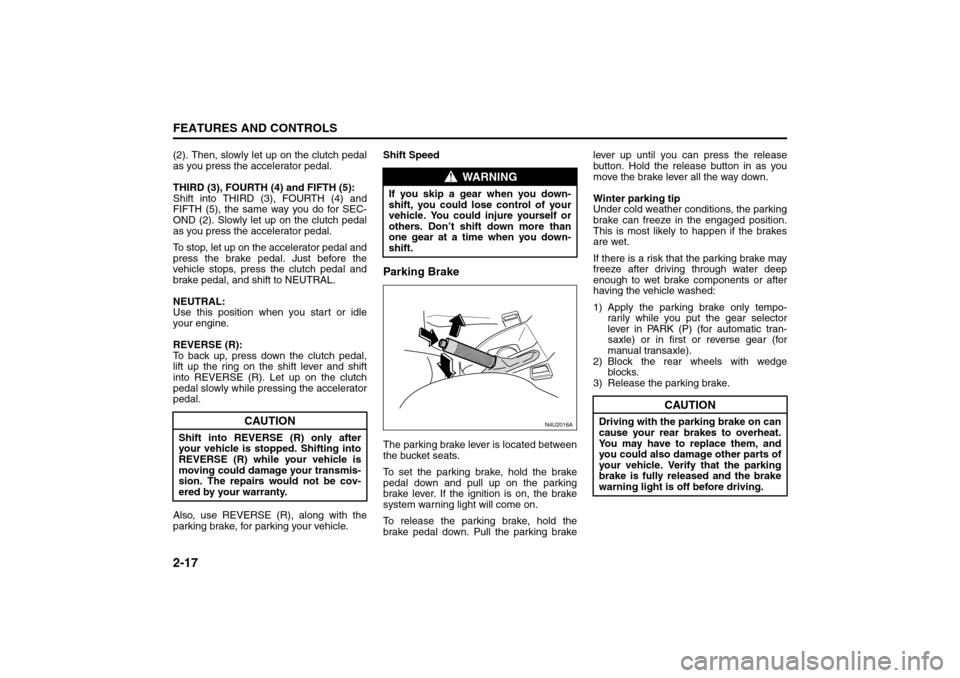
Parking BrakeThe parking brake lever is located between
the bucket seats.
To set the parking brake, hold the brake
pedal down and pull up on the parking
brake lever. If the ignition is on, the brake
system warning light will come on.
To release the parking brake, hold the
brake pedal down. Pull the parking brakelever up until you can press the release
button. Hold the release button in as you
move the brake lever all the way down.
Winter parking tip
Under cold weather conditions, the parking
brake can freeze in the engaged position.
This is most likely to happen if the brakes
are wet.
If there is a risk that the parking brake may
freeze after driving through water deep
enough to wet brake components or after
having the vehicle washed:
1) Apply the parking brake only tempo-
rarily while you put the gear selector
lever in PARK (P) (for automatic tran-
saxle) or in first or reverse gear (for
manual transaxle).
2) Block the rear wheels with wedge
blocks.
3) Release the parking brake.
CAUTION
Shift into REVERSE (R) only after
your vehicle is stopped. Shifting into
REVERSE (R) while your vehicle is
moving could damage your transmis-
sion. The repairs would not be cov-
ered by your warranty.
WARNING
If you skip a gear when you down-
shift, you could lose control of your
vehicle. You could injure yourself or
others. Don’t shift down more than
one gear at a time when you down-
shift.
N4U2016A
CAUTION
Driving with the parking brake on can
cause your rear brakes to overheat.
You may have to replace them, and
you could also damage other parts of
your vehicle. Verify that the parking
brake is fully released and the brake
warning light is off before driving.
Starting and Operating Your Vehicle:
Page 66 of 226
2-18
FEATURES AND CONTROLS
85Z04-03E
Shifting Into Park (P)
(Automatic Transmission)1) Hold the brake pedal down and set the
parking brake.
2) Move the shift lever into PARK (P) posi-
tion.
3) Turn the ignition key to LOCK.
4) Remove the key and take it with you. If
you can leave your vehicle with the igni-
tion key in your hand, your vehicle is in
PA R K ( P ) .Leaving Your Vehicle with the Engine
Running
If you have to leave your vehicle with the
engine running, be sure your vehicle is in
PARK (P) and your parking brake is firmly
set before you leave it. After you’ve moved
the shift lever into PARK (P), hold the regu-
lar brake pedal down. Then, see if you can
move the shift lever away from PARK (P)
without first pushing the button. If you can,
it means that the shift lever wasn’t fully
locked into PARK (P).To r q u e L o c k
If you are parking on a hill and you don’t
shift your transmission into PARK (P) prop-
erly, the weight of the vehicle may put too
much force on the parking pawl in the
transmission. You may find it difficult to pull
the shift lever out of PARK (P). This is
called “torque lock.” To prevent torque lock,
set the parking brake and then shift into
PARK (P) properly before you leave the
driver’s seat. To find out how, see “Shifting
Into Park (P)” in this section.
When you are ready to drive, move the
shift lever out of PARK (P) before you
release the parking brake.
If torque lock does occur, you may need to
have another vehicle push yours a little
uphill to take some of the pressure from
the parking pawl in the transmission, so
you can pull the shift lever out of PARK (P).
Shifting Out of Park (P)
(Automatic Transmission)Your vehicle has a brake transmission shift
interlock system which locks the shift lever
in PARK (P) when the ignition is in the
LOCK position. You have to apply your reg-
ular brakes before you can shift from PARK
(P) when the ignition is in the ON position.
See “Automatic Transmission Operation” in
this section.
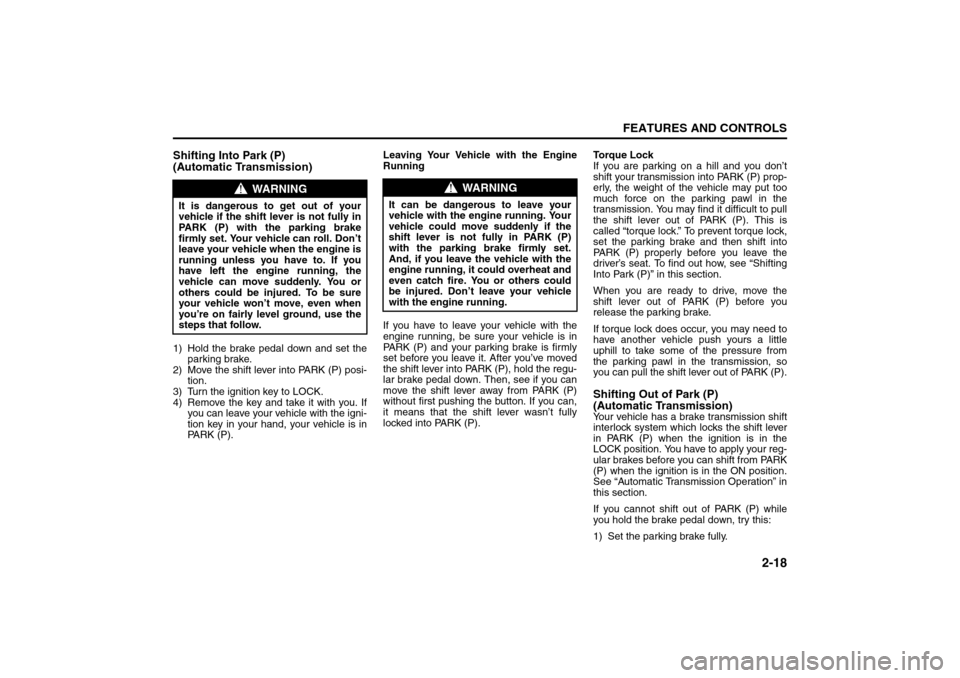
If you cannot shift out of PARK (P) while
you hold the brake pedal down, try this:
1) Set the parking brake fully.
WARNING
It is dangerous to get out of your
vehicle if the shift lever is not fully in
PARK (P) with the parking brake
firmly set. Your vehicle can roll. Don’t
leave your vehicle when the engine is
running unless you have to. If you
have left the engine running, the
vehicle can move suddenly. You or
others could be injured. To be sure
your vehicle won’t move, even when
you’re on fairly level ground, use the
steps that follow.
WARNING
It can be dangerous to leave your
vehicle with the engine running. Your
vehicle could move suddenly if the
shift lever is not fully in PARK (P)
with the parking brake firmly set.
And, if you leave the vehicle with the
engine running, it could overheat and
even catch fire. You or others could
be injured. Don’t leave your vehicle
with the engine running.
Starting and Operating Your Vehicle:
Page 67 of 226
2-19FEATURES AND CONTROLS
85Z04-03E
2) Turn the key to LOCK and remove the
key from the ignition switch.
3) Remove the hole cover from the shift
lock slot with a screwdriver
4) Insert the key into the shift lock slot and
press and hold it.
5) Shift to NEUTRAL (N).
6) Remove the key from the slot, insert it
into the ignition switch and start the
engine.
7) Apply and hold the regular brake fully
and release the parking brake.
8) Shift to the drive gear you want.
9) Have your vehicle fixed as soon as you
can.
Parking Your Vehicle
(Manual Transmission)Before leaving your vehicle, do the follow-
ing:
1) Hold the brake pedal down and firmly
apply the parking brake.
2) Fully press in the clutch pedal and
place the shift lever into the appropriate
position as stated below:
– When parking on level ground, place
the shift lever into FIRST (1) or
REVERSE (R).
– When parking downhill, place the shift
lever in REVERSE (R).
– When parking uphill, place the shift
lever in FIRST (1).
3) After shifting to the appropriate posi-
tion, turn the ignition key to LOCK,
remove the key and release the clutch.
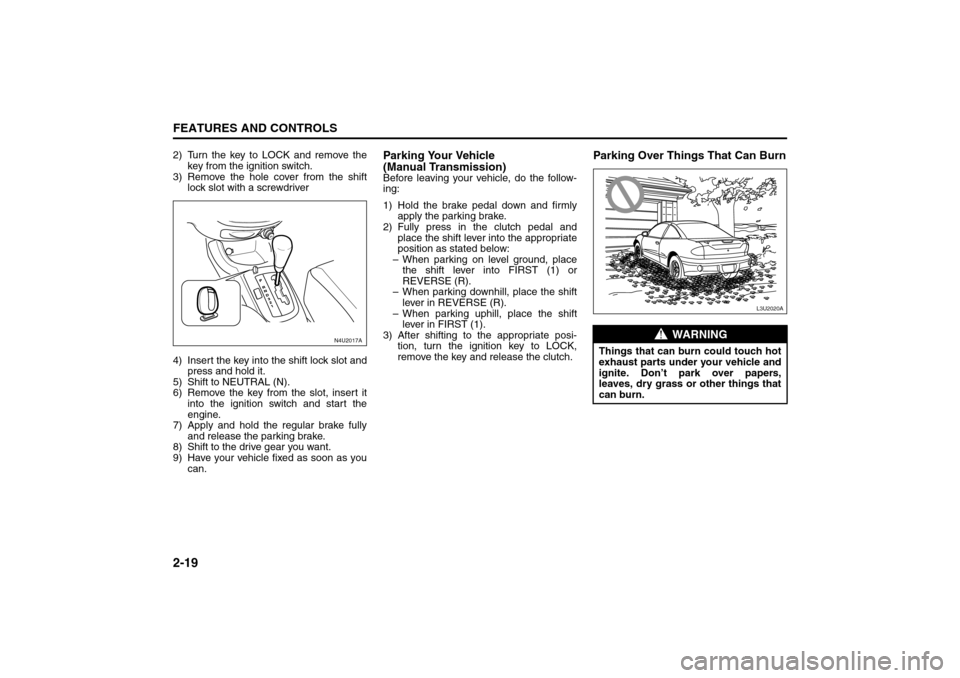
Parking Over Things That Can Burn
N4U2017A
WARNING
Things that can burn could touch hot
exhaust parts under your vehicle and
ignite. Don’t park over papers,
leaves, dry grass or other things that
can burn.
L3U2020A
Starting and Operating Your Vehicle:
Page 69 of 226
2-21FEATURES AND CONTROLS
85Z04-03E
MirrorsManual Rearview MirrorWhen you are sitting in a comfortable driv-
ing position, adjust the mirror so you can
see clearly behind your vehicle. Grip the
mirror in the center to move it up or down
and from side to side.
The day/night adjustment allows you to
adjust the mirror to avoid glare from any
headlamps behind you. Push or pull the
tab for daytime/night use.
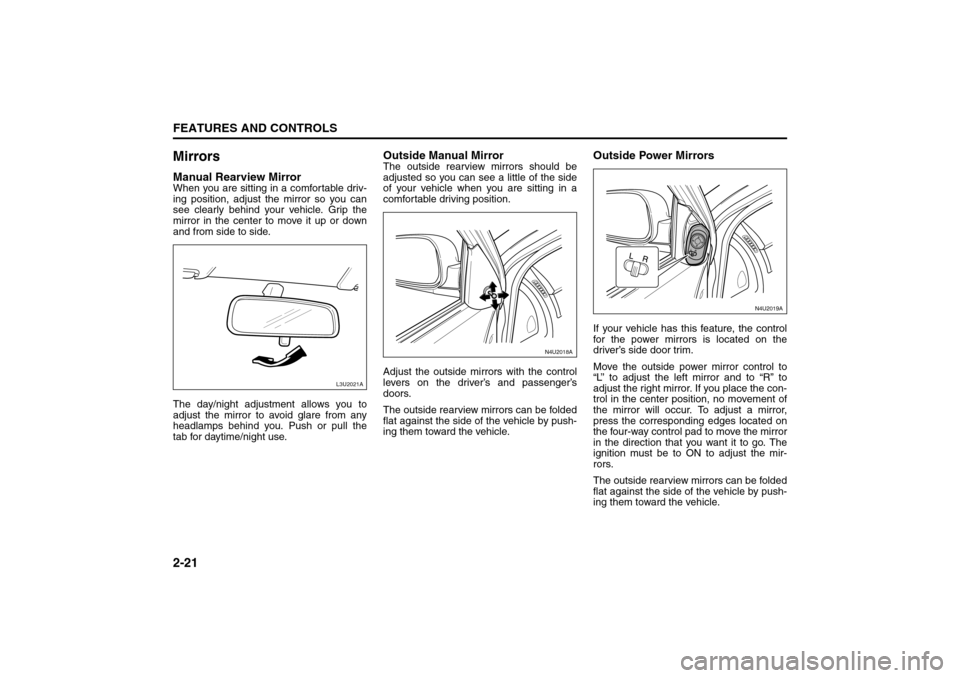
Outside Manual MirrorThe outside rearview mirrors should be
adjusted so you can see a little of the side
of your vehicle when you are sitting in a
comfortable driving position.
Adjust the outside mirrors with the control
levers on the driver’s and passenger’s
doors.
The outside rearview mirrors can be folded
flat against the side of the vehicle by push-
ing them toward the vehicle.
Outside Power MirrorsIf your vehicle has this feature, the control
for the power mirrors is located on the
driver’s side door trim.
Move the outside power mirror control to
“L” to adjust the left mirror and to “R” to
adjust the right mirror. If you place the con-
trol in the center position, no movement of
the mirror will occur. To adjust a mirror,
press the corresponding edges located on
the four-way control pad to move the mirror
in the direction that you want it to go. The
ignition must be to ON to adjust the mir-
rors.
The outside rearview mirrors can be folded
flat against the side of the vehicle by push-
ing them toward the vehicle.
L3U2021A
N4U2018A
N4U2019A
Mirrors:
Page 74 of 226
2-26
FEATURES AND CONTROLS
85Z04-03E
windshield glass to avoid causing breaks in
the resistive material heating element
which can adversely affect radio and
defogger performance. See your SUZUKI
dealer for details.
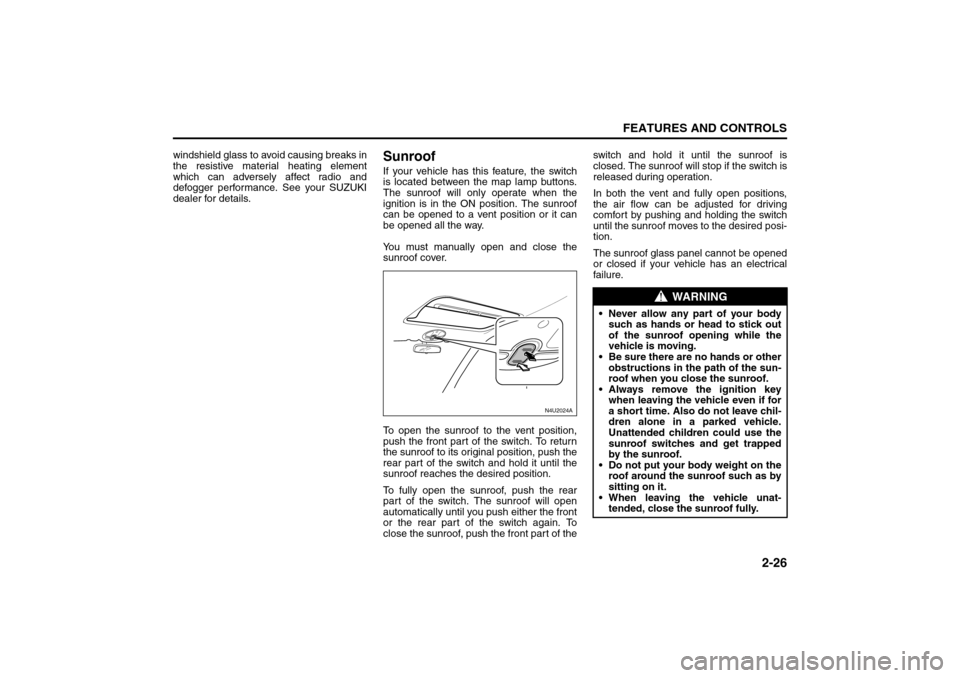
SunroofIf your vehicle has this feature, the switch
is located between the map lamp buttons.
The sunroof will only operate when the
ignition is in the ON position. The sunroof
can be opened to a vent position or it can
be opened all the way.
You must manually open and close the
sunroof cover.
To open the sunroof to the vent position,
push the front part of the switch. To return
the sunroof to its original position, push the
rear part of the switch and hold it until the
sunroof reaches the desired position.
To fully open the sunroof, push the rear
part of the switch. The sunroof will open
automatically until you push either the front
or the rear part of the switch again. To
close the sunroof, push the front part of theswitch and hold it until the sunroof is
closed. The sunroof will stop if the switch is
released during operation.
In both the vent and fully open positions,
the air flow can be adjusted for driving
comfort by pushing and holding the switch
until the sunroof moves to the desired posi-
tion.
The sunroof glass panel cannot be opened
or closed if your vehicle has an electrical
failure.
N4U2024A
WARNING
Never allow any part of your body
such as hands or head to stick out
of the sunroof opening while the
vehicle is moving.
Be sure there are no hands or other
obstructions in the path of the sun-
roof when you close the sunroof.
Always remove the ignition key
when leaving the vehicle even if for
a short time. Also do not leave chil-
dren alone in a parked vehicle.
Unattended children could use the
sunroof switches and get trapped
by the sunroof.
Do not put your body weight on the
roof around the sunroof such as by
sitting on it.
When leaving the vehicle unat-
tended, close the sunroof fully.
Sunroof:
Page 81 of 226
3-5INSTRUMENT PANEL
85Z04-03E
As you signal a turn or a lane change, if
the arrows flash rapidly, a signal bulb may
be burned out and other drivers won’t see
your turn signal.
If a bulb is burned out, replace it to help
avoid an accident. If the arrows don’t go on
at all when you signal a turn, check for
burned-out bulbs and then check the fuse.
See “Fuses and Circuit Breakers” in sec-
tion 5.
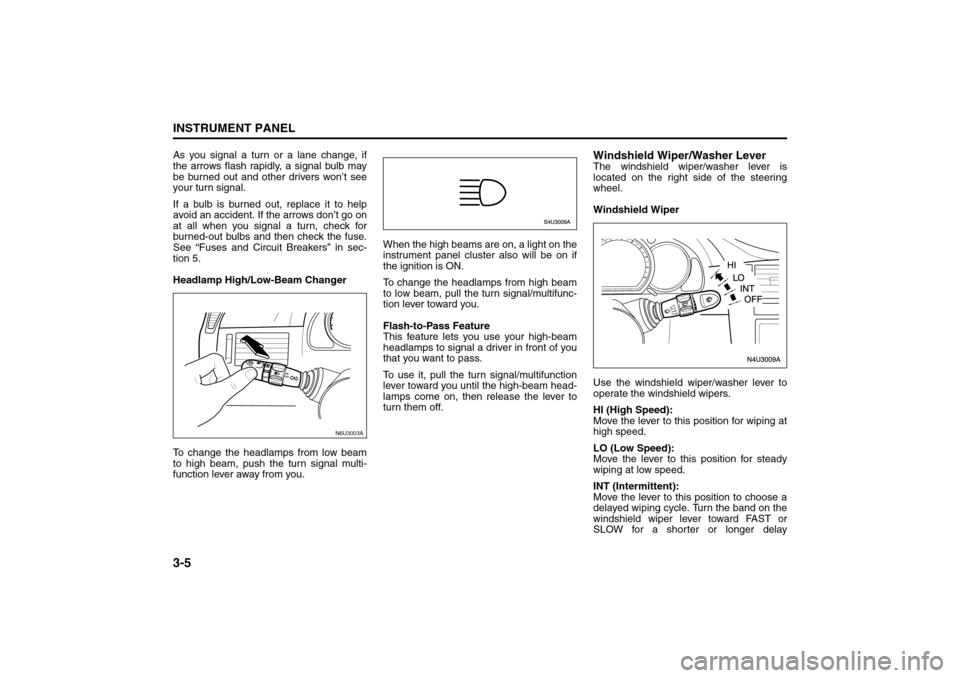
Headlamp High/Low-Beam Changer
To change the headlamps from low beam
to high beam, push the turn signal multi-
function lever away from you.When the high beams are on, a light on the
instrument panel cluster also will be on if
the ignition is ON.
To change the headlamps from high beam
to low beam, pull the turn signal/multifunc-
tion lever toward you.
Flash-to-Pass Feature
This feature lets you use your high-beam
headlamps to signal a driver in front of you
that you want to pass.
To use it, pull the turn signal/multifunction
lever toward you until the high-beam head-
lamps come on, then release the lever to
turn them off.
Windshield Wiper/Washer LeverThe windshield wiper/washer lever is
located on the right side of the steering
wheel.
Windshield Wiper
Use the windshield wiper/washer lever to
operate the windshield wipers.
HI (High Speed):
Move the lever to this position for wiping at
high speed.
LO (Low Speed):
Move the lever to this position for steady
wiping at low speed.
INT (Intermittent):
Move the lever to this position to choose a
delayed wiping cycle. Turn the band on the
windshield wiper lever toward FAST or
SLOW for a shorter or longer delay
N6U3003A
Instrument Panel Overview:
Page 82 of 226
3-6
INSTRUMENT PANEL
85Z04-03E
between wipes. The wiper speed can only
be adjusted when the lever is in the INT
position.
OFF (Off):
Move the lever to this position to turn off
the windshield wipers.
Misting Function
Move the lever toward, but not completely
in, the INT position for a single wiping
cycle. Hold it there until the windshield wip-
ers start; then let go. The windshield wip-
ers will stop after one cycle. If you want
more wipes, hold the lever toward the INT
position longer.
Remember that damaged wiper blades
may prevent you from seeing well enough
to drive safely. To avoid damage, be sure to
clear ice and snow from the wiper blades
before using them.
If they’re frozen to the windshield, carefully
loosen or thaw them. If your blades do
become damaged, get new blades or
blade inserts.
Heavy snow or ice can overload the wiper
motor. A circuit breaker will stop the motor
until it cools. Clear away snow or ice to
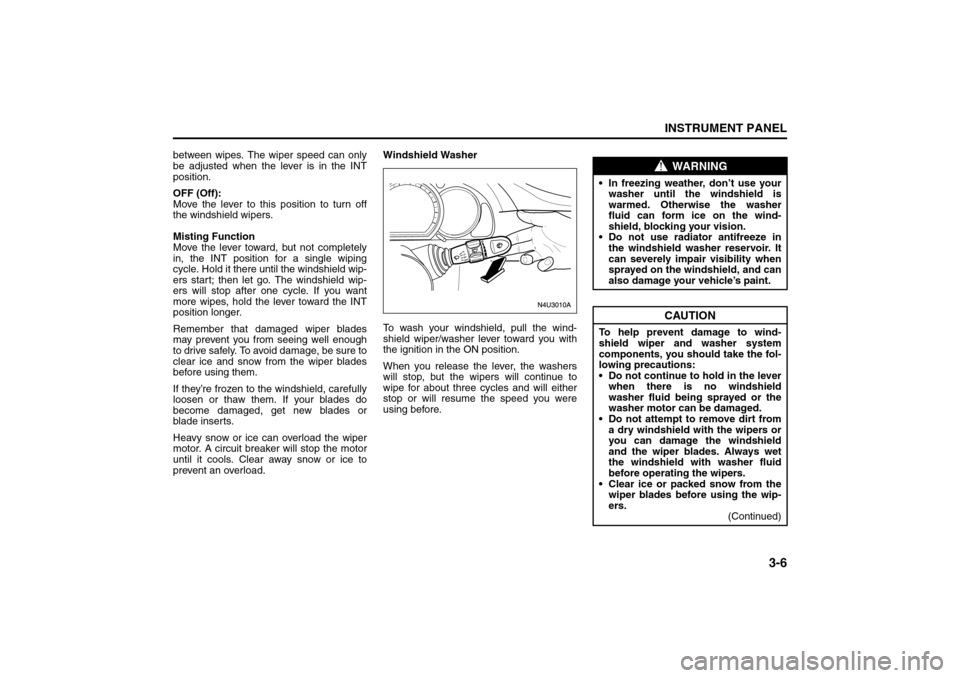
prevent an overload.Windshield Washer
To wash your windshield, pull the wind-
shield wiper/washer lever toward you with
the ignition in the ON position.
When you release the lever, the washers
will stop, but the wipers will continue to
wipe for about three cycles and will either
stop or will resume the speed you were
using before.
WARNING
In freezing weather, don’t use your
washer until the windshield is
warmed. Otherwise the washer
fluid can form ice on the wind-
shield, blocking your vision.
Do not use radiator antifreeze in
the windshield washer reservoir. It
can severely impair visibility when
sprayed on the windshield, and can
also damage your vehicle’s paint.
CAUTION
To help prevent damage to wind-
shield wiper and washer system
components, you should take the fol-
lowing precautions:
Do not continue to hold in the lever
when there is no windshield
washer fluid being sprayed or the
washer motor can be damaged.
Do not attempt to remove dirt from
a dry windshield with the wipers or
you can damage the windshield
and the wiper blades. Always wet
the windshield with washer fluid
before operating the wipers.
Clear ice or packed snow from the
wiper blades before using the wip-
ers.
(Continued)
Instrument Panel Overview:
Page 85 of 226
3-9INSTRUMENT PANEL
85Z04-03E
Erasing Speed Memory
When you turn off the cruise control or the
ignition, your cruise control set speed
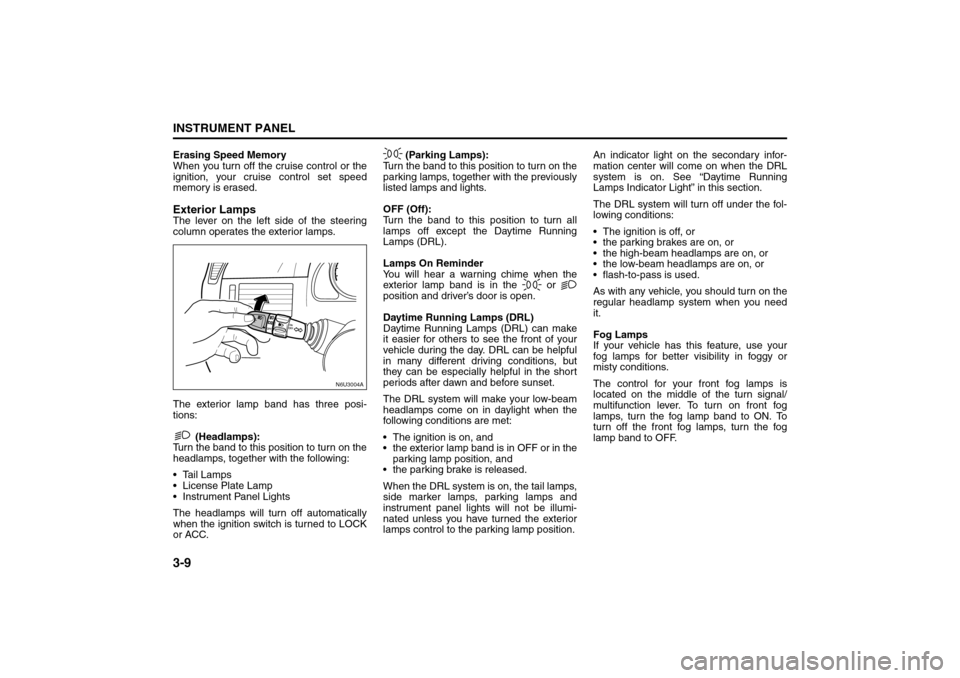
memory is erased.Exterior LampsThe lever on the left side of the steering
column operates the exterior lamps.
The exterior lamp band has three posi-
tions:
(Headlamps):
Turn the band to this position to turn on the
headlamps, together with the following:
Tail Lamps
License Plate Lamp
Instrument Panel Lights
The headlamps will turn off automatically
when the ignition switch is turned to LOCK
or ACC. (Parking Lamps):
Turn the band to this position to turn on the
parking lamps, together with the previously
listed lamps and lights.
OFF (Off):
Turn the band to this position to turn all
lamps off except the Daytime Running
Lamps (DRL).
Lamps On Reminder
You will hear a warning chime when the
exterior lamp band is in the or
position and driver’s door is open.
Daytime Running Lamps (DRL)
Daytime Running Lamps (DRL) can make
it easier for others to see the front of your
vehicle during the day. DRL can be helpful
in many different driving conditions, but
they can be especially helpful in the short
periods after dawn and before sunset.
The DRL system will make your low-beam
headlamps come on in daylight when the
following conditions are met:
The ignition is on, and
the exterior lamp band is in OFF or in the
parking lamp position, and
the parking brake is released.
When the DRL system is on, the tail lamps,
side marker lamps, parking lamps and
instrument panel lights will not be illumi-
nated unless you have turned the exterior
lamps control to the parking lamp position.An indicator light on the secondary infor-
mation center will come on when the DRL
system is on. See “Daytime Running
Lamps Indicator Light” in this section.
The DRL system will turn off under the fol-
lowing conditions:
The ignition is off, or
the parking brakes are on, or
the high-beam headlamps are on, or
the low-beam headlamps are on, or
flash-to-pass is used.
As with any vehicle, you should turn on the
regular headlamp system when you need
it.
Fog Lamps
If your vehicle has this feature, use your
fog lamps for better visibility in foggy or
misty conditions.
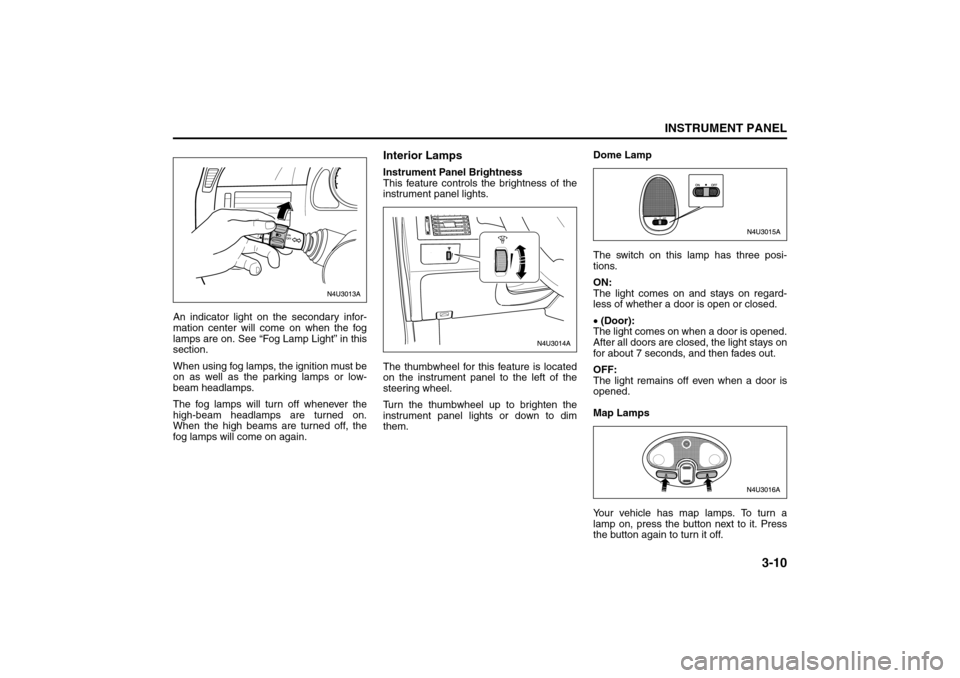
The control for your front fog lamps is
located on the middle of the turn signal/
multifunction lever. To turn on front fog
lamps, turn the fog lamp band to ON. To
turn off the front fog lamps, turn the fog
lamp band to OFF.
N6U3004A
Instrument Panel Overview:
Page 86 of 226
3-10
INSTRUMENT PANEL
85Z04-03E
An indicator light on the secondary infor-
mation center will come on when the fog
lamps are on. See “Fog Lamp Light” in this
section.
When using fog lamps, the ignition must be
on as well as the parking lamps or low-
beam headlamps.
The fog lamps will turn off whenever the
high-beam headlamps are turned on.
When the high beams are turned off, the
fog lamps will come on again.
Interior LampsInstrument Panel Brightness
This feature controls the brightness of the
instrument panel lights.
The thumbwheel for this feature is located
on the instrument panel to the left of the
steering wheel.
Turn the thumbwheel up to brighten the
instrument panel lights or down to dim
them. Dome Lamp
The switch on this lamp has three posi-
tions.
ON:
The light comes on and stays on regard-
less of whether a door is open or closed.
• (Door):
The light comes on when a door is opened.
After all doors are closed, the light stays on
for about 7 seconds, and then fades out.
OFF:
The light remains off even when a door is
opened.
Map Lamps
Your vehicle has map lamps. To turn a
lamp on, press the button next to it. Press
the button again to turn it off.
Instrument Panel Overview:
Page 87 of 226
3-11INSTRUMENT PANEL
85Z04-03E
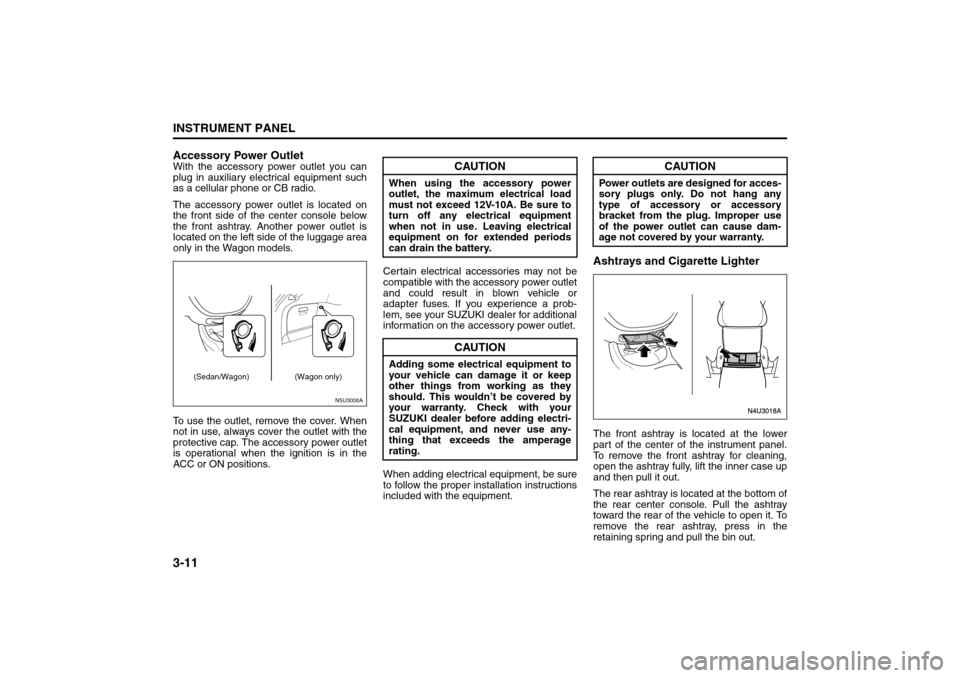
Accessory Power OutletWith the accessory power outlet you can
plug in auxiliary electrical equipment such
as a cellular phone or CB radio.
The accessory power outlet is located on
the front side of the center console below
the front ashtray. Another power outlet is
located on the left side of the luggage area
only in the Wagon models.
To use the outlet, remove the cover. When
not in use, always cover the outlet with the
protective cap. The accessory power outlet
is operational when the ignition is in the
ACC or ON positions.Certain electrical accessories may not be
compatible with the accessory power outlet
and could result in blown vehicle or
adapter fuses. If you experience a prob-
lem, see your SUZUKI dealer for additional
information on the accessory power outlet.
When adding electrical equipment, be sure
to follow the proper installation instructions
included with the equipment.
Ashtrays and Cigarette LighterThe front ashtray is located at the lower
part of the center of the instrument panel.
To remove the front ashtray for cleaning,
open the ashtray fully, lift the inner case up
and then pull it out.
The rear ashtray is located at the bottom of
the rear center console. Pull the ashtray
toward the rear of the vehicle to open it. To
remove the rear ashtray, press in the
retaining spring and pull the bin out.
N5U3006A
(Sedan/Wagon) (Wagon only)
CAUTION
When using the accessory power
outlet, the maximum electrical load
must not exceed 12V-10A. Be sure to
turn off any electrical equipment
when not in use. Leaving electrical
equipment on for extended periods
can drain the battery.
CAUTION
Adding some electrical equipment to
your vehicle can damage it or keep
other things from working as they
should. This wouldn’t be covered by
your warranty. Check with your
SUZUKI dealer before adding electri-
cal equipment, and never use any-
thing that exceeds the amperage
rating.
CAUTION
Power outlets are designed for acces-
sory plugs only. Do not hang any
type of accessory or accessory
bracket from the plug. Improper use
of the power outlet can cause dam-
age not covered by your warranty.
Instrument Panel Overview: