instrument panel SUZUKI GRAND VITARA 1999 2.G User Guide
[x] Cancel search | Manufacturer: SUZUKI, Model Year: 1999, Model line: GRAND VITARA, Model: SUZUKI GRAND VITARA 1999 2.GPages: 656, PDF Size: 14.31 MB
Page 530 of 656
CRUISE CONTROL SYSTEM 8E-9
“Cruise” Indicator Lamp Circuit Check
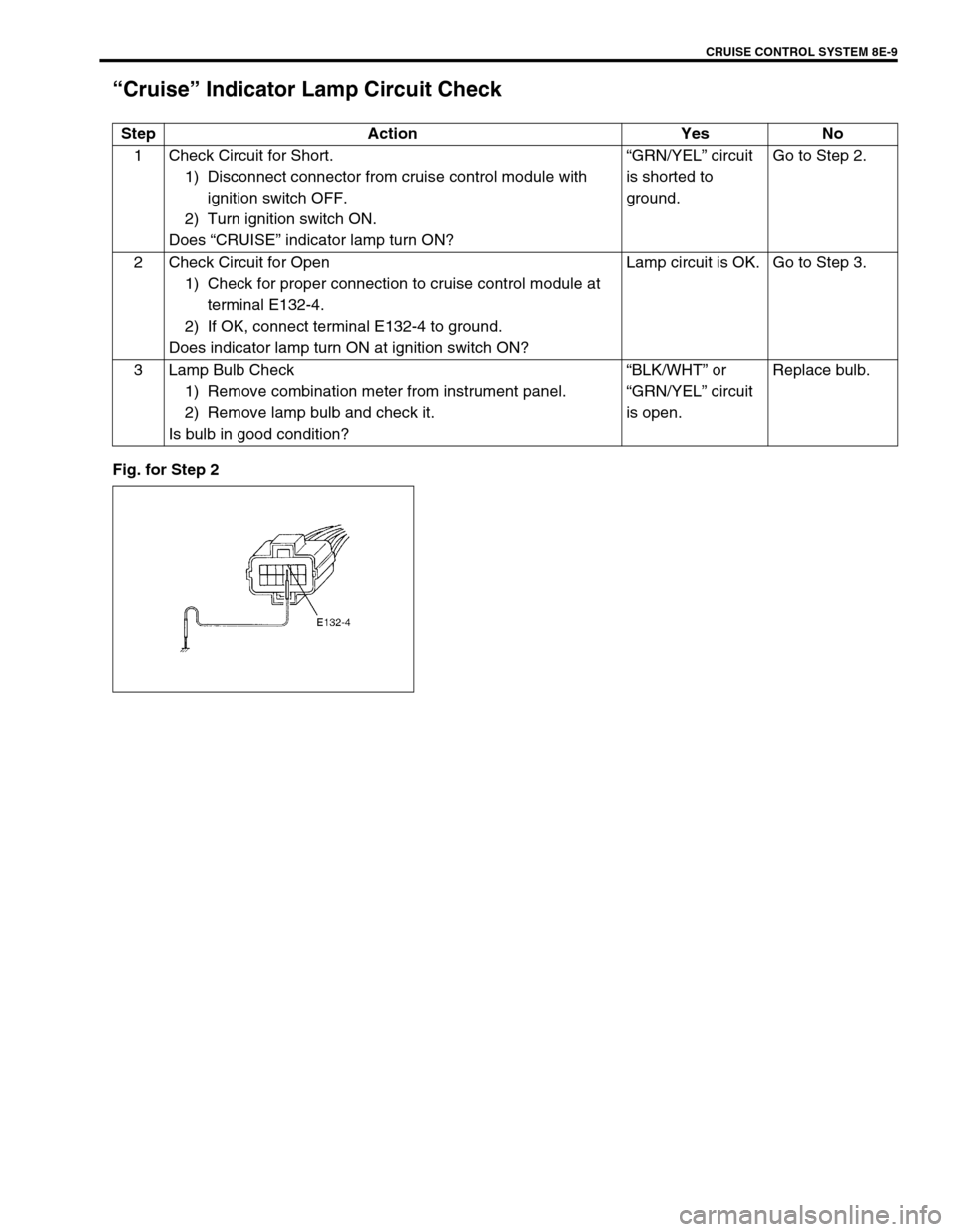
Fig. for Step 2Step Action Yes No
1 Check Circuit for Short.
1) Disconnect connector from cruise control module with
ignition switch OFF.
2) Turn ignition switch ON.
Does “CRUISE” indicator lamp turn ON?“GRN/YEL” circuit
is shorted to
ground.Go to Step 2.
2 Check Circuit for Open
1) Check for proper connection to cruise control module at
terminal E132-4.
2) If OK, connect terminal E132-4 to ground.
Does indicator lamp turn ON at ignition switch ON?Lamp circuit is OK. Go to Step 3.
3 Lamp Bulb Check
1) Remove combination meter from instrument panel.
2) Remove lamp bulb and check it.
Is bulb in good condition?“BLK/WHT” or
“GRN/YEL” circuit
is open.Replace bulb.
Page 540 of 656
CRUISE CONTROL SYSTEM 8E-19
Cruise Cable Play Inspection and Adjustment
INSPECTION AND ADJUSTMENT
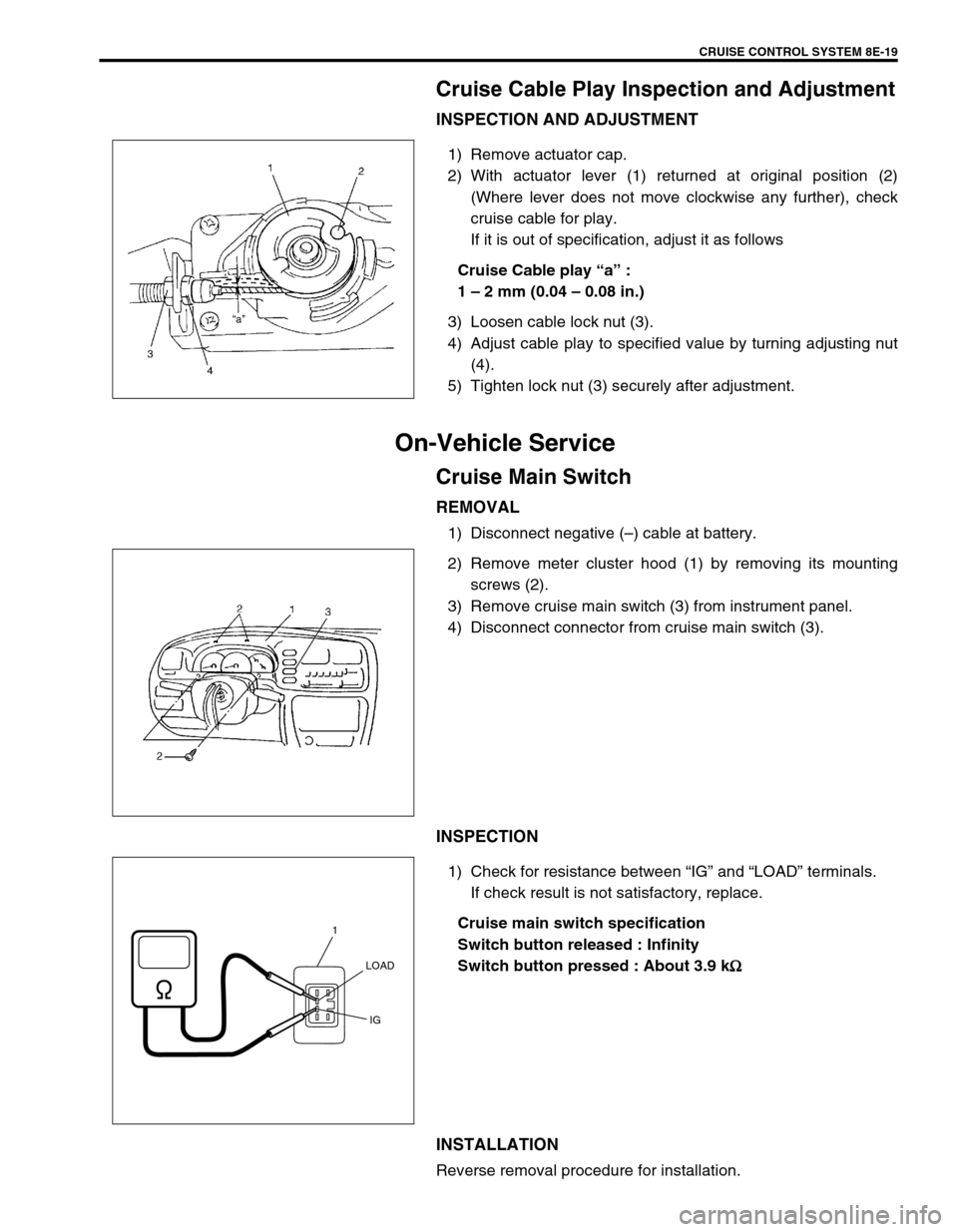
1) Remove actuator cap.
2) With actuator lever (1) returned at original position (2)
(Where lever does not move clockwise any further), check
cruise cable for play.
If it is out of specification, adjust it as follows
Cruise Cable play “a” :
1 – 2 mm (0.04 – 0.08 in.)
3) Loosen cable lock nut (3).
4) Adjust cable play to specified value by turning adjusting nut
(4).
5) Tighten lock nut (3) securely after adjustment.
On-Vehicle Service
Cruise Main Switch
REMOVAL
1) Disconnect negative (–) cable at battery.
2) Remove meter cluster hood (1) by removing its mounting
screws (2).
3) Remove cruise main switch (3) from instrument panel.
4) Disconnect connector from cruise main switch (3).
INSPECTION
1) Check for resistance between “IG” and “LOAD” terminals.
If check result is not satisfactory, replace.
Cruise main switch specification
Switch button released : Infinity
Switch button pressed : About 3.9 kΩ
ΩΩ Ω
INSTALLATION
Reverse removal procedure for installation.
1
LOAD
IG
Page 569 of 656
10-2 RESTRAINT SYSTEM
General Description
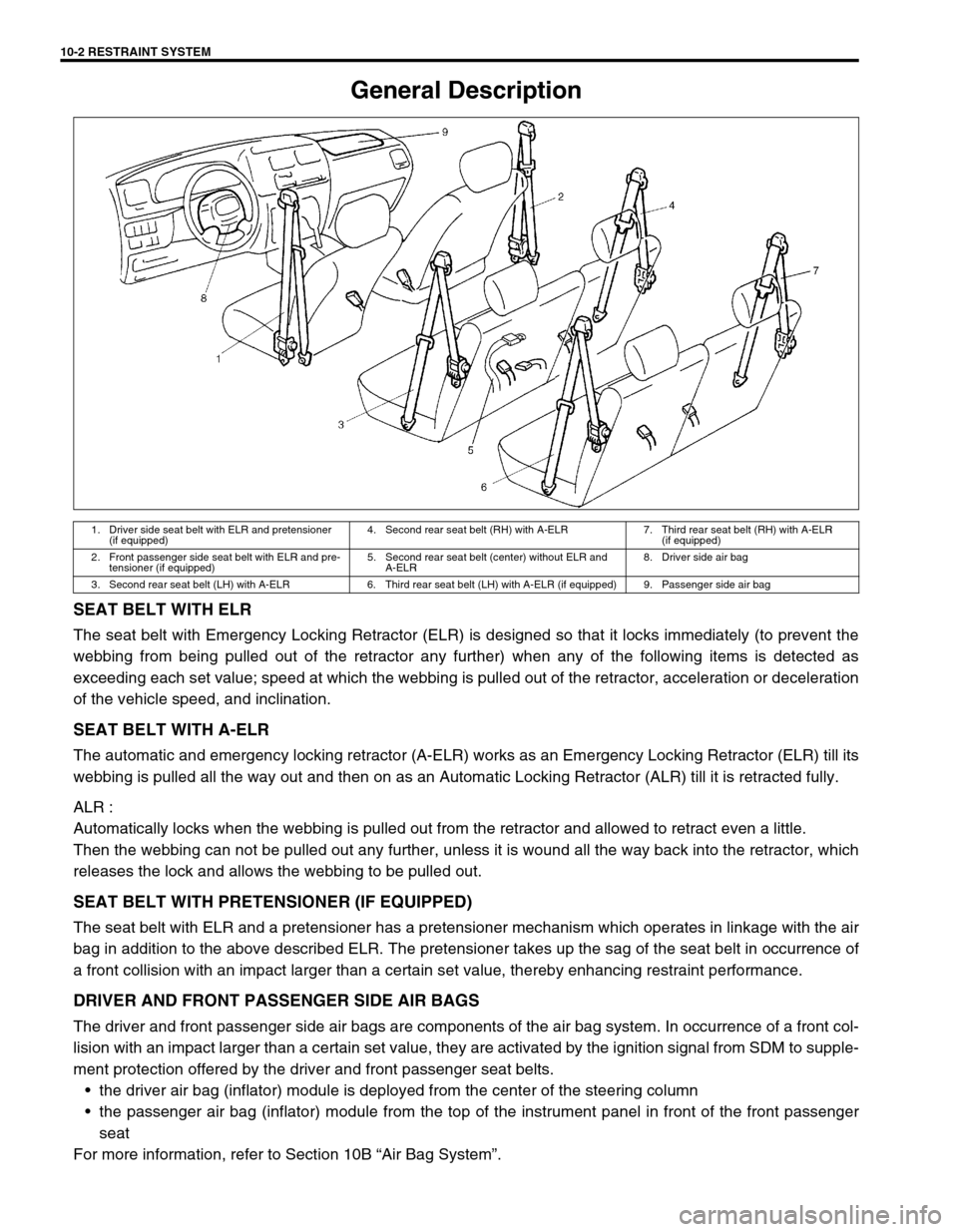
SEAT BELT WITH ELR
The seat belt with Emergency Locking Retractor (ELR) is designed so that it locks immediately (to prevent the
webbing from being pulled out of the retractor any further) when any of the following items is detected as
exceeding each set value; speed at which the webbing is pulled out of the retractor, acceleration or deceleration
of the vehicle speed, and inclination.
SEAT BELT WITH A-ELR
The automatic and emergency locking retractor (A-ELR) works as an Emergency Locking Retractor (ELR) till its
webbing is pulled all the way out and then on as an Automatic Locking Retractor (ALR) till it is retracted fully.
ALR :
Automatically locks when the webbing is pulled out from the retractor and allowed to retract even a little.
Then the webbing can not be pulled out any further, unless it is wound all the way back into the retractor, which
releases the lock and allows the webbing to be pulled out.
SEAT BELT WITH PRETENSIONER (IF EQUIPPED)
The seat belt with ELR and a pretensioner has a pretensioner mechanism which operates in linkage with the air
bag in addition to the above described ELR. The pretensioner takes up the sag of the seat belt in occurrence of
a front collision with an impact larger than a certain set value, thereby enhancing restraint performance.
DRIVER AND FRONT PASSENGER SIDE AIR BAGS
The driver and front passenger side air bags are components of the air bag system. In occurrence of a front col-
lision with an impact larger than a certain set value, they are activated by the ignition signal from SDM to supple-
ment protection offered by the driver and front passenger seat belts.
•the driver air bag (inflator) module is deployed from the center of the steering column
•the passenger air bag (inflator) module from the top of the instrument panel in front of the front passenger
seat
For more information, refer to Section 10B “Air Bag System”.
1. Driver side seat belt with ELR and pretensioner
(if equipped) 4. Second rear seat belt (RH) with A-ELR 7. Third rear seat belt (RH) with A-ELR
(if equipped)
2. Front passenger side seat belt with ELR and pre-
tensioner (if equipped) 5. Second rear seat belt (center) without ELR and
A-ELR8. Driver side air bag
3. Second rear seat belt (LH) with A-ELR 6. Third rear seat belt (LH) with A-ELR (if equipped) 9. Passenger side air bag
Page 580 of 656
AIR BAG SYSTEM 10B-3
General Description
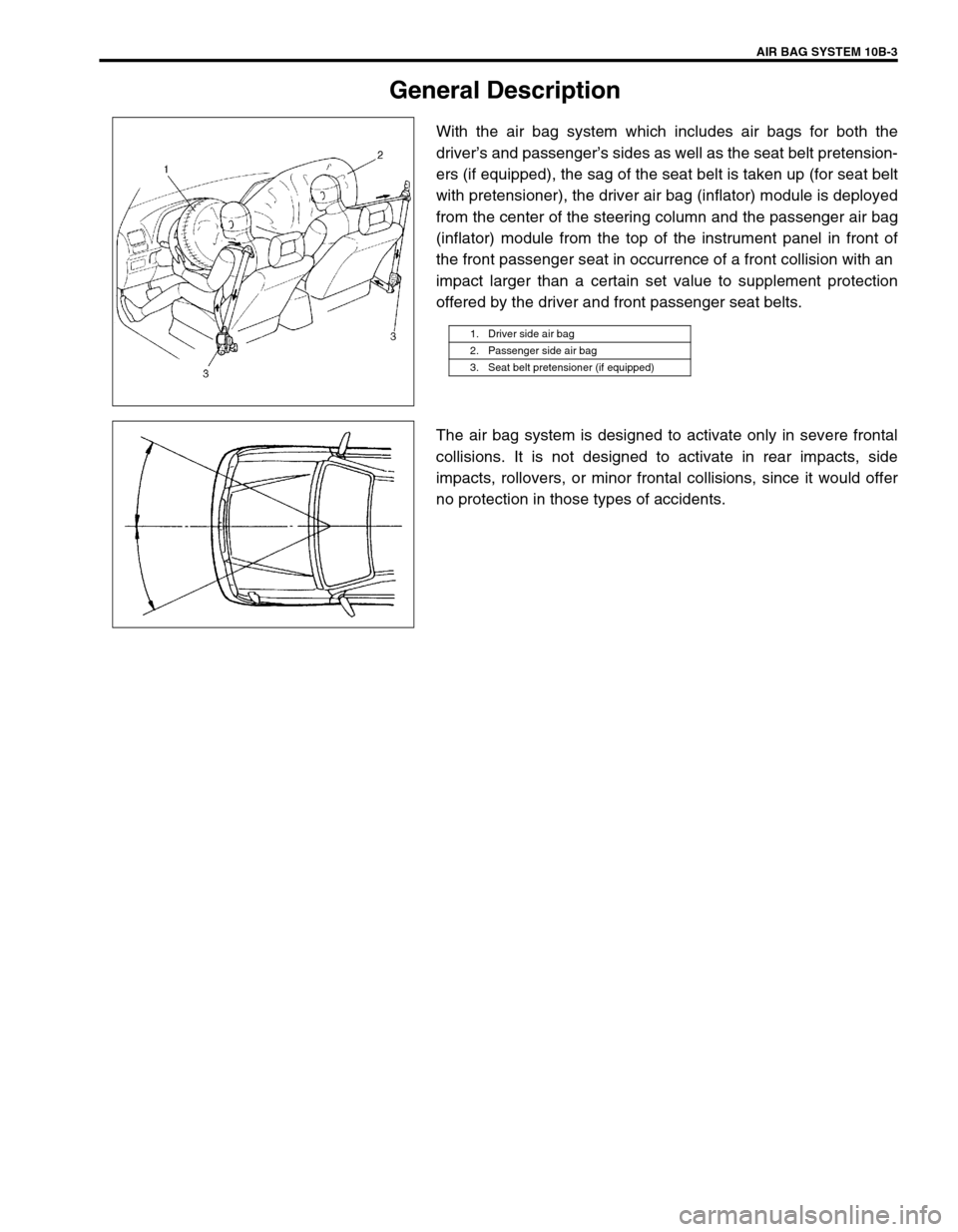
With the air bag system which includes air bags for both the
driver’s and passenger’s sides as well as the seat belt pretension-
ers (if equipped), the sag of the seat belt is taken up (for seat belt
with pretensioner), the driver air bag (inflator) module is deployed
from the center of the steering column and the passenger air bag
(inflator) module from the top of the instrument panel in front of
the front passenger seat in occurrence of a front collision with an
impact larger than a certain set value to supplement protection
offered by the driver and front passenger seat belts.
The air bag system is designed to activate only in severe frontal
collisions. It is not designed to activate in rear impacts, side
impacts, rollovers, or minor frontal collisions, since it would offer
no protection in those types of accidents.
1. Driver side air bag
2. Passenger side air bag
3. Seat belt pretensioner (if equipped)
Page 581 of 656
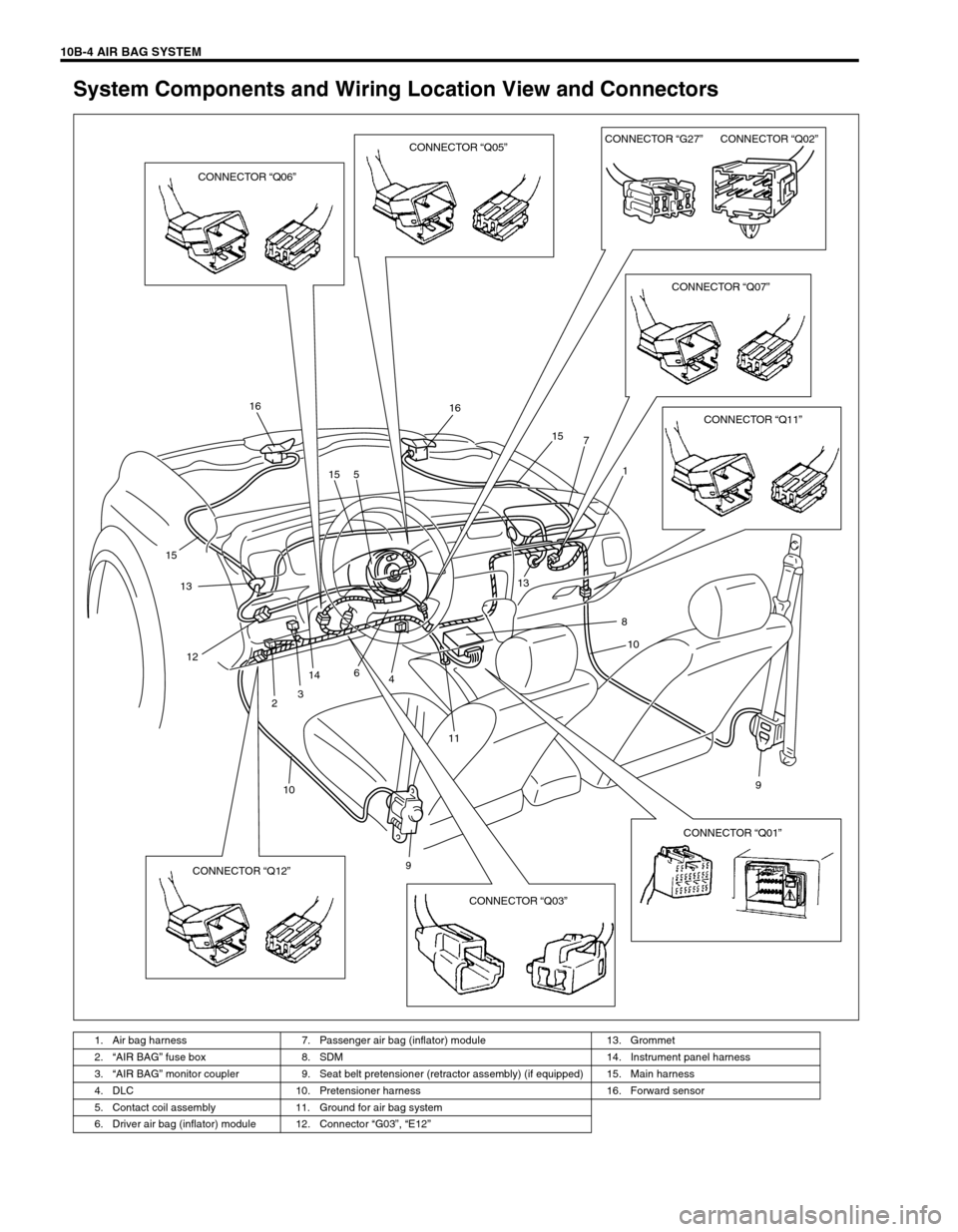
10B-4 AIR BAG SYSTEM
System Components and Wiring Location View and Connectors
1. Air bag harness 7. Passenger air bag (inflator) module 13. Grommet
2.“AIR BAG” fuse box 8. SDM 14. Instrument panel harness
3.“AIR BAG” monitor coupler 9. Seat belt pretensioner (retractor assembly) (if equipped) 15. Main harness
4. DLC 10. Pretensioner harness 16. Forward sensor
5. Contact coil assembly 11. Ground for air bag system
6. Driver air bag (inflator) module 12. Connector “G03”, “E12”
16 16
15
13
12
14
1113
10 15 5
6
3
248
9 1 7 15
9
10
CONNECTOR “Q06”CONNECTOR “Q05”CONNECTOR “G27”CONNECTOR “Q02”
CONNECTOR “Q07”
CONNECTOR “Q11”
CONNECTOR “Q03” CONNECTOR “Q12”CONNECTOR “Q01”
Page 635 of 656
10B-58 AIR BAG SYSTEM
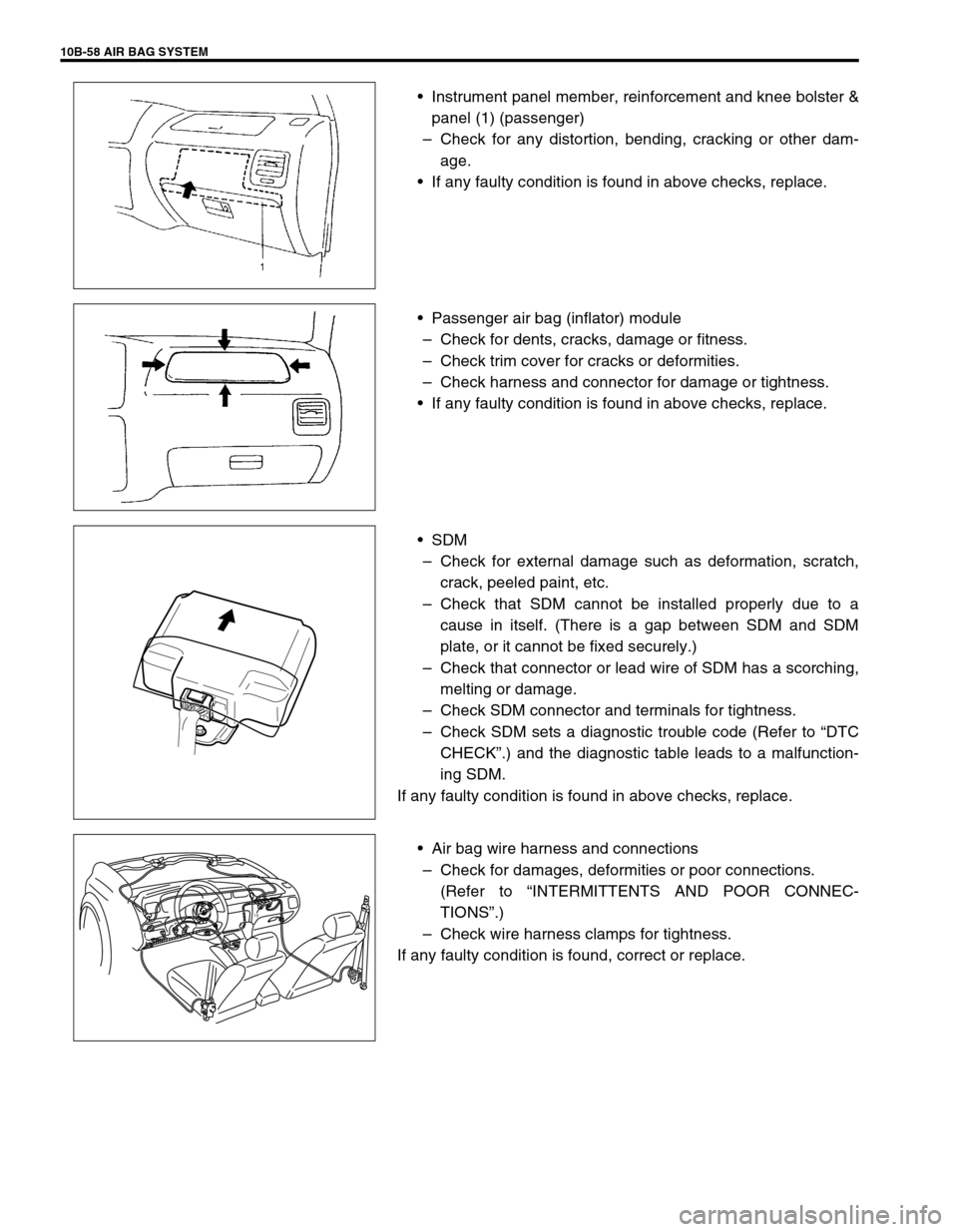
•Instrument panel member, reinforcement and knee bolster &
panel (1) (passenger)
–Check for any distortion, bending, cracking or other dam-
age.
•If any faulty condition is found in above checks, replace.
•Passenger air bag (inflator) module
–Check for dents, cracks, damage or fitness.
–Check trim cover for cracks or deformities.
–Check harness and connector for damage or tightness.
•If any faulty condition is found in above checks, replace.
•SDM
–Check for external damage such as deformation, scratch,
crack, peeled paint, etc.
–Check that SDM cannot be installed properly due to a
cause in itself. (There is a gap between SDM and SDM
plate, or it cannot be fixed securely.)
–Check that connector or lead wire of SDM has a scorching,
melting or damage.
–Check SDM connector and terminals for tightness.
–Check SDM sets a diagnostic trouble code (Refer to “DTC
CHECK”.) and the diagnostic table leads to a malfunction-
ing SDM.
If any faulty condition is found in above checks, replace.
•Air bag wire harness and connections
–Check for damages, deformities or poor connections.
(Refer to “INTERMITTENTS AND POOR CONNEC-
TIONS”.)
–Check wire harness clamps for tightness.
If any faulty condition is found, correct or replace.
15
Page 649 of 656
10B-72 AIR BAG SYSTEM
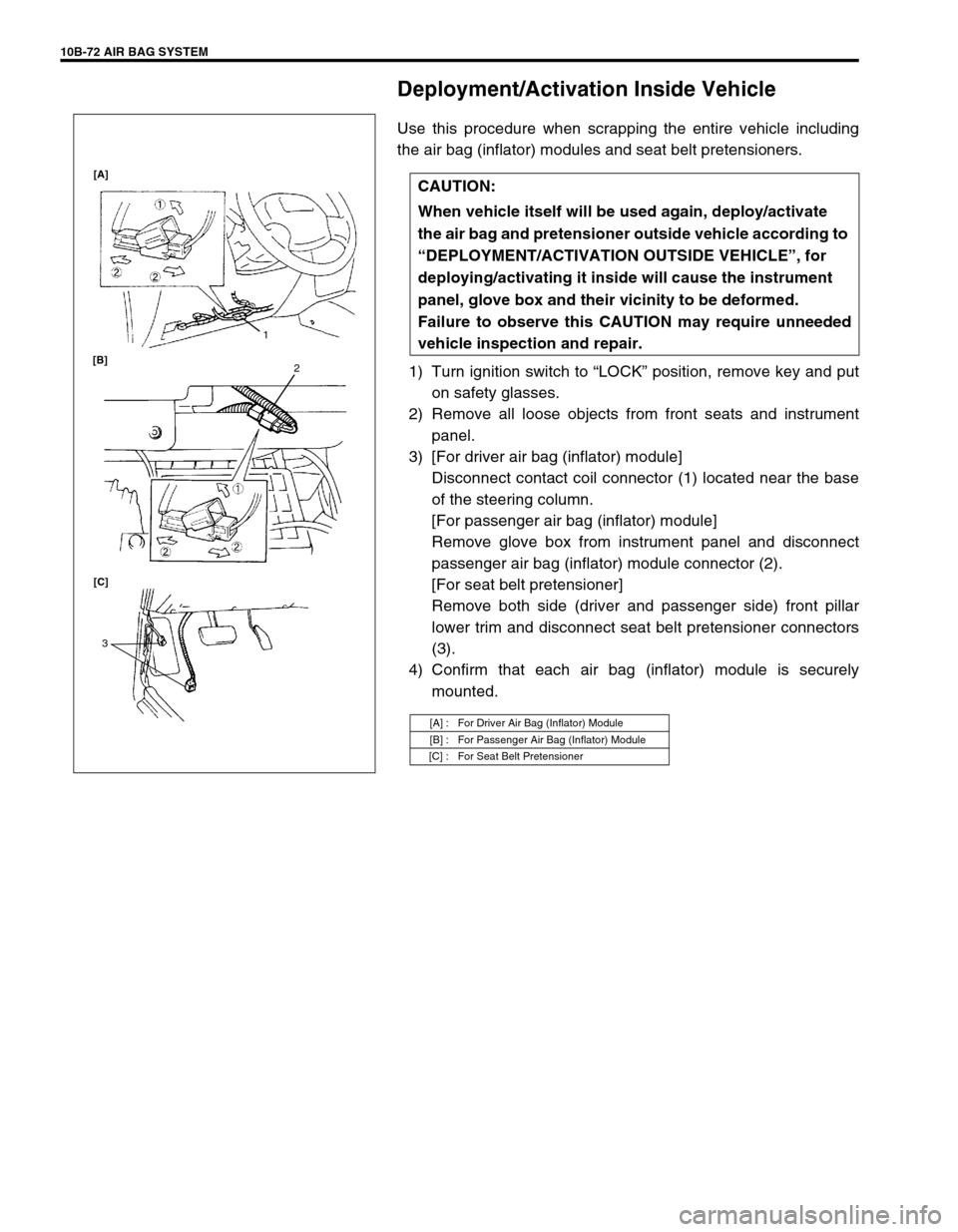
Deployment/Activation Inside Vehicle
Use this procedure when scrapping the entire vehicle including
the air bag (inflator) modules and seat belt pretensioners.
1) Turn ignition switch to “LOCK” position, remove key and put
on safety glasses.
2) Remove all loose objects from front seats and instrument
panel.
3) [For driver air bag (inflator) module]
Disconnect contact coil connector (1) located near the base
of the steering column.
[For passenger air bag (inflator) module]
Remove glove box from instrument panel and disconnect
passenger air bag (inflator) module connector (2).
[For seat belt pretensioner]
Remove both side (driver and passenger side) front pillar
lower trim and disconnect seat belt pretensioner connectors
(3).
4) Confirm that each air bag (inflator) module is securely
mounted. CAUTION:
When vehicle itself will be used again, deploy/activate
the air bag and pretensioner outside vehicle according to
“DEPLOYMENT/ACTIVATION OUTSIDE VEHICLE”, for
deploying/activating it inside will cause the instrument
panel, glove box and their vicinity to be deformed.
Failure to observe this CAUTION may require unneeded
vehicle inspection and repair.
[A] : For Driver Air Bag (Inflator) Module
[B] : For Passenger Air Bag (Inflator) Module
[C] : For Seat Belt Pretensioner
[A]
[B]
[C]
1
2
3