switch SUZUKI GRAND VITARA 1999 2.G User Guide
[x] Cancel search | Manufacturer: SUZUKI, Model Year: 1999, Model line: GRAND VITARA, Model: SUZUKI GRAND VITARA 1999 2.GPages: 656, PDF Size: 14.31 MB
Page 35 of 656
1B-10 AIR CONDITIONING (OPTIONAL)
Performance Diagnosis
1) Confirm that vehicle and environmental conditions are as fol-
lows.
Vehicle is not exposed to direct sun.
Ambient temperature is within 15 - 35 °C (59 - 95 °F).
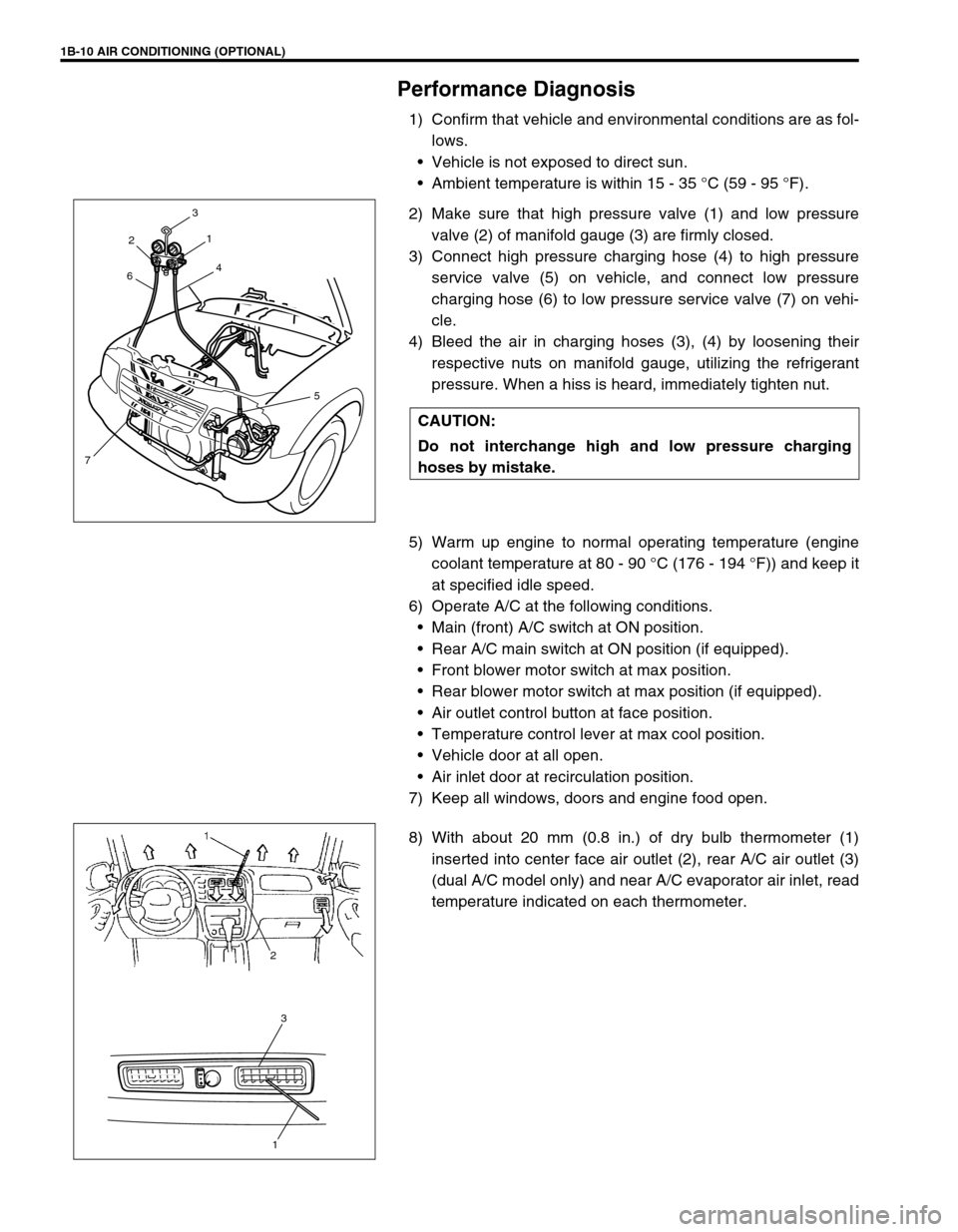
2) Make sure that high pressure valve (1) and low pressure
valve (2) of manifold gauge (3) are firmly closed.
3) Connect high pressure charging hose (4) to high pressure
service valve (5) on vehicle, and connect low pressure
charging hose (6) to low pressure service valve (7) on vehi-
cle.
4) Bleed the air in charging hoses (3), (4) by loosening their
respective nuts on manifold gauge, utilizing the refrigerant
pressure. When a hiss is heard, immediately tighten nut.
5) Warm up engine to normal operating temperature (engine
coolant temperature at 80 - 90 °C (176 - 194 °F)) and keep it
at specified idle speed.
6) Operate A/C at the following conditions.
Main (front) A/C switch at ON position.
Rear A/C main switch at ON position (if equipped).
Front blower motor switch at max position.
Rear blower motor switch at max position (if equipped).
Air outlet control button at face position.
Temperature control lever at max cool position.
Vehicle door at all open.
Air inlet door at recirculation position.
7) Keep all windows, doors and engine food open.
8) With about 20 mm (0.8 in.) of dry bulb thermometer (1)
inserted into center face air outlet (2), rear A/C air outlet (3)
(dual A/C model only) and near A/C evaporator air inlet, read
temperature indicated on each thermometer. CAUTION:
Do not interchange high and low pressure charging
hoses by mistake.
2
64
3
75 1
3
1
2
Page 37 of 656
1B-12 AIR CONDITIONING (OPTIONAL)
Performance diagnosis table
HIGH PRESSURE GAUGE
LOW PRESSURE GAUGE
THERMOMETER AT CENTER DUCT
Condition Possible Cause Correction
Pressure high
(“A” area of high side
graph)Refrigerant overcharged Recharge.
Expansion valve frozen or clogged Check expansion valve.
Clogged refrigerant passage of high side Clean or replace.
Condenser cooling fan malfunction (Insufficient cooling
of condenser)Check condenser cooling fan.
Dirty or bent condenser fins (Insufficient cooling of con-
denser)Clean or repair.
Compressor malfunction (Insufficient oil etc.) Check compressor.
Engine overheat Check engine cooling system.
Pressure low
(“B” area of high side
graph)Insufficient refrigerant (Insufficient charge or leakage) Check for leakage, repair if necessary
and recharge.
Expansion valve malfunction (valve opens too wide) Check expansion valve.
Compressor malfunction (Insufficient compression) Check compressor.
Condition Possible Cause Correction
Pressure high
(“C” area of low side
graph)Expansion valve malfunction (valve opens too wide) Check expansion valve.
Compressor malfunction (Insufficient compression) Check compressor.
Pressure low
(“D” area of low side
graph)Insufficient refrigerant (Insufficient charge or leakage) Check for leakage, repair if necessary
and recharge.
Expansion valve malfunction (valve opens too narrow) Check expansion valve.
Clogged refrigerant passage (crashed pipe) Repair or replace.
Condition Possible Cause Correction
Outlet air temperature at
center duct is high
(Crossing point is in area
“E”)Insufficient or excessive charge of refrigerant Check refrigerant pressure.
Dirty or bent A/C evaporator fins Clean or repair.
Air leakage from cooling (heater) unit or air duct Repair or replace.
Malfunctioning, switch over function of damper in cool-
ing (heater) unitRepair or replace.
Compressor malfunction Check compressor.
Outlet air temperature at
center duct is low
(Crossing point is in area
“F”)Insufficient air volume from center duct (Heater blower
malfunction)Check blower motor and fan.
Compressor malfunction Check compressor.
NOTE:
If ambient temperature is within 30 - 35 °C (85 - 95 °F), it is possible to do using “DETAIL DIAGNOSIS
TABLE” in this section for detail diagnosis.
Page 39 of 656
1B-14 AIR CONDITIONING (OPTIONAL)
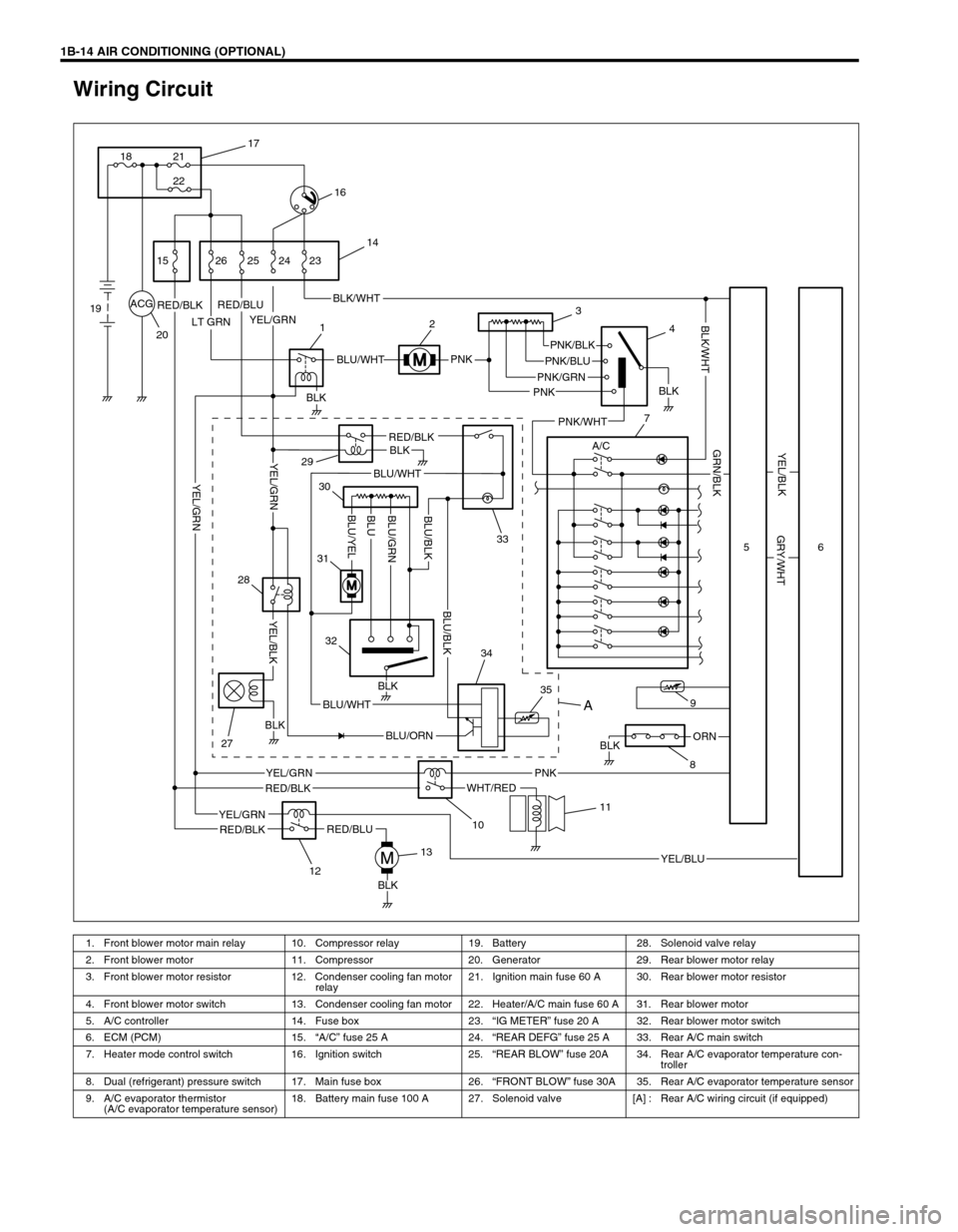
Wiring Circuit
ACG
LT GRN
PNK
PNK
BLKORN
BLK
YEL/GRNRED/BLKBLK/WHT
BLU/WHTPNK/BLK
PNK/GRN
RED/BLK
WHT/RED
YEL/GRN
YEL/BLU
A/C
RED/BLU
RED/BLU
RED/BLKBLK
BLU/ORN
BLU/WHT
BLU/WHT
PNK
PNK/BLU
BLK
PNK/WHT
YEL/BLK
GRY/WHT
GRN/BLK
BLK/WHT
RED/BLK
YEL/GRN
BLK
BLK
BLK
YEL/BLK
YEL/GRN
YEL/GRNBLU/GRN
BLU/YELBLUBLU/BLK
BLU/BLK
17
21
22 18
16
15
19
2026 25 24 23
14
12
29
3
4
7
33 30
31
32
28
27
1213
10
11
35 349
856
A
1. Front blower motor main relay 10. Compressor relay 19. Battery 28. Solenoid valve relay
2. Front blower motor 11. Compressor 20. Generator 29. Rear blower motor relay
3. Front blower motor resistor 12. Condenser cooling fan motor
relay21. Ignition main fuse 60 A 30. Rear blower motor resistor
4. Front blower motor switch 13. Condenser cooling fan motor 22. Heater/A/C main fuse 60 A 31. Rear blower motor
5. A/C controller 14. Fuse box 23.“IG METER” fuse 20 A 32. Rear blower motor switch
6. ECM (PCM) 15.“A/C” fuse 25 A 24.“REAR DEFG” fuse 25 A 33. Rear A/C main switch
7. Heater mode control switch 16. Ignition switch 25.“REAR BLOW” fuse 20A 34. Rear A/C evaporator temperature con-
troller
8. Dual (refrigerant) pressure switch 17. Main fuse box 26.“FRONT BLOW” fuse 30A 35. Rear A/C evaporator temperature sensor
9. A/C evaporator thermistor
(A/C evaporator temperature sensor)18. Battery main fuse 100 A 27. Solenoid valve [A] : Rear A/C wiring circuit (if equipped)
Page 41 of 656
1B-16 AIR CONDITIONING (OPTIONAL)
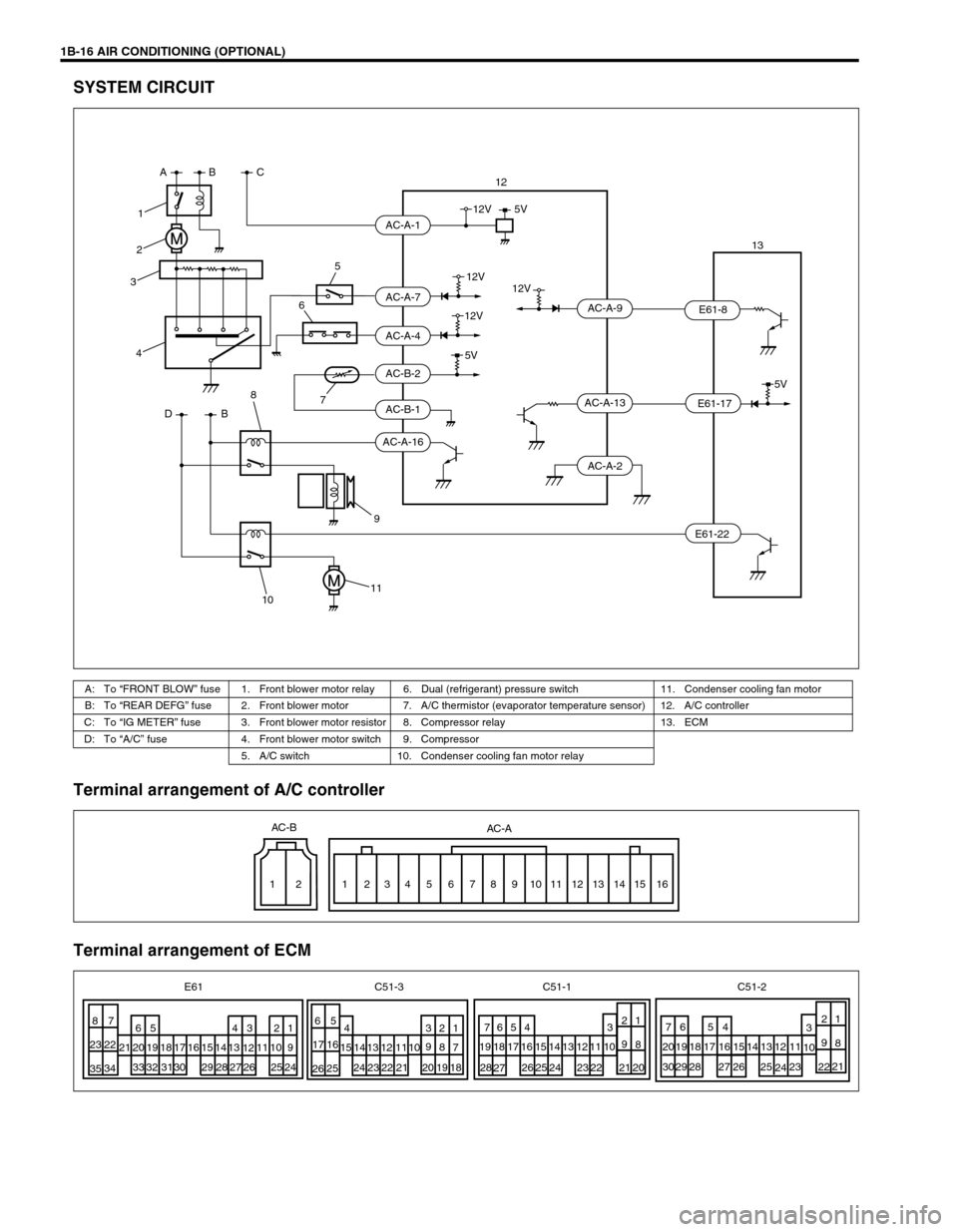
SYSTEM CIRCUIT
Terminal arrangement of A/C controller
Terminal arrangement of ECM
A: To “FRONT BLOW” fuse 1. Front blower motor relay 6. Dual (refrigerant) pressure switch 11. Condenser cooling fan motor
B: To “REAR DEFG” fuse 2. Front blower motor 7. A/C thermistor (evaporator temperature sensor) 12. A/C controller
C: To “IG METER” fuse 3. Front blower motor resistor 8. Compressor relay 13. ECM
D: To “A/C” fuse 4. Front blower motor switch 9. Compressor
5. A/C switch 10. Condenser cooling fan motor relay
5V
12V12V
12V5V
12V
5V
AC-A-1
AC-A-7
AC-A-4
AC-B-2
AC-B-1
AC-A-16AC-A-9
AC-A-2 AC-A-13
E61-8
E61-17
E61-22
A
DBBC
1
2
3
4
7 865
1011912
13
12 12
3
45 6 7 8 9 101112131415 16 AC-B
AC-A
87
22 23
34
3565
16 17
25
262
1
8 9
20
212
1
8 9
21
22 1 2 3 4 5 6
9
24 25 26 27 28 29 30 31 32 3310 11
12 13 14 15 16 17 18 19 20 211 2 3 4
7 8 9
10 11 12 13 14 15
18 19 20 21 22 23 243 4 5 6 7
10 11 12 13 14 15 16 17 18 19
22 23 24 25 26
27 283 4 5 6 7
10 11 12 13 14 15 16 19 18 2017
23
24 25 26 27 29 28 30 E61 C51-3 C51-1 C51-2
Page 42 of 656
AIR CONDITIONING (OPTIONAL) 1B-17
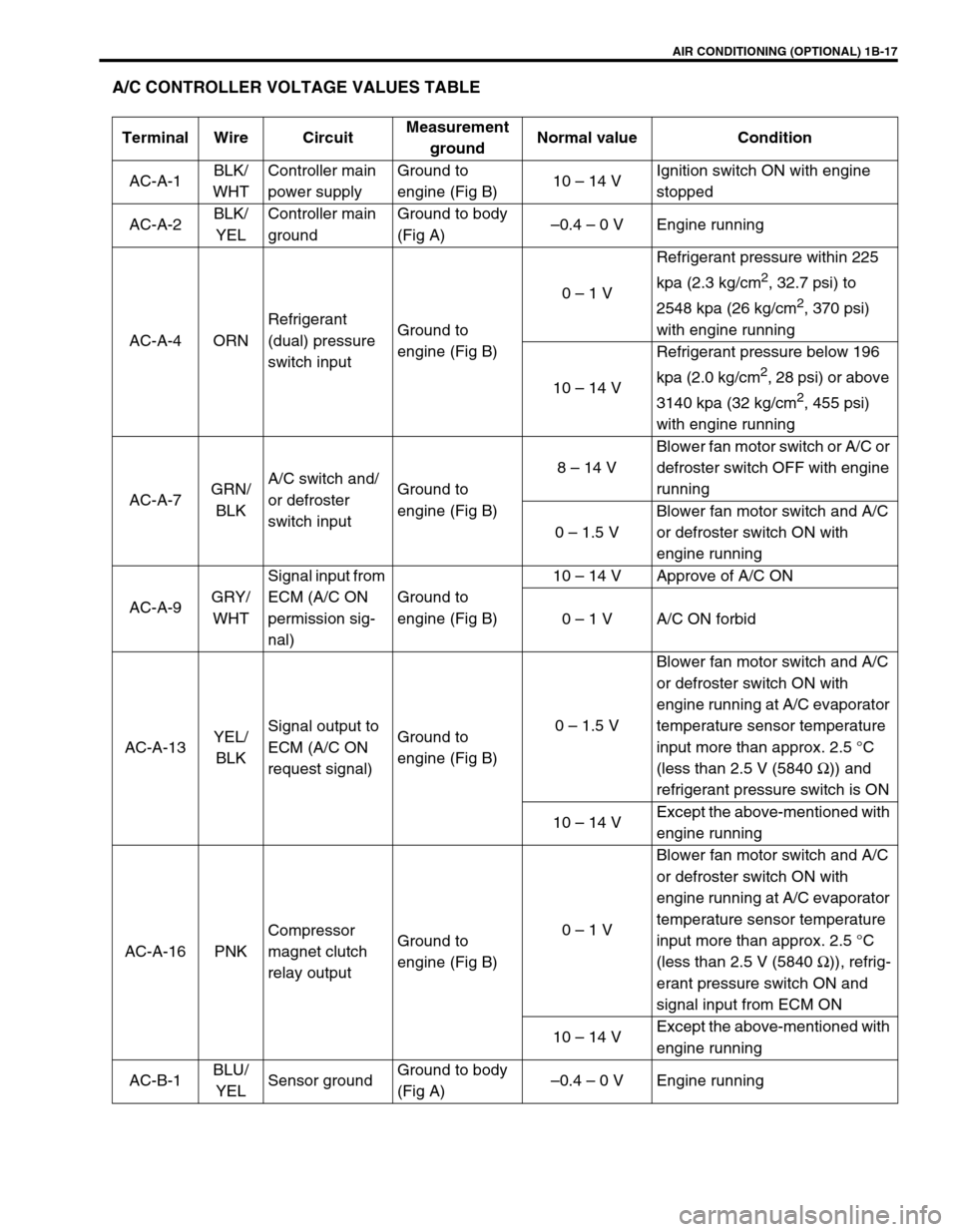
A/C CONTROLLER VOLTAGE VALUES TABLE
Terminal Wire CircuitMeasurement
groundNormal value Condition
AC-A-1BLK/
WHTController main
power supplyGround to
engine (Fig B)10 – 14 VIgnition switch ON with engine
stopped
AC-A-2BLK/
YELController main
groundGround to body
(Fig A)–0.4 – 0 V Engine running
AC-A-4 ORNRefrigerant
(dual) pressure
switch inputGround to
engine (Fig B)0 – 1 VRefrigerant pressure within 225
kpa (2.3 kg/cm
2, 32.7 psi) to
2548 kpa (26 kg/cm
2, 370 psi)
with engine running
10 – 14 VRefrigerant pressure below 196
kpa (2.0 kg/cm
2, 28 psi) or above
3140 kpa (32 kg/cm
2, 455 psi)
with engine running
AC-A-7GRN/
BLKA/C switch and/
or defroster
switch inputGround to
engine (Fig B)8 – 14 VBlower fan motor switch or A/C or
defroster switch OFF with engine
running
0 – 1.5 VBlower fan motor switch and A/C
or defroster switch ON with
engine running
AC-A-9GRY/
WHTSignal input from
ECM (A/C ON
permission sig-
nal)Ground to
engine (Fig B)10 – 14 V Approve of A/C ON
0 – 1 V A/C ON forbid
AC-A-13YEL/
BLKSignal output to
ECM (A/C ON
request signal)Ground to
engine (Fig B)0 – 1.5 VBlower fan motor switch and A/C
or defroster switch ON with
engine running at A/C evaporator
temperature sensor temperature
input more than approx. 2.5 °C
(less than 2.5 V (5840 Ω)) and
refrigerant pressure switch is ON
10 – 14 VExcept the above-mentioned with
engine running
AC-A-16 PNKCompressor
magnet clutch
relay outputGround to
engine (Fig B)0 – 1 VBlower fan motor switch and A/C
or defroster switch ON with
engine running at A/C evaporator
temperature sensor temperature
input more than approx. 2.5 °C
(less than 2.5 V (5840 Ω)), refrig-
erant pressure switch ON and
signal input from ECM ON
10 – 14 VExcept the above-mentioned with
engine running
AC-B-1BLU/
YELSensor groundGround to body
(Fig A)–0.4 – 0 V Engine running
Page 43 of 656
1B-18 AIR CONDITIONING (OPTIONAL)
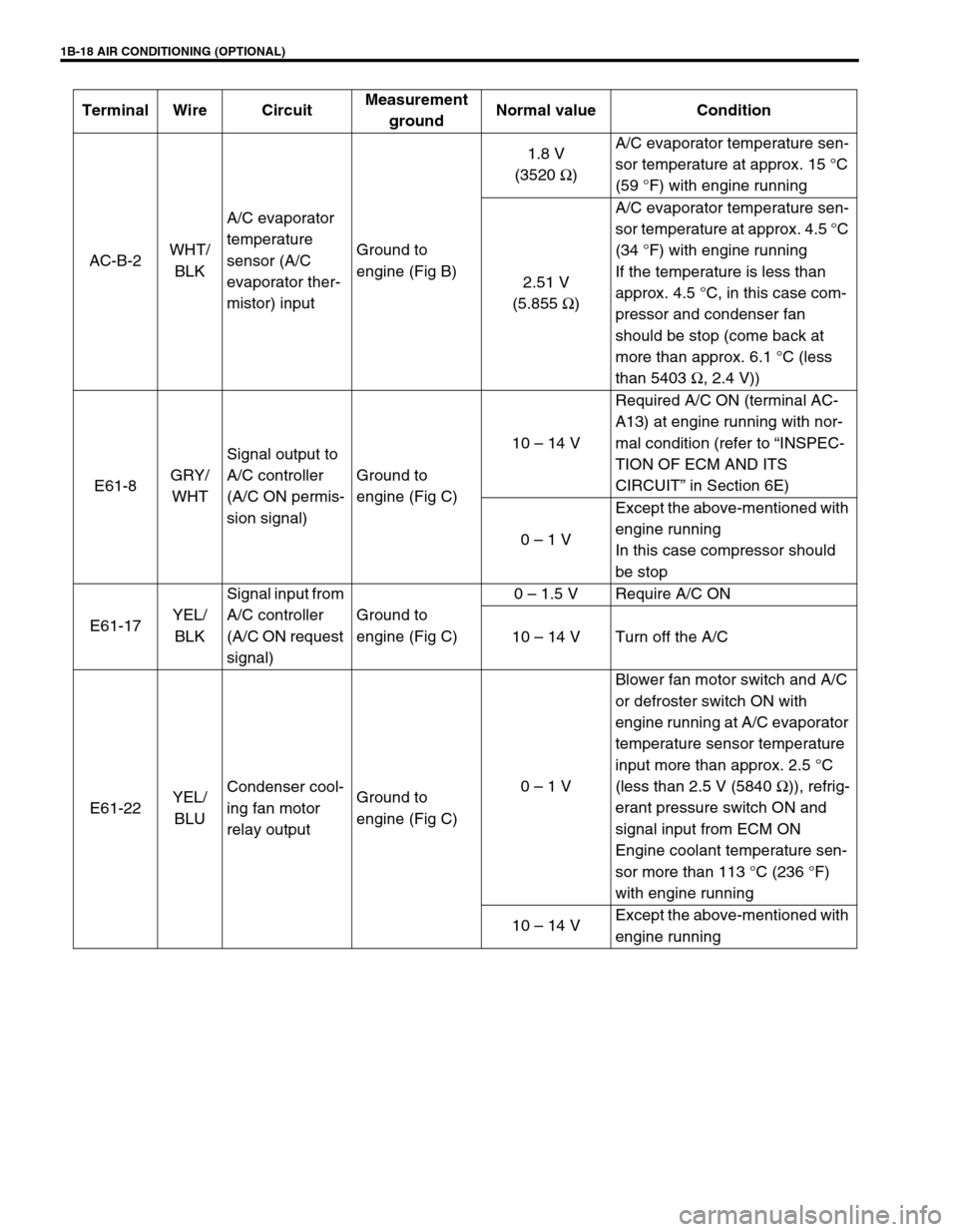
Terminal Wire CircuitMeasurement
groundNormal value Condition
AC-B-2WHT/
BLKA/C evaporator
temperature
sensor (A/C
evaporator ther-
mistor) inputGround to
engine (Fig B)1.8 V
(3520 Ω)A/C evaporator temperature sen-
sor temperature at approx. 15 °C
(59 °F) with engine running
2.51 V
(5.855 Ω)A/C evaporator temperature sen-
sor temperature at approx. 4.5 °C
(34 °F) with engine running
If the temperature is less than
approx. 4.5 °C, in this case com-
pressor and condenser fan
should be stop (come back at
more than approx. 6.1 °C (less
than 5403 Ω, 2.4 V))
E61-8GRY/
WHTSignal output to
A/C controller
(A/C ON permis-
sion signal)Ground to
engine (Fig C)10 – 14 VRequired A/C ON (terminal AC-
A13) at engine running with nor-
mal condition (refer to “INSPEC-
TION OF ECM AND ITS
CIRCUIT” in Section 6E)
0 – 1 VExcept the above-mentioned with
engine running
In this case compressor should
be stop
E61-17YEL/
BLKSignal input from
A/C controller
(A/C ON request
signal)Ground to
engine (Fig C)0 – 1.5 V Require A/C ON
10 – 14 V Turn off the A/C
E61-22YEL/
BLUCondenser cool-
ing fan motor
relay outputGround to
engine (Fig C)0 – 1 VBlower fan motor switch and A/C
or defroster switch ON with
engine running at A/C evaporator
temperature sensor temperature
input more than approx. 2.5 °C
(less than 2.5 V (5840 Ω)), refrig-
erant pressure switch ON and
signal input from ECM ON
Engine coolant temperature sen-
sor more than 113 °C (236 °F)
with engine running
10 – 14 VExcept the above-mentioned with
engine running
Page 50 of 656
AIR CONDITIONING (OPTIONAL) 1B-25
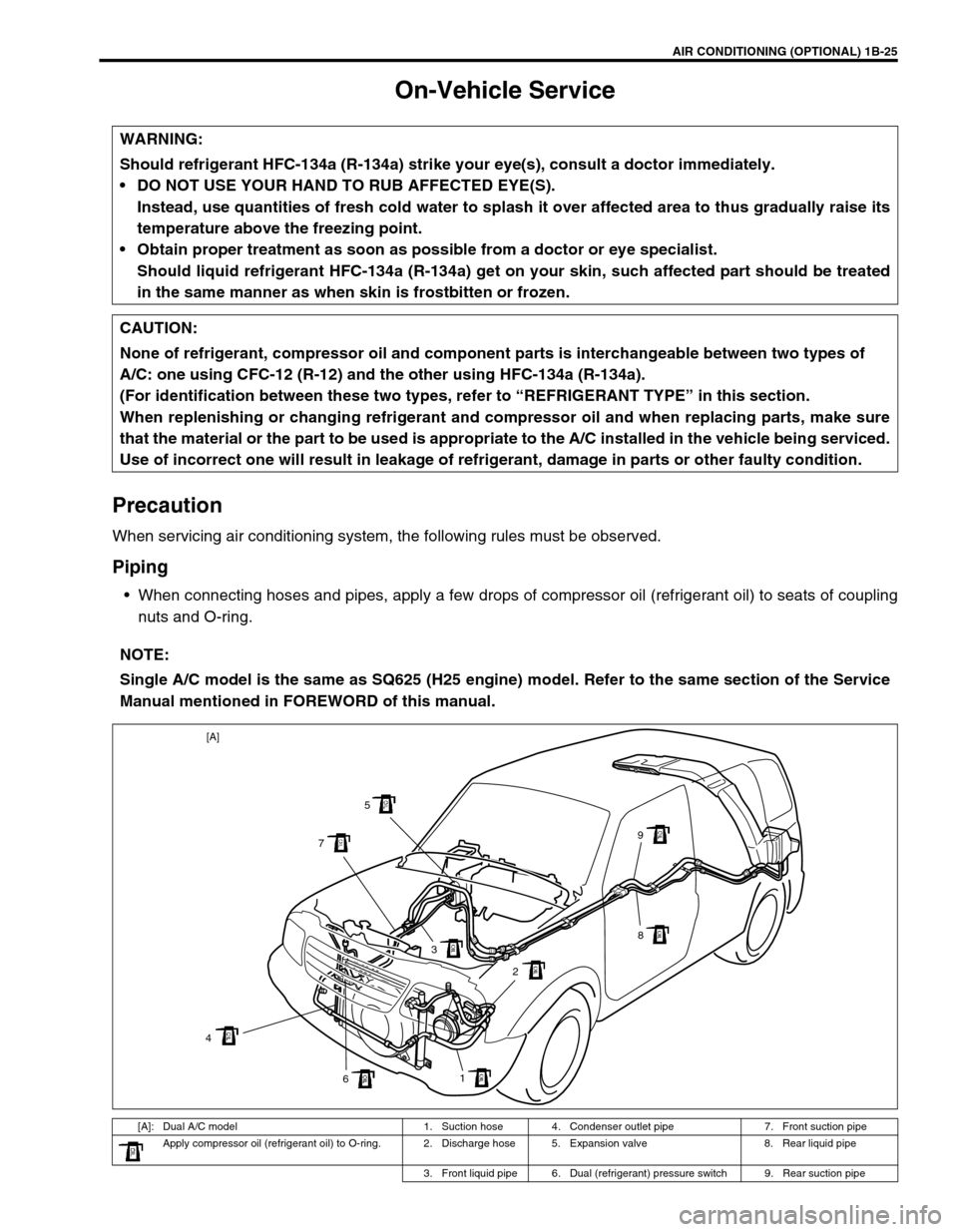
On-Vehicle Service
Precaution
When servicing air conditioning system, the following rules must be observed.
Piping
When connecting hoses and pipes, apply a few drops of compressor oil (refrigerant oil) to seats of coupling
nuts and O-ring. WARNING:
Should refrigerant HFC-134a (R-134a) strike your eye(s), consult a doctor immediately.
DO NOT USE YOUR HAND TO RUB AFFECTED EYE(S).
Instead, use quantities of fresh cold water to splash it over affected area to thus gradually raise its
temperature above the freezing point.
Obtain proper treatment as soon as possible from a doctor or eye specialist.
Should liquid refrigerant HFC-134a (R-134a) get on your skin, such affected part should be treated
in the same manner as when skin is frostbitten or frozen.
CAUTION:
None of refrigerant, compressor oil and component parts is interchangeable between two types of
A/C: one using CFC-12 (R-12) and the other using HFC-134a (R-134a).
(For identification between these two types, refer to “REFRIGERANT TYPE” in this section.
When replenishing or changing refrigerant and compressor oil and when replacing parts, make sure
that the material or the part to be used is appropriate to the A/C installed in the vehicle being serviced.
Use of incorrect one will result in leakage of refrigerant, damage in parts or other faulty condition.
NOTE:
Single A/C model is the same as SQ625 (H25 engine) model. Refer to the same section of the Service
Manual mentioned in FOREWORD of this manual.
[A]: Dual A/C model 1. Suction hose 4. Condenser outlet pipe 7. Front suction pipe
Apply compressor oil (refrigerant oil) to O-ring. 2. Discharge hose 5. Expansion valve 8. Rear liquid pipe
3. Front liquid pipe 6. Dual (refrigerant) pressure switch 9. Rear suction pipe
1
6 43 75
9
8
2 [A]
Page 59 of 656
1B-34 AIR CONDITIONING (OPTIONAL)
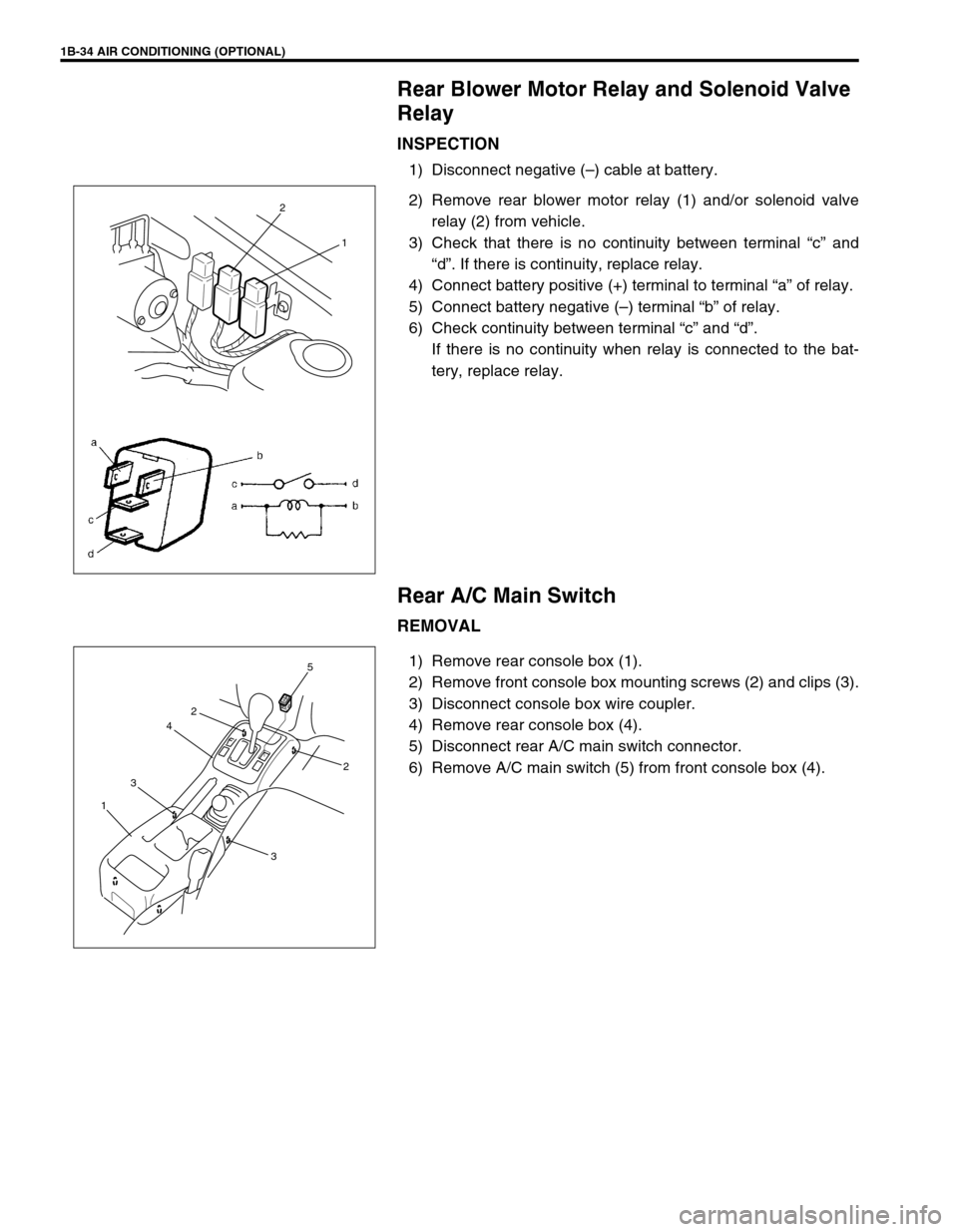
Rear Blower Motor Relay and Solenoid Valve
Relay
INSPECTION
1) Disconnect negative (–) cable at battery.
2) Remove rear blower motor relay (1) and/or solenoid valve
relay (2) from vehicle.
3) Check that there is no continuity between terminal “c” and
“d”. If there is continuity, replace relay.
4) Connect battery positive (+) terminal to terminal “a” of relay.
5) Connect battery negative (–) terminal “b” of relay.
6) Check continuity between terminal “c” and “d”.
If there is no continuity when relay is connected to the bat-
tery, replace relay.
Rear A/C Main Switch
REMOVAL
1) Remove rear console box (1).
2) Remove front console box mounting screws (2) and clips (3).
3) Disconnect console box wire coupler.
4) Remove rear console box (4).
5) Disconnect rear A/C main switch connector.
6) Remove A/C main switch (5) from front console box (4).
2
1
2
4
3
15
2
3
Page 60 of 656
AIR CONDITIONING (OPTIONAL) 1B-35
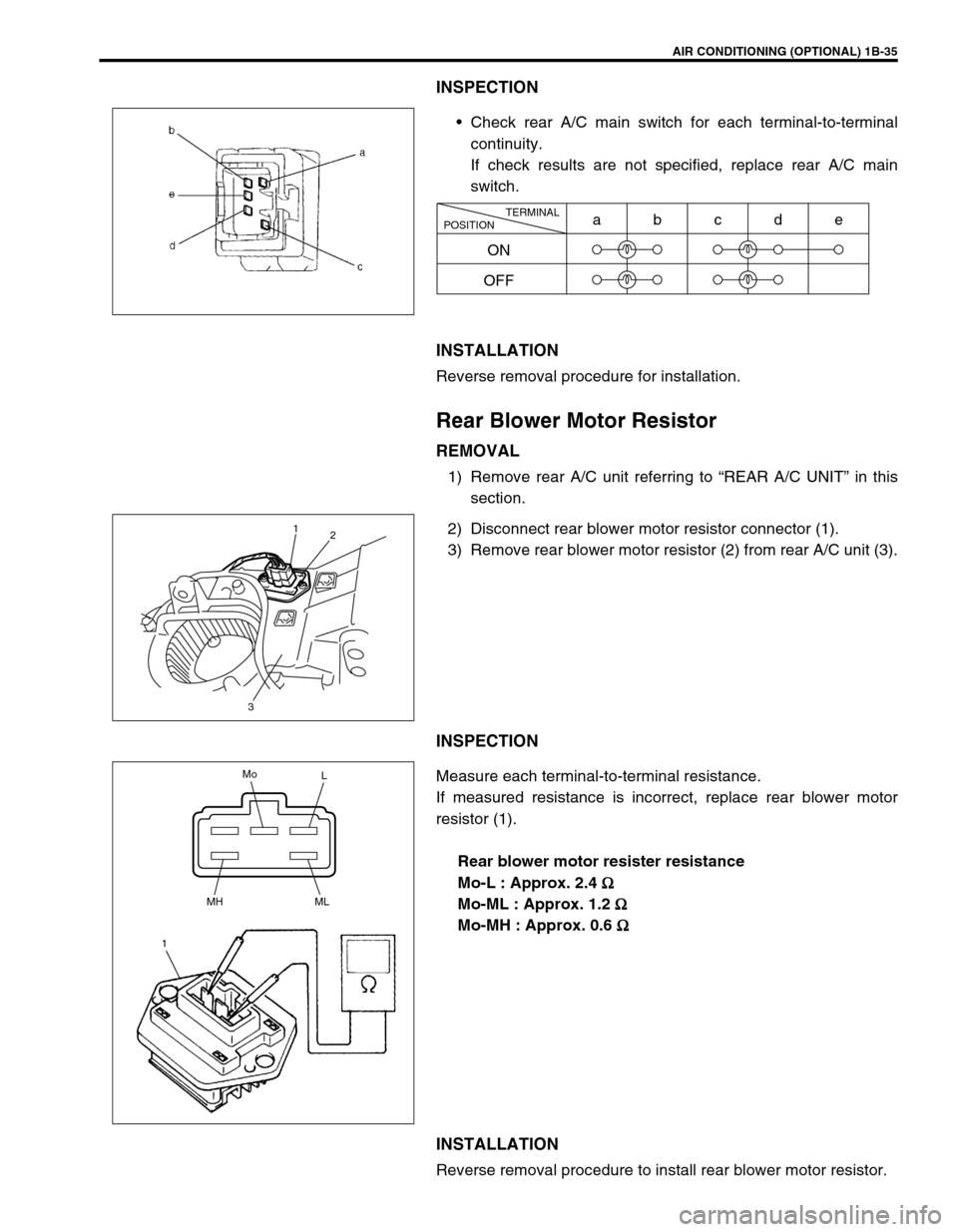
INSPECTION
Check rear A/C main switch for each terminal-to-terminal
continuity.
If check results are not specified, replace rear A/C main
switch.
INSTALLATION
Reverse removal procedure for installation.
Rear Blower Motor Resistor
REMOVAL
1) Remove rear A/C unit referring to “REAR A/C UNIT” in this
section.
2) Disconnect rear blower motor resistor connector (1).
3) Remove rear blower motor resistor (2) from rear A/C unit (3).
INSPECTION
Measure each terminal-to-terminal resistance.
If measured resistance is incorrect, replace rear blower motor
resistor (1).
Rear blower motor resister resistance
Mo-L : Approx. 2.4
Ω
ΩΩ Ω
Mo-ML : Approx. 1.2
Ω
ΩΩ Ω
Mo-MH : Approx. 0.6
Ω
ΩΩ Ω
INSTALLATION
Reverse removal procedure to install rear blower motor resistor.
TERMINAL
POSITION
ON
OFFabcde
1
2
3
Mo
L
MH
1ML
Page 61 of 656
1B-36 AIR CONDITIONING (OPTIONAL)
Rear Blower Motor Switch
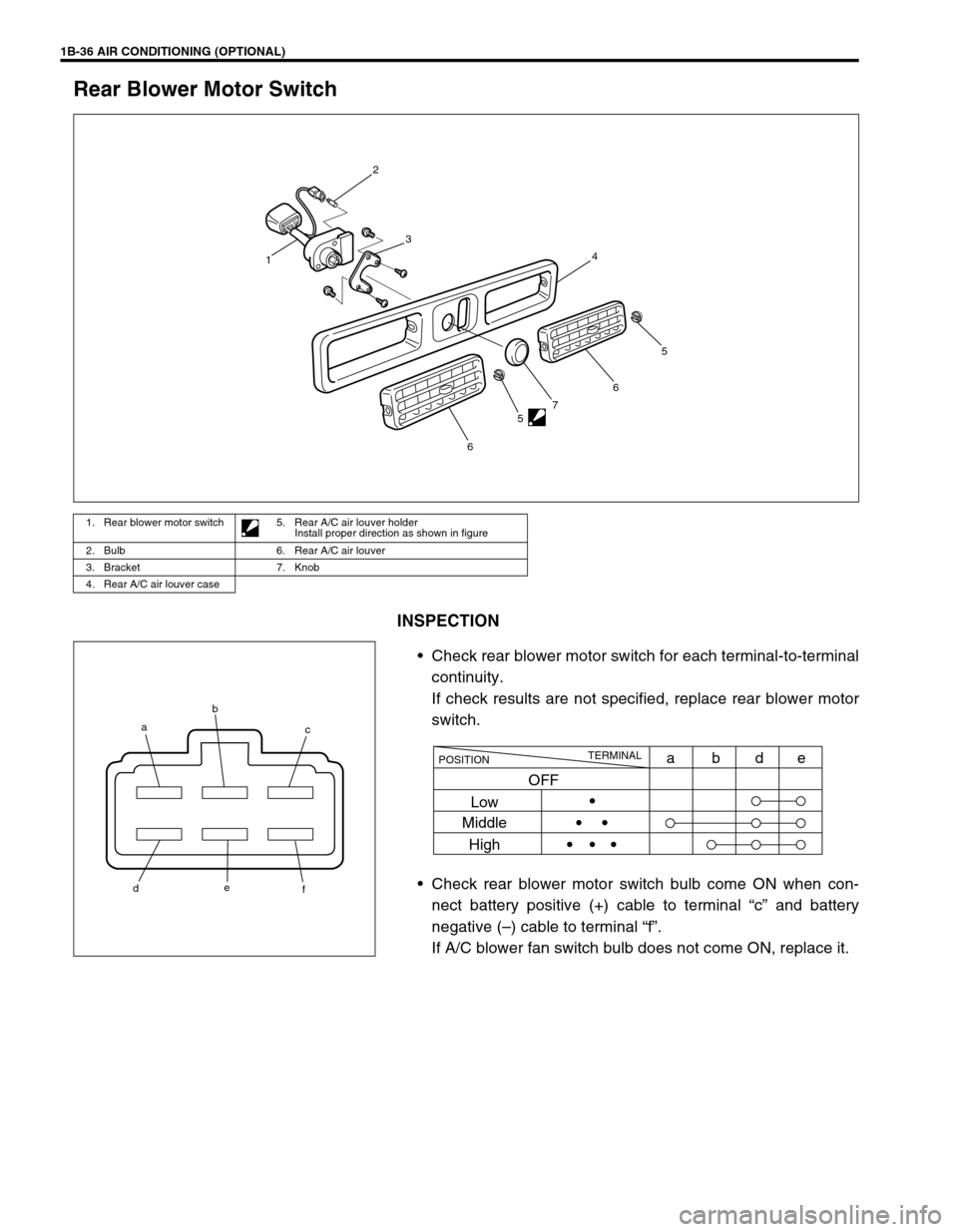
INSPECTION
Check rear blower motor switch for each terminal-to-terminal
continuity.
If check results are not specified, replace rear blower motor
switch.
Check rear blower motor switch bulb come ON when con-
nect battery positive (+) cable to terminal “c” and battery
negative (–) cable to terminal “f”.
If A/C blower fan switch bulb does not come ON, replace it.
1. Rear blower motor switch 5. Rear A/C air louver holder
Install proper direction as shown in figure
2. Bulb 6. Rear A/C air louver
3. Bracket 7. Knob
4. Rear A/C air louver case
2
13
4
66
7
55
ab
f e
dc
TERMINAL
POSITION
Low
Middle
Highabde
OFF