regulator SUZUKI GRAND VITARA 1999 2.G Owner's Manual
[x] Cancel search | Manufacturer: SUZUKI, Model Year: 1999, Model line: GRAND VITARA, Model: SUZUKI GRAND VITARA 1999 2.GPages: 656, PDF Size: 14.31 MB
Page 424 of 656
AUTOMATIC TRANSMISSION (4 A/T) 7B1-15
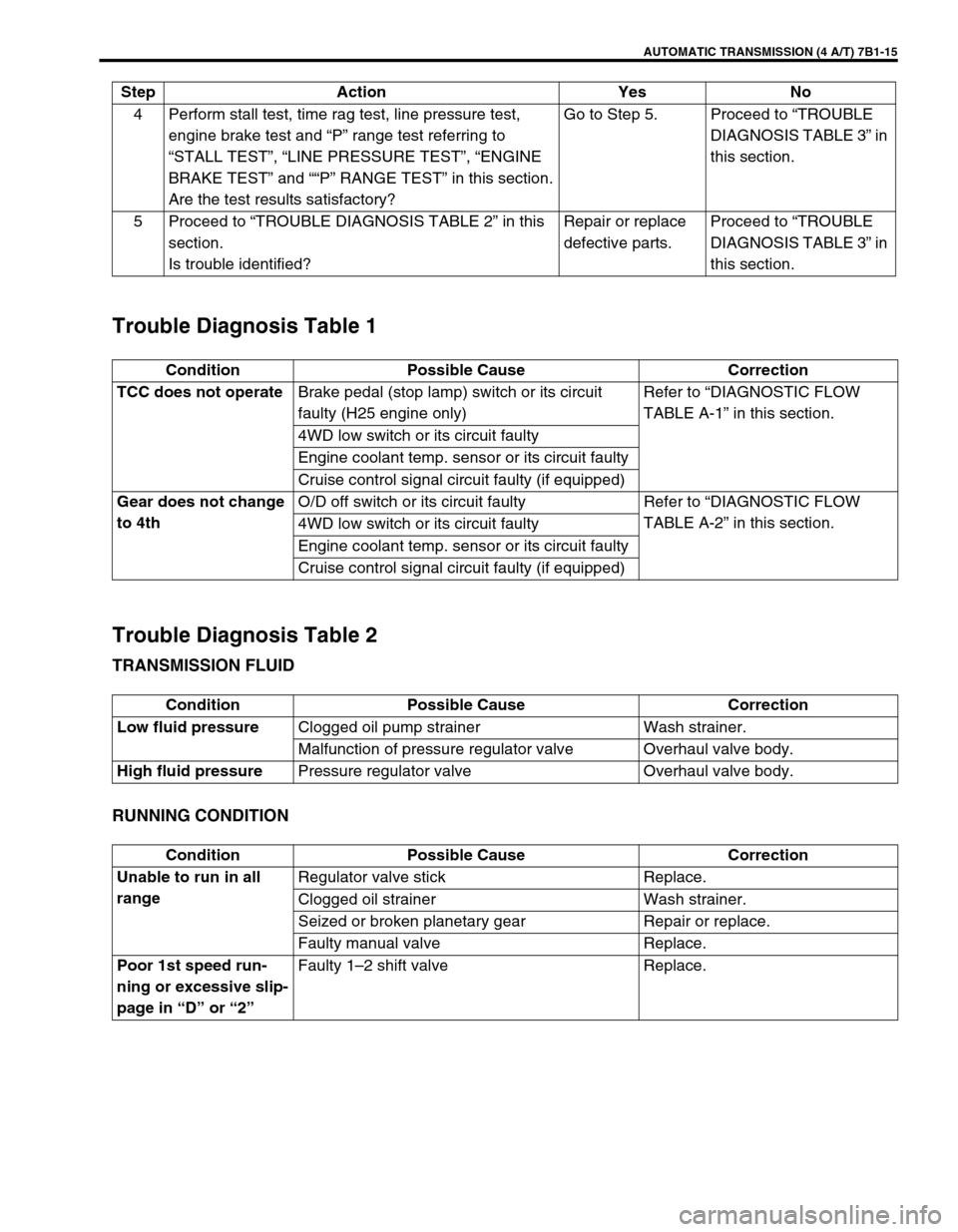
Trouble Diagnosis Table 1
Trouble Diagnosis Table 2
TRANSMISSION FLUID
RUNNING CONDITION
4 Perform stall test, time rag test, line pressure test,
engine brake test and “P” range test referring to
“STALL TEST”, “LINE PRESSURE TEST”, “ENGINE
BRAKE TEST” and ““P” RANGE TEST” in this section.
Are the test results satisfactory?Go to Step 5. Proceed to “TROUBLE
DIAGNOSIS TABLE 3” in
this section.
5 Proceed to “TROUBLE DIAGNOSIS TABLE 2” in this
section.
Is trouble identified?Repair or replace
defective parts.Proceed to “TROUBLE
DIAGNOSIS TABLE 3” in
this section. Step Action Yes No
Condition Possible Cause Correction
TCC does not operateBrake pedal (stop lamp) switch or its circuit
faulty (H25 engine only)Refer to “DIAGNOSTIC FLOW
TABLE A-1” in this section.
4WD low switch or its circuit faulty
Engine coolant temp. sensor or its circuit faulty
Cruise control signal circuit faulty (if equipped)
Gear does not change
to 4thO/D off switch or its circuit faulty Refer to “DIAGNOSTIC FLOW
TABLE A-2” in this section.
4WD low switch or its circuit faulty
Engine coolant temp. sensor or its circuit faulty
Cruise control signal circuit faulty (if equipped)
Condition Possible Cause Correction
Low fluid pressureClogged oil pump strainer Wash strainer.
Malfunction of pressure regulator valve Overhaul valve body.
High fluid pressurePressure regulator valve Overhaul valve body.
Condition Possible Cause Correction
Unable to run in all
rangeRegulator valve stick Replace.
Clogged oil strainer Wash strainer.
Seized or broken planetary gear Repair or replace.
Faulty manual valve Replace.
Poor 1st speed run-
ning or excessive slip-
page in “D” or “2”Faulty 1–2 shift valve Replace.
Page 425 of 656
7B1-16 AUTOMATIC TRANSMISSION (4 A/T)
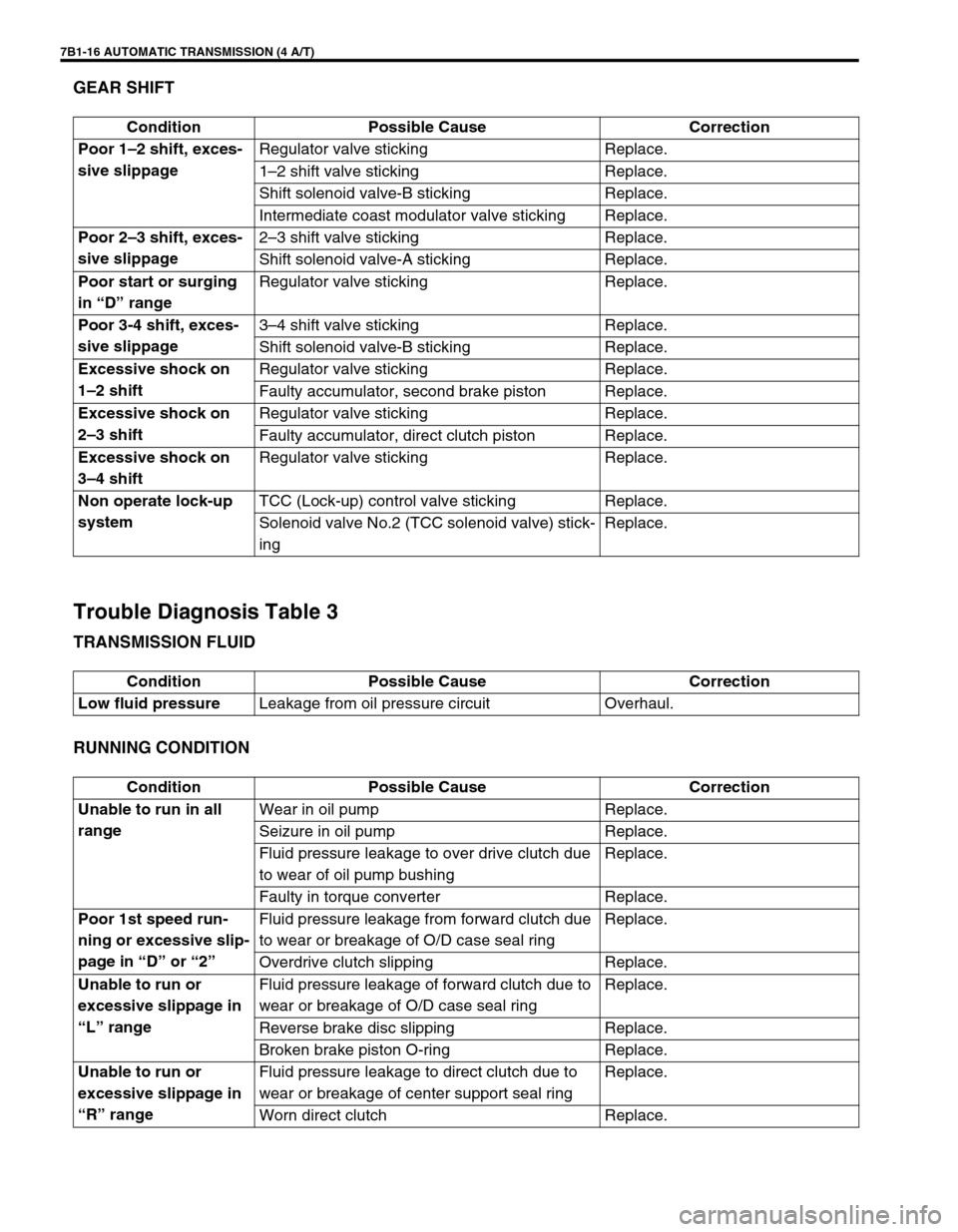
GEAR SHIFT
Trouble Diagnosis Table 3
TRANSMISSION FLUID
RUNNING CONDITION
Condition Possible Cause Correction
Poor 1–2 shift, exces-
sive slippageRegulator valve sticking Replace.
1–2 shift valve sticking Replace.
Shift solenoid valve-B sticking Replace.
Intermediate coast modulator valve sticking Replace.
Poor 2–3 shift, exces-
sive slippage2–3 shift valve sticking Replace.
Shift solenoid valve-A sticking Replace.
Poor start or surging
in “D” rangeRegulator valve sticking Replace.
Poor 3-4 shift, exces-
sive slippage3–4 shift valve sticking Replace.
Shift solenoid valve-B sticking Replace.
Excessive shock on
1–2 shiftRegulator valve sticking Replace.
Faulty accumulator, second brake piston Replace.
Excessive shock on
2–3 shiftRegulator valve sticking Replace.
Faulty accumulator, direct clutch piston Replace.
Excessive shock on
3–4 shiftRegulator valve sticking Replace.
Non operate lock-up
systemTCC (Lock-up) control valve sticking Replace.
Solenoid valve No.2 (TCC solenoid valve) stick-
ingReplace.
Condition Possible Cause Correction
Low fluid pressureLeakage from oil pressure circuit Overhaul.
Condition Possible Cause Correction
Unable to run in all
rangeWear in oil pump Replace.
Seizure in oil pump Replace.
Fluid pressure leakage to over drive clutch due
to wear of oil pump bushingReplace.
Faulty in torque converter Replace.
Poor 1st speed run-
ning or excessive slip-
page in “D” or “2”Fluid pressure leakage from forward clutch due
to wear or breakage of O/D case seal ringReplace.
Overdrive clutch slipping Replace.
Unable to run or
excessive slippage in
“L” rangeFluid pressure leakage of forward clutch due to
wear or breakage of O/D case seal ringReplace.
Reverse brake disc slipping Replace.
Broken brake piston O-ring Replace.
Unable to run or
excessive slippage in
“R” rangeFluid pressure leakage to direct clutch due to
wear or breakage of center support seal ringReplace.
Worn direct clutch Replace.
Page 449 of 656
7B1-40 AUTOMATIC TRANSMISSION (4 A/T)
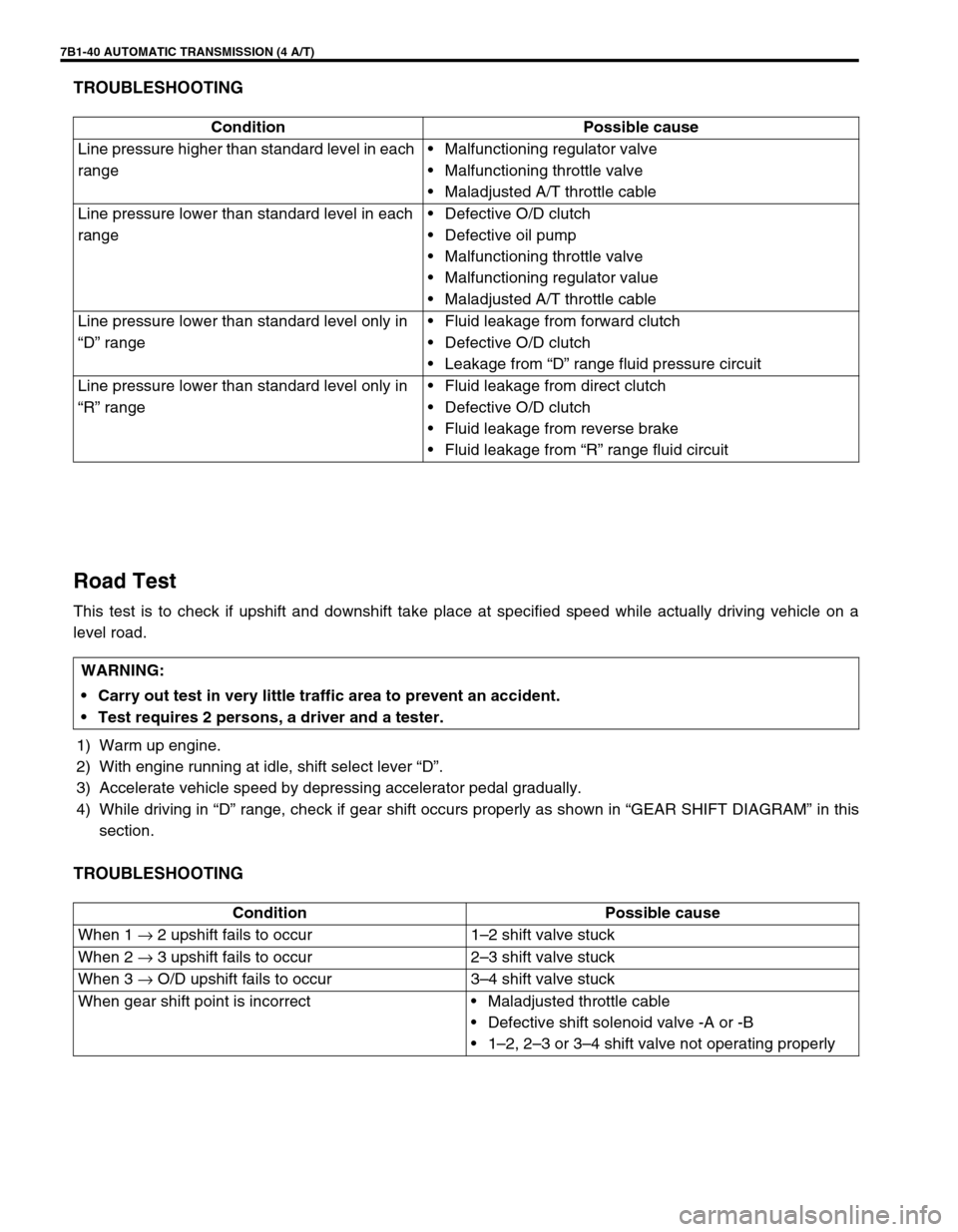
TROUBLESHOOTING
Road Test
This test is to check if upshift and downshift take place at specified speed while actually driving vehicle on a
level road.
1) Warm up engine.
2) With engine running at idle, shift select lever “D”.
3) Accelerate vehicle speed by depressing accelerator pedal gradually.
4) While driving in “D” range, check if gear shift occurs properly as shown in “GEAR SHIFT DIAGRAM” in this
section.
TROUBLESHOOTING
Condition Possible cause
Line pressure higher than standard level in each
range•Malfunctioning regulator valve
•Malfunctioning throttle valve
•Maladjusted A/T throttle cable
Line pressure lower than standard level in each
range•Defective O/D clutch
•Defective oil pump
•Malfunctioning throttle valve
•Malfunctioning regulator value
•Maladjusted A/T throttle cable
Line pressure lower than standard level only in
“D” range•Fluid leakage from forward clutch
•Defective O/D clutch
•Leakage from “D” range fluid pressure circuit
Line pressure lower than standard level only in
“R” range•Fluid leakage from direct clutch
•Defective O/D clutch
•Fluid leakage from reverse brake
•Fluid leakage from “R” range fluid circuit
WARNING:
Carry out test in very little traffic area to prevent an accident.
Test requires 2 persons, a driver and a tester.
Condition Possible cause
When 1 → 2 upshift fails to occur 1–2 shift valve stuck
When 2 → 3 upshift fails to occur 2–3 shift valve stuck
When 3 → O/D upshift fails to occur 3–4 shift valve stuck
When gear shift point is incorrect•Maladjusted throttle cable
•Defective shift solenoid valve -A or -B
•1–2, 2–3 or 3–4 shift valve not operating properly
Page 463 of 656
7B1-54 AUTOMATIC TRANSMISSION (4 A/T)
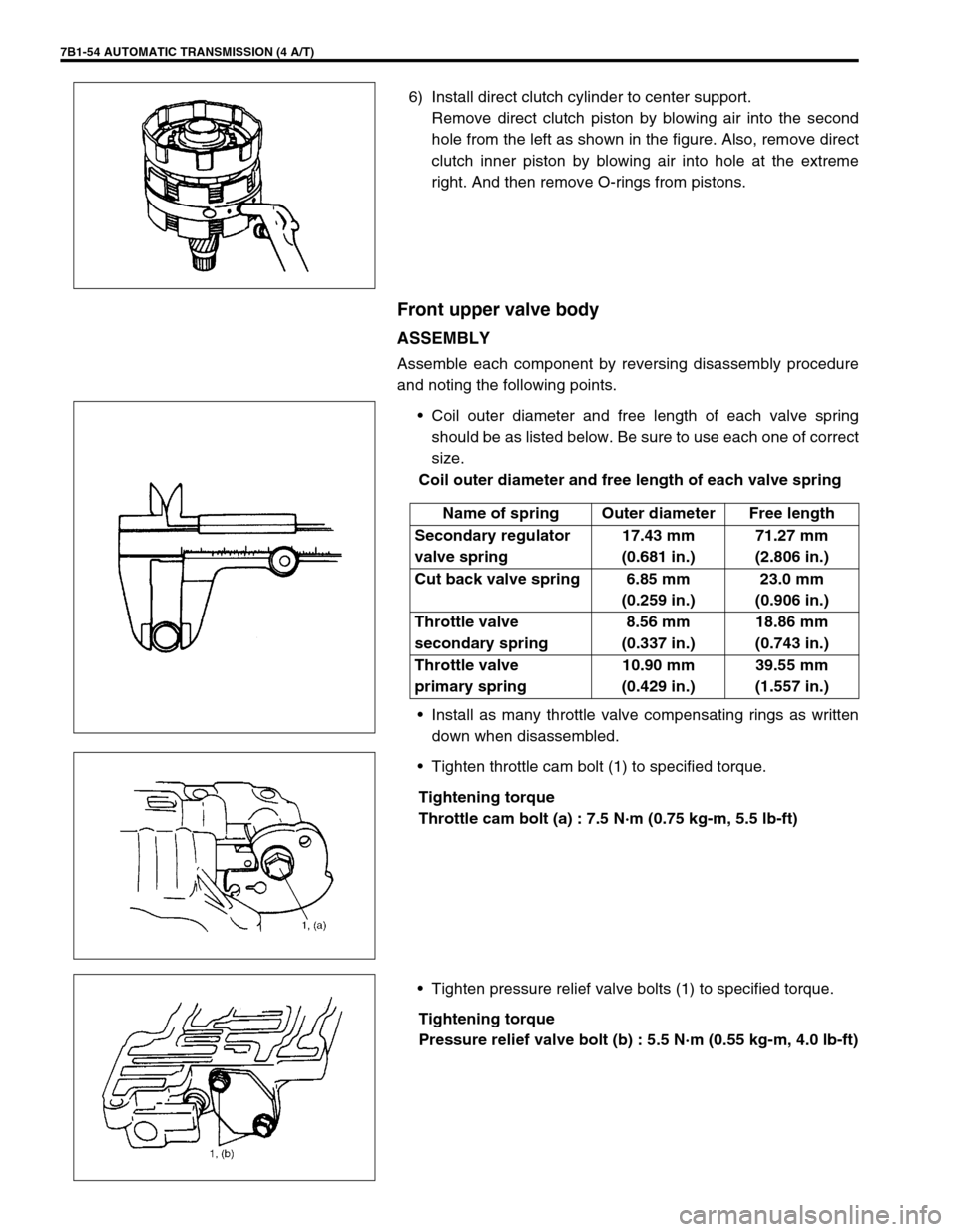
6) Install direct clutch cylinder to center support.
Remove direct clutch piston by blowing air into the second
hole from the left as shown in the figure. Also, remove direct
clutch inner piston by blowing air into hole at the extreme
right. And then remove O-rings from pistons.
Front upper valve body
ASSEMBLY
Assemble each component by reversing disassembly procedure
and noting the following points.
•Coil outer diameter and free length of each valve spring
should be as listed below. Be sure to use each one of correct
size.
Coil outer diameter and free length of each valve spring
•Install as many throttle valve compensating rings as written
down when disassembled.
•Tighten throttle cam bolt (1) to specified torque.
Tightening torque
Throttle cam bolt (a) : 7.5 N·m (0.75 kg-m, 5.5 lb-ft)
•Tighten pressure relief valve bolts (1) to specified torque.
Tightening torque
Pressure relief valve bolt (b) : 5.5 N·m (0.55 kg-m, 4.0 lb-ft)
Name of spring Outer diameter Free length
Secondary regulator
valve spring17.43 mm
(0.681 in.)71.27 mm
(2.806 in.)
Cut back valve spring 6.85 mm
(0.259 in.)23.0 mm
(0.906 in.)
Throttle valve
secondary spring8.56 mm
(0.337 in.)18.86 mm
(0.743 in.)
Throttle valve
primary spring10.90 mm
(0.429 in.)39.55 mm
(1.557 in.)
Page 464 of 656
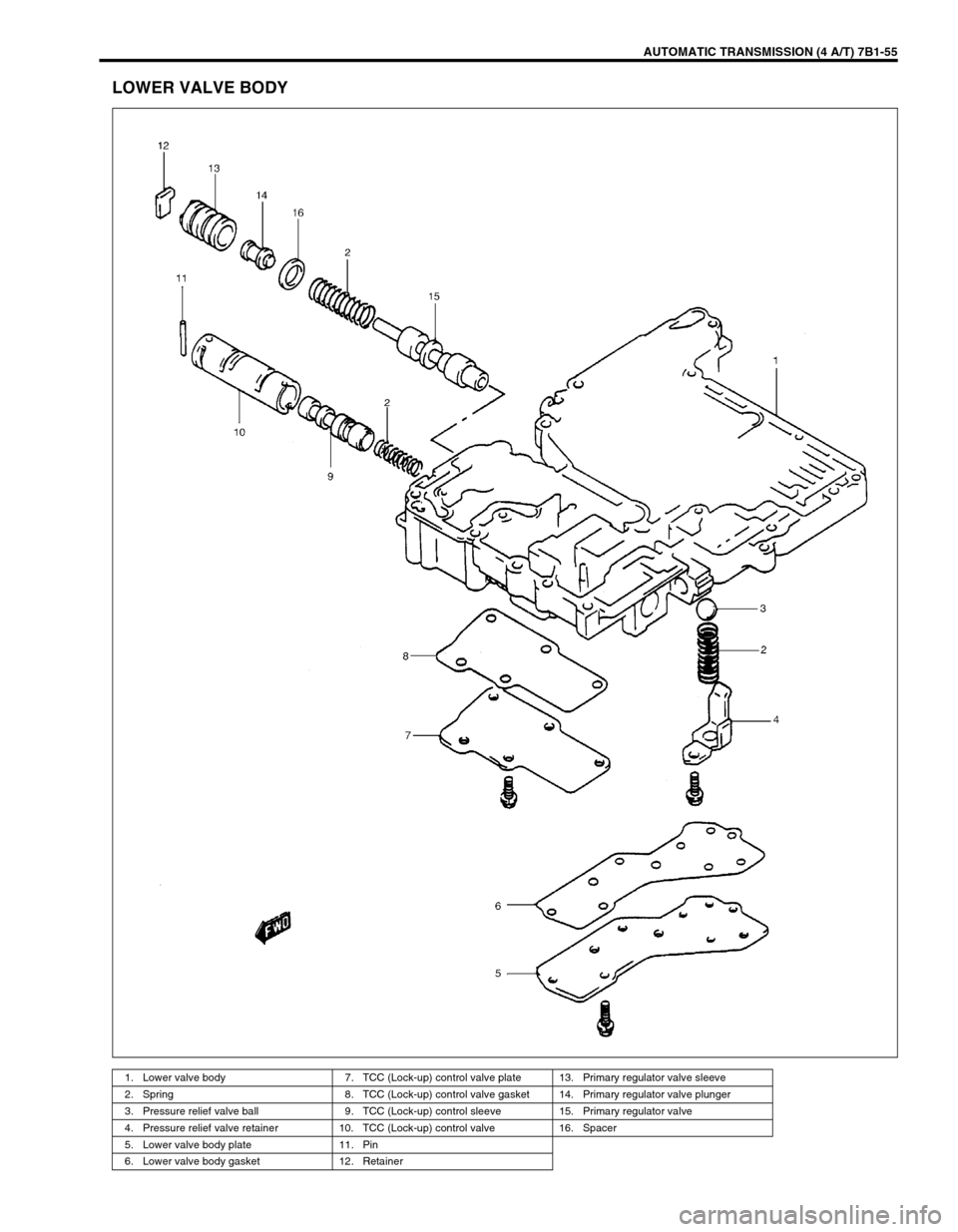
AUTOMATIC TRANSMISSION (4 A/T) 7B1-55
LOWER VALVE BODY
1. Lower valve body 7. TCC (Lock-up) control valve plate 13. Primary regulator valve sleeve
2. Spring 8. TCC (Lock-up) control valve gasket 14. Primary regulator valve plunger
3. Pressure relief valve ball 9. TCC (Lock-up) control sleeve 15. Primary regulator valve
4. Pressure relief valve retainer 10. TCC (Lock-up) control valve 16. Spacer
5. Lower valve body plate 11. Pin
6. Lower valve body gasket 12. Retainer
Page 465 of 656
7B1-56 AUTOMATIC TRANSMISSION (4 A/T)
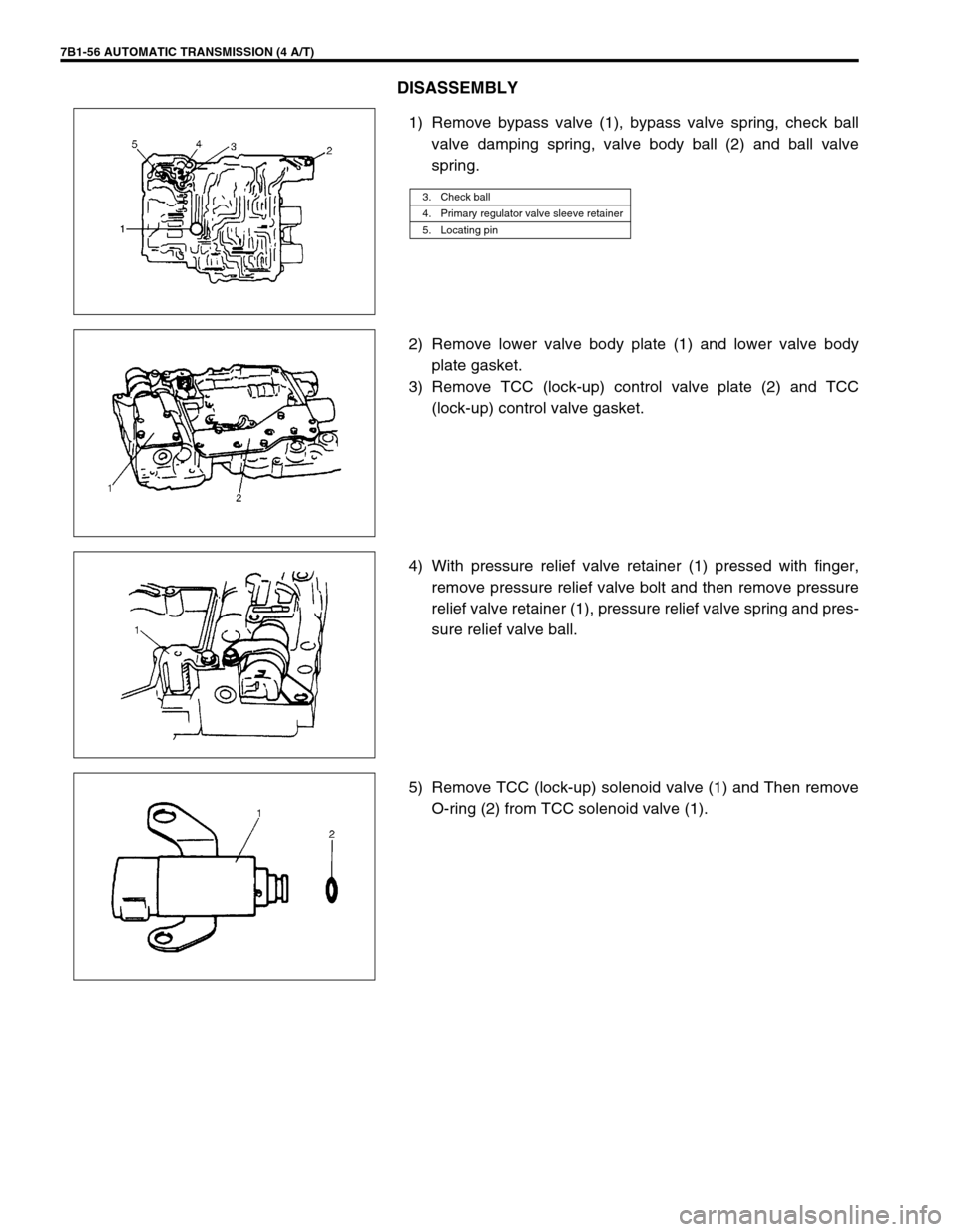
DISASSEMBLY
1) Remove bypass valve (1), bypass valve spring, check ball
valve damping spring, valve body ball (2) and ball valve
spring.
2) Remove lower valve body plate (1) and lower valve body
plate gasket.
3) Remove TCC (lock-up) control valve plate (2) and TCC
(lock-up) control valve gasket.
4) With pressure relief valve retainer (1) pressed with finger,
remove pressure relief valve bolt and then remove pressure
relief valve retainer (1), pressure relief valve spring and pres-
sure relief valve ball.
5) Remove TCC (lock-up) solenoid valve (1) and Then remove
O-ring (2) from TCC solenoid valve (1).
3. Check ball
4. Primary regulator valve sleeve retainer
5. Locating pin
Page 466 of 656
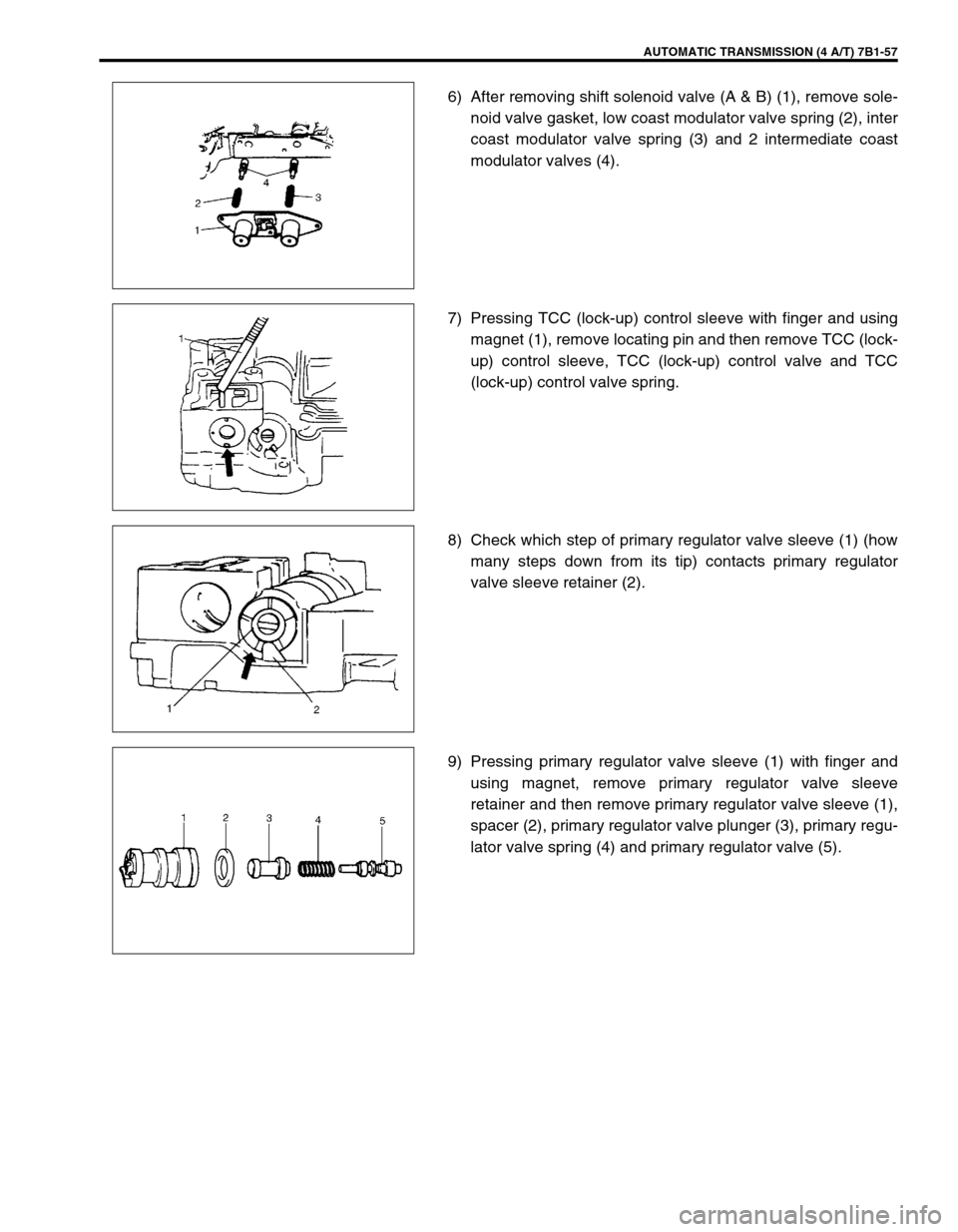
AUTOMATIC TRANSMISSION (4 A/T) 7B1-57
6) After removing shift solenoid valve (A & B) (1), remove sole-
noid valve gasket, low coast modulator valve spring (2), inter
coast modulator valve spring (3) and 2 intermediate coast
modulator valves (4).
7) Pressing TCC (lock-up) control sleeve with finger and using
magnet (1), remove locating pin and then remove TCC (lock-
up) control sleeve, TCC (lock-up) control valve and TCC
(lock-up) control valve spring.
8) Check which step of primary regulator valve sleeve (1) (how
many steps down from its tip) contacts primary regulator
valve sleeve retainer (2).
9) Pressing primary regulator valve sleeve (1) with finger and
using magnet, remove primary regulator valve sleeve
retainer and then remove primary regulator valve sleeve (1),
spacer (2), primary regulator valve plunger (3), primary regu-
lator valve spring (4) and primary regulator valve (5).
Page 467 of 656
7B1-58 AUTOMATIC TRANSMISSION (4 A/T)
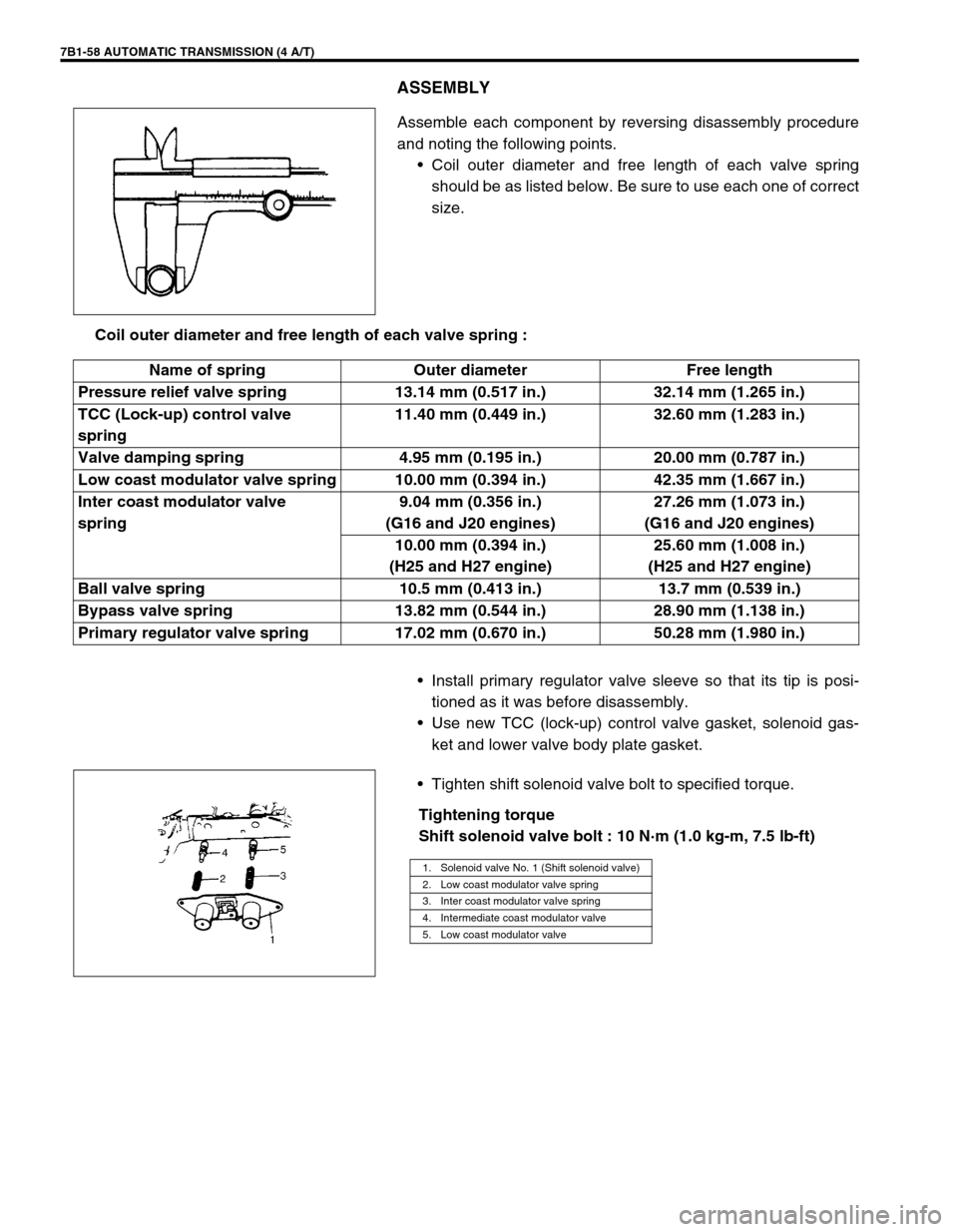
ASSEMBLY
Assemble each component by reversing disassembly procedure
and noting the following points.
•Coil outer diameter and free length of each valve spring
should be as listed below. Be sure to use each one of correct
size.
Coil outer diameter and free length of each valve spring :
•Install primary regulator valve sleeve so that its tip is posi-
tioned as it was before disassembly.
•Use new TCC (lock-up) control valve gasket, solenoid gas-
ket and lower valve body plate gasket.
•Tighten shift solenoid valve bolt to specified torque.
Tightening torque
Shift solenoid valve bolt : 10 N·m (1.0 kg-m, 7.5 lb-ft)
Name of spring Outer diameter Free length
Pressure relief valve spring 13.14 mm (0.517 in.) 32.14 mm (1.265 in.)
TCC (Lock-up) control valve
spring11.40 mm (0.449 in.) 32.60 mm (1.283 in.)
Valve damping spring 4.95 mm (0.195 in.) 20.00 mm (0.787 in.)
Low coast modulator valve spring 10.00 mm (0.394 in.) 42.35 mm (1.667 in.)
Inter coast modulator valve
spring9.04 mm (0.356 in.)
(G16 and J20 engines)27.26 mm (1.073 in.)
(G16 and J20 engines)
10.00 mm (0.394 in.)
(H25 and H27 engine)25.60 mm (1.008 in.)
(H25 and H27 engine)
Ball valve spring 10.5 mm (0.413 in.) 13.7 mm (0.539 in.)
Bypass valve spring 13.82 mm (0.544 in.) 28.90 mm (1.138 in.)
Primary regulator valve spring 17.02 mm (0.670 in.) 50.28 mm (1.980 in.)
1. Solenoid valve No. 1 (Shift solenoid valve)
2. Low coast modulator valve spring
3. Inter coast modulator valve spring
4. Intermediate coast modulator valve
5. Low coast modulator valve
Page 484 of 656
DIFFERENTIAL (FRONT) 7E-11
Unit Repair
Refer to the same section of “UNIT REPAIR MANUAL” mentioned in “FOREWORD” of this manual.
Tightening Torque Specification
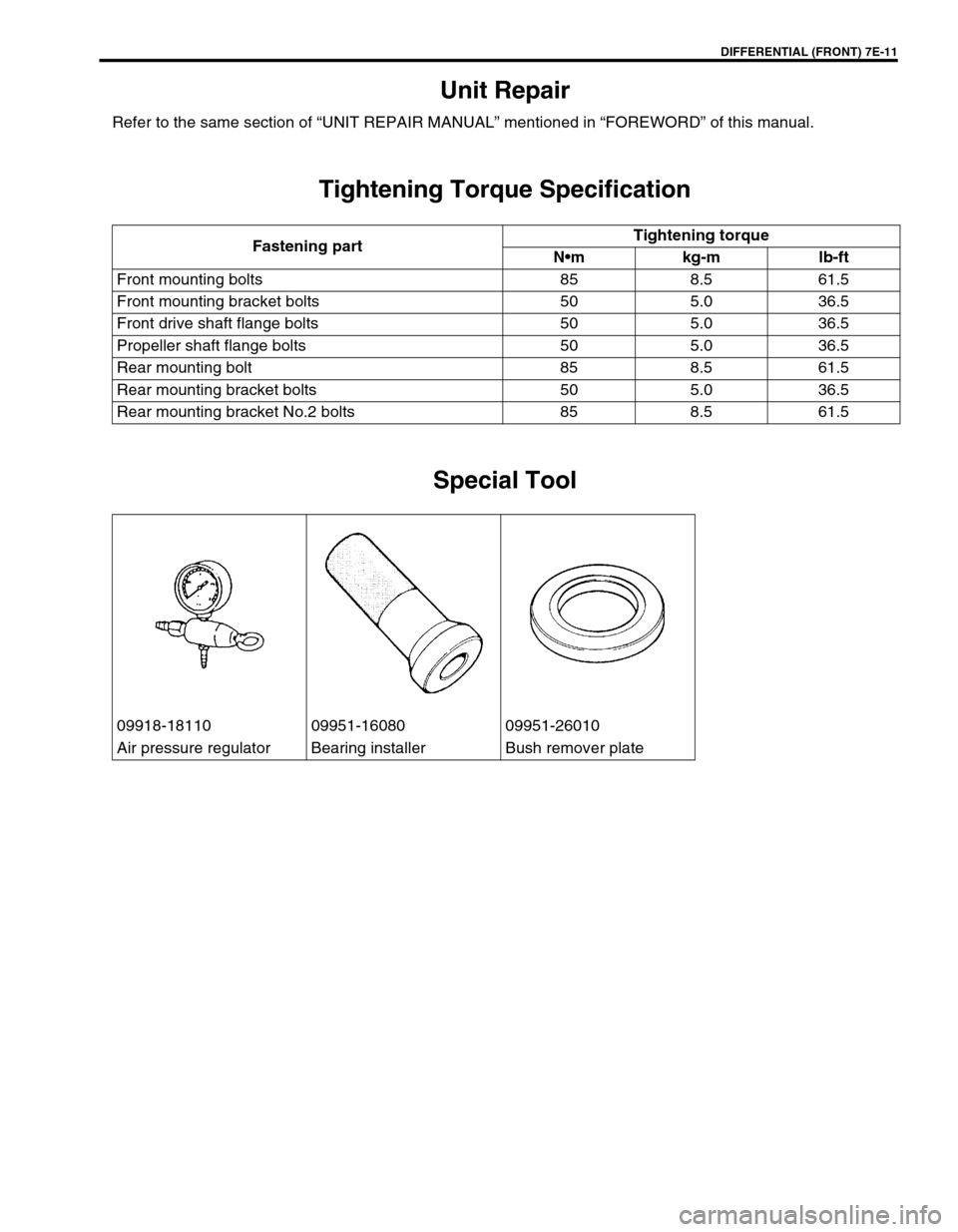
Special Tool
Fastening partTightening torque
Nm kg-m lb-ft
Front mounting bolts 85 8.5 61.5
Front mounting bracket bolts 50 5.0 36.5
Front drive shaft flange bolts 50 5.0 36.5
Propeller shaft flange bolts 50 5.0 36.5
Rear mounting bolt 85 8.5 61.5
Rear mounting bracket bolts 50 5.0 36.5
Rear mounting bracket No.2 bolts 85 8.5 61.5
09918-18110 09951-16080 09951-26010
Air pressure regulator Bearing installer Bush remover plate