regulator SUZUKI GRAND VITARA 1999 2.G User Guide
[x] Cancel search | Manufacturer: SUZUKI, Model Year: 1999, Model line: GRAND VITARA, Model: SUZUKI GRAND VITARA 1999 2.GPages: 656, PDF Size: 14.31 MB
Page 346 of 656
ENGINE AND EMISSION CONTROL SYSTEM (SEQUENTIAL MULTIPORT FUEL INJECTION FOR H27 ENGINE) 6E2-13
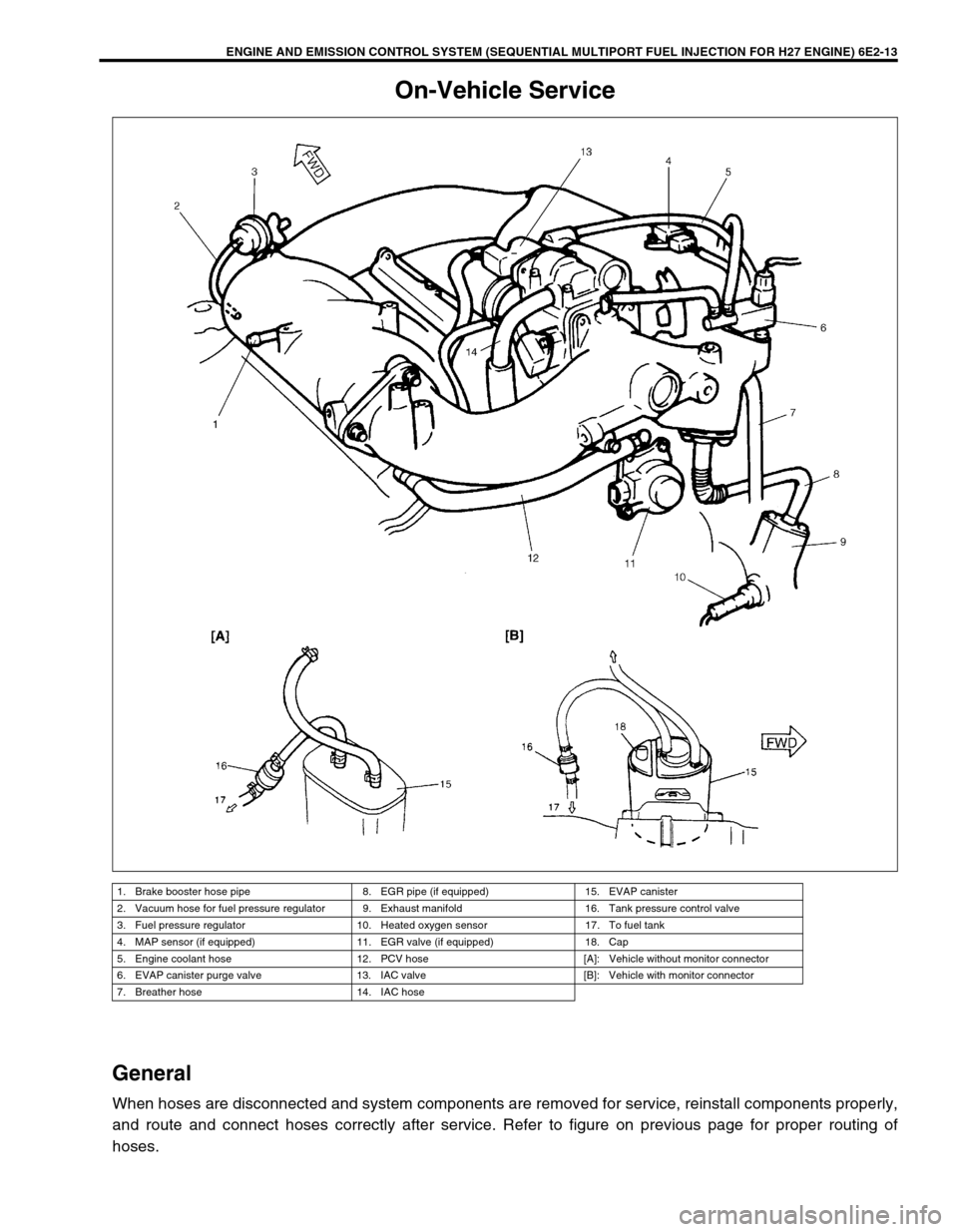
On-Vehicle Service
General
When hoses are disconnected and system components are removed for service, reinstall components properly,
and route and connect hoses correctly after service. Refer to figure on previous page for proper routing of
hoses.
1. Brake booster hose pipe 8. EGR pipe (if equipped) 15. EVAP canister
2. Vacuum hose for fuel pressure regulator 9. Exhaust manifold 16. Tank pressure control valve
3. Fuel pressure regulator 10. Heated oxygen sensor 17. To fuel tank
4. MAP sensor (if equipped) 11. EGR valve (if equipped) 18. Cap
5. Engine coolant hose 12. PCV hose [A]: Vehicle without monitor connector
6. EVAP canister purge valve 13. IAC valve [B]: Vehicle with monitor connector
7. Breather hose 14. IAC hose
Page 358 of 656
ENGINE AND EMISSION CONTROL SYSTEM (SEQUENTIAL MULTIPORT FUEL INJECTION FOR H27 ENGINE) 6E2-25
REMOVAL
Remove fuel tank from body according to procedure described in
Section 6C and remove fuel pump from fuel tank.
INSPECTION
Check fuel pump filter for evidence of dirt and contamination. If
present, clean and check for presence of dirt in fuel tank.
INSTALLATION
Install fuel pump to fuel tank and then install fuel tank to body
according to procedure described in “Section 6C”.
Fuel pressure regulator
REMOVAL
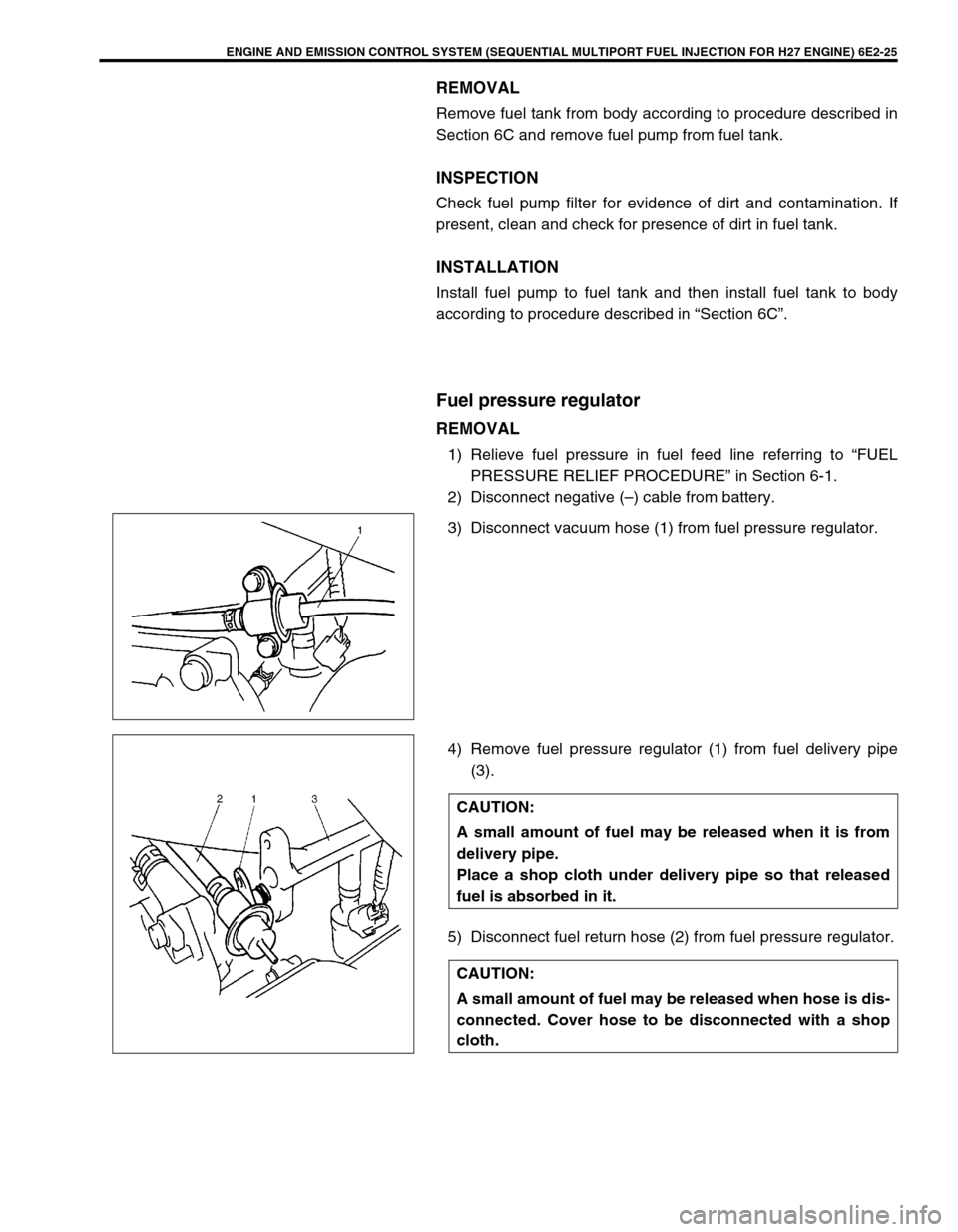
1) Relieve fuel pressure in fuel feed line referring to “FUEL
PRESSURE RELIEF PROCEDURE” in Section 6-1.
2) Disconnect negative (–) cable from battery.
3) Disconnect vacuum hose (1) from fuel pressure regulator.
4) Remove fuel pressure regulator (1) from fuel delivery pipe
(3).
5) Disconnect fuel return hose (2) from fuel pressure regulator.
CAUTION:
A small amount of fuel may be released when it is from
delivery pipe.
Place a shop cloth under delivery pipe so that released
fuel is absorbed in it.
CAUTION:
A small amount of fuel may be released when hose is dis-
connected. Cover hose to be disconnected with a shop
cloth.
Page 359 of 656
6E2-26 ENGINE AND EMISSION CONTROL SYSTEM (SEQUENTIAL MULTIPORT FUEL INJECTION FOR H27 ENGINE)
INSTALLATION
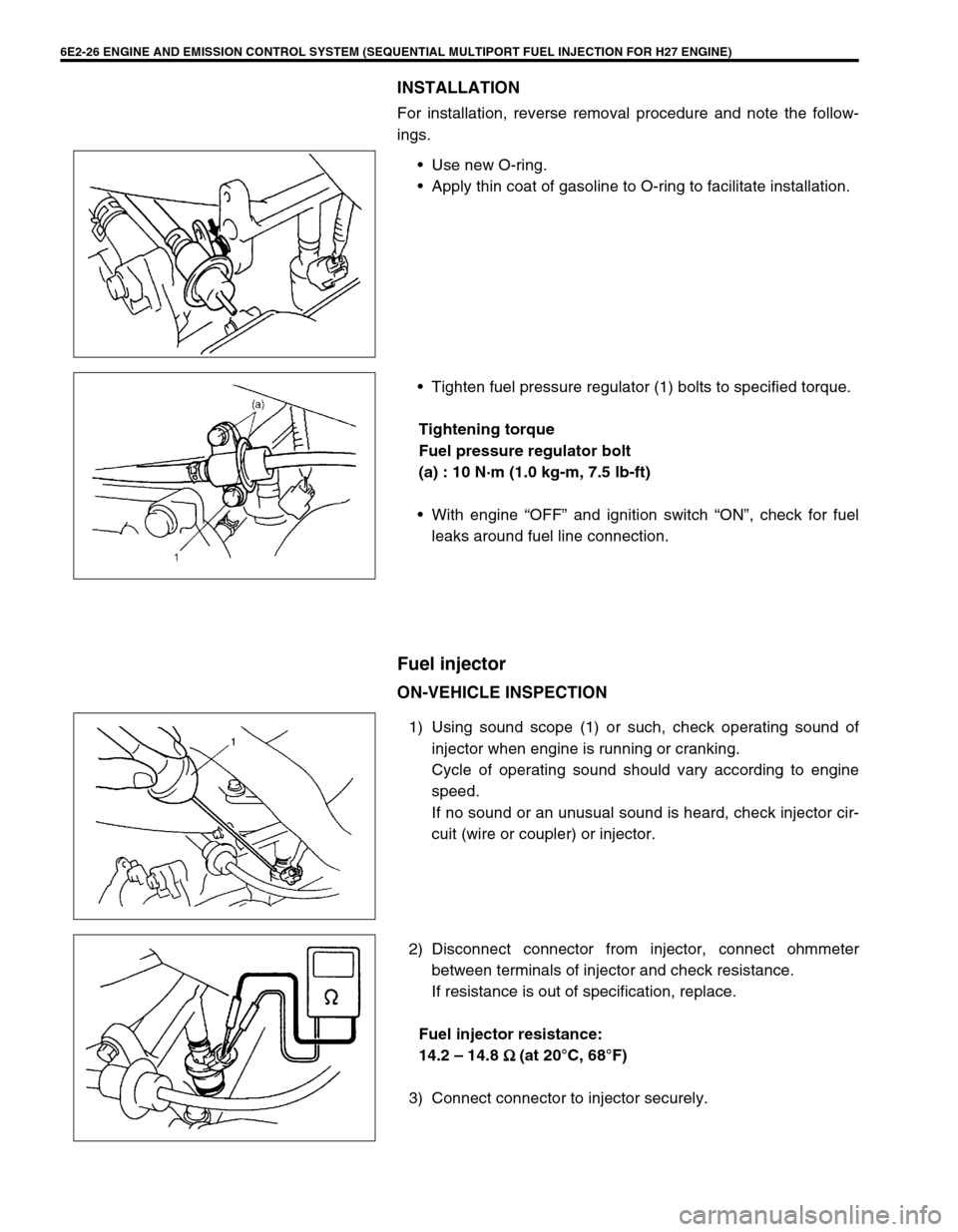
For installation, reverse removal procedure and note the follow-
ings.
•Use new O-ring.
•Apply thin coat of gasoline to O-ring to facilitate installation.
•Tighten fuel pressure regulator (1) bolts to specified torque.
Tightening torque
Fuel pressure regulator bolt
(a) : 10 N·m (1.0 kg-m, 7.5 lb-ft)
•With engine “OFF” and ignition switch “ON”, check for fuel
leaks around fuel line connection.
Fuel injector
ON-VEHICLE INSPECTION
1) Using sound scope (1) or such, check operating sound of
injector when engine is running or cranking.
Cycle of operating sound should vary according to engine
speed.
If no sound or an unusual sound is heard, check injector cir-
cuit (wire or coupler) or injector.
2) Disconnect connector from injector, connect ohmmeter
between terminals of injector and check resistance.
If resistance is out of specification, replace.
Fuel injector resistance:
14.2 – 14.8 Ω
Ω Ω Ω (at 20°C, 68°F)
3) Connect connector to injector securely.
Page 360 of 656
ENGINE AND EMISSION CONTROL SYSTEM (SEQUENTIAL MULTIPORT FUEL INJECTION FOR H27 ENGINE) 6E2-27
REMOVAL
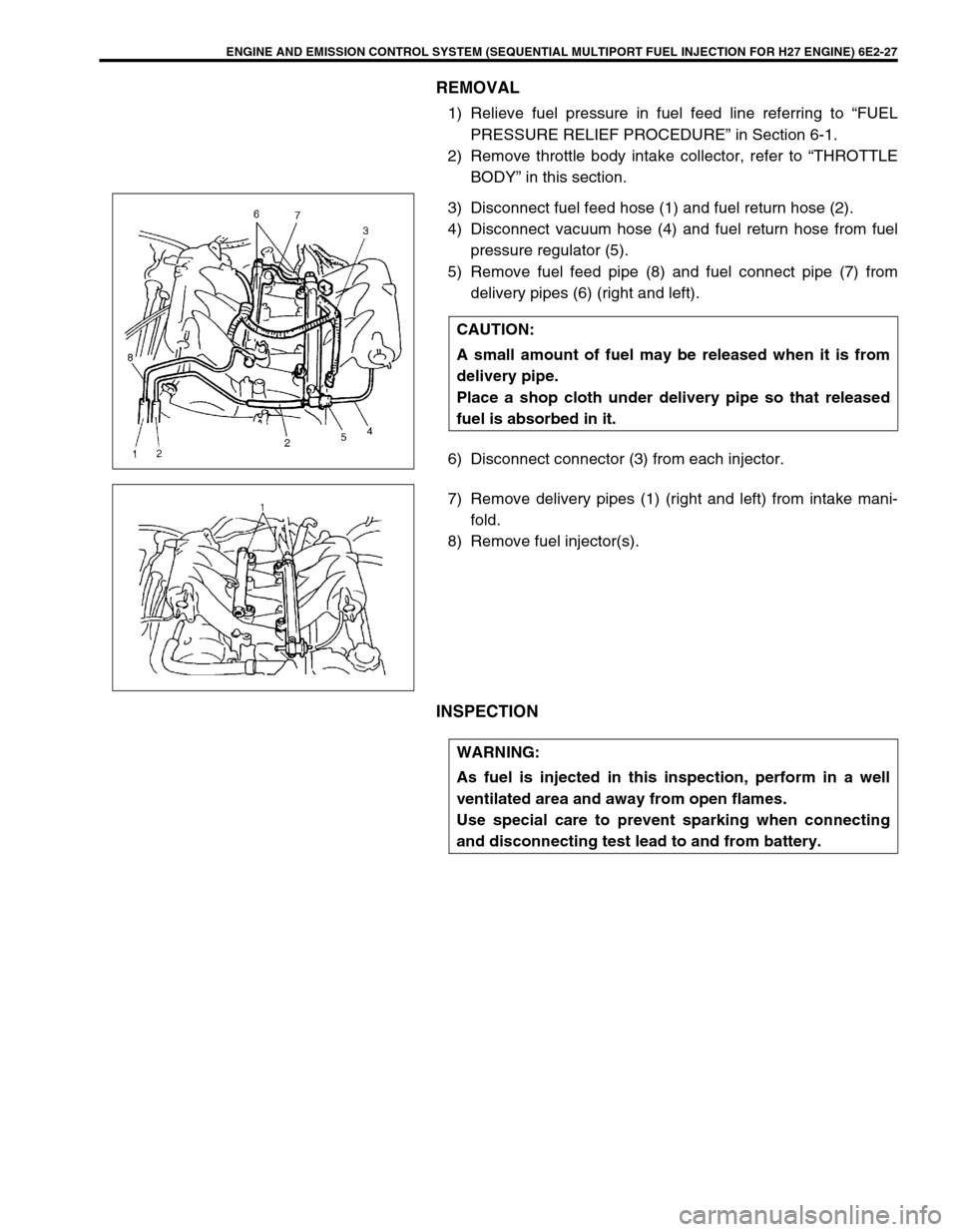
1) Relieve fuel pressure in fuel feed line referring to “FUEL
PRESSURE RELIEF PROCEDURE” in Section 6-1.
2) Remove throttle body intake collector, refer to “THROTTLE
BODY” in this section.
3) Disconnect fuel feed hose (1) and fuel return hose (2).
4) Disconnect vacuum hose (4) and fuel return hose from fuel
pressure regulator (5).
5) Remove fuel feed pipe (8) and fuel connect pipe (7) from
delivery pipes (6) (right and left).
6) Disconnect connector (3) from each injector.
7) Remove delivery pipes (1) (right and left) from intake mani-
fold.
8) Remove fuel injector(s).
INSPECTION
CAUTION:
A small amount of fuel may be released when it is from
delivery pipe.
Place a shop cloth under delivery pipe so that released
fuel is absorbed in it.
WARNING:
As fuel is injected in this inspection, perform in a well
ventilated area and away from open flames.
Use special care to prevent sparking when connecting
and disconnecting test lead to and from battery.
Page 361 of 656
6E2-28 ENGINE AND EMISSION CONTROL SYSTEM (SEQUENTIAL MULTIPORT FUEL INJECTION FOR H27 ENGINE)
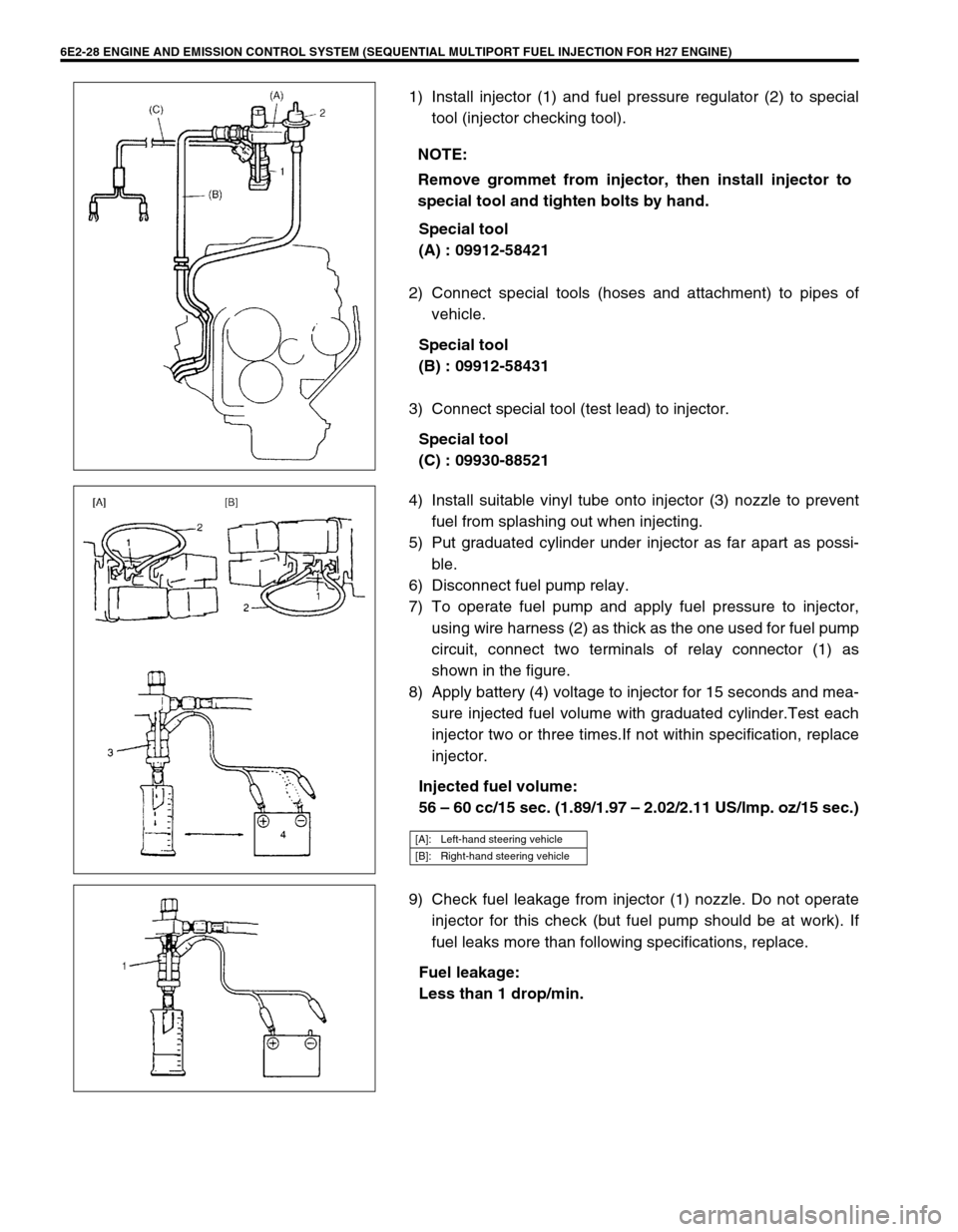
1) Install injector (1) and fuel pressure regulator (2) to special
tool (injector checking tool).
Special tool
(A) : 09912-58421
2) Connect special tools (hoses and attachment) to pipes of
vehicle.
Special tool
(B) : 09912-58431
3) Connect special tool (test lead) to injector.
Special tool
(C) : 09930-88521
4) Install suitable vinyl tube onto injector (3) nozzle to prevent
fuel from splashing out when injecting.
5) Put graduated cylinder under injector as far apart as possi-
ble.
6) Disconnect fuel pump relay.
7) To operate fuel pump and apply fuel pressure to injector,
using wire harness (2) as thick as the one used for fuel pump
circuit, connect two terminals of relay connector (1) as
shown in the figure.
8) Apply battery (4) voltage to injector for 15 seconds and mea-
sure injected fuel volume with graduated cylinder.Test each
injector two or three times.If not within specification, replace
injector.
Injected fuel volume:
56 – 60 cc/15 sec. (1.89/1.97 – 2.02/2.11 US/lmp. oz/15 sec.)
9) Check fuel leakage from injector (1) nozzle. Do not operate
injector for this check (but fuel pump should be at work). If
fuel leaks more than following specifications, replace.
Fuel leakage:
Less than 1 drop/min. NOTE:
Remove grommet from injector, then install injector to
special tool and tighten bolts by hand.
[A]: Left-hand steering vehicle
[B]: Right-hand steering vehicle
Page 363 of 656
6E2-30 ENGINE AND EMISSION CONTROL SYSTEM (SEQUENTIAL MULTIPORT FUEL INJECTION FOR H27 ENGINE)
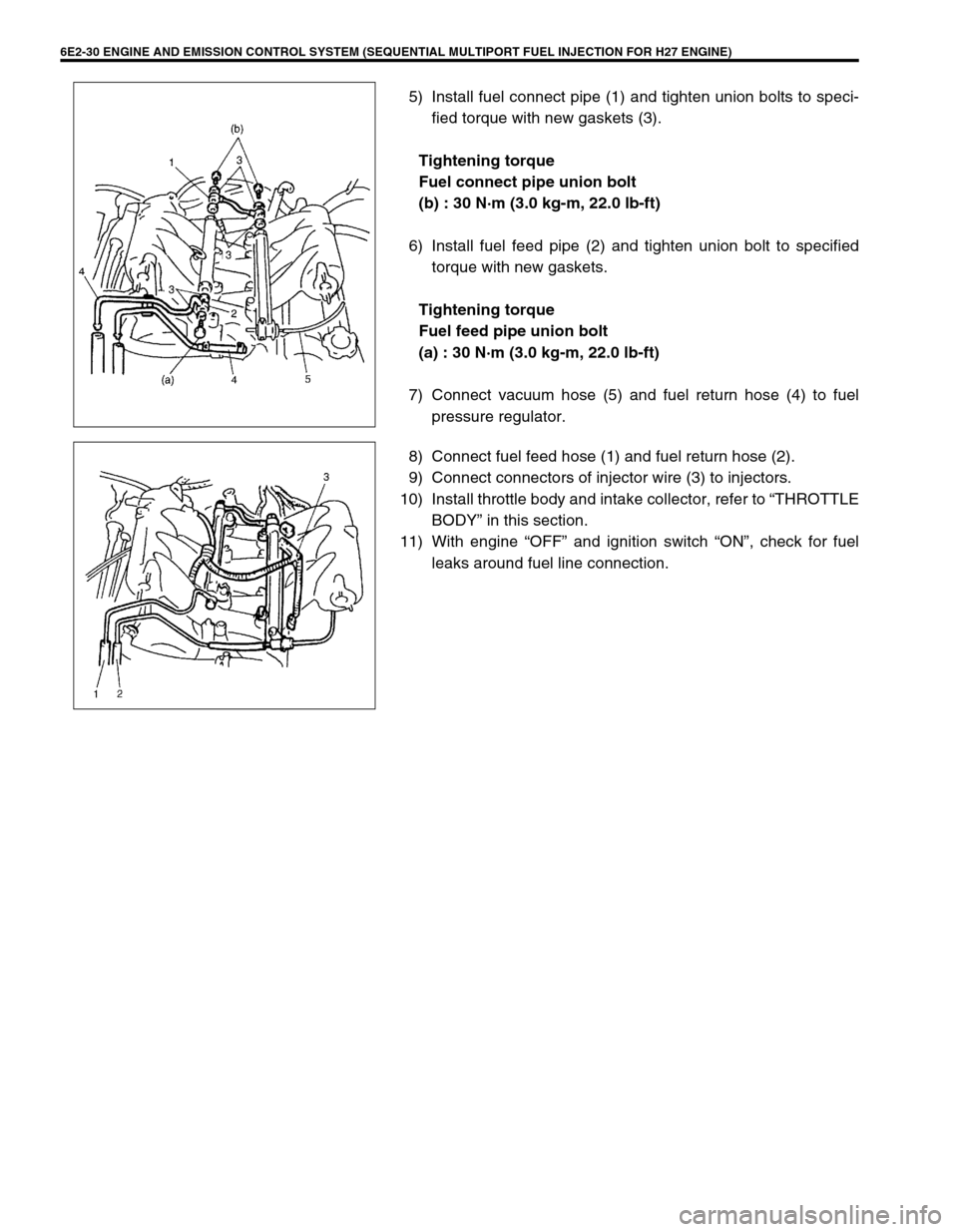
5) Install fuel connect pipe (1) and tighten union bolts to speci-
fied torque with new gaskets (3).
Tightening torque
Fuel connect pipe union bolt
(b) : 30 N·m (3.0 kg-m, 22.0 lb-ft)
6) Install fuel feed pipe (2) and tighten union bolt to specified
torque with new gaskets.
Tightening torque
Fuel feed pipe union bolt
(a) : 30 N·m (3.0 kg-m, 22.0 lb-ft)
7) Connect vacuum hose (5) and fuel return hose (4) to fuel
pressure regulator.
8) Connect fuel feed hose (1) and fuel return hose (2).
9) Connect connectors of injector wire (3) to injectors.
10) Install throttle body and intake collector, refer to “THROTTLE
BODY” in this section.
11) With engine “OFF” and ignition switch “ON”, check for fuel
leaks around fuel line connection.
Page 381 of 656
6E2-48 ENGINE AND EMISSION CONTROL SYSTEM (SEQUENTIAL MULTIPORT FUEL INJECTION FOR H27 ENGINE)
PCV system
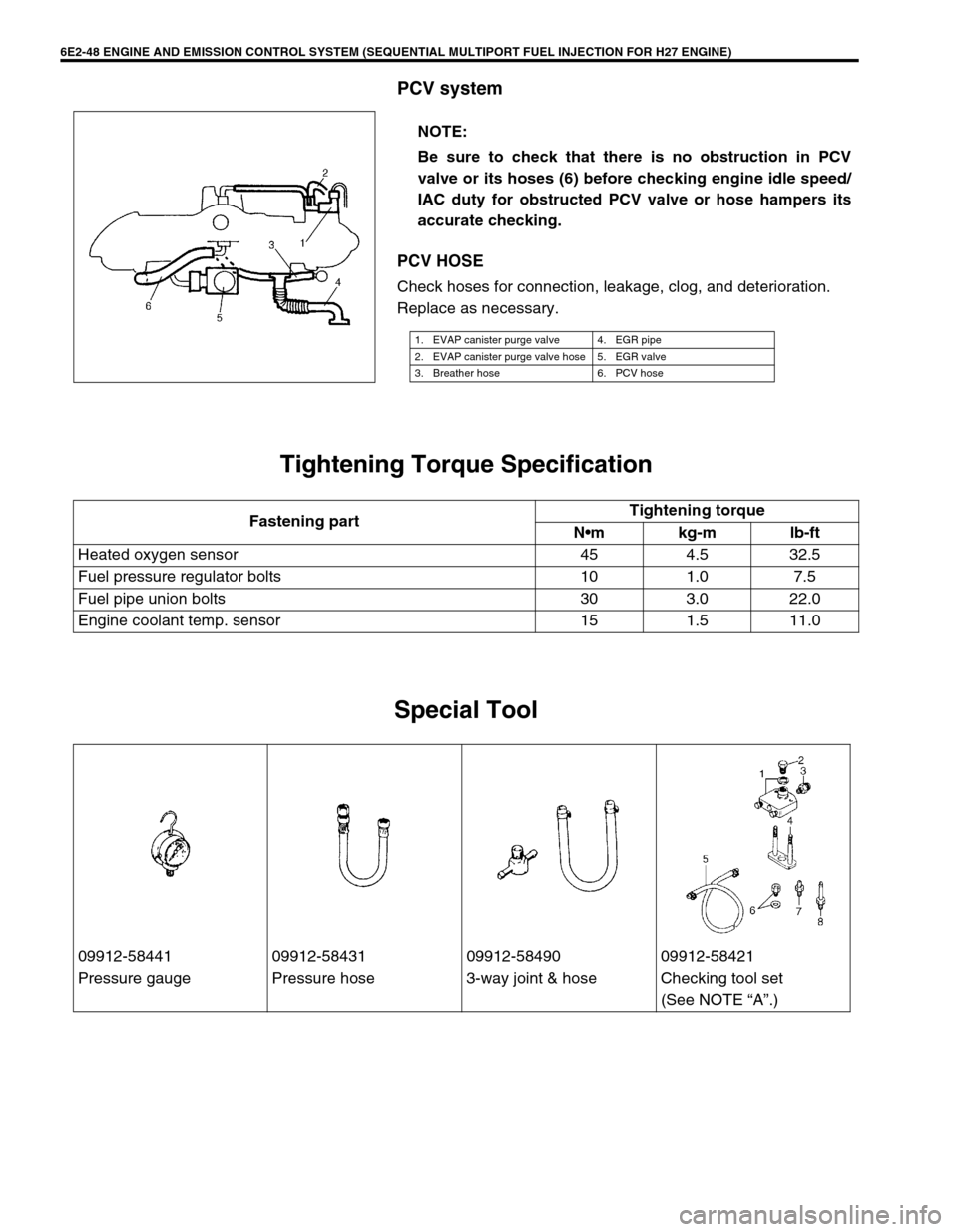
PCV HOSE
Check hoses for connection, leakage, clog, and deterioration.
Replace as necessary.
Tightening Torque Specification
Special Tool
NOTE:
Be sure to check that there is no obstruction in PCV
valve or its hoses (6) before checking engine idle speed/
IAC duty for obstructed PCV valve or hose hampers its
accurate checking.
1. EVAP canister purge valve 4. EGR pipe
2. EVAP canister purge valve hose 5. EGR valve
3. Breather hose 6. PCV hose
Fastening partTightening torque
Nm kg-m lb-ft
Heated oxygen sensor 45 4.5 32.5
Fuel pressure regulator bolts 10 1.0 7.5
Fuel pipe union bolts 30 3.0 22.0
Engine coolant temp. sensor 15 1.5 11.0
09912-58441 09912-58431 09912-58490 09912-58421
Pressure gauge Pressure hose 3-way joint & hose Checking tool set
(See NOTE “A”.)
Page 399 of 656
6H-2 CHARGING SYSTEM
General Description
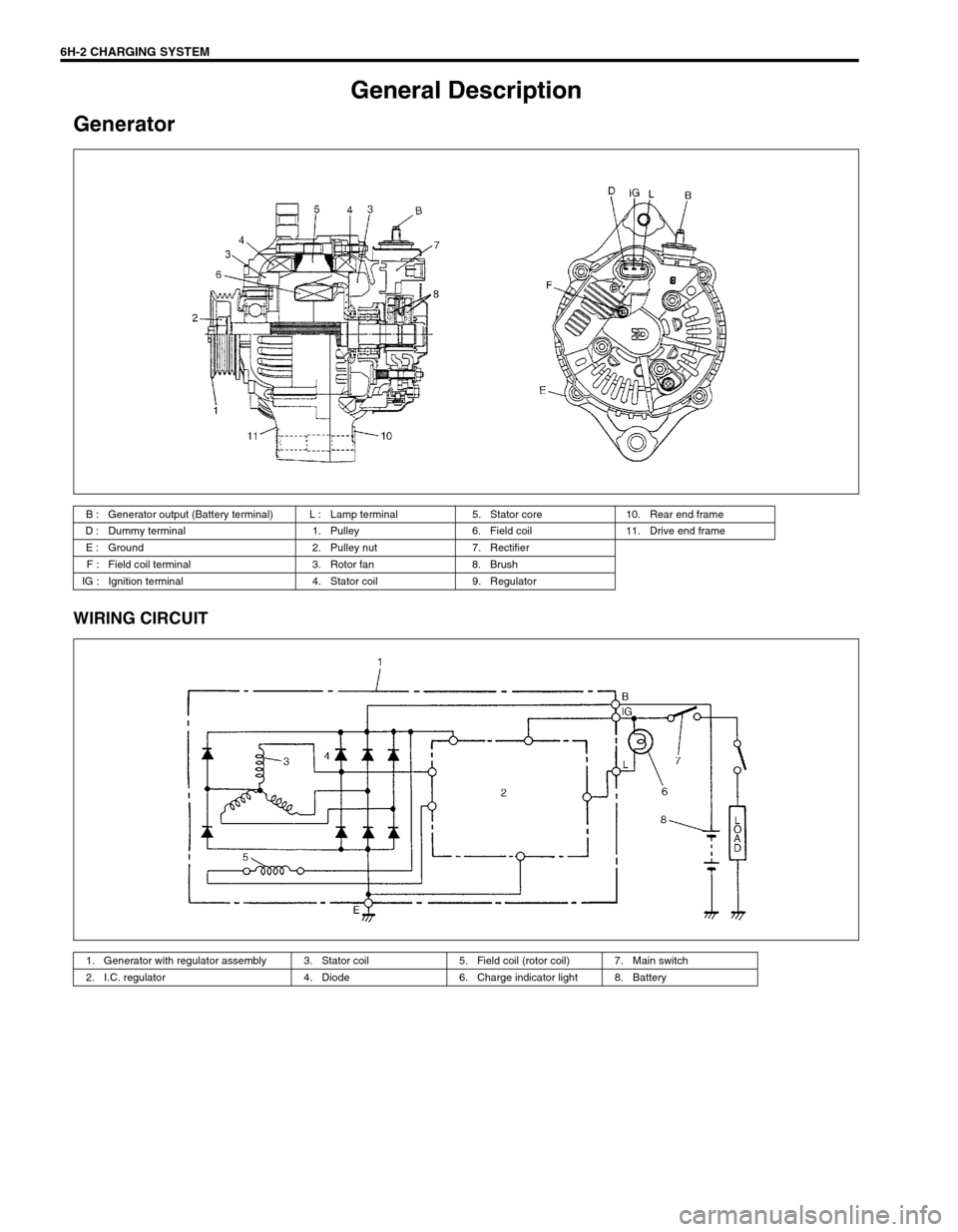
Generator
WIRING CIRCUIT
B : Generator output (Battery terminal) L : Lamp terminal 5. Stator core 10. Rear end frame
D : Dummy terminal 1. Pulley 6. Field coil 11. Drive end frame
E : Ground 2. Pulley nut 7. Rectifier
F : Field coil terminal 3. Rotor fan 8. Brush
IG : Ignition terminal 4. Stator coil 9. Regulator
1. Generator with regulator assembly 3. Stator coil 5. Field coil (rotor coil) 7. Main switch
2. I.C. regulator 4. Diode 6. Charge indicator light 8. Battery
Page 400 of 656
CHARGING SYSTEM 6H-3
Unit Repair Overhaul
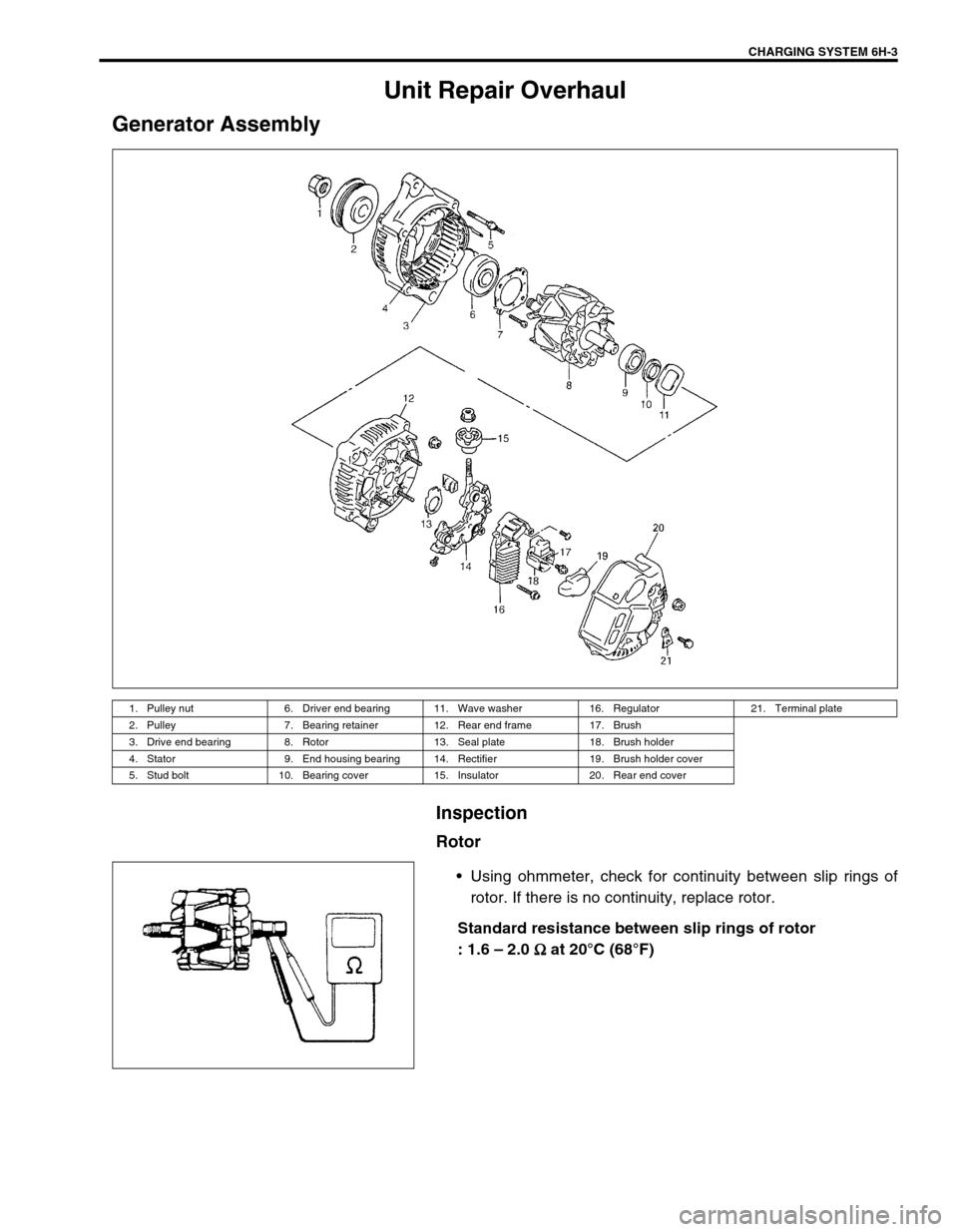
Generator Assembly
Inspection
Rotor
•Using ohmmeter, check for continuity between slip rings of
rotor. If there is no continuity, replace rotor.
Standard resistance between slip rings of rotor
: 1.6 – 2.0 Ω
ΩΩ Ω at 20°C (68°F)
1. Pulley nut 6. Driver end bearing 11. Wave washer 16. Regulator 21. Terminal plate
2. Pulley 7. Bearing retainer 12. Rear end frame 17. Brush
3. Drive end bearing 8. Rotor 13. Seal plate 18. Brush holder
4. Stator 9. End housing bearing 14. Rectifier 19. Brush holder cover
5. Stud bolt 10. Bearing cover 15. Insulator 20. Rear end cover
Page 403 of 656
6H-6 CHARGING SYSTEM
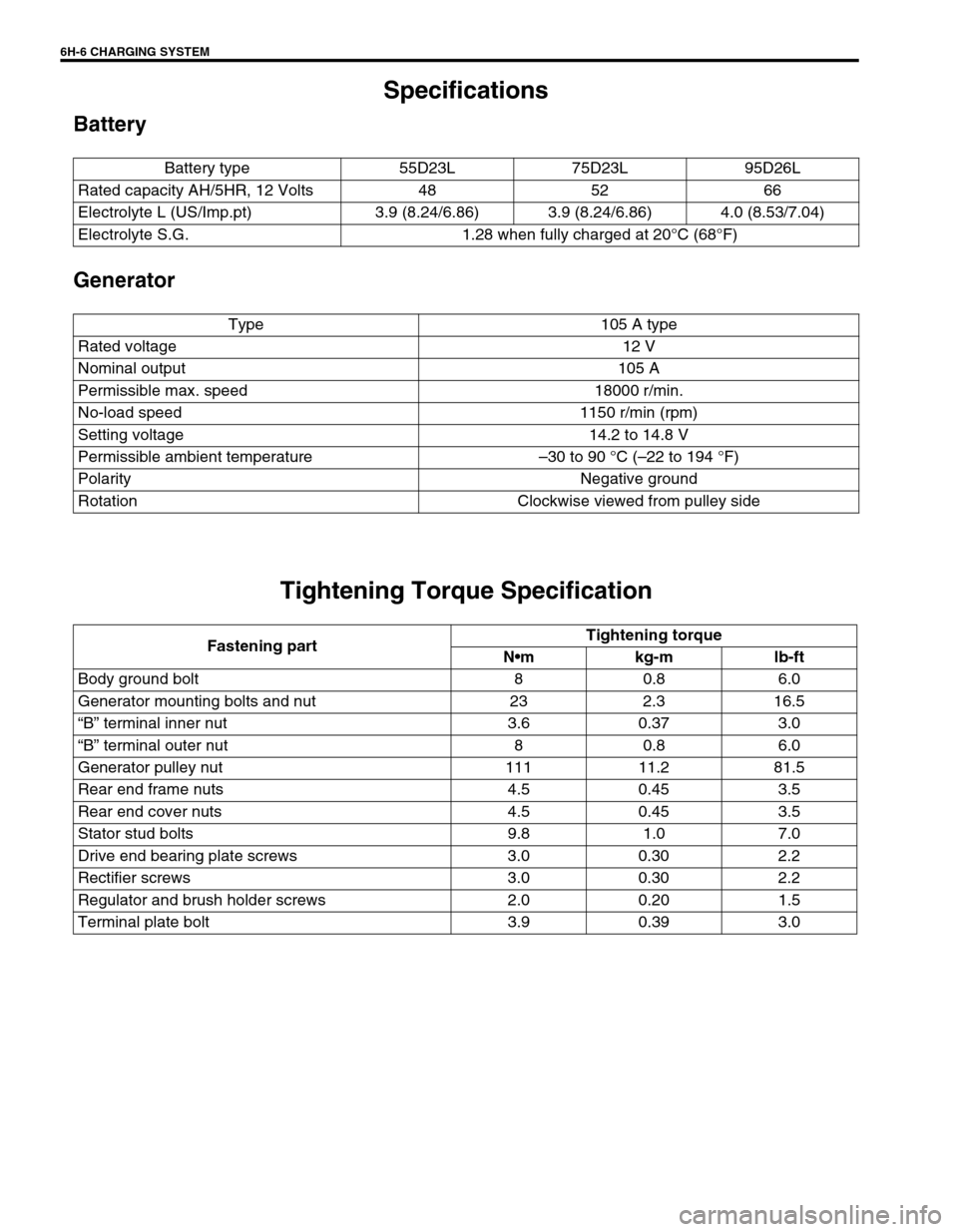
Specifications
Battery
Generator
Tightening Torque Specification
Battery type 55D23L 75D23L 95D26L
Rated capacity AH/5HR, 12 Volts 48 52 66
Electrolyte L (US/Imp.pt) 3.9 (8.24/6.86) 3.9 (8.24/6.86) 4.0 (8.53/7.04)
Electrolyte S.G. 1.28 when fully charged at 20°C (68°F)
Type 105 A type
Rated voltage 12 V
Nominal output 105 A
Permissible max. speed 18000 r/min.
No-load speed 1150 r/min (rpm)
Setting voltage 14.2 to 14.8 V
Permissible ambient temperature–30 to 90 °C (–22 to 194 °F)
Polarity Negative ground
Rotation Clockwise viewed from pulley side
Fastening partTightening torque
Nm kg-m lb-ft
Body ground bolt 8 0.8 6.0
Generator mounting bolts and nut 23 2.3 16.5
“B” terminal inner nut 3.6 0.37 3.0
“B” terminal outer nut 8 0.8 6.0
Generator pulley nut 111 11.2 81.5
Rear end frame nuts 4.5 0.45 3.5
Rear end cover nuts 4.5 0.45 3.5
Stator stud bolts 9.8 1.0 7.0
Drive end bearing plate screws 3.0 0.30 2.2
Rectifier screws 3.0 0.30 2.2
Regulator and brush holder screws 2.0 0.20 1.5
Terminal plate bolt 3.9 0.39 3.0