Temperature SUZUKI GRAND VITARA 1999 2.G Owner's Guide
[x] Cancel search | Manufacturer: SUZUKI, Model Year: 1999, Model line: GRAND VITARA, Model: SUZUKI GRAND VITARA 1999 2.GPages: 656, PDF Size: 14.31 MB
Page 213 of 656
6-1-52 ENGINE GENERAL INFORMATION AND DIAGNOSIS (H27 ENGINE)
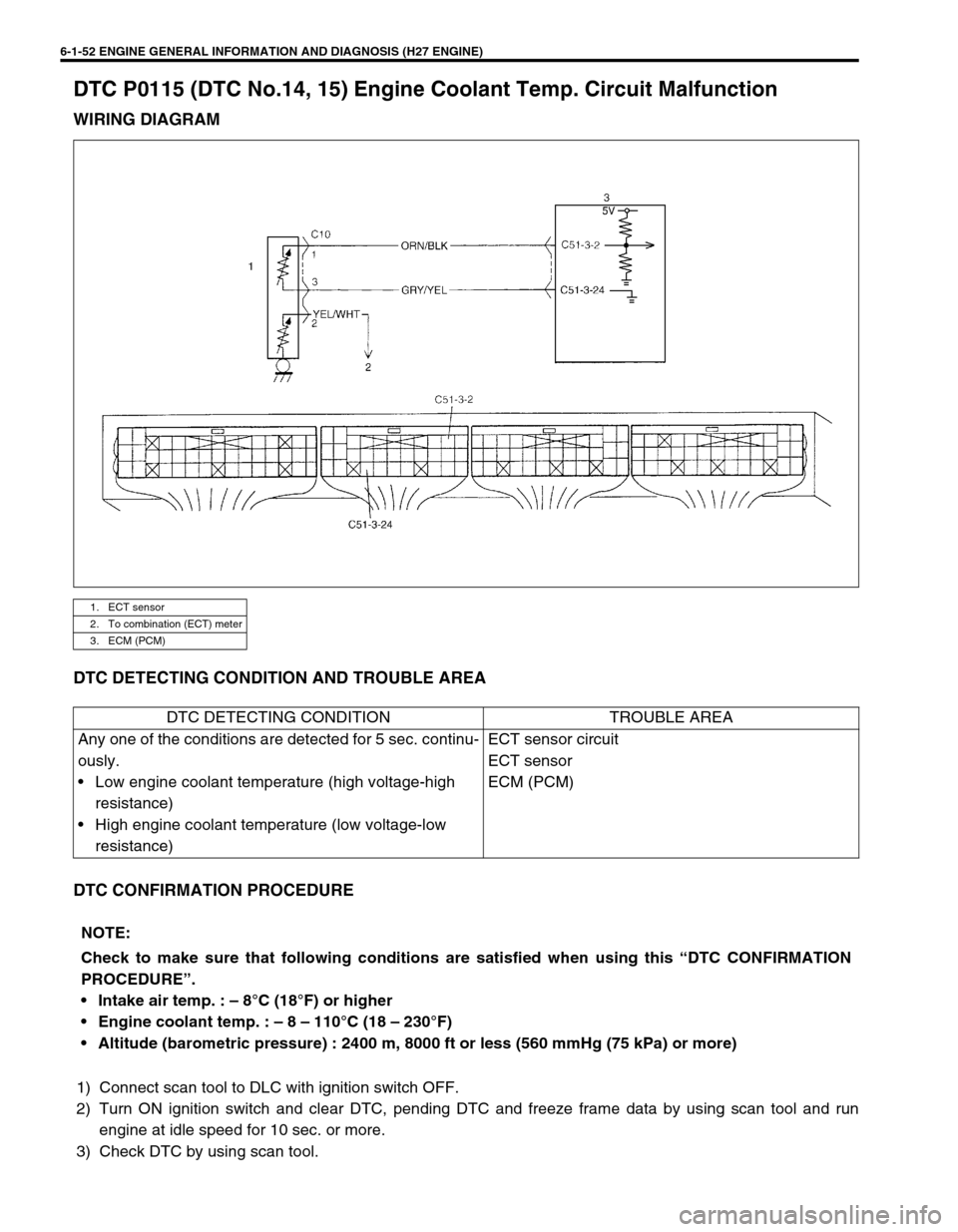
DTC P0115 (DTC No.14, 15) Engine Coolant Temp. Circuit Malfunction
WIRING DIAGRAM
DTC DETECTING CONDITION AND TROUBLE AREA
DTC CONFIRMATION PROCEDURE
1) Connect scan tool to DLC with ignition switch OFF.
2) Turn ON ignition switch and clear DTC, pending DTC and freeze frame data by using scan tool and run
engine at idle speed for 10 sec. or more.
3) Check DTC by using scan tool.
1. ECT sensor
2. To combination (ECT) meter
3. ECM (PCM)
DTC DETECTING CONDITION TROUBLE AREA
Any one of the conditions are detected for 5 sec. continu-
ously.
• Low engine coolant temperature (high voltage-high
resistance)
• High engine coolant temperature (low voltage-low
resistance)ECT sensor circuit
ECT sensor
ECM (PCM)
NOTE:
Check to make sure that following conditions are satisfied when using this “DTC CONFIRMATION
PROCEDURE”.
Intake air temp. : – 8°C (18°F) or higher
Engine coolant temp. : – 8 – 110°C (18 – 230°F)
Altitude (barometric pressure) : 2400 m, 8000 ft or less (560 mmHg (75 kPa) or more)
Page 220 of 656
ENGINE GENERAL INFORMATION AND DIAGNOSIS (H27 ENGINE) 6-1-59
DTC CONFIRMATION PROCEDURE
1) Connect scan tool to DLC with ignition switch OFF.
2) Turn ON ignition switch and clear DTC, pending DTC and freeze frame data by using scan tool and start
engine.
3) Increase vehicle speed to 55 km/h (35 mph) or more.
4) Keep driving above vehicle speed for 2 min. or more (Change of vehicle speed is permitted in this step).
5) Stop vehicle, and run engine at idle speed for 1 min.
6) Check if pending DTC exists by using scan tool. If not, check if oxygen sensor monitoring test has completed
by using scan tool. If not in both of above checks (i.e., no pending DTC and oxygen sensor monitoring test
not completed), check vehicle condition (environmental) and repeat step 3) through 6).
TROUBLESHOOTING
WARNING:
When performing a road test, select a place where there is no traffic or possibility of a traffic acci-
dent and be very careful during testing to avoid occurrence of an accident.
Road test should be carried out with 2 persons, a driver and a tester, on a level road.
NOTE:
Check to make sure that following conditions are satisfied when using this “DTC CONFIRMATION
PROCEDURE”.
Intake air temp. : – 8°C (18°F) or higher
Engine coolant temp. : – 8 – 110°C (18 – 230°F)
Altitude (barometric pressure) : 2400 m, 8000 ft or less (560 mmHg (75 kPa) or more)
Step Action Yes No
1 Was “ENGINE DIAG. FLOW TABLE” performed? Go to Step 2. Go to “ENGINE
DIAG. FLOW
TABLE” in this sec-
tion.
2 HO2S-1 output voltage check :
1) Connect scan tool to DLC with ignition switch OFF.
2) Warm up engine to normal operating temperature and
keep it at 2000 r/min. for 60 sec.
3) Repeat racing engine (Repeat depressing accelerator
pedal 5 to 6 times continuously to enrich A/F mixture
and take foot off from pedal to enlean and check HO2S
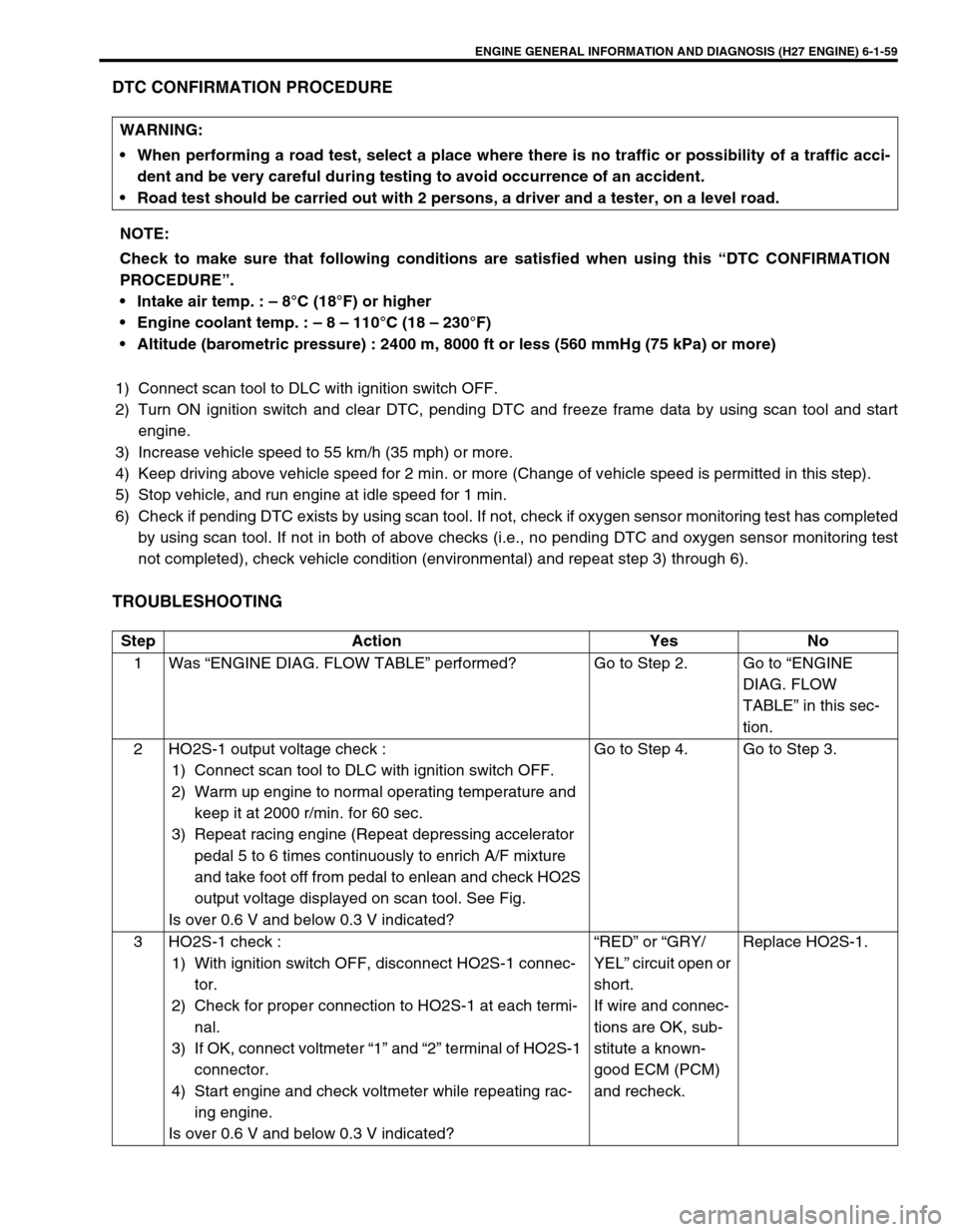
output voltage displayed on scan tool. See Fig.
Is over 0.6 V and below 0.3 V indicated?Go to Step 4. Go to Step 3.
3 HO2S-1 check :
1) With ignition switch OFF, disconnect HO2S-1 connec-
tor.
2) Check for proper connection to HO2S-1 at each termi-
nal.
3) If OK, connect voltmeter “1” and “2” terminal of HO2S-1
connector.
4) Start engine and check voltmeter while repeating rac-
ing engine.
Is over 0.6 V and below 0.3 V indicated?“RED” or “GRY/
YEL” circuit open or
short.
If wire and connec-
tions are OK, sub-
stitute a known-
good ECM (PCM)
and recheck.Replace HO2S-1.
Page 229 of 656
6-1-68 ENGINE GENERAL INFORMATION AND DIAGNOSIS (H27 ENGINE)
DTC CONFIRMATION PROCEDURE
1) Connect scan tool to DLC with ignition switch OFF.
2) Turn ON ignition switch and clear DTC, pending DTC and freeze frame data by using scan tool and start
engine.
3) Increase vehicle speed to 55 km/h (35 mph) or more.
4) Keep driving above vehicle speed for 2 min. or more (Change of vehicle speed is permitted in this step).
5) Stop vehicle, and run engine at idle speed for 1 min.
6) Check if pending DTC exists by using scan tool. If not, check if oxygen sensor monitoring test has completed
by using scan tool. If not in both of above checks (i.e., no pending DTC and oxygen sensor monitoring test
not completed), check vehicle condition (environmental) and repeat step 3) through 6).
TROUBLESHOOTING
WARNING:
When performing a road test, select a place where there is no traffic or possibility of a traffic acci-
dent and be very careful during testing to avoid occurrence of an accident.
Road test should be carried out with 2 persons, a driver and a tester, on a level road.
NOTE:
Check to make sure that following conditions are satisfied when using this “DTC CONFIRMATION
PROCEDURE”.
Intake air temp. : – 8°C (18°F) or higher
Engine coolant temp. : – 8 – 110°C (18 – 230°F)
Altitude (barometric pressure) : 2400 m, 8000 ft or less (560 mmHg (75 kPa) or more)
Step Action Yes No
1 Was “ENGINE DIAG. FLOW TABLE” performed? Go to Step 2. Go to “ENGINE
DIAG. FLOW
TABLE” in this sec-
tion.
2 HO2S-1 output voltage check :
1) Connect scan tool to DLC with ignition switch OFF.
2) Warm up engine to normal operating temperature and
keep it at 2000 r/min. for 60 sec.
3) Repeat racing engine (Repeat depressing accelerator
pedal 5 to 6 times continuously to enrich A/F mixture
and take foot off from pedal to enlean and check HO2S
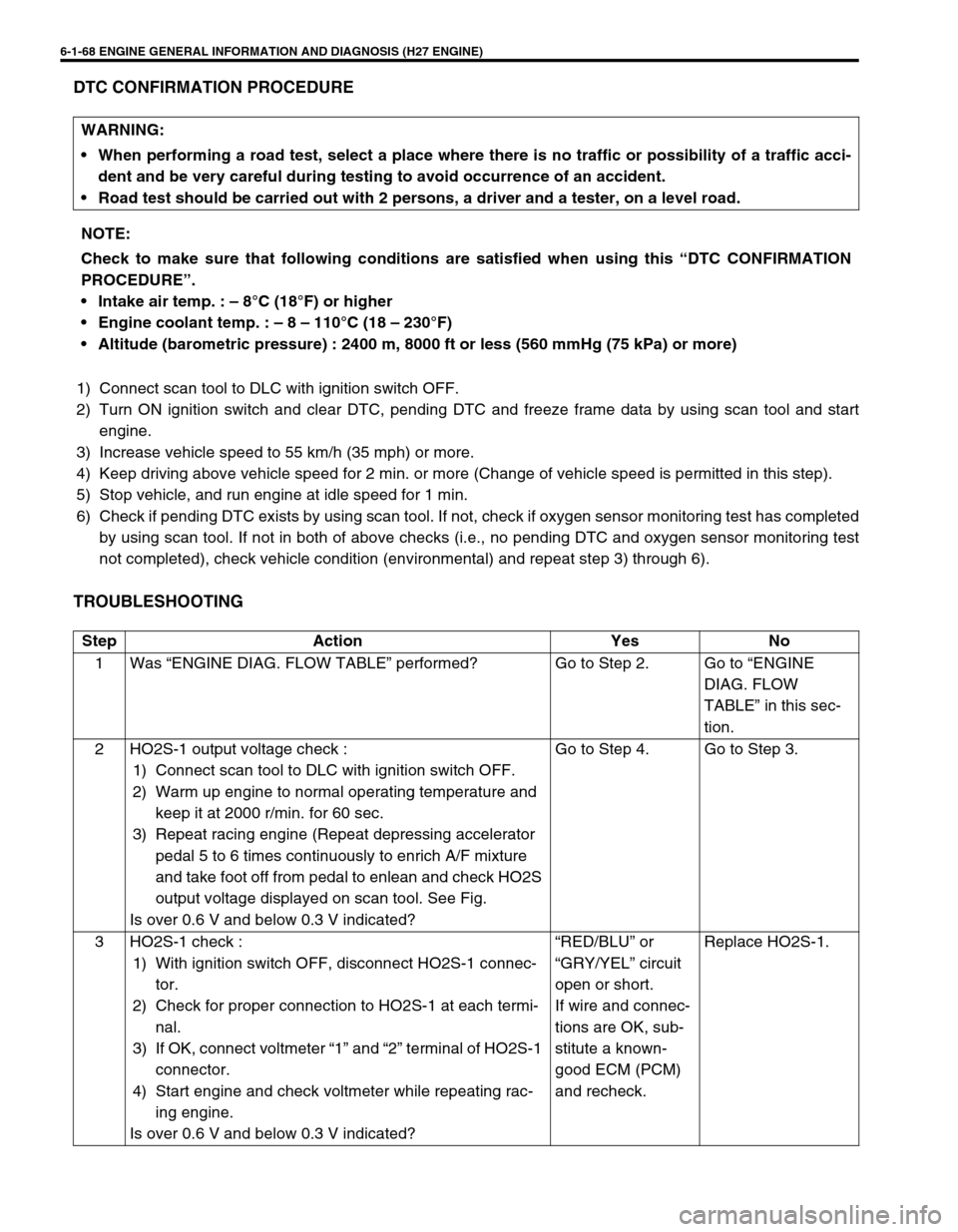
output voltage displayed on scan tool. See Fig.
Is over 0.6 V and below 0.3 V indicated?Go to Step 4. Go to Step 3.
3 HO2S-1 check :
1) With ignition switch OFF, disconnect HO2S-1 connec-
tor.
2) Check for proper connection to HO2S-1 at each termi-
nal.
3) If OK, connect voltmeter “1” and “2” terminal of HO2S-1
connector.
4) Start engine and check voltmeter while repeating rac-
ing engine.
Is over 0.6 V and below 0.3 V indicated?“RED/BLU” or
“GRY/YEL” circuit
open or short.
If wire and connec-
tions are OK, sub-
stitute a known-
good ECM (PCM)
and recheck.Replace HO2S-1.
Page 261 of 656
6-1-100 ENGINE GENERAL INFORMATION AND DIAGNOSIS (H27 ENGINE)
Evap canister purge system inspection
1) Warm up engine to normal operating temperature.
2) Hoist vehicle so that all wheels rotate freely.
3) Set M/T in “Neutral” or A/T in “P” position and parking brake.
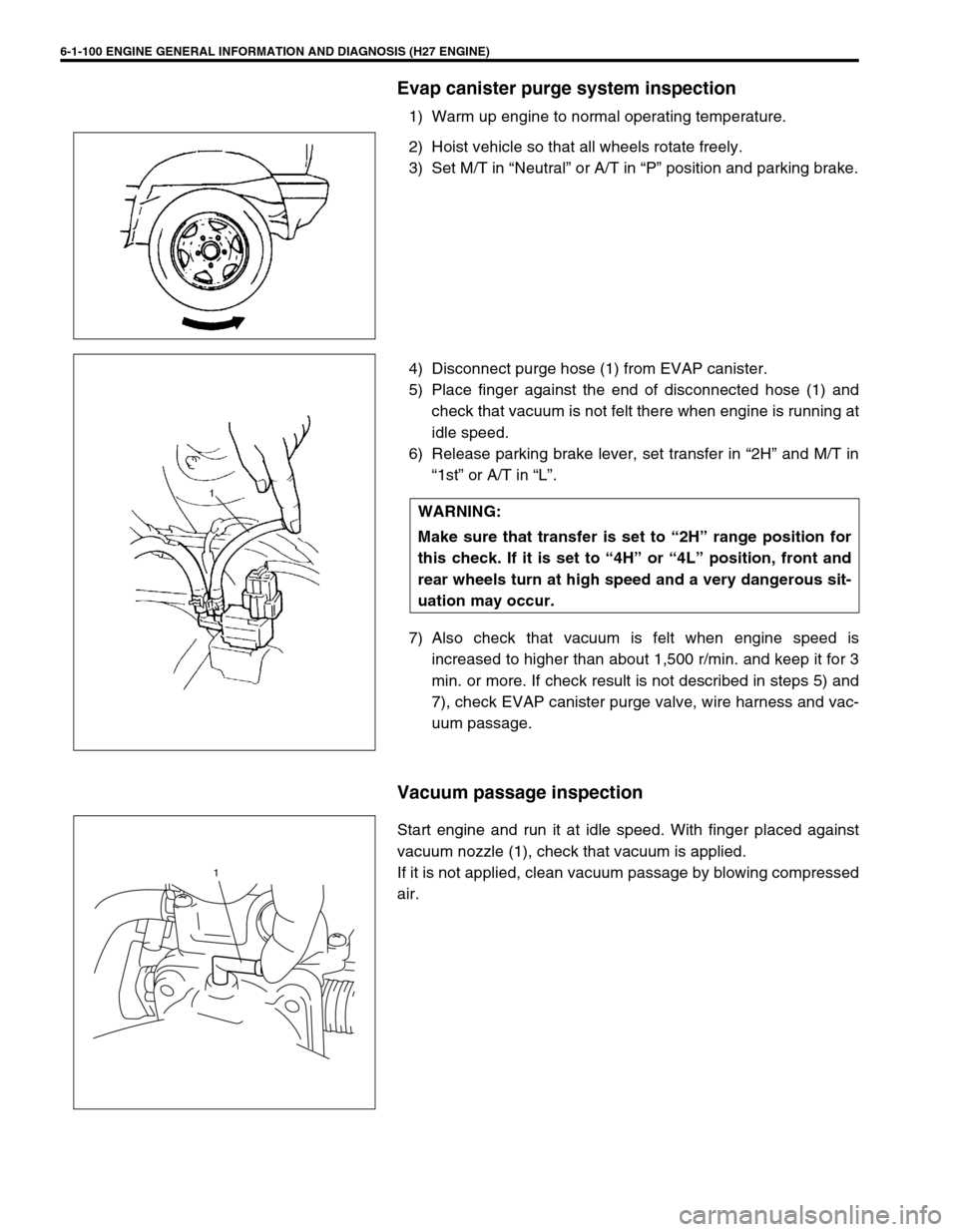
4) Disconnect purge hose (1) from EVAP canister.
5) Place finger against the end of disconnected hose (1) and
check that vacuum is not felt there when engine is running at
idle speed.
6) Release parking brake lever, set transfer in “2H” and M/T in
“1st” or A/T in “L”.
7) Also check that vacuum is felt when engine speed is
increased to higher than about 1,500 r/min. and keep it for 3
min. or more. If check result is not described in steps 5) and
7), check EVAP canister purge valve, wire harness and vac-
uum passage.
Vacuum passage inspection
Start engine and run it at idle speed. With finger placed against
vacuum nozzle (1), check that vacuum is applied.
If it is not applied, clean vacuum passage by blowing compressed
air.
WARNING:
Make sure that transfer is set to “2H” range position for
this check. If it is set to “4H” or “4L” position, front and
rear wheels turn at high speed and a very dangerous sit-
uation may occur.
1
Page 274 of 656
ENGINE GENERAL INFORMATION AND DIAGNOSIS (H27 ENGINE) 6-1-113
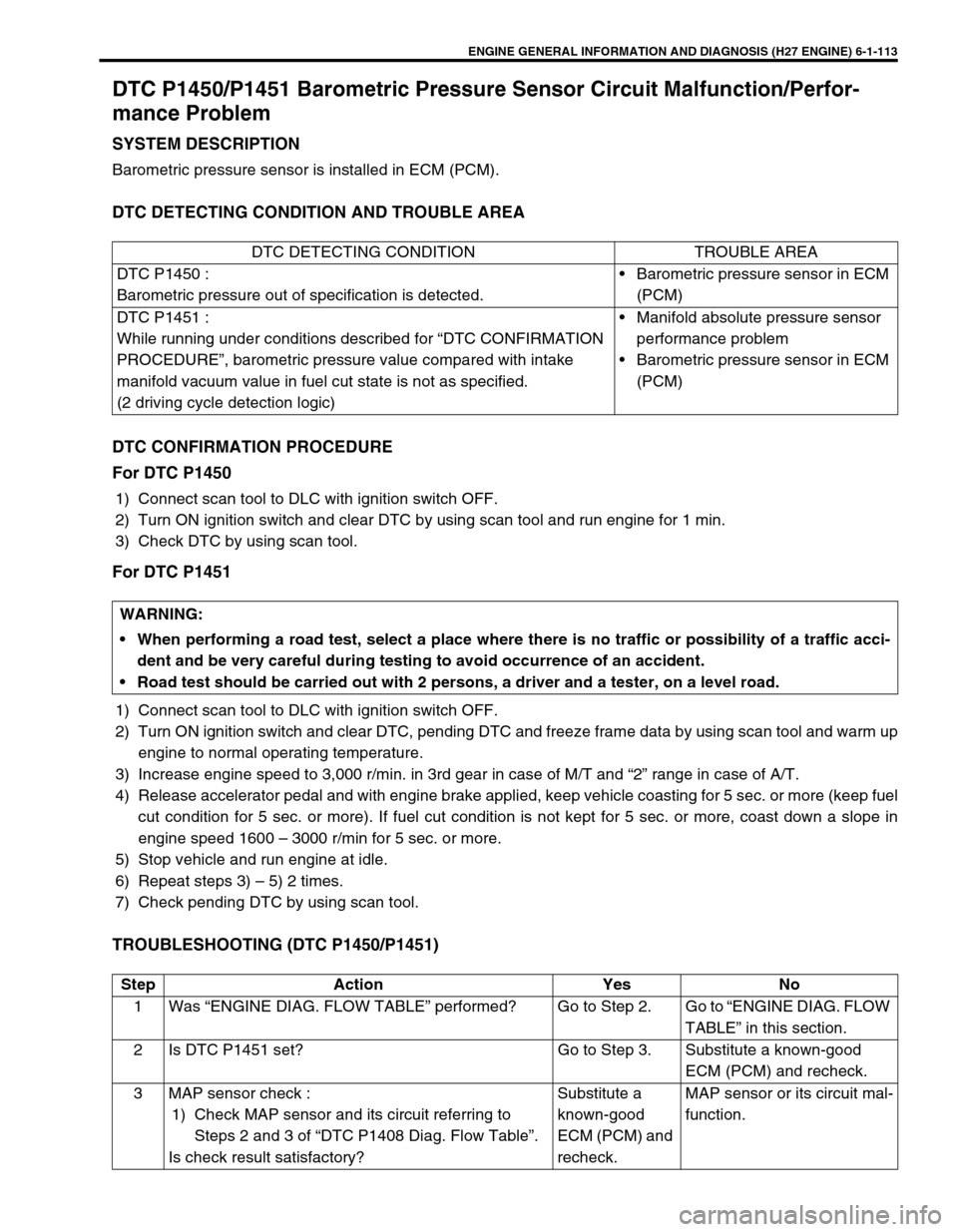
DTC P1450/P1451 Barometric Pressure Sensor Circuit Malfunction/Perfor-
mance Problem
SYSTEM DESCRIPTION
Barometric pressure sensor is installed in ECM (PCM).
DTC DETECTING CONDITION AND TROUBLE AREA
DTC CONFIRMATION PROCEDURE
For DTC P1450
1) Connect scan tool to DLC with ignition switch OFF.
2) Turn ON ignition switch and clear DTC by using scan tool and run engine for 1 min.
3) Check DTC by using scan tool.
For DTC P1451
1) Connect scan tool to DLC with ignition switch OFF.
2) Turn ON ignition switch and clear DTC, pending DTC and freeze frame data by using scan tool and warm up
engine to normal operating temperature.
3) Increase engine speed to 3,000 r/min. in 3rd gear in case of M/T and “2” range in case of A/T.
4) Release accelerator pedal and with engine brake applied, keep vehicle coasting for 5 sec. or more (keep fuel
cut condition for 5 sec. or more). If fuel cut condition is not kept for 5 sec. or more, coast down a slope in
engine speed 1600 – 3000 r/min for 5 sec. or more.
5) Stop vehicle and run engine at idle.
6) Repeat steps 3) – 5) 2 times.
7) Check pending DTC by using scan tool.
TROUBLESHOOTING (DTC P1450/P1451)
DTC DETECTING CONDITION TROUBLE AREA
DTC P1450 :
Barometric pressure out of specification is detected.•Barometric pressure sensor in ECM
(PCM)
DTC P1451 :
While running under conditions described for “DTC CONFIRMATION
PROCEDURE”, barometric pressure value compared with intake
manifold vacuum value in fuel cut state is not as specified.
(2 driving cycle detection logic)•Manifold absolute pressure sensor
performance problem
•Barometric pressure sensor in ECM
(PCM)
WARNING:
When performing a road test, select a place where there is no traffic or possibility of a traffic acci-
dent and be very careful during testing to avoid occurrence of an accident.
Road test should be carried out with 2 persons, a driver and a tester, on a level road.
Step Action Yes No
1Was “ENGINE DIAG. FLOW TABLE” performed? Go to Step 2. Go to “ENGINE DIAG. FLOW
TABLE” in this section.
2 Is DTC P1451 set? Go to Step 3. Substitute a known-good
ECM (PCM) and recheck.
3 MAP sensor check :
1) Check MAP sensor and its circuit referring to
Steps 2 and 3 of “DTC P1408 Diag. Flow Table”.
Is check result satisfactory?Substitute a
known-good
ECM (PCM) and
recheck.MAP sensor or its circuit mal-
function.
Page 281 of 656
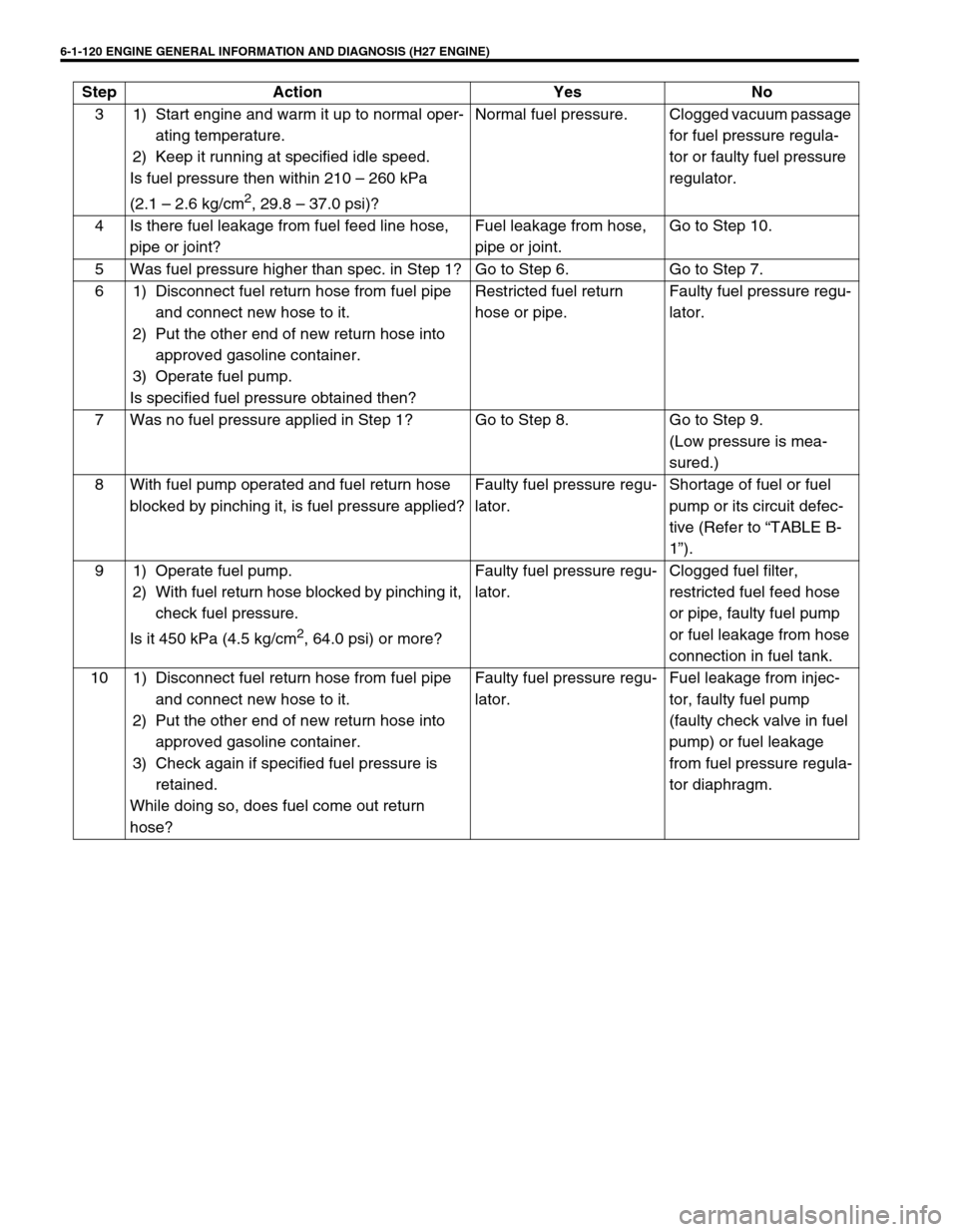
6-1-120 ENGINE GENERAL INFORMATION AND DIAGNOSIS (H27 ENGINE)
3 1) Start engine and warm it up to normal oper-
ating temperature.
2) Keep it running at specified idle speed.
Is fuel pressure then within 210 – 260 kPa
(2.1 – 2.6 kg/cm
2, 29.8 – 37.0 psi)?Normal fuel pressure. Clogged vacuum passage
for fuel pressure regula-
tor or faulty fuel pressure
regulator.
4 Is there fuel leakage from fuel feed line hose,
pipe or joint?Fuel leakage from hose,
pipe or joint.Go to Step 10.
5 Was fuel pressure higher than spec. in Step 1? Go to Step 6. Go to Step 7.
6 1) Disconnect fuel return hose from fuel pipe
and connect new hose to it.
2) Put the other end of new return hose into
approved gasoline container.
3) Operate fuel pump.
Is specified fuel pressure obtained then?Restricted fuel return
hose or pipe.Faulty fuel pressure regu-
lator.
7 Was no fuel pressure applied in Step 1? Go to Step 8. Go to Step 9.
(Low pressure is mea-
sured.)
8 With fuel pump operated and fuel return hose
blocked by pinching it, is fuel pressure applied?Faulty fuel pressure regu-
lator.Shortage of fuel or fuel
pump or its circuit defec-
tive (Refer to “TABLE B-
1”).
9 1) Operate fuel pump.
2) With fuel return hose blocked by pinching it,
check fuel pressure.
Is it 450 kPa (4.5 kg/cm
2, 64.0 psi) or more?Faulty fuel pressure regu-
lator.Clogged fuel filter,
restricted fuel feed hose
or pipe, faulty fuel pump
or fuel leakage from hose
connection in fuel tank.
10 1) Disconnect fuel return hose from fuel pipe
and connect new hose to it.
2) Put the other end of new return hose into
approved gasoline container.
3) Check again if specified fuel pressure is
retained.
While doing so, does fuel come out return
hose?Faulty fuel pressure regu-
lator.Fuel leakage from injec-
tor, faulty fuel pump
(faulty check valve in fuel
pump) or fuel leakage
from fuel pressure regula-
tor diaphragm. Step Action Yes No
Page 314 of 656
ENGINE MECHANICAL (H27 ENGINE) 6A2-27
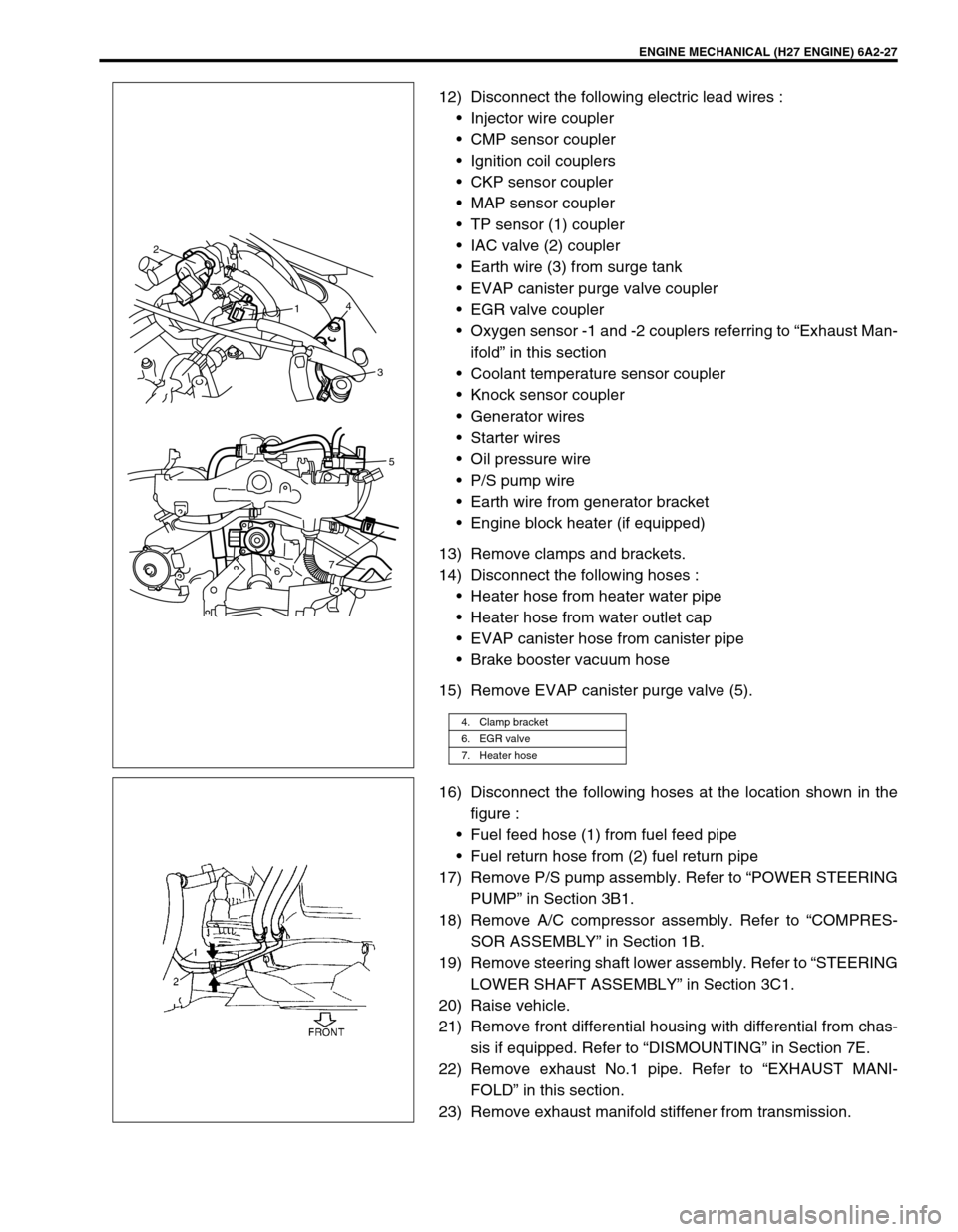
12) Disconnect the following electric lead wires :
•Injector wire coupler
•CMP sensor coupler
•Ignition coil couplers
•CKP sensor coupler
•MAP sensor coupler
•TP sensor (1) coupler
•IAC valve (2) coupler
•Earth wire (3) from surge tank
•EVAP canister purge valve coupler
•EGR valve coupler
•Oxygen sensor -1 and -2 couplers referring to “Exhaust Man-
ifold” in this section
•Coolant temperature sensor coupler
•Knock sensor coupler
•Generator wires
•Starter wires
•Oil pressure wire
•P/S pump wire
•Earth wire from generator bracket
•Engine block heater (if equipped)
13) Remove clamps and brackets.
14) Disconnect the following hoses :
•Heater hose from heater water pipe
•Heater hose from water outlet cap
•EVAP canister hose from canister pipe
•Brake booster vacuum hose
15) Remove EVAP canister purge valve (5).
16) Disconnect the following hoses at the location shown in the
figure :
•Fuel feed hose (1) from fuel feed pipe
•Fuel return hose from (2) fuel return pipe
17) Remove P/S pump assembly. Refer to “POWER STEERING
PUMP” in Section 3B1.
18) Remove A/C compressor assembly. Refer to “COMPRES-
SOR ASSEMBLY” in Section 1B.
19) Remove steering shaft lower assembly. Refer to “STEERING
LOWER SHAFT ASSEMBLY” in Section 3C1.
20) Raise vehicle.
21) Remove front differential housing with differential from chas-
sis if equipped. Refer to “DISMOUNTING” in Section 7E.
22) Remove exhaust No.1 pipe. Refer to “EXHAUST MANI-
FOLD” in this section.
23) Remove exhaust manifold stiffener from transmission.
4. Clamp bracket
6. EGR valve
7. Heater hose
2
14
3
75
6
Page 327 of 656
6B-2 ENGINE COOLING
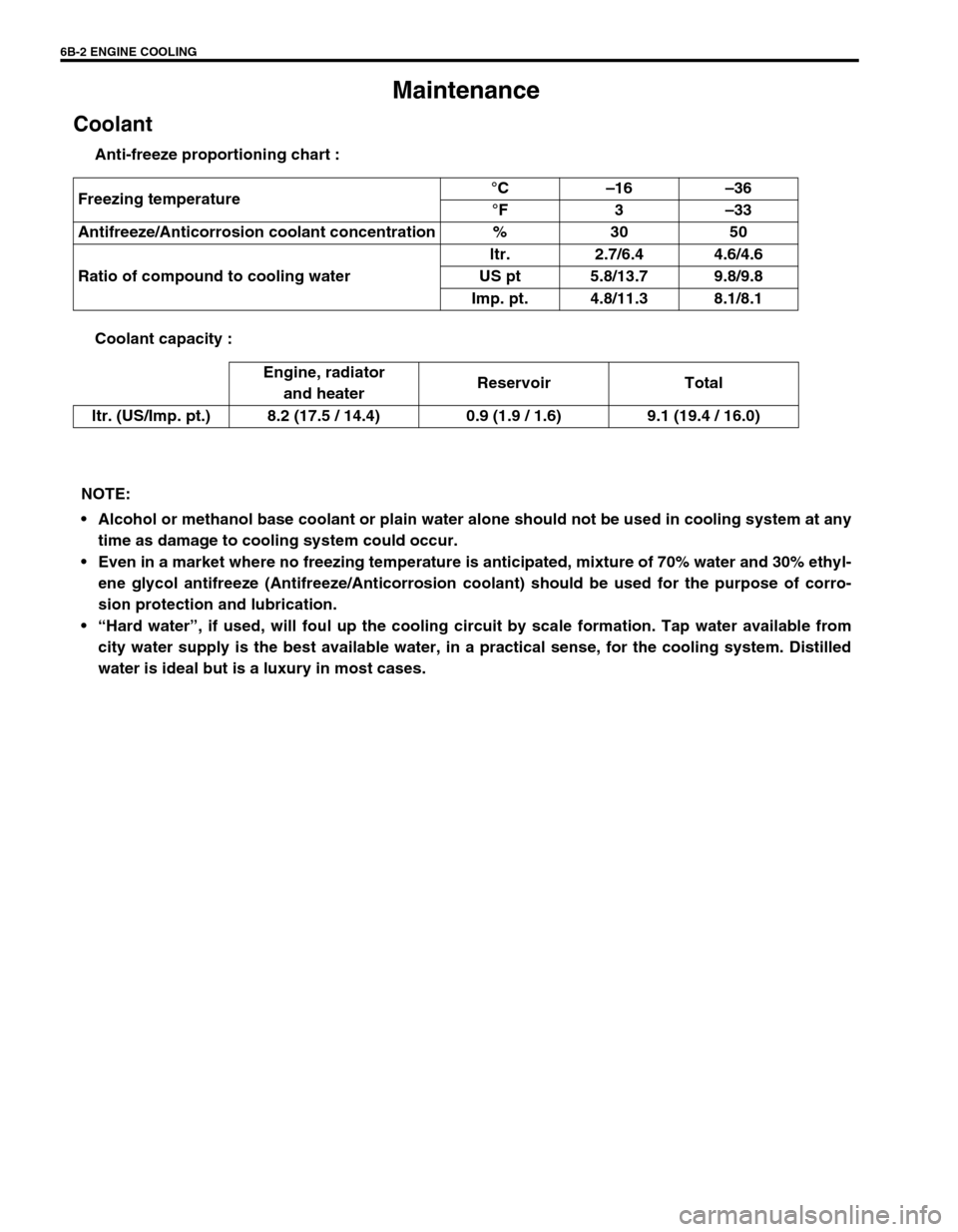
Maintenance
Coolant
Anti-freeze proportioning chart :
Coolant capacity : Freezing temperature°C–16–36
°F3–33
Antifreeze/Anticorrosion coolant concentration % 30 50
Ratio of compound to cooling waterltr. 2.7/6.4 4.6/4.6
US pt 5.8/13.7 9.8/9.8
Imp. pt. 4.8/11.3 8.1/8.1
Engine, radiator
and heaterReservoir Total
ltr. (US/Imp. pt.) 8.2 (17.5 / 14.4) 0.9 (1.9 / 1.6) 9.1 (19.4 / 16.0)
NOTE:
Alcohol or methanol base coolant or plain water alone should not be used in cooling system at any
time as damage to cooling system could occur.
Even in a market where no freezing temperature is anticipated, mixture of 70% water and 30% ethyl-
ene glycol antifreeze (Antifreeze/Anticorrosion coolant) should be used for the purpose of corro-
sion protection and lubrication.
“Hard water”, if used, will foul up the cooling circuit by scale formation. Tap water available from
city water supply is the best available water, in a practical sense, for the cooling system. Distilled
water is ideal but is a luxury in most cases.
Page 335 of 656
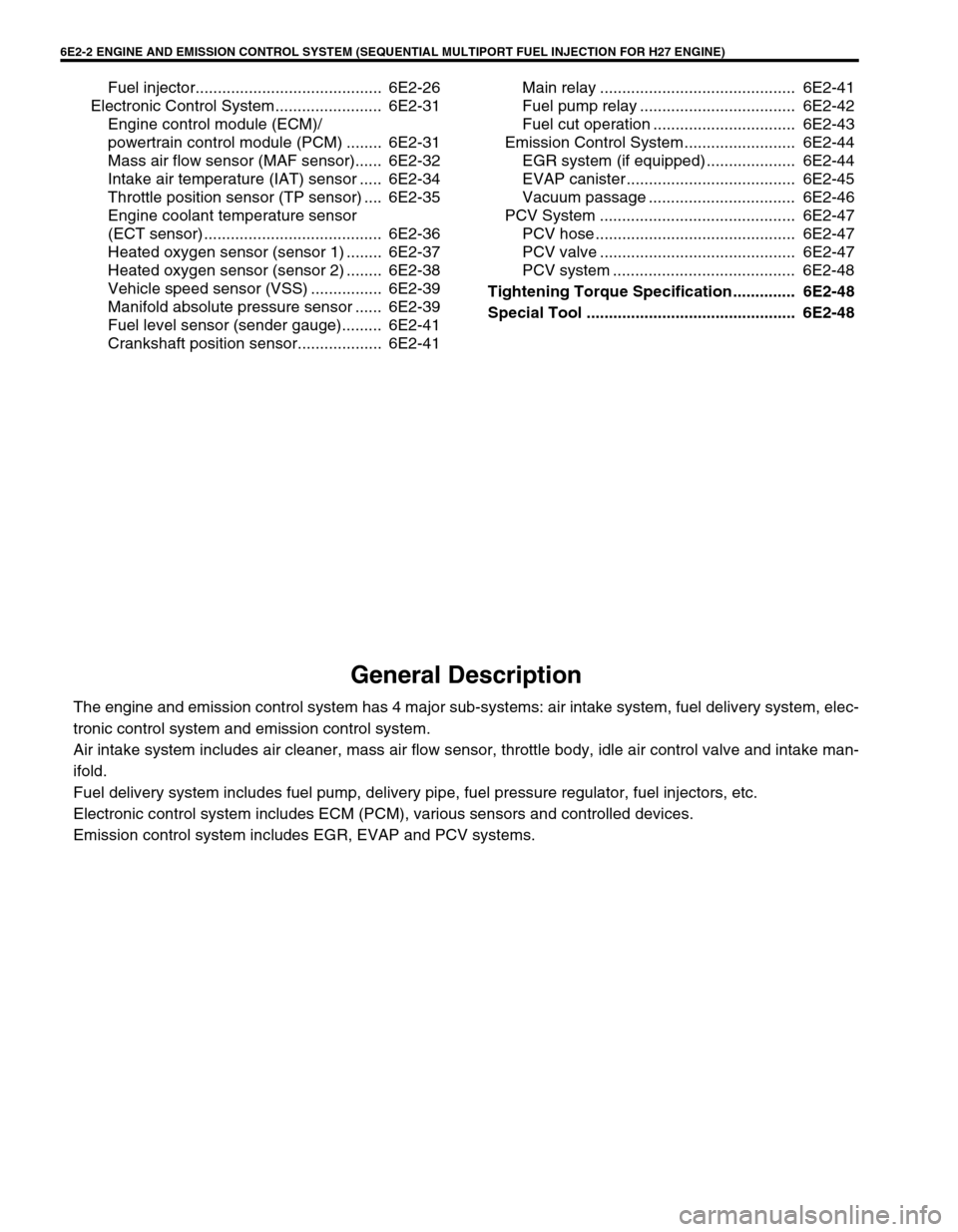
6E2-2 ENGINE AND EMISSION CONTROL SYSTEM (SEQUENTIAL MULTIPORT FUEL INJECTION FOR H27 ENGINE)
Fuel injector.......................................... 6E2-26
Electronic Control System........................ 6E2-31
Engine control module (ECM)/
powertrain control module (PCM) ........ 6E2-31
Mass air flow sensor (MAF sensor)...... 6E2-32
Intake air temperature (IAT) sensor ..... 6E2-34
Throttle position sensor (TP sensor) .... 6E2-35
Engine coolant temperature sensor
(ECT sensor) ........................................ 6E2-36
Heated oxygen sensor (sensor 1) ........ 6E2-37
Heated oxygen sensor (sensor 2) ........ 6E2-38
Vehicle speed sensor (VSS) ................ 6E2-39
Manifold absolute pressure sensor ...... 6E2-39
Fuel level sensor (sender gauge)......... 6E2-41
Crankshaft position sensor................... 6E2-41Main relay ............................................ 6E2-41
Fuel pump relay ................................... 6E2-42
Fuel cut operation ................................ 6E2-43
Emission Control System......................... 6E2-44
EGR system (if equipped) .................... 6E2-44
EVAP canister ...................................... 6E2-45
Vacuum passage ................................. 6E2-46
PCV System ............................................ 6E2-47
PCV hose ............................................. 6E2-47
PCV valve ............................................ 6E2-47
PCV system ......................................... 6E2-48
Tightening Torque Specification.............. 6E2-48
Special Tool ............................................... 6E2-48
General Description
The engine and emission control system has 4 major sub-systems: air intake system, fuel delivery system, elec-
tronic control system and emission control system.
Air intake system includes air cleaner, mass air flow sensor, throttle body, idle air control valve and intake man-
ifold.
Fuel delivery system includes fuel pump, delivery pipe, fuel pressure regulator, fuel injectors, etc.
Electronic control system includes ECM (PCM), various sensors and controlled devices.
Emission control system includes EGR, EVAP and PCV systems.
Page 338 of 656
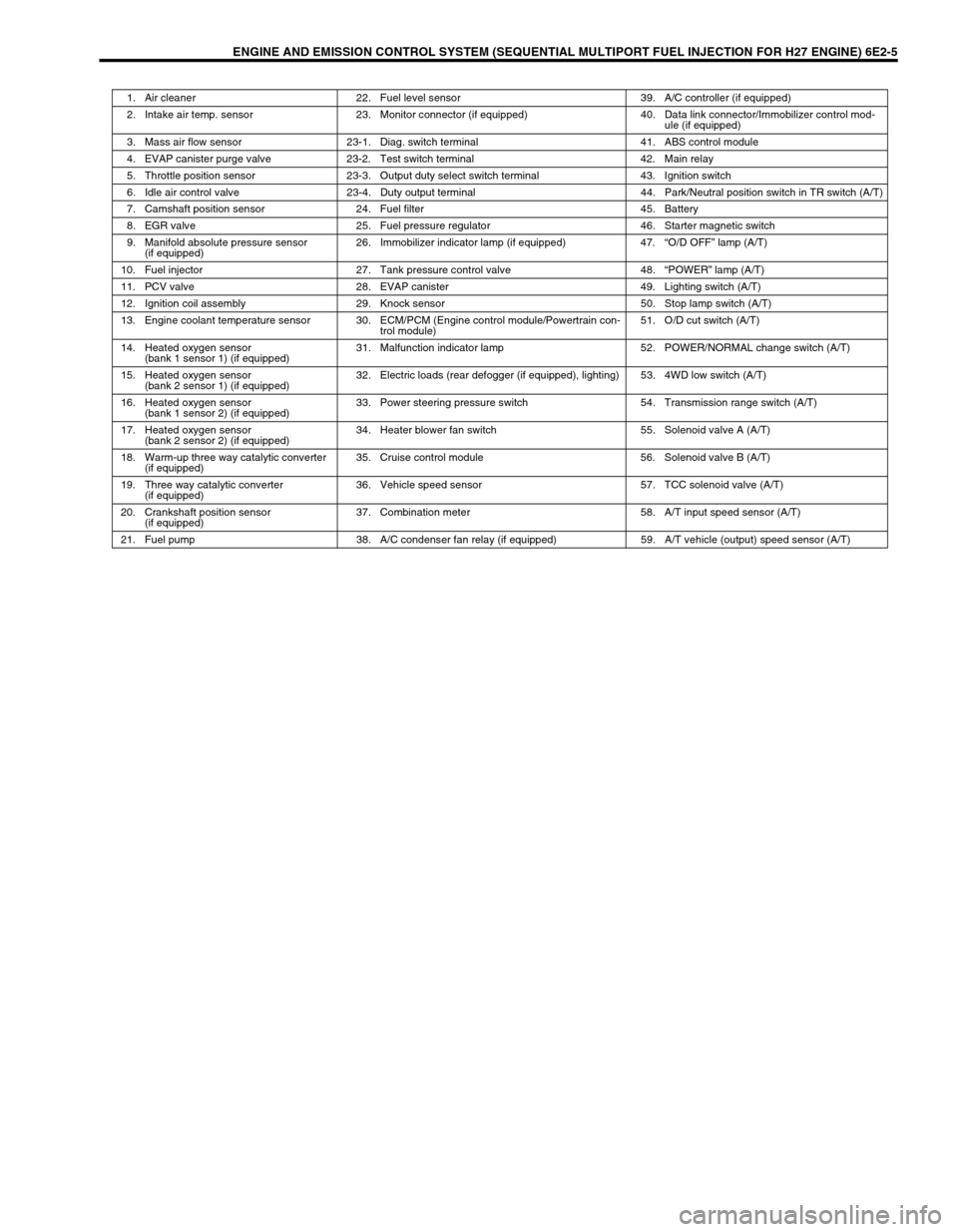
ENGINE AND EMISSION CONTROL SYSTEM (SEQUENTIAL MULTIPORT FUEL INJECTION FOR H27 ENGINE) 6E2-5
1. Air cleaner 22. Fuel level sensor 39. A/C controller (if equipped)
2. Intake air temp. sensor 23. Monitor connector (if equipped) 40. Data link connector/Immobilizer control mod-
ule (if equipped)
3. Mass air flow sensor 23-1. Diag. switch terminal 41. ABS control module
4. EVAP canister purge valve 23-2. Test switch terminal 42. Main relay
5. Throttle position sensor 23-3. Output duty select switch terminal 43. Ignition switch
6. Idle air control valve 23-4. Duty output terminal 44. Park/Neutral position switch in TR switch (A/T)
7. Camshaft position sensor 24. Fuel filter 45. Battery
8. EGR valve 25. Fuel pressure regulator 46. Starter magnetic switch
9. Manifold absolute pressure sensor
(if equipped)26. Immobilizer indicator lamp (if equipped) 47.“O/D OFF” lamp (A/T)
10. Fuel injector 27. Tank pressure control valve 48.“POWER” lamp (A/T)
11. PCV valve 28. EVAP canister 49. Lighting switch (A/T)
12. Ignition coil assembly 29. Knock sensor 50. Stop lamp switch (A/T)
13. Engine coolant temperature sensor 30. ECM/PCM (Engine control module/Powertrain con-
trol module)51. O/D cut switch (A/T)
14. Heated oxygen sensor
(bank 1 sensor 1) (if equipped)31. Malfunction indicator lamp 52. POWER/NORMAL change switch (A/T)
15. Heated oxygen sensor
(bank 2 sensor 1) (if equipped)32. Electric loads (rear defogger (if equipped), lighting) 53. 4WD low switch (A/T)
16. Heated oxygen sensor
(bank 1 sensor 2) (if equipped)33. Power steering pressure switch 54. Transmission range switch (A/T)
17. Heated oxygen sensor
(bank 2 sensor 2) (if equipped)34. Heater blower fan switch 55. Solenoid valve A (A/T)
18. Warm-up three way catalytic converter
(if equipped)35. Cruise control module 56. Solenoid valve B (A/T)
19. Three way catalytic converter
(if equipped)36. Vehicle speed sensor 57. TCC solenoid valve (A/T)
20. Crankshaft position sensor
(if equipped)37. Combination meter 58. A/T input speed sensor (A/T)
21. Fuel pump 38. A/C condenser fan relay (if equipped) 59. A/T vehicle (output) speed sensor (A/T)