charging system SUZUKI GRAND VITARA 2001 2.G User Guide
[x] Cancel search | Manufacturer: SUZUKI, Model Year: 2001, Model line: GRAND VITARA, Model: SUZUKI GRAND VITARA 2001 2.GPages: 656, PDF Size: 14.31 MB
Page 49 of 656
1B-24 AIR CONDITIONING (OPTIONAL)
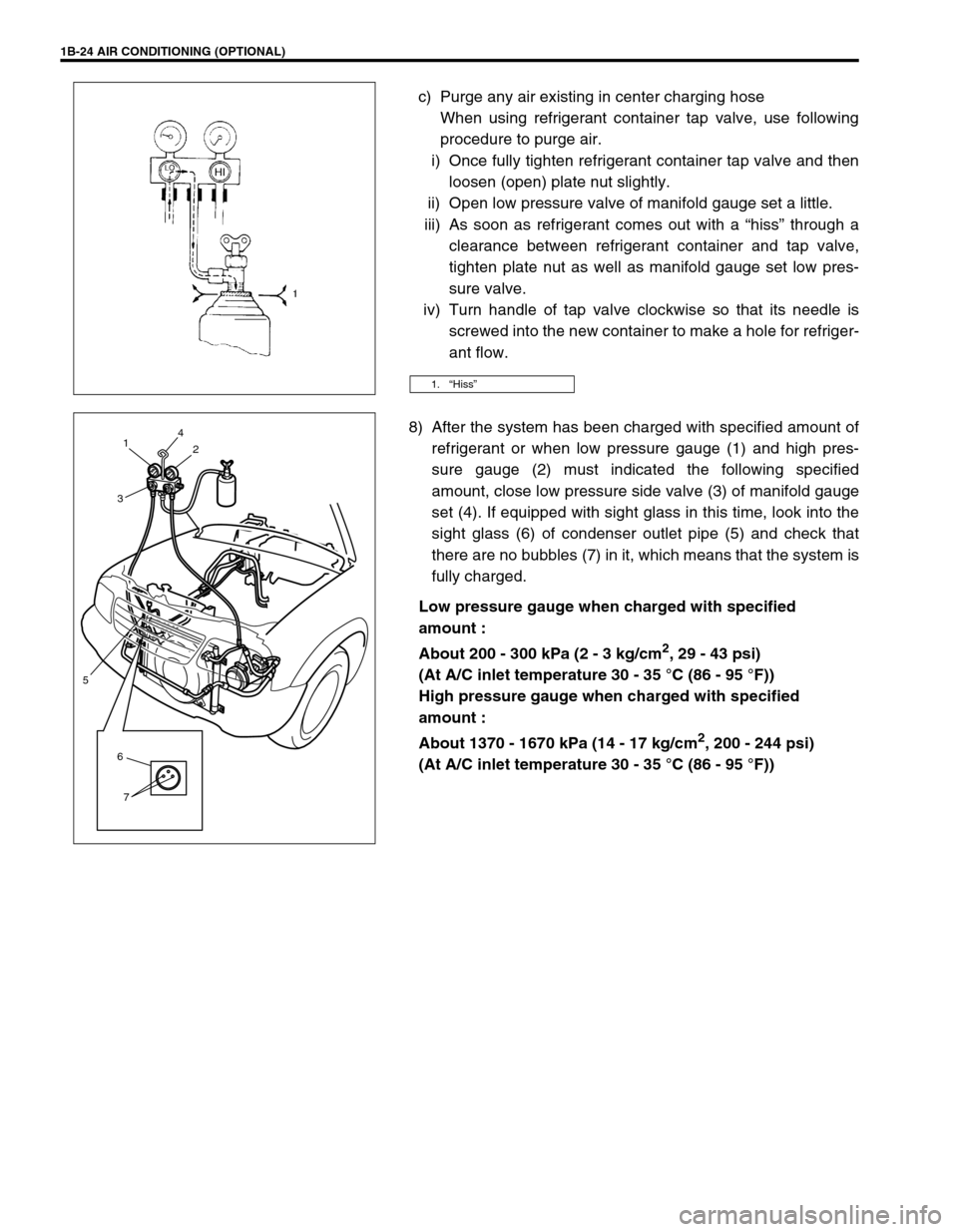
c) Purge any air existing in center charging hose
When using refrigerant container tap valve, use following
procedure to purge air.
i) Once fully tighten refrigerant container tap valve and then
loosen (open) plate nut slightly.
ii) Open low pressure valve of manifold gauge set a little.
iii) As soon as refrigerant comes out with a “hiss” through a
clearance between refrigerant container and tap valve,
tighten plate nut as well as manifold gauge set low pres-
sure valve.
iv) Turn handle of tap valve clockwise so that its needle is
screwed into the new container to make a hole for refriger-
ant flow.
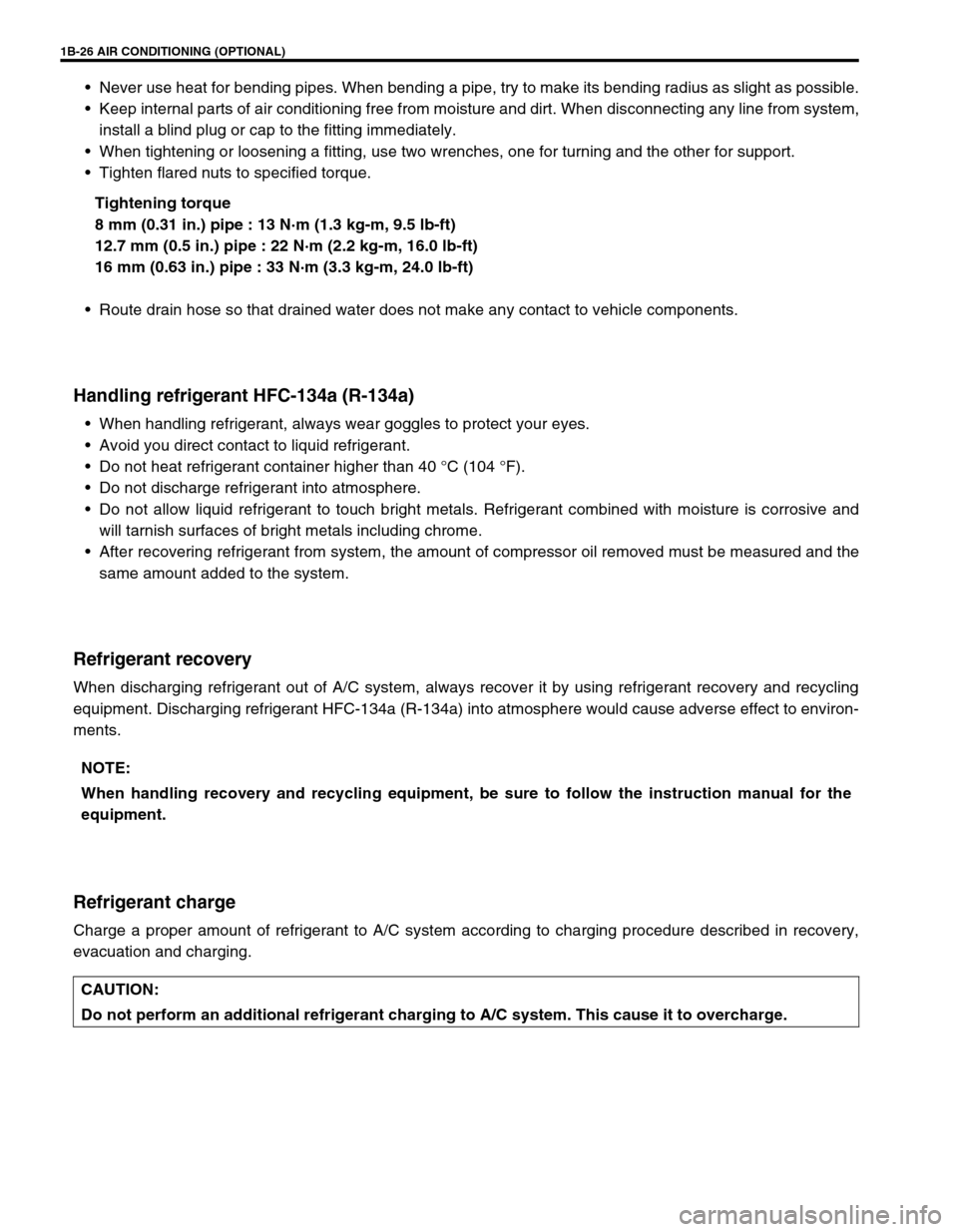
8) After the system has been charged with specified amount of
refrigerant or when low pressure gauge (1) and high pres-
sure gauge (2) must indicated the following specified
amount, close low pressure side valve (3) of manifold gauge
set (4). If equipped with sight glass in this time, look into the
sight glass (6) of condenser outlet pipe (5) and check that
there are no bubbles (7) in it, which means that the system is
fully charged.
Low pressure gauge when charged with specified
amount :
About 200 - 300 kPa (2 - 3 kg/cm
2, 29 - 43 psi)
(At A/C inlet temperature 30 - 35 °C (86 - 95 °F))
High pressure gauge when charged with specified
amount :
About 1370 - 1670 kPa (14 - 17 kg/cm
2, 200 - 244 psi)
(At A/C inlet temperature 30 - 35 °C (86 - 95 °F))
1.“Hiss”
6
7
5
4
2 1
3
Page 51 of 656
1B-26 AIR CONDITIONING (OPTIONAL)
Never use heat for bending pipes. When bending a pipe, try to make its bending radius as slight as possible.
Keep internal parts of air conditioning free from moisture and dirt. When disconnecting any line from system,
install a blind plug or cap to the fitting immediately.
When tightening or loosening a fitting, use two wrenches, one for turning and the other for support.
Tighten flared nuts to specified torque.
Tightening torque
8 mm (0.31 in.) pipe : 13 N·m (1.3 kg-m, 9.5 lb-ft)
12.7 mm (0.5 in.) pipe : 22 N·m (2.2 kg-m, 16.0 lb-ft)
16 mm (0.63 in.) pipe : 33 N·m (3.3 kg-m, 24.0 lb-ft)
Route drain hose so that drained water does not make any contact to vehicle components.
Handling refrigerant HFC-134a (R-134a)
When handling refrigerant, always wear goggles to protect your eyes.
Avoid you direct contact to liquid refrigerant.
Do not heat refrigerant container higher than 40 °C (104 °F).
Do not discharge refrigerant into atmosphere.
Do not allow liquid refrigerant to touch bright metals. Refrigerant combined with moisture is corrosive and
will tarnish surfaces of bright metals including chrome.
After recovering refrigerant from system, the amount of compressor oil removed must be measured and the
same amount added to the system.
Refrigerant recovery
When discharging refrigerant out of A/C system, always recover it by using refrigerant recovery and recycling
equipment. Discharging refrigerant HFC-134a (R-134a) into atmosphere would cause adverse effect to environ-
ments.
Refrigerant charge
Charge a proper amount of refrigerant to A/C system according to charging procedure described in recovery,
evacuation and charging.NOTE:
When handling recovery and recycling equipment, be sure to follow the instruction manual for the
equipment.
CAUTION:
Do not perform an additional refrigerant charging to A/C system. This cause it to overcharge.
Page 56 of 656
AIR CONDITIONING (OPTIONAL) 1B-31
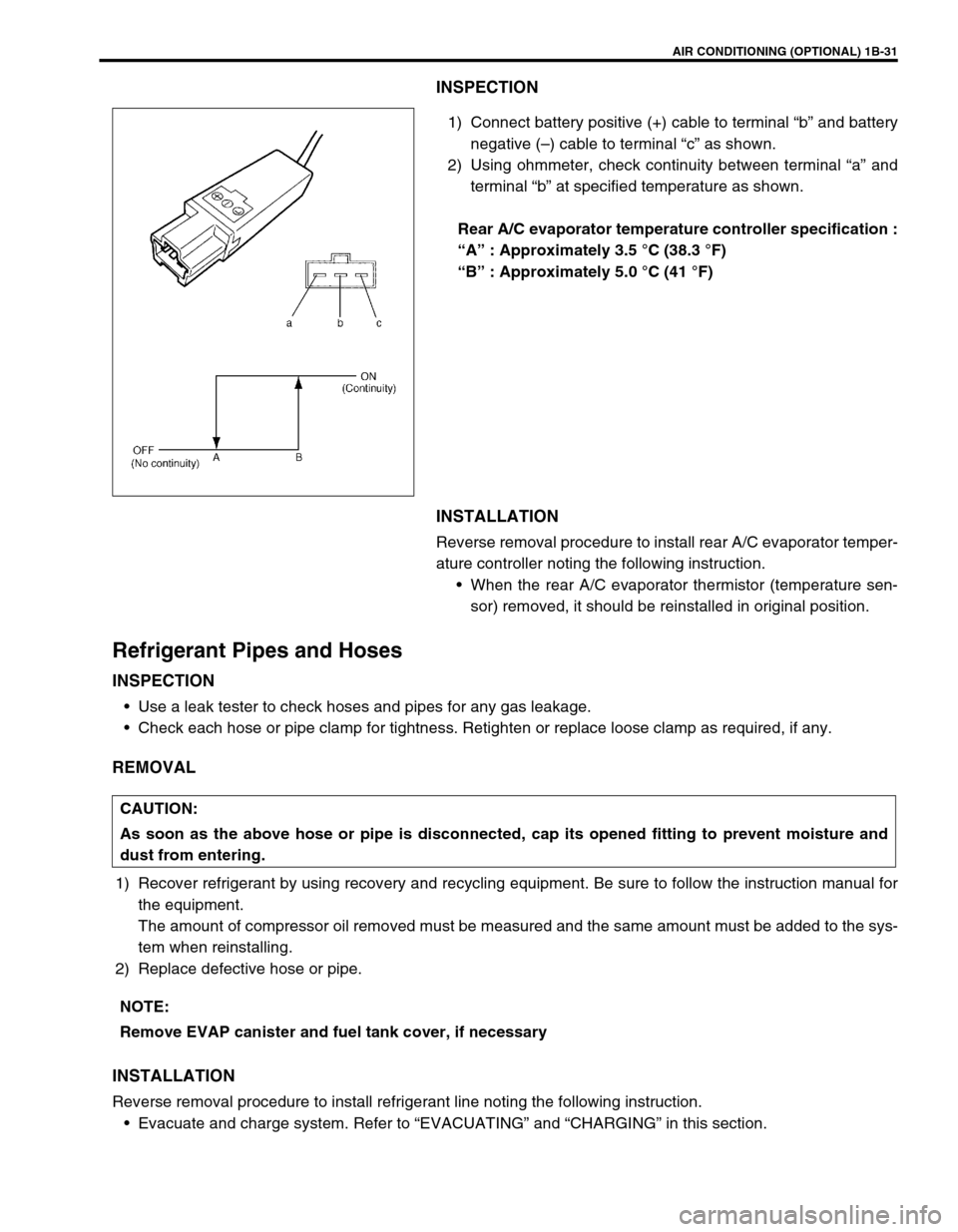
INSPECTION
1) Connect battery positive (+) cable to terminal “b” and battery
negative (–) cable to terminal “c” as shown.
2) Using ohmmeter, check continuity between terminal “a” and
terminal “b” at specified temperature as shown.
Rear A/C evaporator temperature controller specification :
“A” : Approximately 3.5 °C (38.3 °F)
“B” : Approximately 5.0 °C (41 °F)
INSTALLATION
Reverse removal procedure to install rear A/C evaporator temper-
ature controller noting the following instruction.
When the rear A/C evaporator thermistor (temperature sen-
sor) removed, it should be reinstalled in original position.
Refrigerant Pipes and Hoses
INSPECTION
Use a leak tester to check hoses and pipes for any gas leakage.
Check each hose or pipe clamp for tightness. Retighten or replace loose clamp as required, if any.
REMOVAL
1) Recover refrigerant by using recovery and recycling equipment. Be sure to follow the instruction manual for
the equipment.
The amount of compressor oil removed must be measured and the same amount must be added to the sys-
tem when reinstalling.
2) Replace defective hose or pipe.
INSTALLATION
Reverse removal procedure to install refrigerant line noting the following instruction.
Evacuate and charge system. Refer to “EVACUATING” and “CHARGING” in this section.
CAUTION:
As soon as the above hose or pipe is disconnected, cap its opened fitting to prevent moisture and
dust from entering.
NOTE:
Remove EVAP canister and fuel tank cover, if necessary
Page 63 of 656
1B-38 AIR CONDITIONING (OPTIONAL)
Compressor Assembly
INSPECTION
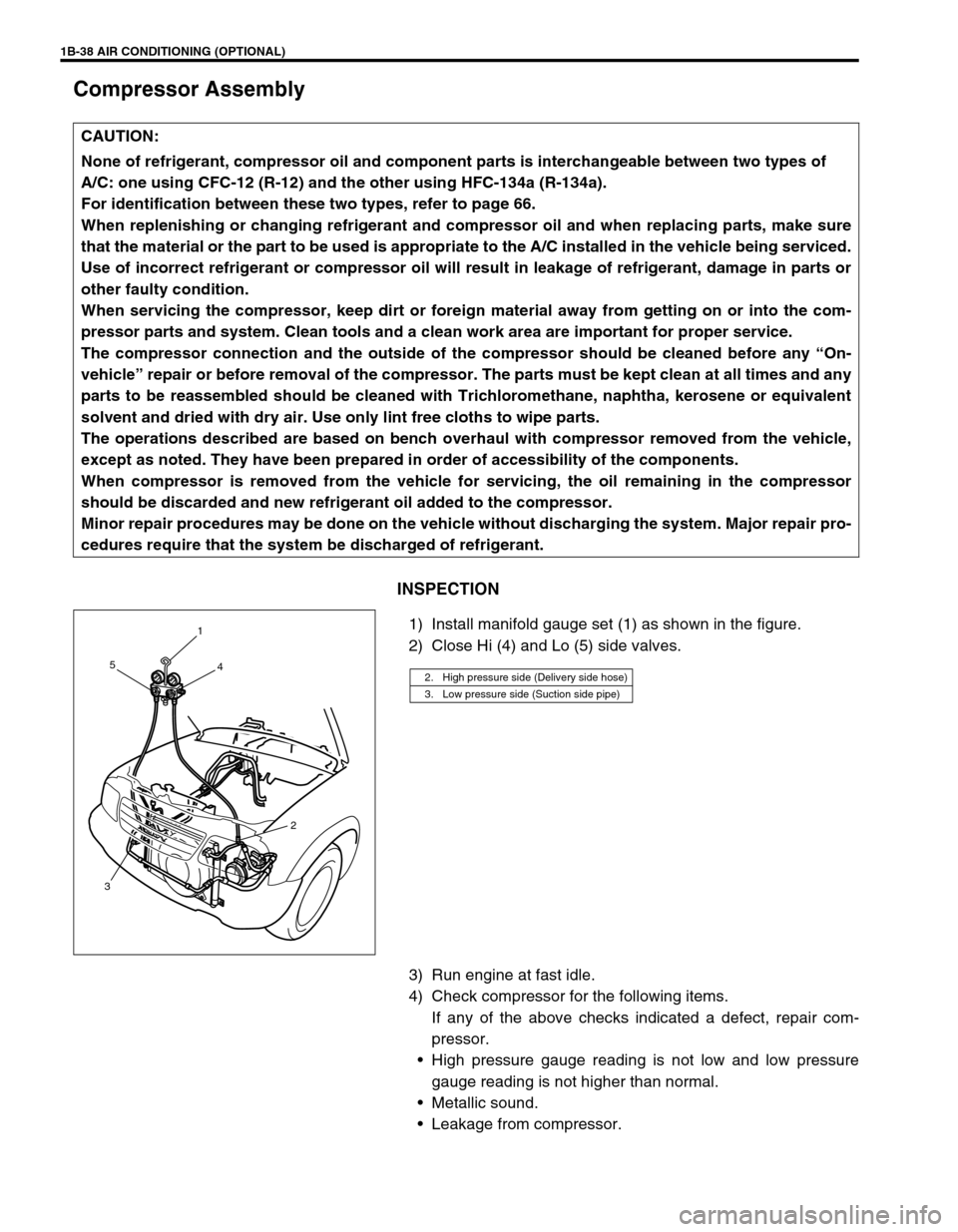
1) Install manifold gauge set (1) as shown in the figure.
2) Close Hi (4) and Lo (5) side valves.
3) Run engine at fast idle.
4) Check compressor for the following items.
If any of the above checks indicated a defect, repair com-
pressor.
High pressure gauge reading is not low and low pressure
gauge reading is not higher than normal.
Metallic sound.
Leakage from compressor. CAUTION:
None of refrigerant, compressor oil and component parts is interchangeable between two types of
A/C: one using CFC-12 (R-12) and the other using HFC-134a (R-134a).
For identification between these two types, refer to page 66.
When replenishing or changing refrigerant and compressor oil and when replacing parts, make sure
that the material or the part to be used is appropriate to the A/C installed in the vehicle being serviced.
Use of incorrect refrigerant or compressor oil will result in leakage of refrigerant, damage in parts or
other faulty condition.
When servicing the compressor, keep dirt or foreign material away from getting on or into the com-
pressor parts and system. Clean tools and a clean work area are important for proper service.
The compressor connection and the outside of the compressor should be cleaned before any “On-
vehicle” repair or before removal of the compressor. The parts must be kept clean at all times and any
parts to be reassembled should be cleaned with Trichloromethane, naphtha, kerosene or equivalent
solvent and dried with dry air. Use only lint free cloths to wipe parts.
The operations described are based on bench overhaul with compressor removed from the vehicle,
except as noted. They have been prepared in order of accessibility of the components.
When compressor is removed from the vehicle for servicing, the oil remaining in the compressor
should be discarded and new refrigerant oil added to the compressor.
Minor repair procedures may be done on the vehicle without discharging the system. Major repair pro-
cedures require that the system be discharged of refrigerant.
2. High pressure side (Delivery side hose)
3. Low pressure side (Suction side pipe)
1
4 5
2
3
Page 65 of 656
1B-40 AIR CONDITIONING (OPTIONAL)
INSTALLATION
Reverse removal procedure to install compressor assembly not-
ing the following instructions.
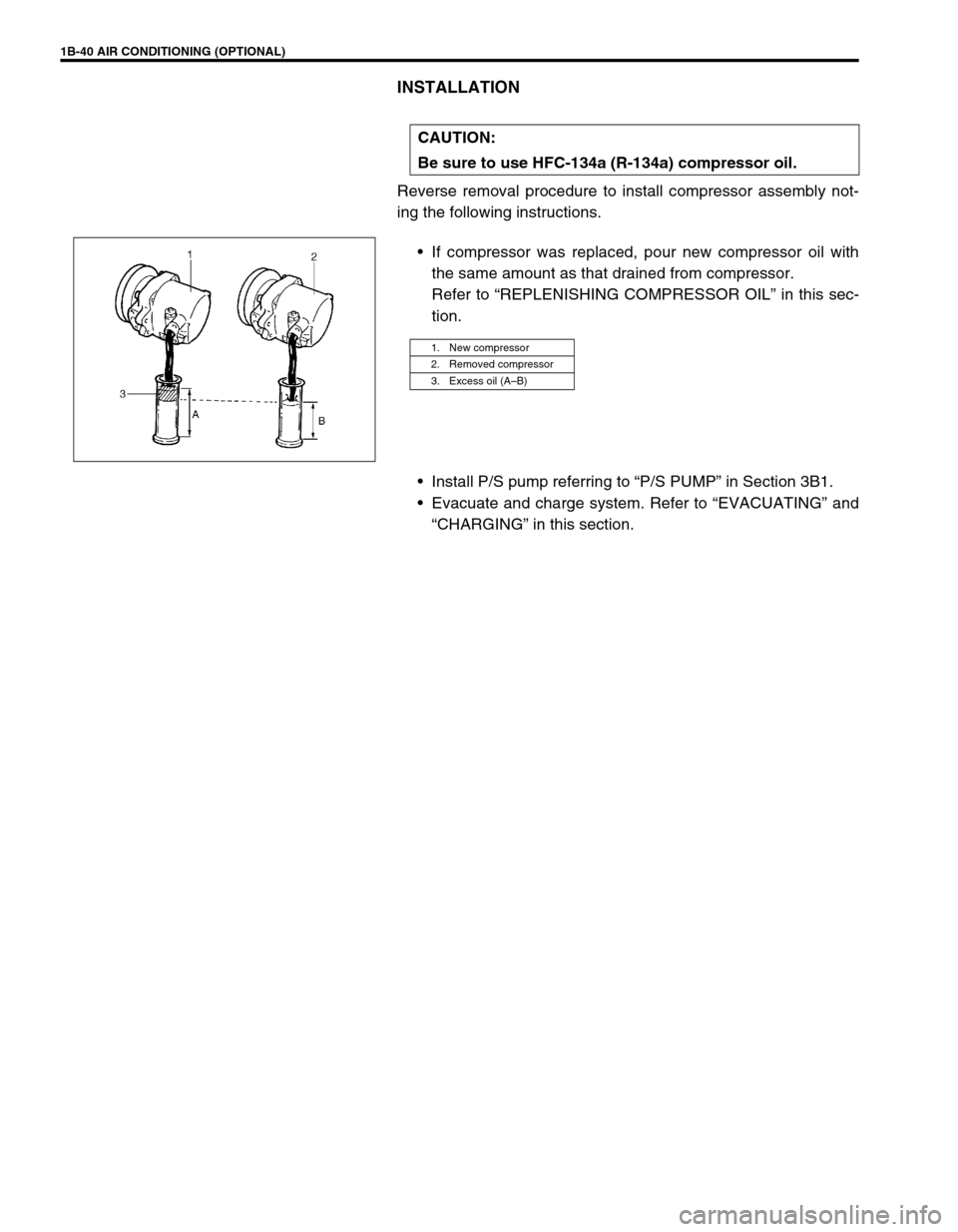
If compressor was replaced, pour new compressor oil with
the same amount as that drained from compressor.
Refer to “REPLENISHING COMPRESSOR OIL” in this sec-
tion.
Install P/S pump referring to “P/S PUMP” in Section 3B1.
Evacuate and charge system. Refer to “EVACUATING” and
“CHARGING” in this section. CAUTION:
Be sure to use HFC-134a (R-134a) compressor oil.
1. New compressor
2. Removed compressor
3. Excess oil (A–B)
Page 150 of 656
ANTILOCK BRAKE SYSTEM (ABS) 5E2-25
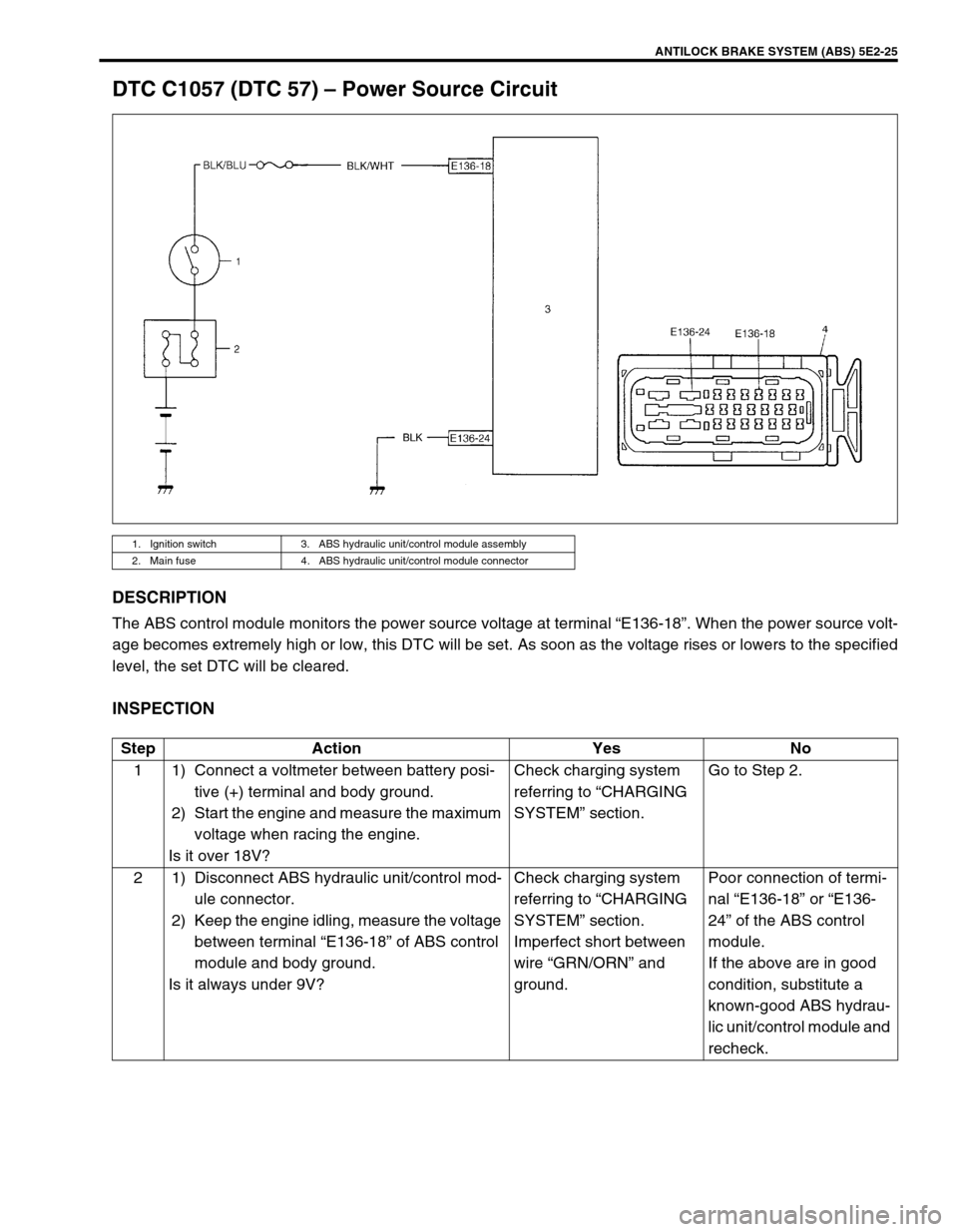
DTC C1057 (DTC 57) – Power Source Circuit
DESCRIPTION
The ABS control module monitors the power source voltage at terminal “E136-18”. When the power source volt-
age becomes extremely high or low, this DTC will be set. As soon as the voltage rises or lowers to the specified
level, the set DTC will be cleared.
INSPECTION
1. Ignition switch 3. ABS hydraulic unit/control module assembly
2. Main fuse 4. ABS hydraulic unit/control module connector
Step Action Yes No
1 1) Connect a voltmeter between battery posi-
tive (+) terminal and body ground.
2) Start the engine and measure the maximum
voltage when racing the engine.
Is it over 18V?Check charging system
referring to “CHARGING
SYSTEM” section.Go to Step 2.
2 1) Disconnect ABS hydraulic unit/control mod-
ule connector.
2) Keep the engine idling, measure the voltage
between terminal “E136-18” of ABS control
module and body ground.
Is it always under 9V?Check charging system
referring to “CHARGING
SYSTEM” section.
Imperfect short between
wire “GRN/ORN” and
ground.Poor connection of termi-
nal “E136-18” or “E136-
24” of the ABS control
module.
If the above are in good
condition, substitute a
known-good ABS hydrau-
lic unit/control module and
recheck.
Page 152 of 656
ANTILOCK BRAKE SYSTEM (ABS) 5E2-27
DTC C1063 (DTC 63) – ABS Fail-Safe Relay Circuit
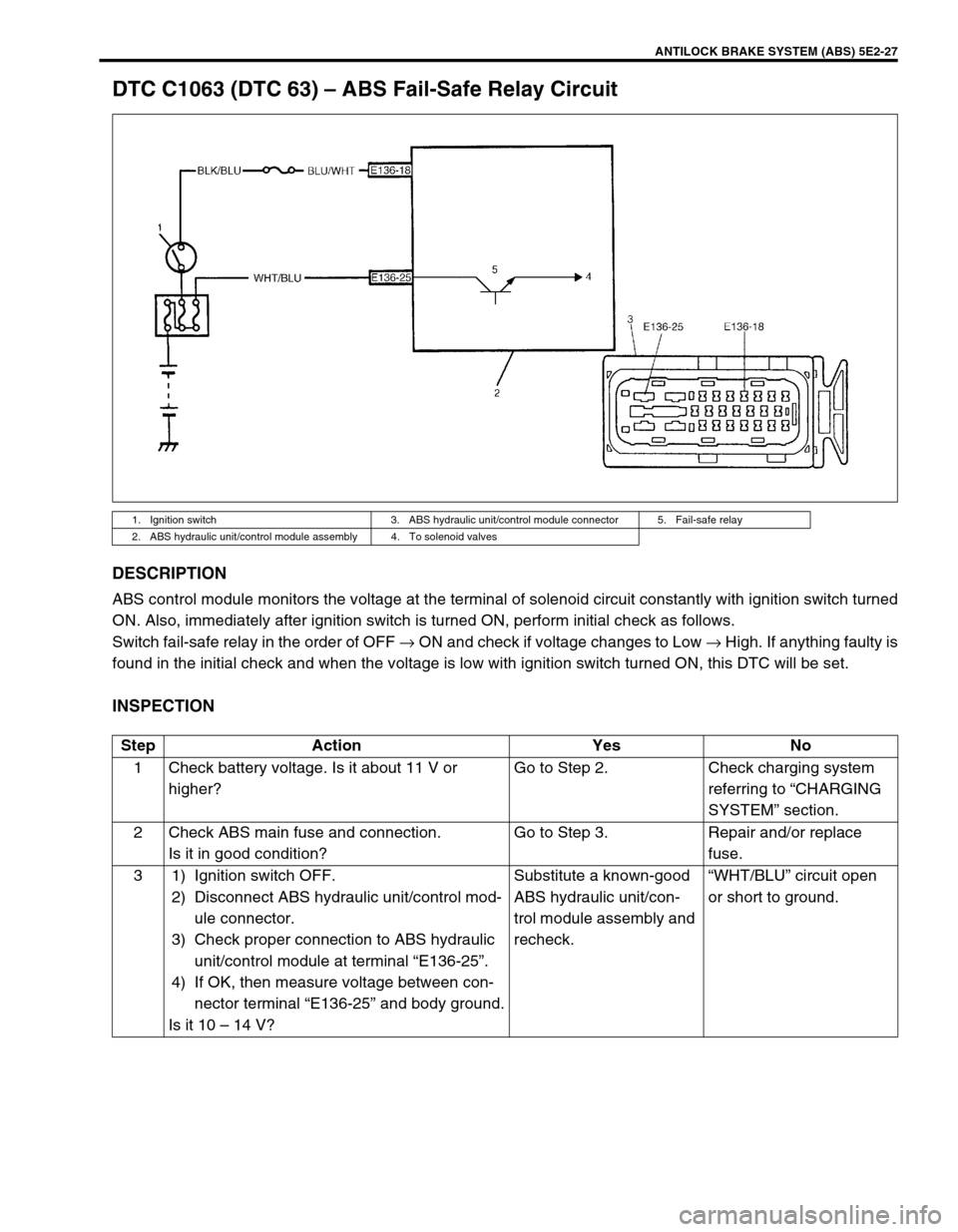
DESCRIPTION
ABS control module monitors the voltage at the terminal of solenoid circuit constantly with ignition switch turned
ON. Also, immediately after ignition switch is turned ON, perform initial check as follows.
Switch fail-safe relay in the order of OFF → ON and check if voltage changes to Low → High. If anything faulty is
found in the initial check and when the voltage is low with ignition switch turned ON, this DTC will be set.
INSPECTION
1. Ignition switch 3. ABS hydraulic unit/control module connector 5. Fail-safe relay
2. ABS hydraulic unit/control module assembly 4. To solenoid valves
Step Action Yes No
1 Check battery voltage. Is it about 11 V or
higher?Go to Step 2. Check charging system
referring to “CHARGING
SYSTEM” section.
2 Check ABS main fuse and connection.
Is it in good condition?Go to Step 3. Repair and/or replace
fuse.
3 1) Ignition switch OFF.
2) Disconnect ABS hydraulic unit/control mod-
ule connector.
3) Check proper connection to ABS hydraulic
unit/control module at terminal “E136-25”.
4) If OK, then measure voltage between con-
nector terminal “E136-25” and body ground.
Is it 10 – 14 V?Substitute a known-good
ABS hydraulic unit/con-
trol module assembly and
recheck.“WHT/BLU” circuit open
or short to ground.
Page 398 of 656
CHARGING SYSTEM 6H-1
6H
SECTION 6H
CHARGING SYSTEM
CONTENTS
General Description ....................................... 6H-2
Generator ..................................................... 6H-2
Unit Repair Overhaul ..................................... 6H-3
Generator Assembly .................................... 6H-3
Inspection ................................................. 6H-3Specifications................................................. 6H-6
Battery.......................................................... 6H-6
Generator ..................................................... 6H-6
Tightening Torque Specification .................. 6H-6
WARNING:
For vehicles equipped with Supplemental Restraint (Air Bag) System:
Service on and around the air bag system components or wiring must be performed only by an
authorized SUZUKI dealer. Refer to “Air Bag System Components and Wiring Location View” under
“General Description” in Section 10B in order to confirm whether you are performing service on or
near the air bag system components or wiring. Please observe all WARNINGS and “Service Precau-
tions” under “On-Vehicle Service” in Section 10B before performing service on or around the air
bag system components or wiring. Failure to follow WARNINGS could result in unintentional activa-
tion of the system or could render the system inoperative. Either of these two conditions may result
in severe injury.
Technical service work must be started at least 90 seconds after the ignition switch is turned to the
“LOCK” position and the negative cable is disconnected from the battery. Otherwise, the system
may be activated by reserve energy in the Sensing and Diagnostic Module (SDM).
NOTE:
For the descriptions (items) not found in this section, refer to the same section of the Service Manual
mentioned in the FOREWORD of this manual.
Page 399 of 656
6H-2 CHARGING SYSTEM
General Description
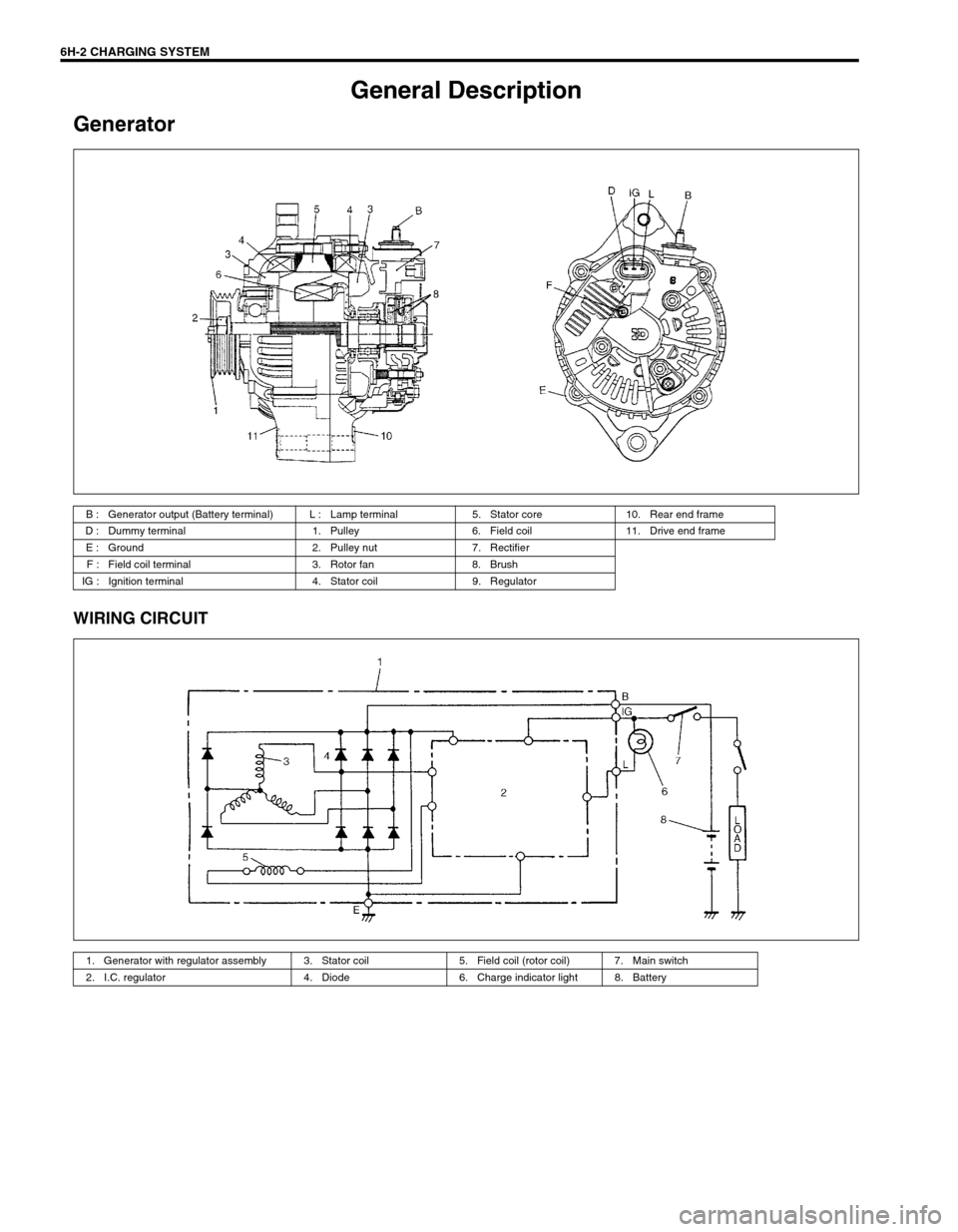
Generator
WIRING CIRCUIT
B : Generator output (Battery terminal) L : Lamp terminal 5. Stator core 10. Rear end frame
D : Dummy terminal 1. Pulley 6. Field coil 11. Drive end frame
E : Ground 2. Pulley nut 7. Rectifier
F : Field coil terminal 3. Rotor fan 8. Brush
IG : Ignition terminal 4. Stator coil 9. Regulator
1. Generator with regulator assembly 3. Stator coil 5. Field coil (rotor coil) 7. Main switch
2. I.C. regulator 4. Diode 6. Charge indicator light 8. Battery
Page 400 of 656
CHARGING SYSTEM 6H-3
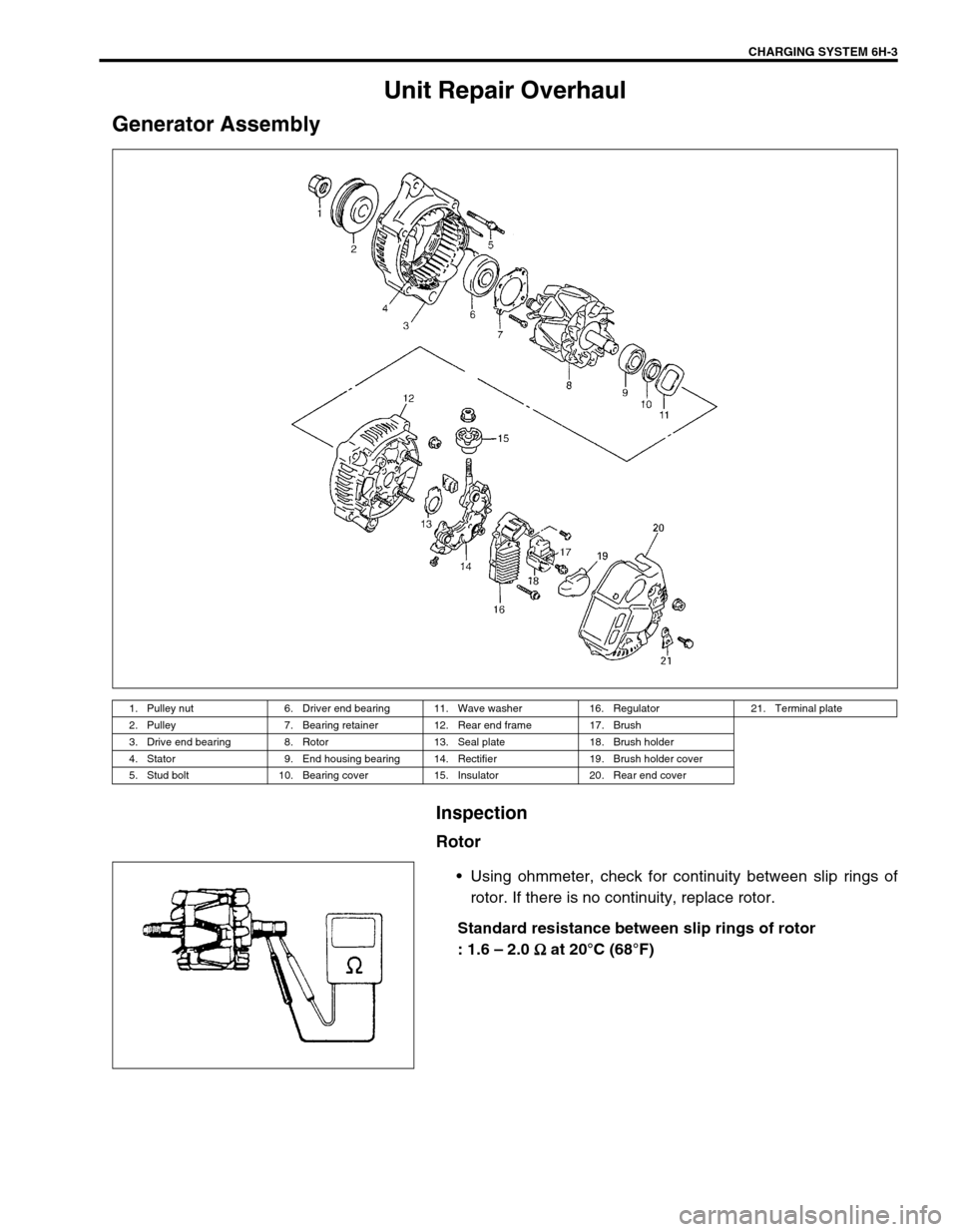
Unit Repair Overhaul
Generator Assembly
Inspection
Rotor
•Using ohmmeter, check for continuity between slip rings of
rotor. If there is no continuity, replace rotor.
Standard resistance between slip rings of rotor
: 1.6 – 2.0 Ω
ΩΩ Ω at 20°C (68°F)
1. Pulley nut 6. Driver end bearing 11. Wave washer 16. Regulator 21. Terminal plate
2. Pulley 7. Bearing retainer 12. Rear end frame 17. Brush
3. Drive end bearing 8. Rotor 13. Seal plate 18. Brush holder
4. Stator 9. End housing bearing 14. Rectifier 19. Brush holder cover
5. Stud bolt 10. Bearing cover 15. Insulator 20. Rear end cover