engine SUZUKI GRAND VITARA 2001 2.G Owners Manual
[x] Cancel search | Manufacturer: SUZUKI, Model Year: 2001, Model line: GRAND VITARA, Model: SUZUKI GRAND VITARA 2001 2.GPages: 656, PDF Size: 14.31 MB
Page 344 of 656
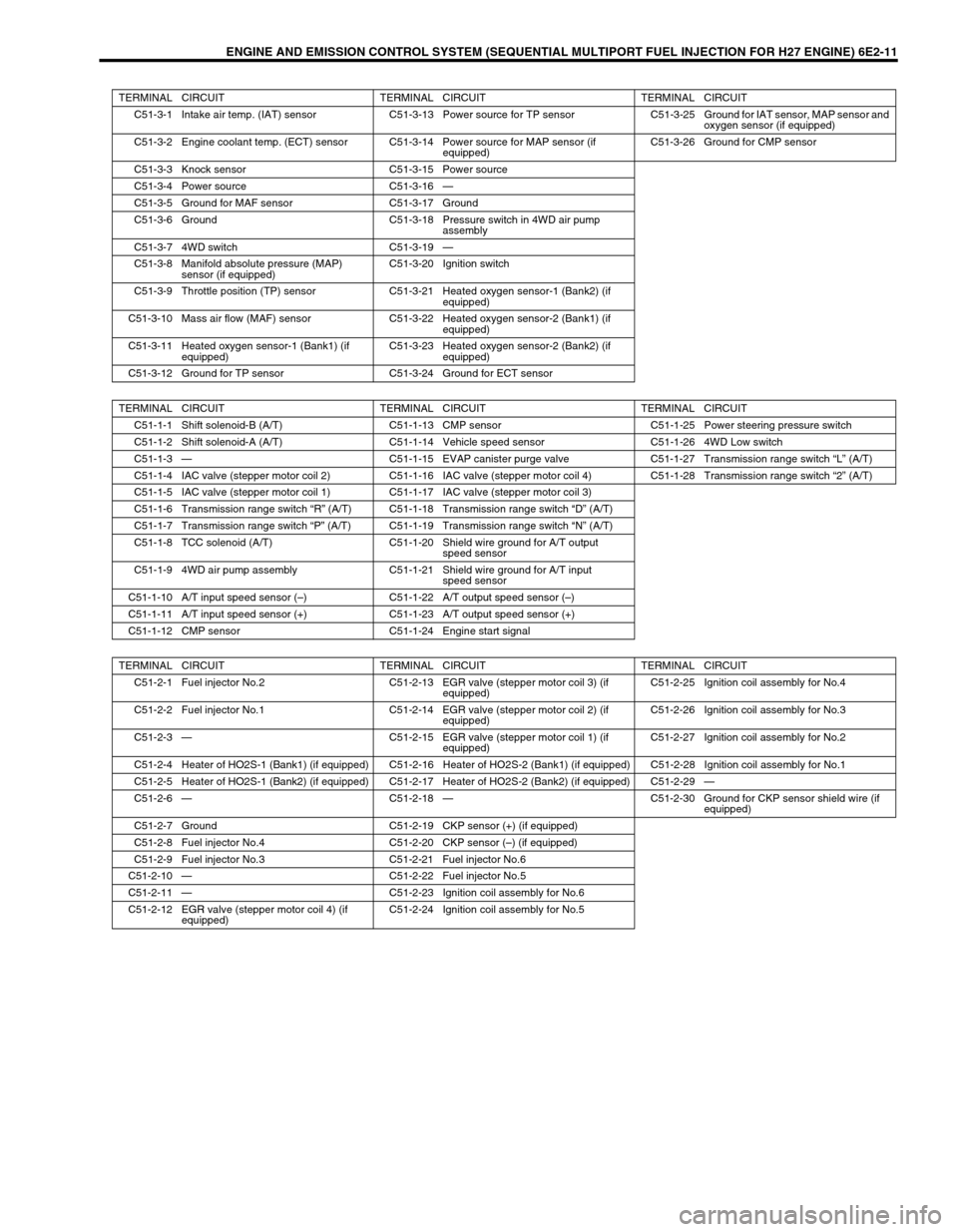
ENGINE AND EMISSION CONTROL SYSTEM (SEQUENTIAL MULTIPORT FUEL INJECTION FOR H27 ENGINE) 6E2-11
TERMINAL CIRCUIT TERMINAL CIRCUIT TERMINAL CIRCUIT
C51-3-1 Intake air temp. (IAT) sensor C51-3-13 Power source for TP sensor C51-3-25 Ground for IAT sensor, MAP sensor and
oxygen sensor (if equipped)
C51-3-2 Engine coolant temp. (ECT) sensor C51-3-14 Power source for MAP sensor (if
equipped)C51-3-26 Ground for CMP sensor
C51-3-3 Knock sensor C51-3-15 Power source
C51-3-4 Power source C51-3-16—
C51-3-5 Ground for MAF sensor C51-3-17 Ground
C51-3-6 Ground C51-3-18 Pressure switch in 4WD air pump
assembly
C51-3-7 4WD switch C51-3-19—
C51-3-8 Manifold absolute pressure (MAP)
sensor (if equipped)C51-3-20 Ignition switch
C51-3-9 Throttle position (TP) sensor C51-3-21 Heated oxygen sensor-1 (Bank2) (if
equipped)
C51-3-10 Mass air flow (MAF) sensor C51-3-22 Heated oxygen sensor-2 (Bank1) (if
equipped)
C51-3-11 Heated oxygen sensor-1 (Bank1) (if
equipped)C51-3-23 Heated oxygen sensor-2 (Bank2) (if
equipped)
C51-3-12 Ground for TP sensor C51-3-24 Ground for ECT sensor
TERMINAL CIRCUIT TERMINAL CIRCUIT TERMINAL CIRCUIT
C51-1-1 Shift solenoid-B (A/T) C51-1-13 CMP sensor C51-1-25 Power steering pressure switch
C51-1-2 Shift solenoid-A (A/T) C51-1-14 Vehicle speed sensor C51-1-26 4WD Low switch
C51-1-3—C51-1-15 EVAP canister purge valve C51-1-27 Transmission range switch “L” (A/T)
C51-1-4 IAC valve (stepper motor coil 2) C51-1-16 IAC valve (stepper motor coil 4) C51-1-28 Transmission range switch “2” (A/T)
C51-1-5 IAC valve (stepper motor coil 1) C51-1-17 IAC valve (stepper motor coil 3)
C51-1-6 Transmission range switch “R” (A/T) C51-1-18 Transmission range switch “D” (A/T)
C51-1-7 Transmission range switch “P” (A/T) C51-1-19 Transmission range switch “N” (A/T)
C51-1-8 TCC solenoid (A/T) C51-1-20 Shield wire ground for A/T output
speed sensor
C51-1-9 4WD air pump assembly C51-1-21 Shield wire ground for A/T input
speed sensor
C51-1-10 A/T input speed sensor (–) C51-1-22 A/T output speed sensor (–)
C51-1-11 A/T input speed sensor (+) C51-1-23 A/T output speed sensor (+)
C51-1-12 CMP sensor C51-1-24 Engine start signal
TERMINAL CIRCUIT TERMINAL CIRCUIT TERMINAL CIRCUIT
C51-2-1 Fuel injector No.2 C51-2-13 EGR valve (stepper motor coil 3) (if
equipped)C51-2-25 Ignition coil assembly for No.4
C51-2-2 Fuel injector No.1 C51-2-14 EGR valve (stepper motor coil 2) (if
equipped)C51-2-26 Ignition coil assembly for No.3
C51-2-3—C51-2-15 EGR valve (stepper motor coil 1) (if
equipped)C51-2-27 Ignition coil assembly for No.2
C51-2-4 Heater of HO2S-1 (Bank1) (if equipped) C51-2-16 Heater of HO2S-2 (Bank1) (if equipped) C51-2-28 Ignition coil assembly for No.1
C51-2-5 Heater of HO2S-1 (Bank2) (if equipped) C51-2-17 Heater of HO2S-2 (Bank2) (if equipped) C51-2-29—
C51-2-6—C51-2-18—C51-2-30 Ground for CKP sensor shield wire (if
equipped)
C51-2-7 Ground C51-2-19 CKP sensor (+) (if equipped)
C51-2-8 Fuel injector No.4 C51-2-20 CKP sensor (–) (if equipped)
C51-2-9 Fuel injector No.3 C51-2-21 Fuel injector No.6
C51-2-10—C51-2-22 Fuel injector No.5
C51-2-11—C51-2-23 Ignition coil assembly for No.6
C51-2-12 EGR valve (stepper motor coil 4) (if
equipped)C51-2-24 Ignition coil assembly for No.5
Page 345 of 656
6E2-12 ENGINE AND EMISSION CONTROL SYSTEM (SEQUENTIAL MULTIPORT FUEL INJECTION FOR H27 ENGINE)
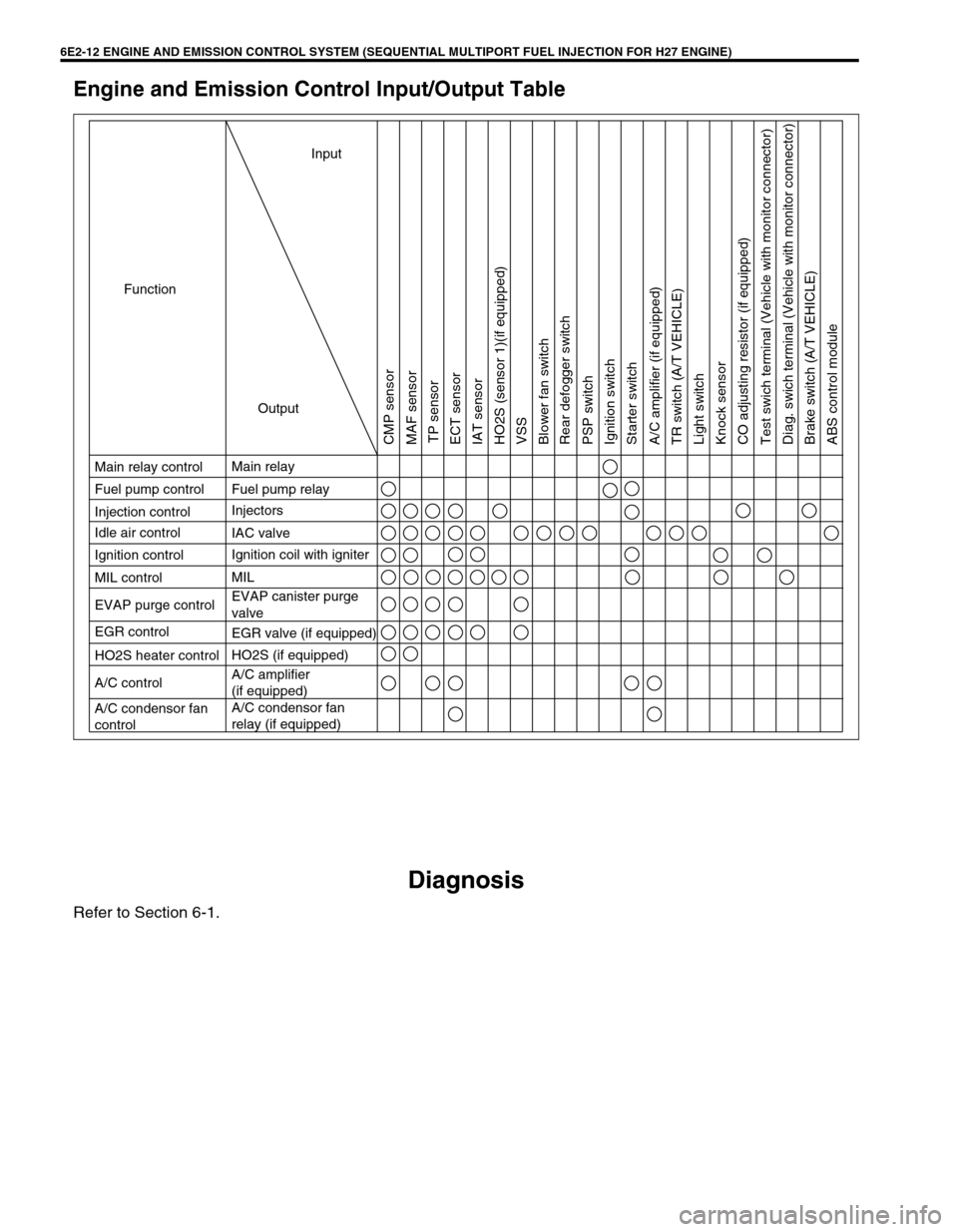
Engine and Emission Control Input/Output Table
Diagnosis
Refer to Section 6-1.
Ignition coil with igniter
HO2S heater control
Input
Output Function
Main relay control
Fuel pump control
Injection control
Ignition control
MIL control Idle air control
EVAP purge control
EGR control
A/C control
A/C condensor fan
controlMain relay
Fuel pump relay
Injectors
MIL
EVAP canister purge
valve IAC valve
EGR valve (if equipped)
HO2S (if equipped)
A/C amplifier
(if equipped)
A/C condensor fan
relay (if equipped)
CMP sensor
MAF sensor
TP sensor
ECT sensor
IAT sensor
HO2S (sensor 1)(if equipped)
VSS
Blower fan switch
Rear defogger switch
PSP switch
Ignition switch
Starter switch
A/C amplifier (if equipped)
TR switch (A/T VEHICLE)
Light switch
Knock sensor
CO adjusting resistor (if equipped)
Test swich terminal (Vehicle with monitor connector)
Diag. swich terminal (Vehicle with monitor connector)
Brake switch (A/T VEHICLE)
ABS control module
Page 346 of 656
ENGINE AND EMISSION CONTROL SYSTEM (SEQUENTIAL MULTIPORT FUEL INJECTION FOR H27 ENGINE) 6E2-13
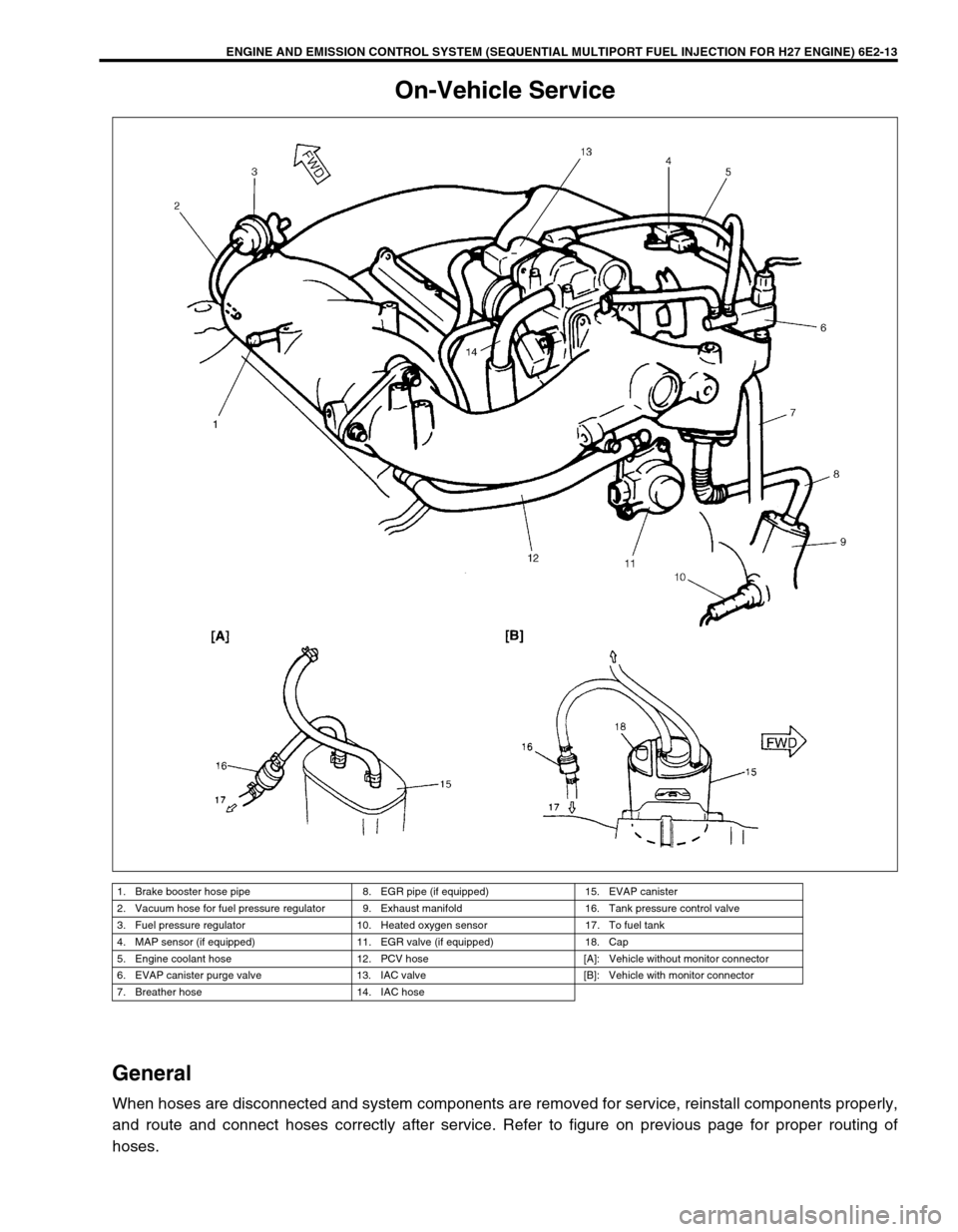
On-Vehicle Service
General
When hoses are disconnected and system components are removed for service, reinstall components properly,
and route and connect hoses correctly after service. Refer to figure on previous page for proper routing of
hoses.
1. Brake booster hose pipe 8. EGR pipe (if equipped) 15. EVAP canister
2. Vacuum hose for fuel pressure regulator 9. Exhaust manifold 16. Tank pressure control valve
3. Fuel pressure regulator 10. Heated oxygen sensor 17. To fuel tank
4. MAP sensor (if equipped) 11. EGR valve (if equipped) 18. Cap
5. Engine coolant hose 12. PCV hose [A]: Vehicle without monitor connector
6. EVAP canister purge valve 13. IAC valve [B]: Vehicle with monitor connector
7. Breather hose 14. IAC hose
Page 347 of 656
6E2-14 ENGINE AND EMISSION CONTROL SYSTEM (SEQUENTIAL MULTIPORT FUEL INJECTION FOR H27 ENGINE)
Accelerator Cable Adjustment
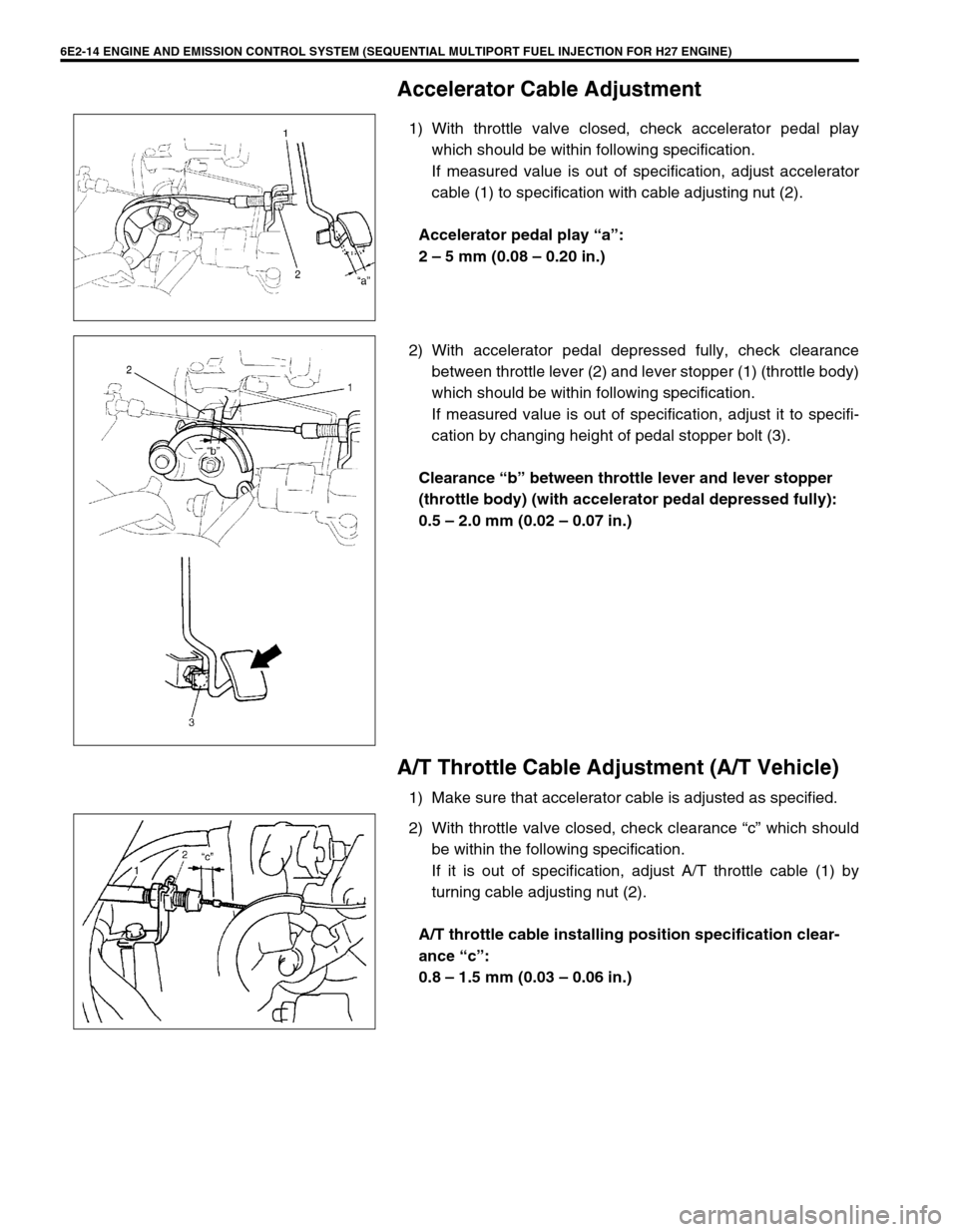
1) With throttle valve closed, check accelerator pedal play
which should be within following specification.
If measured value is out of specification, adjust accelerator
cable (1) to specification with cable adjusting nut (2).
Accelerator pedal play “a”:
2 – 5 mm (0.08 – 0.20 in.)
2) With accelerator pedal depressed fully, check clearance
between throttle lever (2) and lever stopper (1) (throttle body)
which should be within following specification.
If measured value is out of specification, adjust it to specifi-
cation by changing height of pedal stopper bolt (3).
Clearance “b” between throttle lever and lever stopper
(throttle body) (with accelerator pedal depressed fully):
0.5 – 2.0 mm (0.02 – 0.07 in.)
A/T Throttle Cable Adjustment (A/T Vehicle)
1) Make sure that accelerator cable is adjusted as specified.
2) With throttle valve closed, check clearance “c” which should
be within the following specification.
If it is out of specification, adjust A/T throttle cable (1) by
turning cable adjusting nut (2).
A/T throttle cable installing position specification clear-
ance “c”:
0.8 – 1.5 mm (0.03 – 0.06 in.)
Page 348 of 656
ENGINE AND EMISSION CONTROL SYSTEM (SEQUENTIAL MULTIPORT FUEL INJECTION FOR H27 ENGINE) 6E2-15
Idle Speed/Idle Air Control (IAC) Duty Inspec-
tion
Before idle speed/IAC duty check, make sure of the following.
•Lead wires and hoses of engine/emission control systems
are connected securely.
•Accelerator cable is adjusted.
•Ignition timing is within specification.
•All accessories (wipers, heater, lights, A/C, etc.) are out of
service.
•Air cleaner has been properly installed and is in good condi-
tion.
•ECM (PCM) does not detect any malfunction DTC.
After above items are all confirmed, check idle speed and IAC
duty as follows.
[Using SUZUKI scan tool]
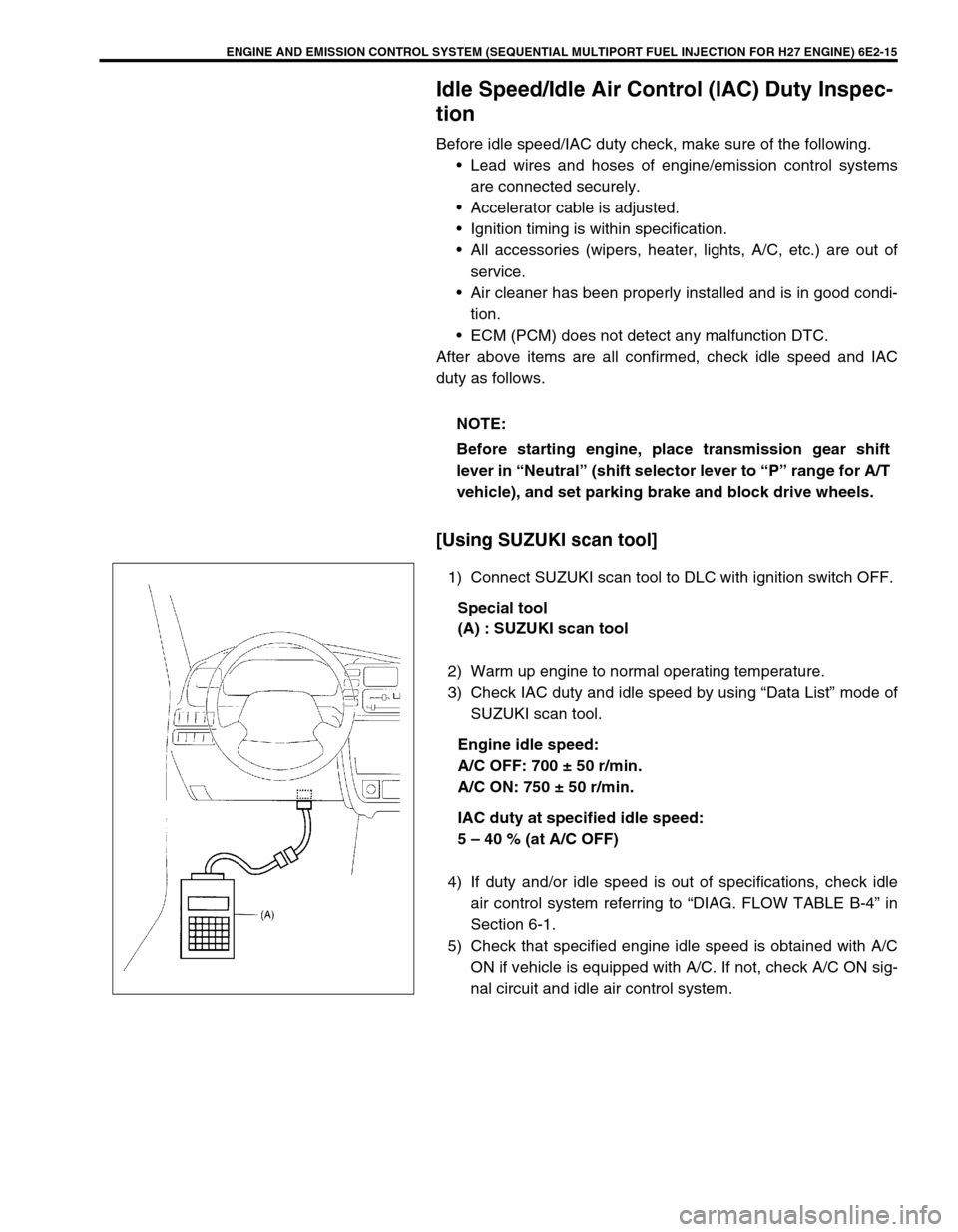
1) Connect SUZUKI scan tool to DLC with ignition switch OFF.
Special tool
(A) : SUZUKI scan tool
2) Warm up engine to normal operating temperature.
3) Check IAC duty and idle speed by using “Data List” mode of
SUZUKI scan tool.
Engine idle speed:
A/C OFF: 700 ± 50 r/min.
A/C ON: 750 ± 50 r/min.
IAC duty at specified idle speed:
5 – 40 % (at A/C OFF)
4) If duty and/or idle speed is out of specifications, check idle
air control system referring to “DIAG. FLOW TABLE B-4” in
Section 6-1.
5) Check that specified engine idle speed is obtained with A/C
ON if vehicle is equipped with A/C. If not, check A/C ON sig-
nal circuit and idle air control system. NOTE:
Before starting engine, place transmission gear shift
lever in “Neutral” (shift selector lever to “P” range for A/T
vehicle), and set parking brake and block drive wheels.
Page 349 of 656
![SUZUKI GRAND VITARA 2001 2.G Owners Manual 6E2-16 ENGINE AND EMISSION CONTROL SYSTEM (SEQUENTIAL MULTIPORT FUEL INJECTION FOR H27 ENGINE)
[Not using SUZUKI scan tool] (vehicle with monitor
connector)
1) Disconnect scan tool from DLC if connec](/img/20/7584/w960_7584-348.png "SUZUKI GRAND VITARA 2001 2.G Owners Manual 6E2-16 ENGINE AND EMISSION CONTROL SYSTEM (SEQUENTIAL MULTIPORT FUEL INJECTION FOR H27 ENGINE)
[Not using SUZUKI scan tool] (vehicle with monitor
connector)
1) Disconnect scan tool from DLC if connec")
6E2-16 ENGINE AND EMISSION CONTROL SYSTEM (SEQUENTIAL MULTIPORT FUEL INJECTION FOR H27 ENGINE)
[Not using SUZUKI scan tool] (vehicle with monitor
connector)
1) Disconnect scan tool from DLC if connected.
2) Warm up engine to normal operating temperature.
3) Stop engine and connect duty meter (3) between duty output
terminal and ground terminal of monitor connector (1).
4) Using service wire (2), ground diagnosis switch terminal in
monitor connector.
5) Set tachometer.
6) Start engine and warm it up completely.
7) Check IAC duty and idle air control system referring to Diag-
nostic Flow Table B-4 “IDLE AIR CONTROL SYSTEM
CHECK” in this section.
•“OFF DUTY METER” is such duty meter that indicates
approx. 100% when terminal voltage is approx. “0 V”.
•“V
B” represents battery voltage while engine of vehicle being
checked is running.
8) Remove service wire from monitor connector.
9) Install cap to monitor connector.
10) Check that specified engine idle speed is obtained with A/C
ON if vehicle is equipped with A/C.
If not, check A/C ON signal circuit and idle air control sys-
tem.
A: Output duty select switch terminal
B: Diagnosis switch terminal
C: Blank
D: Ground terminal
E: Test switch terminal
F: Duty output terminal
A/C OFF A/C ON
Engine idle speed: 700 ± 50 r/min. 750 ± 50 r/min.
IAC duty at specified
idle speed:5 – 40 % (0.7 – 5.6 V
when battery voltage
is 14 V)–
NOTE:
IAC duty can be checked roughly by using voltmeter. I
AC duty to voltage relation is as follows.
ON DUTY METER
INDICATION
(%)OFF DUTY
INDICATION
(%)VOLT METER
INDICATION
(V)
0
50
10010
50
00
0.5 x V
B
VB
Page 350 of 656
ENGINE AND EMISSION CONTROL SYSTEM (SEQUENTIAL MULTIPORT FUEL INJECTION FOR H27 ENGINE) 6E2-17
Idle mixture inspection/adjustment (vehicle without
heated oxygen sensor)
All vehicles not equipped with heated oxygen sensor are shipped
with their CO % factory adjusted as follows.
Engine idle mixture (CO %)
0.8 – 1.3 % at specified idle speed
Idle mixture adjustment should never be changed from the origi-
nal factory setting. However, if during diagnosis, the check indi-
cates idle mixture to be the cause of a driver performance
complaint or emission failure, the idle mixture can be adjusted
using the following procedures.
1) Check idle speed according to “Idle Speed/Idle Air Control
Duty Inspection” in this section.
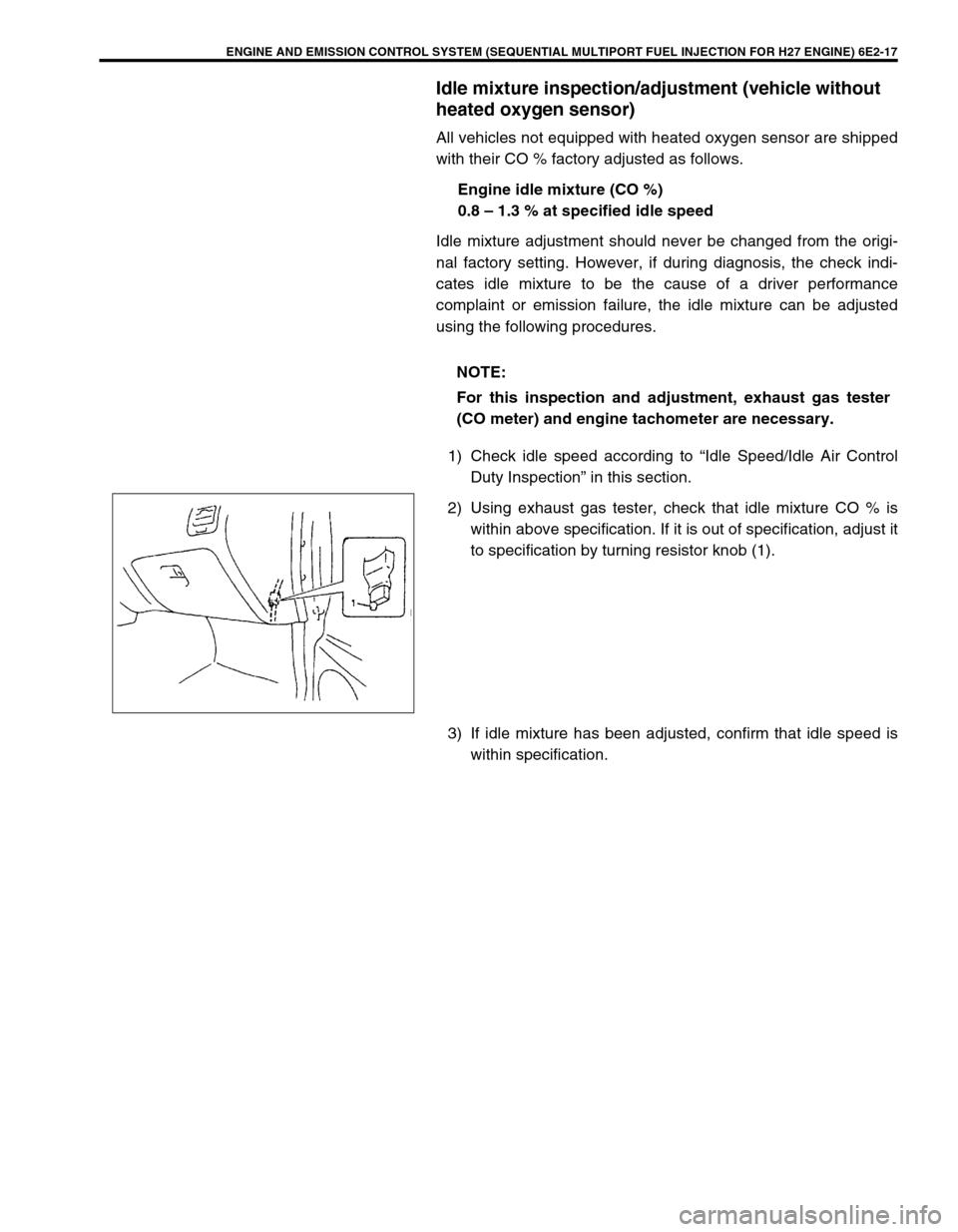
2) Using exhaust gas tester, check that idle mixture CO % is
within above specification. If it is out of specification, adjust it
to specification by turning resistor knob (1).
3) If idle mixture has been adjusted, confirm that idle speed is
within specification. NOTE:
For this inspection and adjustment, exhaust gas tester
(CO meter) and engine tachometer are necessary.
Page 351 of 656
6E2-18 ENGINE AND EMISSION CONTROL SYSTEM (SEQUENTIAL MULTIPORT FUEL INJECTION FOR H27 ENGINE)
Air Intake System
Throttle body
REMOVAL
1) Disconnect negative (–) cable at battery.
2) Drain cooling system.
3) Remove strut tower bar.
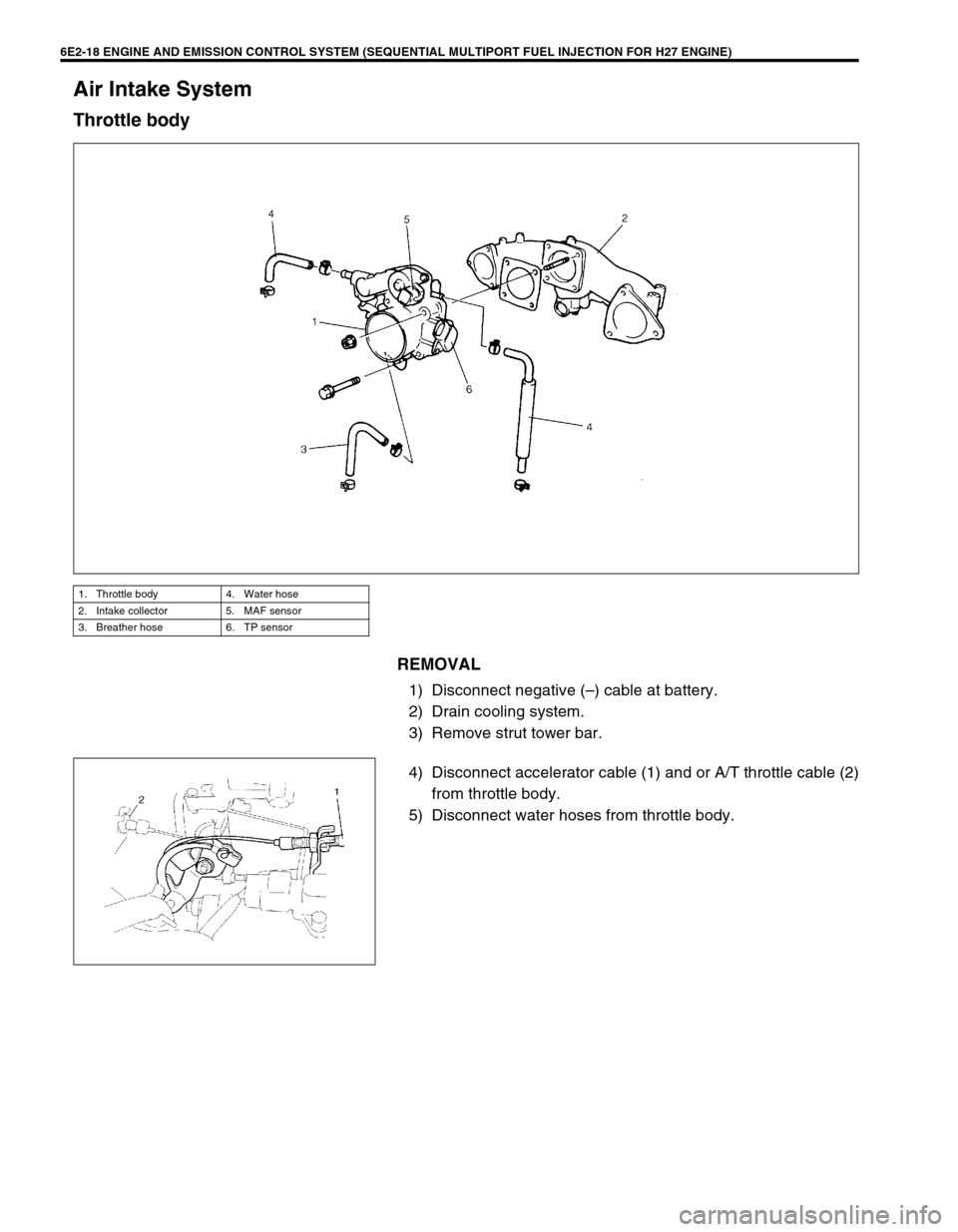
4) Disconnect accelerator cable (1) and or A/T throttle cable (2)
from throttle body.
5) Disconnect water hoses from throttle body.
1. Throttle body 4. Water hose
2. Intake collector 5. MAF sensor
3. Breather hose 6. TP sensor
Page 352 of 656
ENGINE AND EMISSION CONTROL SYSTEM (SEQUENTIAL MULTIPORT FUEL INJECTION FOR H27 ENGINE) 6E2-19
6) Remove surge tank cover.
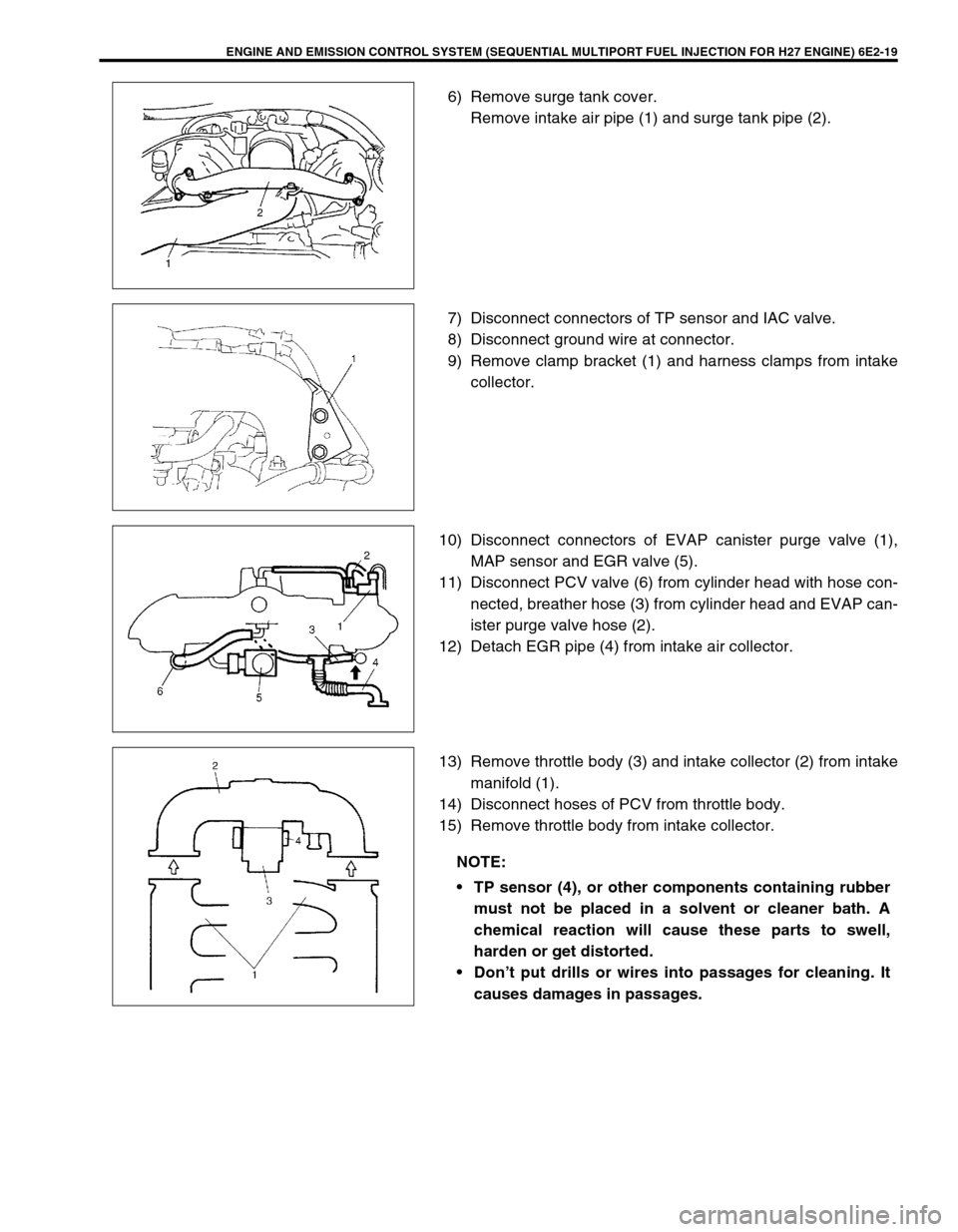
Remove intake air pipe (1) and surge tank pipe (2).
7) Disconnect connectors of TP sensor and IAC valve.
8) Disconnect ground wire at connector.
9) Remove clamp bracket (1) and harness clamps from intake
collector.
10) Disconnect connectors of EVAP canister purge valve (1),
MAP sensor and EGR valve (5).
11) Disconnect PCV valve (6) from cylinder head with hose con-
nected, breather hose (3) from cylinder head and EVAP can-
ister purge valve hose (2).
12) Detach EGR pipe (4) from intake air collector.
13) Remove throttle body (3) and intake collector (2) from intake
manifold (1).
14) Disconnect hoses of PCV from throttle body.
15) Remove throttle body from intake collector.
NOTE:
TP sensor (4), or other components containing rubber
must not be placed in a solvent or cleaner bath. A
chemical reaction will cause these parts to swell,
harden or get distorted.
Don’t put drills or wires into passages for cleaning. It
causes damages in passages.
Page 353 of 656
6E2-20 ENGINE AND EMISSION CONTROL SYSTEM (SEQUENTIAL MULTIPORT FUEL INJECTION FOR H27 ENGINE)
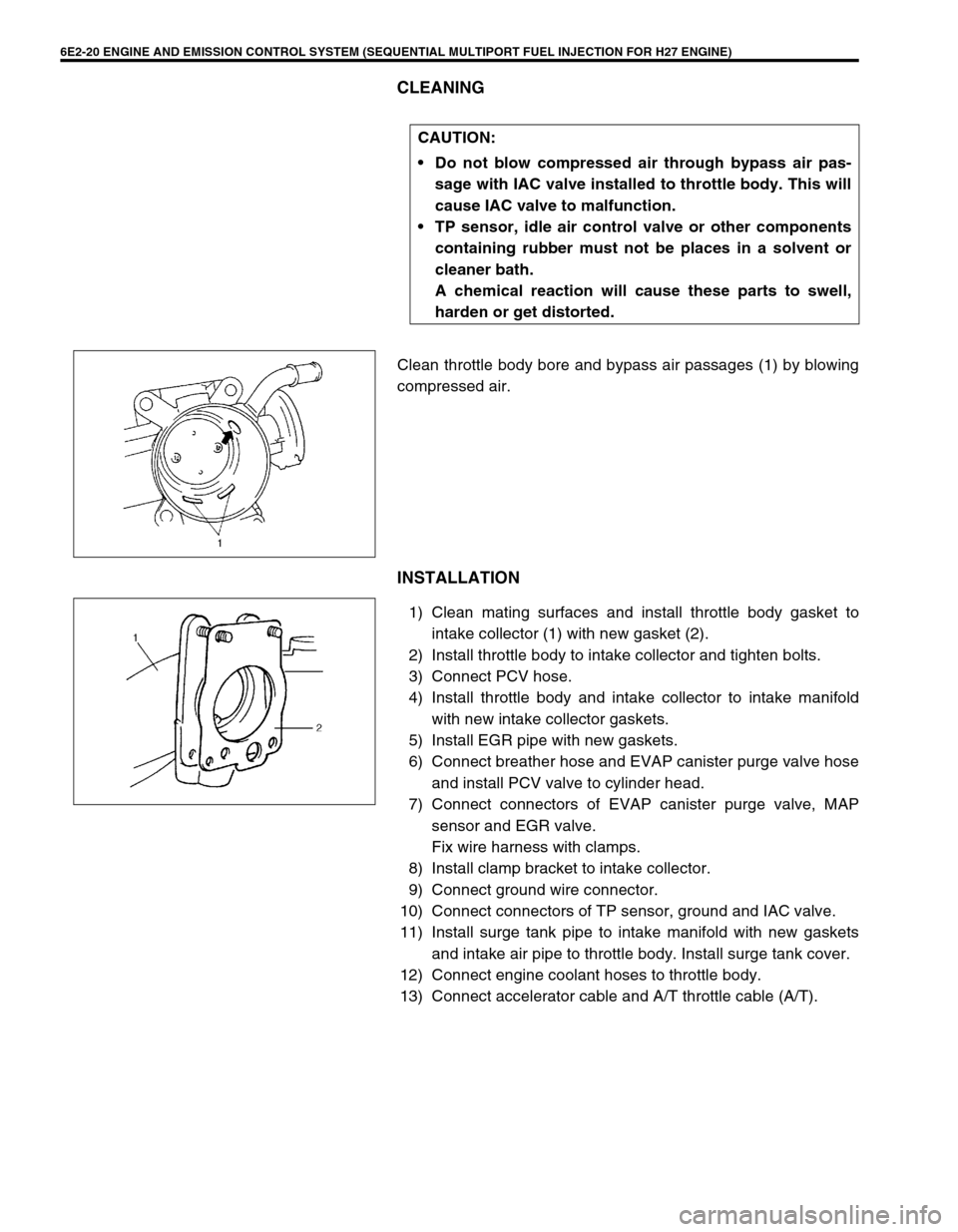
CLEANING
Clean throttle body bore and bypass air passages (1) by blowing
compressed air.
INSTALLATION
1) Clean mating surfaces and install throttle body gasket to
intake collector (1) with new gasket (2).
2) Install throttle body to intake collector and tighten bolts.
3) Connect PCV hose.
4) Install throttle body and intake collector to intake manifold
with new intake collector gaskets.
5) Install EGR pipe with new gaskets.
6) Connect breather hose and EVAP canister purge valve hose
and install PCV valve to cylinder head.
7) Connect connectors of EVAP canister purge valve, MAP
sensor and EGR valve.
Fix wire harness with clamps.
8) Install clamp bracket to intake collector.
9) Connect ground wire connector.
10) Connect connectors of TP sensor, ground and IAC valve.
11) Install surge tank pipe to intake manifold with new gaskets
and intake air pipe to throttle body. Install surge tank cover.
12) Connect engine coolant hoses to throttle body.
13) Connect accelerator cable and A/T throttle cable (A/T).CAUTION:
Do not blow compressed air through bypass air pas-
sage with IAC valve installed to throttle body. This will
cause IAC valve to malfunction.
TP sensor, idle air control valve or other components
containing rubber must not be places in a solvent or
cleaner bath.
A chemical reaction will cause these parts to swell,
harden or get distorted.