ACC WIRE SUZUKI GRAND VITARA 2001 2.G Owner's Manual
[x] Cancel search | Manufacturer: SUZUKI, Model Year: 2001, Model line: GRAND VITARA, Model: SUZUKI GRAND VITARA 2001 2.GPages: 656, PDF Size: 14.31 MB
Page 296 of 656
ENGINE MECHANICAL (H27 ENGINE) 6A2-9
26) Upon completion of installation, verify that there is no fuel
leakage at each connection according to procedure
described in Section 6.
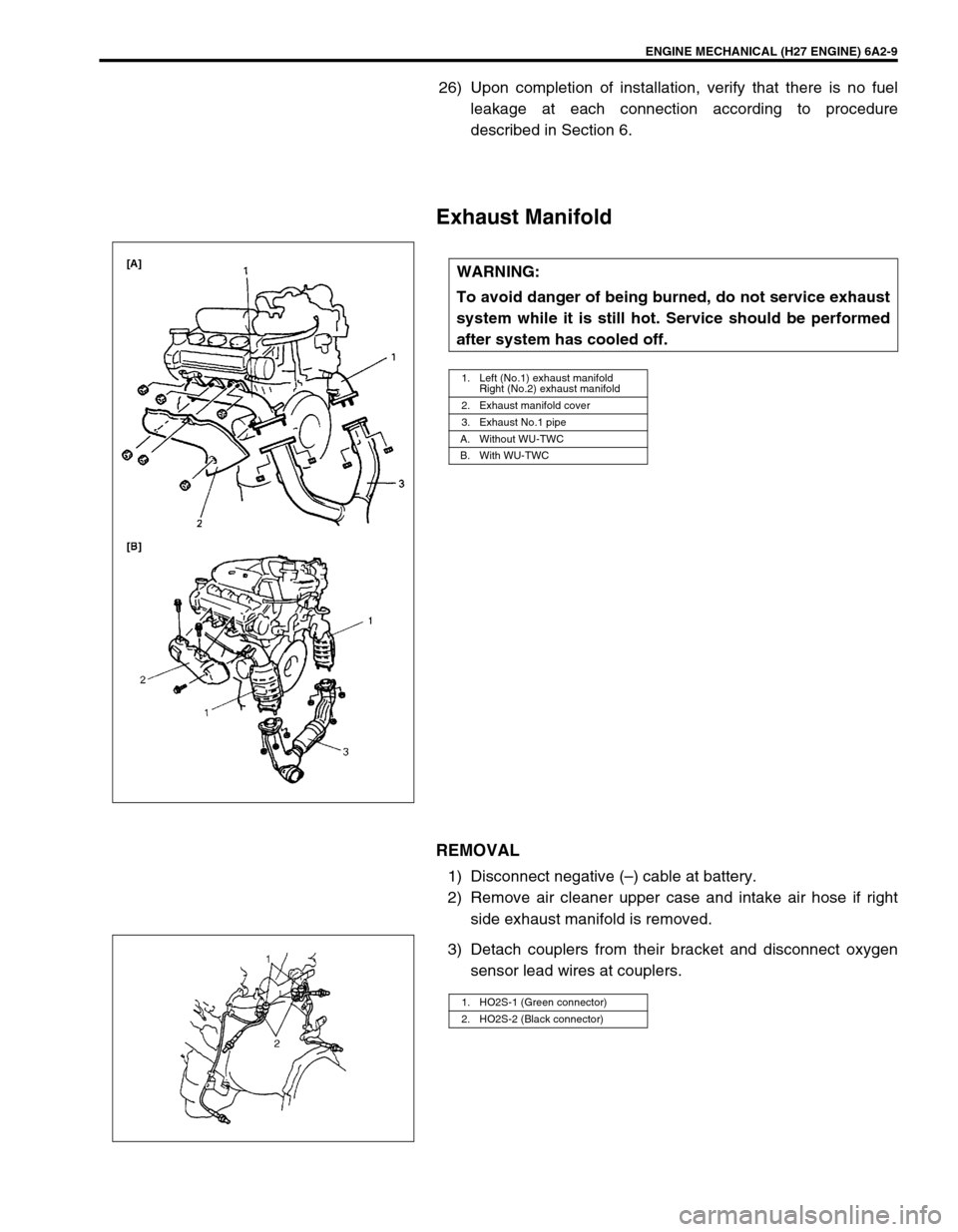
Exhaust Manifold
REMOVAL
1) Disconnect negative (–) cable at battery.
2) Remove air cleaner upper case and intake air hose if right
side exhaust manifold is removed.
3) Detach couplers from their bracket and disconnect oxygen
sensor lead wires at couplers. WARNING:
To avoid danger of being burned, do not service exhaust
system while it is still hot. Service should be performed
after system has cooled off.
1. Left (No.1) exhaust manifold
Right (No.2) exhaust manifold
2. Exhaust manifold cover
3. Exhaust No.1 pipe
A. Without WU-TWC
B. With WU-TWC
1. HO2S-1 (Green connector)
2. HO2S-2 (Black connector)
Page 316 of 656
ENGINE MECHANICAL (H27 ENGINE) 6A2-29
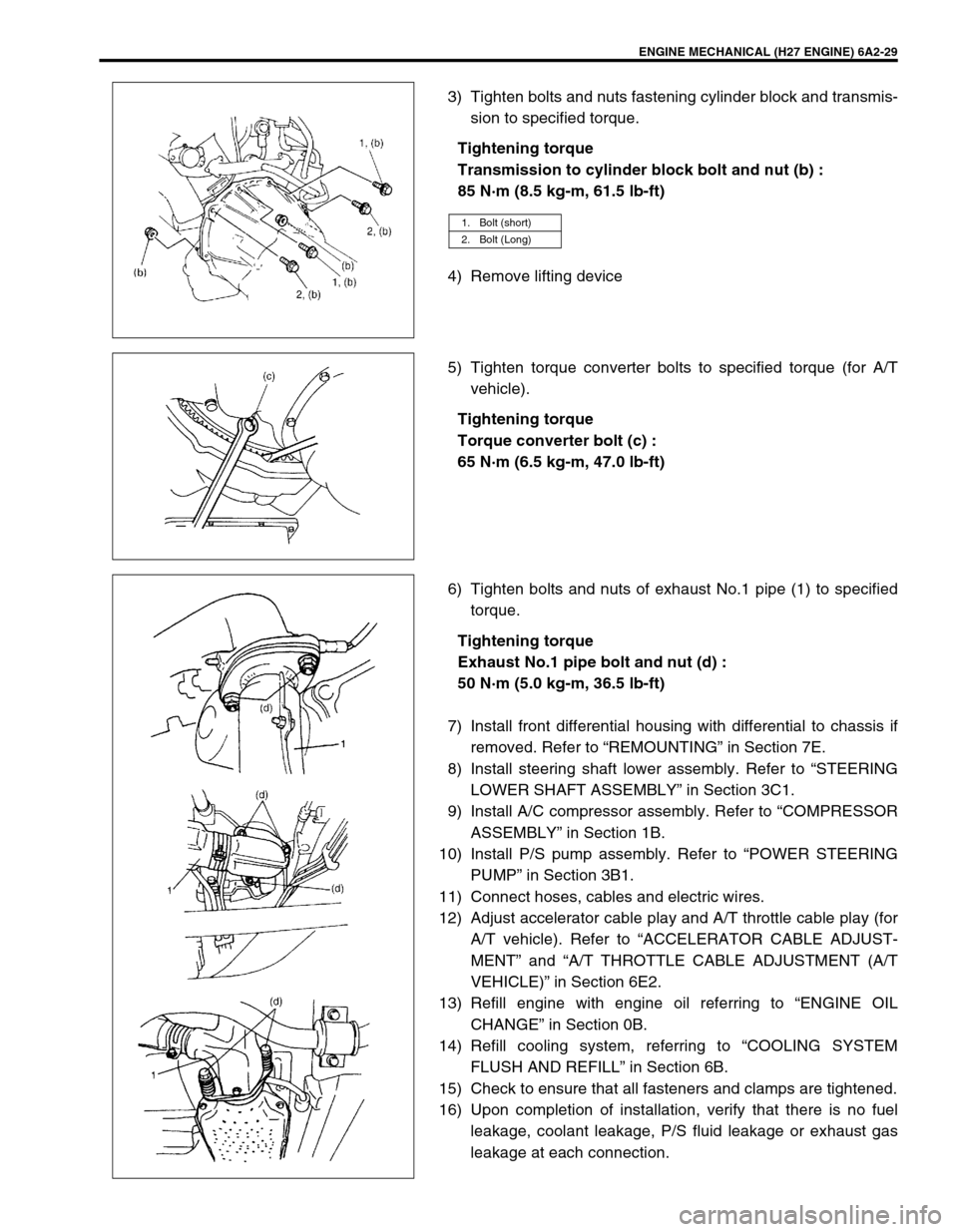
3) Tighten bolts and nuts fastening cylinder block and transmis-
sion to specified torque.
Tightening torque
Transmission to cylinder block bolt and nut (b) :
85 N·m (8.5 kg-m, 61.5 lb-ft)
4) Remove lifting device
5) Tighten torque converter bolts to specified torque (for A/T
vehicle).
Tightening torque
Torque converter bolt (c) :
65 N·m (6.5 kg-m, 47.0 lb-ft)
6) Tighten bolts and nuts of exhaust No.1 pipe (1) to specified
torque.
Tightening torque
Exhaust No.1 pipe bolt and nut (d) :
50 N·m (5.0 kg-m, 36.5 lb-ft)
7) Install front differential housing with differential to chassis if
removed. Refer to “REMOUNTING” in Section 7E.
8) Install steering shaft lower assembly. Refer to “STEERING
LOWER SHAFT ASSEMBLY” in Section 3C1.
9) Install A/C compressor assembly. Refer to “COMPRESSOR
ASSEMBLY” in Section 1B.
10) Install P/S pump assembly. Refer to “POWER STEERING
PUMP” in Section 3B1.
11) Connect hoses, cables and electric wires.
12) Adjust accelerator cable play and A/T throttle cable play (for
A/T vehicle). Refer to “ACCELERATOR CABLE ADJUST-
MENT” and “A/T THROTTLE CABLE ADJUSTMENT (A/T
VEHICLE)” in Section 6E2.
13) Refill engine with engine oil referring to “ENGINE OIL
CHANGE” in Section 0B.
14) Refill cooling system, referring to “COOLING SYSTEM
FLUSH AND REFILL” in Section 6B.
15) Check to ensure that all fasteners and clamps are tightened.
16) Upon completion of installation, verify that there is no fuel
leakage, coolant leakage, P/S fluid leakage or exhaust gas
leakage at each connection.
1. Bolt (short)
2. Bolt (Long)
Page 348 of 656
ENGINE AND EMISSION CONTROL SYSTEM (SEQUENTIAL MULTIPORT FUEL INJECTION FOR H27 ENGINE) 6E2-15
Idle Speed/Idle Air Control (IAC) Duty Inspec-
tion
Before idle speed/IAC duty check, make sure of the following.
•Lead wires and hoses of engine/emission control systems
are connected securely.
•Accelerator cable is adjusted.
•Ignition timing is within specification.
•All accessories (wipers, heater, lights, A/C, etc.) are out of
service.
•Air cleaner has been properly installed and is in good condi-
tion.
•ECM (PCM) does not detect any malfunction DTC.
After above items are all confirmed, check idle speed and IAC
duty as follows.
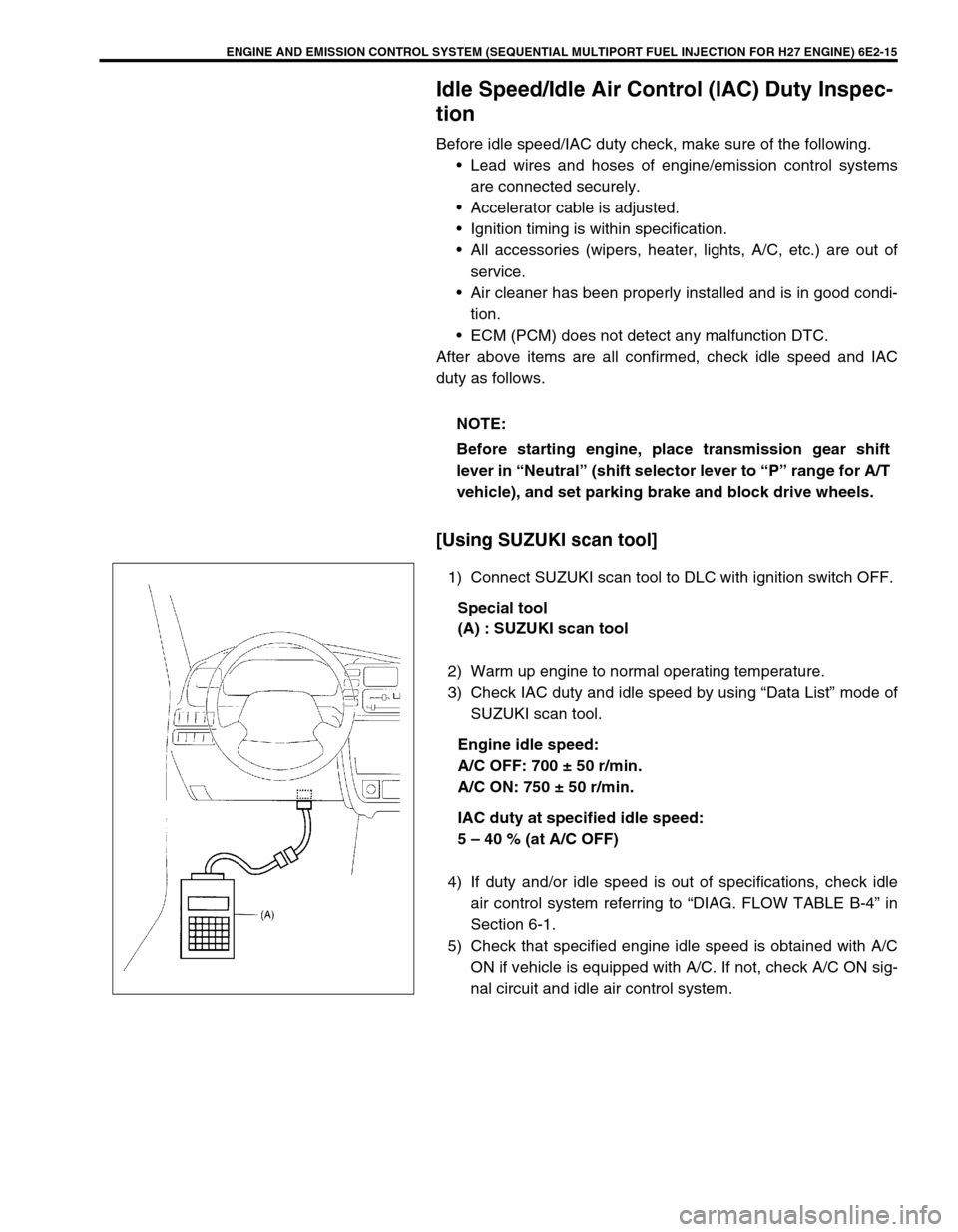
[Using SUZUKI scan tool]
1) Connect SUZUKI scan tool to DLC with ignition switch OFF.
Special tool
(A) : SUZUKI scan tool
2) Warm up engine to normal operating temperature.
3) Check IAC duty and idle speed by using “Data List” mode of
SUZUKI scan tool.
Engine idle speed:
A/C OFF: 700 ± 50 r/min.
A/C ON: 750 ± 50 r/min.
IAC duty at specified idle speed:
5 – 40 % (at A/C OFF)
4) If duty and/or idle speed is out of specifications, check idle
air control system referring to “DIAG. FLOW TABLE B-4” in
Section 6-1.
5) Check that specified engine idle speed is obtained with A/C
ON if vehicle is equipped with A/C. If not, check A/C ON sig-
nal circuit and idle air control system. NOTE:
Before starting engine, place transmission gear shift
lever in “Neutral” (shift selector lever to “P” range for A/T
vehicle), and set parking brake and block drive wheels.
Page 353 of 656
6E2-20 ENGINE AND EMISSION CONTROL SYSTEM (SEQUENTIAL MULTIPORT FUEL INJECTION FOR H27 ENGINE)
CLEANING
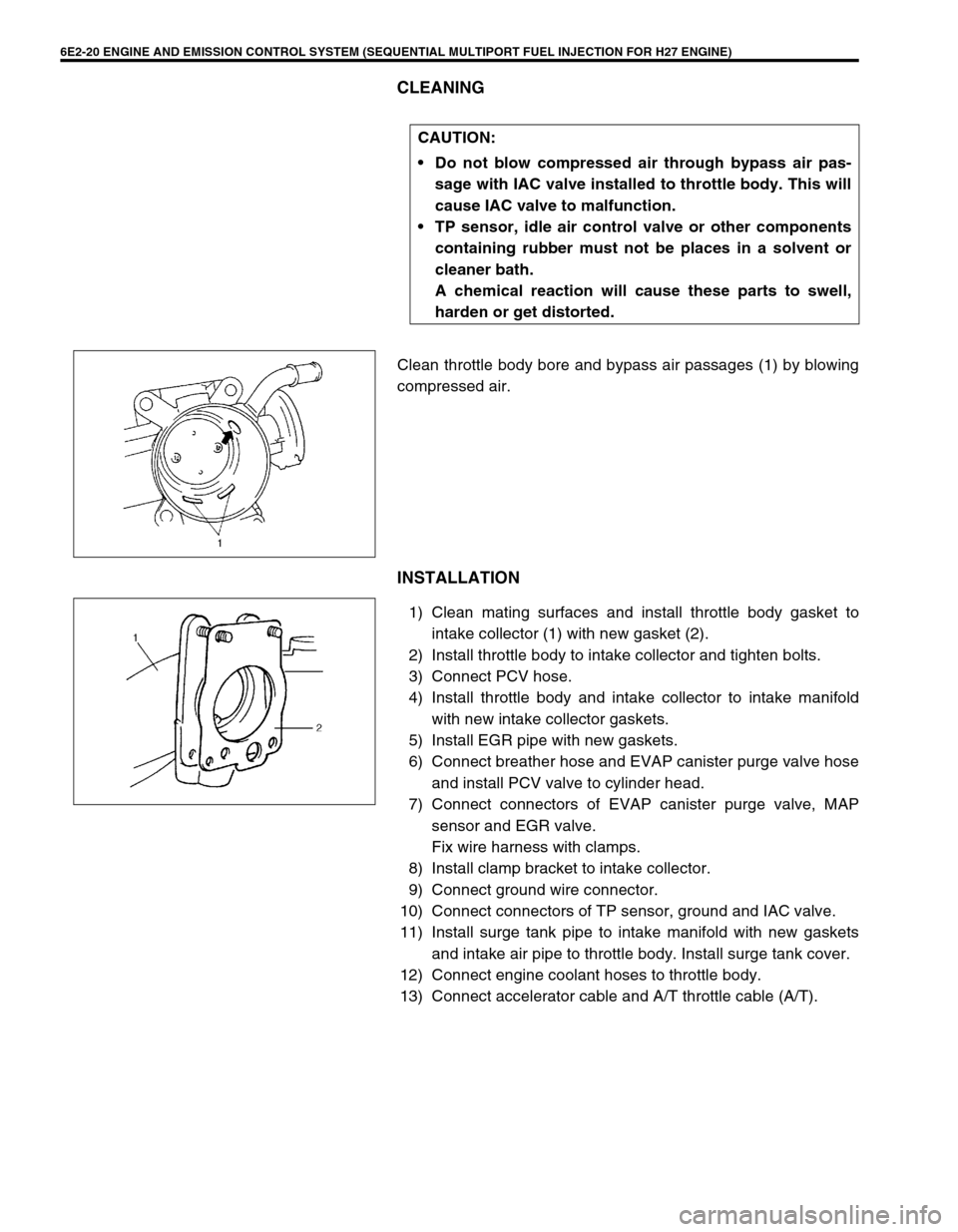
Clean throttle body bore and bypass air passages (1) by blowing
compressed air.
INSTALLATION
1) Clean mating surfaces and install throttle body gasket to
intake collector (1) with new gasket (2).
2) Install throttle body to intake collector and tighten bolts.
3) Connect PCV hose.
4) Install throttle body and intake collector to intake manifold
with new intake collector gaskets.
5) Install EGR pipe with new gaskets.
6) Connect breather hose and EVAP canister purge valve hose
and install PCV valve to cylinder head.
7) Connect connectors of EVAP canister purge valve, MAP
sensor and EGR valve.
Fix wire harness with clamps.
8) Install clamp bracket to intake collector.
9) Connect ground wire connector.
10) Connect connectors of TP sensor, ground and IAC valve.
11) Install surge tank pipe to intake manifold with new gaskets
and intake air pipe to throttle body. Install surge tank cover.
12) Connect engine coolant hoses to throttle body.
13) Connect accelerator cable and A/T throttle cable (A/T).CAUTION:
Do not blow compressed air through bypass air pas-
sage with IAC valve installed to throttle body. This will
cause IAC valve to malfunction.
TP sensor, idle air control valve or other components
containing rubber must not be places in a solvent or
cleaner bath.
A chemical reaction will cause these parts to swell,
harden or get distorted.
Page 359 of 656
6E2-26 ENGINE AND EMISSION CONTROL SYSTEM (SEQUENTIAL MULTIPORT FUEL INJECTION FOR H27 ENGINE)
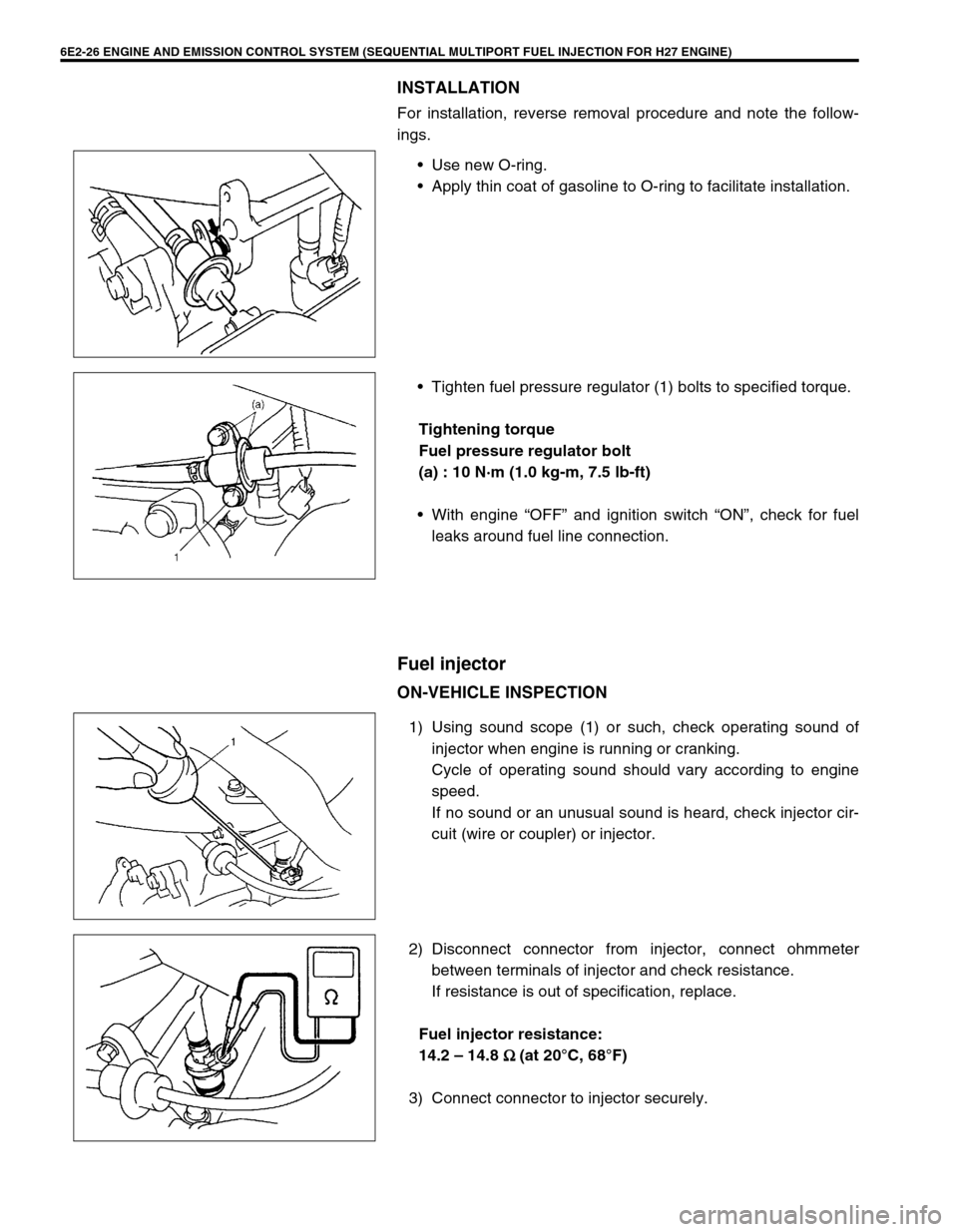
INSTALLATION
For installation, reverse removal procedure and note the follow-
ings.
•Use new O-ring.
•Apply thin coat of gasoline to O-ring to facilitate installation.
•Tighten fuel pressure regulator (1) bolts to specified torque.
Tightening torque
Fuel pressure regulator bolt
(a) : 10 N·m (1.0 kg-m, 7.5 lb-ft)
•With engine “OFF” and ignition switch “ON”, check for fuel
leaks around fuel line connection.
Fuel injector
ON-VEHICLE INSPECTION
1) Using sound scope (1) or such, check operating sound of
injector when engine is running or cranking.
Cycle of operating sound should vary according to engine
speed.
If no sound or an unusual sound is heard, check injector cir-
cuit (wire or coupler) or injector.
2) Disconnect connector from injector, connect ohmmeter
between terminals of injector and check resistance.
If resistance is out of specification, replace.
Fuel injector resistance:
14.2 – 14.8 Ω
Ω Ω Ω (at 20°C, 68°F)
3) Connect connector to injector securely.
Page 377 of 656
6E2-44 ENGINE AND EMISSION CONTROL SYSTEM (SEQUENTIAL MULTIPORT FUEL INJECTION FOR H27 ENGINE)
Emission Control System
EGR system (if equipped)
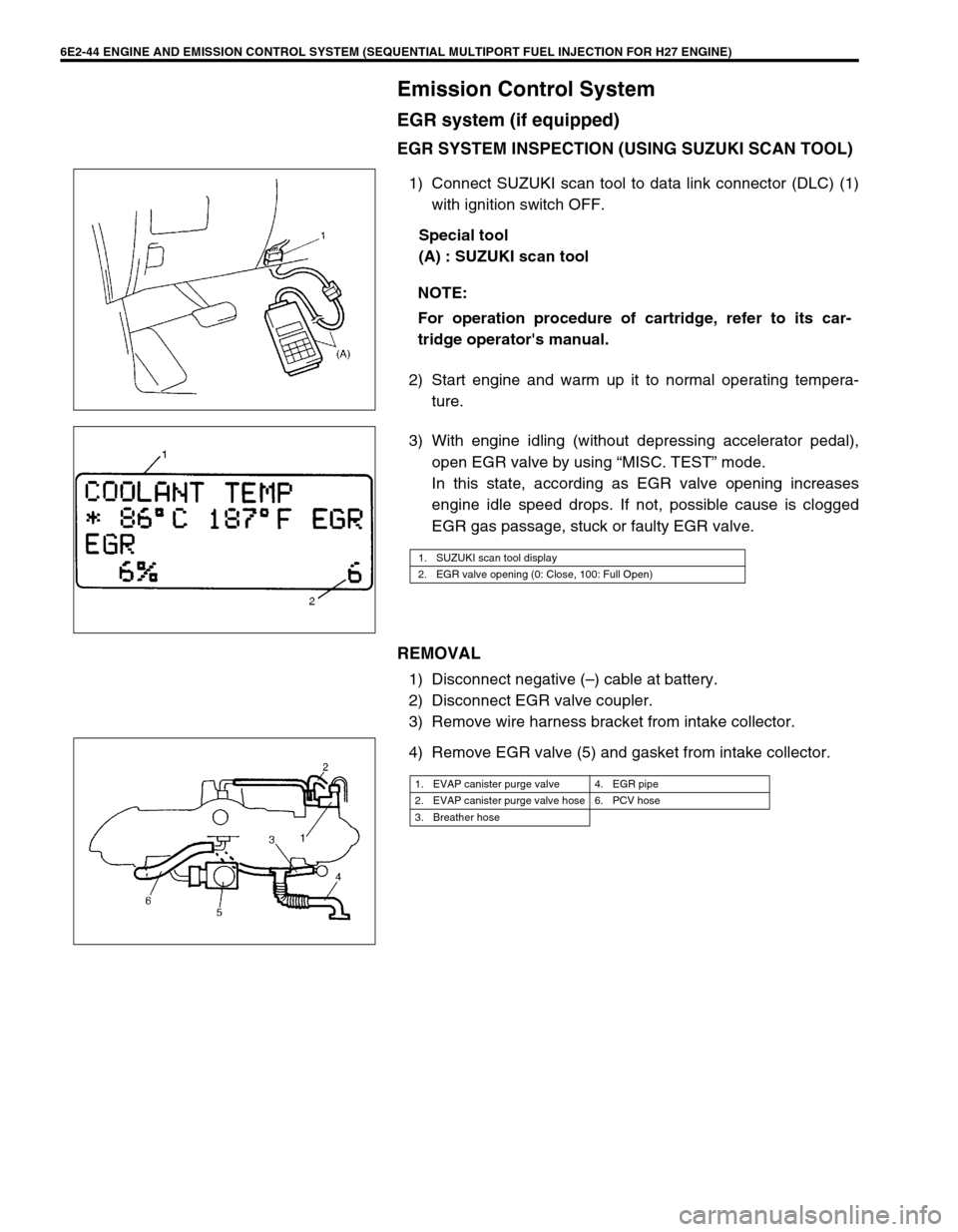
EGR SYSTEM INSPECTION (USING SUZUKI SCAN TOOL)
1) Connect SUZUKI scan tool to data link connector (DLC) (1)
with ignition switch OFF.
Special tool
(A) : SUZUKI scan tool
2) Start engine and warm up it to normal operating tempera-
ture.
3) With engine idling (without depressing accelerator pedal),
open EGR valve by using “MISC. TEST” mode.
In this state, according as EGR valve opening increases
engine idle speed drops. If not, possible cause is clogged
EGR gas passage, stuck or faulty EGR valve.
REMOVAL
1) Disconnect negative (–) cable at battery.
2) Disconnect EGR valve coupler.
3) Remove wire harness bracket from intake collector.
4) Remove EGR valve (5) and gasket from intake collector.NOTE:
For operation procedure of cartridge, refer to its car-
tridge operator's manual.
1. SUZUKI scan tool display
2. EGR valve opening (0: Close, 100: Full Open)
1. EVAP canister purge valve 4. EGR pipe
2. EVAP canister purge valve hose 6. PCV hose
3. Breather hose
Page 417 of 656
7B1-8 AUTOMATIC TRANSMISSION (4 A/T)
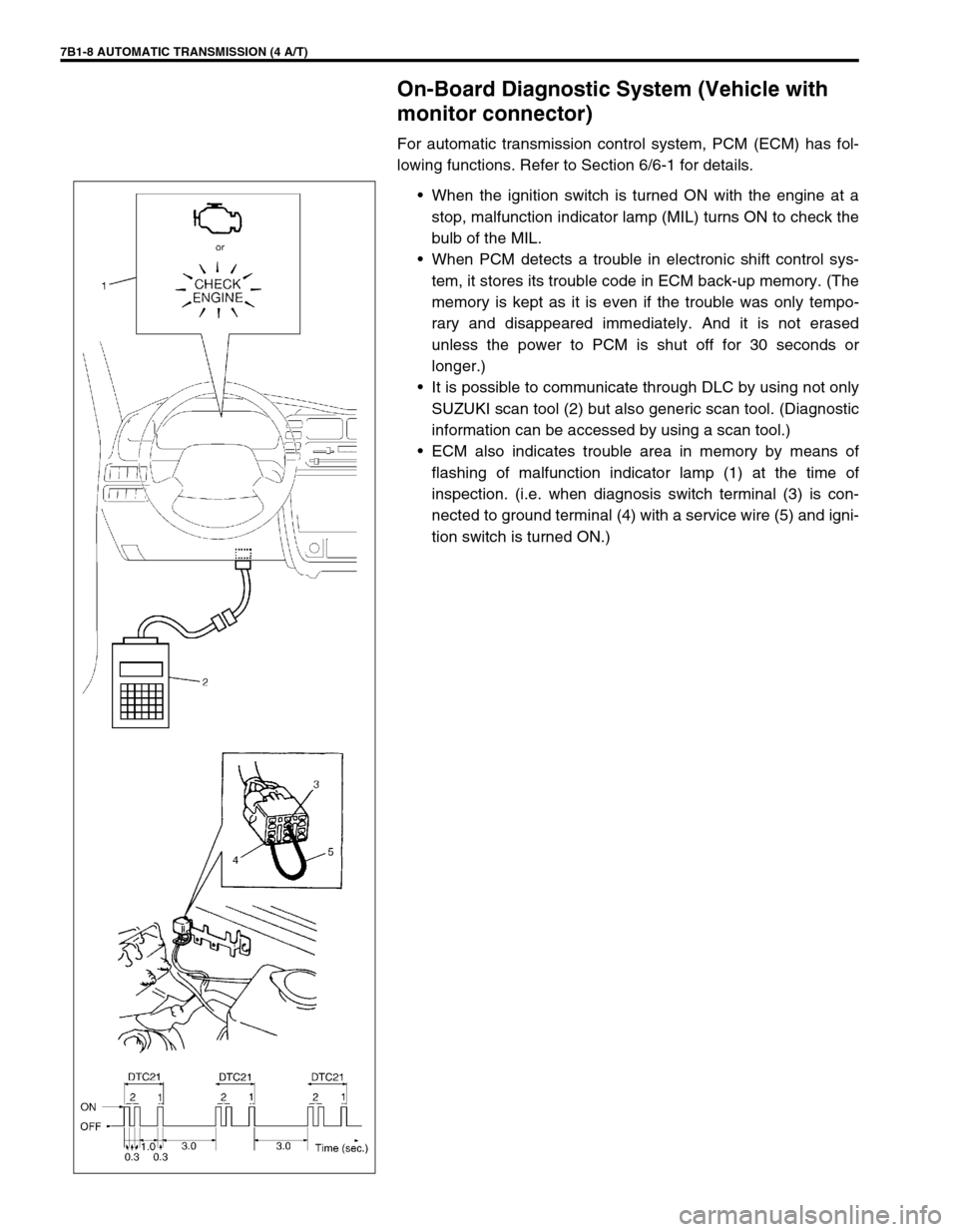
On-Board Diagnostic System (Vehicle with
monitor connector)
For automatic transmission control system, PCM (ECM) has fol-
lowing functions. Refer to Section 6/6-1 for details.
•When the ignition switch is turned ON with the engine at a
stop, malfunction indicator lamp (MIL) turns ON to check the
bulb of the MIL.
•When PCM detects a trouble in electronic shift control sys-
tem, it stores its trouble code in ECM back-up memory. (The
memory is kept as it is even if the trouble was only tempo-
rary and disappeared immediately. And it is not erased
unless the power to PCM is shut off for 30 seconds or
longer.)
•It is possible to communicate through DLC by using not only
SUZUKI scan tool (2) but also generic scan tool. (Diagnostic
information can be accessed by using a scan tool.)
•ECM also indicates trouble area in memory by means of
flashing of malfunction indicator lamp (1) at the time of
inspection. (i.e. when diagnosis switch terminal (3) is con-
nected to ground terminal (4) with a service wire (5) and igni-
tion switch is turned ON.)
Page 418 of 656
AUTOMATIC TRANSMISSION (4 A/T) 7B1-9
Precaution in Diagnosing Trouble
•Don’t disconnect couplers from PCM (ECM), battery cable
from battery, PCM ground wire harness from engine or main
fuse before checking the diagnosis information (DTC, freeze
frame data, etc.) stored in PCM memory. Such disconnec-
tion will clear memorized information in PCM memory.
•Using SUZUKI scan tool or also generic scan tool for vehicle
without monitor connector, the diagnostic information stored
in PCM memory can be checked and cleared as well. Before
its use, be sure to read Operator’s (Instruction) Manual sup-
plied with it carefully to have good understanding of its func-
tions and usage.
•Priorities for diagnosing troubles
If two or more diagnostic trouble codes (DTCs) are stored,
proceed to the flow table of the DTC which was detected
earliest in the order and follow the instruction in that table.
If no instructions are given, troubleshoot diagnostic trouble
codes according to the following priorities.
–Diagnostic trouble codes (DTCs) other than DTC P0171/
P0172/P0174/P0175 (Fuel system too lean/too rich), DTC
P0300/P0301/P0302/P0303/P0304/P0305/P0306 (Misfire
detected) and DTC P0400 (EGR flow malfunction)
–DTC P0171/P0172/P0174/P0175 (Fuel system too lean/too
rich) and DTC P0400 (EGR flow malfunction)
–DTC P0300/P0301/P0302/P0303/P0304/P0305/P0306
(Misfire detected)
•Be sure to read “PRECAUTIONS FOR ELECTRICAL CIR-
CUIT SERVICE” in Section 0A before inspection and
observe what is written there.
•PCM replacement
When substituting a known-good PCM, check for following
conditions.
Neglecting this check may result in damage to a good PCM.
–All relays and actuators have resistance of specified value.
–MAF sensor, MDP sensor, TP sensor and fuel tank pres-
sure sensor are in good condition. Also, the power circuit of
these sensors is not shorted to the ground.
Page 420 of 656
AUTOMATIC TRANSMISSION (4 A/T) 7B1-11
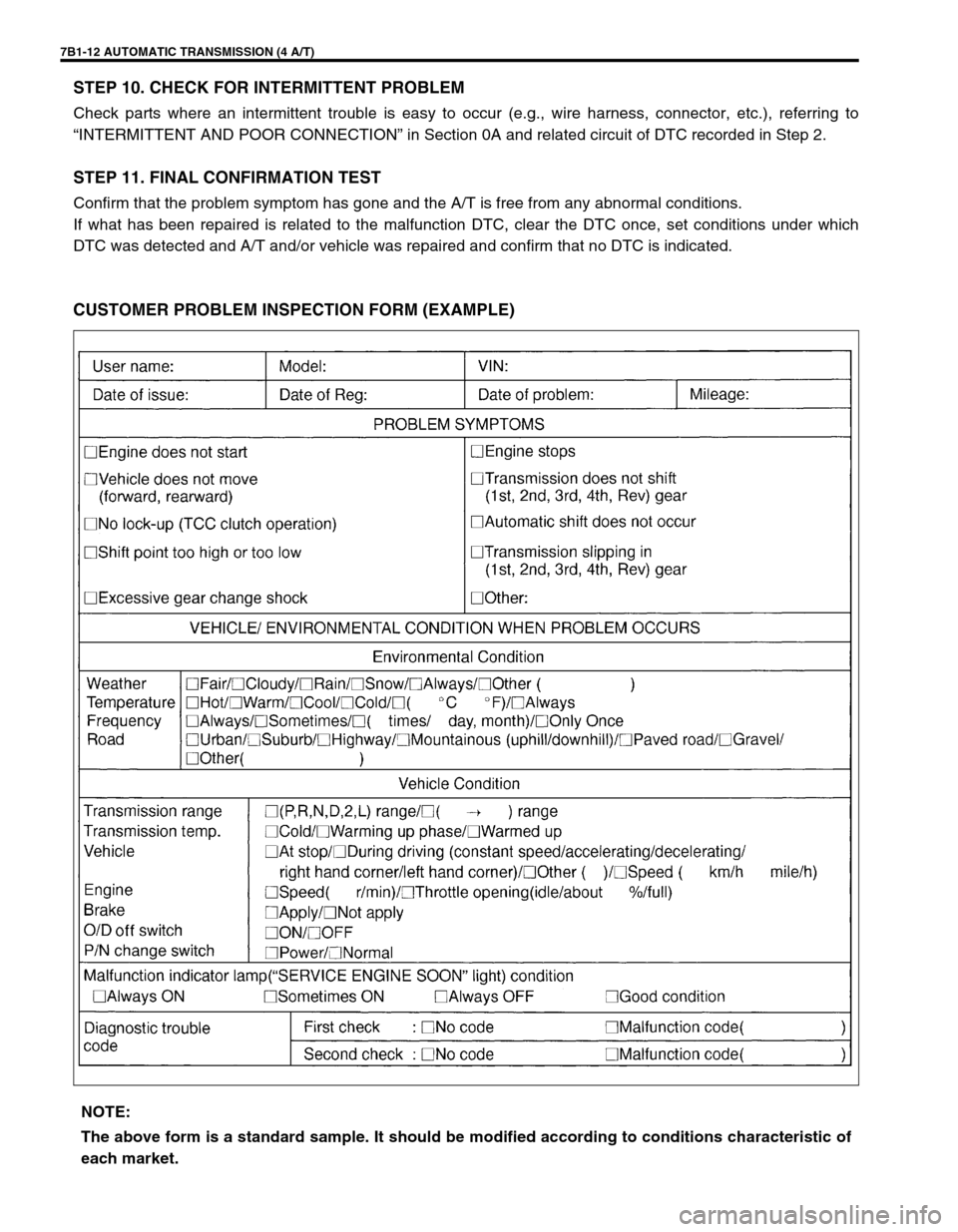
STEP 1. CUSTOMER COMPLAINT ANALYSIS
Record details of the problem (failure, complaint) and how it occurred as described by the customer.
For this purpose, use of such a inspection form will facilitate collecting information to the point required for
proper analysis and diagnosis.
STEP 2. DIAGNOSTIC TROUBLE CODE (DTC)/FREEZE FRAME DATA CHECK, RECORD AND
CLEARANCE
First, referring to DTC check section, check DTC (including pending DTC). If DTC exists, print or write down
DTC and freeze frame data and then clear them by referring to DTC clearance section. DTC indicates malfunc-
tion in the system but it is not possible to know from it whether the malfunction is occurring now or it occurred in
the past and normal condition has been restored. In order to know that, check symptom in question according to
Step 5 and then recheck DTC according to Step 6.
Diagnosing a trouble based on the DTC in this step only or failure to clear the DTC in this step may result in an
faulty diagnosis, trouble diagnosis of a normal circuit or difficulty in troubleshooting which is otherwise unneces-
sary.
STEP 3 and STEP 4. VISUAL INSPECTION
As a preliminary step, be sure to perform visual check of the items that support proper function of the A/T and
engine referring to Visual Inspection section.
STEP 5. TROUBLE SYMPTOM CONFIRMATION
Check trouble symptoms based on information obtained in Step 1 “CUSTOMER COMPLAINT ANALYSIS” and
Step 2 “DTC/FREEZE FRAME DATA CHECK”.
Also, recheck DTC according to “DTC CONFIRMATION PROCEDURE” described in each “DTC FLOW
TABLE”.
STEP 6 and STEP 7. RECHECKING AND RECORD OF DTC/FREEZE FRAME DATA
Refer to “DTC CHECK” in this section for checking procedure.
STEP 8. A/T BASIC CHECK AND TROUBLE DIAGNOSIS TABLE
Perform A/T basic check according to the “A/T Basic Check Flow Table” first. When the end of the flow table has
been reached, check the parts of the system suspected as a possible cause referring to “TROUBLE DIAGNO-
SIS TABLE” and based on symptoms appearing on the vehicle (symptoms obtained through steps of customer
complaint analysis, trouble symptom confirmation and/or A/T basic check) and repair or replace faulty parts, if
any.
STEP 9. DIAGNOSTIC TROUBLE CODE FLOW TABLE
Based on the DTC indicated in Step 6 and 7 and referring to “DIAGNOSTIC TROUBLE CODE FLOW TABLE” in
this section, locate the cause of the trouble, namely in a sensor, switch, wire harness, connector, actuator, PCM
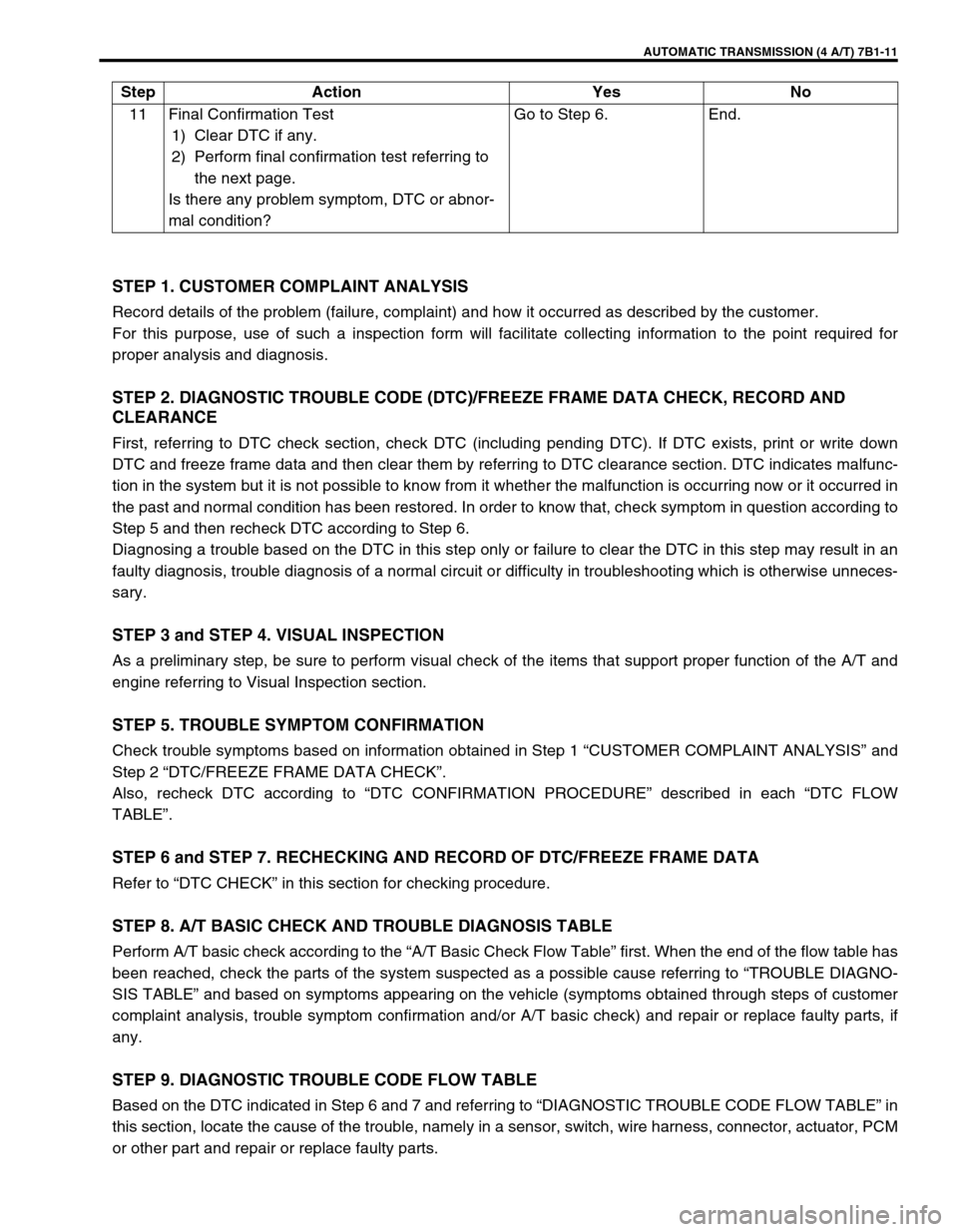
or other part and repair or replace faulty parts.11 Final Confirmation Test
1) Clear DTC if any.
2) Perform final confirmation test referring to
the next page.
Is there any problem symptom, DTC or abnor-
mal condition?Go to Step 6. End. Step Action Yes No
Page 421 of 656
7B1-12 AUTOMATIC TRANSMISSION (4 A/T)
STEP 10. CHECK FOR INTERMITTENT PROBLEM
Check parts where an intermittent trouble is easy to occur (e.g., wire harness, connector, etc.), referring to
“INTERMITTENT AND POOR CONNECTION” in Section 0A and related circuit of DTC recorded in Step 2.
STEP 11. FINAL CONFIRMATION TEST
Confirm that the problem symptom has gone and the A/T is free from any abnormal conditions.
If what has been repaired is related to the malfunction DTC, clear the DTC once, set conditions under which
DTC was detected and A/T and/or vehicle was repaired and confirm that no DTC is indicated.
CUSTOMER PROBLEM INSPECTION FORM (EXAMPLE)
NOTE:
The above form is a standard sample. It should be modified according to conditions characteristic of
each market.