ACC WIRE SUZUKI GRAND VITARA 2001 2.G Owner's Guide
[x] Cancel search | Manufacturer: SUZUKI, Model Year: 2001, Model line: GRAND VITARA, Model: SUZUKI GRAND VITARA 2001 2.GPages: 656, PDF Size: 14.31 MB
Page 423 of 656
7B1-14 AUTOMATIC TRANSMISSION (4 A/T)
Diagnostic Trouble Code Table
Refer to the same item in Section 6-1.
Fail Safe Table
Refer to the same item in Section 6-1.
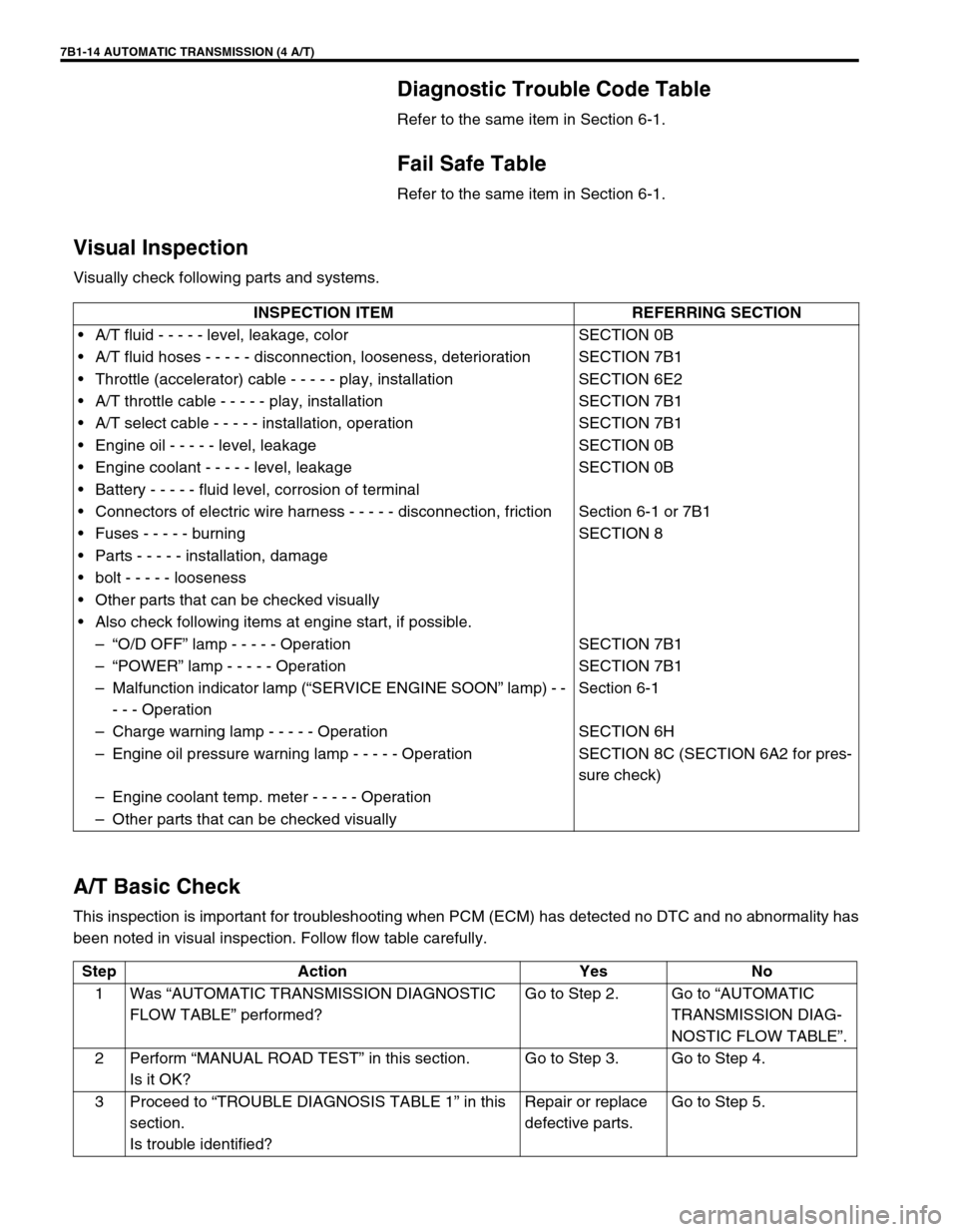
Visual Inspection
Visually check following parts and systems.
A/T Basic Check
This inspection is important for troubleshooting when PCM (ECM) has detected no DTC and no abnormality has
been noted in visual inspection. Follow flow table carefully.INSPECTION ITEM REFERRING SECTION
•A/T fluid - - - - - level, leakage, color SECTION 0B
•A/T fluid hoses - - - - - disconnection, looseness, deterioration SECTION 7B1
•Throttle (accelerator) cable - - - - - play, installation SECTION 6E2
•A/T throttle cable - - - - - play, installation SECTION 7B1
•A/T select cable - - - - - installation, operation SECTION 7B1
•Engine oil - - - - - level, leakage SECTION 0B
•Engine coolant - - - - - level, leakage SECTION 0B
•Battery - - - - - fluid level, corrosion of terminal
•Connectors of electric wire harness - - - - - disconnection, friction Section 6-1 or 7B1
•Fuses - - - - - burning SECTION 8
•Parts - - - - - installation, damage
•bolt - - - - - looseness
•Other parts that can be checked visually
•Also check following items at engine start, if possible.
–“O/D OFF” lamp - - - - - Operation SECTION 7B1
–“POWER” lamp - - - - - Operation SECTION 7B1
–Malfunction indicator lamp (“SERVICE ENGINE SOON” lamp) - -
- - - OperationSection 6-1
–Charge warning lamp - - - - - Operation SECTION 6H
–Engine oil pressure warning lamp - - - - - Operation SECTION 8C (SECTION 6A2 for pres-
sure check)
–Engine coolant temp. meter - - - - - Operation
–Other parts that can be checked visually
Step Action Yes No
1Was “AUTOMATIC TRANSMISSION DIAGNOSTIC
FLOW TABLE” performed?Go to Step 2. Go to “AUTOMATIC
TRANSMISSION DIAG-
NOSTIC FLOW TABLE”.
2Perform “MANUAL ROAD TEST” in this section.
Is it OK?Go to Step 3. Go to Step 4.
3Proceed to “TROUBLE DIAGNOSIS TABLE 1” in this
section.
Is trouble identified?Repair or replace
defective parts.Go to Step 5.
Page 429 of 656
7B1-20 AUTOMATIC TRANSMISSION (4 A/T)
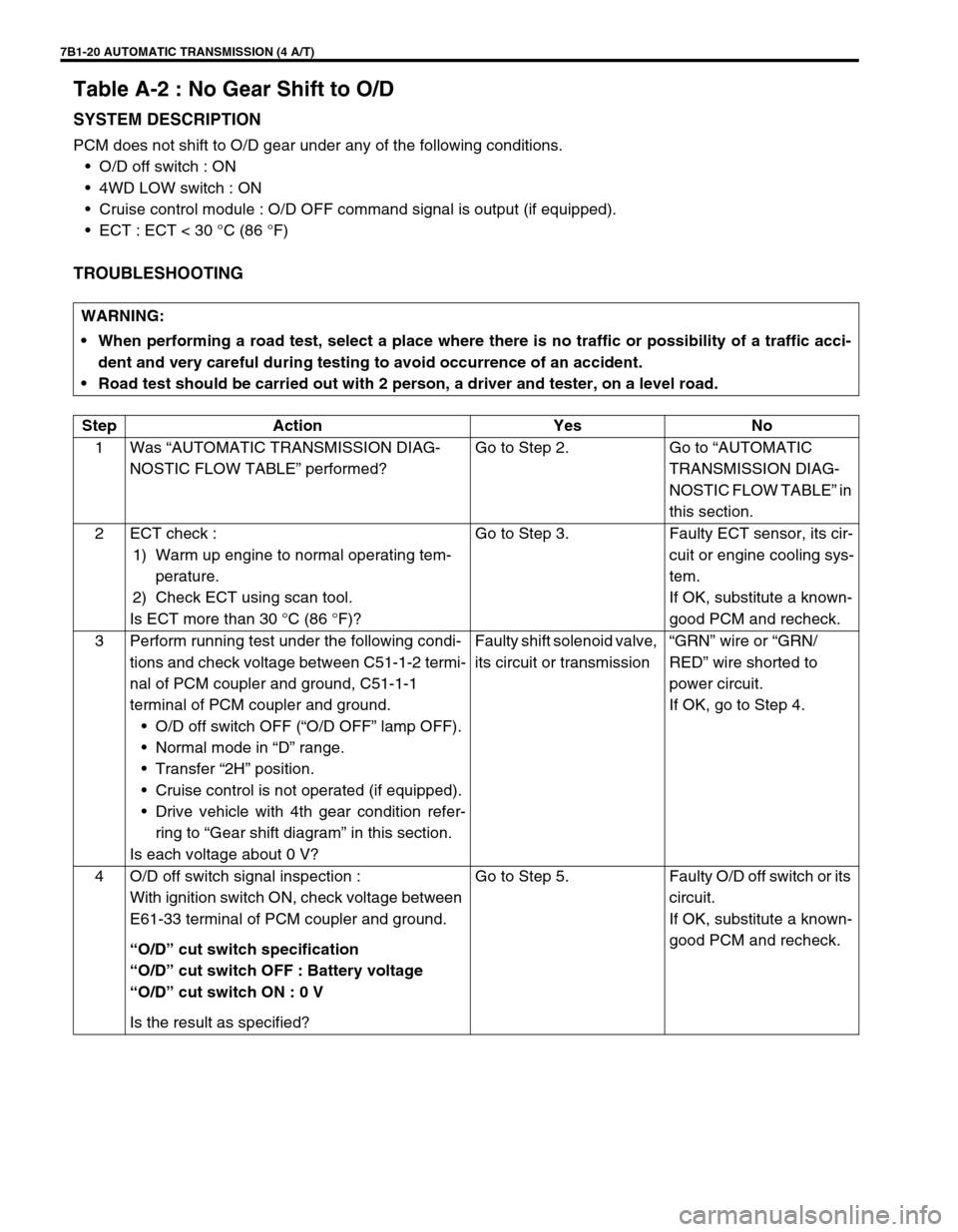
Table A-2 : No Gear Shift to O/D
SYSTEM DESCRIPTION
PCM does not shift to O/D gear under any of the following conditions.
•O/D off switch : ON
•4WD LOW switch : ON
•Cruise control module : O/D OFF command signal is output (if equipped).
•ECT : ECT < 30 °C (86 °F)
TROUBLESHOOTING
WARNING:
When performing a road test, select a place where there is no traffic or possibility of a traffic acci-
dent and very careful during testing to avoid occurrence of an accident.
Road test should be carried out with 2 person, a driver and tester, on a level road.
Step Action Yes No
1Was “AUTOMATIC TRANSMISSION DIAG-
NOSTIC FLOW TABLE” performed?Go to Step 2. Go to “AUTOMATIC
TRANSMISSION DIAG-
NOSTIC FLOW TABLE” in
this section.
2 ECT check :
1) Warm up engine to normal operating tem-
perature.
2) Check ECT using scan tool.
Is ECT more than 30 °C (86 °F)?Go to Step 3. Faulty ECT sensor, its cir-
cuit or engine cooling sys-
tem.
If OK, substitute a known-
good PCM and recheck.
3 Perform running test under the following condi-
tions and check voltage between C51-1-2 termi-
nal of PCM coupler and ground, C51-1-1
terminal of PCM coupler and ground.
•O/D off switch OFF (“O/D OFF” lamp OFF).
•Normal mode in “D” range.
•Transfer “2H” position.
•Cruise control is not operated (if equipped).
•Drive vehicle with 4th gear condition refer-
ring to “Gear shift diagram” in this section.
Is each voltage about 0 V?Faulty shift solenoid valve,
its circuit or transmission“GRN” wire or “GRN/
RED” wire shorted to
power circuit.
If OK, go to Step 4.
4 O/D off switch signal inspection :
With ignition switch ON, check voltage between
E61-33 terminal of PCM coupler and ground.
“O/D” cut switch specification
“O/D” cut switch OFF : Battery voltage
“O/D” cut switch ON : 0 V
Is the result as specified?Go to Step 5. Faulty O/D off switch or its
circuit.
If OK, substitute a known-
good PCM and recheck.
Page 439 of 656
7B1-30 AUTOMATIC TRANSMISSION (4 A/T)
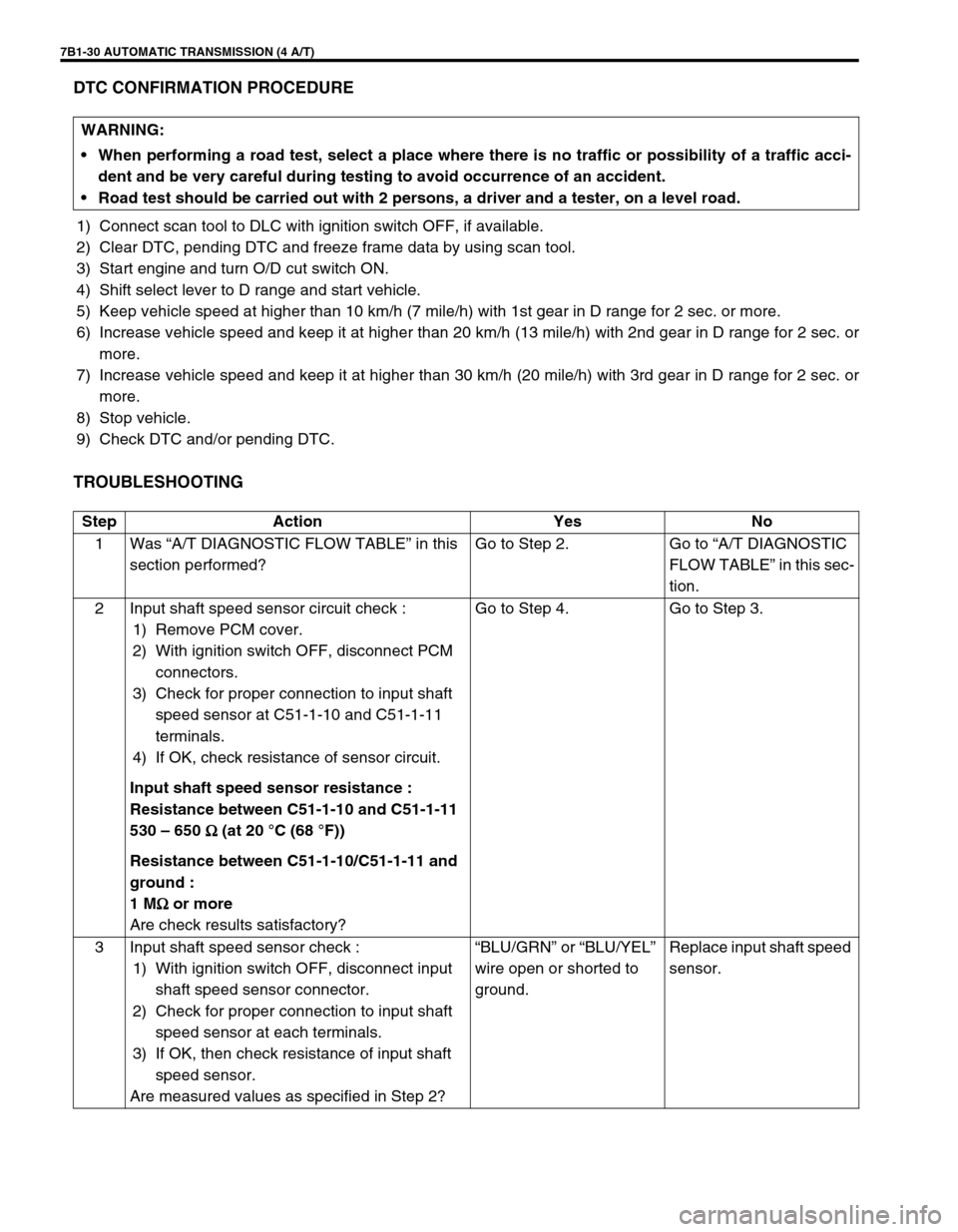
DTC CONFIRMATION PROCEDURE
1) Connect scan tool to DLC with ignition switch OFF, if available.
2) Clear DTC, pending DTC and freeze frame data by using scan tool.
3) Start engine and turn O/D cut switch ON.
4) Shift select lever to D range and start vehicle.
5) Keep vehicle speed at higher than 10 km/h (7 mile/h) with 1st gear in D range for 2 sec. or more.
6) Increase vehicle speed and keep it at higher than 20 km/h (13 mile/h) with 2nd gear in D range for 2 sec. or
more.
7) Increase vehicle speed and keep it at higher than 30 km/h (20 mile/h) with 3rd gear in D range for 2 sec. or
more.
8) Stop vehicle.
9) Check DTC and/or pending DTC.
TROUBLESHOOTING
WARNING:
When performing a road test, select a place where there is no traffic or possibility of a traffic acci-
dent and be very careful during testing to avoid occurrence of an accident.
Road test should be carried out with 2 persons, a driver and a tester, on a level road.
Step Action Yes No
1Was “A/T DIAGNOSTIC FLOW TABLE” in this
section performed?Go to Step 2. Go to “A/T DIAGNOSTIC
FLOW TABLE” in this sec-
tion.
2 Input shaft speed sensor circuit check :
1) Remove PCM cover.
2) With ignition switch OFF, disconnect PCM
connectors.
3) Check for proper connection to input shaft
speed sensor at C51-1-10 and C51-1-11
terminals.
4) If OK, check resistance of sensor circuit.
Input shaft speed sensor resistance :
Resistance between C51-1-10 and C51-1-11
530 – 650 Ω
ΩΩ Ω (at 20 °C (68 °F))
Resistance between C51-1-10/C51-1-11 and
ground :
1 MΩ
ΩΩ Ω or more
Are check results satisfactory?Go to Step 4. Go to Step 3.
3 Input shaft speed sensor check :
1) With ignition switch OFF, disconnect input
shaft speed sensor connector.
2) Check for proper connection to input shaft
speed sensor at each terminals.
3) If OK, then check resistance of input shaft
speed sensor.
Are measured values as specified in Step 2?“BLU/GRN” or “BLU/YEL”
wire open or shorted to
ground.Replace input shaft speed
sensor.
Page 444 of 656
AUTOMATIC TRANSMISSION (4 A/T) 7B1-35
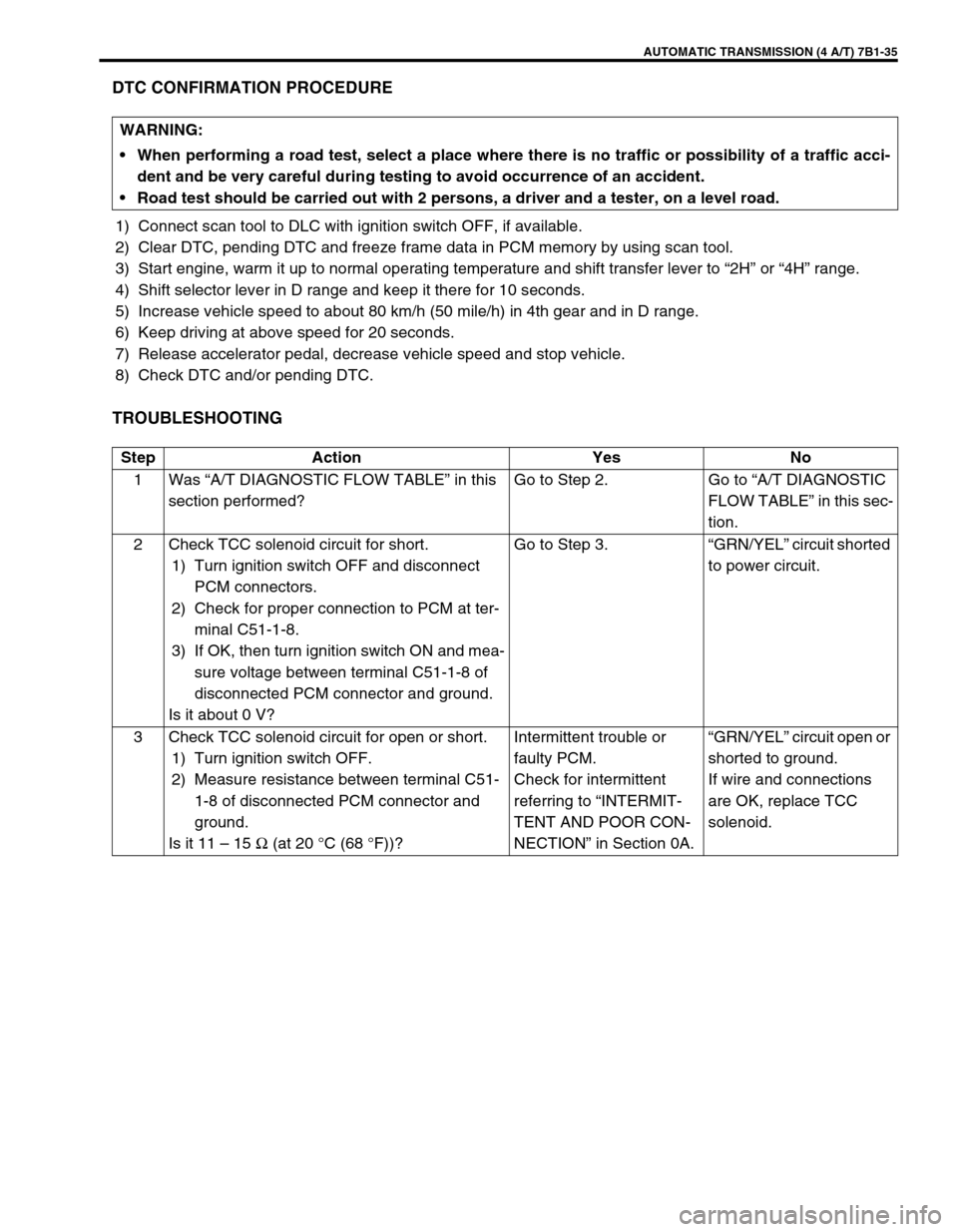
DTC CONFIRMATION PROCEDURE
1) Connect scan tool to DLC with ignition switch OFF, if available.
2) Clear DTC, pending DTC and freeze frame data in PCM memory by using scan tool.
3) Start engine, warm it up to normal operating temperature and shift transfer lever to “2H” or “4H” range.
4) Shift selector lever in D range and keep it there for 10 seconds.
5) Increase vehicle speed to about 80 km/h (50 mile/h) in 4th gear and in D range.
6) Keep driving at above speed for 20 seconds.
7) Release accelerator pedal, decrease vehicle speed and stop vehicle.
8) Check DTC and/or pending DTC.
TROUBLESHOOTING
WARNING:
When performing a road test, select a place where there is no traffic or possibility of a traffic acci-
dent and be very careful during testing to avoid occurrence of an accident.
Road test should be carried out with 2 persons, a driver and a tester, on a level road.
Step Action Yes No
1Was “A/T DIAGNOSTIC FLOW TABLE” in this
section performed?Go to Step 2. Go to “A/T DIAGNOSTIC
FLOW TABLE” in this sec-
tion.
2 Check TCC solenoid circuit for short.
1) Turn ignition switch OFF and disconnect
PCM connectors.
2) Check for proper connection to PCM at ter-
minal C51-1-8.
3) If OK, then turn ignition switch ON and mea-
sure voltage between terminal C51-1-8 of
disconnected PCM connector and ground.
Is it about 0 V?Go to Step 3.“GRN/YEL” circuit shorted
to power circuit.
3 Check TCC solenoid circuit for open or short.
1) Turn ignition switch OFF.
2) Measure resistance between terminal C51-
1-8 of disconnected PCM connector and
ground.
Is it 11 – 15 Ω (at 20 °C (68 °F))?Intermittent trouble or
faulty PCM.
Check for intermittent
referring to “INTERMIT-
TENT AND POOR CON-
NECTION” in Section 0A.“GRN/YEL” circuit open or
shorted to ground.
If wire and connections
are OK, replace TCC
solenoid.
Page 446 of 656
AUTOMATIC TRANSMISSION (4 A/T) 7B1-37
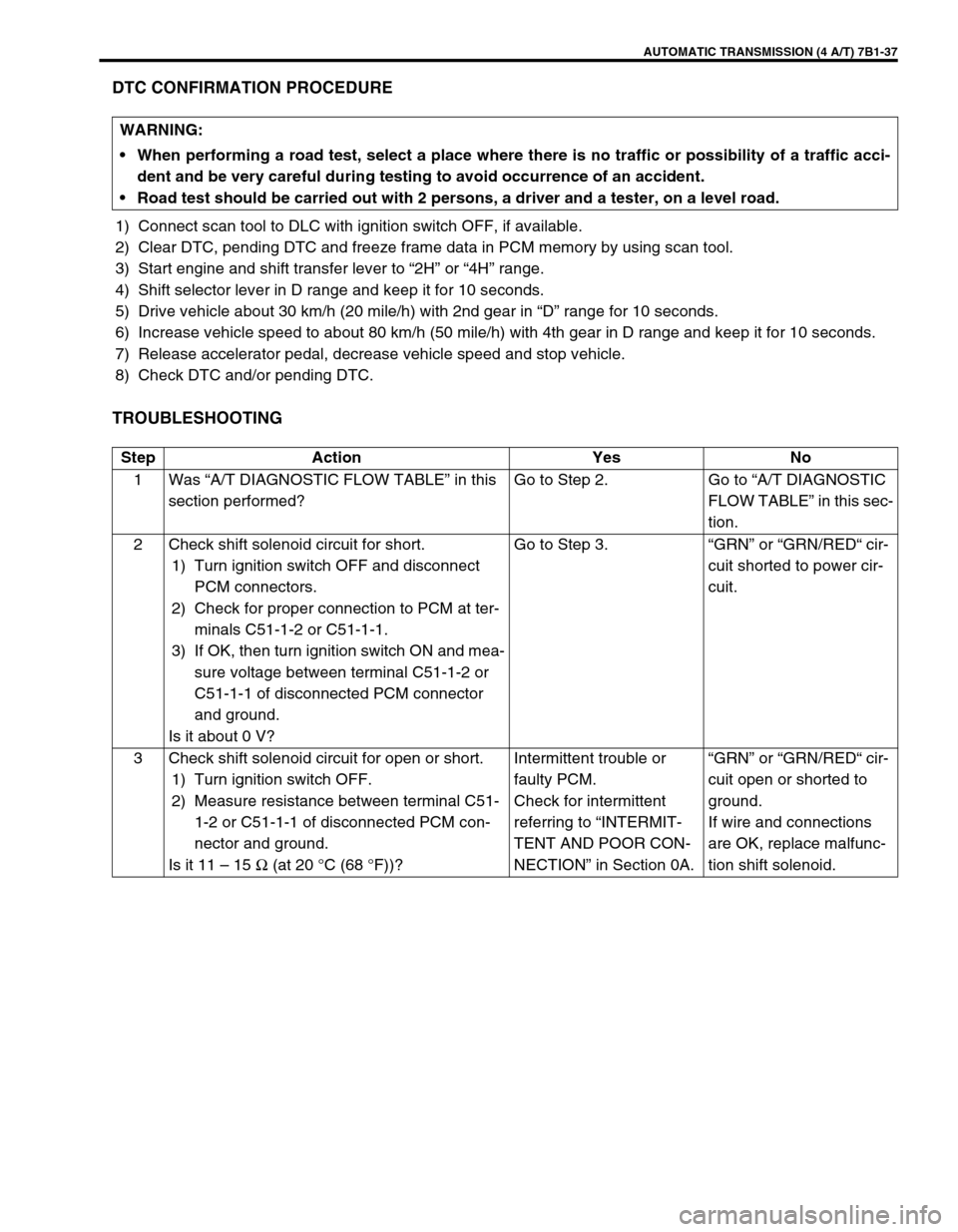
DTC CONFIRMATION PROCEDURE
1) Connect scan tool to DLC with ignition switch OFF, if available.
2) Clear DTC, pending DTC and freeze frame data in PCM memory by using scan tool.
3) Start engine and shift transfer lever to “2H” or “4H” range.
4) Shift selector lever in D range and keep it for 10 seconds.
5) Drive vehicle about 30 km/h (20 mile/h) with 2nd gear in “D” range for 10 seconds.
6) Increase vehicle speed to about 80 km/h (50 mile/h) with 4th gear in D range and keep it for 10 seconds.
7) Release accelerator pedal, decrease vehicle speed and stop vehicle.
8) Check DTC and/or pending DTC.
TROUBLESHOOTING
WARNING:
When performing a road test, select a place where there is no traffic or possibility of a traffic acci-
dent and be very careful during testing to avoid occurrence of an accident.
Road test should be carried out with 2 persons, a driver and a tester, on a level road.
Step Action Yes No
1Was “A/T DIAGNOSTIC FLOW TABLE” in this
section performed?Go to Step 2. Go to “A/T DIAGNOSTIC
FLOW TABLE” in this sec-
tion.
2 Check shift solenoid circuit for short.
1) Turn ignition switch OFF and disconnect
PCM connectors.
2) Check for proper connection to PCM at ter-
minals C51-1-2 or C51-1-1.
3) If OK, then turn ignition switch ON and mea-
sure voltage between terminal C51-1-2 or
C51-1-1 of disconnected PCM connector
and ground.
Is it about 0 V?Go to Step 3.“GRN” or “GRN/RED“ cir-
cuit shorted to power cir-
cuit.
3 Check shift solenoid circuit for open or short.
1) Turn ignition switch OFF.
2) Measure resistance between terminal C51-
1-2 or C51-1-1 of disconnected PCM con-
nector and ground.
Is it 11 – 15 Ω (at 20 °C (68 °F))?Intermittent trouble or
faulty PCM.
Check for intermittent
referring to “INTERMIT-
TENT AND POOR CON-
NECTION” in Section 0A.“GRN” or “GRN/RED“ cir-
cuit open or shorted to
ground.
If wire and connections
are OK, replace malfunc-
tion shift solenoid.
Page 454 of 656
AUTOMATIC TRANSMISSION (4 A/T) 7B1-45
A/T Throttle Cable
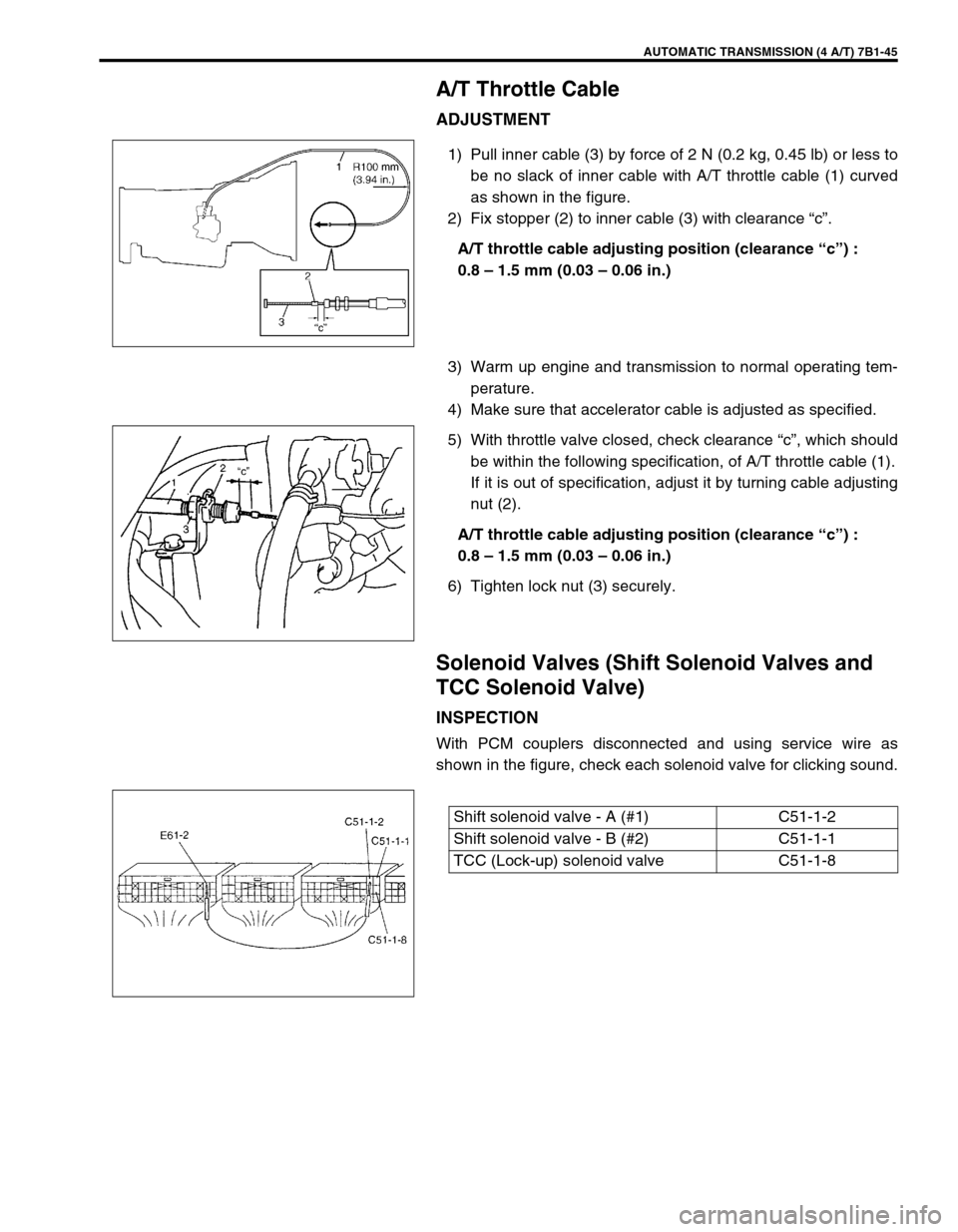
ADJUSTMENT
1) Pull inner cable (3) by force of 2 N (0.2 kg, 0.45 lb) or less to
be no slack of inner cable with A/T throttle cable (1) curved
as shown in the figure.
2) Fix stopper (2) to inner cable (3) with clearance “c”.
A/T throttle cable adjusting position (clearance “c”) :
0.8 – 1.5 mm (0.03 – 0.06 in.)
3) Warm up engine and transmission to normal operating tem-
perature.
4) Make sure that accelerator cable is adjusted as specified.
5) With throttle valve closed, check clearance “c”, which should
be within the following specification, of A/T throttle cable (1).
If it is out of specification, adjust it by turning cable adjusting
nut (2).
A/T throttle cable adjusting position (clearance “c”) :
0.8 – 1.5 mm (0.03 – 0.06 in.)
6) Tighten lock nut (3) securely.
Solenoid Valves (Shift Solenoid Valves and
TCC Solenoid Valve)
INSPECTION
With PCM couplers disconnected and using service wire as
shown in the figure, check each solenoid valve for clicking sound.
Shift solenoid valve - A (#1) C51-1-2
Shift solenoid valve - B (#2) C51-1-1
TCC (Lock-up) solenoid valve C51-1-8
Page 536 of 656
CRUISE CONTROL SYSTEM 8E-15
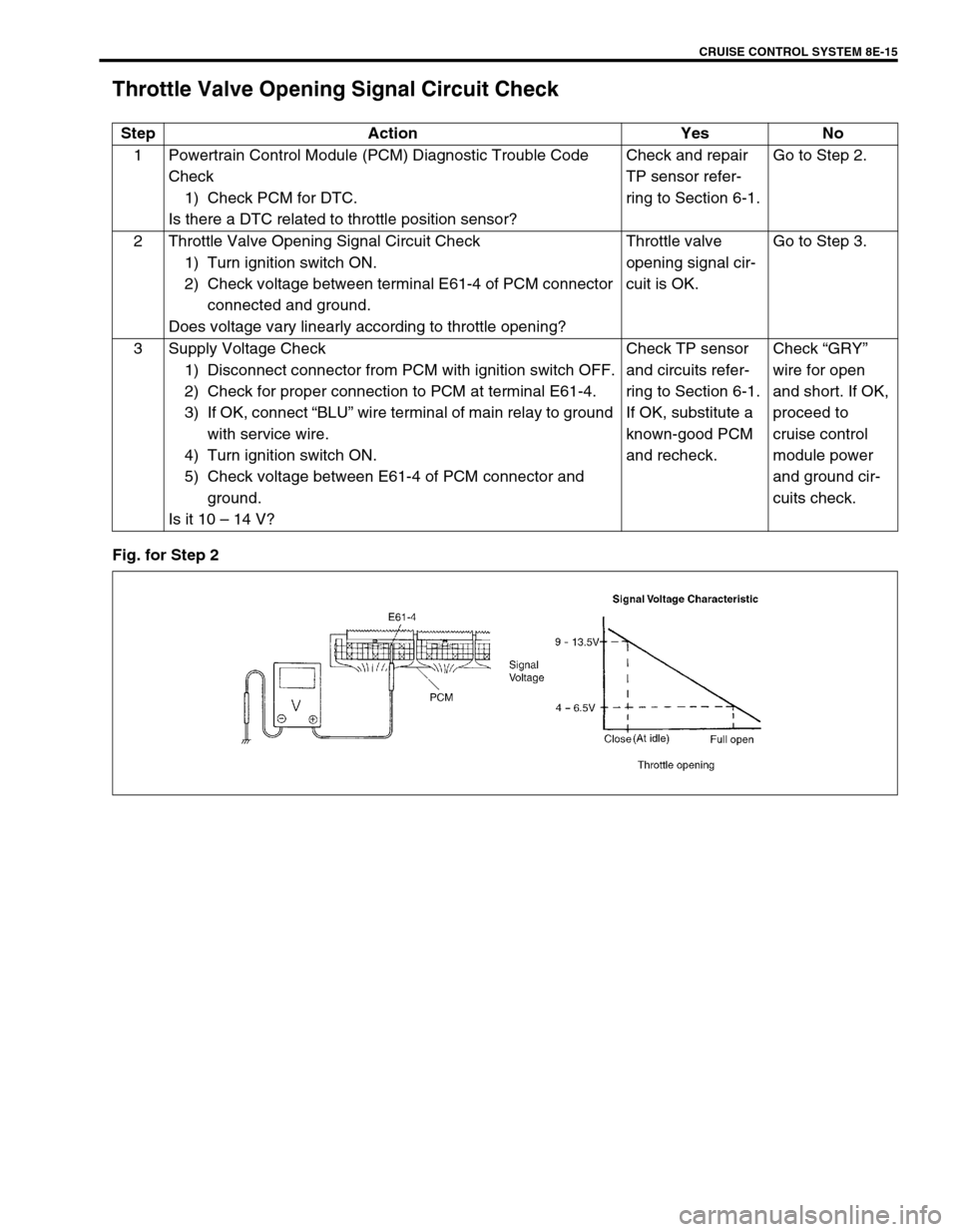
Throttle Valve Opening Signal Circuit Check
Fig. for Step 2Step Action Yes No
1 Powertrain Control Module (PCM) Diagnostic Trouble Code
Check
1) Check PCM for DTC.
Is there a DTC related to throttle position sensor?Check and repair
TP sensor refer-
ring to Section 6-1.Go to Step 2.
2 Throttle Valve Opening Signal Circuit Check
1) Turn ignition switch ON.
2) Check voltage between terminal E61-4 of PCM connector
connected and ground.
Does voltage vary linearly according to throttle opening?Throttle valve
opening signal cir-
cuit is OK.Go to Step 3.
3 Supply Voltage Check
1) Disconnect connector from PCM with ignition switch OFF.
2) Check for proper connection to PCM at terminal E61-4.
3) If OK, connect “BLU” wire terminal of main relay to ground
with service wire.
4) Turn ignition switch ON.
5) Check voltage between E61-4 of PCM connector and
ground.
Is it 10 – 14 V?Check TP sensor
and circuits refer-
ring to Section 6-1.
If OK, substitute a
known-good PCM
and recheck.Check “GRY”
wire for open
and short. If OK,
proceed to
cruise control
module power
and ground cir-
cuits check.
Page 579 of 656

10B-2 AIR BAG SYSTEM
DTC B1031 – Power Source Voltage
High........................................................... 10B-33
DTC B1032 – Power Source Voltage
Low ........................................................... 10B-33
DTC B1035 – RH Forward Sensor Circuit
Open or Short to Ground .......................... 10B-36
DTC B1036 – RH Forward Sensor Circuit
Short Between Two Wires or Short to
Power Circuit............................................. 10B-36
DTC B1037 – LH Forward Sensor Circuit
Open or Short to Ground .......................... 10B-36
DTC B1038 – LH Forward Sensor Circuit
Short Between Two Wires or Short to
Power Circuit............................................. 10B-36
DTC B1041 – Driver Pretensioner Initiator
Circuit Resistance High............................. 10B-40
DTC B1042 – Driver Pretensioner Initiator
Circuit Resistance Low ............................. 10B-40
DTC B1043 – Driver Pretensioner Initiator
Circuit Short to Ground ............................. 10B-40
DTC B1044 – Driver Pretensioner Initiator
Circuit Short to Power Circuit .................... 10B-40
DTC B1045 – Passenger Pretensioner
Initiator Circuit Resistance High ................ 10B-40
DTC B1046 – Passenger Pretensioner
Initiator Circuit Resistance Low................. 10B-40
DTC B1047 – Passenger Pretensioner
Initiator Circuit Short to Ground ................ 10B-40
DTC B1048 – Passenger Pretensioner
Initiator Circuit Short to Power Circuit ....... 10B-40
DTC B1051 – Frontal Crash Detected
(System Activation Command Outputted). 10B-46DTC B1061 – “AIR BAG” Warning Lamp
Circuit Failure............................................ 10B-47
DTC B1071 – Internal SDM Fault ............. 10B-48
DTC B1013 – System Specifications
Different from SDM Specifications ............ 10B-48
On-Vehicle Service ..................................... 10B-49
Service Precautions .................................. 10B-49
Service and diagnosis ........................... 10B-49
Disabling air bag system ....................... 10B-50
Enabling air bag system........................ 10B-50
Handling and storage ............................ 10B-51
Repairs and Inspections Required after
an Accident ............................................... 10B-56
Accident with deployment/activation -
component replacement ....................... 10B-56
Accident with or without deployment/
activation - component inspections....... 10B-57
SDM .......................................................... 10B-60
Forward Sensor ........................................ 10B-62
Seat Belt Pretensioner .............................. 10B-64
Air Bag (Inflator) Module and Seat Belt
Pretensioner Disposal................................ 10B-65
Deployment/Activation Outside Vehicle .... 10B-66
Deployment/Activation Inside Vehicle....... 10B-72
Deployed Air Bag (Inflator) Module and
Activated Seat Belt Pretensioner
Disposal .................................................... 10B-76
Tightening Torque Specification............... 10B-77
Special Tool ................................................ 10B-77
Page 588 of 656
AIR BAG SYSTEM 10B-11
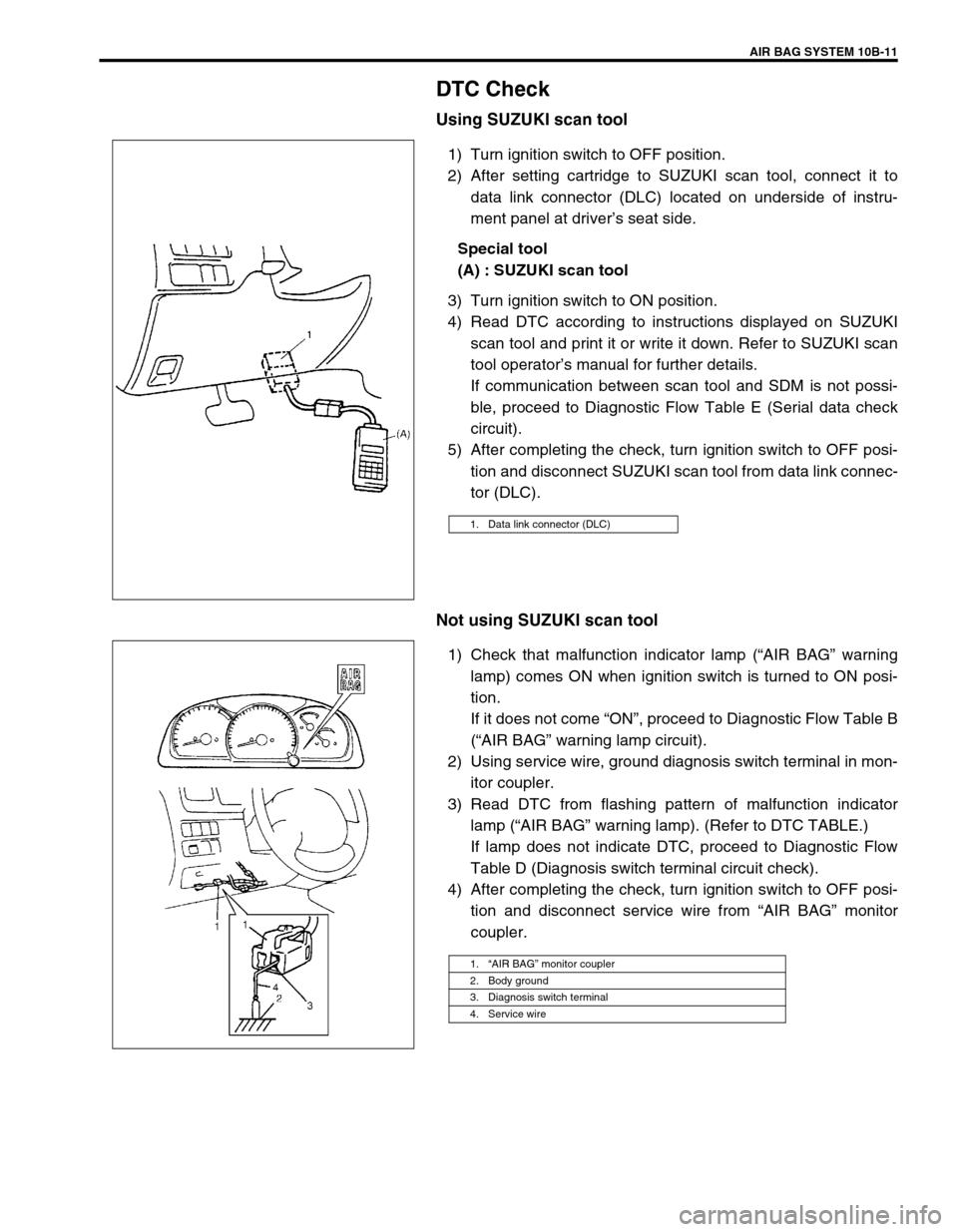
DTC Check
Using SUZUKI scan tool
1) Turn ignition switch to OFF position.
2) After setting cartridge to SUZUKI scan tool, connect it to
data link connector (DLC) located on underside of instru-
ment panel at driver’s seat side.
Special tool
(A) : SUZUKI scan tool
3) Turn ignition switch to ON position.
4) Read DTC according to instructions displayed on SUZUKI
scan tool and print it or write it down. Refer to SUZUKI scan
tool operator’s manual for further details.
If communication between scan tool and SDM is not possi-
ble, proceed to Diagnostic Flow Table E (Serial data check
circuit).
5) After completing the check, turn ignition switch to OFF posi-
tion and disconnect SUZUKI scan tool from data link connec-
tor (DLC).
Not using SUZUKI scan tool
1) Check that malfunction indicator lamp (“AIR BAG” warning
lamp) comes ON when ignition switch is turned to ON posi-
tion.
If it does not come “ON”, proceed to Diagnostic Flow Table B
(“AIR BAG” warning lamp circuit).
2) Using service wire, ground diagnosis switch terminal in mon-
itor coupler.
3) Read DTC from flashing pattern of malfunction indicator
lamp (“AIR BAG” warning lamp). (Refer to DTC TABLE.)
If lamp does not indicate DTC, proceed to Diagnostic Flow
Table D (Diagnosis switch terminal circuit check).
4) After completing the check, turn ignition switch to OFF posi-
tion and disconnect service wire from “AIR BAG” monitor
coupler.
1. Data link connector (DLC)
1.“AIR BAG” monitor coupler
2. Body ground
3. Diagnosis switch terminal
4. Service wire
Page 591 of 656
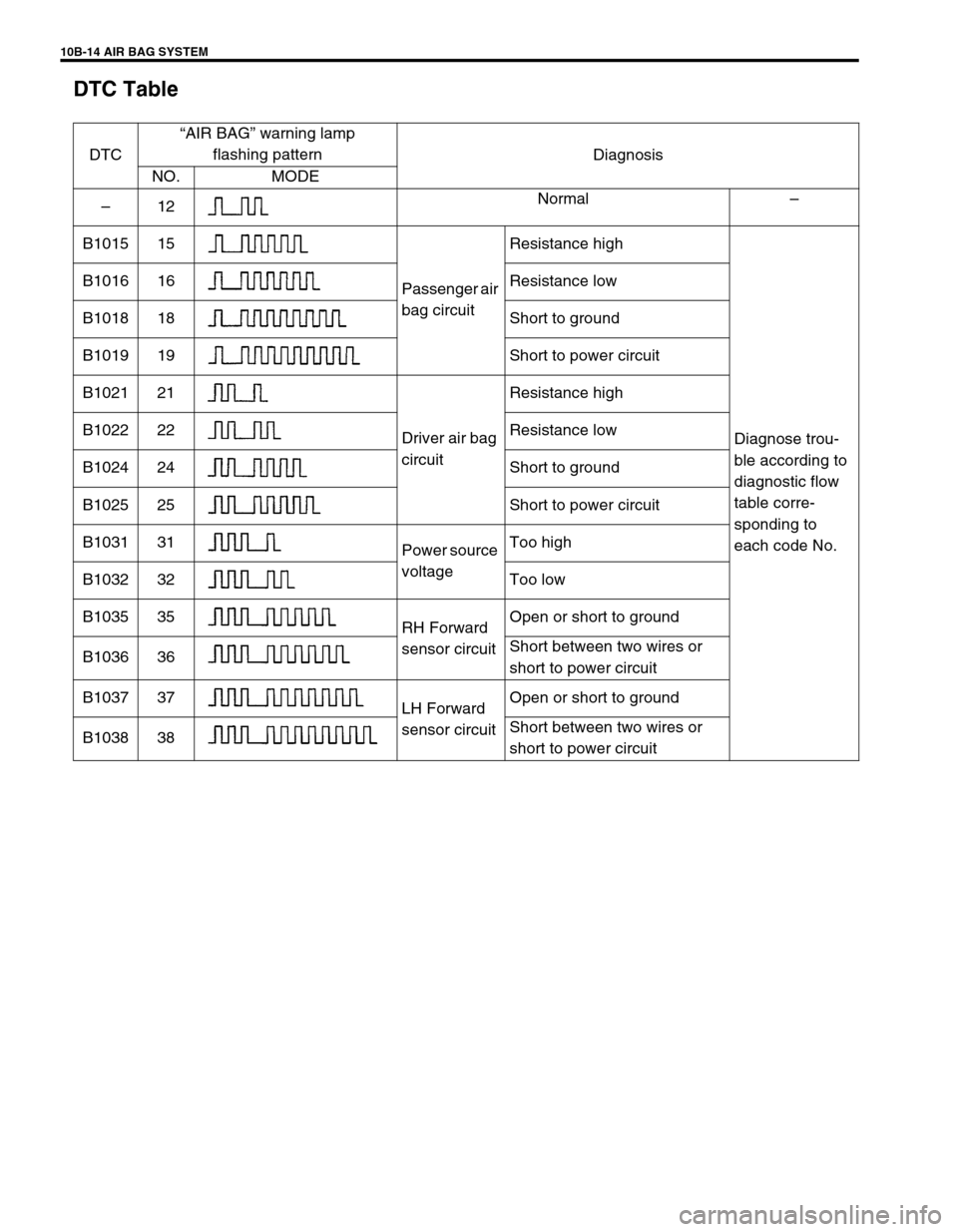
10B-14 AIR BAG SYSTEM
DTC Table
DTC“AIR BAG” warning lamp
flashing pattern
Diagnosis
NO. MODE
–12Normal–
B1015 15
Passenger air
bag circuitResistance high
Diagnose trou-
ble according to
diagnostic flow
table corre-
sponding to
each code No. B1016 16 Resistance low
B1018 18 Short to ground
B1019 19 Short to power circuit
B1021 21
Driver air bag
circuitResistance high
B1022 22 Resistance low
B1024 24 Short to ground
B1025 25 Short to power circuit
B1031 31
Power source
voltageToo high
B1032 32 Too low
B1035 35
RH Forward
sensor circuitOpen or short to ground
B1036 36Short between two wires or
short to power circuit
B1037 37
LH Forward
sensor circuitOpen or short to ground
B1038 38Short between two wires or
short to power circuit