Transfer SUZUKI GRAND VITARA 2001 2.G Owner's Manual
[x] Cancel search | Manufacturer: SUZUKI, Model Year: 2001, Model line: GRAND VITARA, Model: SUZUKI GRAND VITARA 2001 2.GPages: 656, PDF Size: 14.31 MB
Page 441 of 656
7B1-32 AUTOMATIC TRANSMISSION (4 A/T)
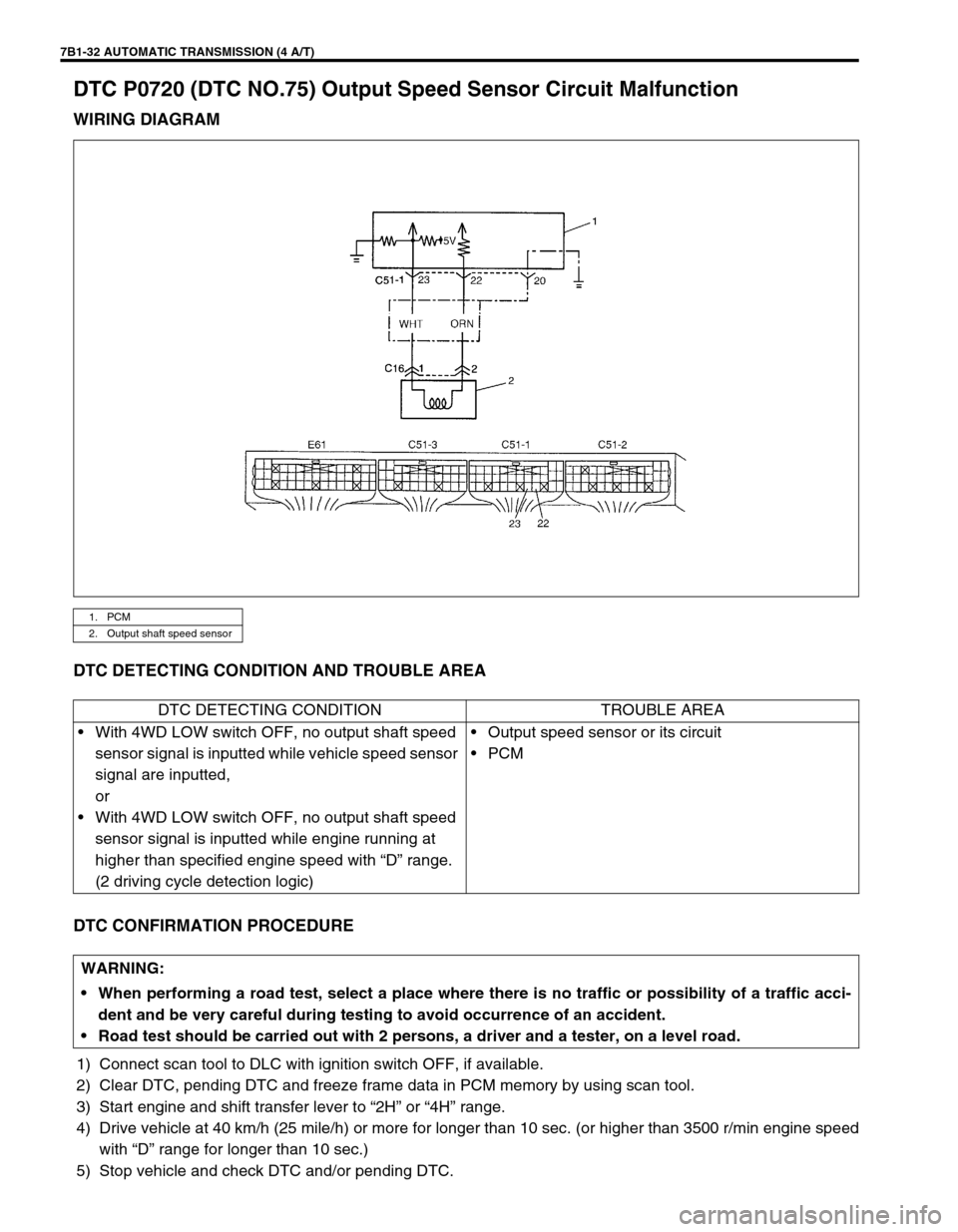
DTC P0720 (DTC NO.75) Output Speed Sensor Circuit Malfunction
WIRING DIAGRAM
DTC DETECTING CONDITION AND TROUBLE AREA
DTC CONFIRMATION PROCEDURE
1) Connect scan tool to DLC with ignition switch OFF, if available.
2) Clear DTC, pending DTC and freeze frame data in PCM memory by using scan tool.
3) Start engine and shift transfer lever to “2H” or “4H” range.
4) Drive vehicle at 40 km/h (25 mile/h) or more for longer than 10 sec. (or higher than 3500 r/min engine speed
with “D” range for longer than 10 sec.)
5) Stop vehicle and check DTC and/or pending DTC.
1. PCM
2. Output shaft speed sensor
DTC DETECTING CONDITION TROUBLE AREA
•With 4WD LOW switch OFF, no output shaft speed
sensor signal is inputted while vehicle speed sensor
signal are inputted,
or
•With 4WD LOW switch OFF, no output shaft speed
sensor signal is inputted while engine running at
higher than specified engine speed with “D” range.
(2 driving cycle detection logic)•Output speed sensor or its circuit
•PCM
WARNING:
When performing a road test, select a place where there is no traffic or possibility of a traffic acci-
dent and be very careful during testing to avoid occurrence of an accident.
Road test should be carried out with 2 persons, a driver and a tester, on a level road.
Page 444 of 656
AUTOMATIC TRANSMISSION (4 A/T) 7B1-35
DTC CONFIRMATION PROCEDURE
1) Connect scan tool to DLC with ignition switch OFF, if available.
2) Clear DTC, pending DTC and freeze frame data in PCM memory by using scan tool.
3) Start engine, warm it up to normal operating temperature and shift transfer lever to “2H” or “4H” range.
4) Shift selector lever in D range and keep it there for 10 seconds.
5) Increase vehicle speed to about 80 km/h (50 mile/h) in 4th gear and in D range.
6) Keep driving at above speed for 20 seconds.
7) Release accelerator pedal, decrease vehicle speed and stop vehicle.
8) Check DTC and/or pending DTC.
TROUBLESHOOTING
WARNING:
When performing a road test, select a place where there is no traffic or possibility of a traffic acci-
dent and be very careful during testing to avoid occurrence of an accident.
Road test should be carried out with 2 persons, a driver and a tester, on a level road.
Step Action Yes No
1Was “A/T DIAGNOSTIC FLOW TABLE” in this
section performed?Go to Step 2. Go to “A/T DIAGNOSTIC
FLOW TABLE” in this sec-
tion.
2 Check TCC solenoid circuit for short.
1) Turn ignition switch OFF and disconnect
PCM connectors.
2) Check for proper connection to PCM at ter-
minal C51-1-8.
3) If OK, then turn ignition switch ON and mea-
sure voltage between terminal C51-1-8 of
disconnected PCM connector and ground.
Is it about 0 V?Go to Step 3.“GRN/YEL” circuit shorted
to power circuit.
3 Check TCC solenoid circuit for open or short.
1) Turn ignition switch OFF.
2) Measure resistance between terminal C51-
1-8 of disconnected PCM connector and
ground.
Is it 11 – 15 Ω (at 20 °C (68 °F))?Intermittent trouble or
faulty PCM.
Check for intermittent
referring to “INTERMIT-
TENT AND POOR CON-
NECTION” in Section 0A.“GRN/YEL” circuit open or
shorted to ground.
If wire and connections
are OK, replace TCC
solenoid.
Page 446 of 656
AUTOMATIC TRANSMISSION (4 A/T) 7B1-37
DTC CONFIRMATION PROCEDURE
1) Connect scan tool to DLC with ignition switch OFF, if available.
2) Clear DTC, pending DTC and freeze frame data in PCM memory by using scan tool.
3) Start engine and shift transfer lever to “2H” or “4H” range.
4) Shift selector lever in D range and keep it for 10 seconds.
5) Drive vehicle about 30 km/h (20 mile/h) with 2nd gear in “D” range for 10 seconds.
6) Increase vehicle speed to about 80 km/h (50 mile/h) with 4th gear in D range and keep it for 10 seconds.
7) Release accelerator pedal, decrease vehicle speed and stop vehicle.
8) Check DTC and/or pending DTC.
TROUBLESHOOTING
WARNING:
When performing a road test, select a place where there is no traffic or possibility of a traffic acci-
dent and be very careful during testing to avoid occurrence of an accident.
Road test should be carried out with 2 persons, a driver and a tester, on a level road.
Step Action Yes No
1Was “A/T DIAGNOSTIC FLOW TABLE” in this
section performed?Go to Step 2. Go to “A/T DIAGNOSTIC
FLOW TABLE” in this sec-
tion.
2 Check shift solenoid circuit for short.
1) Turn ignition switch OFF and disconnect
PCM connectors.
2) Check for proper connection to PCM at ter-
minals C51-1-2 or C51-1-1.
3) If OK, then turn ignition switch ON and mea-
sure voltage between terminal C51-1-2 or
C51-1-1 of disconnected PCM connector
and ground.
Is it about 0 V?Go to Step 3.“GRN” or “GRN/RED“ cir-
cuit shorted to power cir-
cuit.
3 Check shift solenoid circuit for open or short.
1) Turn ignition switch OFF.
2) Measure resistance between terminal C51-
1-2 or C51-1-1 of disconnected PCM con-
nector and ground.
Is it 11 – 15 Ω (at 20 °C (68 °F))?Intermittent trouble or
faulty PCM.
Check for intermittent
referring to “INTERMIT-
TENT AND POOR CON-
NECTION” in Section 0A.“GRN” or “GRN/RED“ cir-
cuit open or shorted to
ground.
If wire and connections
are OK, replace malfunc-
tion shift solenoid.
Page 469 of 656
7B1-60 AUTOMATIC TRANSMISSION (4 A/T)
Accumulator piston and spring specification :
Tightening Torque Specification
Used forPiston outer
diameter “a”Spring free length “b”
Direct clutch accumulator (2)31.80 – 31.85 mm
(1.252 – 1.254 in.)Upper spring 43.56 mm (1.715 in.)
Lower spring 30.00 mm (1.181 in.)
Forward clutch accumulator (1)31.80 – 31.85 mm
(1.252 – 1.254 in.)Upper spring 57.18 mm (2.251 in.)
Lower spring 30.50 mm (1.201 in.)
Second brake accumulator (3)34.80 – 34.85 mm
(1.370 – 1.372 in.)Upper spring 56.16 mm (2.211 in.)
Lower spring 18.5 mm (0.728 in.)
Fastening partTightening torque
Nm kg-m lb-ft
Automatic transmission fluid drain plug 23 2.3 17.0
Transfer oil level/filler and drain plugs 23 2.3 17.0
Transmission case plug 17 1.7 12.5
Manual select lever nut 13 1.3 9.5
Manual select cable nut 7 0.7 5.5
Manual selector assembly bolts 18 1.8 13.5
Transmission to engine bolts and nuts 85 8.5 61.5
Engine rear mounting bolts
Engine rear mounting member bolts50 5.0 36.5
Universal joint flange bolts and nuts 50 5.0 36.5
Torque converter mounting bolts 65 6.5 47.0
Adapter case or extension case bolts 42 4.2 30.0
Transmission range switch lock bolt 5.5 0.55 4.0
Oil pipe union bolts 35 3.5 22.5
Drive plate bolts 78 7.8 56.5
Interlock cable clamp screw 2.2 0.22 1.5
Interlock cable outer mounting nut 13 1.3 9.5
Page 475 of 656
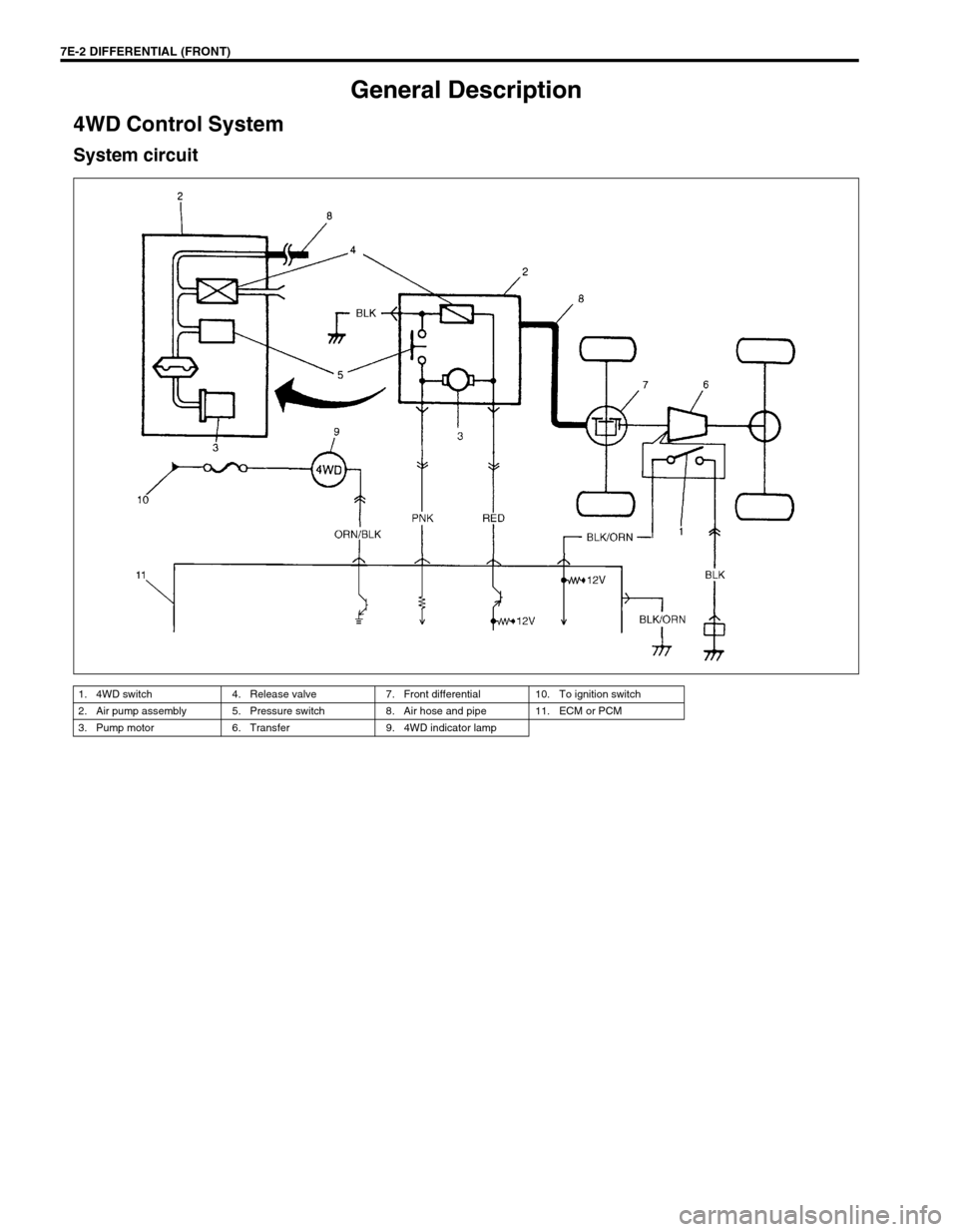
7E-2 DIFFERENTIAL (FRONT)
General Description
4WD Control System
System circuit
1. 4WD switch 4. Release valve 7. Front differential 10. To ignition switch
2. Air pump assembly 5. Pressure switch 8. Air hose and pipe 11. ECM or PCM
3. Pump motor 6. Transfer 9. 4WD indicator lamp
Page 476 of 656
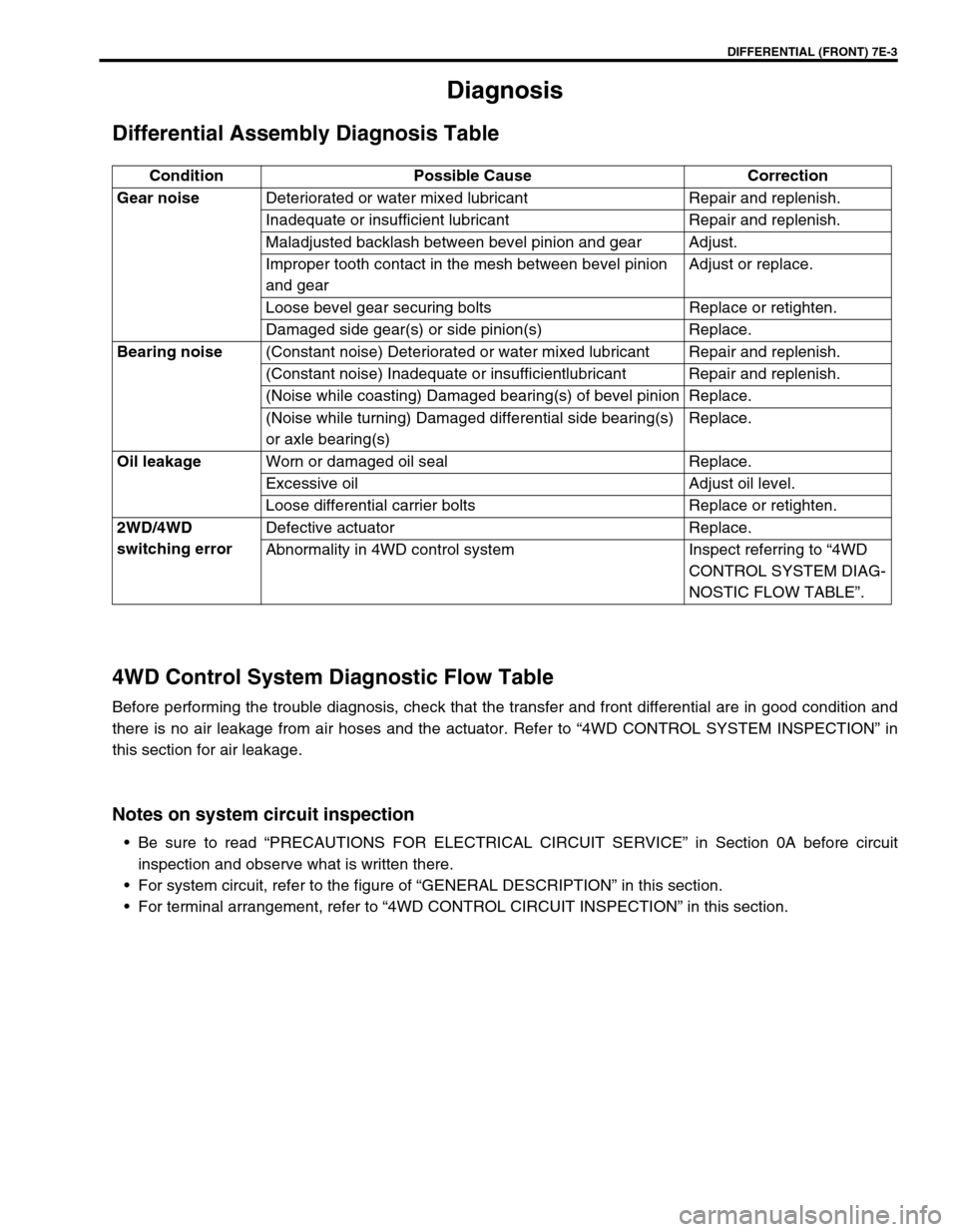
DIFFERENTIAL (FRONT) 7E-3
Diagnosis
Differential Assembly Diagnosis Table
4WD Control System Diagnostic Flow Table
Before performing the trouble diagnosis, check that the transfer and front differential are in good condition and
there is no air leakage from air hoses and the actuator. Refer to “4WD CONTROL SYSTEM INSPECTION” in
this section for air leakage.
Notes on system circuit inspection
•Be sure to read “PRECAUTIONS FOR ELECTRICAL CIRCUIT SERVICE” in Section 0A before circuit
inspection and observe what is written there.
•For system circuit, refer to the figure of “GENERAL DESCRIPTION” in this section.
•For terminal arrangement, refer to “4WD CONTROL CIRCUIT INSPECTION” in this section. Condition Possible Cause Correction
Gear noiseDeteriorated or water mixed lubricant Repair and replenish.
Inadequate or insufficient lubricant Repair and replenish.
Maladjusted backlash between bevel pinion and gear Adjust.
Improper tooth contact in the mesh between bevel pinion
and gearAdjust or replace.
Loose bevel gear securing bolts Replace or retighten.
Damaged side gear(s) or side pinion(s) Replace.
Bearing noise(Constant noise) Deteriorated or water mixed lubricant Repair and replenish.
(Constant noise) Inadequate or insufficientlubricant Repair and replenish.
(Noise while coasting) Damaged bearing(s) of bevel pinion Replace.
(Noise while turning) Damaged differential side bearing(s)
or axle bearing(s)Replace.
Oil leakageWorn or damaged oil seal Replace.
Excessive oil Adjust oil level.
Loose differential carrier bolts Replace or retighten.
2WD/4WD
switching errorDefective actuator Replace.
Abnormality in 4WD control system Inspect referring to “4WD
CONTROL SYSTEM DIAG-
NOSTIC FLOW TABLE”.
Page 477 of 656
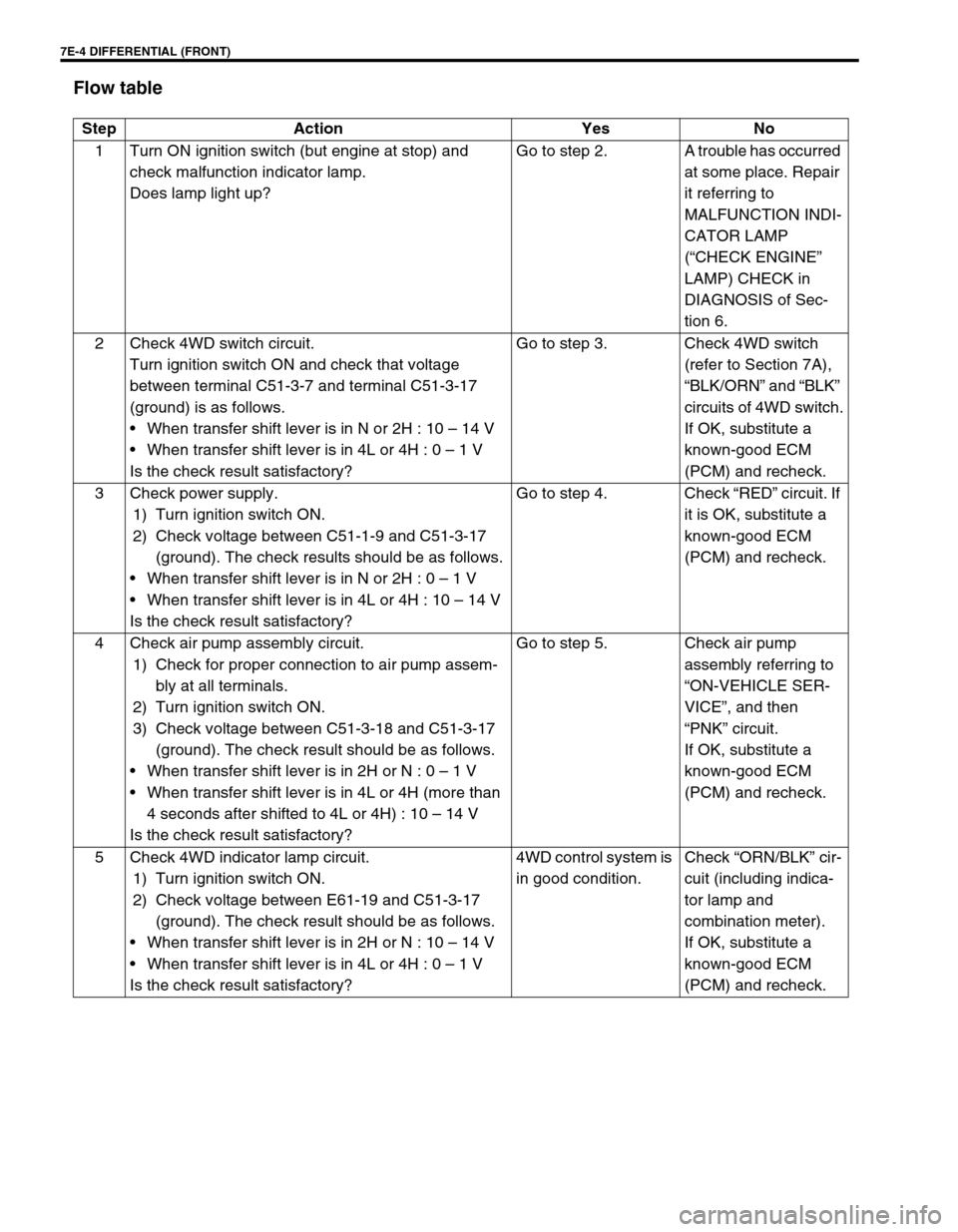
7E-4 DIFFERENTIAL (FRONT)
Flow table
Step Action Yes No
1 Turn ON ignition switch (but engine at stop) and
check malfunction indicator lamp.
Does lamp light up?Go to step 2. A trouble has occurred
at some place. Repair
it referring to
MALFUNCTION INDI-
CATOR LAMP
(“CHECK ENGINE”
LAMP) CHECK in
DIAGNOSIS of Sec-
tion 6.
2 Check 4WD switch circuit.
Turn ignition switch ON and check that voltage
between terminal C51-3-7 and terminal C51-3-17
(ground) is as follows.
When transfer shift lever is in N or 2H : 10 – 14 V
When transfer shift lever is in 4L or 4H : 0 – 1 V
Is the check result satisfactory?Go to step 3. Check 4WD switch
(refer to Section 7A),
“BLK/ORN” and “BLK”
circuits of 4WD switch.
If OK, substitute a
known-good ECM
(PCM) and recheck.
3 Check power supply.
1) Turn ignition switch ON.
2) Check voltage between C51-1-9 and C51-3-17
(ground). The check results should be as follows.
When transfer shift lever is in N or 2H : 0 – 1 V
When transfer shift lever is in 4L or 4H : 10 – 14 V
Is the check result satisfactory?Go to step 4. Check “RED” circuit. If
it is OK, substitute a
known-good ECM
(PCM) and recheck.
4 Check air pump assembly circuit.
1) Check for proper connection to air pump assem-
bly at all terminals.
2) Turn ignition switch ON.
3) Check voltage between C51-3-18 and C51-3-17
(ground). The check result should be as follows.
When transfer shift lever is in 2H or N : 0 – 1 V
When transfer shift lever is in 4L or 4H (more than
4 seconds after shifted to 4L or 4H) : 10 – 14 V
Is the check result satisfactory?Go to step 5. Check air pump
assembly referring to
“ON-VEHICLE SER-
VICE”, and then
“PNK” circuit.
If OK, substitute a
known-good ECM
(PCM) and recheck.
5 Check 4WD indicator lamp circuit.
1) Turn ignition switch ON.
2) Check voltage between E61-19 and C51-3-17
(ground). The check result should be as follows.
When transfer shift lever is in 2H or N : 10 – 14 V
When transfer shift lever is in 4L or 4H : 0 – 1 V
Is the check result satisfactory?4WD control system is
in good condition.Check “ORN/BLK” cir-
cuit (including indica-
tor lamp and
combination meter).
If OK, substitute a
known-good ECM
(PCM) and recheck.
Page 478 of 656
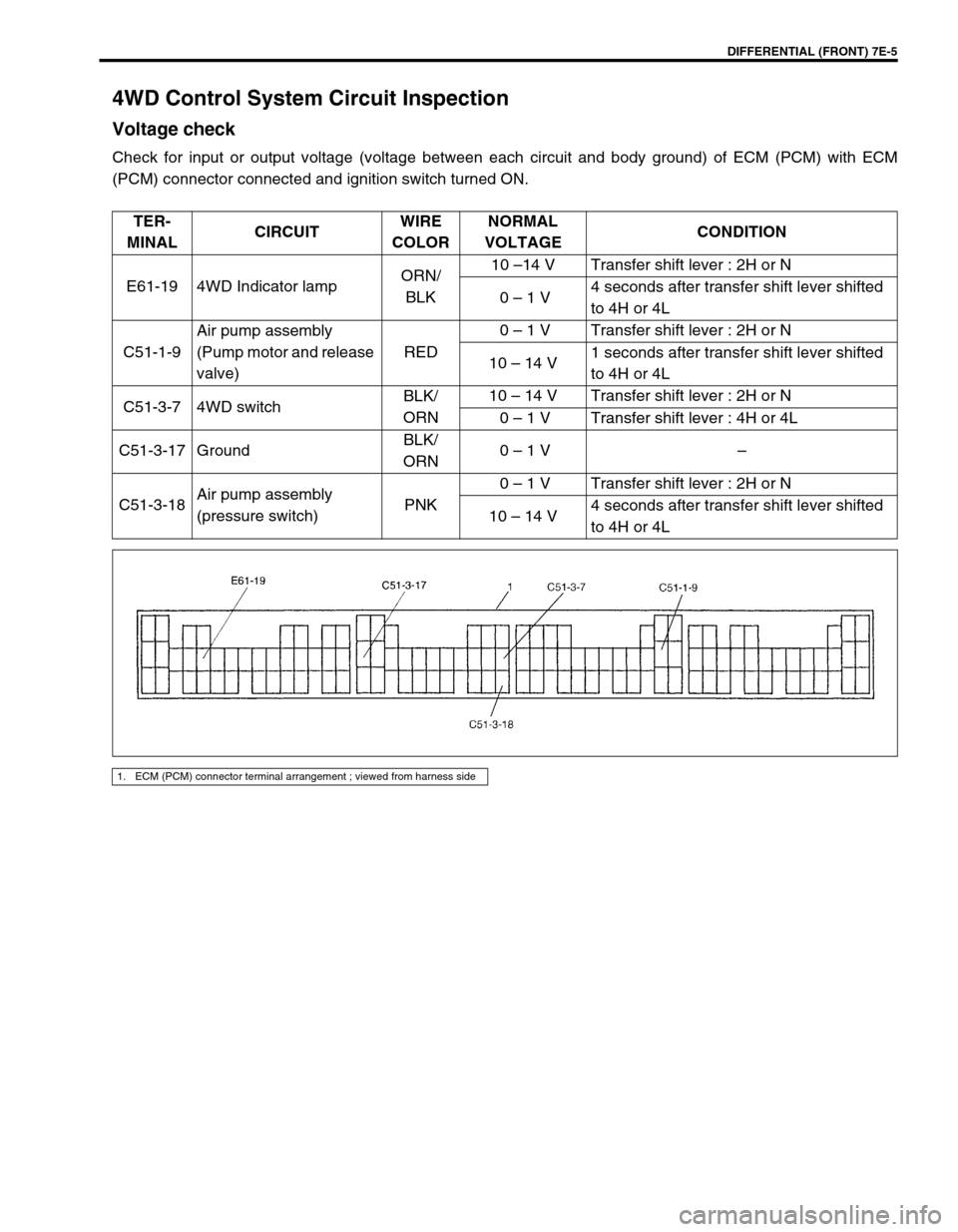
DIFFERENTIAL (FRONT) 7E-5
4WD Control System Circuit Inspection
Voltage check
Check for input or output voltage (voltage between each circuit and body ground) of ECM (PCM) with ECM
(PCM) connector connected and ignition switch turned ON.
TER-
MINALCIRCUITWIRE
COLORNORMAL
VOLTAGECONDITION
E61-19 4WD Indicator lampORN/
BLK10 –14 V Transfer shift lever : 2H or N
0 – 1 V4 seconds after transfer shift lever shifted
to 4H or 4L
C51-1-9Air pump assembly
(Pump motor and release
valve)RED 0 – 1 V Transfer shift lever : 2H or N
10 – 14 V1 seconds after transfer shift lever shifted
to 4H or 4L
C51-3-7 4WD switchBLK/
ORN10 – 14 V Transfer shift lever : 2H or N
0 – 1 V Transfer shift lever : 4H or 4L
C51-3-17 GroundBLK/
ORN 0 – 1 V –
C51-3-18Air pump assembly
(pressure switch)PNK 0 – 1 V Transfer shift lever : 2H or N
10 – 14 V4 seconds after transfer shift lever shifted
to 4H or 4L
1. ECM (PCM) connector terminal arrangement ; viewed from harness side
Page 479 of 656
7E-6 DIFFERENTIAL (FRONT)
4WD Control System Inspection
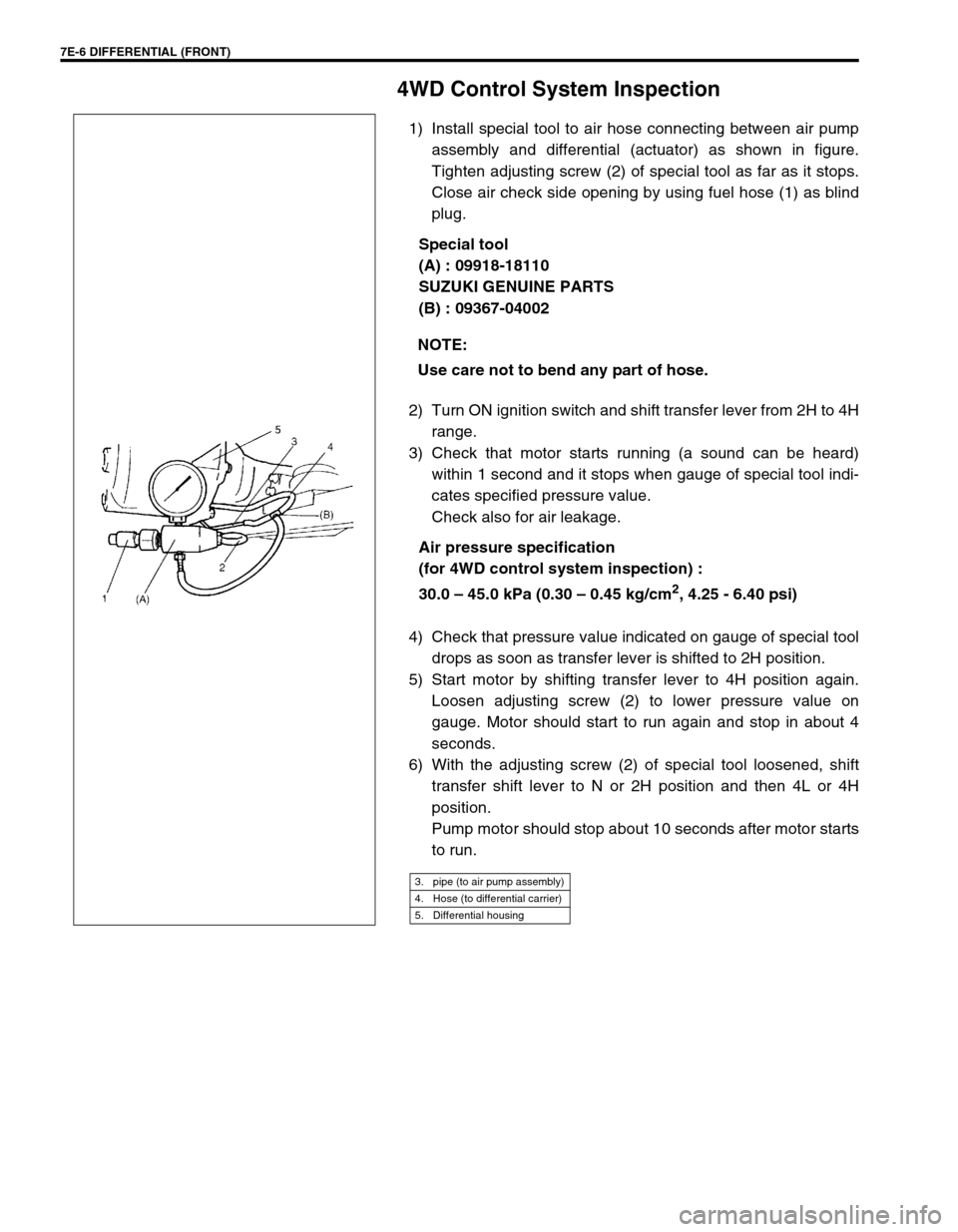
1) Install special tool to air hose connecting between air pump
assembly and differential (actuator) as shown in figure.
Tighten adjusting screw (2) of special tool as far as it stops.
Close air check side opening by using fuel hose (1) as blind
plug.
Special tool
(A) : 09918-18110
SUZUKI GENUINE PARTS
(B) : 09367-04002
2) Turn ON ignition switch and shift transfer lever from 2H to 4H
range.
3) Check that motor starts running (a sound can be heard)
within 1 second and it stops when gauge of special tool indi-
cates specified pressure value.
Check also for air leakage.
Air pressure specification
(for 4WD control system inspection) :
30.0 – 45.0 kPa (0.30 – 0.45 kg/cm
2, 4.25 - 6.40 psi)
4) Check that pressure value indicated on gauge of special tool
drops as soon as transfer lever is shifted to 2H position.
5) Start motor by shifting transfer lever to 4H position again.
Loosen adjusting screw (2) to lower pressure value on
gauge. Motor should start to run again and stop in about 4
seconds.
6) With the adjusting screw (2) of special tool loosened, shift
transfer shift lever to N or 2H position and then 4L or 4H
position.
Pump motor should stop about 10 seconds after motor starts
to run. NOTE:
Use care not to bend any part of hose.
3. pipe (to air pump assembly)
4. Hose (to differential carrier)
5. Differential housing
Page 482 of 656
DIFFERENTIAL (FRONT) 7E-9
Front Differential Assembly
DISMOUNTING
1) Lift up vehicle and drain oil.
2) Disconnect air hose and breather hose from differential
housing.
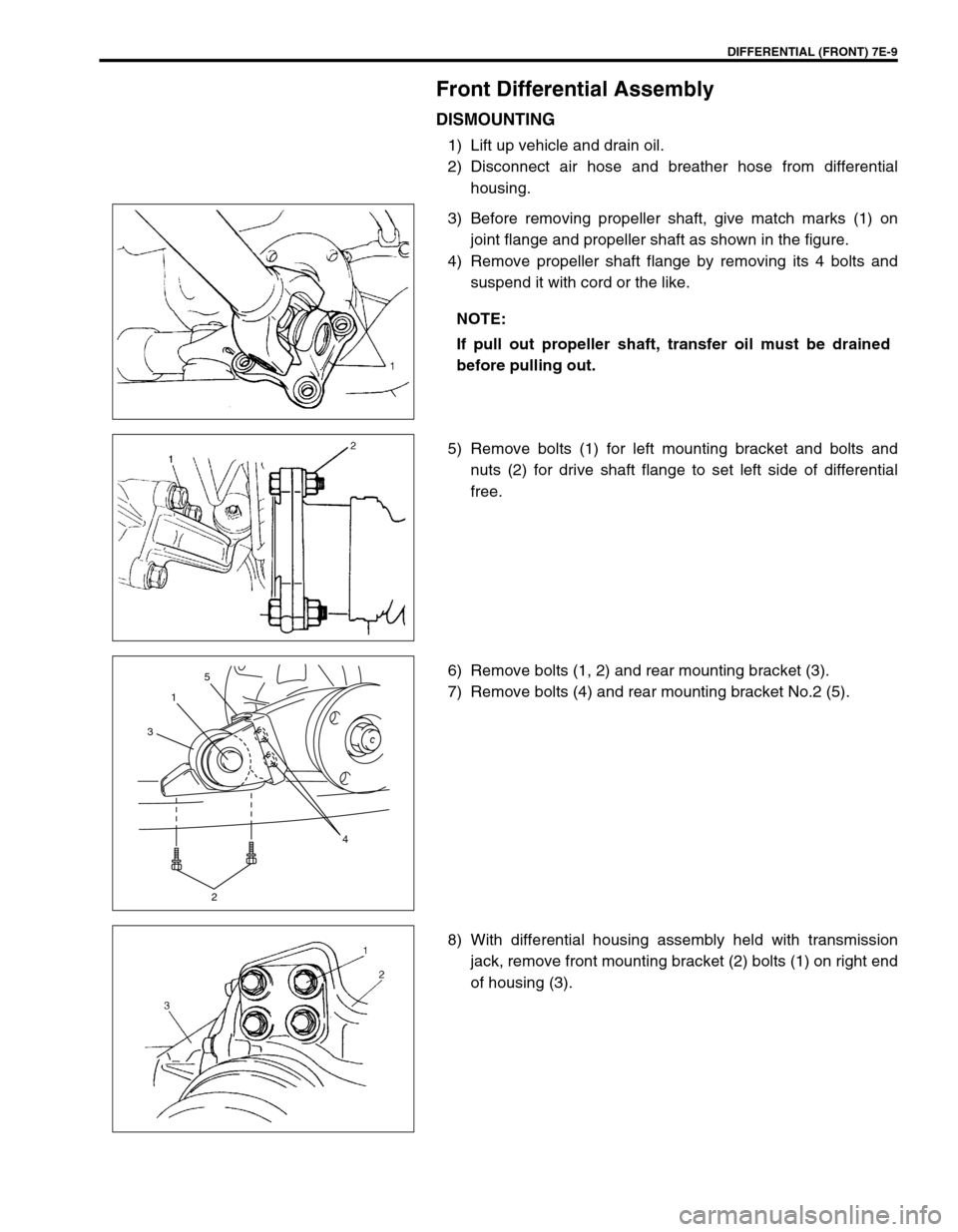
3) Before removing propeller shaft, give match marks (1) on
joint flange and propeller shaft as shown in the figure.
4) Remove propeller shaft flange by removing its 4 bolts and
suspend it with cord or the like.
5) Remove bolts (1) for left mounting bracket and bolts and
nuts (2) for drive shaft flange to set left side of differential
free.
6) Remove bolts (1, 2) and rear mounting bracket (3).
7) Remove bolts (4) and rear mounting bracket No.2 (5).
8) With differential housing assembly held with transmission
jack, remove front mounting bracket (2) bolts (1) on right end
of housing (3). NOTE:
If pull out propeller shaft, transfer oil must be drained
before pulling out.
4 1
2
5
3