Under engine SUZUKI GRAND VITARA 2001 2.G Owner's Manual
[x] Cancel search | Manufacturer: SUZUKI, Model Year: 2001, Model line: GRAND VITARA, Model: SUZUKI GRAND VITARA 2001 2.GPages: 656, PDF Size: 14.31 MB
Page 255 of 656
6-1-94 ENGINE GENERAL INFORMATION AND DIAGNOSIS (H27 ENGINE)
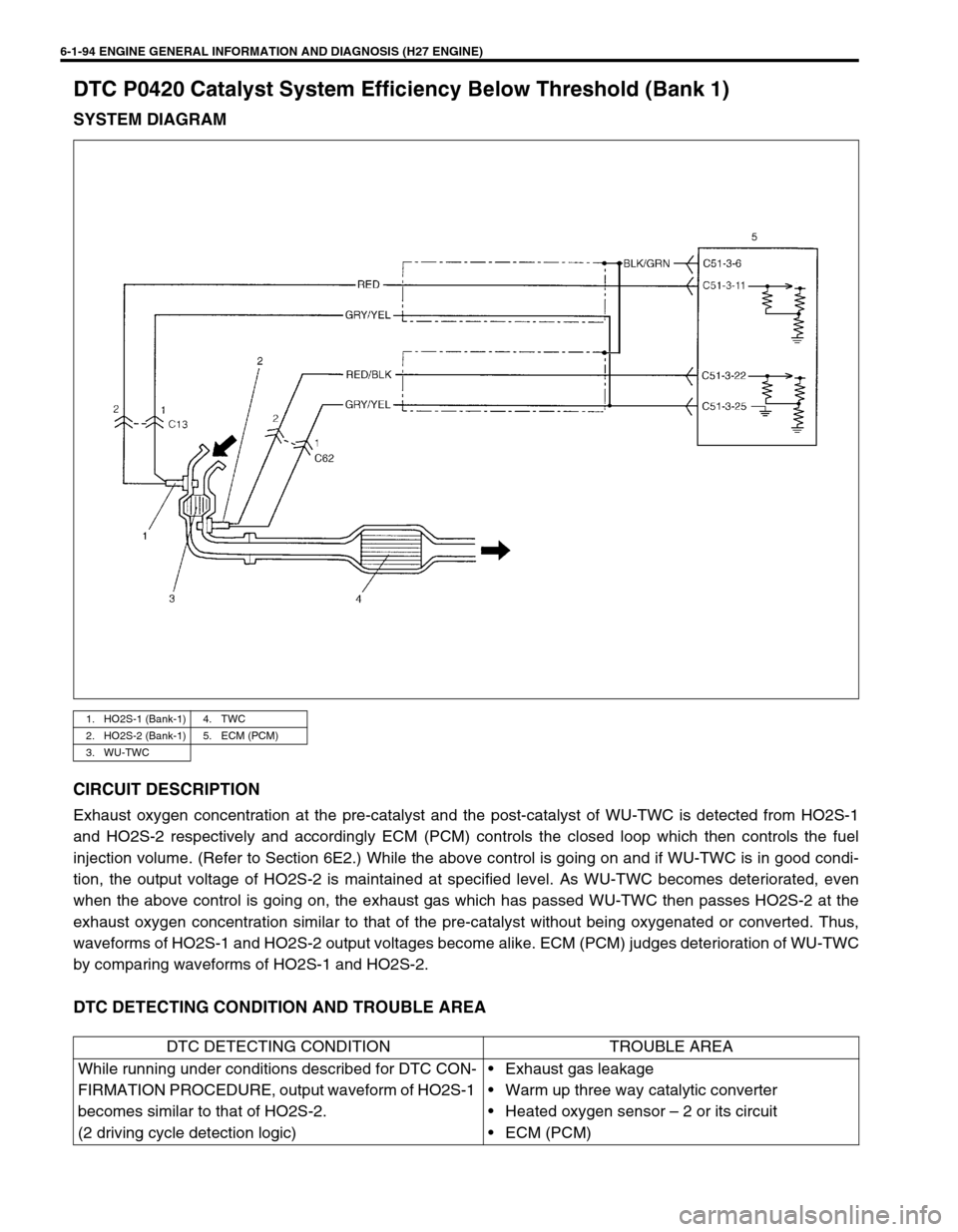
DTC P0420 Catalyst System Efficiency Below Threshold (Bank 1)
SYSTEM DIAGRAM
CIRCUIT DESCRIPTION
Exhaust oxygen concentration at the pre-catalyst and the post-catalyst of WU-TWC is detected from HO2S-1
and HO2S-2 respectively and accordingly ECM (PCM) controls the closed loop which then controls the fuel
injection volume. (Refer to Section 6E2.) While the above control is going on and if WU-TWC is in good condi-
tion, the output voltage of HO2S-2 is maintained at specified level. As WU-TWC becomes deteriorated, even
when the above control is going on, the exhaust gas which has passed WU-TWC then passes HO2S-2 at the
exhaust oxygen concentration similar to that of the pre-catalyst without being oxygenated or converted. Thus,
waveforms of HO2S-1 and HO2S-2 output voltages become alike. ECM (PCM) judges deterioration of WU-TWC
by comparing waveforms of HO2S-1 and HO2S-2.
DTC DETECTING CONDITION AND TROUBLE AREA
1. HO2S-1 (Bank-1) 4. TWC
2. HO2S-2 (Bank-1) 5. ECM (PCM)
3. WU-TWC
DTC DETECTING CONDITION TROUBLE AREA
While running under conditions described for DTC CON-
FIRMATION PROCEDURE, output waveform of HO2S-1
becomes similar to that of HO2S-2.
(2 driving cycle detection logic)• Exhaust gas leakage
• Warm up three way catalytic converter
• Heated oxygen sensor – 2 or its circuit
•ECM (PCM)
Page 257 of 656
6-1-96 ENGINE GENERAL INFORMATION AND DIAGNOSIS (H27 ENGINE)
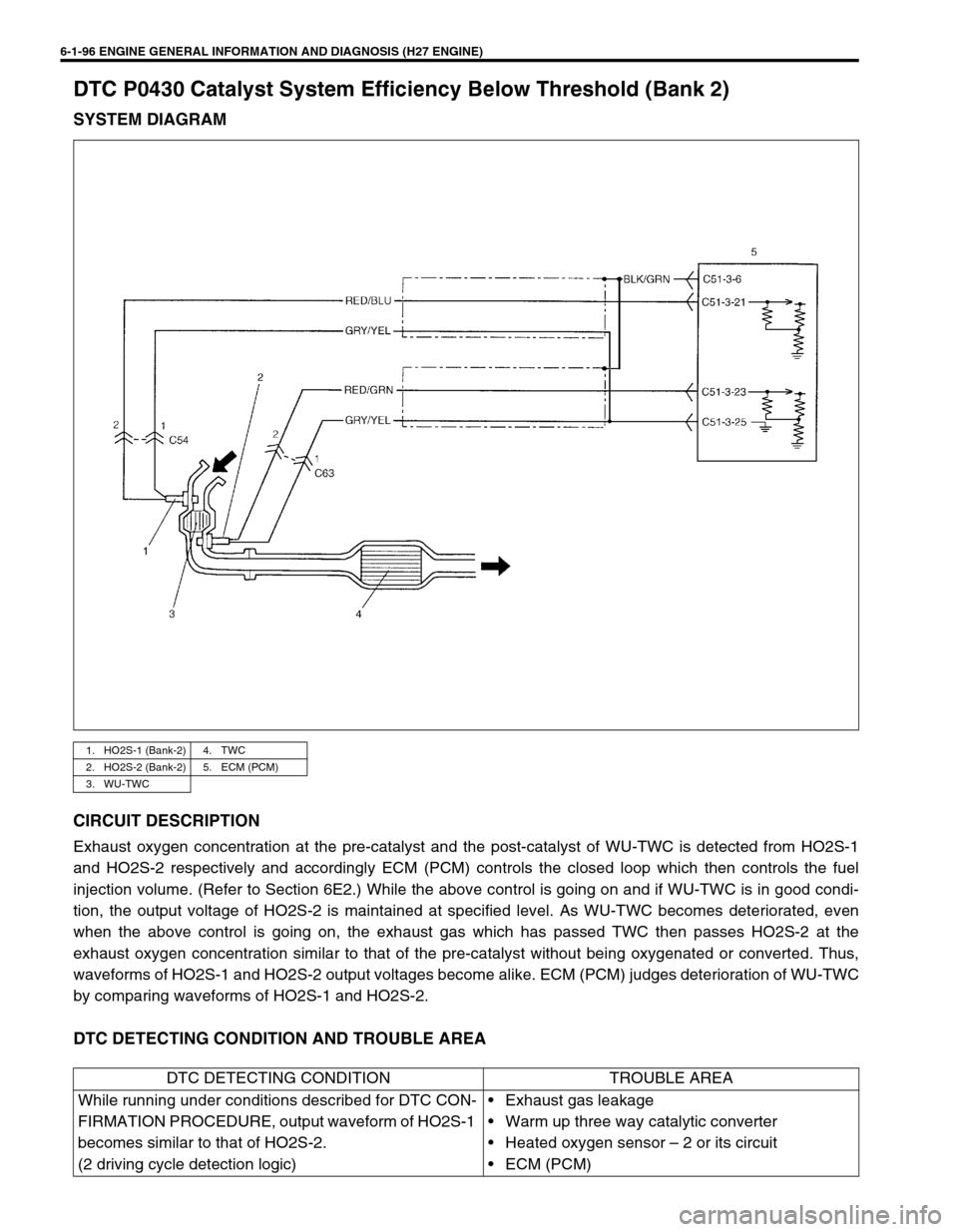
DTC P0430 Catalyst System Efficiency Below Threshold (Bank 2)
SYSTEM DIAGRAM
CIRCUIT DESCRIPTION
Exhaust oxygen concentration at the pre-catalyst and the post-catalyst of WU-TWC is detected from HO2S-1
and HO2S-2 respectively and accordingly ECM (PCM) controls the closed loop which then controls the fuel
injection volume. (Refer to Section 6E2.) While the above control is going on and if WU-TWC is in good condi-
tion, the output voltage of HO2S-2 is maintained at specified level. As WU-TWC becomes deteriorated, even
when the above control is going on, the exhaust gas which has passed TWC then passes HO2S-2 at the
exhaust oxygen concentration similar to that of the pre-catalyst without being oxygenated or converted. Thus,
waveforms of HO2S-1 and HO2S-2 output voltages become alike. ECM (PCM) judges deterioration of WU-TWC
by comparing waveforms of HO2S-1 and HO2S-2.
DTC DETECTING CONDITION AND TROUBLE AREA
1. HO2S-1 (Bank-2) 4. TWC
2. HO2S-2 (Bank-2) 5. ECM (PCM)
3. WU-TWC
DTC DETECTING CONDITION TROUBLE AREA
While running under conditions described for DTC CON-
FIRMATION PROCEDURE, output waveform of HO2S-1
becomes similar to that of HO2S-2.
(2 driving cycle detection logic)• Exhaust gas leakage
• Warm up three way catalytic converter
• Heated oxygen sensor – 2 or its circuit
•ECM (PCM)
Page 273 of 656
6-1-112 ENGINE GENERAL INFORMATION AND DIAGNOSIS (H27 ENGINE)
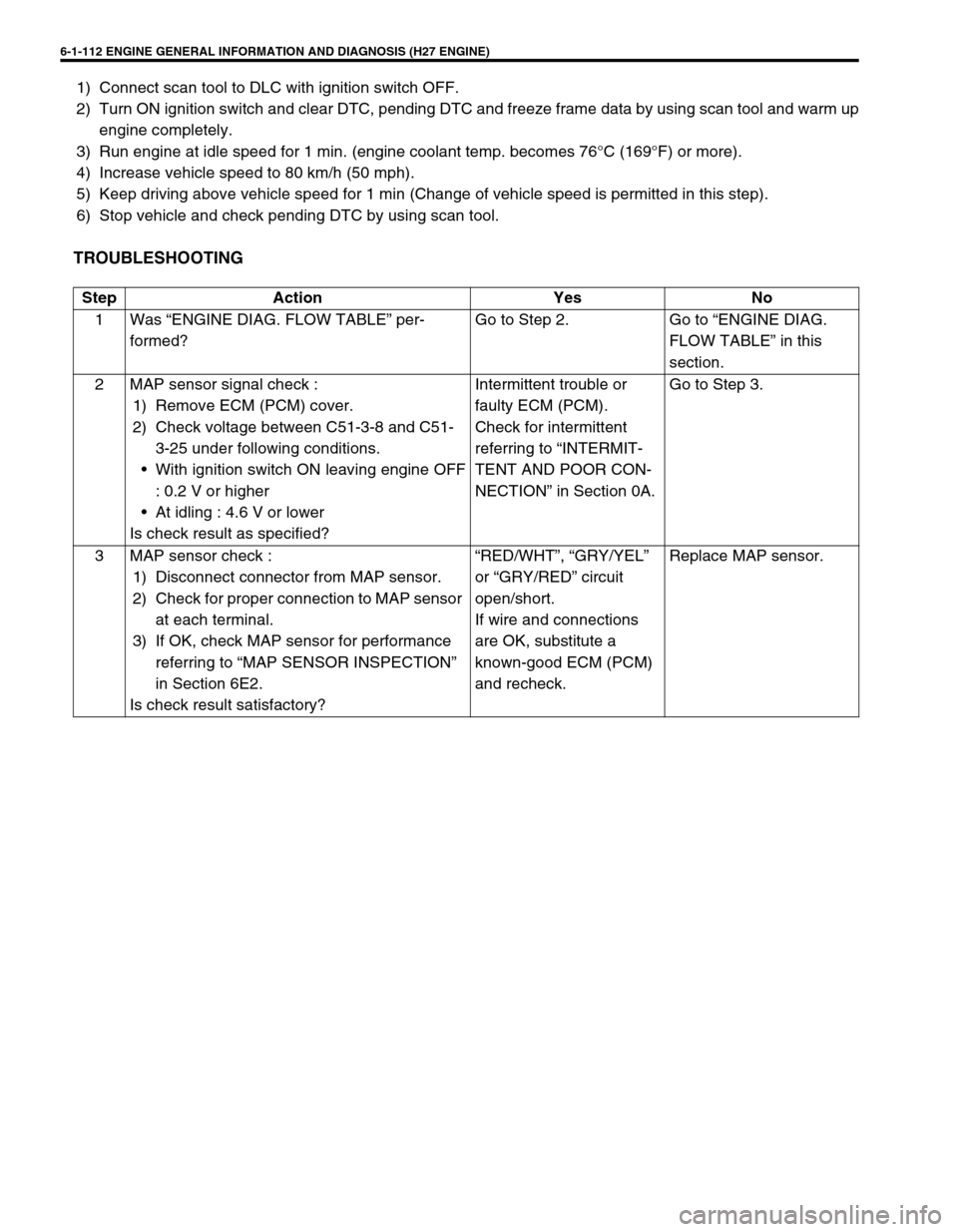
1) Connect scan tool to DLC with ignition switch OFF.
2) Turn ON ignition switch and clear DTC, pending DTC and freeze frame data by using scan tool and warm up
engine completely.
3) Run engine at idle speed for 1 min. (engine coolant temp. becomes 76°C (169°F) or more).
4) Increase vehicle speed to 80 km/h (50 mph).
5) Keep driving above vehicle speed for 1 min (Change of vehicle speed is permitted in this step).
6) Stop vehicle and check pending DTC by using scan tool.
TROUBLESHOOTING
Step Action Yes No
1Was “ENGINE DIAG. FLOW TABLE” per-
formed?Go to Step 2. Go to “ENGINE DIAG.
FLOW TABLE” in this
section.
2 MAP sensor signal check :
1) Remove ECM (PCM) cover.
2) Check voltage between C51-3-8 and C51-
3-25 under following conditions.
•With ignition switch ON leaving engine OFF
: 0.2 V or higher
•At idling : 4.6 V or lower
Is check result as specified?Intermittent trouble or
faulty ECM (PCM).
Check for intermittent
referring to “INTERMIT-
TENT AND POOR CON-
NECTION” in Section 0A.Go to Step 3.
3 MAP sensor check :
1) Disconnect connector from MAP sensor.
2) Check for proper connection to MAP sensor
at each terminal.
3) If OK, check MAP sensor for performance
referring to “MAP SENSOR INSPECTION”
in Section 6E2.
Is check result satisfactory?“RED/WHT”, “GRY/YEL”
or “GRY/RED” circuit
open/short.
If wire and connections
are OK, substitute a
known-good ECM (PCM)
and recheck.Replace MAP sensor.
Page 274 of 656
ENGINE GENERAL INFORMATION AND DIAGNOSIS (H27 ENGINE) 6-1-113
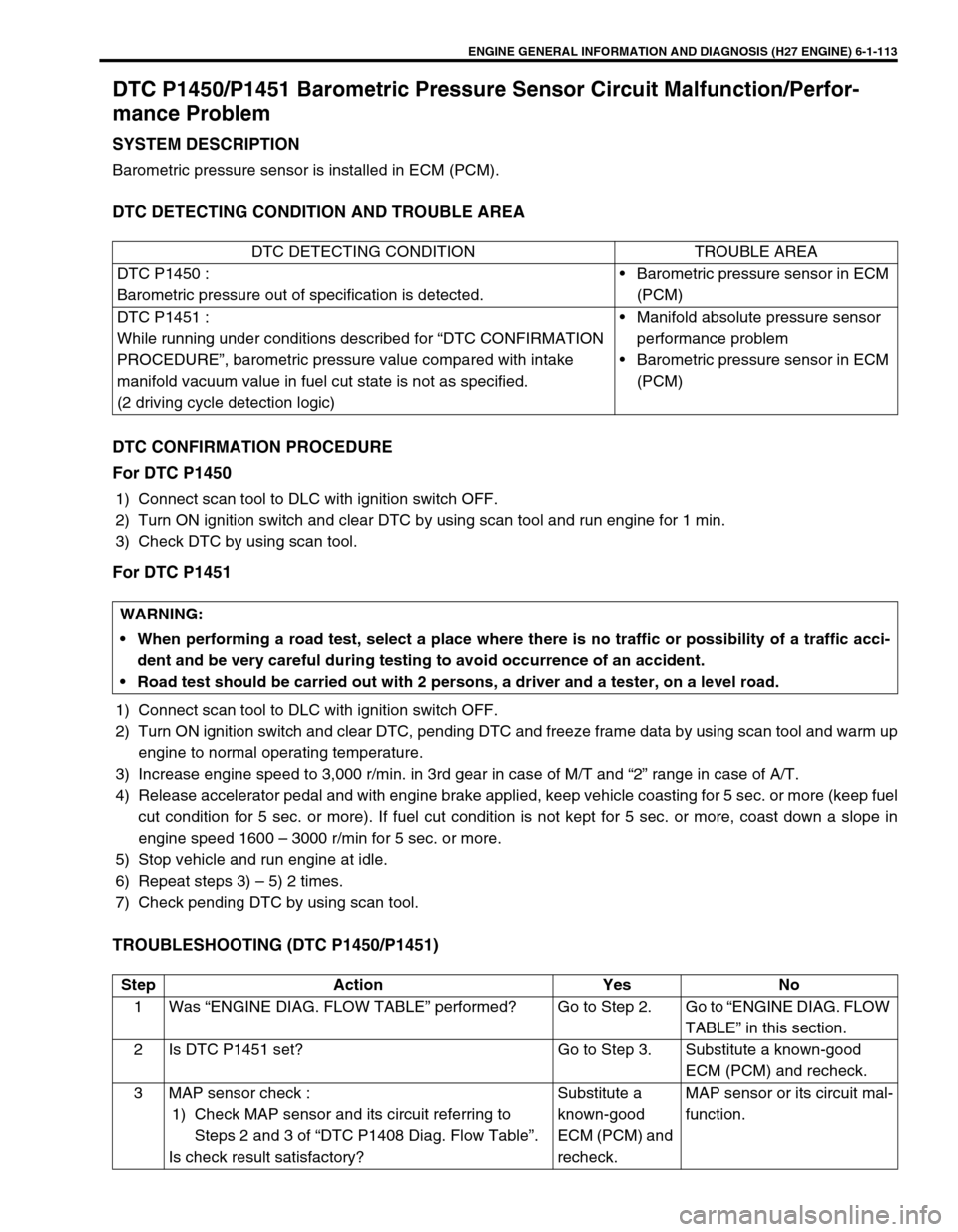
DTC P1450/P1451 Barometric Pressure Sensor Circuit Malfunction/Perfor-
mance Problem
SYSTEM DESCRIPTION
Barometric pressure sensor is installed in ECM (PCM).
DTC DETECTING CONDITION AND TROUBLE AREA
DTC CONFIRMATION PROCEDURE
For DTC P1450
1) Connect scan tool to DLC with ignition switch OFF.
2) Turn ON ignition switch and clear DTC by using scan tool and run engine for 1 min.
3) Check DTC by using scan tool.
For DTC P1451
1) Connect scan tool to DLC with ignition switch OFF.
2) Turn ON ignition switch and clear DTC, pending DTC and freeze frame data by using scan tool and warm up
engine to normal operating temperature.
3) Increase engine speed to 3,000 r/min. in 3rd gear in case of M/T and “2” range in case of A/T.
4) Release accelerator pedal and with engine brake applied, keep vehicle coasting for 5 sec. or more (keep fuel
cut condition for 5 sec. or more). If fuel cut condition is not kept for 5 sec. or more, coast down a slope in
engine speed 1600 – 3000 r/min for 5 sec. or more.
5) Stop vehicle and run engine at idle.
6) Repeat steps 3) – 5) 2 times.
7) Check pending DTC by using scan tool.
TROUBLESHOOTING (DTC P1450/P1451)
DTC DETECTING CONDITION TROUBLE AREA
DTC P1450 :
Barometric pressure out of specification is detected.•Barometric pressure sensor in ECM
(PCM)
DTC P1451 :
While running under conditions described for “DTC CONFIRMATION
PROCEDURE”, barometric pressure value compared with intake
manifold vacuum value in fuel cut state is not as specified.
(2 driving cycle detection logic)•Manifold absolute pressure sensor
performance problem
•Barometric pressure sensor in ECM
(PCM)
WARNING:
When performing a road test, select a place where there is no traffic or possibility of a traffic acci-
dent and be very careful during testing to avoid occurrence of an accident.
Road test should be carried out with 2 persons, a driver and a tester, on a level road.
Step Action Yes No
1Was “ENGINE DIAG. FLOW TABLE” performed? Go to Step 2. Go to “ENGINE DIAG. FLOW
TABLE” in this section.
2 Is DTC P1451 set? Go to Step 3. Substitute a known-good
ECM (PCM) and recheck.
3 MAP sensor check :
1) Check MAP sensor and its circuit referring to
Steps 2 and 3 of “DTC P1408 Diag. Flow Table”.
Is check result satisfactory?Substitute a
known-good
ECM (PCM) and
recheck.MAP sensor or its circuit mal-
function.
Page 275 of 656
6-1-114 ENGINE GENERAL INFORMATION AND DIAGNOSIS (H27 ENGINE)
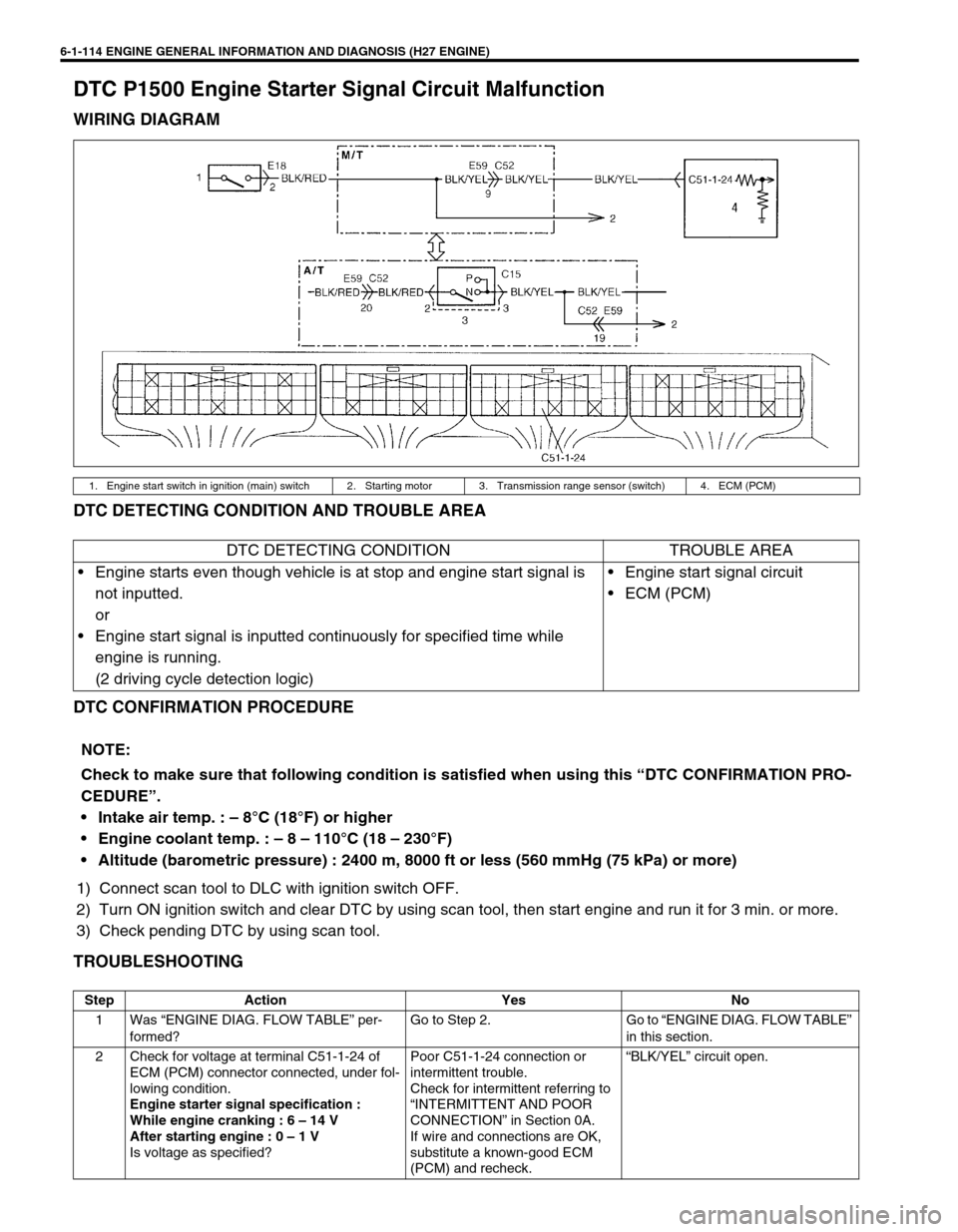
DTC P1500 Engine Starter Signal Circuit Malfunction
WIRING DIAGRAM
DTC DETECTING CONDITION AND TROUBLE AREA
DTC CONFIRMATION PROCEDURE
1) Connect scan tool to DLC with ignition switch OFF.
2) Turn ON ignition switch and clear DTC by using scan tool, then start engine and run it for 3 min. or more.
3) Check pending DTC by using scan tool.
TROUBLESHOOTING
1. Engine start switch in ignition (main) switch 2. Starting motor 3. Transmission range sensor (switch) 4. ECM (PCM)
DTC DETECTING CONDITION TROUBLE AREA
•Engine starts even though vehicle is at stop and engine start signal is
not inputted.
or
•Engine start signal is inputted continuously for specified time while
engine is running.
(2 driving cycle detection logic)•Engine start signal circuit
•ECM (PCM)
NOTE:
Check to make sure that following condition is satisfied when using this “DTC CONFIRMATION PRO-
CEDURE”.
Intake air temp. : – 8°C (18°F) or higher
Engine coolant temp. : – 8 – 110°C (18 – 230°F)
Altitude (barometric pressure) : 2400 m, 8000 ft or less (560 mmHg (75 kPa) or more)
Step Action Yes No
1Was “ENGINE DIAG. FLOW TABLE” per-
formed?Go to Step 2. Go to “ENGINE DIAG. FLOW TABLE”
in this section.
2 Check for voltage at terminal C51-1-24 of
ECM (PCM) connector connected, under fol-
lowing condition.
Engine starter signal specification :
While engine cranking : 6 – 14 V
After starting engine : 0 – 1 V
Is voltage as specified?Poor C51-1-24 connection or
intermittent trouble.
Check for intermittent referring to
“INTERMITTENT AND POOR
CONNECTION” in Section 0A.
If wire and connections are OK,
substitute a known-good ECM
(PCM) and recheck.“BLK/YEL” circuit open.
Page 285 of 656
6-1-124 ENGINE GENERAL INFORMATION AND DIAGNOSIS (H27 ENGINE)
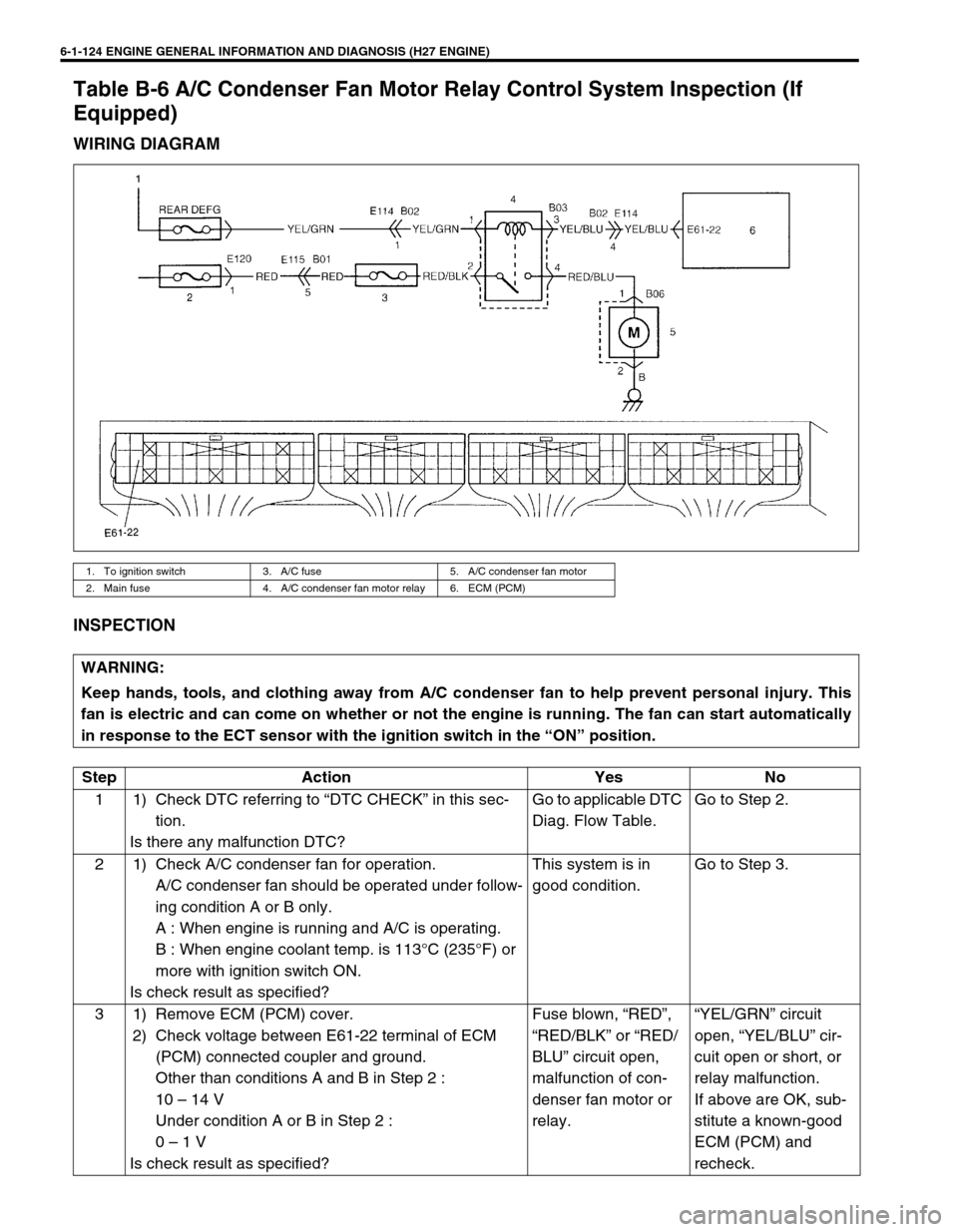
Table B-6 A/C Condenser Fan Motor Relay Control System Inspection (If
Equipped)
WIRING DIAGRAM
INSPECTION
1. To ignition switch 3. A/C fuse 5. A/C condenser fan motor
2. Main fuse 4. A/C condenser fan motor relay 6. ECM (PCM)
WARNING:
Keep hands, tools, and clothing away from A/C condenser fan to help prevent personal injury. This
fan is electric and can come on whether or not the engine is running. The fan can start automatically
in response to the ECT sensor with the ignition switch in the “ON” position.
Step Action Yes No
1 1) Check DTC referring to “DTC CHECK” in this sec-
tion.
Is there any malfunction DTC?Go to applicable DTC
Diag. Flow Table.Go to Step 2.
2 1) Check A/C condenser fan for operation.
A/C condenser fan should be operated under follow-
ing condition A or B only.
A : When engine is running and A/C is operating.
B : When engine coolant temp. is 113°C (235°F) or
more with ignition switch ON.
Is check result as specified?This system is in
good condition.Go to Step 3.
3 1) Remove ECM (PCM) cover.
2) Check voltage between E61-22 terminal of ECM
(PCM) connected coupler and ground.
Other than conditions A and B in Step 2 :
10 – 14 V
Under condition A or B in Step 2 :
0 – 1 V
Is check result as specified?Fuse blown, “RED”,
“RED/BLK” or “RED/
BLU” circuit open,
malfunction of con-
denser fan motor or
relay.“YEL/GRN” circuit
open, “YEL/BLU” cir-
cuit open or short, or
relay malfunction.
If above are OK, sub-
stitute a known-good
ECM (PCM) and
recheck.
Page 288 of 656
ENGINE MECHANICAL (H27 ENGINE) 6A2-1
6A2
SECTION 6A2
ENGINE MECHANICAL (H27 ENGINE)
CONTENTS
On-Vehicle Service........................................6A2-2
Throttle Body and Intake Manifold .............. 6A2-2
Exhaust Manifold ......................................... 6A2-9
LH (No.1) Bank 2nd Timing Chain
and Chain Tensioner ................................. 6A2-13
Camshaft and Valve Lash Adjuster ........... 6A2-14
Valves and Cylinder Heads ....................... 6A2-17
Piston, Piston Rings, Connecting Rodsand Cylinders ............................................ 6A2-21
Unit Repair Overhaul .................................. 6A2-26
Engine Assembly ...................................... 6A2-26
Main Bearings, Crankshaft
and Cylinder Block .................................... 6A2-30
Special Tool ................................................. 6A2-36
WARNING:
For vehicles equipped with Supplemental Restraint (Air Bag) System:
Service on and around the air bag system components or wiring must be performed only by an
authorized SUZUKI dealer. Refer to “Air Bag System Components and Wiring Location View” under
“General Description” in air bag system section in order to confirm whether you are performing ser-
vice on or near the air bag system components or wiring. Please observe all WARNINGS and “Ser-
vice Precautions” under “On-Vehicle Service” in air bag system section before performing service
on or around the air bag system components or wiring. Failure to follow WARNINGS could result in
unintentional activation of the system or could render the system inoperative. Either of these two
conditions may result in severe injury.
Technical service work must be started at least 90 seconds after the ignition switch is turned to the
“LOCK” position and the negative cable is disconnected from the battery. Otherwise, the system
may be activated by reserve energy in the Sensing and Diagnostic Module (SDM).
NOTE:
For the descriptions (items) not found in this section, refer to the same section of service manual
mentioned in the FOREWORD of this manual.
Whether following systems (parts) are used in the particular vehicle or not depends on specifica-
tions. Be sure to bear this in mind when performing service work.
–EGR valve
–Warm up three way catalytic converter
–Heated oxygen sensor(s)
–Three way catalytic converter
–CKP sensor
–MAP sensor
Page 290 of 656
ENGINE MECHANICAL (H27 ENGINE) 6A2-3
REMOVAL
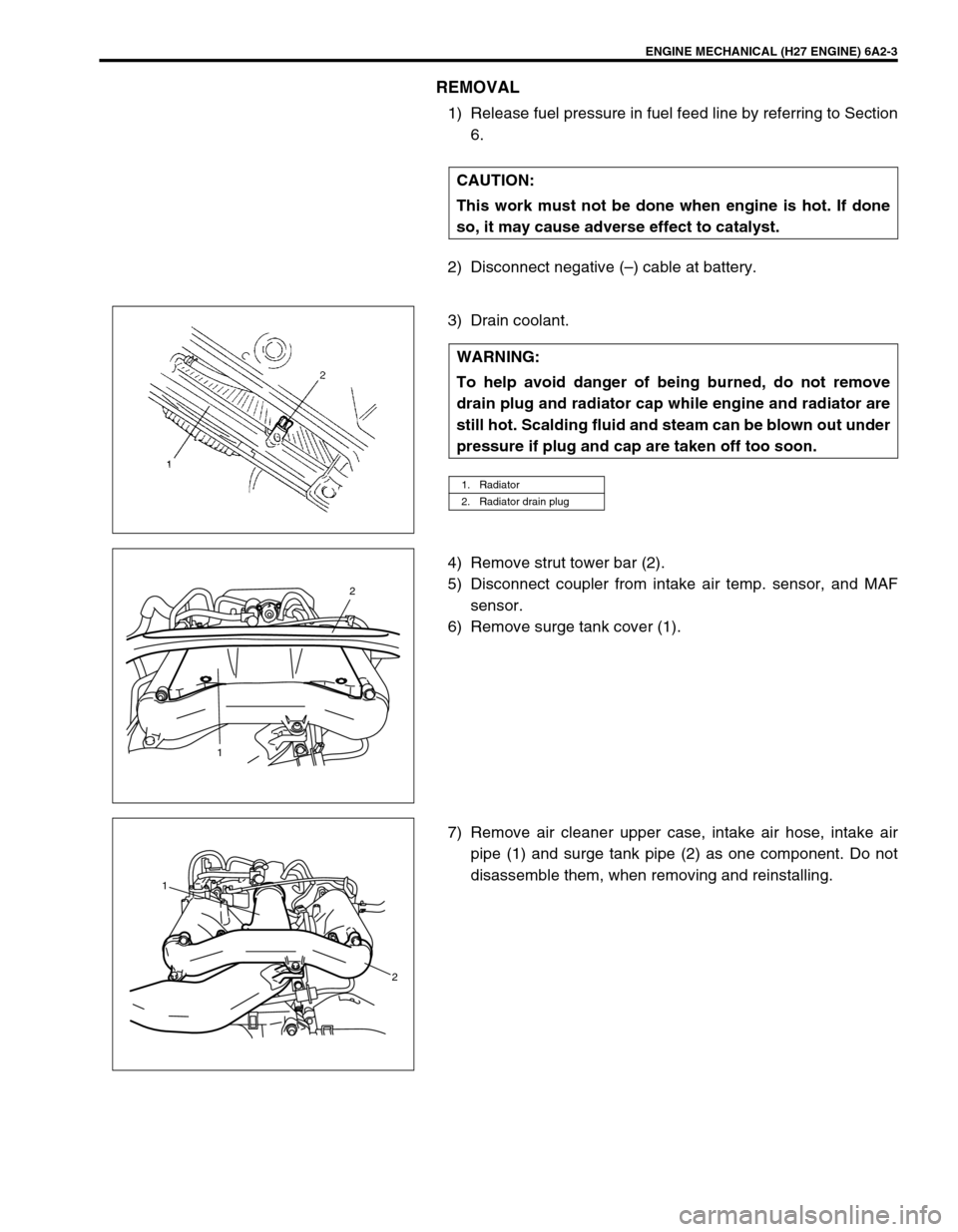
1) Release fuel pressure in fuel feed line by referring to Section
6.
2) Disconnect negative (–) cable at battery.
3) Drain coolant.
4) Remove strut tower bar (2).
5) Disconnect coupler from intake air temp. sensor, and MAF
sensor.
6) Remove surge tank cover (1).
7) Remove air cleaner upper case, intake air hose, intake air
pipe (1) and surge tank pipe (2) as one component. Do not
disassemble them, when removing and reinstalling. CAUTION:
This work must not be done when engine is hot. If done
so, it may cause adverse effect to catalyst.
WARNING:
To help avoid danger of being burned, do not remove
drain plug and radiator cap while engine and radiator are
still hot. Scalding fluid and steam can be blown out under
pressure if plug and cap are taken off too soon.
1. Radiator
2. Radiator drain plug
2
1
1
2
Page 315 of 656
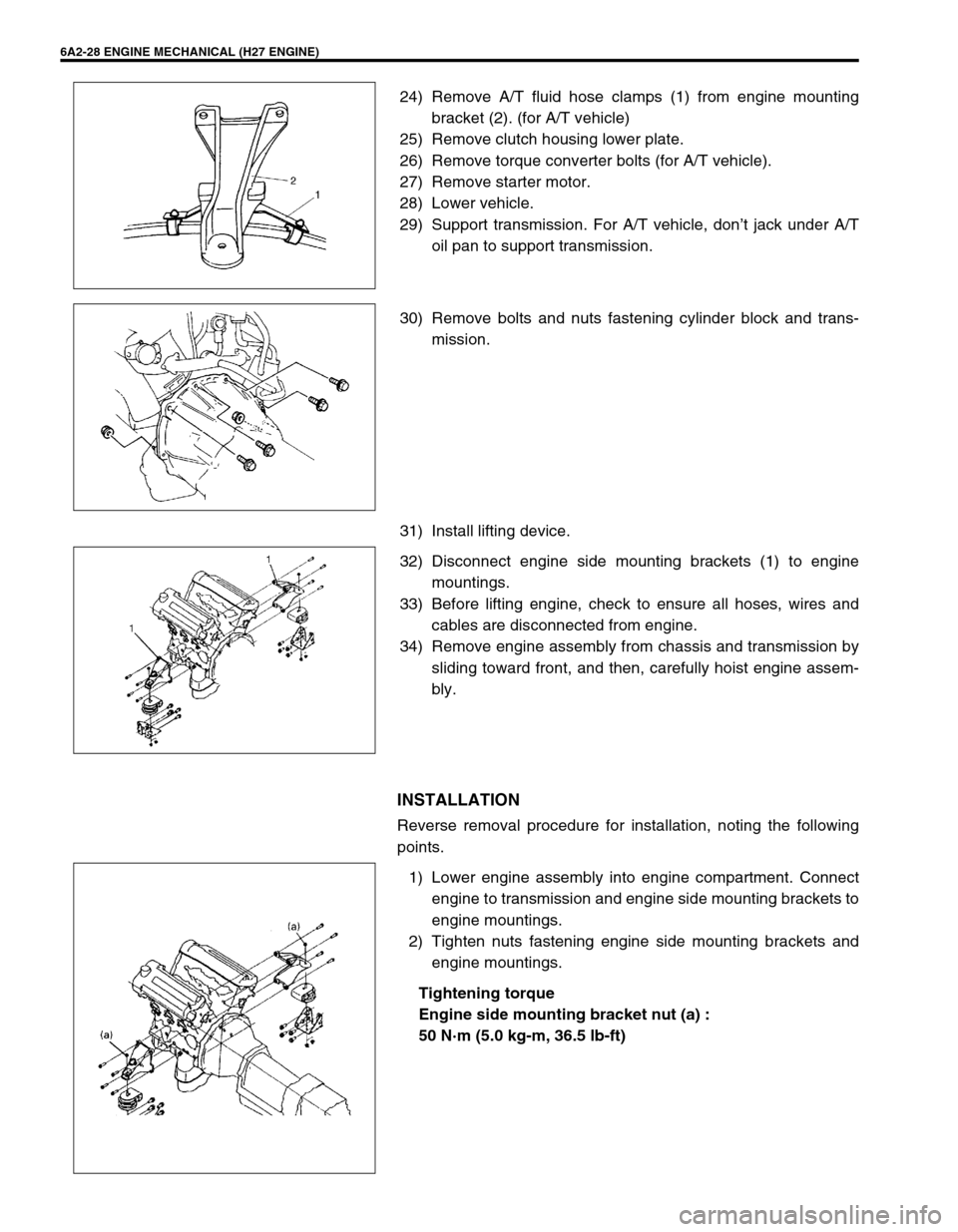
6A2-28 ENGINE MECHANICAL (H27 ENGINE)
24) Remove A/T fluid hose clamps (1) from engine mounting
bracket (2). (for A/T vehicle)
25) Remove clutch housing lower plate.
26) Remove torque converter bolts (for A/T vehicle).
27) Remove starter motor.
28) Lower vehicle.
29) Support transmission. For A/T vehicle, don’t jack under A/T
oil pan to support transmission.
30) Remove bolts and nuts fastening cylinder block and trans-
mission.
31) Install lifting device.
32) Disconnect engine side mounting brackets (1) to engine
mountings.
33) Before lifting engine, check to ensure all hoses, wires and
cables are disconnected from engine.
34) Remove engine assembly from chassis and transmission by
sliding toward front, and then, carefully hoist engine assem-
bly.
INSTALLATION
Reverse removal procedure for installation, noting the following
points.
1) Lower engine assembly into engine compartment. Connect
engine to transmission and engine side mounting brackets to
engine mountings.
2) Tighten nuts fastening engine side mounting brackets and
engine mountings.
Tightening torque
Engine side mounting bracket nut (a) :
50 N·m (5.0 kg-m, 36.5 lb-ft)
Page 318 of 656
ENGINE MECHANICAL (H27 ENGINE) 6A2-31
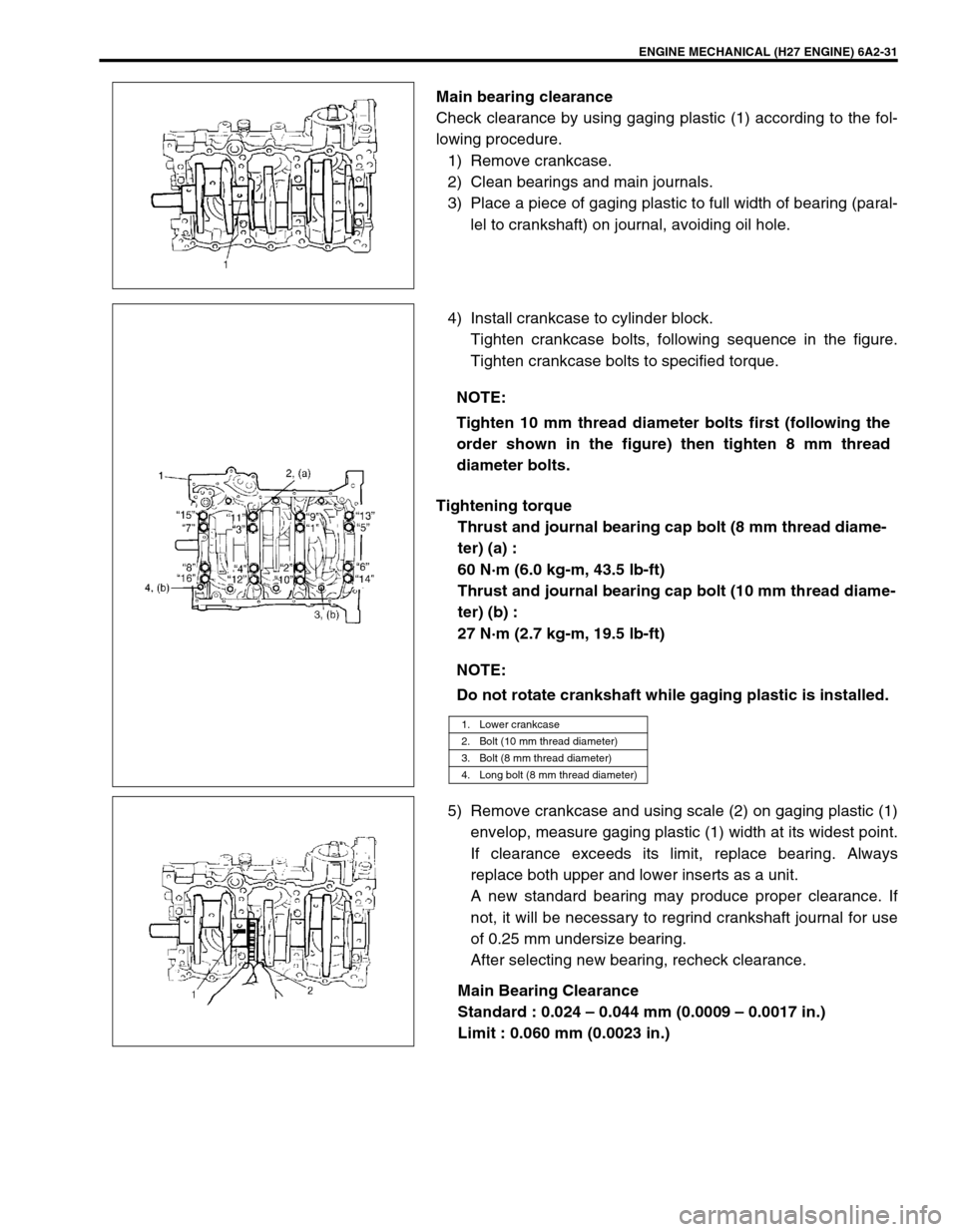
Main bearing clearance
Check clearance by using gaging plastic (1) according to the fol-
lowing procedure.
1) Remove crankcase.
2) Clean bearings and main journals.
3) Place a piece of gaging plastic to full width of bearing (paral-
lel to crankshaft) on journal, avoiding oil hole.
4) Install crankcase to cylinder block.
Tighten crankcase bolts, following sequence in the figure.
Tighten crankcase bolts to specified torque.
Tightening torque
Thrust and journal bearing cap bolt (8 mm thread diame-
ter) (a) :
60 N·m (6.0 kg-m, 43.5 lb-ft)
Thrust and journal bearing cap bolt (10 mm thread diame-
ter) (b) :
27 N·m (2.7 kg-m, 19.5 lb-ft)
5) Remove crankcase and using scale (2) on gaging plastic (1)
envelop, measure gaging plastic (1) width at its widest point.
If clearance exceeds its limit, replace bearing. Always
replace both upper and lower inserts as a unit.
A new standard bearing may produce proper clearance. If
not, it will be necessary to regrind crankshaft journal for use
of 0.25 mm undersize bearing.
After selecting new bearing, recheck clearance.
Main Bearing Clearance
Standard : 0.024 – 0.044 mm (0.0009 – 0.0017 in.)
Limit : 0.060 mm (0.0023 in.)
NOTE:
Tighten 10 mm thread diameter bolts first (following the
order shown in the figure) then tighten 8 mm thread
diameter bolts.
NOTE:
Do not rotate crankshaft while gaging plastic is installed.
1. Lower crankcase
2. Bolt (10 mm thread diameter)
3. Bolt (8 mm thread diameter)
4. Long bolt (8 mm thread diameter)