Under engine SUZUKI GRAND VITARA 2001 2.G User Guide
[x] Cancel search | Manufacturer: SUZUKI, Model Year: 2001, Model line: GRAND VITARA, Model: SUZUKI GRAND VITARA 2001 2.GPages: 656, PDF Size: 14.31 MB
Page 167 of 656
6-1-6 ENGINE GENERAL INFORMATION AND DIAGNOSIS (H27 ENGINE)
Engine Diagnosis
General Description
This vehicle is equipped with an engine and emission control system which are under control of ECM (PCM).
The engine and emission control system in this vehicle are controlled by ECM (PCM). ECM (PCM) has an On-
Board Diagnostic system which detects a malfunction in this system and abnormality of those parts that influ-
ence the engine exhaust emission. When diagnosing engine troubles, be sure to have full understanding of the
outline of “ON-BOARD DIAGNOSTIC SYSTEM” and each item in “PRECAUTION IN DIAGNOSING TROUBLE”
and execute diagnosis according to “ENGINE DIAGNOSTIC FLOW TABLE” in this section.
There is a close relationship between the engine mechanical, engine cooling system, ignition system, exhaust
system, etc. and the engine and emission control system in their structure and operation. In case of an engine
trouble, even when the malfunction indicator lamp (MIL) doesn’t turn ON, it should be diagnosed according to
“ENGINE DIAGNOSTIC FLOW TABLE” in this section.
On-Board Diagnostic System (Vehicle without
Monitor Connector)
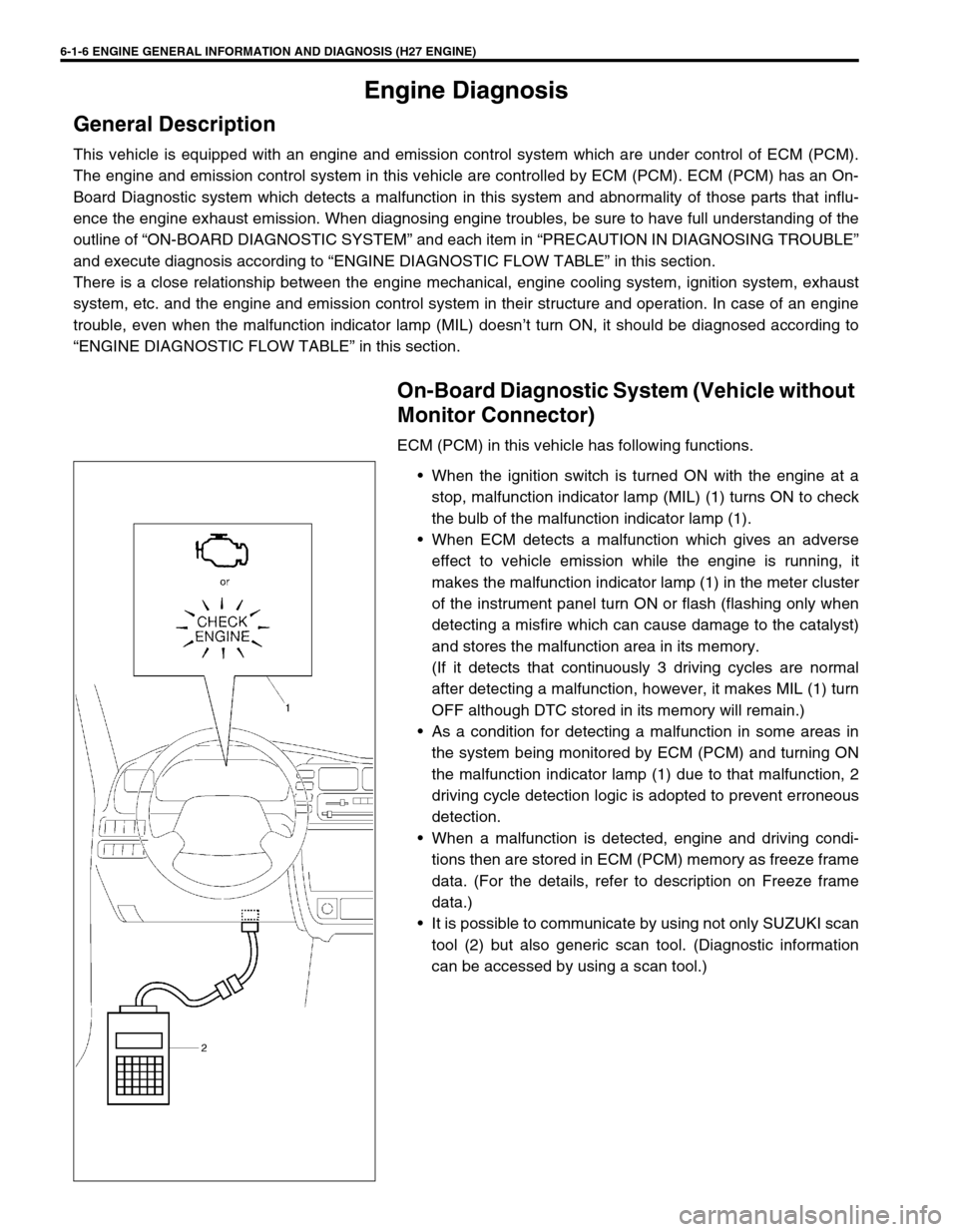
ECM (PCM) in this vehicle has following functions.
When the ignition switch is turned ON with the engine at a
stop, malfunction indicator lamp (MIL) (1) turns ON to check
the bulb of the malfunction indicator lamp (1).
When ECM detects a malfunction which gives an adverse
effect to vehicle emission while the engine is running, it
makes the malfunction indicator lamp (1) in the meter cluster
of the instrument panel turn ON or flash (flashing only when
detecting a misfire which can cause damage to the catalyst)
and stores the malfunction area in its memory.
(If it detects that continuously 3 driving cycles are normal
after detecting a malfunction, however, it makes MIL (1) turn
OFF although DTC stored in its memory will remain.)
As a condition for detecting a malfunction in some areas in
the system being monitored by ECM (PCM) and turning ON
the malfunction indicator lamp (1) due to that malfunction, 2
driving cycle detection logic is adopted to prevent erroneous
detection.
When a malfunction is detected, engine and driving condi-
tions then are stored in ECM (PCM) memory as freeze frame
data. (For the details, refer to description on Freeze frame
data.)
It is possible to communicate by using not only SUZUKI scan
tool (2) but also generic scan tool. (Diagnostic information
can be accessed by using a scan tool.)
Page 171 of 656
6-1-10 ENGINE GENERAL INFORMATION AND DIAGNOSIS (H27 ENGINE)
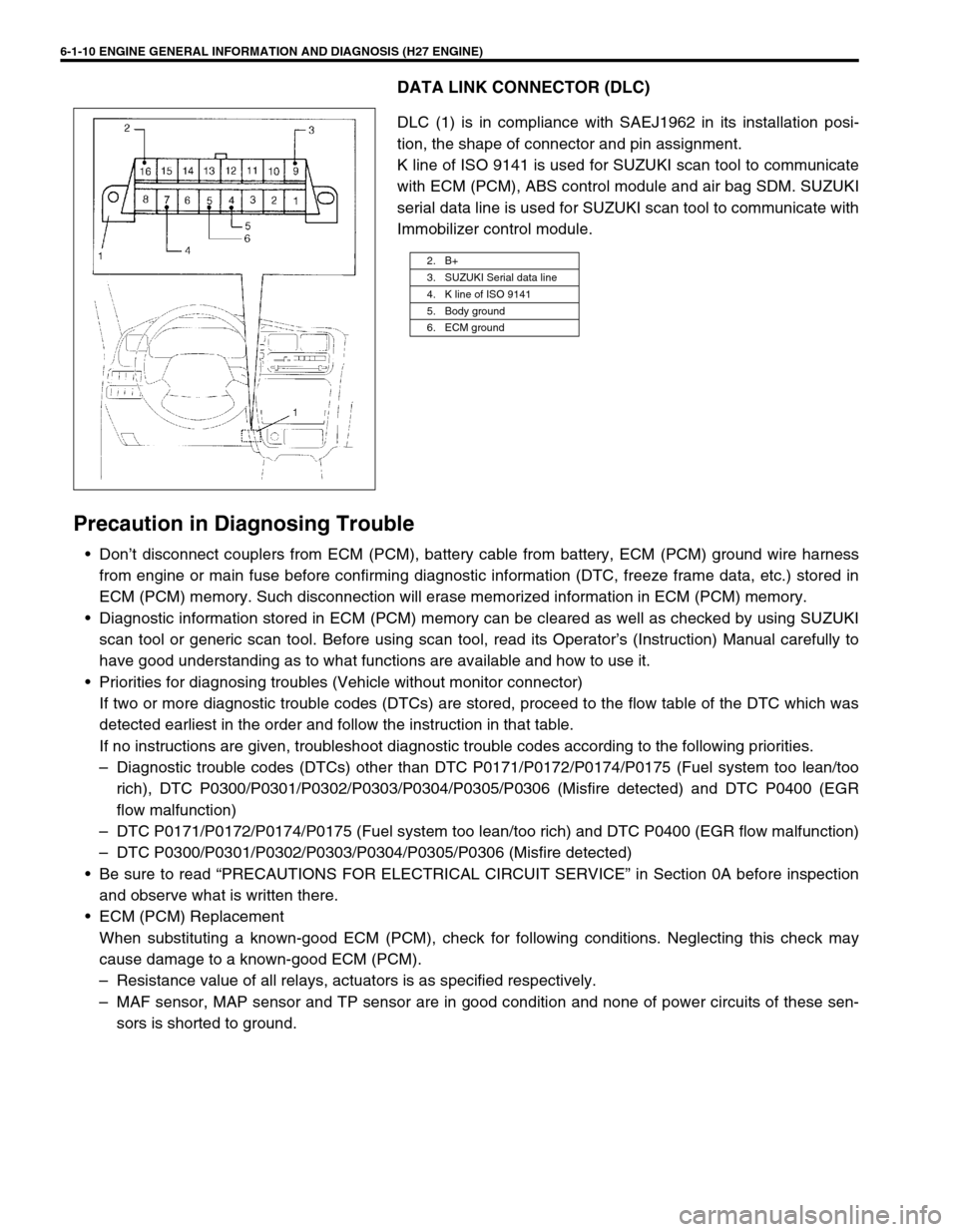
DATA LINK CONNECTOR (DLC)
DLC (1) is in compliance with SAEJ1962 in its installation posi-
tion, the shape of connector and pin assignment.
K line of ISO 9141 is used for SUZUKI scan tool to communicate
with ECM (PCM), ABS control module and air bag SDM. SUZUKI
serial data line is used for SUZUKI scan tool to communicate with
Immobilizer control module.
Precaution in Diagnosing Trouble
• Don’t disconnect couplers from ECM (PCM), battery cable from battery, ECM (PCM) ground wire harness
from engine or main fuse before confirming diagnostic information (DTC, freeze frame data, etc.) stored in
ECM (PCM) memory. Such disconnection will erase memorized information in ECM (PCM) memory.
• Diagnostic information stored in ECM (PCM) memory can be cleared as well as checked by using SUZUKI
scan tool or generic scan tool. Before using scan tool, read its Operator’s (Instruction) Manual carefully to
have good understanding as to what functions are available and how to use it.
• Priorities for diagnosing troubles (Vehicle without monitor connector)
If two or more diagnostic trouble codes (DTCs) are stored, proceed to the flow table of the DTC which was
detected earliest in the order and follow the instruction in that table.
If no instructions are given, troubleshoot diagnostic trouble codes according to the following priorities.
– Diagnostic trouble codes (DTCs) other than DTC P0171/P0172/P0174/P0175 (Fuel system too lean/too
rich), DTC P0300/P0301/P0302/P0303/P0304/P0305/P0306 (Misfire detected) and DTC P0400 (EGR
flow malfunction)
– DTC P0171/P0172/P0174/P0175 (Fuel system too lean/too rich) and DTC P0400 (EGR flow malfunction)
– DTC P0300/P0301/P0302/P0303/P0304/P0305/P0306 (Misfire detected)
• Be sure to read “PRECAUTIONS FOR ELECTRICAL CIRCUIT SERVICE” in Section 0A before inspection
and observe what is written there.
• ECM (PCM) Replacement
When substituting a known-good ECM (PCM), check for following conditions. Neglecting this check may
cause damage to a known-good ECM (PCM).
– Resistance value of all relays, actuators is as specified respectively.
– MAF sensor, MAP sensor and TP sensor are in good condition and none of power circuits of these sen-
sors is shorted to ground.
2. B+
3. SUZUKI Serial data line
4. K line of ISO 9141
5. Body ground
6. ECM ground
Page 177 of 656
6-1-16 ENGINE GENERAL INFORMATION AND DIAGNOSIS (H27 ENGINE)
Malfunction Indicator Lamp (MIL) Check
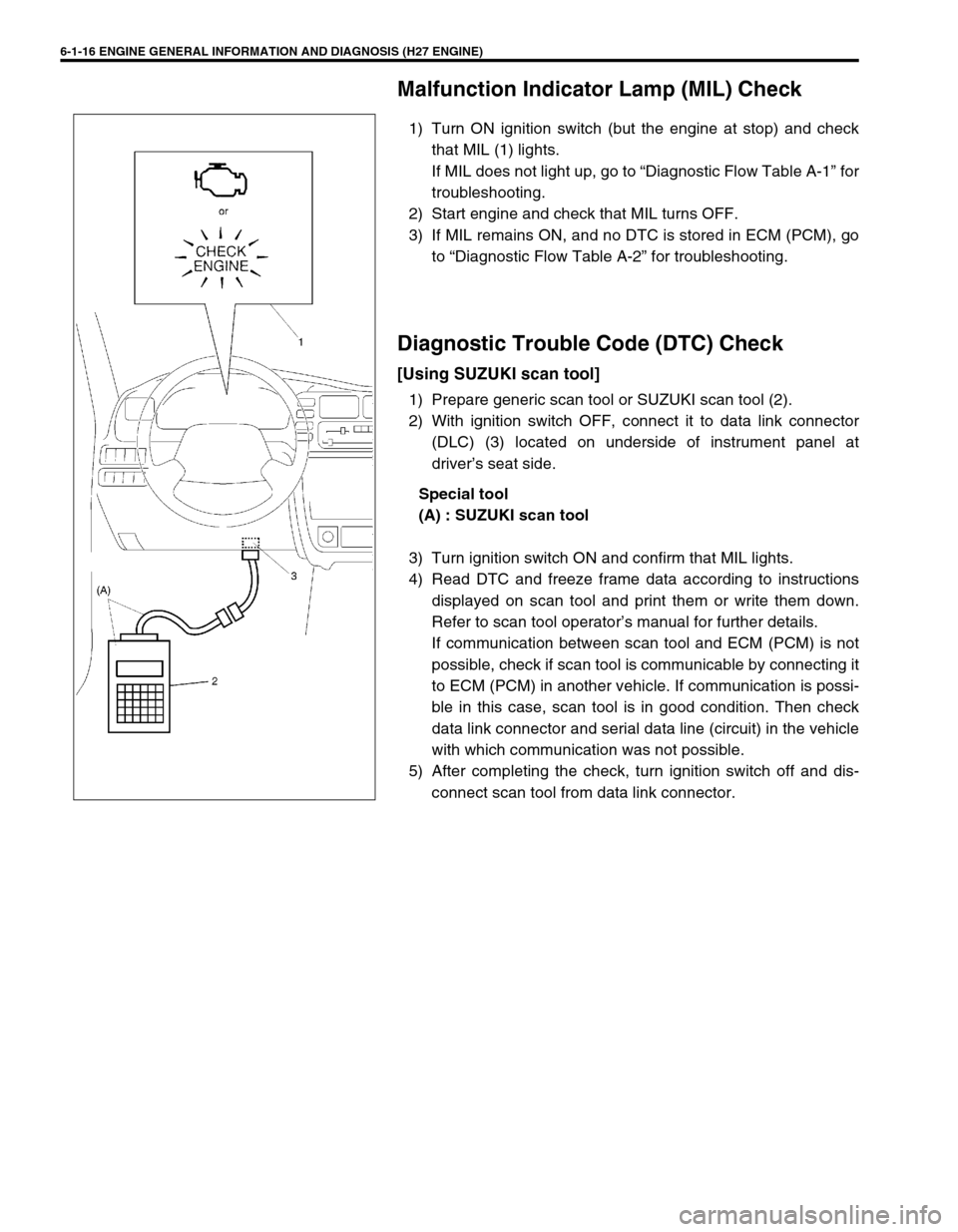
1) Turn ON ignition switch (but the engine at stop) and check
that MIL (1) lights.
If MIL does not light up, go to “Diagnostic Flow Table A-1” for
troubleshooting.
2) Start engine and check that MIL turns OFF.
3) If MIL remains ON, and no DTC is stored in ECM (PCM), go
to “Diagnostic Flow Table A-2” for troubleshooting.
Diagnostic Trouble Code (DTC) Check
[Using SUZUKI scan tool]
1) Prepare generic scan tool or SUZUKI scan tool (2).
2) With ignition switch OFF, connect it to data link connector
(DLC) (3) located on underside of instrument panel at
driver’s seat side.
Special tool
(A) : SUZUKI scan tool
3) Turn ignition switch ON and confirm that MIL lights.
4) Read DTC and freeze frame data according to instructions
displayed on scan tool and print them or write them down.
Refer to scan tool operator’s manual for further details.
If communication between scan tool and ECM (PCM) is not
possible, check if scan tool is communicable by connecting it
to ECM (PCM) in another vehicle. If communication is possi-
ble in this case, scan tool is in good condition. Then check
data link connector and serial data line (circuit) in the vehicle
with which communication was not possible.
5) After completing the check, turn ignition switch off and dis-
connect scan tool from data link connector.
Page 179 of 656
![SUZUKI GRAND VITARA 2001 2.G User Guide 6-1-18 ENGINE GENERAL INFORMATION AND DIAGNOSIS (H27 ENGINE)
[Without using scan tool]
1) Turn the ignition switch OFF position.
2) Disconnect battery negative cable for specified time below to
erase](/img/20/7584/w960_7584-178.png "SUZUKI GRAND VITARA 2001 2.G User Guide 6-1-18 ENGINE GENERAL INFORMATION AND DIAGNOSIS (H27 ENGINE)
[Without using scan tool]
1) Turn the ignition switch OFF position.
2) Disconnect battery negative cable for specified time below to
erase")
6-1-18 ENGINE GENERAL INFORMATION AND DIAGNOSIS (H27 ENGINE)
[Without using scan tool]
1) Turn the ignition switch OFF position.
2) Disconnect battery negative cable for specified time below to
erase diagnostic trouble code stored in ECM memory and
reconnect it.
Time required to erase DTC:
Diagnostic Trouble Code (DTC) Table
Ambient
temperatureTime to cut power to ECM
Over 0°C (32°F) 30 sec. or longer
Under 0°C
(32°F)Not specifiable.
Select a place with higher than 0°C
(32°F) temperature.
DTC NO. DETECTED ITEMDETECTING CONDITION
(DTC will set when detecting : )MIL
(vehicle
without
monitor
connector)MIL
(vehicle
with
monitor
connector)
P0100
(No.34)
Mass air flow circuit malfunc-
tionSensor output too low
1 driving
cycle1 driving
cycle
P0100
(No.33)Sensor output too high
P0110
(No.25)
Intake air temp. circuit mal-
functionIntake air temp. circuit low input
1 driving
cycle1 driving
cycle
P0110
(No.23)Intake air temp. circuit high input
P0115
(No.15)
Engine coolant temp. circuit
malfunctionEngine coolant temp. circuit low input
1 driving
cycle1 driving
cycle
P0115
(No.14)Engine coolant temp. circuit high input
P0120
(No.22)
Throttle position circuit mal-
functionThrottle position circuit low input
1 driving
cycle1 driving
cycle
P0120
(No.21)Throttle position circuit high input
P0121Throttle position circuit perfor-
mance problemPoor performance of TP sensor2 driving
cyclesNot
applicable
*P0130HO2S circuit malfunction
(Bank 1 - Sensor 1)Min. output voltage of HO2S-1 is
higher than specification.
2 driving
cyclesNot
applicable Min. output voltage of HO2S-1 is
lower than specification.
Output voltage of HO2S-1 fails to go
above specification.
**P0130
(No.13)HO2S (Bank 1 - Sensor 1) no
activity detectedOutput voltage of HO2S-1 fails to go
above specification (or HO2S-1 cir-
cuit open).2 driving
cycles2 driving
cycles
Page 194 of 656
ENGINE GENERAL INFORMATION AND DIAGNOSIS (H27 ENGINE) 6-1-33
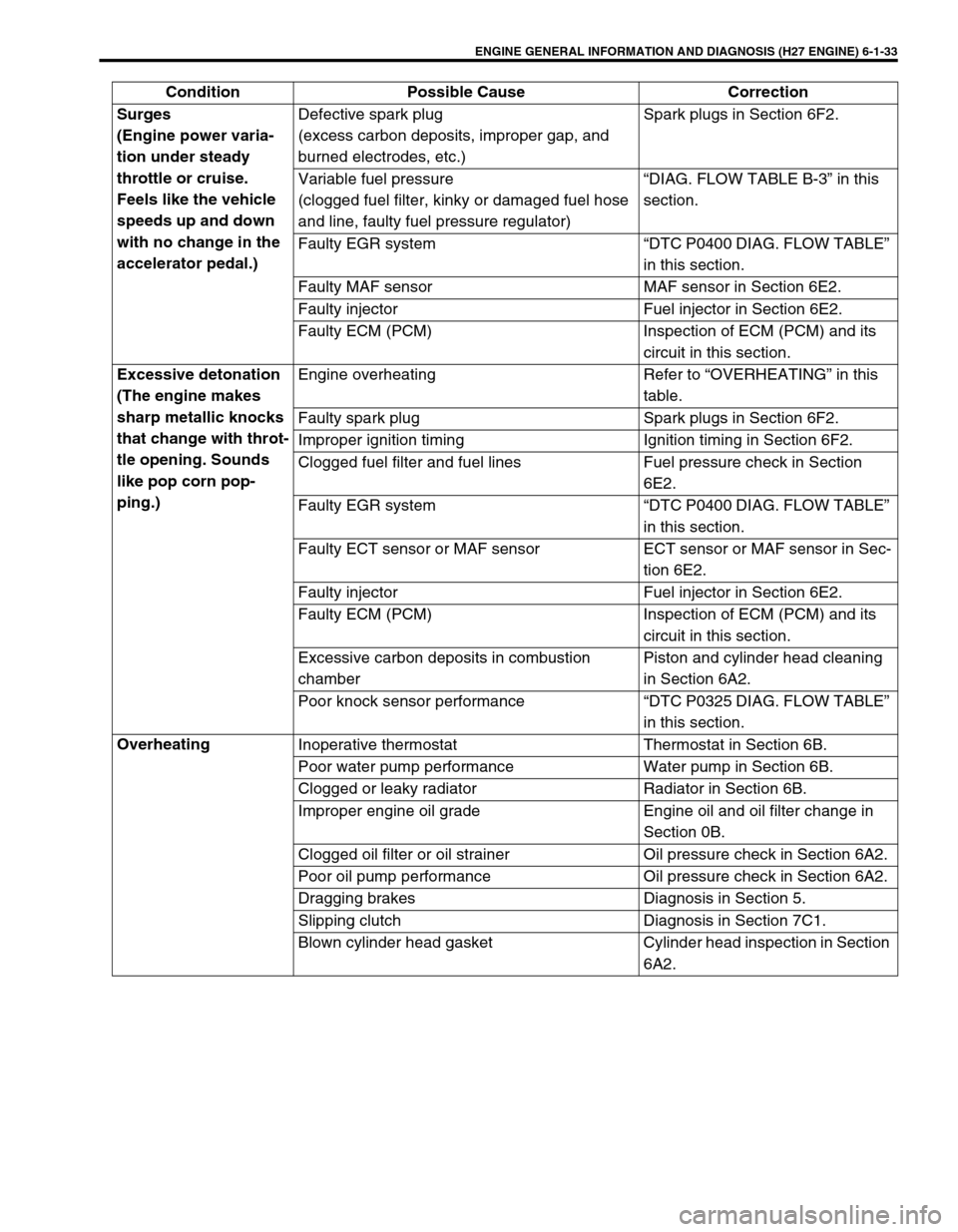
Surges
(Engine power varia-
tion under steady
throttle or cruise.
Feels like the vehicle
speeds up and down
with no change in the
accelerator pedal.)Defective spark plug
(excess carbon deposits, improper gap, and
burned electrodes, etc.)Spark plugs in Section 6F2.
Variable fuel pressure
(clogged fuel filter, kinky or damaged fuel hose
and line, faulty fuel pressure regulator)“DIAG. FLOW TABLE B-3” in this
section.
Faulty EGR system “DTC P0400 DIAG. FLOW TABLE”
in this section.
Faulty MAF sensor MAF sensor in Section 6E2.
Faulty injector Fuel injector in Section 6E2.
Faulty ECM (PCM) Inspection of ECM (PCM) and its
circuit in this section.
Excessive detonation
(The engine makes
sharp metallic knocks
that change with throt-
tle opening. Sounds
like pop corn pop-
ping.)Engine overheating Refer to “OVERHEATING” in this
table.
Faulty spark plug Spark plugs in Section 6F2.
Improper ignition timing Ignition timing in Section 6F2.
Clogged fuel filter and fuel lines Fuel pressure check in Section
6E2.
Faulty EGR system “DTC P0400 DIAG. FLOW TABLE”
in this section.
Faulty ECT sensor or MAF sensor ECT sensor or MAF sensor in Sec-
tion 6E2.
Faulty injector Fuel injector in Section 6E2.
Faulty ECM (PCM) Inspection of ECM (PCM) and its
circuit in this section.
Excessive carbon deposits in combustion
chamberPiston and cylinder head cleaning
in Section 6A2.
Poor knock sensor performance “DTC P0325 DIAG. FLOW TABLE”
in this section.
Overheating
Inoperative thermostat Thermostat in Section 6B.
Poor water pump performance Water pump in Section 6B.
Clogged or leaky radiator Radiator in Section 6B.
Improper engine oil grade Engine oil and oil filter change in
Section 0B.
Clogged oil filter or oil strainer Oil pressure check in Section 6A2.
Poor oil pump performance Oil pressure check in Section 6A2.
Dragging brakes Diagnosis in Section 5.
Slipping clutch Diagnosis in Section 7C1.
Blown cylinder head gasket Cylinder head inspection in Section
6A2. Condition Possible Cause Correction
Page 200 of 656
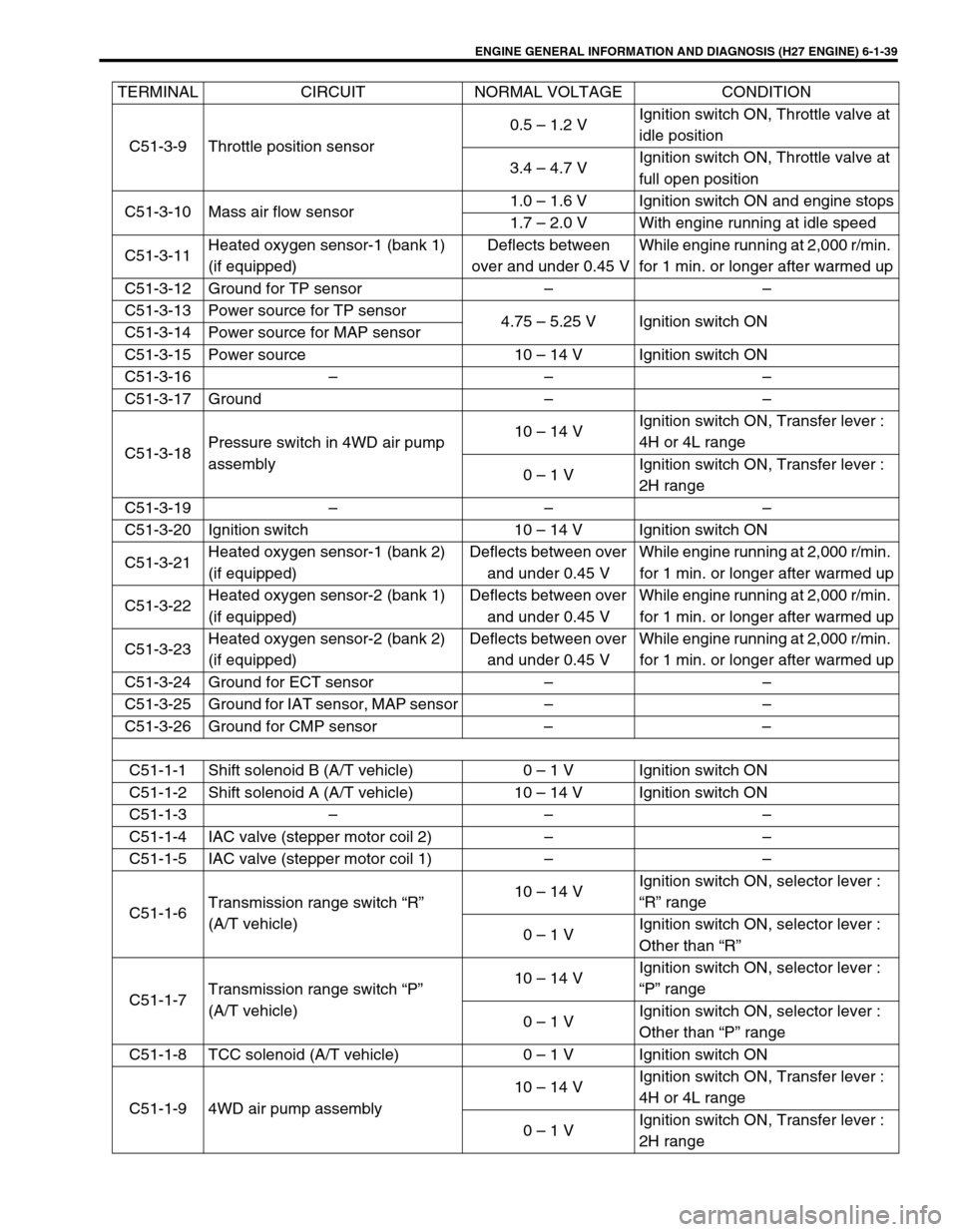
ENGINE GENERAL INFORMATION AND DIAGNOSIS (H27 ENGINE) 6-1-39
C51-3-9 Throttle position sensor0.5 – 1.2 VIgnition switch ON, Throttle valve at
idle position
3.4 – 4.7 VIgnition switch ON, Throttle valve at
full open position
C51-3-10 Mass air flow sensor1.0 – 1.6 V Ignition switch ON and engine stops
1.7 – 2.0 V With engine running at idle speed
C51-3-11Heated oxygen sensor-1 (bank 1)
(if equipped)Deflects between
over and under 0.45 VWhile engine running at 2,000 r/min.
for 1 min. or longer after warmed up
C51-3-12 Ground for TP sensor – –
C51-3-13 Power source for TP sensor
4.75 – 5.25 V Ignition switch ON
C51-3-14 Power source for MAP sensor
C51-3-15 Power source 10 – 14 V Ignition switch ON
C51-3-16 – – –
C51-3-17 Ground – –
C51-3-18Pressure switch in 4WD air pump
assembly10 – 14 VIgnition switch ON, Transfer lever :
4H or 4L range
0 – 1 VIgnition switch ON, Transfer lever :
2H range
C51-3-19 – – –
C51-3-20 Ignition switch 10 – 14 V Ignition switch ON
C51-3-21Heated oxygen sensor-1 (bank 2)
(if equipped)Deflects between over
and under 0.45 VWhile engine running at 2,000 r/min.
for 1 min. or longer after warmed up
C51-3-22Heated oxygen sensor-2 (bank 1)
(if equipped)Deflects between over
and under 0.45 VWhile engine running at 2,000 r/min.
for 1 min. or longer after warmed up
C51-3-23Heated oxygen sensor-2 (bank 2)
(if equipped)Deflects between over
and under 0.45 VWhile engine running at 2,000 r/min.
for 1 min. or longer after warmed up
C51-3-24 Ground for ECT sensor – –
C51-3-25 Ground for IAT sensor, MAP sensor – –
C51-3-26 Ground for CMP sensor – –
C51-1-1 Shift solenoid B (A/T vehicle) 0 – 1 V Ignition switch ON
C51-1-2 Shift solenoid A (A/T vehicle) 10 – 14 V Ignition switch ON
C51-1-3 – – –
C51-1-4 IAC valve (stepper motor coil 2) – –
C51-1-5 IAC valve (stepper motor coil 1) – –
C51-1-6Transmission range switch “R”
(A/T vehicle)10 – 14 VIgnition switch ON, selector lever :
“R” range
0 – 1 VIgnition switch ON, selector lever :
Other than “R”
C51-1-7Transmission range switch “P”
(A/T vehicle)10 – 14 VIgnition switch ON, selector lever :
“P” range
0 – 1 VIgnition switch ON, selector lever :
Other than “P” range
C51-1-8 TCC solenoid (A/T vehicle) 0 – 1 V Ignition switch ON
C51-1-9 4WD air pump assembly10 – 14 VIgnition switch ON, Transfer lever :
4H or 4L range
0 – 1 VIgnition switch ON, Transfer lever :
2H range TERMINAL CIRCUIT NORMAL VOLTAGE CONDITION
Page 219 of 656
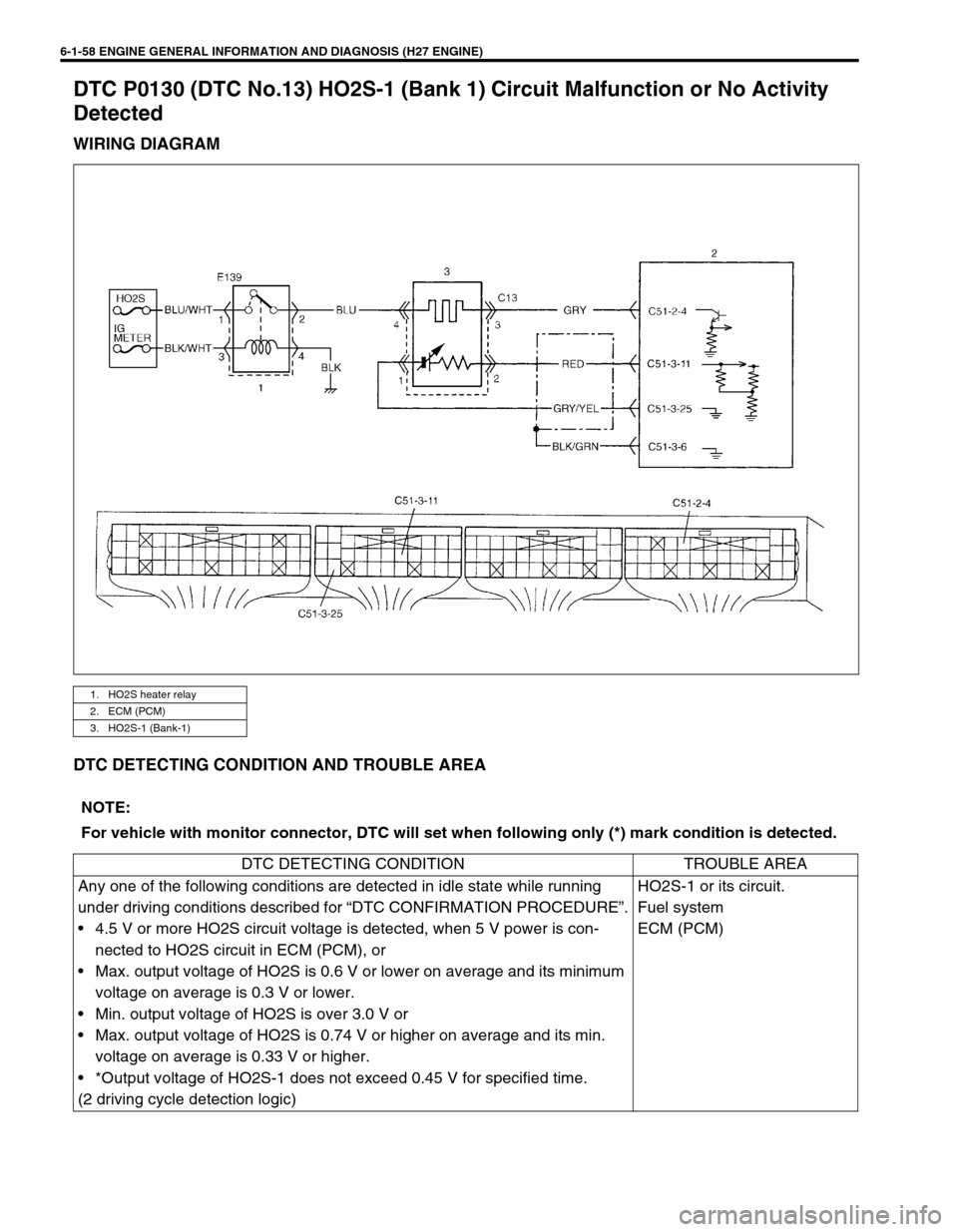
6-1-58 ENGINE GENERAL INFORMATION AND DIAGNOSIS (H27 ENGINE)
DTC P0130 (DTC No.13) HO2S-1 (Bank 1) Circuit Malfunction or No Activity
Detected
WIRING DIAGRAM
DTC DETECTING CONDITION AND TROUBLE AREA
1. HO2S heater relay
2. ECM (PCM)
3. HO2S-1 (Bank-1)
NOTE:
For vehicle with monitor connector, DTC will set when following only (*) mark condition is detected.
DTC DETECTING CONDITION TROUBLE AREA
Any one of the following conditions are detected in idle state while running
under driving conditions described for “DTC CONFIRMATION PROCEDURE”.
• 4.5 V or more HO2S circuit voltage is detected, when 5 V power is con-
nected to HO2S circuit in ECM (PCM), or
• Max. output voltage of HO2S is 0.6 V or lower on average and its minimum
voltage on average is 0.3 V or lower.
• Min. output voltage of HO2S is over 3.0 V or
• Max. output voltage of HO2S is 0.74 V or higher on average and its min.
voltage on average is 0.33 V or higher.
• *Output voltage of HO2S-1 does not exceed 0.45 V for specified time.
(2 driving cycle detection logic)HO2S-1 or its circuit.
Fuel system
ECM (PCM)
Page 221 of 656
6-1-60 ENGINE GENERAL INFORMATION AND DIAGNOSIS (H27 ENGINE)
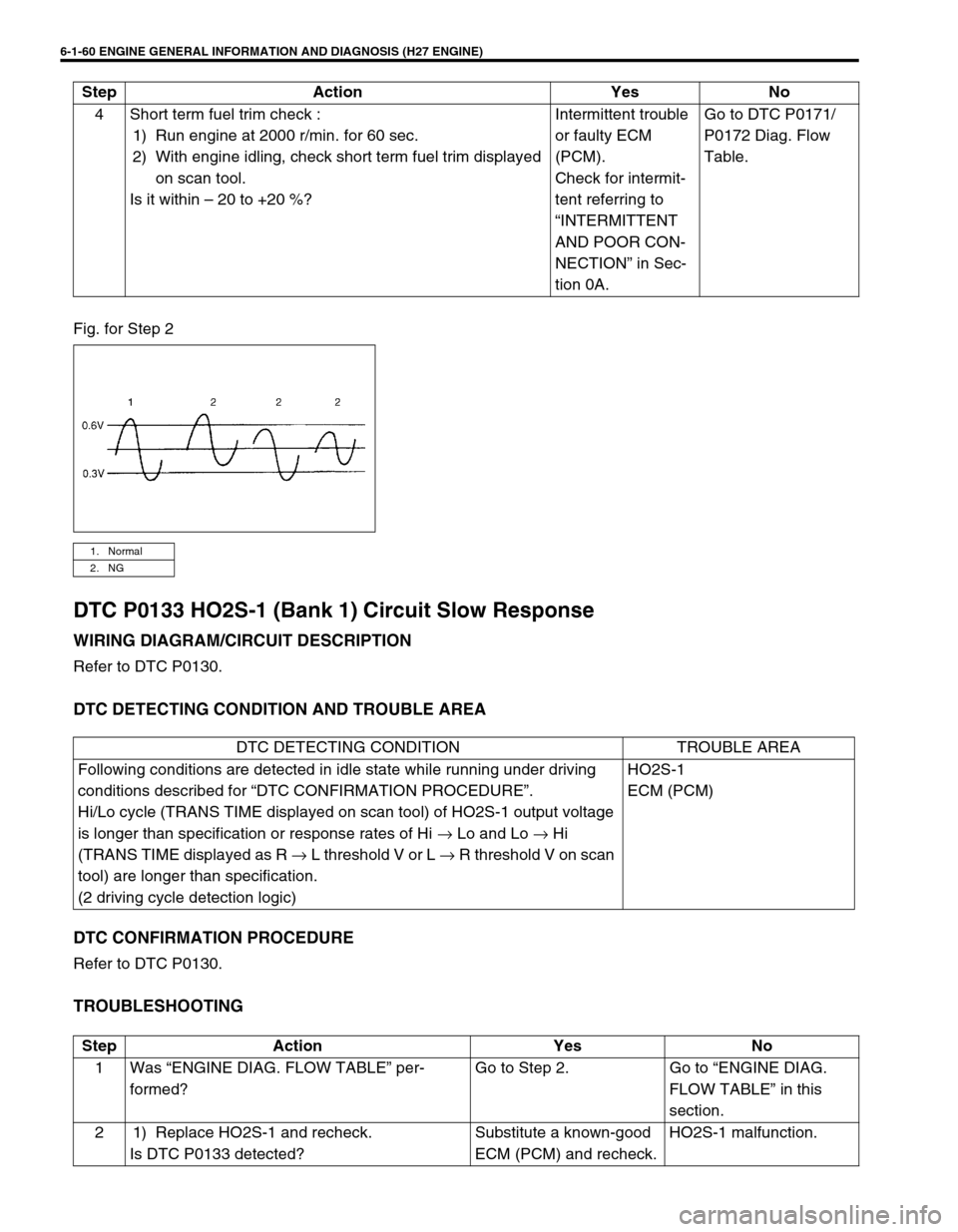
Fig. for Step 2
DTC P0133 HO2S-1 (Bank 1) Circuit Slow Response
WIRING DIAGRAM/CIRCUIT DESCRIPTION
Refer to DTC P0130.
DTC DETECTING CONDITION AND TROUBLE AREA
DTC CONFIRMATION PROCEDURE
Refer to DTC P0130.
TROUBLESHOOTING
4 Short term fuel trim check :
1) Run engine at 2000 r/min. for 60 sec.
2) With engine idling, check short term fuel trim displayed
on scan tool.
Is it within – 20 to +20 %?Intermittent trouble
or faulty ECM
(PCM).
Check for intermit-
tent referring to
“INTERMITTENT
AND POOR CON-
NECTION” in Sec-
tion 0A.Go to DTC P0171/
P0172 Diag. Flow
Table. Step Action Yes No
1. Normal
2. NG
DTC DETECTING CONDITION TROUBLE AREA
Following conditions are detected in idle state while running under driving
conditions described for “DTC CONFIRMATION PROCEDURE”.
Hi/Lo cycle (TRANS TIME displayed on scan tool) of HO2S-1 output voltage
is longer than specification or response rates of Hi → Lo and Lo → Hi
(TRANS TIME displayed as R → L threshold V or L → R threshold V on scan
tool) are longer than specification.
(2 driving cycle detection logic)HO2S-1
ECM (PCM)
Step Action Yes No
1 Was “ENGINE DIAG. FLOW TABLE” per-
formed?Go to Step 2. Go to “ENGINE DIAG.
FLOW TABLE” in this
section.
2 1) Replace HO2S-1 and recheck.
Is DTC P0133 detected?Substitute a known-good
ECM (PCM) and recheck.HO2S-1 malfunction.
Page 228 of 656
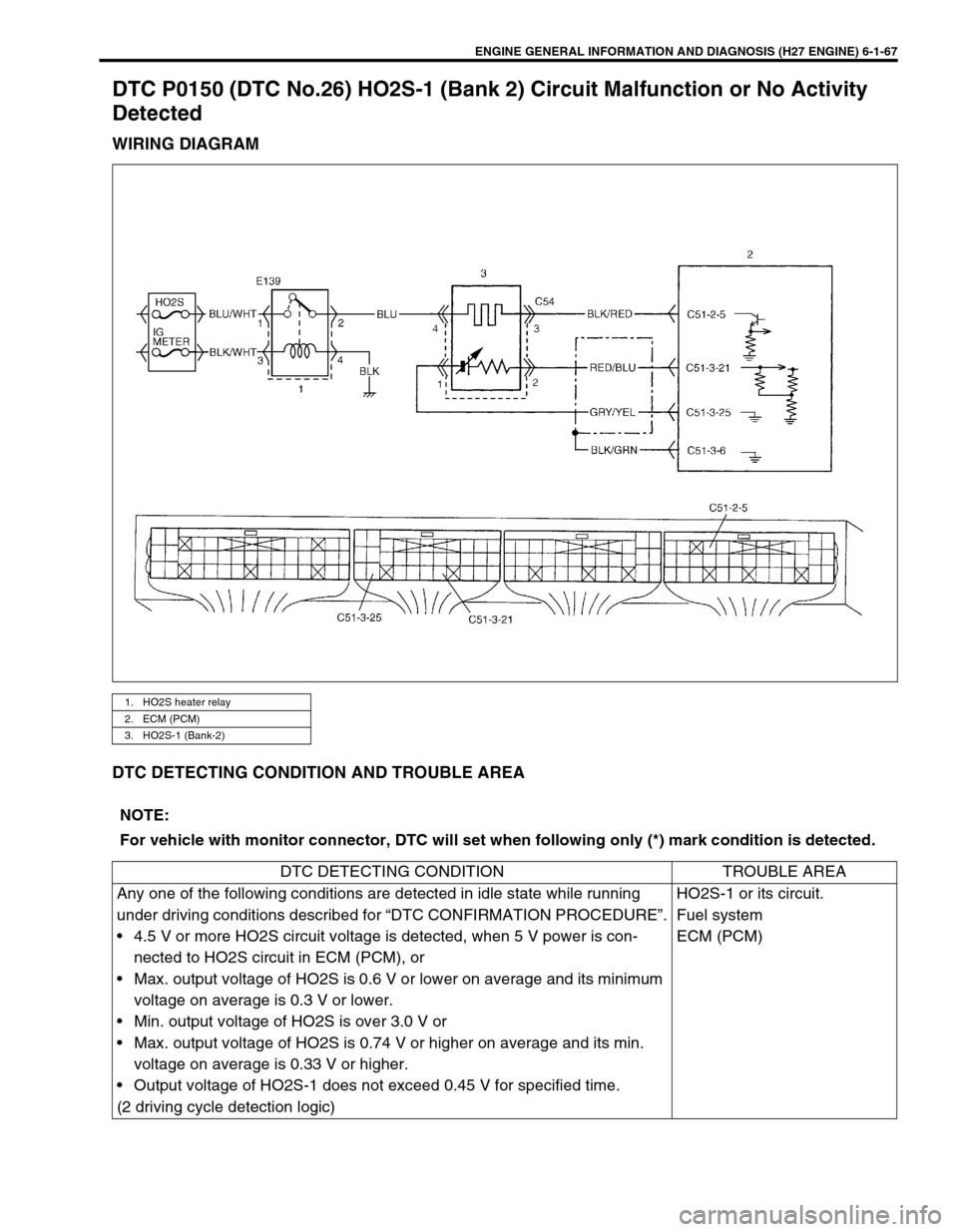
ENGINE GENERAL INFORMATION AND DIAGNOSIS (H27 ENGINE) 6-1-67
DTC P0150 (DTC No.26) HO2S-1 (Bank 2) Circuit Malfunction or No Activity
Detected
WIRING DIAGRAM
DTC DETECTING CONDITION AND TROUBLE AREA
1. HO2S heater relay
2. ECM (PCM)
3. HO2S-1 (Bank-2)
NOTE:
For vehicle with monitor connector, DTC will set when following only (*) mark condition is detected.
DTC DETECTING CONDITION TROUBLE AREA
Any one of the following conditions are detected in idle state while running
under driving conditions described for “DTC CONFIRMATION PROCEDURE”.
• 4.5 V or more HO2S circuit voltage is detected, when 5 V power is con-
nected to HO2S circuit in ECM (PCM), or
• Max. output voltage of HO2S is 0.6 V or lower on average and its minimum
voltage on average is 0.3 V or lower.
• Min. output voltage of HO2S is over 3.0 V or
• Max. output voltage of HO2S is 0.74 V or higher on average and its min.
voltage on average is 0.33 V or higher.
• Output voltage of HO2S-1 does not exceed 0.45 V for specified time.
(2 driving cycle detection logic)HO2S-1 or its circuit.
Fuel system
ECM (PCM)
Page 230 of 656
ENGINE GENERAL INFORMATION AND DIAGNOSIS (H27 ENGINE) 6-1-69
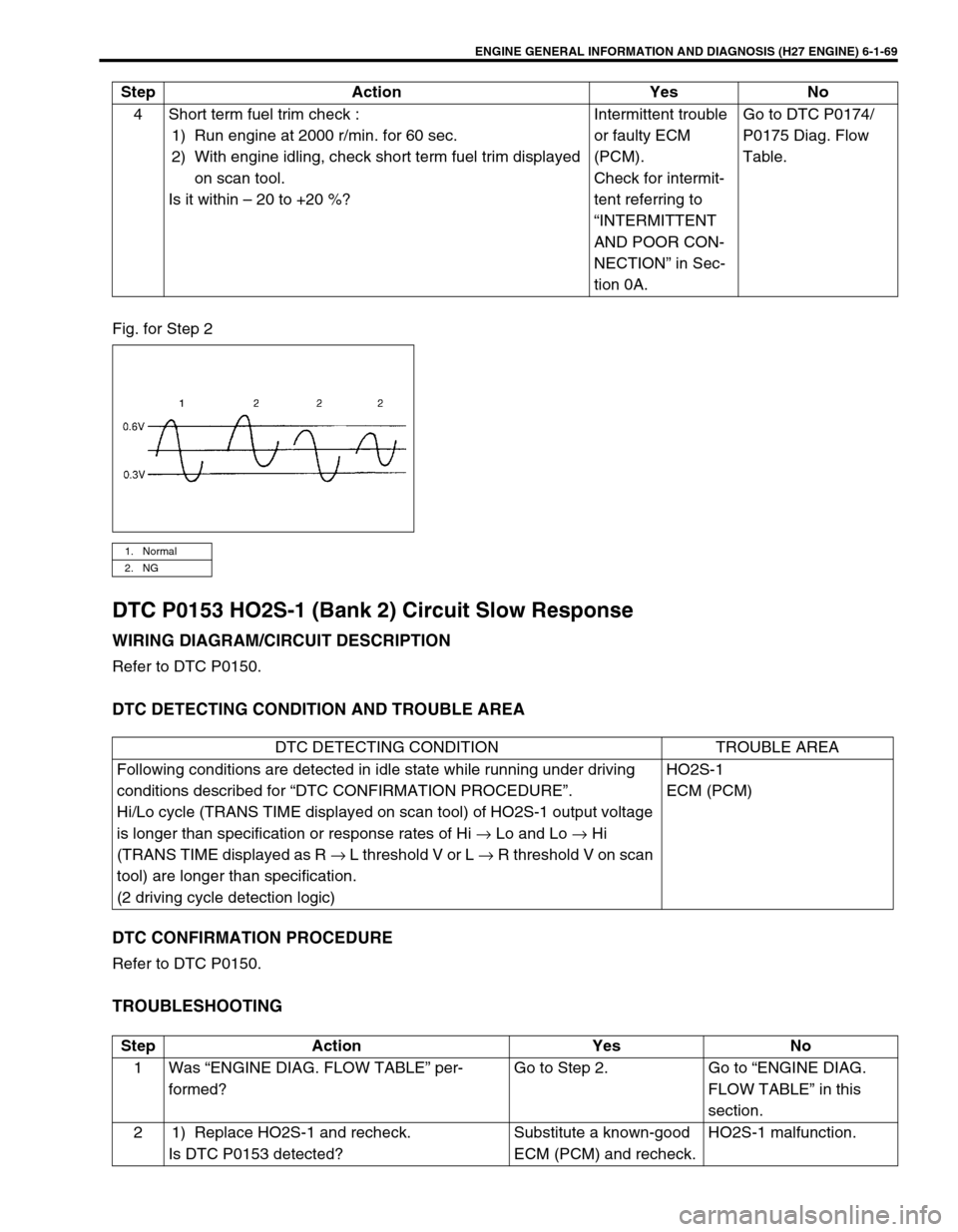
Fig. for Step 2
DTC P0153 HO2S-1 (Bank 2) Circuit Slow Response
WIRING DIAGRAM/CIRCUIT DESCRIPTION
Refer to DTC P0150.
DTC DETECTING CONDITION AND TROUBLE AREA
DTC CONFIRMATION PROCEDURE
Refer to DTC P0150.
TROUBLESHOOTING
4 Short term fuel trim check :
1) Run engine at 2000 r/min. for 60 sec.
2) With engine idling, check short term fuel trim displayed
on scan tool.
Is it within – 20 to +20 %?Intermittent trouble
or faulty ECM
(PCM).
Check for intermit-
tent referring to
“INTERMITTENT
AND POOR CON-
NECTION” in Sec-
tion 0A.Go to DTC P0174/
P0175 Diag. Flow
Table. Step Action Yes No
1. Normal
2. NG
DTC DETECTING CONDITION TROUBLE AREA
Following conditions are detected in idle state while running under driving
conditions described for “DTC CONFIRMATION PROCEDURE”.
Hi/Lo cycle (TRANS TIME displayed on scan tool) of HO2S-1 output voltage
is longer than specification or response rates of Hi → Lo and Lo → Hi
(TRANS TIME displayed as R → L threshold V or L → R threshold V on scan
tool) are longer than specification.
(2 driving cycle detection logic)HO2S-1
ECM (PCM)
Step Action Yes No
1 Was “ENGINE DIAG. FLOW TABLE” per-
formed?Go to Step 2. Go to “ENGINE DIAG.
FLOW TABLE” in this
section.
2 1) Replace HO2S-1 and recheck.
Is DTC P0153 detected?Substitute a known-good
ECM (PCM) and recheck.HO2S-1 malfunction.