Speed SUZUKI GRAND VITARA 2001 2.G Owner's Guide
[x] Cancel search | Manufacturer: SUZUKI, Model Year: 2001, Model line: GRAND VITARA, Model: SUZUKI GRAND VITARA 2001 2.GPages: 656, PDF Size: 14.31 MB
Page 193 of 656
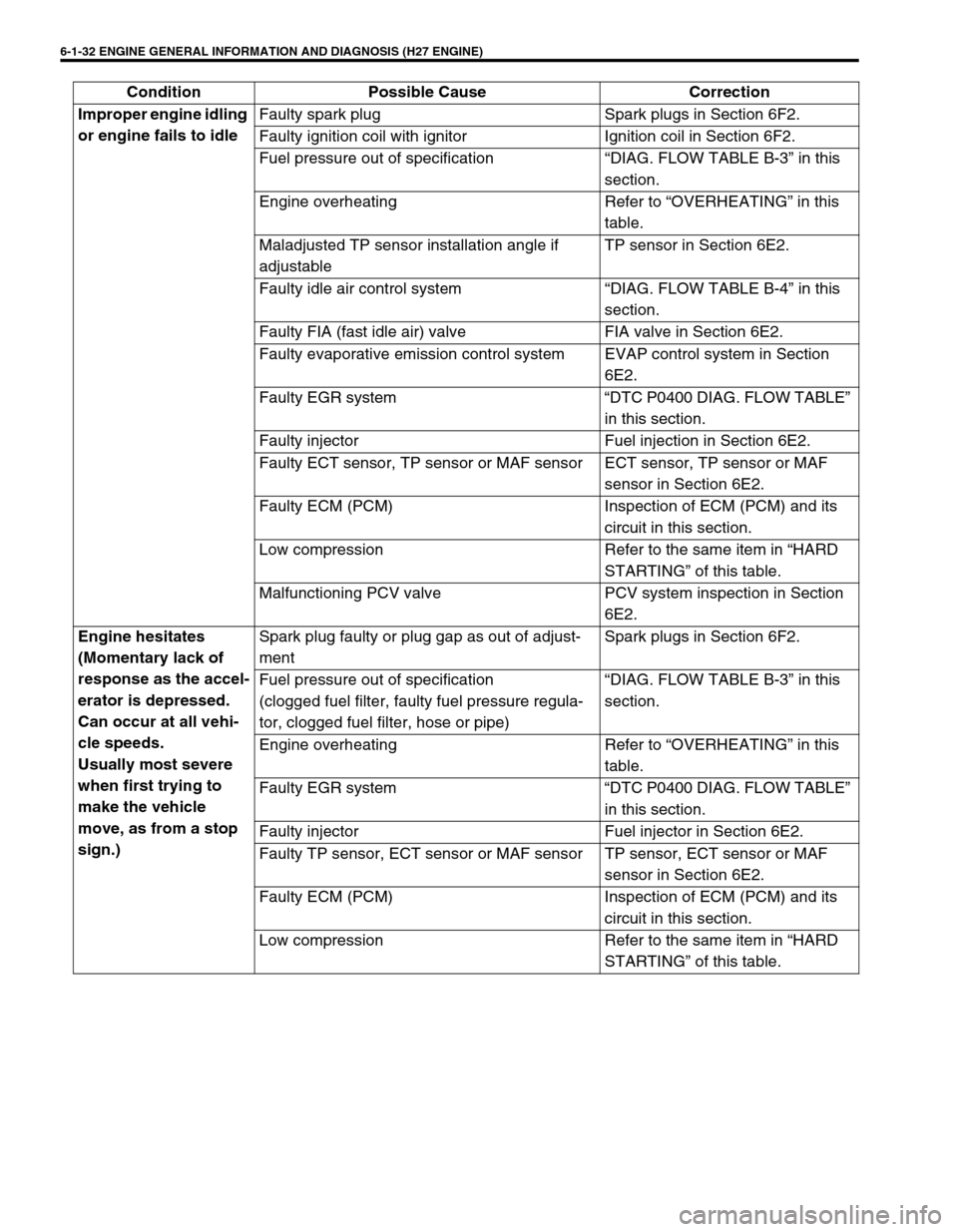
6-1-32 ENGINE GENERAL INFORMATION AND DIAGNOSIS (H27 ENGINE)
Improper engine idling
or engine fails to idleFaulty spark plug Spark plugs in Section 6F2.
Faulty ignition coil with ignitor Ignition coil in Section 6F2.
Fuel pressure out of specification “DIAG. FLOW TABLE B-3” in this
section.
Engine overheating Refer to “OVERHEATING” in this
table.
Maladjusted TP sensor installation angle if
adjustableTP sensor in Section 6E2.
Faulty idle air control system “DIAG. FLOW TABLE B-4” in this
section.
Faulty FIA (fast idle air) valve FIA valve in Section 6E2.
Faulty evaporative emission control system EVAP control system in Section
6E2.
Faulty EGR system “DTC P0400 DIAG. FLOW TABLE”
in this section.
Faulty injector Fuel injection in Section 6E2.
Faulty ECT sensor, TP sensor or MAF sensor ECT sensor, TP sensor or MAF
sensor in Section 6E2.
Faulty ECM (PCM) Inspection of ECM (PCM) and its
circuit in this section.
Low compression Refer to the same item in “HARD
STARTING” of this table.
Malfunctioning PCV valve PCV system inspection in Section
6E2.
Engine hesitates
(Momentary lack of
response as the accel-
erator is depressed.
Can occur at all vehi-
cle speeds.
Usually most severe
when first trying to
make the vehicle
move, as from a stop
sign.)Spark plug faulty or plug gap as out of adjust-
mentSpark plugs in Section 6F2.
Fuel pressure out of specification
(clogged fuel filter, faulty fuel pressure regula-
tor, clogged fuel filter, hose or pipe)“DIAG. FLOW TABLE B-3” in this
section.
Engine overheating Refer to “OVERHEATING” in this
table.
Faulty EGR system “DTC P0400 DIAG. FLOW TABLE”
in this section.
Faulty injector Fuel injector in Section 6E2.
Faulty TP sensor, ECT sensor or MAF sensor TP sensor, ECT sensor or MAF
sensor in Section 6E2.
Faulty ECM (PCM) Inspection of ECM (PCM) and its
circuit in this section.
Low compression Refer to the same item in “HARD
STARTING” of this table. Condition Possible Cause Correction
Page 194 of 656
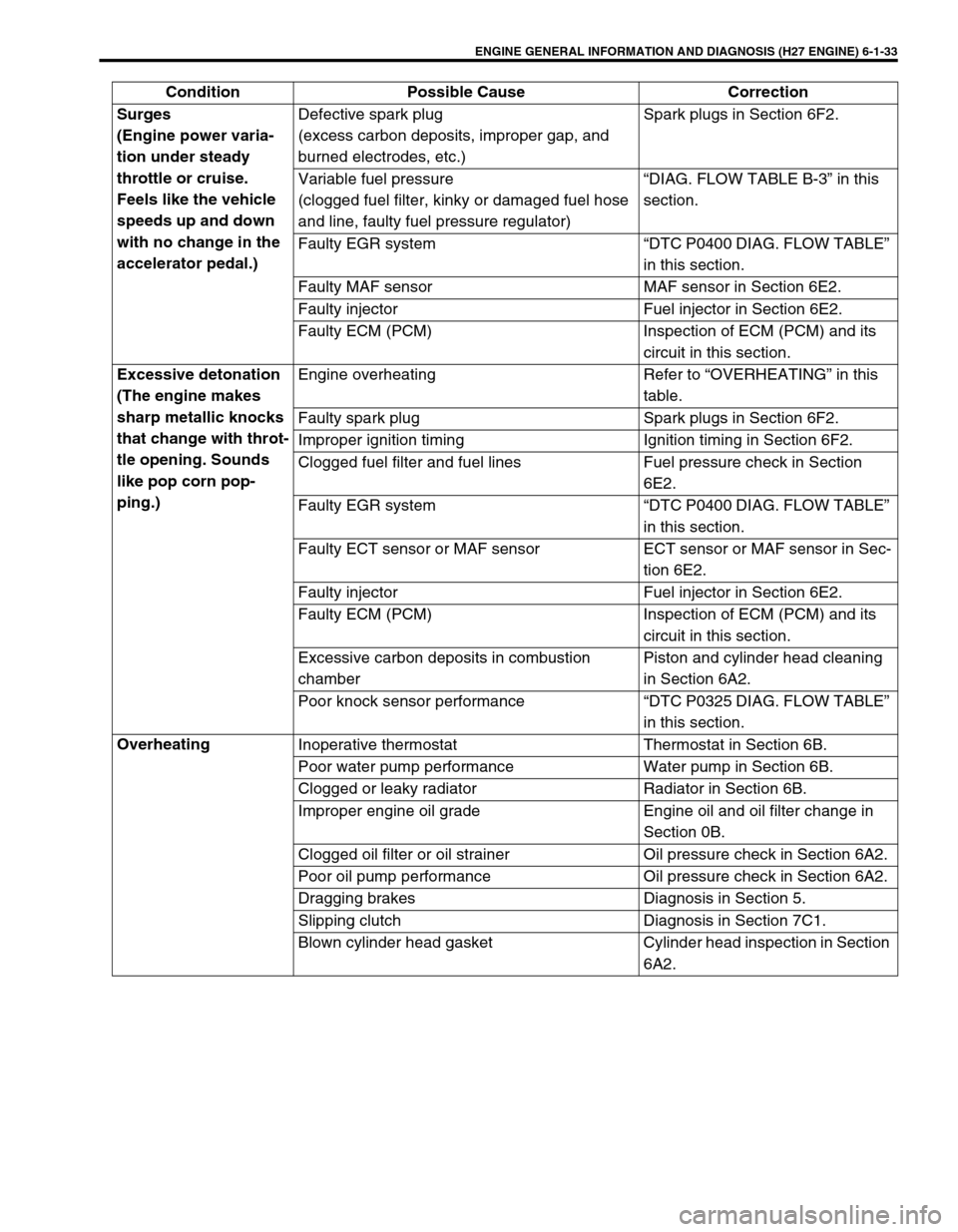
ENGINE GENERAL INFORMATION AND DIAGNOSIS (H27 ENGINE) 6-1-33
Surges
(Engine power varia-
tion under steady
throttle or cruise.
Feels like the vehicle
speeds up and down
with no change in the
accelerator pedal.)Defective spark plug
(excess carbon deposits, improper gap, and
burned electrodes, etc.)Spark plugs in Section 6F2.
Variable fuel pressure
(clogged fuel filter, kinky or damaged fuel hose
and line, faulty fuel pressure regulator)“DIAG. FLOW TABLE B-3” in this
section.
Faulty EGR system “DTC P0400 DIAG. FLOW TABLE”
in this section.
Faulty MAF sensor MAF sensor in Section 6E2.
Faulty injector Fuel injector in Section 6E2.
Faulty ECM (PCM) Inspection of ECM (PCM) and its
circuit in this section.
Excessive detonation
(The engine makes
sharp metallic knocks
that change with throt-
tle opening. Sounds
like pop corn pop-
ping.)Engine overheating Refer to “OVERHEATING” in this
table.
Faulty spark plug Spark plugs in Section 6F2.
Improper ignition timing Ignition timing in Section 6F2.
Clogged fuel filter and fuel lines Fuel pressure check in Section
6E2.
Faulty EGR system “DTC P0400 DIAG. FLOW TABLE”
in this section.
Faulty ECT sensor or MAF sensor ECT sensor or MAF sensor in Sec-
tion 6E2.
Faulty injector Fuel injector in Section 6E2.
Faulty ECM (PCM) Inspection of ECM (PCM) and its
circuit in this section.
Excessive carbon deposits in combustion
chamberPiston and cylinder head cleaning
in Section 6A2.
Poor knock sensor performance “DTC P0325 DIAG. FLOW TABLE”
in this section.
Overheating
Inoperative thermostat Thermostat in Section 6B.
Poor water pump performance Water pump in Section 6B.
Clogged or leaky radiator Radiator in Section 6B.
Improper engine oil grade Engine oil and oil filter change in
Section 0B.
Clogged oil filter or oil strainer Oil pressure check in Section 6A2.
Poor oil pump performance Oil pressure check in Section 6A2.
Dragging brakes Diagnosis in Section 5.
Slipping clutch Diagnosis in Section 7C1.
Blown cylinder head gasket Cylinder head inspection in Section
6A2. Condition Possible Cause Correction
Page 200 of 656
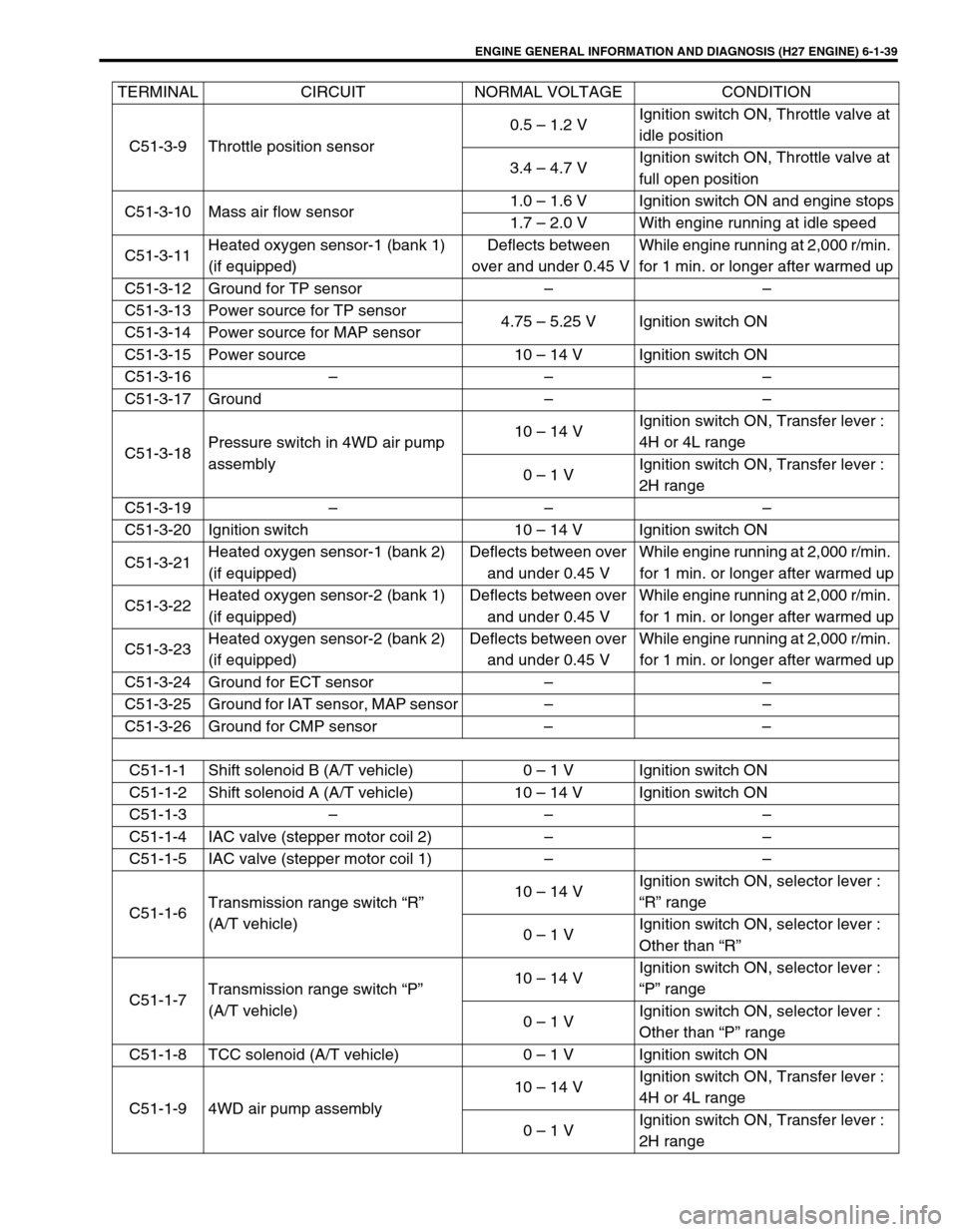
ENGINE GENERAL INFORMATION AND DIAGNOSIS (H27 ENGINE) 6-1-39
C51-3-9 Throttle position sensor0.5 – 1.2 VIgnition switch ON, Throttle valve at
idle position
3.4 – 4.7 VIgnition switch ON, Throttle valve at
full open position
C51-3-10 Mass air flow sensor1.0 – 1.6 V Ignition switch ON and engine stops
1.7 – 2.0 V With engine running at idle speed
C51-3-11Heated oxygen sensor-1 (bank 1)
(if equipped)Deflects between
over and under 0.45 VWhile engine running at 2,000 r/min.
for 1 min. or longer after warmed up
C51-3-12 Ground for TP sensor – –
C51-3-13 Power source for TP sensor
4.75 – 5.25 V Ignition switch ON
C51-3-14 Power source for MAP sensor
C51-3-15 Power source 10 – 14 V Ignition switch ON
C51-3-16 – – –
C51-3-17 Ground – –
C51-3-18Pressure switch in 4WD air pump
assembly10 – 14 VIgnition switch ON, Transfer lever :
4H or 4L range
0 – 1 VIgnition switch ON, Transfer lever :
2H range
C51-3-19 – – –
C51-3-20 Ignition switch 10 – 14 V Ignition switch ON
C51-3-21Heated oxygen sensor-1 (bank 2)
(if equipped)Deflects between over
and under 0.45 VWhile engine running at 2,000 r/min.
for 1 min. or longer after warmed up
C51-3-22Heated oxygen sensor-2 (bank 1)
(if equipped)Deflects between over
and under 0.45 VWhile engine running at 2,000 r/min.
for 1 min. or longer after warmed up
C51-3-23Heated oxygen sensor-2 (bank 2)
(if equipped)Deflects between over
and under 0.45 VWhile engine running at 2,000 r/min.
for 1 min. or longer after warmed up
C51-3-24 Ground for ECT sensor – –
C51-3-25 Ground for IAT sensor, MAP sensor – –
C51-3-26 Ground for CMP sensor – –
C51-1-1 Shift solenoid B (A/T vehicle) 0 – 1 V Ignition switch ON
C51-1-2 Shift solenoid A (A/T vehicle) 10 – 14 V Ignition switch ON
C51-1-3 – – –
C51-1-4 IAC valve (stepper motor coil 2) – –
C51-1-5 IAC valve (stepper motor coil 1) – –
C51-1-6Transmission range switch “R”
(A/T vehicle)10 – 14 VIgnition switch ON, selector lever :
“R” range
0 – 1 VIgnition switch ON, selector lever :
Other than “R”
C51-1-7Transmission range switch “P”
(A/T vehicle)10 – 14 VIgnition switch ON, selector lever :
“P” range
0 – 1 VIgnition switch ON, selector lever :
Other than “P” range
C51-1-8 TCC solenoid (A/T vehicle) 0 – 1 V Ignition switch ON
C51-1-9 4WD air pump assembly10 – 14 VIgnition switch ON, Transfer lever :
4H or 4L range
0 – 1 VIgnition switch ON, Transfer lever :
2H range TERMINAL CIRCUIT NORMAL VOLTAGE CONDITION
Page 201 of 656
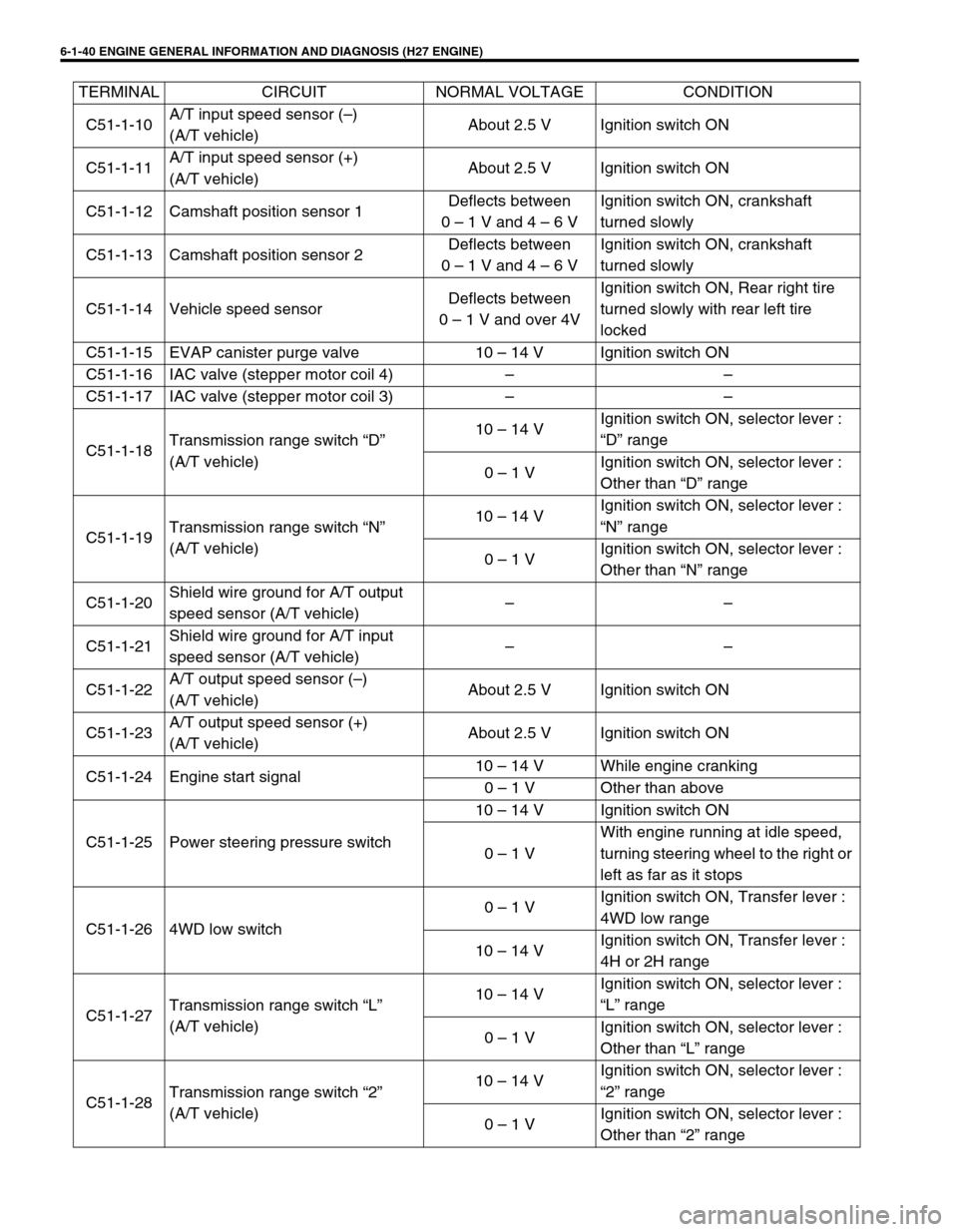
6-1-40 ENGINE GENERAL INFORMATION AND DIAGNOSIS (H27 ENGINE)
C51-1-10A/T input speed sensor (–)
(A/T vehicle)About 2.5 V Ignition switch ON
C51-1-11A/T input speed sensor (+)
(A/T vehicle)About 2.5 V Ignition switch ON
C51-1-12 Camshaft position sensor 1Deflects between
0 – 1 V and 4 – 6 VIgnition switch ON, crankshaft
turned slowly
C51-1-13 Camshaft position sensor 2Deflects between
0 – 1 V and 4 – 6 VIgnition switch ON, crankshaft
turned slowly
C51-1-14 Vehicle speed sensorDeflects between
0 – 1 V and over 4VIgnition switch ON, Rear right tire
turned slowly with rear left tire
locked
C51-1-15 EVAP canister purge valve 10 – 14 V Ignition switch ON
C51-1-16 IAC valve (stepper motor coil 4) – –
C51-1-17 IAC valve (stepper motor coil 3) – –
C51-1-18Transmission range switch “D”
(A/T vehicle)10 – 14 VIgnition switch ON, selector lever :
“D” range
0 – 1 VIgnition switch ON, selector lever :
Other than “D” range
C51-1-19Transmission range switch “N”
(A/T vehicle)10 – 14 VIgnition switch ON, selector lever :
“N” range
0 – 1 VIgnition switch ON, selector lever :
Other than “N” range
C51-1-20Shield wire ground for A/T output
speed sensor (A/T vehicle)––
C51-1-21Shield wire ground for A/T input
speed sensor (A/T vehicle)––
C51-1-22A/T output speed sensor (–)
(A/T vehicle)About 2.5 V Ignition switch ON
C51-1-23A/T output speed sensor (+)
(A/T vehicle)About 2.5 V Ignition switch ON
C51-1-24 Engine start signal10 – 14 V While engine cranking
0 – 1 V Other than above
C51-1-25 Power steering pressure switch10 – 14 V Ignition switch ON
0 – 1 VWith engine running at idle speed,
turning steering wheel to the right or
left as far as it stops
C51-1-26 4WD low switch0 – 1 VIgnition switch ON, Transfer lever :
4WD low range
10 – 14 VIgnition switch ON, Transfer lever :
4H or 2H range
C51-1-27Transmission range switch “L”
(A/T vehicle)10 – 14 VIgnition switch ON, selector lever :
“L” range
0 – 1 VIgnition switch ON, selector lever :
Other than “L” range
C51-1-28Transmission range switch “2”
(A/T vehicle)10 – 14 VIgnition switch ON, selector lever :
“2” range
0 – 1 VIgnition switch ON, selector lever :
Other than “2” range TERMINAL CIRCUIT NORMAL VOLTAGE CONDITION
Page 202 of 656
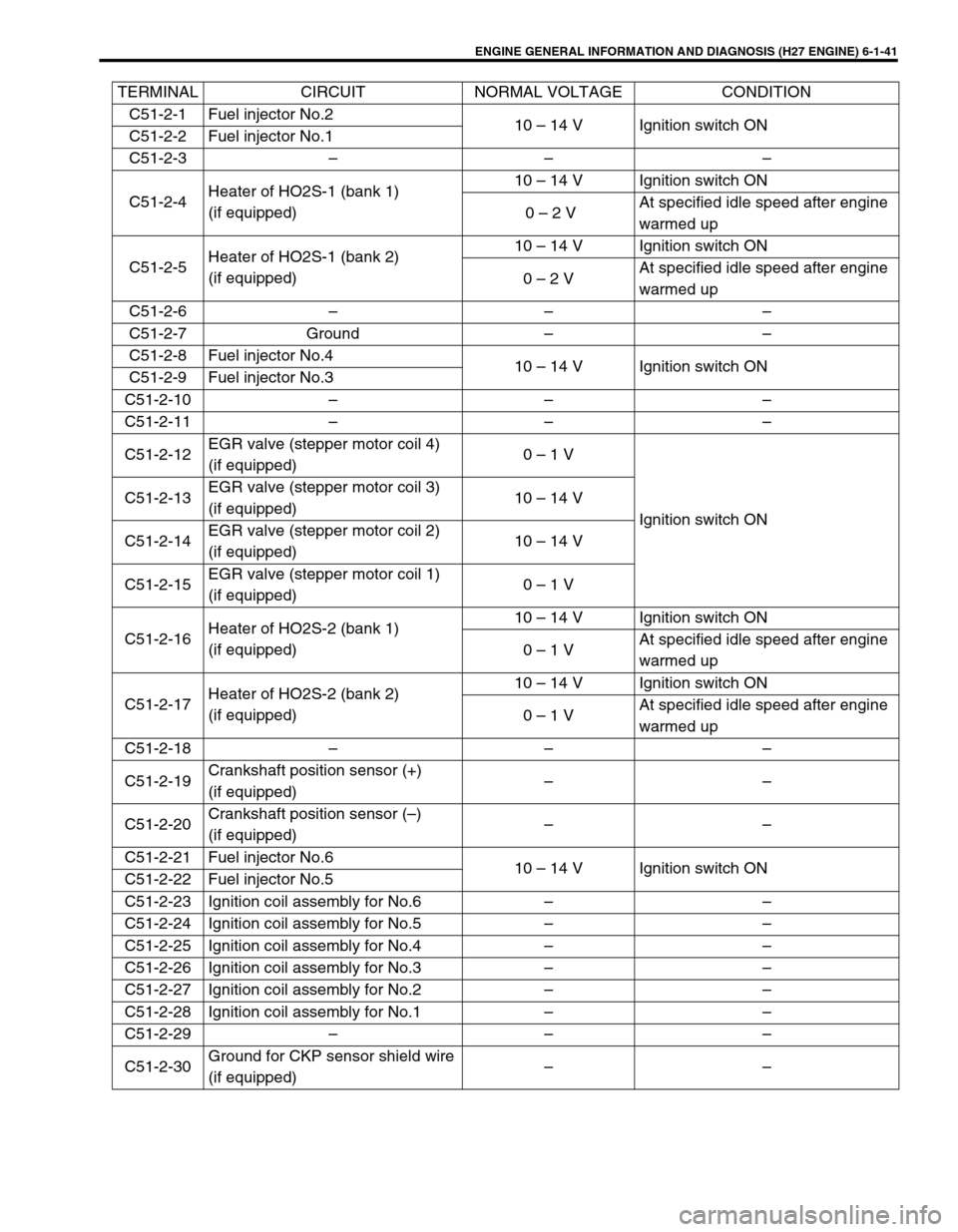
ENGINE GENERAL INFORMATION AND DIAGNOSIS (H27 ENGINE) 6-1-41
C51-2-1 Fuel injector No.2
10 – 14 V Ignition switch ON
C51-2-2 Fuel injector No.1
C51-2-3 – – –
C51-2-4Heater of HO2S-1 (bank 1)
(if equipped)10 – 14 V Ignition switch ON
0 – 2 VAt specified idle speed after engine
warmed up
C51-2-5Heater of HO2S-1 (bank 2)
(if equipped)10 – 14 V Ignition switch ON
0 – 2 VAt specified idle speed after engine
warmed up
C51-2-6 – – –
C51-2-7 Ground – –
C51-2-8 Fuel injector No.4
10 – 14 V Ignition switch ON
C51-2-9 Fuel injector No.3
C51-2-10 – – –
C51-2-11 – – –
C51-2-12EGR valve (stepper motor coil 4)
(if equipped)0 – 1 V
Ignition switch ON C51-2-13EGR valve (stepper motor coil 3)
(if equipped)10 – 14 V
C51-2-14EGR valve (stepper motor coil 2)
(if equipped)10 – 14 V
C51-2-15EGR valve (stepper motor coil 1)
(if equipped)0 – 1 V
C51-2-16Heater of HO2S-2 (bank 1)
(if equipped)10 – 14 V Ignition switch ON
0 – 1 VAt specified idle speed after engine
warmed up
C51-2-17Heater of HO2S-2 (bank 2)
(if equipped)10 – 14 V Ignition switch ON
0 – 1 VAt specified idle speed after engine
warmed up
C51-2-18 – – –
C51-2-19Crankshaft position sensor (+)
(if equipped)––
C51-2-20Crankshaft position sensor (–)
(if equipped)––
C51-2-21 Fuel injector No.6
10 – 14 V Ignition switch ON
C51-2-22 Fuel injector No.5
C51-2-23 Ignition coil assembly for No.6 – –
C51-2-24 Ignition coil assembly for No.5 – –
C51-2-25 Ignition coil assembly for No.4 – –
C51-2-26 Ignition coil assembly for No.3 – –
C51-2-27 Ignition coil assembly for No.2 – –
C51-2-28 Ignition coil assembly for No.1 – –
C51-2-29 – – –
C51-2-30Ground for CKP sensor shield wire
(if equipped)–– TERMINAL CIRCUIT NORMAL VOLTAGE CONDITION
Page 210 of 656
ENGINE GENERAL INFORMATION AND DIAGNOSIS (H27 ENGINE) 6-1-49
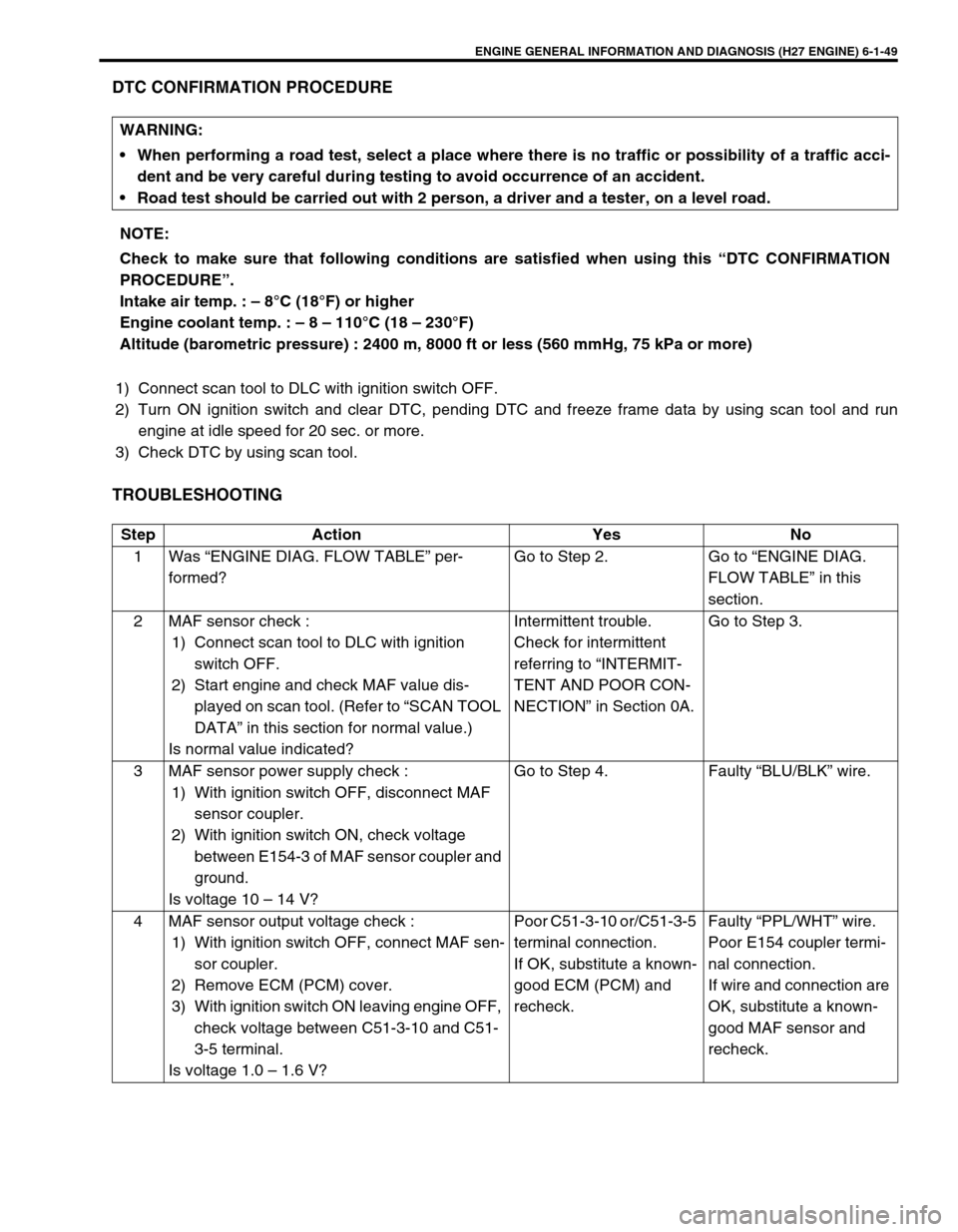
DTC CONFIRMATION PROCEDURE
1) Connect scan tool to DLC with ignition switch OFF.
2) Turn ON ignition switch and clear DTC, pending DTC and freeze frame data by using scan tool and run
engine at idle speed for 20 sec. or more.
3) Check DTC by using scan tool.
TROUBLESHOOTING
WARNING:
When performing a road test, select a place where there is no traffic or possibility of a traffic acci-
dent and be very careful during testing to avoid occurrence of an accident.
Road test should be carried out with 2 person, a driver and a tester, on a level road.
NOTE:
Check to make sure that following conditions are satisfied when using this “DTC CONFIRMATION
PROCEDURE”.
Intake air temp. : – 8°C (18°F) or higher
Engine coolant temp. : – 8 – 110°C (18 – 230°F)
Altitude (barometric pressure) : 2400 m, 8000 ft or less (560 mmHg, 75 kPa or more)
Step Action Yes No
1 Was “ENGINE DIAG. FLOW TABLE” per-
formed?Go to Step 2. Go to “ENGINE DIAG.
FLOW TABLE” in this
section.
2 MAF sensor check :
1) Connect scan tool to DLC with ignition
switch OFF.
2) Start engine and check MAF value dis-
played on scan tool. (Refer to “SCAN TOOL
DATA” in this section for normal value.)
Is normal value indicated?Intermittent trouble.
Check for intermittent
referring to “INTERMIT-
TENT AND POOR CON-
NECTION” in Section 0A.Go to Step 3.
3 MAF sensor power supply check :
1) With ignition switch OFF, disconnect MAF
sensor coupler.
2) With ignition switch ON, check voltage
between E154-3 of MAF sensor coupler and
ground.
Is voltage 10 – 14 V?Go to Step 4. Faulty “BLU/BLK” wire.
4 MAF sensor output voltage check :
1) With ignition switch OFF, connect MAF sen-
sor coupler.
2) Remove ECM (PCM) cover.
3) With ignition switch ON leaving engine OFF,
check voltage between C51-3-10 and C51-
3-5 terminal.
Is voltage 1.0 – 1.6 V?Poor C51-3-10 or/C51-3-5
terminal connection.
If OK, substitute a known-
good ECM (PCM) and
recheck.Faulty “PPL/WHT” wire.
Poor E154 coupler termi-
nal connection.
If wire and connection are
OK, substitute a known-
good MAF sensor and
recheck.
Page 211 of 656
6-1-50 ENGINE GENERAL INFORMATION AND DIAGNOSIS (H27 ENGINE)
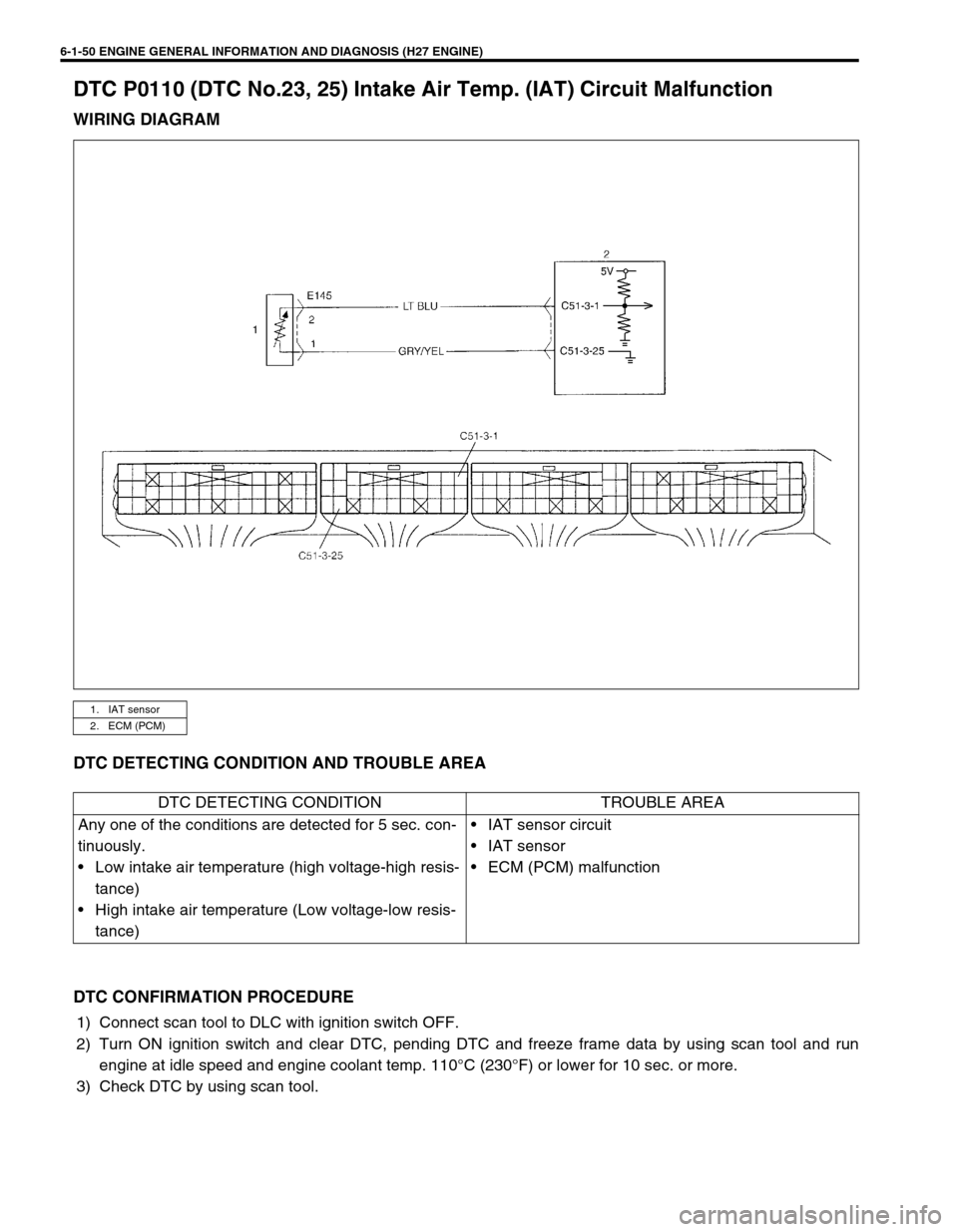
DTC P0110 (DTC No.23, 25) Intake Air Temp. (IAT) Circuit Malfunction
WIRING DIAGRAM
DTC DETECTING CONDITION AND TROUBLE AREA
DTC CONFIRMATION PROCEDURE
1) Connect scan tool to DLC with ignition switch OFF.
2) Turn ON ignition switch and clear DTC, pending DTC and freeze frame data by using scan tool and run
engine at idle speed and engine coolant temp. 110°C (230°F) or lower for 10 sec. or more.
3) Check DTC by using scan tool.
1. IAT sensor
2. ECM (PCM)
DTC DETECTING CONDITION TROUBLE AREA
Any one of the conditions are detected for 5 sec. con-
tinuously.
• Low intake air temperature (high voltage-high resis-
tance)
• High intake air temperature (Low voltage-low resis-
tance)• IAT sensor circuit
• IAT sensor
• ECM (PCM) malfunction
Page 213 of 656
6-1-52 ENGINE GENERAL INFORMATION AND DIAGNOSIS (H27 ENGINE)
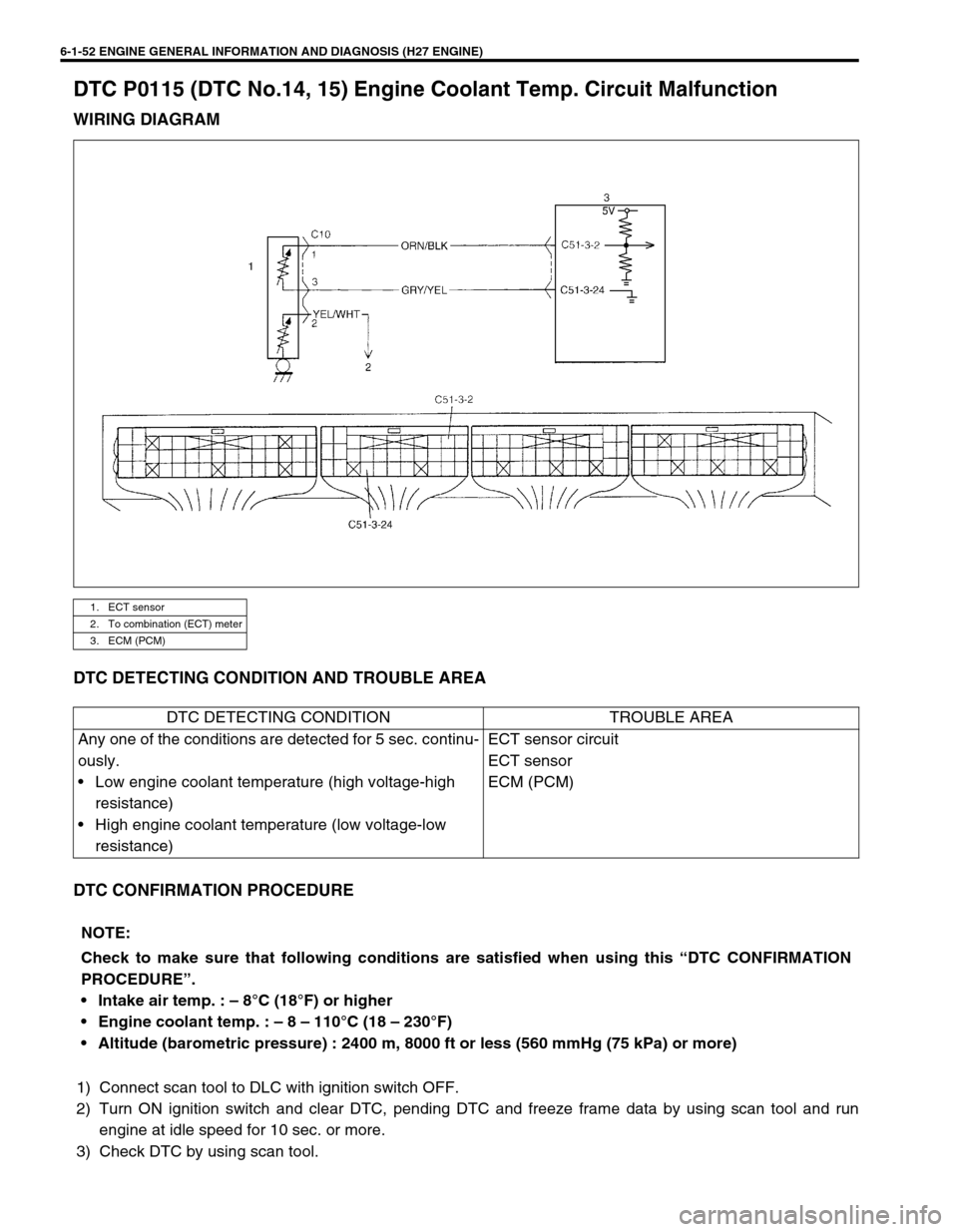
DTC P0115 (DTC No.14, 15) Engine Coolant Temp. Circuit Malfunction
WIRING DIAGRAM
DTC DETECTING CONDITION AND TROUBLE AREA
DTC CONFIRMATION PROCEDURE
1) Connect scan tool to DLC with ignition switch OFF.
2) Turn ON ignition switch and clear DTC, pending DTC and freeze frame data by using scan tool and run
engine at idle speed for 10 sec. or more.
3) Check DTC by using scan tool.
1. ECT sensor
2. To combination (ECT) meter
3. ECM (PCM)
DTC DETECTING CONDITION TROUBLE AREA
Any one of the conditions are detected for 5 sec. continu-
ously.
• Low engine coolant temperature (high voltage-high
resistance)
• High engine coolant temperature (low voltage-low
resistance)ECT sensor circuit
ECT sensor
ECM (PCM)
NOTE:
Check to make sure that following conditions are satisfied when using this “DTC CONFIRMATION
PROCEDURE”.
Intake air temp. : – 8°C (18°F) or higher
Engine coolant temp. : – 8 – 110°C (18 – 230°F)
Altitude (barometric pressure) : 2400 m, 8000 ft or less (560 mmHg (75 kPa) or more)
Page 215 of 656
6-1-54 ENGINE GENERAL INFORMATION AND DIAGNOSIS (H27 ENGINE)
DTC P0120 (DTC No.21, 22) Throttle Position Circuit Malfunction
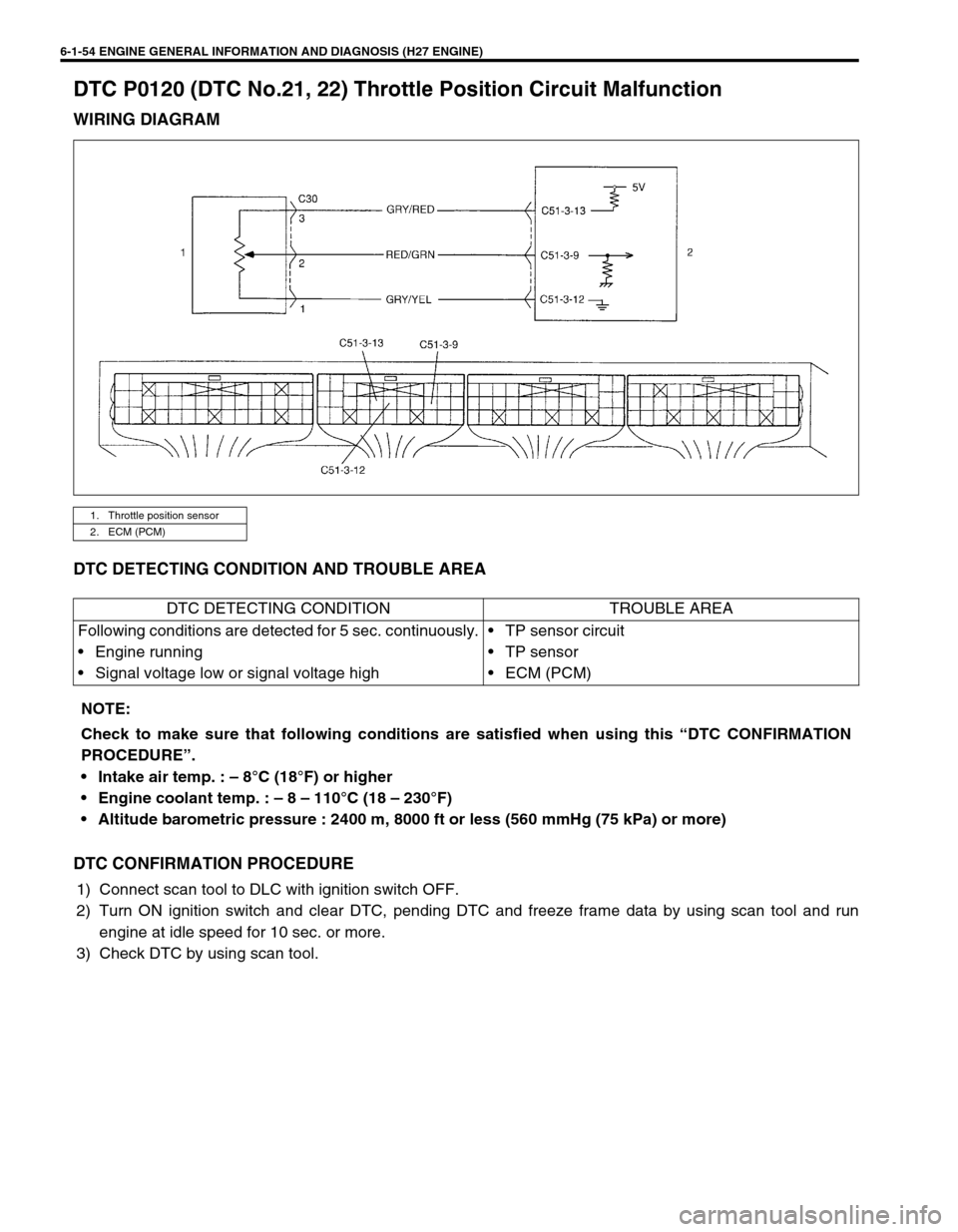
WIRING DIAGRAM
DTC DETECTING CONDITION AND TROUBLE AREA
DTC CONFIRMATION PROCEDURE
1) Connect scan tool to DLC with ignition switch OFF.
2) Turn ON ignition switch and clear DTC, pending DTC and freeze frame data by using scan tool and run
engine at idle speed for 10 sec. or more.
3) Check DTC by using scan tool.
1. Throttle position sensor
2. ECM (PCM)
DTC DETECTING CONDITION TROUBLE AREA
Following conditions are detected for 5 sec. continuously.
• Engine running
• Signal voltage low or signal voltage high• TP sensor circuit
•TP sensor
•ECM (PCM)
NOTE:
Check to make sure that following conditions are satisfied when using this “DTC CONFIRMATION
PROCEDURE”.
Intake air temp. : – 8°C (18°F) or higher
Engine coolant temp. : – 8 – 110°C (18 – 230°F)
Altitude barometric pressure : 2400 m, 8000 ft or less (560 mmHg (75 kPa) or more)
Page 217 of 656
6-1-56 ENGINE GENERAL INFORMATION AND DIAGNOSIS (H27 ENGINE)
DTC P0121 Throttle Position Circuit Range/Performance Problem
WIRING DIAGRAM/CIRCUIT DESCRIPTION
Refer to DTC P0120.
DTC DETECTING CONDITION AND TROUBLE AREA
DTC CONFIRMATION PROCEDURE
1) Connect scan tool to DLC with ignition switch OFF.
2) Turn ON ignition switch and clear DTC, pending DTC and freeze frame data by using scan tool and start
engine.
3) Increase vehicle speed to 60 km/h (40 mph).
4) Keep driving above vehicle speed for 5 min (Change of vehicle speed is permitted in this step).
5) Stop vehicle and run engine at idle speed for 1 min.
6) Increase vehicle speed till engine speed is reached 2,000 – 3,000 r/min in proper gear.
7) Keep driving at that engine speed for 30 sec or more (Engine speed is kept constant in this step).
8) Stop vehicle.
9) Repeat step 6) to 8).
10) Check pending DTC by using scan tool.DTC DETECTING CONDITION TROUBLE AREA
Throttle opening change is smaller than specification
while intake air volume changes and engine is running at
constant speed. (2 driving cycle detection logic)•TP sensor
•ECM (PCM)
WARNING:
When performing a road test, select a place where there is no traffic or possibility of a traffic acci-
dent and be very careful during testing to avoid occurrence of an accident.
Road test should be carried out with 2 persons, a driver and a tester, on a level road.
NOTE:
Check to make sure that following conditions are satisfied when using this “DTC CONFIRMATION
PROCEDURE”.
Intake air temp. : – 8°C (18°F) or higher
Engine coolant temp. : – 8 – 110°C (18 – 230°F)
Altitude barometric pressure : 2400 m, 8000 ft or less (560 mmHg (75 kPa) or more)