check engine SUZUKI GRAND VITARA 2001 2.G Owner's Guide
[x] Cancel search | Manufacturer: SUZUKI, Model Year: 2001, Model line: GRAND VITARA, Model: SUZUKI GRAND VITARA 2001 2.GPages: 656, PDF Size: 14.31 MB
Page 192 of 656
ENGINE GENERAL INFORMATION AND DIAGNOSIS (H27 ENGINE) 6-1-31
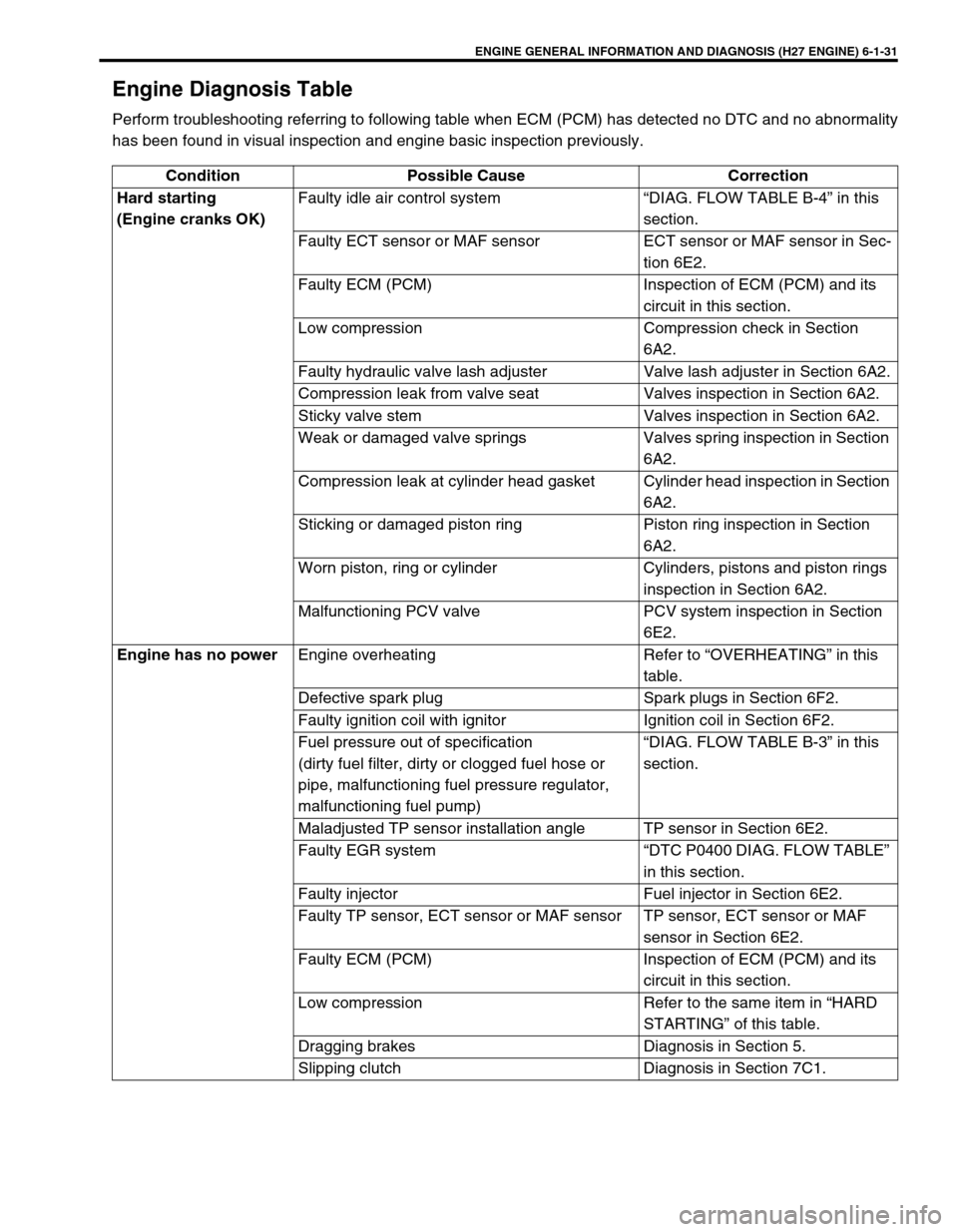
Engine Diagnosis Table
Perform troubleshooting referring to following table when ECM (PCM) has detected no DTC and no abnormality
has been found in visual inspection and engine basic inspection previously.
Condition Possible Cause Correction
Hard starting
(Engine cranks OK)Faulty idle air control system “DIAG. FLOW TABLE B-4” in this
section.
Faulty ECT sensor or MAF sensor ECT sensor or MAF sensor in Sec-
tion 6E2.
Faulty ECM (PCM) Inspection of ECM (PCM) and its
circuit in this section.
Low compression Compression check in Section
6A2.
Faulty hydraulic valve lash adjuster Valve lash adjuster in Section 6A2.
Compression leak from valve seat Valves inspection in Section 6A2.
Sticky valve stem Valves inspection in Section 6A2.
Weak or damaged valve springs Valves spring inspection in Section
6A2.
Compression leak at cylinder head gasket Cylinder head inspection in Section
6A2.
Sticking or damaged piston ring Piston ring inspection in Section
6A2.
Worn piston, ring or cylinder Cylinders, pistons and piston rings
inspection in Section 6A2.
Malfunctioning PCV valve PCV system inspection in Section
6E2.
Engine has no power
Engine overheating Refer to “OVERHEATING” in this
table.
Defective spark plug Spark plugs in Section 6F2.
Faulty ignition coil with ignitor Ignition coil in Section 6F2.
Fuel pressure out of specification
(dirty fuel filter, dirty or clogged fuel hose or
pipe, malfunctioning fuel pressure regulator,
malfunctioning fuel pump)“DIAG. FLOW TABLE B-3” in this
section.
Maladjusted TP sensor installation angle TP sensor in Section 6E2.
Faulty EGR system “DTC P0400 DIAG. FLOW TABLE”
in this section.
Faulty injector Fuel injector in Section 6E2.
Faulty TP sensor, ECT sensor or MAF sensor TP sensor, ECT sensor or MAF
sensor in Section 6E2.
Faulty ECM (PCM) Inspection of ECM (PCM) and its
circuit in this section.
Low compression Refer to the same item in “HARD
STARTING” of this table.
Dragging brakes Diagnosis in Section 5.
Slipping clutch Diagnosis in Section 7C1.
Page 194 of 656
ENGINE GENERAL INFORMATION AND DIAGNOSIS (H27 ENGINE) 6-1-33
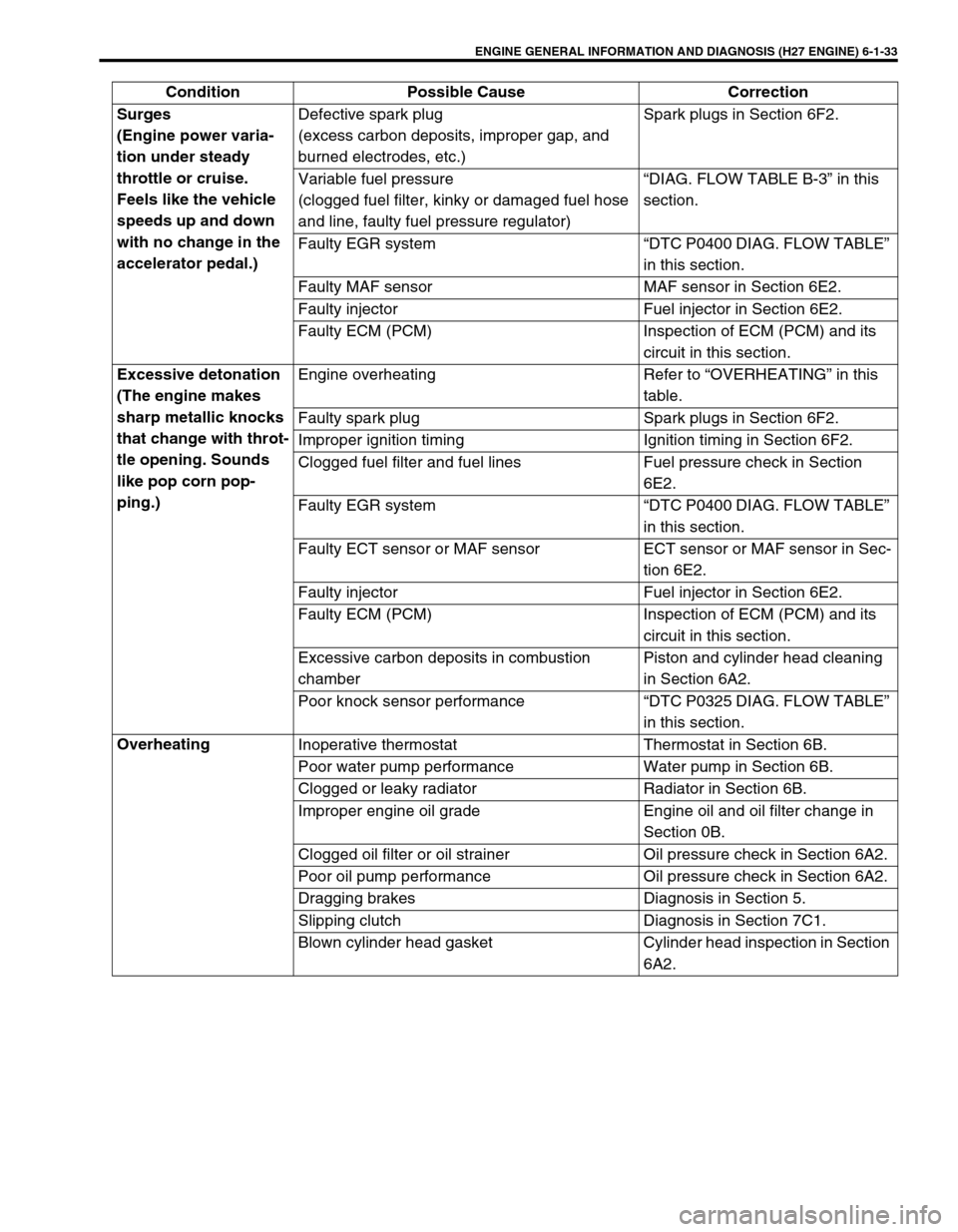
Surges
(Engine power varia-
tion under steady
throttle or cruise.
Feels like the vehicle
speeds up and down
with no change in the
accelerator pedal.)Defective spark plug
(excess carbon deposits, improper gap, and
burned electrodes, etc.)Spark plugs in Section 6F2.
Variable fuel pressure
(clogged fuel filter, kinky or damaged fuel hose
and line, faulty fuel pressure regulator)“DIAG. FLOW TABLE B-3” in this
section.
Faulty EGR system “DTC P0400 DIAG. FLOW TABLE”
in this section.
Faulty MAF sensor MAF sensor in Section 6E2.
Faulty injector Fuel injector in Section 6E2.
Faulty ECM (PCM) Inspection of ECM (PCM) and its
circuit in this section.
Excessive detonation
(The engine makes
sharp metallic knocks
that change with throt-
tle opening. Sounds
like pop corn pop-
ping.)Engine overheating Refer to “OVERHEATING” in this
table.
Faulty spark plug Spark plugs in Section 6F2.
Improper ignition timing Ignition timing in Section 6F2.
Clogged fuel filter and fuel lines Fuel pressure check in Section
6E2.
Faulty EGR system “DTC P0400 DIAG. FLOW TABLE”
in this section.
Faulty ECT sensor or MAF sensor ECT sensor or MAF sensor in Sec-
tion 6E2.
Faulty injector Fuel injector in Section 6E2.
Faulty ECM (PCM) Inspection of ECM (PCM) and its
circuit in this section.
Excessive carbon deposits in combustion
chamberPiston and cylinder head cleaning
in Section 6A2.
Poor knock sensor performance “DTC P0325 DIAG. FLOW TABLE”
in this section.
Overheating
Inoperative thermostat Thermostat in Section 6B.
Poor water pump performance Water pump in Section 6B.
Clogged or leaky radiator Radiator in Section 6B.
Improper engine oil grade Engine oil and oil filter change in
Section 0B.
Clogged oil filter or oil strainer Oil pressure check in Section 6A2.
Poor oil pump performance Oil pressure check in Section 6A2.
Dragging brakes Diagnosis in Section 5.
Slipping clutch Diagnosis in Section 7C1.
Blown cylinder head gasket Cylinder head inspection in Section
6A2. Condition Possible Cause Correction
Page 196 of 656
ENGINE GENERAL INFORMATION AND DIAGNOSIS (H27 ENGINE) 6-1-35
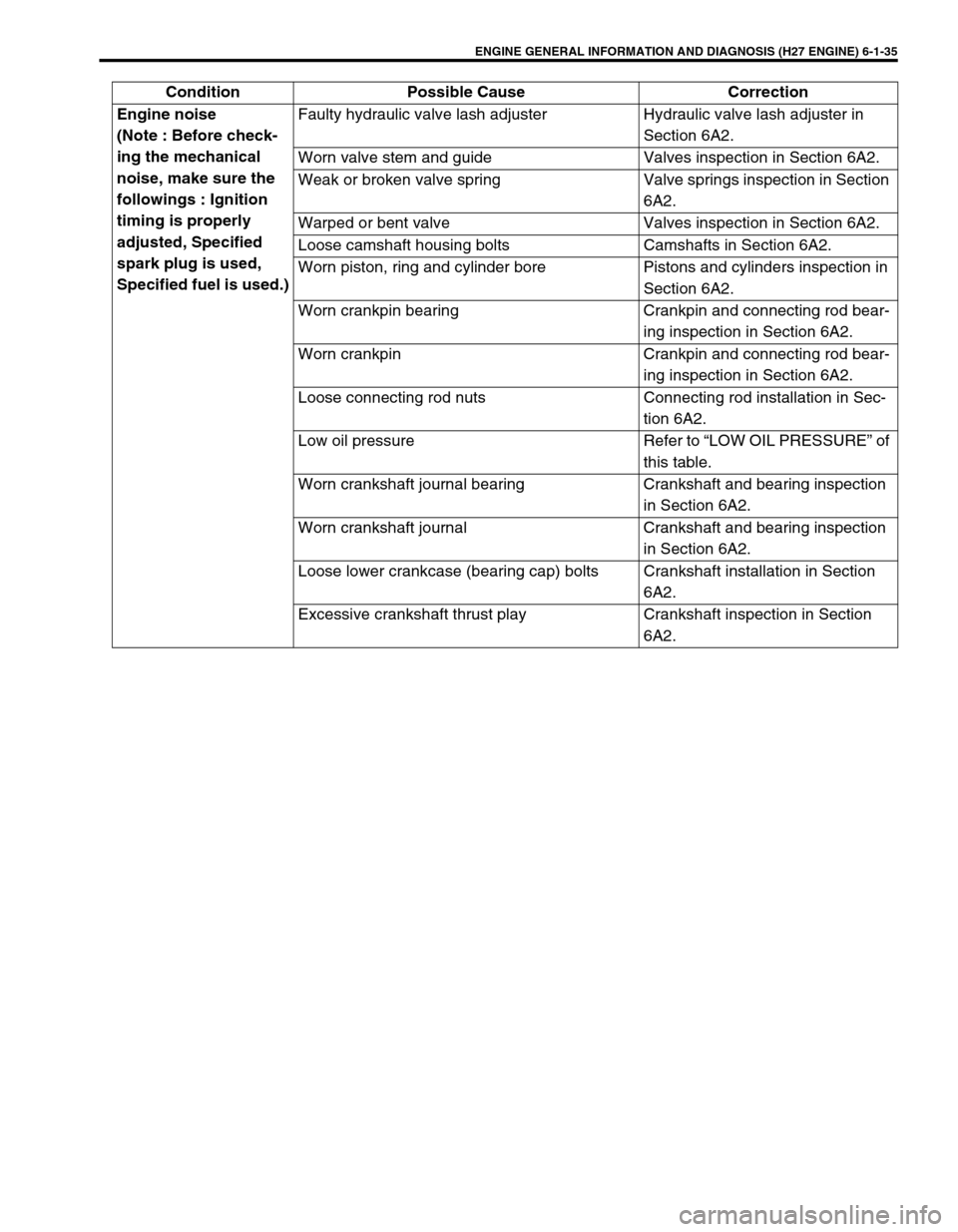
Engine noise
(Note : Before check-
ing the mechanical
noise, make sure the
followings : Ignition
timing is properly
adjusted, Specified
spark plug is used,
Specified fuel is used.)Faulty hydraulic valve lash adjuster Hydraulic valve lash adjuster in
Section 6A2.
Worn valve stem and guide Valves inspection in Section 6A2.
Weak or broken valve spring Valve springs inspection in Section
6A2.
Warped or bent valve Valves inspection in Section 6A2.
Loose camshaft housing bolts Camshafts in Section 6A2.
Worn piston, ring and cylinder bore Pistons and cylinders inspection in
Section 6A2.
Worn crankpin bearing Crankpin and connecting rod bear-
ing inspection in Section 6A2.
Worn crankpin Crankpin and connecting rod bear-
ing inspection in Section 6A2.
Loose connecting rod nuts Connecting rod installation in Sec-
tion 6A2.
Low oil pressure Refer to “LOW OIL PRESSURE” of
this table.
Worn crankshaft journal bearing Crankshaft and bearing inspection
in Section 6A2.
Worn crankshaft journal Crankshaft and bearing inspection
in Section 6A2.
Loose lower crankcase (bearing cap) bolts Crankshaft installation in Section
6A2.
Excessive crankshaft thrust play Crankshaft inspection in Section
6A2. Condition Possible Cause Correction
Page 197 of 656
6-1-36 ENGINE GENERAL INFORMATION AND DIAGNOSIS (H27 ENGINE)
Inspection of PCM (ECM) and its Circuits
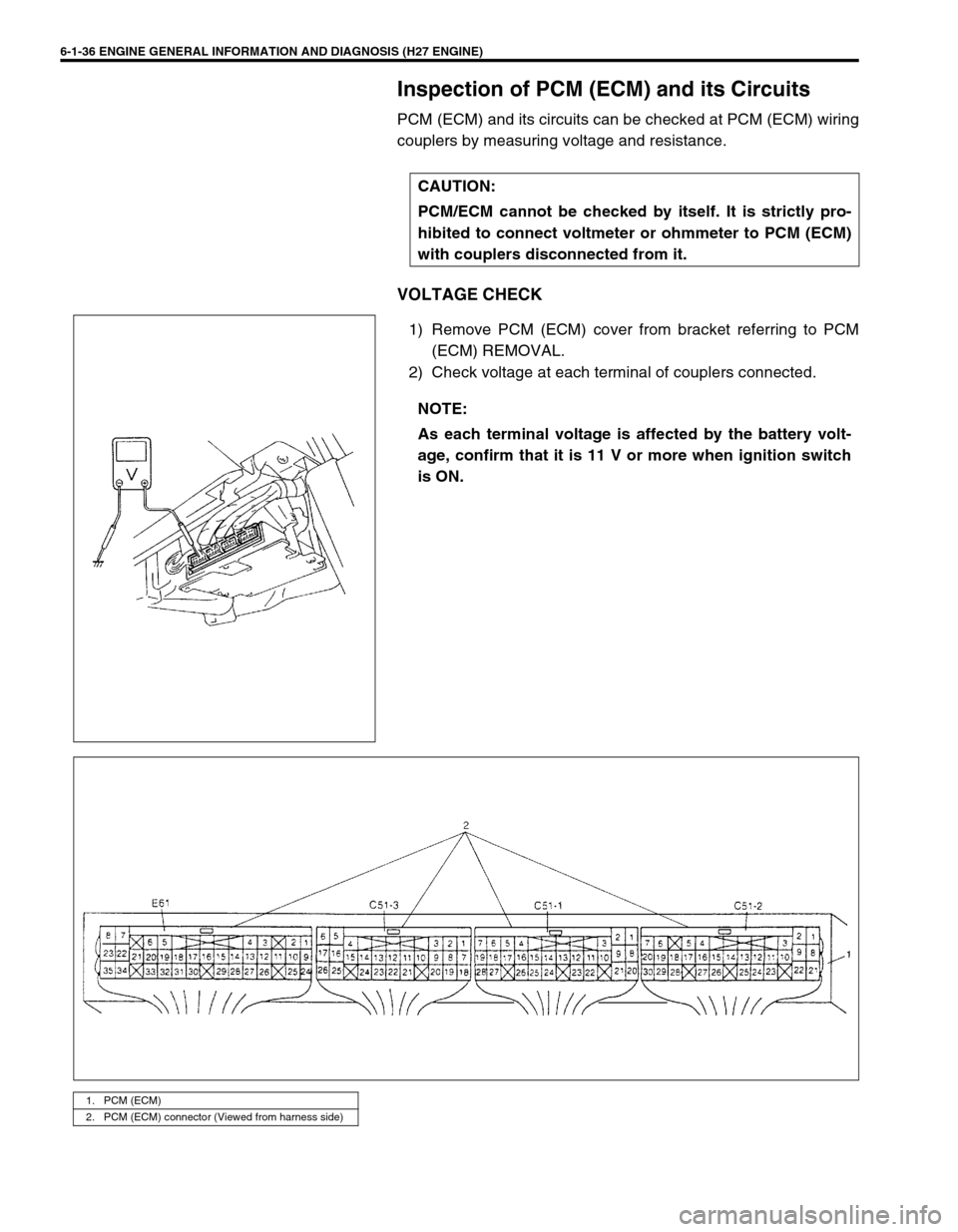
PCM (ECM) and its circuits can be checked at PCM (ECM) wiring
couplers by measuring voltage and resistance.
VOLTAGE CHECK
1) Remove PCM (ECM) cover from bracket referring to PCM
(ECM) REMOVAL.
2) Check voltage at each terminal of couplers connected.CAUTION:
PCM/ECM cannot be checked by itself. It is strictly pro-
hibited to connect voltmeter or ohmmeter to PCM (ECM)
with couplers disconnected from it.
NOTE:
As each terminal voltage is affected by the battery volt-
age, confirm that it is 11 V or more when ignition switch
is ON.
1. PCM (ECM)
2. PCM (ECM) connector (Viewed from harness side)
Page 203 of 656
6-1-42 ENGINE GENERAL INFORMATION AND DIAGNOSIS (H27 ENGINE)
RESISTANCE CHECK
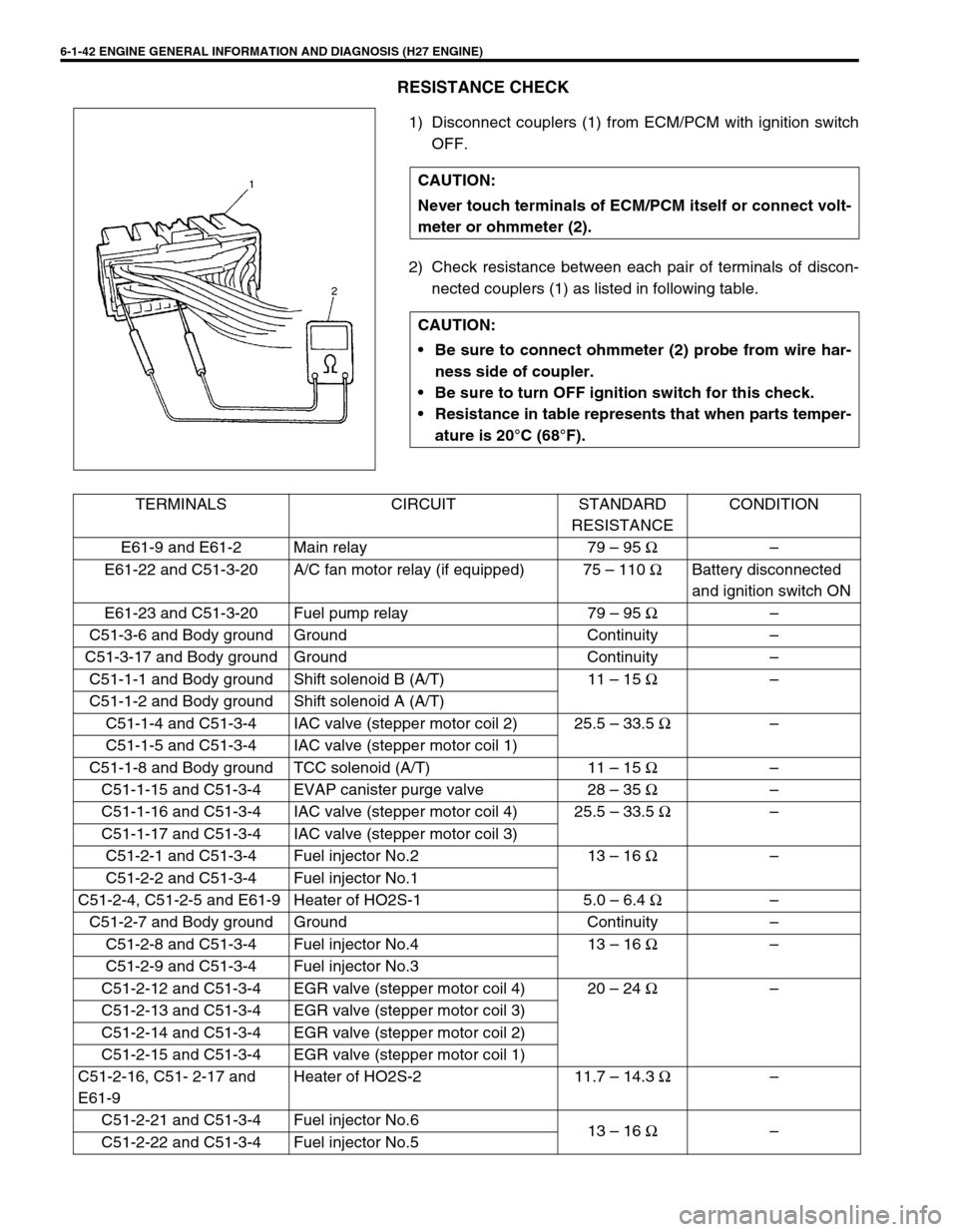
1) Disconnect couplers (1) from ECM/PCM with ignition switch
OFF.
2) Check resistance between each pair of terminals of discon-
nected couplers (1) as listed in following table. CAUTION:
Never touch terminals of ECM/PCM itself or connect volt-
meter or ohmmeter (2).
CAUTION:
Be sure to connect ohmmeter (2) probe from wire har-
ness side of coupler.
Be sure to turn OFF ignition switch for this check.
Resistance in table represents that when parts temper-
ature is 20°C (68°F).
TERMINALS CIRCUIT STANDARD
RESISTANCECONDITION
E61-9 and E61-2 Main relay 79 – 95 Ω–
E61-22 and C51-3-20 A/C fan motor relay (if equipped) 75 – 110 ΩBattery disconnected
and ignition switch ON
E61-23 and C51-3-20 Fuel pump relay 79 – 95 Ω–
C51-3-6 and Body ground Ground Continuity –
C51-3-17 and Body ground Ground Continuity –
C51-1-1 and Body ground Shift solenoid B (A/T) 11 – 15 Ω–
C51-1-2 and Body ground Shift solenoid A (A/T)
C51-1-4 and C51-3-4 IAC valve (stepper motor coil 2) 25.5 – 33.5 Ω–
C51-1-5 and C51-3-4 IAC valve (stepper motor coil 1)
C51-1-8 and Body ground TCC solenoid (A/T) 11 – 15 Ω–
C51-1-15 and C51-3-4 EVAP canister purge valve 28 – 35 Ω–
C51-1-16 and C51-3-4 IAC valve (stepper motor coil 4) 25.5 – 33.5 Ω–
C51-1-17 and C51-3-4 IAC valve (stepper motor coil 3)
C51-2-1 and C51-3-4 Fuel injector No.2 13 – 16 Ω–
C51-2-2 and C51-3-4 Fuel injector No.1
C51-2-4, C51-2-5 and E61-9 Heater of HO2S-1 5.0 – 6.4 Ω–
C51-2-7 and Body ground Ground Continuity –
C51-2-8 and C51-3-4 Fuel injector No.4 13 – 16 Ω–
C51-2-9 and C51-3-4 Fuel injector No.3
C51-2-12 and C51-3-4 EGR valve (stepper motor coil 4) 20 – 24 Ω–
C51-2-13 and C51-3-4 EGR valve (stepper motor coil 3)
C51-2-14 and C51-3-4 EGR valve (stepper motor coil 2)
C51-2-15 and C51-3-4 EGR valve (stepper motor coil 1)
C51-2-16, C51- 2-17 and
E61-9Heater of HO2S-2 11.7 – 14.3 Ω–
C51-2-21 and C51-3-4 Fuel injector No.6
13 – 16 Ω–
C51-2-22 and C51-3-4 Fuel injector No.5
Page 204 of 656
ENGINE GENERAL INFORMATION AND DIAGNOSIS (H27 ENGINE) 6-1-43
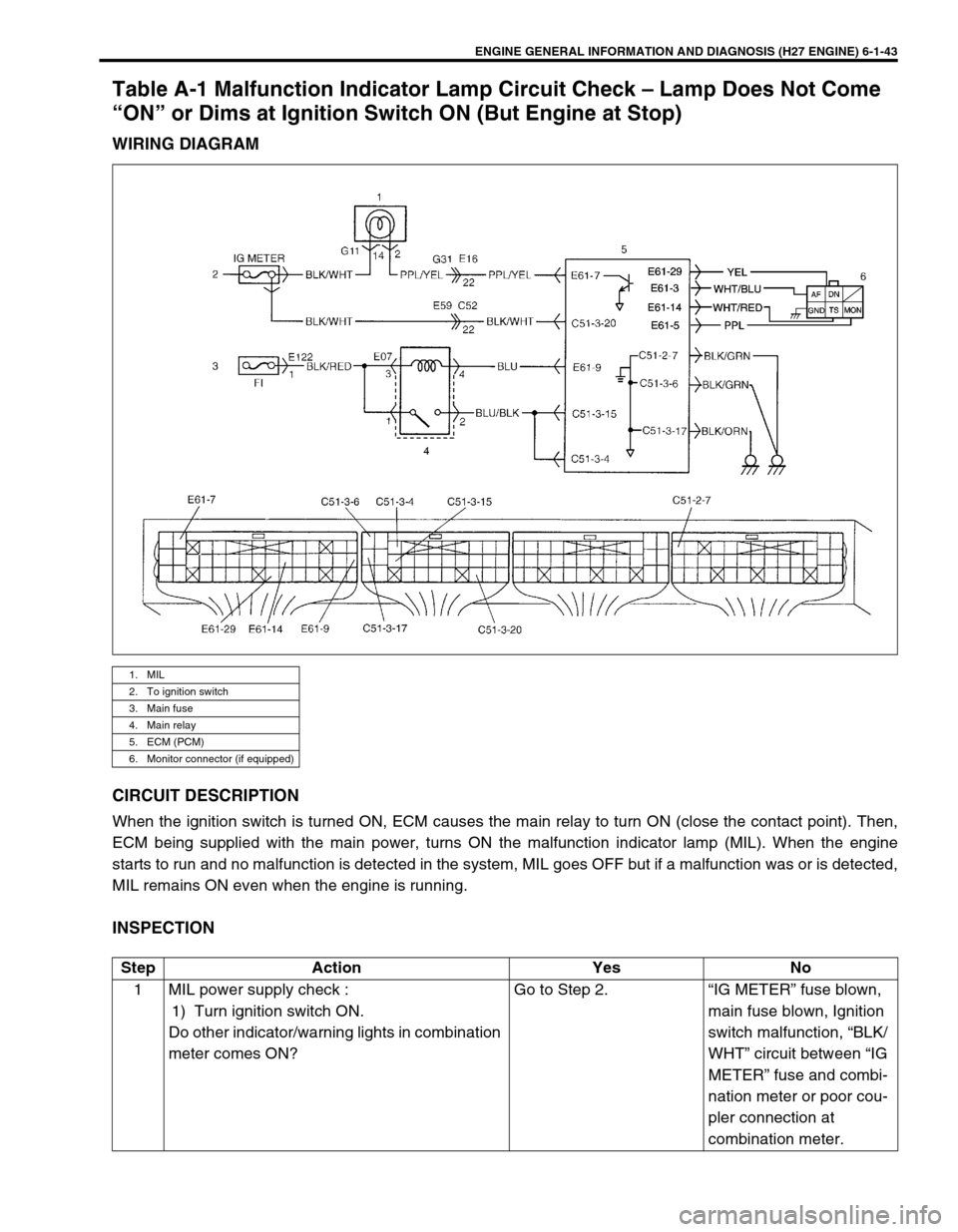
Table A-1 Malfunction Indicator Lamp Circuit Check – Lamp Does Not Come
“ON” or Dims at Ignition Switch ON (But Engine at Stop)
WIRING DIAGRAM
CIRCUIT DESCRIPTION
When the ignition switch is turned ON, ECM causes the main relay to turn ON (close the contact point). Then,
ECM being supplied with the main power, turns ON the malfunction indicator lamp (MIL). When the engine
starts to run and no malfunction is detected in the system, MIL goes OFF but if a malfunction was or is detected,
MIL remains ON even when the engine is running.
INSPECTION
1. MIL
2. To ignition switch
3. Main fuse
4. Main relay
5. ECM (PCM)
6. Monitor connector (if equipped)
Step Action Yes No
1 MIL power supply check :
1) Turn ignition switch ON.
Do other indicator/warning lights in combination
meter comes ON?Go to Step 2. “IG METER” fuse blown,
main fuse blown, Ignition
switch malfunction, “BLK/
WHT” circuit between “IG
METER” fuse and combi-
nation meter or poor cou-
pler connection at
combination meter.
Page 205 of 656
6-1-44 ENGINE GENERAL INFORMATION AND DIAGNOSIS (H27 ENGINE)
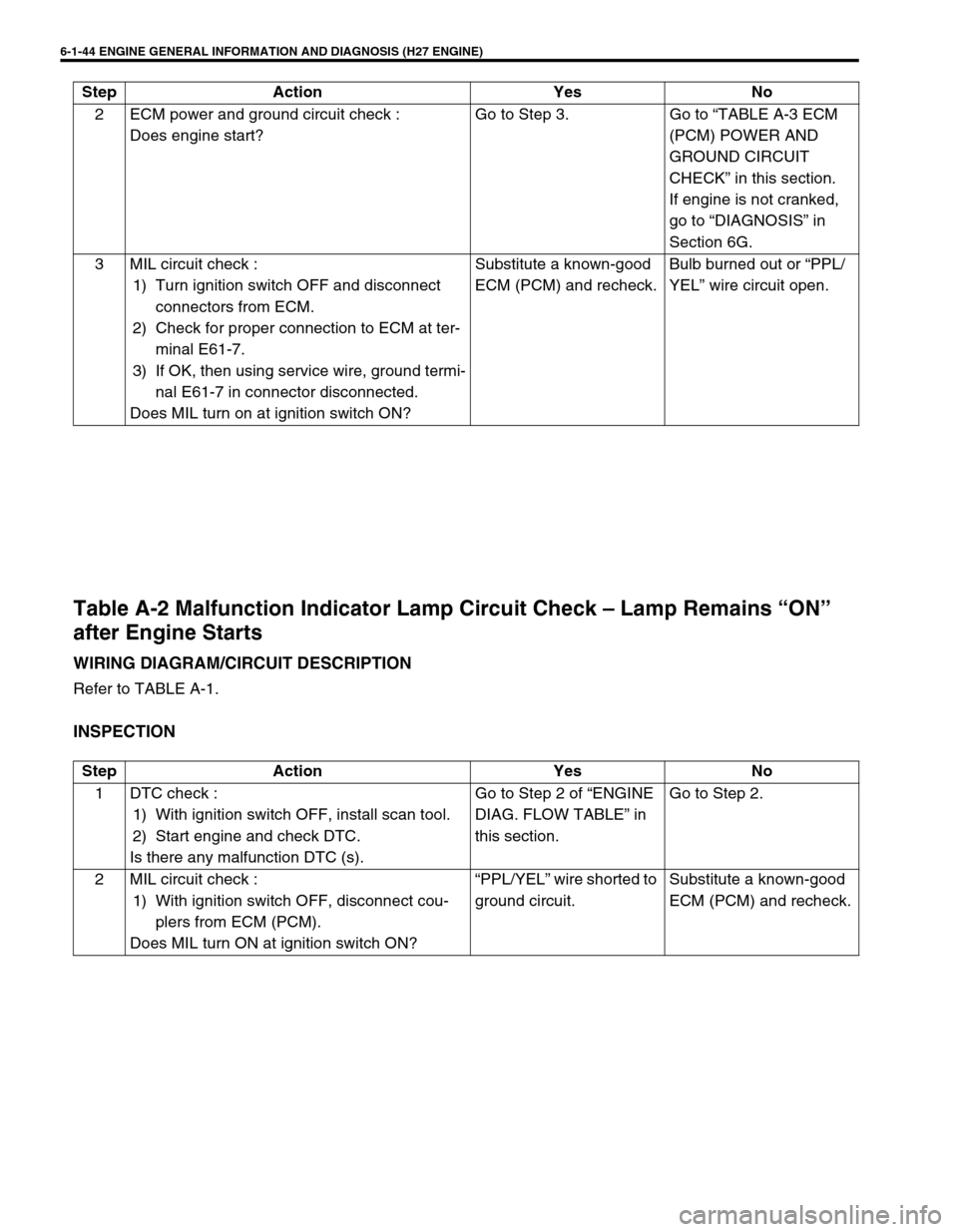
Table A-2 Malfunction Indicator Lamp Circuit Check – Lamp Remains “ON”
after Engine Starts
WIRING DIAGRAM/CIRCUIT DESCRIPTION
Refer to TABLE A-1.
INSPECTION
2 ECM power and ground circuit check :
Does engine start?Go to Step 3. Go to “TABLE A-3 ECM
(PCM) POWER AND
GROUND CIRCUIT
CHECK” in this section.
If engine is not cranked,
go to “DIAGNOSIS” in
Section 6G.
3 MIL circuit check :
1) Turn ignition switch OFF and disconnect
connectors from ECM.
2) Check for proper connection to ECM at ter-
minal E61-7.
3) If OK, then using service wire, ground termi-
nal E61-7 in connector disconnected.
Does MIL turn on at ignition switch ON?Substitute a known-good
ECM (PCM) and recheck.Bulb burned out or “PPL/
YEL” wire circuit open. Step Action Yes No
Step Action Yes No
1 DTC check :
1) With ignition switch OFF, install scan tool.
2) Start engine and check DTC.
Is there any malfunction DTC (s).Go to Step 2 of “ENGINE
DIAG. FLOW TABLE” in
this section.Go to Step 2.
2 MIL circuit check :
1) With ignition switch OFF, disconnect cou-
plers from ECM (PCM).
Does MIL turn ON at ignition switch ON?“PPL/YEL” wire shorted to
ground circuit.Substitute a known-good
ECM (PCM) and recheck.
Page 206 of 656
ENGINE GENERAL INFORMATION AND DIAGNOSIS (H27 ENGINE) 6-1-45
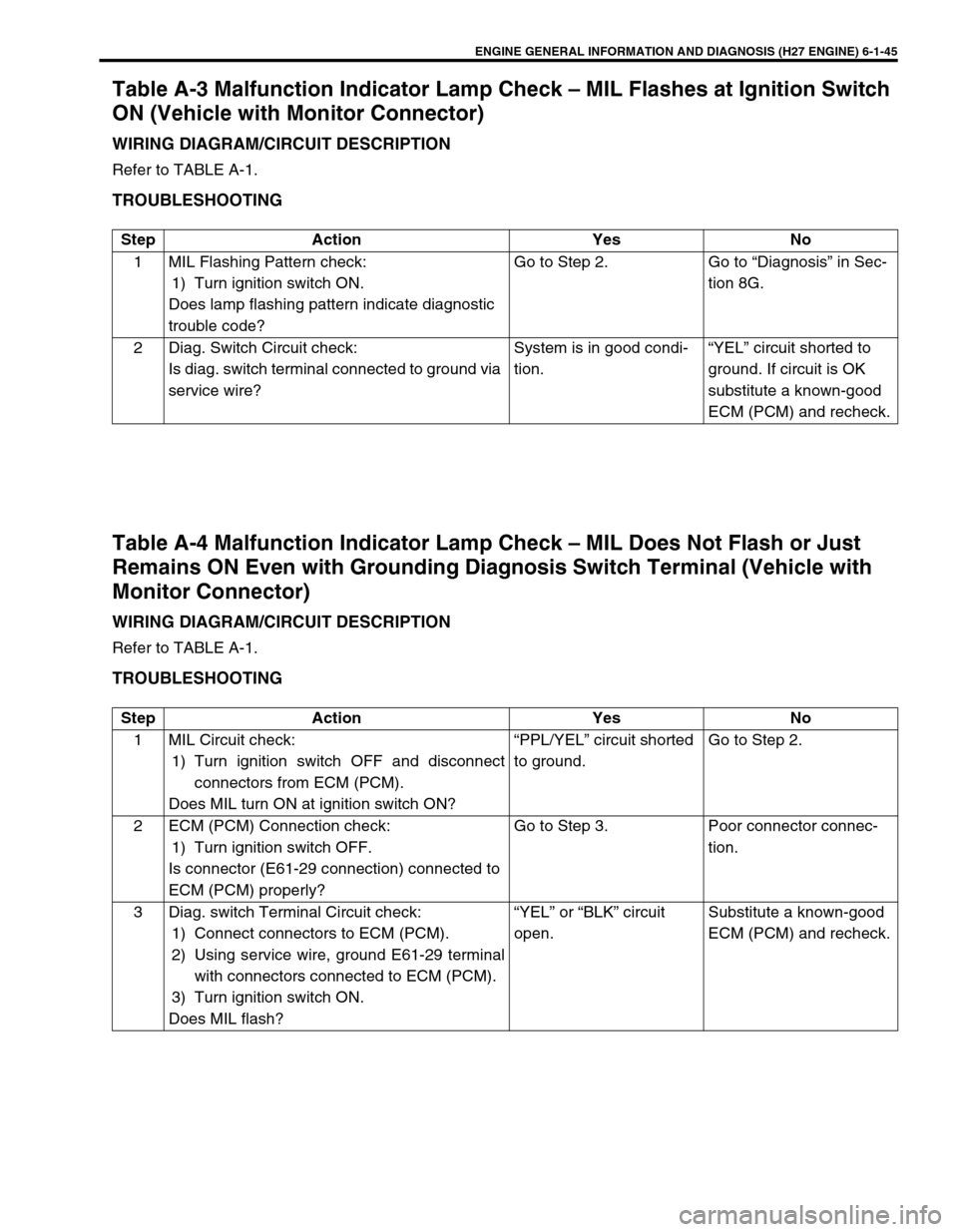
Table A-3 Malfunction Indicator Lamp Check – MIL Flashes at Ignition Switch
ON (Vehicle with Monitor Connector)
WIRING DIAGRAM/CIRCUIT DESCRIPTION
Refer to TABLE A-1.
TROUBLESHOOTING
Table A-4 Malfunction Indicator Lamp Check – MIL Does Not Flash or Just
Remains ON Even with Grounding Diagnosis Switch Terminal (Vehicle with
Monitor Connector)
WIRING DIAGRAM/CIRCUIT DESCRIPTION
Refer to TABLE A-1.
TROUBLESHOOTING
Step Action Yes No
1 MIL Flashing Pattern check:
1) Turn ignition switch ON.
Does lamp flashing pattern indicate diagnostic
trouble code?Go to Step 2. Go to “Diagnosis” in Sec-
tion 8G.
2 Diag. Switch Circuit check:
Is diag. switch terminal connected to ground via
service wire?System is in good condi-
tion.“YEL” circuit shorted to
ground. If circuit is OK
substitute a known-good
ECM (PCM) and recheck.
Step Action Yes No
1 MIL Circuit check:
1) Turn ignition switch OFF and disconnect
connectors from ECM (PCM).
Does MIL turn ON at ignition switch ON?“PPL/YEL” circuit shorted
to ground.Go to Step 2.
2 ECM (PCM) Connection check:
1) Turn ignition switch OFF.
Is connector (E61-29 connection) connected to
ECM (PCM) properly?Go to Step 3. Poor connector connec-
tion.
3 Diag. switch Terminal Circuit check:
1) Connect connectors to ECM (PCM).
2) Using service wire, ground E61-29 terminal
with connectors connected to ECM (PCM).
3) Turn ignition switch ON.
Does MIL flash?“YEL” or “BLK” circuit
open.Substitute a known-good
ECM (PCM) and recheck.
Page 207 of 656
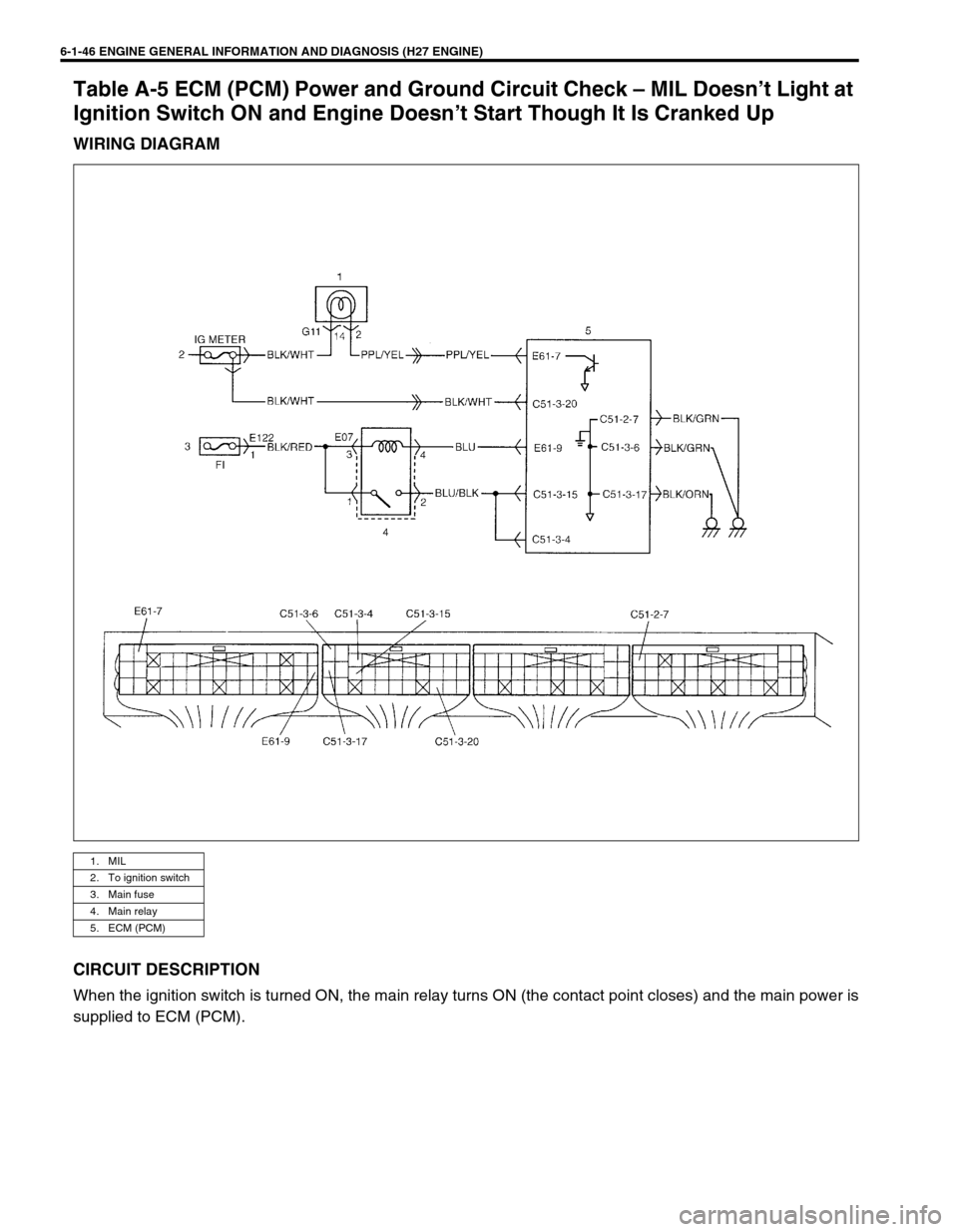
6-1-46 ENGINE GENERAL INFORMATION AND DIAGNOSIS (H27 ENGINE)
Table A-5 ECM (PCM) Power and Ground Circuit Check – MIL Doesn’t Light at
Ignition Switch ON and Engine Doesn’t Start Though It Is Cranked Up
WIRING DIAGRAM
CIRCUIT DESCRIPTION
When the ignition switch is turned ON, the main relay turns ON (the contact point closes) and the main power is
supplied to ECM (PCM).
1. MIL
2. To ignition switch
3. Main fuse
4. Main relay
5. ECM (PCM)
Page 208 of 656
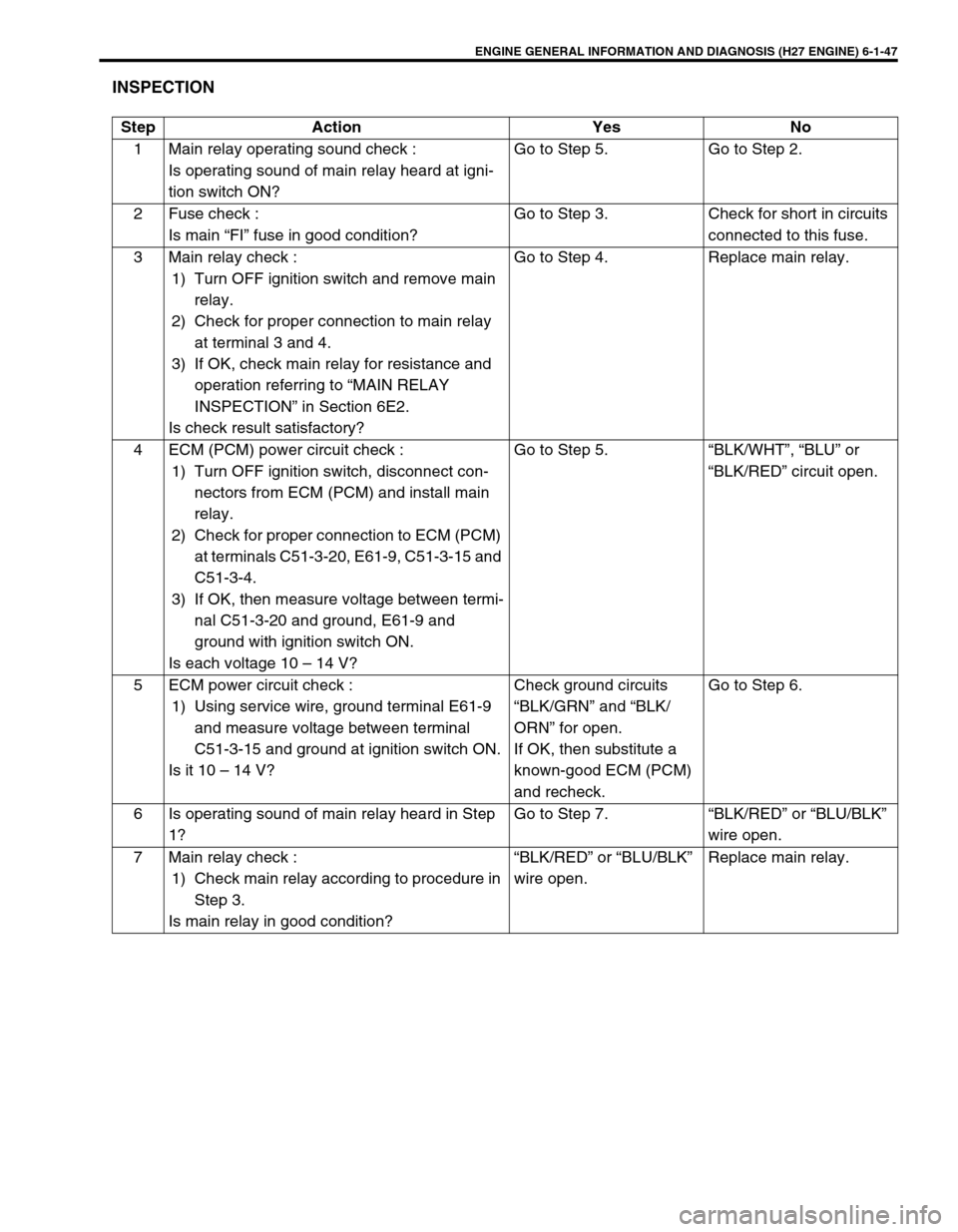
ENGINE GENERAL INFORMATION AND DIAGNOSIS (H27 ENGINE) 6-1-47
INSPECTION
Step Action Yes No
1 Main relay operating sound check :
Is operating sound of main relay heard at igni-
tion switch ON?Go to Step 5. Go to Step 2.
2 Fuse check :
Is main “FI” fuse in good condition?Go to Step 3. Check for short in circuits
connected to this fuse.
3 Main relay check :
1) Turn OFF ignition switch and remove main
relay.
2) Check for proper connection to main relay
at terminal 3 and 4.
3) If OK, check main relay for resistance and
operation referring to “MAIN RELAY
INSPECTION” in Section 6E2.
Is check result satisfactory?Go to Step 4. Replace main relay.
4 ECM (PCM) power circuit check :
1) Turn OFF ignition switch, disconnect con-
nectors from ECM (PCM) and install main
relay.
2) Check for proper connection to ECM (PCM)
at terminals C51-3-20, E61-9, C51-3-15 and
C51-3-4.
3) If OK, then measure voltage between termi-
nal C51-3-20 and ground, E61-9 and
ground with ignition switch ON.
Is each voltage 10 – 14 V?Go to Step 5. “BLK/WHT”, “BLU” or
“BLK/RED” circuit open.
5 ECM power circuit check :
1) Using service wire, ground terminal E61-9
and measure voltage between terminal
C51-3-15 and ground at ignition switch ON.
Is it 10 – 14 V?Check ground circuits
“BLK/GRN” and “BLK/
ORN” for open.
If OK, then substitute a
known-good ECM (PCM)
and recheck.Go to Step 6.
6 Is operating sound of main relay heard in Step
1?Go to Step 7. “BLK/RED” or “BLU/BLK”
wire open.
7 Main relay check :
1) Check main relay according to procedure in
Step 3.
Is main relay in good condition?“BLK/RED” or “BLU/BLK”
wire open.Replace main relay.